

Soil life

Encyclopedia
Soil life or soil biota is a collective term for all the organisms living within the soil.
content of the soil and its heartiful structure are important for their well-being, but it is the life in the earth that powers its cycles and provides its fertility. Without the activities of soil organisms, organic materials would accumulate and litter the soil surface, and there would be no food for plants.
The soil biota includes:
Of these, bacteria and fungi play key roles in maintaining a healthy soil. They act as decomposers that break down organic materials to produce detritus
and other breakdown products. Soil detritivore
s, like earthworms, ingest detritus and decompose it. Saprotrophs, well represented by fungi and bacteria, extract soluble nutrients from delitro.
This table is a résumé of soil life, coherent with prevalent taxonomy as used in the linked Wikipedia articles.
are single-cell organisms and the most numerous denizens of agriculture, with populations ranging from 100 million to 3 billion in a gram. They are
capable of very rapid reproduction by binary fission (dividing into two) in favourable conditions. One bacterium is capable of producing 16 million more in just 24 hours. Most soil bacteria live close to plant roots and are often referred to as rhizobacteria. Bacteria live in soil water, including the film of moisture surrounding soil particles, and some are able to swim by means of flagella
. The majority of the beneficial soil-dwelling bacteria need oxygen (and are thus termed aerobic
bacteria), whilst those that do not require air are referred to as anaerobic
, and tend to cause putrefaction
of dead organic matter. Aerobic bacteria are most active in a soil
that is moist (but
not saturated, as this will deprive aerobic bacteria of the air that they require), and neutral soil pH
, and where there is plenty of food (carbohydrate
s and micronutrient
s from organic matter) available. Hostile conditions will not completely kill bacteria; rather, the bacteria will stop growing and get into a dormant stage, and those individuals with pro-adaptive mutation
s may compete better in the new conditions. Some gram-positive bacteria produce spores in order to wait for more favourable circumstances, and gram-negative bacteria get into a "nonculturable" stage. Bacteria are colonized by persistent viral agents (bacteriophage
s) that determine gene word order in bacterial host.
From the organic gardener's point of view, the important roles that bacteria play are:
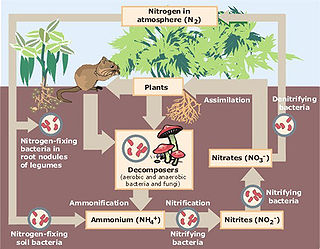
is a vital part of the nitrogen cycle
, wherein certain bacteria (which manufacture their own carbohydrate
supply without using the process of photosynthesis) are able to transform nitrogen
in the form of ammonium, which is produced by the decomposition of proteins, into nitrates, which are available to growing plants, and once again converted to proteins.
constantly puts additional nitrogen into biological circulation. This is carried out by free-living nitrogen-fixing bacteria in the soil or water such as Azotobacter
, or by those that live in close symbiosis with leguminous plants, such as rhizobia
. These bacteria form colonies in nodules they create on the roots of pea
s, bean
s, and related species. These are able to convert nitrogen from
the atmosphere into nitrogen-containing organic substances.
into organic compounds, a series of processes called denitrification returns an approximately equal amount of nitrogen to the atmosphere. Denitrifying bacteria tend to be anaerobes, or facultatively anaerobes (can alter between the oxygen dependent and oxygen independent types of metabolisms), including Achromobacter
and Pseudomonas
. The putrefaction process caused by oxygen-free conditions converts nitrates and nitrites in soil into nitrogen gas or into gaseous compounds such as nitrous oxide
or nitric oxide
. In excess, denitrification can
lead to overall losses of available soil nitrogen and subsequent loss of soil fertility. However, fixed nitrogen may circulate many times between organisms and the soil
before denitrification returns it to the atmosphere. The diagram above illustrates the nitrogen cycle.
are critical in the decomposition of organic matter
and in humus formation, and their presence is responsible for the sweet "earthy" aroma associated with a good healthy soil. They require plenty of air and a pH between 6.0 and 7.5, but are more tolerant of dry conditions than most other bacteria and fungi.
, such as yeast
s and moulds. Fungi have no chlorophyll
, and are not able to photosynthesis
e; besides, they cannot use atmospheric carbon dioxide as a source of carbon, therefore they are chemo-heterotrophic
, meaning that, like animal
s, they require a chemical source of energy rather than being able to use light as an energy source, as well as organic substrates to get carbon for growth and development.
Many fungi are parasitic, often causing disease to their living host plant, although some have beneficial relationships with living plants, as illustrated below. In terms of soil and humus creation, the most important fungi tend to be saprotrophic; that is, they live on dead or decaying organic matter, thus breaking it down and converting it to forms that are available to the higher plants. A succession of fungi species will colonise the dead matter, beginning with those that use sugars and starches, which are succeeded by those that are able to break down cellulose
and lignin
s.
Fungi spread underground by sending long thin threads known as mycelium
throughout the soil; these threads can be observed throughout many soils and compost
heaps. From the mycelia the fungi is able to throw up its fruiting bodies, the visible part above the soil (e.g., mushroom
s, toadstools, and puffball
s), which may contain millions of spore
s. When the fruiting body bursts, these spores are dispersed through the air to settle in
fresh environments, and are able to lie dormant for up to years until the right conditions for their activation arise or the right food is made available.
e (from myco meaning fungal and rhiza meaning root). Plant root hairs are invaded by the mycelia of the mycorrhiza, which lives partly in the soil and partly in the root, and may either cover the length of the root hair as a sheath or be concentrated around its tip. The mycorrhiza obtains the carbohydrates that it requires from the root, in return providing
the plant with nutrients including nitrogen and moisture. Later the plant roots will also absorb the mycelium into its own tissues.
Beneficial mycorrhizal associations are to be found in many of our edible and flowering crops. Shewell Cooper
suggests that these include at least 80% of the brassica
and solanum
families (including tomato
es and potato
es), as well as the majority of tree
species, especially in forest
and woodlands. Here the mycorrhizae create a fine underground mesh that extends greatly beyond the limits of the tree's roots, greatly increasing their feeding range and actually causing neighbouring trees to become physically interconnected. The benefits of mycorrhizal relations to their plant partners are not limited to nutrients, but can be essential for plant reproduction: In situations where little light is able to reach the forest floor, such as the North American pine forests, a young seedling cannot obtain sufficient light to photosynthesise for itself and will not grow properly in a sterile soil. But, if the ground is underlain by a mycorrhizal mat, then the developing seedling will throw down roots that can link with the fungal threads and through them obtain the nutrients it needs, often indirectly obtained from its parents or neighbouring trees.
David Attenborough
points out the plant, fungi, animal relationship that creates a "Three way harmonious trio" to be found in forest ecosystem
s, wherein the plant/fungi symbiosis is enhanced by animals such as the wild boar, deer, mice, or flying squirrel, which feed upon the fungi's fruiting bodies, including truffles, and cause their further spread (Private Life Of Plants, 1995). A greater understanding of the complex relationships that pervade natural systems is one of the major justifications of the organic gardener, in refraining from the use of artificial chemicals and the damage these might cause.
Overview
In balanced soil, plants grow in an active and steady environment. The mineralMineral
A mineral is a naturally occurring solid chemical substance formed through biogeochemical processes, having characteristic chemical composition, highly ordered atomic structure, and specific physical properties. By comparison, a rock is an aggregate of minerals and/or mineraloids and does not...
content of the soil and its heartiful structure are important for their well-being, but it is the life in the earth that powers its cycles and provides its fertility. Without the activities of soil organisms, organic materials would accumulate and litter the soil surface, and there would be no food for plants.
The soil biota includes:
- Megafauna: size range - 20 mm upward, e.g. molesMole (animal)Moles are small cylindrical mammals adapted to a subterranean lifestyle. They have velvety fur; tiny or invisible ears and eyes; and short, powerful limbs with large paws oriented for digging. The term is especially and most properly used for the true moles, those of the Talpidae family in the...
, rabbitRabbitRabbits are small mammals in the family Leporidae of the order Lagomorpha, found in several parts of the world...
s, and rodentRodentRodentia is an order of mammals also known as rodents, characterised by two continuously growing incisors in the upper and lower jaws which must be kept short by gnawing....
s. - Macrofauna: size range - 2 to 20 mm, e.g. woodliceWoodlouseA woodlouse is a crustacean with a rigid, segmented, long exoskeleton and fourteen jointed limbs...
, earthwormEarthwormEarthworm is the common name for the largest members of Oligochaeta in the phylum Annelida. In classical systems they were placed in the order Opisthopora, on the basis of the male pores opening posterior to the female pores, even though the internal male segments are anterior to the female...
s, beetleBeetleColeoptera is an order of insects commonly called beetles. The word "coleoptera" is from the Greek , koleos, "sheath"; and , pteron, "wing", thus "sheathed wing". Coleoptera contains more species than any other order, constituting almost 25% of all known life-forms...
s, centipedeCentipedeCentipedes are arthropods belonging to the class Chilopoda of the subphylum Myriapoda. They are elongated metameric animals with one pair of legs per body segment. Despite the name, centipedes can have a varying number of legs from under 20 to over 300. Centipedes have an odd number of pairs of...
s, slugSlugSlug is a common name that is normally applied to any gastropod mollusc that lacks a shell, has a very reduced shell, or has a small internal shell...
s, snailSnailSnail is a common name applied to most of the members of the molluscan class Gastropoda that have coiled shells in the adult stage. When the word is used in its most general sense, it includes sea snails, land snails and freshwater snails. The word snail without any qualifier is however more often...
s, antAntAnts are social insects of the family Formicidae and, along with the related wasps and bees, belong to the order Hymenoptera. Ants evolved from wasp-like ancestors in the mid-Cretaceous period between 110 and 130 million years ago and diversified after the rise of flowering plants. More than...
s, and harvestmen. - Mesofauna: size range - 100 micrometreMicrometreA micrometer , is by definition 1×10⁻⁶ of a meter .In plain English, it means one-millionth of a meter . Its unit symbol in the International System of Units is μm...
s to 2 mm, e.g. tardigradeTardigradeTardigrades form the phylum Tardigrada, part of the superphylum Ecdysozoa. They are microscopic, water-dwelling, segmented animals with eight legs. Tardigrades were first described by Johann August Ephraim Goeze in 1773...
s, miteMiteMites, along with ticks, are small arthropods belonging to the subclass Acari and the class Arachnida. The scientific discipline devoted to the study of ticks and mites is called acarology.-Diversity and systematics:...
s and springtailSpringtailSpringtails form the largest of the three lineages of modern hexapods that are no longer considered insects...
s. - Microfauna and Microflora: size range - 1 to 100 micrometres, e.g. yeastYeastYeasts are eukaryotic micro-organisms classified in the kingdom Fungi, with 1,500 species currently described estimated to be only 1% of all fungal species. Most reproduce asexually by mitosis, and many do so by an asymmetric division process called budding...
s, bacteriaBacteriaBacteria are a large domain of prokaryotic microorganisms. Typically a few micrometres in length, bacteria have a wide range of shapes, ranging from spheres to rods and spirals...
(commonly actinobacteriaActinobacteriaActinobacteria are a group of Gram-positive bacteria with high guanine and cytosine content. They can be terrestrial or aquatic. Actinobacteria is one of the dominant phyla of the bacteria....
), fungiFungusA fungus is a member of a large group of eukaryotic organisms that includes microorganisms such as yeasts and molds , as well as the more familiar mushrooms. These organisms are classified as a kingdom, Fungi, which is separate from plants, animals, and bacteria...
, protozoaProtozoaProtozoa are a diverse group of single-cells eukaryotic organisms, many of which are motile. Throughout history, protozoa have been defined as single-cell protists with animal-like behavior, e.g., movement...
, roundworms, and rotiferRotiferThe rotifers make up a phylum of microscopic and near-microscopic pseudocoelomate animals. They were first described by Rev. John Harris in 1696, and other forms were described by Anton van Leeuwenhoek in 1703...
s.
Of these, bacteria and fungi play key roles in maintaining a healthy soil. They act as decomposers that break down organic materials to produce detritus
Detritus (biology)
In biology, detritus is non-living particulate organic material . It typically includes the bodies or fragments of dead organisms as well as fecal material. Detritus is typically colonized by communities of microorganisms which act to decompose the material...
and other breakdown products. Soil detritivore
Detritivore
Detritivores, also known as detritophages or detritus feeders or detritus eaters or saprophages, are heterotrophs that obtain nutrients by consuming detritus . By doing so, they contribute to decomposition and the nutrient cycles...
s, like earthworms, ingest detritus and decompose it. Saprotrophs, well represented by fungi and bacteria, extract soluble nutrients from delitro.
Soil life table
This table is a résumé of soil life, coherent with prevalent taxonomy as used in the linked Wikipedia articles.
| Domain | Kingdom | Phylum | Class | Order | Family | Genus |
|---|---|---|---|---|---|---|
| Prokaryote Prokaryote The prokaryotes are a group of organisms that lack a cell nucleus , or any other membrane-bound organelles. The organisms that have a cell nucleus are called eukaryotes. Most prokaryotes are unicellular, but a few such as myxobacteria have multicellular stages in their life cycles... |
Bacteria Bacteria Bacteria are a large domain of prokaryotic microorganisms. Typically a few micrometres in length, bacteria have a wide range of shapes, ranging from spheres to rods and spirals... |
Proteobacteria Proteobacteria The Proteobacteria are a major group of bacteria. They include a wide variety of pathogens, such as Escherichia, Salmonella, Vibrio, Helicobacter, and many other notable genera.... |
Beta Proteobacteria | Nitrosomonadales Nitrosomonadales The Nitrosomonadales are a small order of Proteobacteria. Like all Proteobacteria, they are gram-negative. They include Nitrosomonas, Nitrosospira, Gallionella , and Spirillum. The species Spirillum minus causes Rat bite fever.-References:*Garrity, George M.; Brenner, Don J.; Krieg, Noel R.;... |
Nitrosomonadaceae | Nitrosomonas Nitrosomonas Nitrosomonas is a genus comprising rod shaped chemoautotrophic bacteria.This rare bacteria oxidizes ammonia into nitrite as a metabolic process. Nitrosomonas are useful in treatment of industrial and sewage waste and in the process of bioremediation. They are important in the nitrogen cycle by... |
| Prokaryote Prokaryote The prokaryotes are a group of organisms that lack a cell nucleus , or any other membrane-bound organelles. The organisms that have a cell nucleus are called eukaryotes. Most prokaryotes are unicellular, but a few such as myxobacteria have multicellular stages in their life cycles... |
Bacteria Bacteria Bacteria are a large domain of prokaryotic microorganisms. Typically a few micrometres in length, bacteria have a wide range of shapes, ranging from spheres to rods and spirals... |
Proteobacteria Proteobacteria The Proteobacteria are a major group of bacteria. They include a wide variety of pathogens, such as Escherichia, Salmonella, Vibrio, Helicobacter, and many other notable genera.... |
Alpha Proteobacteria | Rhizobiales Rhizobiales Rhizobiales is an order of alpha proteobacteria. They are gram-negative.The rhizobia, which fix nitrogen and are symbiotic with plant roots, appear in several different families here. The Bradyrhizobiaceae, Hyphomicrobiaceae, Phyllobacteriaceae, and Rhizobiaceae are the four families that contain... |
Bradyrhizobiaceae Bradyrhizobiaceae The Bradyrhizobiaceae are a family of bacteria, with ten genera. They include plant-associated bacteria such as Bradyrhizobium, a genus of rhizobia associated with some legumes. It also contains animal-associated bacteria such as Afipia felis, formerly thought to cause cat-scratch disease... |
Nitrobacter Nitrobacter Nitrobacter is genus of mostly rod-shaped, gram-negative, and chemoautotrophic bacteria.Nitrobacter plays an important role in the nitrogen cycle by oxidizing nitrite into nitrate in soil... |
| Prokaryote Prokaryote The prokaryotes are a group of organisms that lack a cell nucleus , or any other membrane-bound organelles. The organisms that have a cell nucleus are called eukaryotes. Most prokaryotes are unicellular, but a few such as myxobacteria have multicellular stages in their life cycles... |
Bacteria Bacteria Bacteria are a large domain of prokaryotic microorganisms. Typically a few micrometres in length, bacteria have a wide range of shapes, ranging from spheres to rods and spirals... |
Proteobacteria Proteobacteria The Proteobacteria are a major group of bacteria. They include a wide variety of pathogens, such as Escherichia, Salmonella, Vibrio, Helicobacter, and many other notable genera.... |
Alpha Proteobacteria | Rhizobiales Rhizobiales Rhizobiales is an order of alpha proteobacteria. They are gram-negative.The rhizobia, which fix nitrogen and are symbiotic with plant roots, appear in several different families here. The Bradyrhizobiaceae, Hyphomicrobiaceae, Phyllobacteriaceae, and Rhizobiaceae are the four families that contain... |
Rhizobiaceae Rhizobiaceae The Rhizobiaceae are a family of proteobacteria, including many species of rhizobia as well as plant parasites like Agrobacterium. Rhizobiaceae are, like all Proteobacteria, gram-negative. They are aerobic and the cells are usually rod-shaped. Many species of the Rhizobiaceae are diazotrophs, they... |
Rhizobium Rhizobium Rhizobium is a genus of Gram-negative soil bacteria that fix nitrogen. Rhizobium forms an endosymbiotic nitrogen fixing association with roots of legumes and Parasponia.... |
| Prokaryote Prokaryote The prokaryotes are a group of organisms that lack a cell nucleus , or any other membrane-bound organelles. The organisms that have a cell nucleus are called eukaryotes. Most prokaryotes are unicellular, but a few such as myxobacteria have multicellular stages in their life cycles... |
Bacteria Bacteria Bacteria are a large domain of prokaryotic microorganisms. Typically a few micrometres in length, bacteria have a wide range of shapes, ranging from spheres to rods and spirals... |
Proteobacteria Proteobacteria The Proteobacteria are a major group of bacteria. They include a wide variety of pathogens, such as Escherichia, Salmonella, Vibrio, Helicobacter, and many other notable genera.... |
Gamma Proteobacteria | Pseudomonadales Pseudomonadales The Pseudomonadales are an order of Proteobacteria. A few members are opportunistic pathogens, such as species of Pseudomonas, Moraxella, and Acinetobacter, which may cause pneumonia.-Pseudomonas:... |
Azotobacteraceae Azotobacteraceae The family Azotobacteraceae contains aerobic diazotrophs with two Genera, Azomonas and Azotobacter, distinguished by the ability to form cysts. The family is also characterized by variable cell shape, the classic shape being ovoid while many are pleomorphic... |
Azotobacter Azotobacter Azotobacter is a genus of usually motile, oval or spherical bacteria that form thick-walled cysts and may produce large quantities of capsular slime. They are aerobic, free-living soil microbes which play an important role in the nitrogen cycle in nature, binding atmospheric nitrogen, which is... |
| Prokaryote Prokaryote The prokaryotes are a group of organisms that lack a cell nucleus , or any other membrane-bound organelles. The organisms that have a cell nucleus are called eukaryotes. Most prokaryotes are unicellular, but a few such as myxobacteria have multicellular stages in their life cycles... |
Bacteria Bacteria Bacteria are a large domain of prokaryotic microorganisms. Typically a few micrometres in length, bacteria have a wide range of shapes, ranging from spheres to rods and spirals... |
Actinobacteria Actinobacteria Actinobacteria are a group of Gram-positive bacteria with high guanine and cytosine content. They can be terrestrial or aquatic. Actinobacteria is one of the dominant phyla of the bacteria.... |
Actinobacteria Actinobacteria Actinobacteria are a group of Gram-positive bacteria with high guanine and cytosine content. They can be terrestrial or aquatic. Actinobacteria is one of the dominant phyla of the bacteria.... |
|||
| Prokaryote Prokaryote The prokaryotes are a group of organisms that lack a cell nucleus , or any other membrane-bound organelles. The organisms that have a cell nucleus are called eukaryotes. Most prokaryotes are unicellular, but a few such as myxobacteria have multicellular stages in their life cycles... |
Bacteria Bacteria Bacteria are a large domain of prokaryotic microorganisms. Typically a few micrometres in length, bacteria have a wide range of shapes, ranging from spheres to rods and spirals... |
Cyanobacteria (Blue-green algae) | ||||
| Prokaryote Prokaryote The prokaryotes are a group of organisms that lack a cell nucleus , or any other membrane-bound organelles. The organisms that have a cell nucleus are called eukaryotes. Most prokaryotes are unicellular, but a few such as myxobacteria have multicellular stages in their life cycles... |
Bacteria Bacteria Bacteria are a large domain of prokaryotic microorganisms. Typically a few micrometres in length, bacteria have a wide range of shapes, ranging from spheres to rods and spirals... |
Firmicutes Firmicutes The Firmicutes are a phylum of bacteria, most of which have Gram-positive cell wall structure. A few, however, such as Megasphaera, Pectinatus, Selenomonas and Zymophilus, have a porous pseudo-outer-membrane that causes them to stain Gram-negative... |
Clostridia Clostridia The Clostridia are a class of Firmicutes, including Clostridium and other similar genera. They are distinguished from the Bacilli by lacking aerobic respiration. They are obligate anaerobes and oxygen is toxic to them. Species of the genus Clostridium are all Gram-positive and have the ability to... |
Clostridiales | Clostridiaceae Clostridiaceae The Clostridiaceae are a family of the Clostridia, and contains the Clostridium genus.The family Clostridiaceae defined by the taxonomic outline of ' Bergey's Manual of Systematic... |
Clostridium Clostridium Clostridium is a genus of Gram-positive bacteria, belonging to the Firmicutes. They are obligate anaerobes capable of producing endospores. Individual cells are rod-shaped, which gives them their name, from the Greek kloster or spindle... |
| Eukaryote Eukaryote A eukaryote is an organism whose cells contain complex structures enclosed within membranes. Eukaryotes may more formally be referred to as the taxon Eukarya or Eukaryota. The defining membrane-bound structure that sets eukaryotic cells apart from prokaryotic cells is the nucleus, or nuclear... |
Fungi | Ascomycota Ascomycota The Ascomycota are a Division/Phylum of the kingdom Fungi, and subkingdom Dikarya. Its members are commonly known as the Sac fungi. They are the largest phylum of Fungi, with over 64,000 species... |
Eurotiomycetes Eurotiomycetes The Eurotiomycetes is a class of ascomycetes within the subphylum Pezizomycotina.Some members of the Eurotiomycetes were previously grouped in the class Plectomycetes.-Nomenclature:... |
Eurotiales Eurotiales The Eurotiales are an order of sac fungi, also known as the green and blue molds. The order contains 3 families, 49 genera, and 928 species. It was circumscribed in 1980.... |
Trichocomaceae Trichocomaceae Trichocomaceae is a family of the order Eurotiales. Taxa are saprobes with aggressive colonization strategies, adaptable to extreme environmental conditions. Family members are cosmopolitan in distribution, ubiquitous in soil and very common associates of decaying plant and food material. The... |
Penicillium Penicillium Penicillium is a genus of ascomycetous fungi of major importance in the natural environment as well as food and drug production. Members of the genus produce penicillin, a molecule that is used as an antibiotic, which kills or stops the growth of certain kinds of bacteria inside the body... |
| Eukaryote Eukaryote A eukaryote is an organism whose cells contain complex structures enclosed within membranes. Eukaryotes may more formally be referred to as the taxon Eukarya or Eukaryota. The defining membrane-bound structure that sets eukaryotic cells apart from prokaryotic cells is the nucleus, or nuclear... |
Fungi | Ascomycota Ascomycota The Ascomycota are a Division/Phylum of the kingdom Fungi, and subkingdom Dikarya. Its members are commonly known as the Sac fungi. They are the largest phylum of Fungi, with over 64,000 species... |
Eurotiomycetes Eurotiomycetes The Eurotiomycetes is a class of ascomycetes within the subphylum Pezizomycotina.Some members of the Eurotiomycetes were previously grouped in the class Plectomycetes.-Nomenclature:... |
Eurotiales Eurotiales The Eurotiales are an order of sac fungi, also known as the green and blue molds. The order contains 3 families, 49 genera, and 928 species. It was circumscribed in 1980.... |
Trichocomaceae Trichocomaceae Trichocomaceae is a family of the order Eurotiales. Taxa are saprobes with aggressive colonization strategies, adaptable to extreme environmental conditions. Family members are cosmopolitan in distribution, ubiquitous in soil and very common associates of decaying plant and food material. The... |
Aspergillus Aspergillus Aspergillus is a genus consisting of several hundred mold species found in various climates worldwide. Aspergillus was first catalogued in 1729 by the Italian priest and biologist Pier Antonio Micheli... |
| Eukaryote Eukaryote A eukaryote is an organism whose cells contain complex structures enclosed within membranes. Eukaryotes may more formally be referred to as the taxon Eukarya or Eukaryota. The defining membrane-bound structure that sets eukaryotic cells apart from prokaryotic cells is the nucleus, or nuclear... |
Fungi | Ascomycota Ascomycota The Ascomycota are a Division/Phylum of the kingdom Fungi, and subkingdom Dikarya. Its members are commonly known as the Sac fungi. They are the largest phylum of Fungi, with over 64,000 species... |
Sordariomycetes Sordariomycetes The Sordariomycetes are a class of fungi in the subdivision Pezizomycotina , consisting of 15 orders, 64 families, 1119 genera, and 10564 species.Sordariomycetes generally produce their asci in perithecial fruiting bodies.... |
Hypocreales Hypocreales The Hypocreales are an order of fungi within the class Sordariomycetes, consisting of 7 families, 237 genera, and 2647 species.Species of Hypocreales are usually recognized by their brightly colored, perithecial ascomata, or spore-producing structures... |
Nectriaceae Nectriaceae Nectriaceae is a family of fungi in the order Hypocreales.-List of genera:This is an incomplete list of genera in the Nectriaceae family:*Albonectria*Allonectella*Calonectria*Calostilbe*Calostilbella*Corallomycetella... |
Fusarium Fusarium Fusarium is a large genus of filamentous fungi widely distributed in soil and in association with plants. Most species are harmless saprobes, and are relatively abundant members of the soil microbial community. Some species produce mycotoxins in cereal crops that can affect human and animal health... |
| Eukariote | Fungi | Ascomycota Ascomycota The Ascomycota are a Division/Phylum of the kingdom Fungi, and subkingdom Dikarya. Its members are commonly known as the Sac fungi. They are the largest phylum of Fungi, with over 64,000 species... |
Sordariomycetes Sordariomycetes The Sordariomycetes are a class of fungi in the subdivision Pezizomycotina , consisting of 15 orders, 64 families, 1119 genera, and 10564 species.Sordariomycetes generally produce their asci in perithecial fruiting bodies.... |
Hypocreales Hypocreales The Hypocreales are an order of fungi within the class Sordariomycetes, consisting of 7 families, 237 genera, and 2647 species.Species of Hypocreales are usually recognized by their brightly colored, perithecial ascomata, or spore-producing structures... |
Hypocreaceae Hypocreaceae The Hypocreaceae are a family within the class Sordariomycetes. Species of Hypocreaceae are usually recognized by their brightly colored, perithecial ascomata, typically yellow, orange or red. The family was proposed by Giuseppe De Notaris in 1844. According to the Dictionary of the Fungi , the... |
Trichoderma Trichoderma Trichoderma is a genus of fungi that is present in all soils, where they are the most prevalent culturable fungi. Many species in this genus can be characterized as opportunistic avirulent plant symbionts.-Species:... |
| Eukaryote Eukaryote A eukaryote is an organism whose cells contain complex structures enclosed within membranes. Eukaryotes may more formally be referred to as the taxon Eukarya or Eukaryota. The defining membrane-bound structure that sets eukaryotic cells apart from prokaryotic cells is the nucleus, or nuclear... |
Fungi | Basidiomycota Basidiomycota Basidiomycota is one of two large phyla that, together with the Ascomycota, comprise the subkingdom Dikarya within the Kingdom Fungi... |
Agaricomycetes Agaricomycetes Agaricomycetes is a class of fungi. The taxon is roughly identical to that defined for the Homobasidiomycetes by Hibbett & Thorn, with the inclusion of Auriculariales and Sebacinales. It includes not only mushrooms but also most species placed in the deprecated taxa Gasteromycetes and... |
Cantharellales Cantharellales The Cantharellales are an order of fungi in the class Agaricomycetes. The order includes not only the chanterelles , but also some of the tooth fungi , clavarioid fungi , and corticioid fungi... |
Ceratobasidiaceae Ceratobasidiaceae The Ceratobasidiaceae are a family of fungi in the order Cantharellales. All species within the family have basidiocarps that are thin and effused. They have sometimes been included within the corticioid fungi or alternatively within the "heterobasidiomycetes". Species are saprotrophic, but some... |
Rhizoctonia Rhizoctonia Rhizoctonia is a genus of anamorphic fungi in the order Cantharellales. Species do not produce spores, but are composed of hyphae and sclerotia and are asexual states of fungi in the genus Thanatephorus. Rhizoctonia species are saprotrophic, but are also facultative plant pathogens, causing... |
| Eukaryote Eukaryote A eukaryote is an organism whose cells contain complex structures enclosed within membranes. Eukaryotes may more formally be referred to as the taxon Eukarya or Eukaryota. The defining membrane-bound structure that sets eukaryotic cells apart from prokaryotic cells is the nucleus, or nuclear... |
Fungi | Zygomycota Zygomycota Zygomycota, or zygote fungi, is a phylum of fungi. The name comes from zygosporangia, where resistant spherical spores are formed during sexual reproduction. Approximately 1060 species are known. They are mostly terrestrial in habitat, living in soil or on decaying plant or animal material... |
Zygomycetes | Mucorales Mucorales The Mucorales is the largest and best studied order of Zygomycete fungi. Members of this order are sometimes called pin molds.-Systematics:... |
Mucoraceae Mucoraceae The Mucoraceae are a family of fungi of the order Mucorales, characterized by having the thallus not segmented or ramified. Pathogenic genera include Absidia, Apophysomyces, Mucor, Rhizomucor, and Rhizopus. According to a 2008 estimate, the family contains 25 genera and 129... |
Mucor Mucor Mucor is a microbial genus of about 3000 species of moulds commonly found in soil, digestive systems, plant surfaces, and rotten vegetable matter.-Description:... |
| Eukaryote Eukaryote A eukaryote is an organism whose cells contain complex structures enclosed within membranes. Eukaryotes may more formally be referred to as the taxon Eukarya or Eukaryota. The defining membrane-bound structure that sets eukaryotic cells apart from prokaryotic cells is the nucleus, or nuclear... |
Chromalveolata | Heterokontophyta | Bacillariophyceae (Diatomea algae) | |||
| Eukaryote Eukaryote A eukaryote is an organism whose cells contain complex structures enclosed within membranes. Eukaryotes may more formally be referred to as the taxon Eukarya or Eukaryota. The defining membrane-bound structure that sets eukaryotic cells apart from prokaryotic cells is the nucleus, or nuclear... |
Chromalveolata | Heterokontophyta | Xanthophyceae (Yellow-green algae Yellow-green algae Yellow-green algae or xanthophytes are an important group of heterokont algae. Most live in freshwater, but some are found in marine and soil habitats. They vary from single-celled flagellates to simple colonial and filamentous forms. Xanthophyte chloroplasts contain the photosynthetic pigments... ) |
|||
| Eukaryote Eukaryote A eukaryote is an organism whose cells contain complex structures enclosed within membranes. Eukaryotes may more formally be referred to as the taxon Eukarya or Eukaryota. The defining membrane-bound structure that sets eukaryotic cells apart from prokaryotic cells is the nucleus, or nuclear... |
Chromalveolata | Ciliophora | ||||
| Eukaryote Eukaryote A eukaryote is an organism whose cells contain complex structures enclosed within membranes. Eukaryotes may more formally be referred to as the taxon Eukarya or Eukaryota. The defining membrane-bound structure that sets eukaryotic cells apart from prokaryotic cells is the nucleus, or nuclear... |
Amoebozoa Amoebozoa The Amoebozoa are a major group of amoeboid protozoa, including the majority that move by means ofinternal cytoplasmic flow. Their pseudopodia are characteristically blunt and finger-like,... |
|||||
| Eukaryote Eukaryote A eukaryote is an organism whose cells contain complex structures enclosed within membranes. Eukaryotes may more formally be referred to as the taxon Eukarya or Eukaryota. The defining membrane-bound structure that sets eukaryotic cells apart from prokaryotic cells is the nucleus, or nuclear... |
Plantae | Chlorophyta Chlorophyta Chlorophyta is a division of green algae, informally called chlorophytes. The name is used in two very different senses so that care is needed to determine the use by a particular author... (green algae Green algae The green algae are the large group of algae from which the embryophytes emerged. As such, they form a paraphyletic group, although the group including both green algae and embryophytes is monophyletic... ) |
Chlorophyceae Chlorophyceae The Chlorophyceae are one of the classes of green algae, distinguished mainly on the basis of ultrastructural morphology. For example the chlorophycean CW clade, and chlorophycean DO clade, are defined by the arrangement of their flagella. Members of the CW clade have flagella that are displaced... |
|||
| Eukaryote Eukaryote A eukaryote is an organism whose cells contain complex structures enclosed within membranes. Eukaryotes may more formally be referred to as the taxon Eukarya or Eukaryota. The defining membrane-bound structure that sets eukaryotic cells apart from prokaryotic cells is the nucleus, or nuclear... |
Animalia | Nematoda | ||||
| Eukaryote Eukaryote A eukaryote is an organism whose cells contain complex structures enclosed within membranes. Eukaryotes may more formally be referred to as the taxon Eukarya or Eukaryota. The defining membrane-bound structure that sets eukaryotic cells apart from prokaryotic cells is the nucleus, or nuclear... |
Animalia | Rotifer Rotifer The rotifers make up a phylum of microscopic and near-microscopic pseudocoelomate animals. They were first described by Rev. John Harris in 1696, and other forms were described by Anton van Leeuwenhoek in 1703... |
||||
| Eukaryote Eukaryote A eukaryote is an organism whose cells contain complex structures enclosed within membranes. Eukaryotes may more formally be referred to as the taxon Eukarya or Eukaryota. The defining membrane-bound structure that sets eukaryotic cells apart from prokaryotic cells is the nucleus, or nuclear... |
Animalia | Tardigrada | ||||
| Eukaryote Eukaryote A eukaryote is an organism whose cells contain complex structures enclosed within membranes. Eukaryotes may more formally be referred to as the taxon Eukarya or Eukaryota. The defining membrane-bound structure that sets eukaryotic cells apart from prokaryotic cells is the nucleus, or nuclear... |
Animalia | Arthropoda | Entognatha Entognatha The Entognatha is a class of ametabolous arthropods, which, together with insects, makes up the subphylum Hexapoda. Their mouthparts are entognathous, meaning they are retracted within the head. Entognatha are apterous, meaning they lack wings. The class contains three orders: Collembola , Diplura... |
Collembola | ||
| Eukaryote Eukaryote A eukaryote is an organism whose cells contain complex structures enclosed within membranes. Eukaryotes may more formally be referred to as the taxon Eukarya or Eukaryota. The defining membrane-bound structure that sets eukaryotic cells apart from prokaryotic cells is the nucleus, or nuclear... |
Animalia | Arthropoda | Arachnida | Acarina Acarina Acari are a taxon of arachnids that contains mites and ticks. The diversity of the Acari is extraordinary and its fossil history goes back to at least the early Devonian period. As a result, acarologists have proposed a complex set of taxonomic ranks to classify mites... |
||
| Eukaryote Eukaryote A eukaryote is an organism whose cells contain complex structures enclosed within membranes. Eukaryotes may more formally be referred to as the taxon Eukarya or Eukaryota. The defining membrane-bound structure that sets eukaryotic cells apart from prokaryotic cells is the nucleus, or nuclear... |
Animalia | Arthropoda | Arachnida | Pseudoscorpionida | ||
| Eukaryote Eukaryote A eukaryote is an organism whose cells contain complex structures enclosed within membranes. Eukaryotes may more formally be referred to as the taxon Eukarya or Eukaryota. The defining membrane-bound structure that sets eukaryotic cells apart from prokaryotic cells is the nucleus, or nuclear... |
Animalia | Arthropoda | Insecta | Choleoptera (larvae Larvae In Roman mythology, lemures were shades or spirits of the restless or malignant dead, and are probably cognate with an extended sense of larvae as disturbing or frightening... ) |
||
| Eukaryote Eukaryote A eukaryote is an organism whose cells contain complex structures enclosed within membranes. Eukaryotes may more formally be referred to as the taxon Eukarya or Eukaryota. The defining membrane-bound structure that sets eukaryotic cells apart from prokaryotic cells is the nucleus, or nuclear... |
Animalia | Arthropoda | Insecta | Coleoptera | Carabidae (Ground beetles) | |
| Eukaryote Eukaryote A eukaryote is an organism whose cells contain complex structures enclosed within membranes. Eukaryotes may more formally be referred to as the taxon Eukarya or Eukaryota. The defining membrane-bound structure that sets eukaryotic cells apart from prokaryotic cells is the nucleus, or nuclear... |
Animalia | Arthropoda | Insecta | Coleoptera | Staphylinidae (Rove beetle Rove beetle The rove beetles are a large family of beetles, primarily distinguished by their short elytra that leave more than half of their abdomens exposed. With over 46,000 species in thousands of genera, the group is the second largest family of beetles after the Curculionidae... ) |
|
| Eukaryote Eukaryote A eukaryote is an organism whose cells contain complex structures enclosed within membranes. Eukaryotes may more formally be referred to as the taxon Eukarya or Eukaryota. The defining membrane-bound structure that sets eukaryotic cells apart from prokaryotic cells is the nucleus, or nuclear... |
Animalia | Arthropoda | Insecta | Diptera Diptera Diptera , or true flies, is the order of insects possessing only a single pair of wings on the mesothorax; the metathorax bears a pair of drumstick like structures called the halteres, the remnants of the hind wings. It is a large order, containing an estimated 240,000 species, although under half... (larvae Larvae In Roman mythology, lemures were shades or spirits of the restless or malignant dead, and are probably cognate with an extended sense of larvae as disturbing or frightening... ) |
||
| Eukaryote Eukaryote A eukaryote is an organism whose cells contain complex structures enclosed within membranes. Eukaryotes may more formally be referred to as the taxon Eukarya or Eukaryota. The defining membrane-bound structure that sets eukaryotic cells apart from prokaryotic cells is the nucleus, or nuclear... |
Animalia | Arthropoda | Insecta | Hymenoptera Hymenoptera Hymenoptera is one of the largest orders of insects, comprising the sawflies, wasps, bees and ants. There are over 130,000 recognized species, with many more remaining to be described. The name refers to the heavy wings of the insects, and is derived from the Ancient Greek ὑμήν : membrane and... |
Formicidae (Ant Ant Ants are social insects of the family Formicidae and, along with the related wasps and bees, belong to the order Hymenoptera. Ants evolved from wasp-like ancestors in the mid-Cretaceous period between 110 and 130 million years ago and diversified after the rise of flowering plants. More than... ) |
|
| Eukaryote Eukaryote A eukaryote is an organism whose cells contain complex structures enclosed within membranes. Eukaryotes may more formally be referred to as the taxon Eukarya or Eukaryota. The defining membrane-bound structure that sets eukaryotic cells apart from prokaryotic cells is the nucleus, or nuclear... |
Animalia | Arthropoda | Chilopoda (Centipede Centipede Centipedes are arthropods belonging to the class Chilopoda of the subphylum Myriapoda. They are elongated metameric animals with one pair of legs per body segment. Despite the name, centipedes can have a varying number of legs from under 20 to over 300. Centipedes have an odd number of pairs of... ) |
|||
| Eukaryote Eukaryote A eukaryote is an organism whose cells contain complex structures enclosed within membranes. Eukaryotes may more formally be referred to as the taxon Eukarya or Eukaryota. The defining membrane-bound structure that sets eukaryotic cells apart from prokaryotic cells is the nucleus, or nuclear... |
Animalia | Arthropoda | Diplopoda (Millipede Millipede Millipedes are arthropods that have two pairs of legs per segment . Each segment that has two pairs of legs is a result of two single segments fused together as one... ) |
|||
| Eukaryote Eukaryote A eukaryote is an organism whose cells contain complex structures enclosed within membranes. Eukaryotes may more formally be referred to as the taxon Eukarya or Eukaryota. The defining membrane-bound structure that sets eukaryotic cells apart from prokaryotic cells is the nucleus, or nuclear... |
Animalia | Arthropoda | Malacostraca Malacostraca Malacostraca is the largest of the six classes of crustaceans, containing over 25,000 extant species, divided among 16 orders. Its members display a greater diversity of body forms than any other class of animals, and include crabs, lobsters, shrimp, krill, woodlice, scuds , mantis shrimp and many... |
Isopoda Isopoda Isopods are an order of peracarid crustaceans, including familiar animals such as woodlice and pill bugs. The name Isopoda derives from the Greek roots and... (woodlouse Woodlouse A woodlouse is a crustacean with a rigid, segmented, long exoskeleton and fourteen jointed limbs... ) |
||
| Eukaryote Eukaryote A eukaryote is an organism whose cells contain complex structures enclosed within membranes. Eukaryotes may more formally be referred to as the taxon Eukarya or Eukaryota. The defining membrane-bound structure that sets eukaryotic cells apart from prokaryotic cells is the nucleus, or nuclear... |
Animalia | Annelida | Clitellata Clitellata Clitellata is a class of Annelid worms, characterized by having a clitellum - the 'collar' that forms a reproductive cocoon during part of their life cycle. The clitellates comprise around 8,000 species... |
Haplotaxida Haplotaxida The Haplotaxida are one of two orders within the annelid subclass Oligochaeta, the other being the Lumbriculida. No real common name exists, but they are simply referred to as haplotaxids.... |
Enchytraeidae Enchytraeidae The Enchytraeidae are a microdrile oligochaete family. They resemble small earthworms and include both terrestrial species known as potworms that live in highly organic terrestrial environments, as well as some that are marine... |
|
| Eukaryote Eukaryote A eukaryote is an organism whose cells contain complex structures enclosed within membranes. Eukaryotes may more formally be referred to as the taxon Eukarya or Eukaryota. The defining membrane-bound structure that sets eukaryotic cells apart from prokaryotic cells is the nucleus, or nuclear... |
Animalia | Annelida | Clitellata Clitellata Clitellata is a class of Annelid worms, characterized by having a clitellum - the 'collar' that forms a reproductive cocoon during part of their life cycle. The clitellates comprise around 8,000 species... |
Haplotaxida Haplotaxida The Haplotaxida are one of two orders within the annelid subclass Oligochaeta, the other being the Lumbriculida. No real common name exists, but they are simply referred to as haplotaxids.... |
Lumbricidae Lumbricidae The Lumbricidae is a family of earthworms which includes most of the earthworm species well known to Europeans. About 33 lumbricid species have become naturalized around the world, but the bulk of the species are in Holarctic: from Canada and the United States The Lumbricidae is a family of... |
|
| Eukaryote Eukaryote A eukaryote is an organism whose cells contain complex structures enclosed within membranes. Eukaryotes may more formally be referred to as the taxon Eukarya or Eukaryota. The defining membrane-bound structure that sets eukaryotic cells apart from prokaryotic cells is the nucleus, or nuclear... |
Animalia | Mollusca Mollusca The Mollusca , common name molluscs or mollusksSpelled mollusks in the USA, see reasons given in Rosenberg's ; for the spelling mollusc see the reasons given by , is a large phylum of invertebrate animals. There are around 85,000 recognized extant species of molluscs. Mollusca is the largest... |
Gasteropoda | |||
Bacteria
BacteriaBacteria
Bacteria are a large domain of prokaryotic microorganisms. Typically a few micrometres in length, bacteria have a wide range of shapes, ranging from spheres to rods and spirals...
are single-cell organisms and the most numerous denizens of agriculture, with populations ranging from 100 million to 3 billion in a gram. They are
capable of very rapid reproduction by binary fission (dividing into two) in favourable conditions. One bacterium is capable of producing 16 million more in just 24 hours. Most soil bacteria live close to plant roots and are often referred to as rhizobacteria. Bacteria live in soil water, including the film of moisture surrounding soil particles, and some are able to swim by means of flagella
Flagellum
A flagellum is a tail-like projection that protrudes from the cell body of certain prokaryotic and eukaryotic cells, and plays the dual role of locomotion and sense organ, being sensitive to chemicals and temperatures outside the cell. There are some notable differences between prokaryotic and...
. The majority of the beneficial soil-dwelling bacteria need oxygen (and are thus termed aerobic
Aerobic organism
An aerobic organism or aerobe is an organism that can survive and grow in an oxygenated environment.Faculitative anaerobes grow and survive in an oxygenated environment and so do aerotolerant anaerobes.-Glucose:...
bacteria), whilst those that do not require air are referred to as anaerobic
Anaerobic organism
An anaerobic organism or anaerobe is any organism that does not require oxygen for growth. It could possibly react negatively and may even die if oxygen is present...
, and tend to cause putrefaction
Putrefaction
Putrefaction is one of seven stages in the decomposition of the body of a dead animal. It can be viewed, in broad terms, as the decomposition of proteins, in a process that results in the eventual breakdown of cohesion between tissues and the liquefaction of most organs.-Description:In terms of...
of dead organic matter. Aerobic bacteria are most active in a soil
Soil
Soil is a natural body consisting of layers of mineral constituents of variable thicknesses, which differ from the parent materials in their morphological, physical, chemical, and mineralogical characteristics...
that is moist (but
not saturated, as this will deprive aerobic bacteria of the air that they require), and neutral soil pH
Soil pH
The soil pH is a measure of the acidity or basicity in soils. pH is defined as the negative logarithm of the activity of hydrogen ions in solution. It ranges from 0 to 14, with 7 being neutral. A pH below 7 is acidic and above 7 is basic. Soil pH is considered a master variable in soils as it...
, and where there is plenty of food (carbohydrate
Carbohydrate
A carbohydrate is an organic compound with the empirical formula ; that is, consists only of carbon, hydrogen, and oxygen, with a hydrogen:oxygen atom ratio of 2:1 . However, there are exceptions to this. One common example would be deoxyribose, a component of DNA, which has the empirical...
s and micronutrient
Micronutrient
Micronutrients are nutrients required by humans and other living things throughout life in small quantities to orchestrate a whole range of physiological functions, but which the organism itself cannot produce. For people, they include dietary trace minerals in amounts generally less than 100...
s from organic matter) available. Hostile conditions will not completely kill bacteria; rather, the bacteria will stop growing and get into a dormant stage, and those individuals with pro-adaptive mutation
Mutation
In molecular biology and genetics, mutations are changes in a genomic sequence: the DNA sequence of a cell's genome or the DNA or RNA sequence of a virus. They can be defined as sudden and spontaneous changes in the cell. Mutations are caused by radiation, viruses, transposons and mutagenic...
s may compete better in the new conditions. Some gram-positive bacteria produce spores in order to wait for more favourable circumstances, and gram-negative bacteria get into a "nonculturable" stage. Bacteria are colonized by persistent viral agents (bacteriophage
Bacteriophage
A bacteriophage is any one of a number of viruses that infect bacteria. They do this by injecting genetic material, which they carry enclosed in an outer protein capsid...
s) that determine gene word order in bacterial host.
From the organic gardener's point of view, the important roles that bacteria play are:
Nitrification
NitrificationNitrification
Nitrification is the biological oxidation of ammonia with oxygen into nitrite followed by the oxidation of these nitrites into nitrates. Degradation of ammonia to nitrite is usually the rate limiting step of nitrification. Nitrification is an important step in the nitrogen cycle in soil...
is a vital part of the nitrogen cycle
Nitrogen cycle
The nitrogen cycle is the process by which nitrogen is converted between its various chemical forms. This transformation can be carried out by both biological and non-biological processes. Important processes in the nitrogen cycle include fixation, mineralization, nitrification, and denitrification...
, wherein certain bacteria (which manufacture their own carbohydrate
Carbohydrate
A carbohydrate is an organic compound with the empirical formula ; that is, consists only of carbon, hydrogen, and oxygen, with a hydrogen:oxygen atom ratio of 2:1 . However, there are exceptions to this. One common example would be deoxyribose, a component of DNA, which has the empirical...
supply without using the process of photosynthesis) are able to transform nitrogen
Nitrogen
Nitrogen is a chemical element that has the symbol N, atomic number of 7 and atomic mass 14.00674 u. Elemental nitrogen is a colorless, odorless, tasteless, and mostly inert diatomic gas at standard conditions, constituting 78.08% by volume of Earth's atmosphere...
in the form of ammonium, which is produced by the decomposition of proteins, into nitrates, which are available to growing plants, and once again converted to proteins.
Nitrogen fixation
In another part of the cycle, the process of nitrogen fixationNitrogen fixation
Nitrogen fixation is the natural process, either biological or abiotic, by which nitrogen in the atmosphere is converted into ammonia . This process is essential for life because fixed nitrogen is required to biosynthesize the basic building blocks of life, e.g., nucleotides for DNA and RNA and...
constantly puts additional nitrogen into biological circulation. This is carried out by free-living nitrogen-fixing bacteria in the soil or water such as Azotobacter
Azotobacter
Azotobacter is a genus of usually motile, oval or spherical bacteria that form thick-walled cysts and may produce large quantities of capsular slime. They are aerobic, free-living soil microbes which play an important role in the nitrogen cycle in nature, binding atmospheric nitrogen, which is...
, or by those that live in close symbiosis with leguminous plants, such as rhizobia
Rhizobia
Rhizobia are soil bacteria that fix nitrogen after becoming established inside root nodules of legumes . Rhizobia require a plant host; they cannot independently fix nitrogen...
. These bacteria form colonies in nodules they create on the roots of pea
Pea
A pea is most commonly the small spherical seed or the seed-pod of the pod fruit Pisum sativum. Each pod contains several peas. Peapods are botanically a fruit, since they contain seeds developed from the ovary of a flower. However, peas are considered to be a vegetable in cooking...
s, bean
Bean
Bean is a common name for large plant seeds of several genera of the family Fabaceae used for human food or animal feed....
s, and related species. These are able to convert nitrogen from
the atmosphere into nitrogen-containing organic substances.
Denitrification
While nitrogen fixation converts nitrogen from the atmosphereEarth's atmosphere
The atmosphere of Earth is a layer of gases surrounding the planet Earth that is retained by Earth's gravity. The atmosphere protects life on Earth by absorbing ultraviolet solar radiation, warming the surface through heat retention , and reducing temperature extremes between day and night...
into organic compounds, a series of processes called denitrification returns an approximately equal amount of nitrogen to the atmosphere. Denitrifying bacteria tend to be anaerobes, or facultatively anaerobes (can alter between the oxygen dependent and oxygen independent types of metabolisms), including Achromobacter
Achromobacter
The Achromobacter are a genus of bacteria, included in the order Burkholderiales. The cells are straight rods and are motile by using 1 – 20 peritrichous flagella. They are strictly aerobic and are found in water and soils....
and Pseudomonas
Pseudomonas
Pseudomonas is a genus of gammaproteobacteria, belonging to the family Pseudomonadaceae containing 191 validly described species.Recently, 16S rRNA sequence analysis has redefined the taxonomy of many bacterial species. As a result, the genus Pseudomonas includes strains formerly classified in the...
. The putrefaction process caused by oxygen-free conditions converts nitrates and nitrites in soil into nitrogen gas or into gaseous compounds such as nitrous oxide
Nitrous oxide
Nitrous oxide, commonly known as laughing gas or sweet air, is a chemical compound with the formula . It is an oxide of nitrogen. At room temperature, it is a colorless non-flammable gas, with a slightly sweet odor and taste. It is used in surgery and dentistry for its anesthetic and analgesic...
or nitric oxide
Nitric oxide
Nitric oxide, also known as nitrogen monoxide, is a diatomic molecule with chemical formula NO. It is a free radical and is an important intermediate in the chemical industry...
. In excess, denitrification can
lead to overall losses of available soil nitrogen and subsequent loss of soil fertility. However, fixed nitrogen may circulate many times between organisms and the soil
before denitrification returns it to the atmosphere. The diagram above illustrates the nitrogen cycle.
Actinobacteria
ActinobacteriaActinobacteria
Actinobacteria are a group of Gram-positive bacteria with high guanine and cytosine content. They can be terrestrial or aquatic. Actinobacteria is one of the dominant phyla of the bacteria....
are critical in the decomposition of organic matter
Organic matter
Organic matter is matter that has come from a once-living organism; is capable of decay, or the product of decay; or is composed of organic compounds...
and in humus formation, and their presence is responsible for the sweet "earthy" aroma associated with a good healthy soil. They require plenty of air and a pH between 6.0 and 7.5, but are more tolerant of dry conditions than most other bacteria and fungi.
Fungi
A gram of garden soil can contain around one million fungiFungus
A fungus is a member of a large group of eukaryotic organisms that includes microorganisms such as yeasts and molds , as well as the more familiar mushrooms. These organisms are classified as a kingdom, Fungi, which is separate from plants, animals, and bacteria...
, such as yeast
Yeast
Yeasts are eukaryotic micro-organisms classified in the kingdom Fungi, with 1,500 species currently described estimated to be only 1% of all fungal species. Most reproduce asexually by mitosis, and many do so by an asymmetric division process called budding...
s and moulds. Fungi have no chlorophyll
Chlorophyll
Chlorophyll is a green pigment found in almost all plants, algae, and cyanobacteria. Its name is derived from the Greek words χλωρος, chloros and φύλλον, phyllon . Chlorophyll is an extremely important biomolecule, critical in photosynthesis, which allows plants to obtain energy from light...
, and are not able to photosynthesis
Photosynthesis
Photosynthesis is a chemical process that converts carbon dioxide into organic compounds, especially sugars, using the energy from sunlight. Photosynthesis occurs in plants, algae, and many species of bacteria, but not in archaea. Photosynthetic organisms are called photoautotrophs, since they can...
e; besides, they cannot use atmospheric carbon dioxide as a source of carbon, therefore they are chemo-heterotrophic
Chemoorganoheterotrophy
A chemoorganoheterotrophic organism is one that requires organic substrates to get its carbon for growth and development, and that produces its energy from oxido-reduction of an organic compound. This group of organisms may be further subdivided according to what kind of organic substrate and...
, meaning that, like animal
Animal
Animals are a major group of multicellular, eukaryotic organisms of the kingdom Animalia or Metazoa. Their body plan eventually becomes fixed as they develop, although some undergo a process of metamorphosis later on in their life. Most animals are motile, meaning they can move spontaneously and...
s, they require a chemical source of energy rather than being able to use light as an energy source, as well as organic substrates to get carbon for growth and development.
Many fungi are parasitic, often causing disease to their living host plant, although some have beneficial relationships with living plants, as illustrated below. In terms of soil and humus creation, the most important fungi tend to be saprotrophic; that is, they live on dead or decaying organic matter, thus breaking it down and converting it to forms that are available to the higher plants. A succession of fungi species will colonise the dead matter, beginning with those that use sugars and starches, which are succeeded by those that are able to break down cellulose
Cellulose
Cellulose is an organic compound with the formula , a polysaccharide consisting of a linear chain of several hundred to over ten thousand β linked D-glucose units....
and lignin
Lignin
Lignin or lignen is a complex chemical compound most commonly derived from wood, and an integral part of the secondary cell walls of plants and some algae. The term was introduced in 1819 by de Candolle and is derived from the Latin word lignum, meaning wood...
s.
Fungi spread underground by sending long thin threads known as mycelium
Mycelium
thumb|right|Fungal myceliaMycelium is the vegetative part of a fungus, consisting of a mass of branching, thread-like hyphae. The mass of hyphae is sometimes called shiro, especially within the fairy ring fungi. Fungal colonies composed of mycelia are found in soil and on or within many other...
throughout the soil; these threads can be observed throughout many soils and compost
Compost
Compost is organic matter that has been decomposed and recycled as a fertilizer and soil amendment. Compost is a key ingredient in organic farming. At its most essential, the process of composting requires simply piling up waste outdoors and waiting for the materials to break down from anywhere...
heaps. From the mycelia the fungi is able to throw up its fruiting bodies, the visible part above the soil (e.g., mushroom
Mushroom
A mushroom is the fleshy, spore-bearing fruiting body of a fungus, typically produced above ground on soil or on its food source. The standard for the name "mushroom" is the cultivated white button mushroom, Agaricus bisporus; hence the word "mushroom" is most often applied to those fungi that...
s, toadstools, and puffball
Puffball
A puffball is a member of any of several groups of fungus in the division Basidiomycota. The puffballs were previously treated as a taxonomic group called the Gasteromycetes or Gasteromycetidae, but they are now known to be a polyphyletic assemblage. The distinguishing feature of all puffballs is...
s), which may contain millions of spore
Spore
In biology, a spore is a reproductive structure that is adapted for dispersal and surviving for extended periods of time in unfavorable conditions. Spores form part of the life cycles of many bacteria, plants, algae, fungi and some protozoa. According to scientist Dr...
s. When the fruiting body bursts, these spores are dispersed through the air to settle in
fresh environments, and are able to lie dormant for up to years until the right conditions for their activation arise or the right food is made available.
Mycorrhizae
Those fungi that are able to live symbiotically with living plants, creating a relationship that is beneficial to both, are known as MycorrhizaMycorrhiza
A mycorrhiza is a symbiotic association between a fungus and the roots of a vascular plant....
e (from myco meaning fungal and rhiza meaning root). Plant root hairs are invaded by the mycelia of the mycorrhiza, which lives partly in the soil and partly in the root, and may either cover the length of the root hair as a sheath or be concentrated around its tip. The mycorrhiza obtains the carbohydrates that it requires from the root, in return providing
the plant with nutrients including nitrogen and moisture. Later the plant roots will also absorb the mycelium into its own tissues.
Beneficial mycorrhizal associations are to be found in many of our edible and flowering crops. Shewell Cooper
Shewell Cooper
Dr. Wilfred Edward Shewell-Cooper, M.B.E., N.D.H., F.L.S., F.R.S.L., F.R.H.S., Dip. Hort. was a British organic gardener and pioneer of no dig gardening. He was the author of Soil, Humus and Health , The Royal Gardeners , Grow your own food supply , The ABC of Vegetable Gardening and many other...
suggests that these include at least 80% of the brassica
Brassica
Brassica is a genus of plants in the mustard family . The members of the genus may be collectively known either as cabbages, or as mustards...
and solanum
Solanum
Solanum, the nightshades, horsenettles and relatives, is a large and diverse genus of annual and perennial plants. They grow as forbs, vines, subshrubs, shrubs, and small trees, and often have attractive fruit and flowers. Many formerly independent genera like Lycopersicon or Cyphomandra are...
families (including tomato
Tomato
The word "tomato" may refer to the plant or the edible, typically red, fruit which it bears. Originating in South America, the tomato was spread around the world following the Spanish colonization of the Americas, and its many varieties are now widely grown, often in greenhouses in cooler...
es and potato
Potato
The potato is a starchy, tuberous crop from the perennial Solanum tuberosum of the Solanaceae family . The word potato may refer to the plant itself as well as the edible tuber. In the region of the Andes, there are some other closely related cultivated potato species...
es), as well as the majority of tree
Tree
A tree is a perennial woody plant. It is most often defined as a woody plant that has many secondary branches supported clear of the ground on a single main stem or trunk with clear apical dominance. A minimum height specification at maturity is cited by some authors, varying from 3 m to...
species, especially in forest
Forest
A forest, also referred to as a wood or the woods, is an area with a high density of trees. As with cities, depending where you are in the world, what is considered a forest may vary significantly in size and have various classification according to how and what of the forest is composed...
and woodlands. Here the mycorrhizae create a fine underground mesh that extends greatly beyond the limits of the tree's roots, greatly increasing their feeding range and actually causing neighbouring trees to become physically interconnected. The benefits of mycorrhizal relations to their plant partners are not limited to nutrients, but can be essential for plant reproduction: In situations where little light is able to reach the forest floor, such as the North American pine forests, a young seedling cannot obtain sufficient light to photosynthesise for itself and will not grow properly in a sterile soil. But, if the ground is underlain by a mycorrhizal mat, then the developing seedling will throw down roots that can link with the fungal threads and through them obtain the nutrients it needs, often indirectly obtained from its parents or neighbouring trees.
David Attenborough
David Attenborough
Sir David Frederick Attenborough OM, CH, CVO, CBE, FRS, FZS, FSA is a British broadcaster and naturalist. His career as the face and voice of natural history programmes has endured for more than 50 years...
points out the plant, fungi, animal relationship that creates a "Three way harmonious trio" to be found in forest ecosystem
Ecosystem
An ecosystem is a biological environment consisting of all the organisms living in a particular area, as well as all the nonliving , physical components of the environment with which the organisms interact, such as air, soil, water and sunlight....
s, wherein the plant/fungi symbiosis is enhanced by animals such as the wild boar, deer, mice, or flying squirrel, which feed upon the fungi's fruiting bodies, including truffles, and cause their further spread (Private Life Of Plants, 1995). A greater understanding of the complex relationships that pervade natural systems is one of the major justifications of the organic gardener, in refraining from the use of artificial chemicals and the damage these might cause.
See also
- AgroecologyAgroecologyAgroecology is the application of ecological principles to the production of food, fuel, fiber, and pharmaceuticals. The term encompasses a broad range of approaches, and is considered "a science, a movement, [and] a practice."...
- Biogeochemical cycleBiogeochemical cycleIn ecology and Earth science, a biogeochemical cycle or substance turnover or cycling of substances is a pathway by which a chemical element or molecule moves through both biotic and abiotic compartments of Earth. A cycle is a series of change which comes back to the starting point and which can...
- Soil biologySoil biologySoil biology is the study of microbial and faunal activity and ecology in soil. These organisms include earthworms, nematodes, protozoa, fungi, bacteria and different arthropods...
- Soil zoologySoil zoologySoil zoology is the study of animals living fully or partially in the soil . The term was apparently first used for a conference of soil zoologists presenting their research at the University of Nottingham, UK, in 1955.-Bibliography:...
- Soil food webSoil food webThe soil food web is the community of organisms living all or part of their lives in the soil. It describes a complex living system in the soil and how it interacts with the environment, plants, and animals....
External links
- The real dirt on no-till soil (pdf file)
- Why organic fertilizers are a good choice for healthy soil
- Effects of transgenic zeaxanthin potatoes on soil quality Biosafety research project funded by the BMBF
- Phospholipid fatty-acid analysis protocol A method for analyzing the soil microbial community (pdf file)