

Software development process

Encyclopedia
A software development process, also known as a software development life cycle (SDLC), is a structure imposed on the development
of a software product. Similar terms include software life cycle and software process. It is often considered a subset of systems development life cycle
. There are several models for such processes, each describing approaches to a variety of tasks or activities that take place during the process. Some people consider a lifecycle model a more general term and a software development process a more specific term. For example, there are many specific software development processes that 'fit' the spiral lifecycle model. ISO/IEC 12207 is an international standard for software lifecycle processes. It aims to be the standard that defines all the tasks required for developing and maintaining software.
organizations implement process methodologies. Many of them are in the defense industry
, which in the U.S. requires a rating based on 'process models' to obtain contracts.
The international standard for describing the method of selecting, implementing and monitoring the life cycle for software is ISO/IEC 12207.
A decades-long goal has been to find repeatable, predictable processes that improve productivity and quality. Some try to systematize or formalize the seemingly unruly task of writing software. Others apply project management techniques to writing software. Without project management, software projects can easily be delivered late or over budget. With large numbers of software projects not meeting their expectations in terms of functionality, cost, or delivery schedule, effective project management appears to be lacking.
Organizations may create a Software Engineering Process Group (SEPG), which is the focal point for process improvement. Composed of line practitioners who have varied skills, the group is at the center of the collaborative effort of everyone in the organization who is involved with software engineering process improvement.
s or requirements analysis
. Customers typically have an abstract idea of what they want as an end result, but not what software should do. Skilled and experienced software engineers recognize incomplete, ambiguous, or even contradictory requirements at this point. Frequently demonstrating live code may help reduce the risk that the requirements are incorrect.
Once the general requirements are gathered from the client, an analysis of the scope of the development should be determined and clearly stated. This is often called a scope document.
Certain functionality may be out of scope of the project as a function of cost or as a result of unclear requirements at the start of development. If the development is done externally, this document can be considered a legal document so that if there are ever disputes, any ambiguity of what was promised to the client can be clarified.
is the part of the process where software engineers
actually program
the code for the project.
Software testing
is an integral and important phase of the software development process. This part of the process ensures that defects
are recognized as soon as possible.
Documenting
the internal design of software for the purpose of future maintenance and enhancement is done throughout development. This may also include the writing of an API, be it external or internal. The software engineering process chosen by the developing team will determine how much internal documentation (if any) is necessary. Plan-driven models (e.g., Waterfall
) generally produce more documentation than Agile
models.
starts after the code is appropriately tested, is approved for release and sold or otherwise distributed into a production environment.
Software Training and Support
is important and a lot of developers fail to realize that. It would not matter how much time and planning a development team puts into creating software if nobody in an organization ends up using it. People are often resistant to change and avoid venturing into an unfamiliar area, so as a part of the deployment phase, it is very important to have training classes for new clients of your software.
Maintaining
and enhancing software to cope with newly discovered problems
or new requirements can take far more time than the initial development of the software. It may be necessary to add code that does not fit the original design to correct an unforeseen problem or it may be that a customer is requesting more functionality and code can be added to accommodate their requests. If the labor cost of the maintenance phase exceeds 25% of the prior-phases' labor cost, then it is likely that the overall quality of at least one prior phase is poor. In that case, management should consider the option of rebuilding the system (or portions) before maintenance cost is out of control.
In a strict Waterfall model, after each phase is finished, it proceeds to the next one. Reviews may occur before moving to the next phase which allows for the possibility of changes (which may involve a formal change control process). Reviews may also be employed to ensure that the phase is indeed complete; the phase completion criteria are often referred to as a "gate" that the project must pass through to move to the next phase. Waterfall discourages revisiting and revising any prior phase once it's complete. This "inflexibility" in a pure Waterfall model has been a source of criticism by supporters of other more "flexible" models.
In 1988, Barry Boehm
published a formal software system development "spiral model," which combines some key aspect of the waterfall model
and rapid prototyping
methodologies, but provided emphasis in a key area many felt had been neglected by other methodologies: deliberate iterative risk analysis, particularly suited to large-scale complex systems.
The Spiral is visualized as a process passing through some number of iterations, with the four quadrant diagram representative of the following activities:
Risk-driven spiral model, emphasizing the conditions of options and constraints in order to support software reuse, software quality can help as a special goal of integration into the product development. However, the spiral model has some restrictive conditions, as follows:
The first stage is to formulate a plan to achieve the objectives with these constraints, and then strive to find and remove all potential risks through careful analysis and, if necessary, by constructing a prototype. If some risks can not be ruled out, the customer has to decide whether to terminate the project or to ignore the risks and continue anyway. Finally, the results are evaluated and the design of the next phase begins.
There are many variations of agile processes:
s immediately begin producing code
. At some point, testing
begins (often late in the development cycle), and the inevitable bugs must then be fixed before the product can be shipped. See also: Continuous integration
ISO 9000
ISO/IEC 15504
are mathematical approaches to solving software (and hardware) problems at the requirements, specification and design levels. Examples of formal methods include the B-Method
, Petri net
s, Automated theorem proving
, RAISE
and VDM
. Various formal specification notations are available, such as the Z notation
. More generally, automata theory
can be used to build up and validate application behavior by designing a system of finite state machine
s.
Finite state machine (FSM) based methodologies allow executable software specification and by-passing of conventional coding (see virtual finite state machine
or event driven finite state machine).
Formal methods are most likely to be applied in avionics software
, particularly where the software is safety critical. Software safety assurance standards, such as DO178B demand formal methods at the highest level of categorization (Level A).
Formalization of software development is creeping in, in other places, with the application of Object Constraint Language
(and specializations such as Java Modeling Language
) and especially with Model-driven architecture
allowing execution of designs, if not specifications.
Another emerging trend in software development is to write a specification in some form of logic (usually a variation of FOL), and then to directly execute the logic as though it were a program. The OWL
language, based on Description Logic, is an example. There is also work on mapping some version of English (or another natural language) automatically to and from logic, and executing the logic directly. Examples are Attempto Controlled English
, and Internet Business Logic, which do not seek to control the vocabulary or syntax. A feature of systems that support bidirectional English-logic mapping and direct execution of the logic is that they can be made to explain their results, in English, at the business or scientific level.
The Government Accountability Office, in a 2003 report on one of the Federal Aviation Administration’s air traffic control modernization programs, recommends following the agency’s guidance for managing major acquisition systems by
Software development
Software development is the development of a software product...
of a software product. Similar terms include software life cycle and software process. It is often considered a subset of systems development life cycle
Systems Development Life Cycle
The systems development life cycle , or software development life cycle in systems engineering, information systems and software engineering, is a process of creating or altering information systems, and the models and methodologies that people use to develop these systems.In software engineering...
. There are several models for such processes, each describing approaches to a variety of tasks or activities that take place during the process. Some people consider a lifecycle model a more general term and a software development process a more specific term. For example, there are many specific software development processes that 'fit' the spiral lifecycle model. ISO/IEC 12207 is an international standard for software lifecycle processes. It aims to be the standard that defines all the tasks required for developing and maintaining software.
Overview
The large and growing body of software developmentSoftware development
Software development is the development of a software product...
organizations implement process methodologies. Many of them are in the defense industry
Arms industry
The arms industry is a global industry and business which manufactures and sells weapons and military technology and equipment. It comprises government and commercial industry involved in research, development, production, and service of military material, equipment and facilities...
, which in the U.S. requires a rating based on 'process models' to obtain contracts.
The international standard for describing the method of selecting, implementing and monitoring the life cycle for software is ISO/IEC 12207.
A decades-long goal has been to find repeatable, predictable processes that improve productivity and quality. Some try to systematize or formalize the seemingly unruly task of writing software. Others apply project management techniques to writing software. Without project management, software projects can easily be delivered late or over budget. With large numbers of software projects not meeting their expectations in terms of functionality, cost, or delivery schedule, effective project management appears to be lacking.
Organizations may create a Software Engineering Process Group (SEPG), which is the focal point for process improvement. Composed of line practitioners who have varied skills, the group is at the center of the collaborative effort of everyone in the organization who is involved with software engineering process improvement.
Software development activities
Planning
An important task in creating a software program is extracting the requirementRequirement
In engineering, a requirement is a singular documented physical and functional need that a particular product or service must be or perform. It is most commonly used in a formal sense in systems engineering, software engineering, or enterprise engineering...
s or requirements analysis
Requirements analysis
Requirements analysis in systems engineering and software engineering, encompasses those tasks that go into determining the needs or conditions to meet for a new or altered product, taking account of the possibly conflicting requirements of the various stakeholders, such as beneficiaries or users...
. Customers typically have an abstract idea of what they want as an end result, but not what software should do. Skilled and experienced software engineers recognize incomplete, ambiguous, or even contradictory requirements at this point. Frequently demonstrating live code may help reduce the risk that the requirements are incorrect.
Once the general requirements are gathered from the client, an analysis of the scope of the development should be determined and clearly stated. This is often called a scope document.
Certain functionality may be out of scope of the project as a function of cost or as a result of unclear requirements at the start of development. If the development is done externally, this document can be considered a legal document so that if there are ever disputes, any ambiguity of what was promised to the client can be clarified.
Implementation, testing and documenting
ImplementationImplementation
Implementation is the realization of an application, or execution of a plan, idea, model, design, specification, standard, algorithm, or policy.-Computer Science:...
is the part of the process where software engineers
Software engineering
Software Engineering is the application of a systematic, disciplined, quantifiable approach to the development, operation, and maintenance of software, and the study of these approaches; that is, the application of engineering to software...
actually program
Computer programming
Computer programming is the process of designing, writing, testing, debugging, and maintaining the source code of computer programs. This source code is written in one or more programming languages. The purpose of programming is to create a program that performs specific operations or exhibits a...
the code for the project.
Software testing
Software testing
Software testing is an investigation conducted to provide stakeholders with information about the quality of the product or service under test. Software testing can also provide an objective, independent view of the software to allow the business to appreciate and understand the risks of software...
is an integral and important phase of the software development process. This part of the process ensures that defects
Software bug
A software bug is the common term used to describe an error, flaw, mistake, failure, or fault in a computer program or system that produces an incorrect or unexpected result, or causes it to behave in unintended ways. Most bugs arise from mistakes and errors made by people in either a program's...
are recognized as soon as possible.
Documenting
Software documentation
Software documentation or source code documentation is written text that accompanies computer software. It either explains how it operates or how to use it, and may mean different things to people in different roles....
the internal design of software for the purpose of future maintenance and enhancement is done throughout development. This may also include the writing of an API, be it external or internal. The software engineering process chosen by the developing team will determine how much internal documentation (if any) is necessary. Plan-driven models (e.g., Waterfall
Waterfall model
The waterfall model is a sequential design process, often used in software development processes, in which progress is seen as flowing steadily downwards through the phases of Conception, Initiation, Analysis, Design, Construction, Testing, Production/Implementation and Maintenance.The waterfall...
) generally produce more documentation than Agile
Agile software development
Agile software development is a group of software development methodologies based on iterative and incremental development, where requirements and solutions evolve through collaboration between self-organizing, cross-functional teams...
models.
Deployment and maintenance
DeploymentSoftware deployment
Software deployment is all of the activities that make a software system available for use.The general deployment process consists of several interrelated activities with possible transitions between them. These activities can occur at the producer site or at the consumer site or both...
starts after the code is appropriately tested, is approved for release and sold or otherwise distributed into a production environment.
Software Training and Support
Technical support
Technical support or tech support refers to a range of services by which enterprises provide assistance to users of technology products such as mobile phones, televisions, computers, software products or other electronic or mechanical goods...
is important and a lot of developers fail to realize that. It would not matter how much time and planning a development team puts into creating software if nobody in an organization ends up using it. People are often resistant to change and avoid venturing into an unfamiliar area, so as a part of the deployment phase, it is very important to have training classes for new clients of your software.
Maintaining
Software maintenance
Software Maintenance in software engineering is the modification of a software product after delivery to correct faults, to improve performance or other attributes....
and enhancing software to cope with newly discovered problems
Software bug
A software bug is the common term used to describe an error, flaw, mistake, failure, or fault in a computer program or system that produces an incorrect or unexpected result, or causes it to behave in unintended ways. Most bugs arise from mistakes and errors made by people in either a program's...
or new requirements can take far more time than the initial development of the software. It may be necessary to add code that does not fit the original design to correct an unforeseen problem or it may be that a customer is requesting more functionality and code can be added to accommodate their requests. If the labor cost of the maintenance phase exceeds 25% of the prior-phases' labor cost, then it is likely that the overall quality of at least one prior phase is poor. In that case, management should consider the option of rebuilding the system (or portions) before maintenance cost is out of control.
Software development models
Several models exist to streamline the development process. Each one has its pros and cons, and it's up to the development team to adopt the most appropriate one for the project. Sometimes a combination of the models may be more suitable.Waterfall model
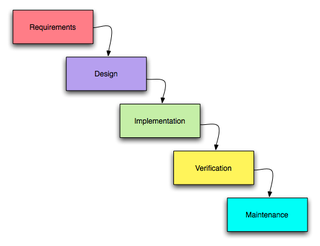
The waterfall model shows a process, where developers are to follow these phases in order:- Requirements specificationSoftware Requirements Specification-Organization of an SRS:A Software Requirements Specification – a requirements specification for a software system – is a complete description of the behavior of a system to be developed. It includes a set of use cases that describe all the interactions the users will have with the software. In...
(Requirements analysisRequirements analysisRequirements analysis in systems engineering and software engineering, encompasses those tasks that go into determining the needs or conditions to meet for a new or altered product, taking account of the possibly conflicting requirements of the various stakeholders, such as beneficiaries or users...
) - Software designSoftware designSoftware design is a process of problem solving and planning for a software solution. After the purpose and specifications of software are determined, software developers will design or employ designers to develop a plan for a solution...
- Implementation and IntegrationSystem integrationIn engineering, system integration is the bringing together of the component subsystems into one system and ensuring that the subsystems function together as a system...
- TestingSoftware testingSoftware testing is an investigation conducted to provide stakeholders with information about the quality of the product or service under test. Software testing can also provide an objective, independent view of the software to allow the business to appreciate and understand the risks of software...
(or ValidationData validationIn computer science, data validation is the process of ensuring that a program operates on clean, correct and useful data. It uses routines, often called "validation rules" or "check routines", that check for correctness, meaningfulness, and security of data that are input to the system...
) - DeploymentSoftware deploymentSoftware deployment is all of the activities that make a software system available for use.The general deployment process consists of several interrelated activities with possible transitions between them. These activities can occur at the producer site or at the consumer site or both...
(or InstallationInstallation (computer programs)Installation of a program is the act of putting the program onto a computer system so that it can be executed....
) - MaintenanceSoftware maintenanceSoftware Maintenance in software engineering is the modification of a software product after delivery to correct faults, to improve performance or other attributes....
In a strict Waterfall model, after each phase is finished, it proceeds to the next one. Reviews may occur before moving to the next phase which allows for the possibility of changes (which may involve a formal change control process). Reviews may also be employed to ensure that the phase is indeed complete; the phase completion criteria are often referred to as a "gate" that the project must pass through to move to the next phase. Waterfall discourages revisiting and revising any prior phase once it's complete. This "inflexibility" in a pure Waterfall model has been a source of criticism by supporters of other more "flexible" models.
Spiral model
The key characteristic of a Spiral model is risk management at regular stages in the development cycle.In 1988, Barry Boehm
Barry Boehm
Barry W. Boehm is an American software engineer, TRW Emeritus Professor of Software Engineering at the Computer Science Department of the University of Southern California, and known for his many contributions to software engineering.- Biography :...
published a formal software system development "spiral model," which combines some key aspect of the waterfall model
Waterfall model
The waterfall model is a sequential design process, often used in software development processes, in which progress is seen as flowing steadily downwards through the phases of Conception, Initiation, Analysis, Design, Construction, Testing, Production/Implementation and Maintenance.The waterfall...
and rapid prototyping
Rapid application development
Rapid application development is a software development methodology that uses minimal planning in favor of rapid prototyping. The "planning" of software developed using RAD is interleaved with writing the software itself...
methodologies, but provided emphasis in a key area many felt had been neglected by other methodologies: deliberate iterative risk analysis, particularly suited to large-scale complex systems.
The Spiral is visualized as a process passing through some number of iterations, with the four quadrant diagram representative of the following activities:
- formulate plans to: identify software targets, selected to implement the program, clarify the project development restrictions;
- Risk analysis: an analytical assessment of selected programs, to consider how to identify and eliminate risk;
- the implementation of the project: the implementation of software development and verification;
Risk-driven spiral model, emphasizing the conditions of options and constraints in order to support software reuse, software quality can help as a special goal of integration into the product development. However, the spiral model has some restrictive conditions, as follows:
- The spiral model emphasizes risk analysis, and thus requires customers to accept this analysis and act on it. This requires both trust in the developer as well as the willingness to spend more to fix the issues, which is the reason why this model is often used for large-scale internal software development.
- If the implementation of risk analysis will greatly affect the profits of the project, the spiral model should not be used.
- Software developers have to actively look for possible risks, and analyze it accurately for the spiral model to work.
The first stage is to formulate a plan to achieve the objectives with these constraints, and then strive to find and remove all potential risks through careful analysis and, if necessary, by constructing a prototype. If some risks can not be ruled out, the customer has to decide whether to terminate the project or to ignore the risks and continue anyway. Finally, the results are evaluated and the design of the next phase begins.
Iterative and incremental development
Iterative development prescribes the construction of initially small but ever-larger portions of a software project to help all those involved to uncover important issues early before problems or faulty assumptions can lead to disaster.Agile development
Agile software development uses iterative development as a basis but advocates a lighter and more people-centric viewpoint than traditional approaches. Agile processes use feedback, rather than planning, as their primary control mechanism. The feedback is driven by regular tests and releases of the evolving software.There are many variations of agile processes:
- In Extreme ProgrammingExtreme ProgrammingExtreme programming is a software development methodology which is intended to improve software quality and responsiveness to changing customer requirements...
(XP), the phases are carried out in extremely small (or "continuous") steps compared to the older, "batch" processes. The (intentionally incomplete) first pass through the steps might take a day or a week, rather than the months or years of each complete step in the Waterfall model. First, one writes automated tests, to provide concrete goals for development. Next is coding (by a pair of programmers), which is complete when all the tests pass, and the programmers can't think of any more tests that are needed. Design and architecture emerge out of refactoringRefactoringCode refactoring is "disciplined technique for restructuring an existing body of code, altering its internal structure without changing its external behavior", undertaken in order to improve some of the nonfunctional attributes of the software....
, and come after coding. The same people who do the coding do design. (Only the last feature — merging design and code — is common to all the other agile processes.) The incomplete but functional system is deployed or demonstrated for (some subset of) the users (at least one of which is on the development team). At this point, the practitioners start again on writing tests for the next most important part of the system. - ScrumScrum (development)Scrum is an iterative, incremental framework for project management often seen in agile software development, a type of software engineering....
Code and fix
"Code and fix" development is not so much a deliberate strategy as an artifact of naiveté and schedule pressure on software developers. Without much of a design in the way, programmerProgrammer
A programmer, computer programmer or coder is someone who writes computer software. The term computer programmer can refer to a specialist in one area of computer programming or to a generalist who writes code for many kinds of software. One who practices or professes a formal approach to...
s immediately begin producing code
Source code
In computer science, source code is text written using the format and syntax of the programming language that it is being written in. Such a language is specially designed to facilitate the work of computer programmers, who specify the actions to be performed by a computer mostly by writing source...
. At some point, testing
Software testing
Software testing is an investigation conducted to provide stakeholders with information about the quality of the product or service under test. Software testing can also provide an objective, independent view of the software to allow the business to appreciate and understand the risks of software...
begins (often late in the development cycle), and the inevitable bugs must then be fixed before the product can be shipped. See also: Continuous integration
Continuous integration
In software engineering, continuous integration implements continuous processes of applying quality control — small pieces of effort, applied frequently...
Process improvement models
Capability Maturity Model Integration- The Capability Maturity Model IntegrationCapability Maturity Model IntegrationCapability Maturity Model Integration is a process improvement approach whose goal is to help organizations improve their performance. CMMI can be used to guide process improvement across a project, a division, or an entire organization...
(CMMI) is one of the leading models and based on best practice. Independent assessments grade organizations on how well they follow their defined processes, not on the quality of those processes or the software produced. CMMI has replaced CMMCapability Maturity ModelThe Capability Maturity Model is a development model that was created after study of data collected from organizations that contracted with the U.S. Department of Defense, who funded the research. This model became the foundation from which CMU created the Software Engineering Institute...
.
ISO 9000
- ISO 9000ISO 9000The ISO 9000 family of standards relates to quality management systems and is designed to help organizations ensure they meet the needs of customers and other stakeholders . The standards are published by ISO, the International Organization for Standardization, and available through National...
describes standards for a formally organized process to manufacture a product and the methods of managing and monitoring progress. Although the standard was originally created for the manufacturing sector, ISO 9000 standards have been applied to software development as well. Like CMMI, certification with ISO 9000 does not guarantee the quality of the end result, only that formalized business processes have been followed.
ISO/IEC 15504
- ISO/IEC 15504 Information technology — Process assessment also known as Software Process Improvement Capability Determination (SPICE), is a "framework for the assessment of software processes". This standard is aimed at setting out a clear model for process comparison. SPICE is used much like CMMI. It models processes to manage, control, guide and monitor software development. This model is then used to measure what a development organization or project team actually does during software development. This information is analyzed to identify weaknesses and drive improvement. It also identifies strengths that can be continued or integrated into common practice for that organization or team.
Formal methods
Formal methodsFormal methods
In computer science and software engineering, formal methods are a particular kind of mathematically-based techniques for the specification, development and verification of software and hardware systems...
are mathematical approaches to solving software (and hardware) problems at the requirements, specification and design levels. Examples of formal methods include the B-Method
B-Method
The B method is method of software development based on B, a tool-supported formal method based around an abstract machine notation, used in the development of computer software. It was originally developed by Jean-Raymond Abrial in France and the UK. B is related to the Z notation and supports...
, Petri net
Petri net
A Petri net is one of several mathematical modeling languages for the description of distributed systems. A Petri net is a directed bipartite graph, in which the nodes represent transitions and places...
s, Automated theorem proving
Automated theorem proving
Automated theorem proving or automated deduction, currently the most well-developed subfield of automated reasoning , is the proving of mathematical theorems by a computer program.- Decidability of the problem :...
, RAISE
Raise
Raise is a fell in the English Lake District. It stands on the main spine of the Helvellyn range in the Eastern Fells, between Thirlmere and Ullswater.-Topography:...
and VDM
Vienna Development Method
The Vienna Development Method is one of the longest-established Formal Methods for the development of computer-based systems. Originating in work done at IBM's Vienna Laboratory in the 1970s, it has grown to include a group of techniques and tools based on a formal specification language - the VDM...
. Various formal specification notations are available, such as the Z notation
Z notation
The Z notation , named after Zermelo–Fraenkel set theory, is a formal specification language used for describing and modelling computing systems. It is targeted at the clear specification of computer programs and computer-based systems in general.-History:...
. More generally, automata theory
Automata theory
In theoretical computer science, automata theory is the study of abstract machines and the computational problems that can be solved using these machines. These abstract machines are called automata...
can be used to build up and validate application behavior by designing a system of finite state machine
Finite state machine
A finite-state machine or finite-state automaton , or simply a state machine, is a mathematical model used to design computer programs and digital logic circuits. It is conceived as an abstract machine that can be in one of a finite number of states...
s.
Finite state machine (FSM) based methodologies allow executable software specification and by-passing of conventional coding (see virtual finite state machine
Virtual finite state machine
A virtual finite state machine is a finite state machine defined in a virtual environment. The VFSM concept provides a software specification method to describe the behaviour of a control system using assigned names of input control properties and of output actions.The VFSM method introduces an...
or event driven finite state machine).
Formal methods are most likely to be applied in avionics software
Avionics software
Avionics software is embedded software with legally mandated safety and reliability concerns used in avionics. The main difference between avionic software and conventional embedded software is that the development process is required by law and is optimized for safety.It is claimed that the...
, particularly where the software is safety critical. Software safety assurance standards, such as DO178B demand formal methods at the highest level of categorization (Level A).
Formalization of software development is creeping in, in other places, with the application of Object Constraint Language
Object Constraint Language
The Object Constraint Language is a declarative language for describing rules that apply to Unified Modeling Language models developed at IBM and now part of the UML standard. Initially, OCL was only a formal specification language extension to UML. OCL may now be used with any Meta-Object...
(and specializations such as Java Modeling Language
Java Modeling Language
The Java Modeling Language is a specification language for Java programs, using Hoare style pre- and postconditions and invariants, that follows the design by contract paradigm...
) and especially with Model-driven architecture
Model-driven architecture
Model-driven architecture is a software design approach for the development of software systems. It provides a set of guidelines for the structuring of specifications, which are expressed as models. Model-driven architecture is a kind of domain engineering, and supports model-driven engineering of...
allowing execution of designs, if not specifications.
Another emerging trend in software development is to write a specification in some form of logic (usually a variation of FOL), and then to directly execute the logic as though it were a program. The OWL
Web Ontology Language
The Web Ontology Language is a family of knowledge representation languages for authoring ontologies.The languages are characterised by formal semantics and RDF/XML-based serializations for the Semantic Web...
language, based on Description Logic, is an example. There is also work on mapping some version of English (or another natural language) automatically to and from logic, and executing the logic directly. Examples are Attempto Controlled English
Attempto Controlled English
Attempto Controlled English is a controlled natural language, i.e. a subset of standard English with a restricted syntax and a restricted semantics described by a small set of construction and interpretation rules....
, and Internet Business Logic, which do not seek to control the vocabulary or syntax. A feature of systems that support bidirectional English-logic mapping and direct execution of the logic is that they can be made to explain their results, in English, at the business or scientific level.
The Government Accountability Office, in a 2003 report on one of the Federal Aviation Administration’s air traffic control modernization programs, recommends following the agency’s guidance for managing major acquisition systems by
- establishing, maintaining, and controlling an accurate, valid, and current performance measurement baseline, which would include negotiating all authorized, unpriced work within 3 months;
- conducting an integrated baseline review of any major contract modifications within 6 months; and
- preparing a rigorous life-cycle cost estimate, including a risk assessment, in accordance with the Acquisition System Toolset’s guidance and identifying the level of uncertainty inherent in the estimate.
Development methods
- Chaos modelChaos modelIn computing, the Chaos model is a structure of software development. Its creator, L.B.S. Raccoon, noted that project management models such as the spiral model and waterfall model, while good at managing schedules and staff, didn't provide methods to fix bugs or solve other technical problems...
- Extreme ProgrammingExtreme ProgrammingExtreme programming is a software development methodology which is intended to improve software quality and responsiveness to changing customer requirements...
- ICONIXICONIXICONIX is a software development methodology which predates both the Rational Unified Process , Extreme Programming and Agile software development. Like RUP, the ICONIX process is UML Use Case driven but more lightweight than RUP. Unlike the XP and Agile approaches, ICONIX provides sufficient...
(UML-based object modeling with use cases) - Incremental funding methodologyIncremental funding methodologyThe Incremental Funding Methodology is an ROI-informed approach to software development in which software is developed and delivered in carefully prioritized chunks of customer valued functionality. These chunks are known as Minimum Marketable Features or MMFs.IFM integrates traditional software...
- Model-driven engineeringModel-driven engineeringModel-driven engineering is a software development methodology which focuses on creating and exploiting domain models , rather than on the computing concepts...
- Service-oriented modelingService-oriented modelingService-oriented modeling is the discipline of modeling business and software systems, for the purpose of designing and specifying service-oriented business systems within a variety of architectural styles, such as enterprise architecture, application architecture, service-oriented architecture,...
- Software prototypingSoftware prototyping*Software prototyping, refers to the activity of creating prototypes of software applications, i.e., incomplete versions of the software program being developed...
- Specification and Description LanguageSpecification and Description LanguageSpecification and Description Language is a specification language targeted at the unambiguous specification and description of the behaviour of reactive and distributed systems.- Overview :It is defined by the ITU-T...
- Top–down and bottom–up design
- Unified ProcessUnified ProcessThe Unified Software Development Process or Unified Process is a popular iterative and incremental software development process framework. The best-known and extensively documented refinement of the Unified Process is the Rational Unified Process ....
- User experienceUser experienceUser experience is the way a person feels about using a product, system or service. User experience highlights the experiential, affective, meaningful and valuable aspects of human-computer interaction and product ownership, but it also includes a person’s perceptions of the practical aspects such...
- V-Model (software development)V-Model (software development)The V-model represents a software development process which may be considered an extension of the waterfall model. Instead of moving down in a linear way, the process steps are bent upwards after the coding phase, to form the typical V shape...
- Verification and Validation (software)
Related subjects
- Bachelor of Science in Information TechnologyBachelor of Science in Information TechnologyA Bachelor of Science in Information Technology, , is a bachelor's degree awarded for the completion of an undergraduate course or program in information technology....
- Best Coding PracticesBest Coding PracticesBest coding practices for software development can be broken into many levels based on the coding language, the platform, the target environment and so forth...
- Conceptual modelConceptual modelIn the most general sense, a model is anything used in any way to represent anything else. Some models are physical objects, for instance, a toy model which may be assembled, and may even be made to work like the object it represents. They are used to help us know and understand the subject matter...
- Cost estimation in software engineering
- IPO ModelIPO ModelThe Input-Process-Output Model also known as the IPO+S Model is a functional model and conceptual schema of a general system. An IPO chart identifies a program’s inputs, its outputs, and the processing steps required to transform the inputs into the outputs.- Overview :The IPO model has many...
- List of software development philosophies
- Method engineeringMethod engineeringMethod engineering in the "field of information systems is the discipline to construct new methods from existing methods". It focuses on "the design, construction and evaluation of methods, techniques and support tools for information systems development"....
- Outline of software engineeringOutline of software engineeringThe following outline is provided as an overview of and topical guide to software engineering:Software engineering – application of a systematic, disciplined, quantifiable approach to the development, operation, and maintenance of software; that is the application of engineering to...
- Performance engineeringPerformance EngineeringPerformance engineering within systems engineering, encompasses the set of roles, skills, activities, practices, tools, and deliverables applied at every phase of the Systems Development Life Cycle which ensures that a solution will be designed, implemented, and operationally supported to meet the...
- Process (computing)Process (computing)In computing, a process is an instance of a computer program that is being executed. It contains the program code and its current activity. Depending on the operating system , a process may be made up of multiple threads of execution that execute instructions concurrently.A computer program is a...
- Programming paradigmProgramming paradigmA programming paradigm is a fundamental style of computer programming. Paradigms differ in the concepts and abstractions used to represent the elements of a program and the steps that compose a computation A programming paradigm is a fundamental style of computer programming. (Compare with a...
- Programming productivityProgramming productivityProgramming productivity refers to a variety of software development issues and methodologies affecting the quantity and quality of code produced by an individual or team...
- ProjectProjectA project in business and science is typically defined as a collaborative enterprise, frequently involving research or design, that is carefully planned to achieve a particular aim. Projects can be further defined as temporary rather than permanent social systems that are constituted by teams...
- Rapid application developmentRapid application developmentRapid application development is a software development methodology that uses minimal planning in favor of rapid prototyping. The "planning" of software developed using RAD is interleaved with writing the software itself...
- Service-oriented modelingService-oriented modelingService-oriented modeling is the discipline of modeling business and software systems, for the purpose of designing and specifying service-oriented business systems within a variety of architectural styles, such as enterprise architecture, application architecture, service-oriented architecture,...
- Software designSoftware designSoftware design is a process of problem solving and planning for a software solution. After the purpose and specifications of software are determined, software developers will design or employ designers to develop a plan for a solution...
- Software developmentSoftware developmentSoftware development is the development of a software product...
- Software documentationSoftware documentationSoftware documentation or source code documentation is written text that accompanies computer software. It either explains how it operates or how to use it, and may mean different things to people in different roles....
- Software release life cycle
- Systems designSystems designSystems design is the process of defining the architecture, components, modules, interfaces, and data for a system to satisfy specified requirements. One could see it as the application of systems theory to product development...
- Systems Development Life CycleSystems Development Life CycleThe systems development life cycle , or software development life cycle in systems engineering, information systems and software engineering, is a process of creating or altering information systems, and the models and methodologies that people use to develop these systems.In software engineering...
- Test effortTest effortIn software development, test effort refers to the expenses for tests. There is a relation with test costs and failure costs...
External links
- Gerhard Fischer, "The Software Technology of the 21st Century: From Software Reuse to Collaborative Software Design", 2001
- Lydia Ash: The Web Testing Companion: The Insider's Guide to Efficient and Effective Tests, Wiley, May 2, 2003. ISBN 0-471-43021-8
- SaaSSDLC.com — Software as a Service Systems Development Life Cycle Project
- Software development life cycle (SDLC) [visual image], software development life cycle
- Heraprocess.org — Hera is a light process solution for managing web projects
