

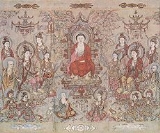
Society of the Song Dynasty

Encyclopedia
China
Chinese civilization may refer to:* China for more general discussion of the country.* Chinese culture* Greater China, the transnational community of ethnic Chinese.* History of China* Sinosphere, the area historically affected by Chinese culture...
society during the Song Dynasty
Song Dynasty
The Song Dynasty was a ruling dynasty in China between 960 and 1279; it succeeded the Five Dynasties and Ten Kingdoms Period, and was followed by the Yuan Dynasty. It was the first government in world history to issue banknotes or paper money, and the first Chinese government to establish a...
(AD 960–1279) was marked by political and legal reforms, a philosophical revival of Confucianism
Confucianism
Confucianism is a Chinese ethical and philosophical system developed from the teachings of the Chinese philosopher Confucius . Confucianism originated as an "ethical-sociopolitical teaching" during the Spring and Autumn Period, but later developed metaphysical and cosmological elements in the Han...
, and the development of cities beyond administrative purposes into centers of trade, industry, and maritime
Maritime history
Maritime history is the study of human activity at sea. It covers a broad thematic element of history that often uses a global approach, although national and regional histories remain predominant...
commerce. The inhabitants of rural areas were mostly farmers, although some were also hunters, fishers, or government employees working in mines or the salt marshes. Conversely, shopkeepers, artisans, city guards, entertainers, laborers, and wealthy merchants lived in the county and provincial centers along with the Chinese gentry
Gentry (China)
As used for imperial China, landed gentry does not correspond to any term in Chinese. One standard work remarks that under the Ming dynasty, called shenshi or shenjin, meaning variously degree-holders, literati, scholar-bureaucrats or officials, they are loosely known in English as the Chinese...
—a small, elite community of educated scholars and scholar-officials
Scholar-bureaucrats
Scholar-officials or Scholar-bureaucrats were civil servants appointed by the emperor of China to perform day-to-day governance from the Sui Dynasty to the end of the Qing Dynasty in 1912, China's last imperial dynasty. These officials mostly came from the well-educated men known as the...
. As landholders and drafted government officials, the gentry considered themselves the leading members of society; gaining their cooperation and employment was essential for the county or provincial bureaucrat overburdened with official duties. In many ways, scholar-officials of the Song period differed from the more aristocratic scholar-officials of the Tang Dynasty
Tang Dynasty
The Tang Dynasty was an imperial dynasty of China preceded by the Sui Dynasty and followed by the Five Dynasties and Ten Kingdoms Period. It was founded by the Li family, who seized power during the decline and collapse of the Sui Empire...
(618–907). Civil service examinations became the primary means of appointment to an official post as competitors vying for official degrees dramatically increased. Frequent disagreements amongst ministers of state on ideological and policy issues led to political strife and the rise of political factions. This undermined the marriage strategies of the professional elite, which broke apart as a social group and gave way to a multitude of families which provided sons for civil service
Civil service
The term civil service has two distinct meanings:* A branch of governmental service in which individuals are employed on the basis of professional merit as proven by competitive examinations....
.
Confucian or Legalist
Legalism (Chinese philosophy)
In Chinese history, Legalism was one of the main philosophic currents during the Warring States Period, although the term itself was invented in the Han Dynasty and thus does not refer to an organized 'school' of thought....
scholars in ancient China—perhaps as far back as the late Zhou Dynasty
Zhou Dynasty
The Zhou Dynasty was a Chinese dynasty that followed the Shang Dynasty and preceded the Qin Dynasty. Although the Zhou Dynasty lasted longer than any other dynasty in Chinese history, the actual political and military control of China by the Ji family lasted only until 771 BC, a period known as...
(c. 1046–256 BC)—categorized all socio-economic groups into four broad and hierarchical occupations
Four occupations
The four occupations or "four categories of the people" was a hierarchic social class structure developed in ancient China by either Confucian or Legalist scholars as far back as the late Zhou Dynasty and is considered a central part of the Fengjian social structure...
(in descending order): the shi (scholars, or gentry), the nong (peasant farmers), the gong (artisans and craftsmen), and the shang (merchants). Wealthy landholders and officials possessed the resources to better prepare their sons for the civil service examinations, yet they were often rivaled in their power and wealth by merchants of the Song period. Merchants frequently colluded commercially and politically with officials, despite the fact that scholar-officials looked down on mercantile vocations as less respectable pursuits than farming or craftsmanship. The military also provided a means for advancement in Song society for those who became officers, even though soldiers were not highly respected members of society. Although certain domestic and familial duties were expected of women in Song society, they nonetheless enjoyed a wide range of social and legal rights in an otherwise patriarchal
Patriarchy
Patriarchy is a social system in which the role of the male as the primary authority figure is central to social organization, and where fathers hold authority over women, children, and property. It implies the institutions of male rule and privilege, and entails female subordination...
society. Women's improved rights to property came gradually with the increasing value of dowries
Dowry
A dowry is the money, goods, or estate that a woman brings forth to the marriage. It contrasts with bride price, which is paid to the bride's parents, and dower, which is property settled on the bride herself by the groom at the time of marriage. The same culture may simultaneously practice both...
offered by brides' families.
Daoism
Taoism
Taoism refers to a philosophical or religious tradition in which the basic concept is to establish harmony with the Tao , which is the mechanism of everything that exists...
and Buddhism
Buddhism
Buddhism is a religion and philosophy encompassing a variety of traditions, beliefs and practices, largely based on teachings attributed to Siddhartha Gautama, commonly known as the Buddha . The Buddha lived and taught in the northeastern Indian subcontinent some time between the 6th and 4th...
were the dominant religions of China in the Song era, the latter deeply impacting many beliefs and principles of Neo-Confucianism
Neo-Confucianism
Neo-Confucianism is an ethical and metaphysical Chinese philosophy influenced by Confucianism, that was primarily developed during the Song Dynasty and Ming Dynasty, but which can be traced back to Han Yu and Li Ao in the Tang Dynasty....
throughout the dynasty. Ironically, Buddhism came under heavy criticism by staunch Confucian advocates and philosophers of the time. Older beliefs in ancient Chinese mythology
Chinese mythology
Chinese mythology is a collection of cultural history, folktales, and religions that have been passed down in oral or written tradition. These include creation myths and legends and myths concerning the founding of Chinese culture and the Chinese state...
, folk religion
Chinese folk religion
Chinese folk religion or Shenism , which is a term of considerable debate, are labels used to describe the collection of ethnic religious traditions which have been a main belief system in China and among Han Chinese ethnic groups for most of the civilization's history until today...
, and ancestor worship also played a large part in people's daily lives, as the Chinese believed that deities and ghosts of the spiritual realm frequently interacted with the living realm.
The Song justice system was maintained by policing sheriffs, investigators, official coroners, and exam-drafted officials who acted as magistrate
Magistrate
A magistrate is an officer of the state; in modern usage the term usually refers to a judge or prosecutor. This was not always the case; in ancient Rome, a magistratus was one of the highest government officers and possessed both judicial and executive powers. Today, in common law systems, a...
s. Song magistrates were encouraged to apply both their practical knowledge as well as the written law in making judicial decisions that would promote societal morality. Advancements in early forensic science, a greater emphasis on gathering credible evidence, and careful recording by clerks of autopsy reports and witness testimonies aided authorities in convicting criminals.
Urban growth and management

Technology of the Song Dynasty
The Song Dynasty provided some of the most significant technological advances in Chinese history, many of which came from talented statesmen drafted by the government through imperial examinations....
and an agricultural revolution
Economy of the Song Dynasty
The economy of China under the Song Dynasty of China was marked by commercial expansion, financial prosperity, increased international trade-contacts, and a revolution in agricultural productivity. Private finance grew, stimulating the development of a country-wide market network which linked the...
. Kaifeng
Kaifeng
Kaifeng , known previously by several names , is a prefecture-level city in east-central Henan province, Central China. Nearly 5 million people live in the metropolitan area...
, which served as the capital and seat of government during the Northern Song (960–1127), had some half a million residents in 1021, with another half-million living in the city's nine designated suburbs. By 1100, the civilian population within the city walls was 1,050,000; the army stationed there brought the total to 1.4 million. Hangzhou
Hangzhou
Hangzhou , formerly transliterated as Hangchow, is the capital and largest city of Zhejiang Province in Eastern China. Governed as a sub-provincial city, and as of 2010, its entire administrative division or prefecture had a registered population of 8.7 million people...
, the capital during the Southern Song (1127–1279), had more than 400,000 inhabitants during the late 12th century, primarily due to its trading position at the southern terminus of the Grand Canal, known as the lower Yangzi's
Yangtze River
The Yangtze, Yangzi or Cháng Jiāng is the longest river in Asia, and the third-longest in the world. It flows for from the glaciers on the Tibetan Plateau in Qinghai eastward across southwest, central and eastern China before emptying into the East China Sea at Shanghai. It is also one of the...
"grain basket." During the 13th century, the city's population soared to approximately a million people, with the 1270 census counting 186,330 registered families living in the city. Although not as agriculturally rich as areas like western Sichuan
Sichuan
' , known formerly in the West by its postal map spellings of Szechwan or Szechuan is a province in Southwest China with its capital in Chengdu...
, the region of Fujian
Fujian
' , formerly romanised as Fukien or Huguing or Foukien, is a province on the southeast coast of mainland China. Fujian is bordered by Zhejiang to the north, Jiangxi to the west, and Guangdong to the south. Taiwan lies to the east, across the Taiwan Strait...
also underwent a massive population growth; government records indicate a 1500% increase in the number of registered households from the years 742 to 1208. With a thriving shipbuilding
Shipbuilding
Shipbuilding is the construction of ships and floating vessels. It normally takes place in a specialized facility known as a shipyard. Shipbuilders, also called shipwrights, follow a specialized occupation that traces its roots to before recorded history.Shipbuilding and ship repairs, both...
industry and new mining
Mining
Mining is the extraction of valuable minerals or other geological materials from the earth, from an ore body, vein or seam. The term also includes the removal of soil. Materials recovered by mining include base metals, precious metals, iron, uranium, coal, diamonds, limestone, oil shale, rock...
facilities, Fujian became the economic powerhouse of China during the Song period. The great seaport of China, Quanzhou
Quanzhou
Quanzhou is a prefecture-level city in Fujian province, People's Republic of China. It borders all other prefecture-level cities in Fujian but two and faces the Taiwan Strait...
, was located in Fujian, and by 1120 its governor claimed that the city's population had reached some 500,000. The inland Fujianese city of Jiankang
Nanjing
' is the capital of Jiangsu province in China and has a prominent place in Chinese history and culture, having been the capital of China on several occasions...
was also very large at this time, with a population of about 200,000. Robert Hartwell states that from 742 to 1200 the population growth of North China
Northern and southern China
Northern China and southern China are two approximate regions within China. The exact boundary between these two regions has never been precisely defined...
increased by only 54% percent in comparison to the Southeast which grew by 695%, the middle Yangzi Valley by 483%, the Lingnan
Lingnan
Lingnan is a geographic area referring to lands in the south of China's "Five Ranges" which are Tayu, Qitian, Dupang, Mengzhu, Yuecheng. The region covers the Guangdong, Guangxi, Hunan and Jiangxi provinces of modern China and northern Vietnam...
region by 150%, and the upper Yangzi Valley by 135%. From the 8th to 11th centuries the lower Yangzi Valley experienced modest population growth in comparison to other regions of South China. The shift of the capital to Hangzhou did not create an immediate dramatic change in population growth until the period from 1170 to 1225, when new polder
Polder
A polder is a low-lying tract of land enclosed by embankments known as dikes, that forms an artificial hydrological entity, meaning it has no connection with outside water other than through manually-operated devices...
s allowed land reclamation
Land reclamation
Land reclamation, usually known as reclamation, is the process to create new land from sea or riverbeds. The land reclaimed is known as reclamation ground or landfill.- Habitation :...
for nearly all the arable land between Lake Tai and the East China Sea
East China Sea
The East China Sea is a marginal sea east of China. It is a part of the Pacific Ocean and covers an area of 1,249,000 km² or 750,000 square miles.-Geography:...
as well as the mouth of the Yangzi to the northern Zhejiang
Zhejiang
Zhejiang is an eastern coastal province of the People's Republic of China. The word Zhejiang was the old name of the Qiantang River, which passes through Hangzhou, the provincial capital...
coast.

Chang'an
Chang'an is an ancient capital of more than ten dynasties in Chinese history, today known as Xi'an. Chang'an literally means "Perpetual Peace" in Classical Chinese. During the short-lived Xin Dynasty, the city was renamed "Constant Peace" ; yet after its fall in AD 23, the old name was restored...
. A center of great wealth, Chang'an's importance as the political center eclipsed its importance as a commercial entrepôt
Entrepôt
An entrepôt is a trading post where merchandise can be imported and exported without paying import duties, often at a profit. This profit is possible because of trade conditions, for example, the reluctance of ships to travel the entire length of a long trading route, and selling to the entrepôt...
; Yangzhou
Yangzhou
Yangzhou is a prefecture-level city in central Jiangsu Province, People's Republic of China. Sitting on the northern bank of the Yangtze River, it borders the provincial capital of Nanjing to the southwest, Huai'an to the north, Yancheng to the northeast, Taizhou to the east, and Zhenjiang across...
was the economic hub of China during the Tang period. On the other hand, Kaifeng's role as a commercial center in China was as important as its political role. After the curfew was abolished in 1063, marketplaces in Kaifeng were open every hour of the day, whereas a strict curfew was imposed upon the two official marketplaces of Tang era Chang'an starting at dusk; this curfew limited its commercial potential. Shopkeepers and peddlers in Kaifeng began selling their goods at dawn. Along the wide avenue of the Imperial Way, breakfast delicacies were sold in shops and stalls and peddlers offered hot water for washing the face at the entrances of bathhouses
Public bathing
Public baths originated from a communal need for cleanliness. The term public may confuse some people, as some types of public baths are restricted depending on membership, gender, religious affiliation, or other reasons. As societies have changed, public baths have been replaced as private bathing...
. Lively activity in the markets did not begin to wane until about the evening meal of the day, while noodle shops remained open all day and night. People in the Song era were also more eager to purchase houses located near bustling markets than in earlier periods. Kaifeng's wealthy, multi-story houses and common urban dwellings were situated along the streets of the city, rather than hidden inside walled compounds and gated wards as they had been in the earlier Tang capital.
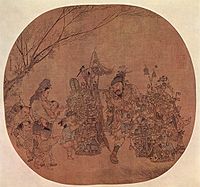
In order to maintain swift communication from one town or city to another, the Song laid out many miles of roadways and hundreds of bridges throughout rural China. They also maintained an efficient postal service nicknamed the hot-foot relay, which featured thousands of postal officers managed by the central government. Postal clerks kept records of dispatches, and postal stations maintained a staff of cantonal officers who guarded mail delivery routes. After the Song period, the Yuan Dynasty transformed the postal system into a more militarized organization, with couriers managed under controllers. This system persisted from the 14th century until the 19th century, when the telegraph and modern road-building were introduced to China from the West.
Amusements and pastimes
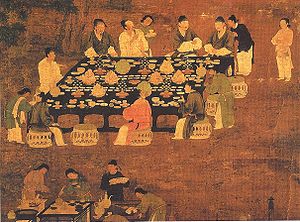
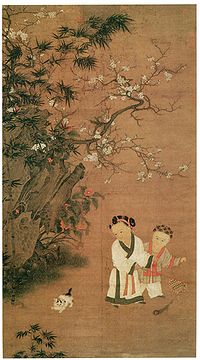
The entertainment quarters of Kaifeng, Hangzhou, and other cities featured amusements including snake charmers
Snake charming
Snake charming is the practice of pretending to hypnotise a snake by playing an instrument. A typical performance may also include handling the snakes or performing other seemingly dangerous acts, as well as other street performance staples, like juggling and sleight of hand...
, sword swallowers
Sword swallowing
Sword swallowing is an ancient performance art in which the performer passes a sword through the mouth and down the esophagus towards the stomach...
, fortunetellers, acrobats, puppeteers, actors, storytellers, tea houses and restaurants, and brokers offering young women who could serve as hired maids, concubines, singing girls, or prostitutes. These entertainment quarters, covered bazaars known as pleasure grounds, were places where strict social morals and formalities could be largely ignored. The pleasure grounds were located within the city, outside the ramparts near the gates, and in the suburbs; each was regulated by a state-appointed official. Games and entertainments were an all-day affair, while the taverns and singing girl houses were open until two o'clock in the morning. While being served by waiters and ladies who heated up wine for parties, drinking playboys in winehouses would often be approached by common folk called "idlers" (xianhan) who offered to run errands, fetch and send money, and summon singing girls.
Dramatic performances, often accompanied by music, were popular in the markets. The actors were distinguished in rank by type and color of clothing, honing their acting skills at drama schools. Satirical
Satire
Satire is primarily a literary genre or form, although in practice it can also be found in the graphic and performing arts. In satire, vices, follies, abuses, and shortcomings are held up to ridicule, ideally with the intent of shaming individuals, and society itself, into improvement...
sketches denouncing corrupt government officials were especially popular. Actors on stage always spoke their lines in Classical Chinese
Classical Chinese
Classical Chinese or Literary Chinese is a traditional style of written Chinese based on the grammar and vocabulary of ancient Chinese, making it different from any modern spoken form of Chinese...
; vernacular Chinese
Vernacular Chinese
Written Vernacular Chinese refers to forms of written Chinese based on the vernacular language, in contrast to Classical Chinese, the written standard used from the Spring and Autumn Period to the early twentieth century...
that imitated the common spoken language was not introduced into theatrical performances until the subsequent Yuan Dynasty. Although trained to speak in the erudite Classical language, acting troupes commonly drew their membership from one of the lowest social groups in society: prostitutes. Of the fifty some theatres located in the pleasure grounds of Kaifeng, four of these theatres were large enough to entertain audiences of several thousand each, drawing huge crowds which nearby businesses thrived upon.
There were also many vibrant public festivities held in cities and rural communities. Martial arts
Martial arts
Martial arts are extensive systems of codified practices and traditions of combat, practiced for a variety of reasons, including self-defense, competition, physical health and fitness, as well as mental and spiritual development....
were a source of public entertainment; the Chinese held fighting matches on lei tai, a raised platform without rails. With the rise in popularity of distinctive urban and domestic activities during the Song Dynasty, there was a decline in traditional outdoor Chinese pastimes such as hunting, horseback riding, and polo
Polo
Polo is a team sport played on horseback in which the objective is to score goals against an opposing team. Sometimes called, "The Sport of Kings", it was highly popularized by the British. Players score by driving a small white plastic or wooden ball into the opposing team's goal using a...
. In terms of domestic leisure, the Chinese enjoyed a host of different activities, including board games such as xiangqi
Xiangqi
Xiangqi is a two-player Chinese board game in the same family as Western chess, chaturanga, shogi, Indian chess and janggi. The present-day form of Xiangqi originated in China and is therefore commonly called Chinese chess in English. Xiangqi is one of the most popular board games in China...
and go
Go (board game)
Go , is an ancient board game for two players that originated in China more than 2,000 years ago...
. There were lavish garden spaces designated for those wishing to stroll, and people often took their boats out on the lake to entertain guests or to stage boat races
Dragon boat
A dragon boat is a human-powered watercraft traditionally made, in the Pearl River delta region of southern China - Guangdong Province, of teak wood to various designs and sizes. In other parts of China different woods are used to build these traditional watercraft...
.
Rural life

There were varying types of land ownership and tenure depending on the topography and climate of one's locality. In hilly, peripheral areas far from trade routes, most peasant farmers owned and cultivated their own fields. In frontier regions such as Hunan
Hunan
' is a province of South-Central China, located to the south of the middle reaches of the Yangtze River and south of Lake Dongting...
and Sichuan
Sichuan
' , known formerly in the West by its postal map spellings of Szechwan or Szechuan is a province in Southwest China with its capital in Chengdu...
, owners of wealthy estates gathered serf
SERF
A spin exchange relaxation-free magnetometer is a type of magnetometer developed at Princeton University in the early 2000s. SERF magnetometers measure magnetic fields by using lasers to detect the interaction between alkali metal atoms in a vapor and the magnetic field.The name for the technique...
s to till their lands. The most advanced areas had few estates with serfs tilling the fields; these regions had long fostered wet-rice cultivation, which did not require centralized management of farming. Landlords set fixed rents for tenant farmer
Tenant farmer
A tenant farmer is one who resides on and farms land owned by a landlord. Tenant farming is an agricultural production system in which landowners contribute their land and often a measure of operating capital and management; while tenant farmers contribute their labor along with at times varying...
s in these regions, while independent small farming families also owned their own lots.
The Song government provided tax incentives to farmers who tilled lands along the edges of lakes, marshes, seas, and terraced mountain slopes
Terrace (agriculture)
Terraces are used in farming to cultivate sloped land. Graduated terrace steps are commonly used to farm on hilly or mountainous terrain. Terraced fields decrease erosion and surface runoff, and are effective for growing crops requiring much water, such as rice...
. Farming was made possible in these difficult terrains due to improvements in damming techniques and using chain pumps to elevate water to higher irrigation planes. The 10th century introduction of early-ripening rice that could grow in varied climatic zones and topographic conditions allowed for a significantly large migration from the most productive lands that had been farmed for centuries into previously uninhabited areas in the surrounding hinterland of the Yangzi Valley and Southeast China, which experienced rapid development. The widespread cultivation of rice in China necessitated new trends of labor and agricultural techniques. An effective yield from rice paddies required careful transplanting of rows of rice seedlings, sufficient weeding, maintenance of water levels, and draining of fields for harvest. Planting and weeding often required a dirty day of work, since the farmers had to wade through the muddy water of the rice paddies on bare feet. For other crops, water buffalos were used as draft animals for ploughing and harrowing the fields, while properly aged and mixed compost and manure was constantly spread.
Social class

Scholar-bureaucrats
Scholar-officials or Scholar-bureaucrats were civil servants appointed by the emperor of China to perform day-to-day governance from the Sui Dynasty to the end of the Qing Dynasty in 1912, China's last imperial dynasty. These officials mostly came from the well-educated men known as the...
and all those who held examination degrees or were candidates of the civil service examinations. The Song scholar-officials and examination candidates were better educated, less aristocrat
Aristocracy (class)
The aristocracy are people considered to be in the highest social class in a society which has or once had a political system of Aristocracy. Aristocrats possess hereditary titles granted by a monarch, which once granted them feudal or legal privileges, or deriving, as in Ancient Greece and India,...
ic in their habits, and more numerous than in the Tang period. Following the logic of the Confucian philosophical classics
Chinese classic texts
Chinese classic texts, or Chinese canonical texts, today often refer to the pre-Qin Chinese texts, especially the Neo-Confucian titles of Four Books and Five Classics , a selection of short books and chapters from the voluminous collection called the Thirteen Classics. All of these pre-Qin texts...
, Song scholar-officials viewed themselves as highly moralistic figures whose responsibility was to keep greedy merchants and power-hungry military men in their place. Even if a degree-holding scholar was never appointed to an official government post, he nonetheless felt himself responsible for upholding morality in society, and became an elite member of his community.
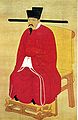
Arguably the most influential factor shaping this new class was the competitive nature of scholarly candidates entering civil service through the imperial examinations. Although not all scholar-officials came from the landholding class, sons of prominent landholders had better access to higher education, and thus greater ability to pass examinations for government service. Gaining a scholarly degree by passing prefectural, circuit-level, or palace exams in the Song period was the most important prerequisite in being considered for appointment, especially to higher posts; this was a departure from the Tang period, when the examination system was enacted on a much smaller scale. A higher degree attained through the three levels of examinations meant a greater chance of obtaining higher offices in government. Not only did this ensure a higher salary, but also greater social prestige, visibly distinguished by dress. This institutionalized distinction of scholar-officials by dress included the type and even color of traditional silken robes
Han Chinese clothing
Hanfu or Han Chinese Clothing, also sometimes known as Hanzhuang , Huafu , and sometimes referred in English sources simply as Silk Robe or Chinese Silk Robe refers to the historical dress of the Han Chinese people, which was worn for millennia before the conquest by the Manchus and the...
, hats, and girdles, demarcating that scholar-official's level of administrative authority. This rigid code of dress was especially enforced during the beginning of the dynasty, although the prestigious clothing color of purple slowly began to diffuse through the ranks of middle and low grade officials.
Scholar-officials and gentry also distinguished themselves through their intellectual pursuits. While some such as Shen Kuo
Shen Kuo
Shen Kuo or Shen Gua , style name Cunzhong and pseudonym Mengqi Weng , was a polymathic Chinese scientist and statesman of the Song Dynasty...
(1031–1095) and Su Song
Su Song
Su Song was a renowned Chinese polymath who specialized himself as a statesman, astronomer, cartographer, horologist, pharmacologist, mineralogist, zoologist, botanist, mechanical and architectural engineer, poet, antiquarian, and ambassador of the Song Dynasty .Su Song was the engineer of a...
(1020–1101) dabbled in every known field of science, study, and statecraft, Song elites were generally most interested in the leisurely pursuits of composing and reciting poetry, art collecting, and antiquarian
Antiquarian
An antiquarian or antiquary is an aficionado or student of antiquities or things of the past. More specifically, the term is used for those who study history with particular attention to ancient objects of art or science, archaeological and historic sites, or historic archives and manuscripts...
ism. Yet even this pursuit could turn into a scholarly one. It was the official, historian, poet, and essayist Ouyang Xiu
Ouyang Xiu
Ouyang Xiu was a Chinese statesman, historian, essayist and poet of the Song Dynasty. He is also known by his courtesy name of Yongshu, and was also self nicknamed The Old Drunkard 醉翁, or Householder of the One of Six 六一居士 in his old age...
(1007–1072) who compiled an analytical catalogue of ancient rubbings on stone and bronze which pioneered ideas in early epigraphy
Epigraphy
Epigraphy Epigraphy Epigraphy (from the , literally "on-writing", is the study of inscriptions or epigraphs as writing; that is, the science of identifying the graphemes and of classifying their use as to cultural context and date, elucidating their meaning and assessing what conclusions can be...
and archeology. Shen Kuo even took an interdisciplinary
Interdisciplinarity
Interdisciplinarity involves the combining of two or more academic fields into one single discipline. An interdisciplinary field crosses traditional boundaries between academic disciplines or schools of thought, as new needs and professions have emerged....
approach to archeological study, in order to aid his work in astronomy, mathematics, and recording ancient musical measures
Bar (music)
In musical notation, a bar is a segment of time defined by a given number of beats of a given duration. Typically, a piece consists of several bars of the same length, and in modern musical notation the number of beats in each bar is specified at the beginning of the score by the top number of a...
. The scholar-official and historian Zeng Gong
Zeng Gong
Zeng Gong , courtesy name Zigu , was a Chinese scholar and historian of the Song Dynasty in China. He was one of the supporters of the New Classical Prose Movement and is regarded as founder of one of the Eight Great Schools of Thought of the Tang and Song dynasties .Zeng Gong was born in Jianchang...
(1019–1083) reclaimed last chapters of the ancient Zhan Guo Ce
Zhan Guo Ce
The Zhan Guo Ce is a renowned ancient Chinese historical work and compilation of sporadic materials on the Warring States Period compiled between the 3rd to 1st centuries BCE...
, proofreading and editing the version that would become the accepted modern version. The ideal official and gentry scholars were also expected to employ these intellectual pursuits for the good of the community, such as writing local histories or gazetteer
Gazetteer
A gazetteer is a geographical dictionary or directory, an important reference for information about places and place names , used in conjunction with a map or a full atlas. It typically contains information concerning the geographical makeup of a country, region, or continent as well as the social...
s. In the case of Shen Kuo and Su Song, their pursuits in academic fields such as classifying pharmaceuticals
Traditional Chinese medicine
Traditional Chinese Medicine refers to a broad range of medicine practices sharing common theoretical concepts which have been developed in China and are based on a tradition of more than 2,000 years, including various forms of herbal medicine, acupuncture, massage , exercise , and dietary therapy...
and improving calendrical science through court work in astronomy
Chinese astronomy
Astronomy in China has a very long history, with historians considering that "they [the Chinese] were the most persistent and accurate observers of celestial phenomena anywhere in the world before the Arabs."...
fit this ideal.
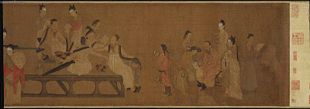
_001.jpg)
Four Arts of the Chinese Scholar
The Four Arts of the Chinese Scholar, otherwise known as siyi , is a term used to describe four main accomplishments required of the Chinese scholar gentleman...
—was a metaphor for accepted gentry pastimes of playing the Chinese zither
Guqin
The guqin is the modern name for a plucked seven-string Chinese musical instrument of the zither family...
, playing Chinese chess
Xiangqi
Xiangqi is a two-player Chinese board game in the same family as Western chess, chaturanga, shogi, Indian chess and janggi. The present-day form of Xiangqi originated in China and is therefore commonly called Chinese chess in English. Xiangqi is one of the most popular board games in China...
, Zen
Zen
Zen is a school of Mahāyāna Buddhism founded by the Buddhist monk Bodhidharma. The word Zen is from the Japanese pronunciation of the Chinese word Chán , which in turn is derived from the Sanskrit word dhyāna, which can be approximately translated as "meditation" or "meditative state."Zen...
Buddhist meditation
Buddhist meditation
Buddhist meditation refers to the meditative practices associated with the religion and philosophy of Buddhism.Core meditation techniques have been preserved in ancient Buddhist texts and have proliferated and diversified through teacher-student transmissions. Buddhists pursue meditation as part of...
, ink (calligraphy and painting
Chinese painting
Chinese painting is one of the oldest continuous artistic traditions in the world. The earliest paintings were not representational but ornamental; they consisted of patterns or designs rather than pictures. Early pottery was painted with spirals, zigzags, dots, or animals...
), tea drinking
Chinese tea
The practice of drinking tea has had a long history in China, having originated there. The Chinese drink tea during many parts of the day such as during meals for good health or for simple pleasure.-History:...
, alchemy
Alchemy
Alchemy is an influential philosophical tradition whose early practitioners’ claims to profound powers were known from antiquity. The defining objectives of alchemy are varied; these include the creation of the fabled philosopher's stone possessing powers including the capability of turning base...
, chanting poetry
Chinese poetry
Chinese poetry is poetry written, spoken, or chanted in the Chinese language, which includes various versions of Chinese language, including Classical Chinese, Standard Chinese, Mandarin Chinese, Cantonese, Yue Chinese, as well as many other historical and vernacular varieties of the Chinese language...
, conversation, and drinking wine
Wine in China
Wine in China refers to grape wines that are produced in China. Grape wine has a long history in China, along with other Chinese alcoholic beverages....
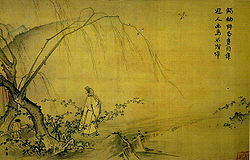
. The painted artwork of the gentry shifted dramatically in style from Northern to Southern Song, due to underlying political, demographic, and social circumstance. Northern Song gentry and officials, who were concerned largely with tackling issues of national interest and not much for local affairs, preferred painting huge landscape scenes where any individuals were but tiny figures immersed within a larger context. During the Southern Song, political, familial, and social concerns became heavily embedded with localized interests; these changes correlate with the chief style of Southern Song paintings, where small, intimate scenes with a primary focus on individuals was emphasized.
The wealthy families living on the estates of these scholar-officials – as well as rich merchants, princes, and nobles—often maintained a massive entourage of employed servants, technical staffs, and personal favorites. They hired personal artisans such as jewellers, sculptors, and embroiderers
Embroidery
Embroidery is the art or handicraft of decorating fabric or other materials with needle and thread or yarn. Embroidery may also incorporate other materials such as metal strips, pearls, beads, quills, and sequins....
, while servants cleaned house, shopped for goods, attended to kitchen duties, and prepared furnishings for banquets, weddings, and funerals. Rich families also hosted literary men such as secretaries, copyists, and hired tutors to educate their sons. They were also the patrons of musicians, painters, poets, chess players, and storytellers.
The historian Jacques Gernet stresses that these servants and favorites hosted by rich families represented the more fortunate members of the lower class. Other laborers and workers such as water-carriers, navvies
Navvy
Navvy is a shorter form of navigator or navigational engineer and is particularly applied to describe the manual labourers working on major civil engineering projects...
, peddlers, physiognomists
Physiognomy
Physiognomy is the assessment of a person's character or personality from their outer appearance, especially the face...
, and soothsayers "lived for the most part from hand to mouth." The entertainment business in the covered bazaars in the marketplace and at the entrances of bridges also provided a lowly means of occupation for storytellers, puppeteers, jugglers, acrobats, tightrope walkers
Tightrope walking
Tightrope walking is the art of walking along a thin wire or rope, usually at a great height. One or more artists performs in front of an audience or as a publicity stunt...
, exhibitors of wild animals, and old soldiers who flaunted their strength by lifting heavy beams, iron weights, and stones for show. These people found the best and most competitive work during annual festivals. In contrast, the rural poor consisted mostly of peasant farmers
Peasant
A peasant is an agricultural worker who generally tend to be poor and homeless-Etymology:The word is derived from 15th century French païsant meaning one from the pays, or countryside, ultimately from the Latin pagus, or outlying administrative district.- Position in society :Peasants typically...
. However, some in rural areas chose vocations centered chiefly around hunting, fishing, forestry, and state-offered occupations such as mining or working in the salt marsh
Salt marsh
A salt marsh is an environment in the upper coastal intertidal zone between land and salt water or brackish water, it is dominated by dense stands of halophytic plants such as herbs, grasses, or low shrubs. These plants are terrestrial in origin and are essential to the stability of the salt marsh...
es.
According to their Confucian ethics, elite and cultured scholar-officials viewed themselves as the pinnacle members of society (second only to the imperial family). Rural farmers were seen as the essential pillars that provided food for all of society; they were given more respect than the local or regional merchant, no matter how rich and powerful. The Confucian-taught scholar-official elite who ran China's vast bureaucracy viewed their society's growing interest in commercialism as a sign of moral decay. Nonetheless, Song Chinese urban society was teeming with wholesalers, shippers, storage keepers, brokers, traveling salesmen, retail shopkeepers, peddlers, and many other lowly commercial-based vocations.
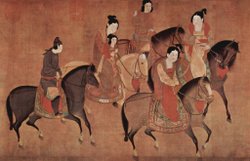
Guild
A guild is an association of craftsmen in a particular trade. The earliest types of guild were formed as confraternities of workers. They were organized in a manner something between a trade union, a cartel, and a secret society...
s; whenever the state requisitioned goods and assessed taxes it dealt with guild heads, who ensured fair prices and fair wages via official intermediaries. Yet joining a guild was an immediate means to neither empowerment nor independence; historian Jacques Gernet states: "[the guilds] were too numerous and too varied to allow their influence to be felt."
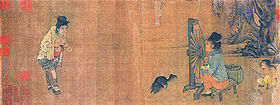
Artisan
An artisan is a skilled manual worker who makes items that may be functional or strictly decorative, including furniture, clothing, jewellery, household items, and tools...
s and craftsmen were essential workers in society on a tier just below the farming peasants, and different from the merchants and traders who were considered parasitic. It was craftsmen and artisans who fashioned and manufactured all of the goods needed in Song society, such as standard-sized waterwheels and chain pumps made by skilled wheelwright
Wheelwright
A wheelwright is a person who builds or repairs wheels. The word is the combination of "wheel" and the archaic word "wright", which comes from the Old English word "wryhta", meaning a worker or maker...
s. Although architects and carpenter builders were not as highly venerated as the scholar-officials, there were some architectural engineers and authors who gained wide acclaim at court and in the public sphere for their achievements. This included the official Li Jie (1065–1110), a scholar who was eventually promoted to high positions in government agencies of building and engineering. His written manual
Yingzao Fashi
The Yingzao Fashi is a technical treatise on architecture and craftsmanship written by the Chinese author Li Jie , the Directorate of Buildings and Construction during the mid Song Dynasty of China. A promising architect, he revised many older treatises on architecture from 1097 to 1100...
on building codes and procedures was sponsored by Emperor Huizong (r. 1100–1126) for these government agencies to employ and was widely printed for the benefit of literate craftsmen and artisans nationwide. The technical written work of the earlier 10th century architect Yu Hao
Yu Hao
Yu Hao was an eminent Chinese structural engineer and architect during the Song Dynasty period .-Legacy:Yu Hao was given the title of Master-Carpenter , for his architectural skill...
was also given a great amount of praise by the polymath
Polymath
A polymath is a person whose expertise spans a significant number of different subject areas. In less formal terms, a polymath may simply be someone who is very knowledgeable...
scholar-official Shen Kuo in his Dream Pool Essays
Dream Pool Essays
The Dream Pool Essays was an extensive book written by the polymath Chinese scientist and statesman Shen Kuo by 1088 AD, during the Song Dynasty of China...
of 1088.
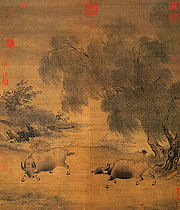
Jiedushi
The Jiedushi were regional military governors in China during the Tang Dynasty and the Five Dynasties and Ten Kingdoms Period. Originally set up to counter external threats, the jiedushi were given enormous power, including the ability to maintain their own armies, collect taxes, and pass their...
in the late Tang Dynasty and the Five Dynasties and Ten Kingdoms (907–960) period amassed more power than the civil officials, in some respects replacing them and the civilian government altogether. Song emperors expanded the civil service examination system and government school system in order to avoid the earlier scenario of domination by military strongmen over the civil order.
Government schools versus private academies

Emperor Ping of Han
Emperor Ping was an emperor of the Chinese Han Dynasty from 1 BC to AD 5. After Emperor Ai died childless, the throne was passed to his cousin Emperor Ping—then a child of nine years old. Wang Mang was appointed regent by the Grand Empress Dowager Wang...
(9 BC–5 AD). During the Northern Song Dynasty, the government gradually reestablished an official school system after it was heavily damaged during the preceding Five Dynasties period. Government-established schools soon eclipsed the role of private academies by the mid-11th century. At the apex of higher education in the school system were the central schools located in the capital city, the Guozijian
Guozijian
The Guozijian , or Kuo Tzu Chien, the School of the Sons of State, sometimes called the Imperial Academy, Imperial College, Imperial Central School, was the national central institute of learning in Chinese dynasties after the Sui. It was the highest institute of learning in China's traditional...
, the Taixue
Taixue
Taixue , or sometimes called the "Imperial Academy", "Imperial School" , "Imperial University" or "Imperial Central University", was the highest rank of educational establishment in Ancient China between the Han Dynasty and Sui Dynasty. It was replaced by the Guozijian...
, and several vocational schools. The first major reform effort to rebuild prefectural and county schools was initiated by Chancellor Fan Zhongyan
Fan Zhongyan
Fan Zhongyan , born in Wuxian , Suzhou , was a prominent politician and literary figure in Song dynasty China. He was also a strategist and educator...
(989–1052) in the 1040s. Before this time, the bulk of funds allotted for the establishment of prefectural and county schools was left up to private financing and minimal amount of government funding; Fan's reform effort started the trend of greater government financing, at least for prefectural schools. Major expansion of educational facilities was initiated by Emperor Huizong, who used funds originally allotted for disaster relief and food-price stabilizing to fund new prefectural and county schools and demoted officials who neglected to repair, rebuild, and maintain these government schools. The historian John W. Chaffe states that by the early 12th century the state school system had 1500000 acres (6,070.3 km²) of land that could provide for some 200,000 student residents living in dormitories. After the widespread destruction of schools during the Jurchen invasions from the 1120s to 1140s, Emperor Gaozong of Song
Emperor Gaozong of Song
Emperor Gaozong , born Zhao Gou, was the tenth emperor of the Song Dynasty of China, and the first emperor of the Southern Song. He reigned from 1127 to 1162. He fled south after the Jurchens overran Kaifeng in the Jingkang Incident, hence the beginning of the Southern Song dynasty 1127–1279...
(r. 1127–1162) issued an edict to restore prefectural schools in 1142 and county schools in 1148, although the county schools by and large were reconstructed by the efforts of local county officials' private fundraising.
Yuelu Academy
The Yuelu Academy is located on the east side of Yuelu Mountain in Changsha, the capital of Hunan province, China, on the west bank of the Xiang River....
, founded in 976 during the reign of Emperor Taizu
Emperor Taizu of Song
Emperor Tàizǔ , born Zhao Kuangyin , was the founder of the Song Dynasty of China, reigning from 960 to 976.-Ancestry and early life:...
(r. 960–976). The Chinese scientist and statesman Shen Kuo was once the head chancellor of the Hanlin Academy
Hanlin Academy
The Hanlin Academy was an academic and administrative institution founded in the eighth century Tang dynasty China by Emperor Xuanzong.Membership in the academy was confined to an elite group of scholars, who performed secretarial and literary tasks for the court. One of its main duties was to...
, established during the Tang Dynasty. The Neo-Confucian
Neo-Confucianism
Neo-Confucianism is an ethical and metaphysical Chinese philosophy influenced by Confucianism, that was primarily developed during the Song Dynasty and Ming Dynasty, but which can be traced back to Han Yu and Li Ao in the Tang Dynasty....
Donglin Academy
Donglin Academy
The Donglin Academy , also known as the Guishan Academy , was originally built in AD 1111 during the Northern Song dynasty at present-day Wuxi in China...
, established in 1111, was founded upon the staunch teaching that adulterant influences of other ideologies such as Buddhism
Buddhism
Buddhism is a religion and philosophy encompassing a variety of traditions, beliefs and practices, largely based on teachings attributed to Siddhartha Gautama, commonly known as the Buddha . The Buddha lived and taught in the northeastern Indian subcontinent some time between the 6th and 4th...
should not influence the teaching of their purely Confucian school. This belief hearkened back to the writings of the Tang Dynasty essayist, prose stylist, and poet Han Yu
Han Yu
Han Yu , born in Nanyang, Henan, China, was a precursor of Neo-Confucianism as well as an essayist and poet, during the Tang dynasty. The Indiana Companion calls him "comparable in stature to Dante, Shakespeare or Goethe" for his influence on the Chinese literary tradition . He stood for strong...
(768–824), who was certainly a critic of Buddhism and its influence upon Confucian values. Although the White Deer Grotto Academy
White Deer Grotto Academy
The White Deer Grotto Academy was located at the foot of Wulou Peak in Lushan, now in Jiujiang, Jiangxi province. It was one of the Four Great Academies of China.- History :...
of the Southern Tang
Southern Tang
Southern Tang was one of the Ten Kingdoms in south-central China created following the Tang Dynasty from 937-975. Southern Tang replaced the Wu Kingdom when Li Bian deposed the emperor Yang Pu....
(937–976) had fallen out of use during the early half of the Song, the Neo-Confucian philosopher Zhu Xi
Zhu Xi
Zhū Xī or Chu Hsi was a Song Dynasty Confucian scholar who became the leading figure of the School of Principle and the most influential rationalist Neo-Confucian in China...
(1130–1200) reinvigorated it.
Zhu Xi was one of many critics who argued that government schools did not sufficiently encourage personal cultivation of the self and molded students into officials who cared only for profit and salary. Not all social and political philosophers in the Song period blamed the examination system as the root of the problem (but merely as a method of recruitment and selection), emphasizing instead the gentry's failure to take responsibility in society as the cultural elite. Zhu Xi also laid emphasis on the Four Books, a series of Confucian classics that would become the official introduction of education for all Confucian students, yet were initially discarded by his contemporaries. After his death, his commentary on the Four Books found appeal amongst scholar-officials and in 1241 his writings were adopted as mandatory readings for examination candidates with the support of Emperor Lizong
Emperor Lizong of Song
Emperor Lizong 理宗 was the 14th emperor of the Song Dynasty of China, and the fifth emperor of the Southern Song. His personal name was Zhao Yun . He reigned from 1224 to 1264. His temple name means "Reasonable Ancestor"...
(r. 1224–1264).
Examinations and elite families
_001.jpg)
Imperial examination
The Imperial examination was an examination system in Imperial China designed to select the best administrative officials for the state's bureaucracy. This system had a huge influence on both society and culture in Imperial China and was directly responsible for the creation of a class of...
s far outmatched the actual number of jinshi, or "presented scholars" who were given official appointments in the Song Dynasty. Five times more jinshi were accepted in the Song period than during the Tang, yet the larger number of degree holders did not lower the prestige of the degree. Rather, it encouraged more to enter and compete in the exams, which were held every three years. Roughly 30,000 men took the prefectural exams in the early 11th century, increasing to nearly 80,000 around 1100, and finally to an astonishing 400,000 exam takers by the 13th century. With these odds, the chances of an applicant passing the examination and becoming a graduate was 1 in 333. Once a degree was obtained, however, this did not ensure an immediate path to office. The total number of scholar-officials in the Tang was about 18,000, while the total number in the Song had only increased to about 20,000. With China's growing population and an almost stagnant number of officials accepted into government, the degree holders who were not appointed to office fulfilled an important role on the grassroots level of society. They became the local elite of their communities, while scholar-officials relied upon them for maintaining order and fulfilling various duties under their jurisdiction.
An atmosphere of intellectual competition existed between aspiring Confucian scholars. Wealthy families were eager to gather stacks of published books for their personal libraries, collecting books that covered the Confucian classics as well as philosophical works, mathematical treatises, pharmaceutical documents, Buddhist sutra
Sutra
Sūtra is an aphorism or a collection of such aphorisms in the form of a manual. Literally it means a thread or line that holds things together and is derived from the verbal root siv-, meaning to sew , as does the medical term...
s, and other literature aimed at the gentry class. The advancement of widespread book manufacturing through woodblock printing
Woodblock printing
Woodblock printing is a technique for printing text, images or patterns used widely throughout East Asia and originating in China in antiquity as a method of printing on textiles and later paper....
and then movable type
Movable type
Movable type is the system of printing and typography that uses movable components to reproduce the elements of a document ....
printing
Printing
Printing is a process for reproducing text and image, typically with ink on paper using a printing press. It is often carried out as a large-scale industrial process, and is an essential part of publishing and transaction printing....
by the 11th century aided in the expansion of the number of educated candidates for the civil service exams. These developments also reduced the overall cost of books so that they became more accessible to those of lesser means.
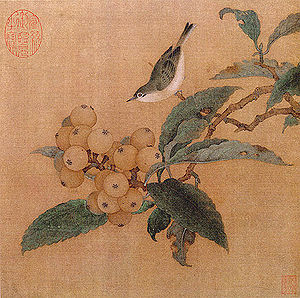
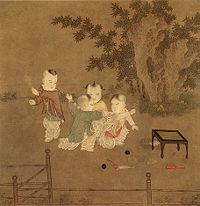
Ebrey states that meritocracy
Meritocracy
Meritocracy, in the first, most administrative sense, is a system of government or other administration wherein appointments and responsibilities are objectively assigned to individuals based upon their "merits", namely intelligence, credentials, and education, determined through evaluations or...
and a greater sense of social mobility
Social mobility
Social mobility refers to the movement of people in a population from one social class or economic level to another. It typically refers to vertical mobility -- movement of individuals or groups up from one socio-economic level to another, often by changing jobs or marrying; but can also refer to...
were also prevalent in the civil service examination system, as the government held a list of all examination graduates, showing that only roughly half of those who passed had a father, or grandfather, or great-grandfather who served as a government official. However, Robert Hartwell and Robert P. Hymes state that this fact, first presented by Edward A. Kracke in 1947 and supported by Sudō Yoshiyuki and Ho Ping-ti, emphasizes the role of the nuclear family
Nuclear family
Nuclear family is a term used to define a family group consisting of a father and mother and their children. This is in contrast to the smaller single-parent family, and to the larger extended family. Nuclear families typically center on a married couple, but not always; the nuclear family may have...
and only demonstrates three paternal ascendants of the candidates while ignoring the demographic reality of Song China, the significant proportion of males in each generation that had no surviving sons, and the role of the extended family
Extended family
The term extended family has several distinct meanings. In modern Western cultures dominated by nuclear family constructs, it has come to be used generically to refer to grandparents, uncles, aunts, and cousins, whether they live together within the same household or not. However, it may also refer...
. Male children with fathers who were incumbents in office had the advantage of early education and experience, as they were often appointed by their father to low-level staff positions. Yet with the so-called 'protection' (yin) privilege this arrangement was extended to close relatives, as an elder brother, uncle, father-in-law, and even father-in-law to one's uncle could help one secure a future in office. The Song era poet Su Shi
Su Shi
Su Shi , was a writer, poet, artist, calligrapher, pharmacologist, gastronome, and statesman of the Song Dynasty, and one of the major poets of the Song era. His courtesy name was Zizhan and his pseudonym was Dongpo Jushi , and he is often referred to as Su Dongpo...
(1037–1101) wrote a poem called On the Birth of My Son, poking fun at the situation of children from affluent and politically connected backgrounds having the upper edge over bright children of lower status:
 |
Families, when a child is born Want it to be intelligent. I, through intelligence Having wrecked my whole life, Only hope the baby will prove Ignorant and stupid. Then he will crown a tranquil life By becoming a Cabinet Minister. |
 |
Robert Hartwell notes that in the Northern Song Dynasty there were two types of elites who dominated the civil service: a founding elite and a professional elite. The founding elite consisted of the North China military governors
Jiedushi
The Jiedushi were regional military governors in China during the Tang Dynasty and the Five Dynasties and Ten Kingdoms Period. Originally set up to counter external threats, the jiedushi were given enormous power, including the ability to maintain their own armies, collect taxes, and pass their...
of the 10th century, their associates, personal staffs, and bureaucrats who had served in the capitals of the administrations of the previous Five Dynasties. The professional bureaucracy consisted of elite families who had established residence in Kaifeng or subordinate capitals, claimed prestigious clan ancestry, had intermarried with other prominent families, had members in higher offices over generations, and periodically dominated Song government until the 12th century. The prominent families of this professional elite accounted for 18 of the 11th century chancellors
Chancellor of China
The Chancellor , variously translated as Prime Minister, Chancellor of State, Premier or Chief Councillor, was a generic name given to the highest-ranking official in the imperial government in ancient China...
, the highest official post. From 960 to 986, the founding military elite from Shanxi
Shanxi
' is a province in Northern China. Its one-character abbreviation is "晋" , after the state of Jin that existed here during the Spring and Autumn Period....
, Shaanxi
Shaanxi
' is a province in the central part of Mainland China, and it includes portions of the Loess Plateau on the middle reaches of the Yellow River in addition to the Qinling Mountains across the southern part of this province...
, and Hebei
Hebei
' is a province of the People's Republic of China in the North China region. Its one-character abbreviation is "" , named after Ji Province, a Han Dynasty province that included what is now southern Hebei...
represented 46% of fiscal offices, people from districts in Songzhou—the military governorship of the founding emperor
Emperor Taizu of Song
Emperor Tàizǔ , born Zhao Kuangyin , was the founder of the Song Dynasty of China, reigning from 960 to 976.-Ancestry and early life:...
—represented 22% of fiscal offices, and those from Kaifeng and Luoyang
Luoyang
Luoyang is a prefecture-level city in western Henan province of Central China. It borders the provincial capital of Zhengzhou to the east, Pingdingshan to the southeast, Nanyang to the south, Sanmenxia to the west, Jiyuan to the north, and Jiaozuo to the northeast.Situated on the central plain of...
filled 13% of fiscal posts. In the same period, the founding elite and professional elite filled over 90% of policy-making positions. However, after 983, when the south had been conquered and consolidated into the empire, a semi-hereditary professional elite gradually replaced the founding elite. After 1086 not a single family of the founding elite had a member in either policy-making or financial positions. Between 998 and 1085, the 35 most important families of the professional elite represented only 5% of the families that had members in policy-making offices, yet they disproportionately held 23% of these positions. By the late 11th century the professional elite began to break apart as a distinguishable status group aiming for civil service. They were replaced by a multitude of local gentry lineages who had their children pursue a slew of different professions other than official careers. Hartwell states that this shift of power was the result of the professional elite's lineage strategies being undermined by the rise of factional partisan politics in the latter half of the 11th century.

Emperor Shenzong of Song
Emperor Shenzong of Song was the sixth emperor of the Chinese Song Dynasty. His personal name was Zhao Xu...
(r. 1068–1085) that the now heavily populated regions of South China began providing a quantity of officials in policy-making posts that were proportionate to their share of China's total population. From 1125 to 1205, about 80% of all those who held office in one of the six ministries of the central government had spent most of their low-grade official careers within the area of modern southern Anhui
Anhui
Anhui is a province in the People's Republic of China. Located in eastern China across the basins of the Yangtze River and the Huai River, it borders Jiangsu to the east, Zhejiang to the southeast, Jiangxi to the south, Hubei to the southwest, Henan to the northwest, and Shandong for a tiny...
, southern Jiangsu
Jiangsu
' is a province of the People's Republic of China, located along the east coast of the country. The name comes from jiang, short for the city of Jiangning , and su, for the city of Suzhou. The abbreviation for this province is "苏" , the second character of its name...
, Zhejiang, and Fujian provinces. Almost 100% of these officials were born and buried within this southeastern macroregion.
Administrative units
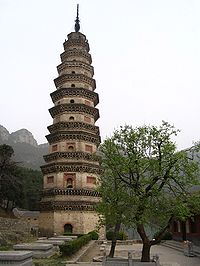
Prefecture (China)
The term Prefectures, or the more formal prefectural level divisions, in the context of China, is used to refer to several unrelated political divisions in both ancient and modern China. Other than provincial level divisions, prefectural level divisions are not mentioned in the Chinese constitution...
), which in turn were divided
History of the political divisions of China
The history of the administrative divisions of China is quite complex. Across history, what is called 'China' has taken many shapes, and many political organizations...
into the smallest political units of counties (xian); there were about 1,230 counties during the Song period. The prefect
Prefect
Prefect is a magisterial title of varying definition....
during the early Northern Song was the prime official of local government authority, who was the lowest regional official allowed to memorialize the throne
Petition
A petition is a request to do something, most commonly addressed to a government official or public entity. Petitions to a deity are a form of prayer....
, was primary tax collector, and head magistrate over several magistrates within his jurisdiction that dealt with civil disputes and maintaining order. By the late Northern Song, the growth in the number of counties with different proportions in population under a prefect's jurisdiction decreased the importance of the latter office, as it became more difficult for the prefect to manage the counties. This was part of a larger continuum of administrative trends from the Tang to Ming dynasties, with the gradual decline of importance of intermediate administrative units—the prefectures—alongside a shift of power from central government to large regional administrations; the latter experienced progressively less influence of central government in their routine affairs. In the Southern Song, four semi-autonomous regional command systems were established based on territorial and military units; this influenced the model of detached service secretariats which became the provincial administrations (sheng
Province (China)
A province, in the context of Chinese government, is a translation of sheng formally provincial level divisions, which is an administrative division. Provinces, municipalities, autonomous regions, and the special administrative regions, make up the four types of province of administrative division...
) of the Yuan
Yuan Dynasty
The Yuan Dynasty , or Great Yuan Empire was a ruling dynasty founded by the Mongol leader Kublai Khan, who ruled most of present-day China, all of modern Mongolia and its surrounding areas, lasting officially from 1271 to 1368. It is considered both as a division of the Mongol Empire and as an...
(1279–1368), Ming
Ming Dynasty
The Ming Dynasty, also Empire of the Great Ming, was the ruling dynasty of China from 1368 to 1644, following the collapse of the Mongol-led Yuan Dynasty. The Ming, "one of the greatest eras of orderly government and social stability in human history", was the last dynasty in China ruled by ethnic...
(1368–1644), and Qing
Qing Dynasty
The Qing Dynasty was the last dynasty of China, ruling from 1644 to 1912 with a brief, abortive restoration in 1917. It was preceded by the Ming Dynasty and followed by the Republic of China....
(1644–1912) dynasties. The administrative control of the Southern Song central government over the empire became increasingly limited to the circuits located in closer proximity to the capital at Hangzhou, while those farther away practiced greater autonomy.
Official careers
After the tumultuous An Lushan Rebellion (755–763), the early Tang career path of officials rising in a hierarchy of six ministriesThree Departments and Six Ministries
The Three Departments and Six Ministries system was the main central administrative system adopted in ancient China. The system first took shape after the Western Han Dynasty , was officially instituted in Sui Dynasty , and matured during Tang Dynasty...
—with Works given the lowest status and Personnel the highest—was changed into a system where officials chose specialized careers within one of the six ministries. The commissions of Salt and Iron, Funds, and Census that were created to deal with immediate financial crisis after An Lushan's insurrection were the influential basis for this change in career paths that became focused within functionally distinct hierarchies. The varied career backgrounds and expertise of early Northern Song officials meant that they were to be given specific assignment to work in only one of the ministries: Personnel, Revenue, Rites, War, Justice, or Works. As China's population increased and regional economies became more complex the central government could no longer handle the separate parts of the empire efficiently. As a result of this, in 1082 the reorganization of the central bureaucracy scrapped the hierarchies of commissions in favor of the early Tang model of officials advancing through a hierarchy of ministries, each with different levels of prestige.
Lower-grade officials on the county and prefectural levels performed the necessary duties of administration such as collecting taxes, overseeing criminal cases, implementing efforts to fight famine and natural calamity, and occasionally supervising market affairs or public works. Since the incredible growth of China's population far outmatched the total number of officials accepted as administrators in the Song government, educated gentry who had not been appointed to an official post were entrusted as supervisors of affairs in rural communities. It was the "upper gentry" of high-grade officials in the capital—comprising mostly those who passed the palace exams—who were in a position to influence and reform society.
Political partisanship and reform
Sinology
Sinology in general use is the study of China and things related to China, but, especially in the American academic context, refers more strictly to the study of classical language and literature, and the philological approach...
historian Jacques Gernet put it. The Chancellor Fan Zhongyan
Fan Zhongyan
Fan Zhongyan , born in Wuxian , Suzhou , was a prominent politician and literary figure in Song dynasty China. He was also a strategist and educator...
(989–1052) introduced a series of reforms
Qingli Reforms
The Qingli Reforms also called Minor Reforms, took place in China’s Song Dynasty under the leadership of Fan Zhongyan and Ouyang Xiu. Taking place from 1043 to 1045, it was a short-lived attempt to introduce reforms into the traditional way of conducting governmental affairs in China...
between 1043 and 1045 that received heated backlash from the conservative element at court. Fan set out to erase corruption from the recruitment system by providing higher salaries for minor officials, in order to persuade them not to become corrupt and take bribes. He also established sponsorship programs that would ensure officials were drafted on their merits, administrative skills, and moral character more than their etiquette
Etiquette
Etiquette is a code of behavior that delineates expectations for social behavior according to contemporary conventional norms within a society, social class, or group...
and cultured appearance. However, the conservatives at court did not want their career paths and comfortable positions jeopardized by new standards, so they rallied to successfully halt the reforms.
Inspired by Fan, the later Chancellor Wang Anshi
Wang Anshi
Wang Anshi was a Chinese economist, statesman, chancellor and poet of the Song Dynasty who attempted controversial, major socioeconomic reforms...
(1021–1086) implemented a series of reforms in 1069 upon his ascendance to office. Wang promulgated a community-based law enforcement and civil order known as the Baojia system
Baojia system
The baojia system was an invention of Wang Anshi of the Song Dynasty, who created this community-based system of law enforcement and civil control that was included in his large reform of Chinese government from 1069-1076.-Imperial China:...
. Wang Anshi attempted to diminish the importance of landholding and private wealth in favor of mutual-responsibility social groups that shared similar values and could be easily controlled by the government. Just as scholar-officials owed their social prestige to their government degrees, Wang wanted to structure all of society as a mass of dependents loyal to the central government. He used various means, including the prohibition of landlords offering loans to tenants; this role was assumed by the government. Wang established local militia
Militia
The term militia is commonly used today to refer to a military force composed of ordinary citizens to provide defense, emergency law enforcement, or paramilitary service, in times of emergency without being paid a regular salary or committed to a fixed term of service. It is a polyseme with...
s that could aid the official standing army and lessen the constrained state budget expenses for the military. He set up low-cost loans for the benefit of rural farmers, whom he viewed as the backbone of the Song economy. Since the land tax exacted from rural farmers filled the state treasury's coffers, Wang implemented a reform to update the land-survey system so that more accurate assessments could be gathered. Wang removed the mandatory poetry requirement in the civil service exams, on the grounds that many otherwise skilled and knowledgeable Confucian students were being denied entry into the administration. Wang also established government monopolies for tea, salt, and wine production. All of these programs received heavy criticism from conservative ministerial peers, who believed his reforms damaged local family wealth which provided the basis for the production of examination candidates, managers, merchants, landlords, and other essential members of society. Historian Paul J. Smith writes that Wang's reforms—the New Policies—represented the professional bureaucratic elite's final attempt to bring the thriving economy under state control to remedy the lack of state resources in combating powerful enemies to the north—the Liao
Liao Dynasty
The Liao Dynasty , also known as the Khitan Empire was an empire in East Asia that ruled over the regions of Manchuria, Mongolia, and parts of northern China proper between 9071125...
and Western Xia
Western Xia
The Western Xia Dynasty or the Tangut Empire, was known to the Tanguts and the Tibetans as Minyak.The state existed from 1038 to 1227 AD in what are now the northwestern Chinese provinces of Ningxia, Gansu, eastern Qinghai, northern Shaanxi, northeastern Xinjiang, southwest Inner Mongolia, and...
.

Tao
Dao or Tao is a Chinese word meaning 'way', 'path', 'route', or sometimes more loosely, 'doctrine' or 'principle'...
) embodied in the Five Classics was known by the ancient sages and was transmitted from one sage to another in an almost telepathic manner
Telepathy
Telepathy , is the induction of mental states from one mind to another. The term was coined in 1882 by the classical scholar Fredric W. H. Myers, a founder of the Society for Psychical Research, and has remained more popular than the more-correct expression thought-transference...
, but after it reached Mencius
Mencius
Mencius was a Chinese philosopher who was arguably the most famous Confucian after Confucius himself.-Life:Mencius, also known by his birth name Meng Ke or Ko, was born in the State of Zou, now forming the territory of the county-level city of Zoucheng , Shandong province, only thirty kilometres ...
(c. 372–c. 289 BC) there was no one worthy of accepting the transference of the dao. Some believed that the long dormant dao could be revived if one were truly a sage; Lo writes of Song Neo-Confucianists, "it is this self-image which explained their militant stand in relation to conventional ethics and scholarship." Wang defined his life mission as restoring the unity of dao, as he believed it had not departed from the world but had become fragmented by schools of Confucian thought, each one propagating only half-truths. Lo asserts that Wang, believing that he was in possession of the dao, followed Yi Zhi
Yi Zhi
Yi Yin , also known as A Heng ), was a minister of the early Shang Dynasty. He was one of the most honoured officials of the early Shang Dynasty. He helped Tang of Shang, the founder of the Shang dynasty, to defeat King Jie of Xia. Oracle inscriptions of Yi have been found, evidence that his social...
and the Duke of Zhou
Duke of Zhou
The Duke of Zhou played a major role in consolidating the newly-founded Zhou Dynasty . He was the brother of King Wu of Zhou, the first king of the ancient Chinese Zhou Dynasty...
's classic examples in resisting the wishes of selfish or foolish men by ignoring criticism and public opinion. If unflinching certitude in his sagehood and faultless reforms was not enough, Wang sought potential allies and formed a coalition that became known as the New Policies Group, which in turn emboldened his known political rivals to band together in opposition to him. Yet factional power struggles were not steeped in ideological discourse alone; cliques had formed naturally with shifting alliances of professional elite lineages and efforts to obtain a greater share of available offices for one's immediate and extended kinship over vying competitors. People such as Su Shi also opposed Wang's faction on practical grounds; for example, Su's critical poem hinting that Wang's salt monopoly hindered effective salt distribution.
Wang resigned in 1076 and his leaderless faction faced uncertainty with the death of its patron emperor in 1085. The political faction led by the historian and official Sima Guang
Sima Guang
Sīmǎ Guāng was a Chinese historian, scholar, and high chancellor of the Song Dynasty, jinshi 1038.-Life, profession, and works:...
(1019–1086) then took control of the central government, allied with the dowager empress
Empress Dowager
Empress Dowager was the title given to the mother of a Chinese, Korean, Japanese or Vietnamese emperor.The title was also given occasionally to another woman of the same generation, while a woman from the previous generation was sometimes given the title of Grand empress dowager. Numerous empress...
who acted as regent
Regent
A regent, from the Latin regens "one who reigns", is a person selected to act as head of state because the ruler is a minor, not present, or debilitated. Currently there are only two ruling Regencies in the world, sovereign Liechtenstein and the Malaysian constitutive state of Terengganu...
over the young Emperor Zhezong of Song
Emperor Zhezong of Song
Emperor Zhezong was the seventh emperor of the Song Dynasty of China. His personal name was Zhao4 Xu1. He reigned from 1085 to 1100....
(r. 1085–1100). Wang's new policies were completely reversed, including popular reforms like the tax substitution for corvée
Corvée
Corvée is unfree labour, often unpaid, that is required of people of lower social standing and imposed on them by the state or a superior . The corvée was the earliest and most widespread form of taxation, which can be traced back to the beginning of civilization...
labor service. When Emperor Zhezong came of age and replaced his grandmother as the state power, he favored Wang's policies and once again instituted the reforms in 1093. The reform party was favored during the reign of Huizong (r. 1100–1125) while conservatives were persecuted—especially during the chancellery of Cai Jing
Cai Jing
Cai Jing , style name Yuanchang , was a government official and calligrapher who lived during the Northern Song Dynasty. Cai Jing is also featured as one of the antagonists and nemesis of the 108 Liangshan heroes in the Water Margin, one of the Four Great Classical Novels of Chinese...
(1047–1126). As each political faction gained advantage over the other, ministers of the opposing side were labeled "obstructionist" and were sent out of the capital to govern remote frontier regions of the empire. This form of political exile was not only politically damaging, but could also be physically threatening. Those who fell from favor could be sent to govern areas of the deep south where the deadly disease malaria
Malaria
Malaria is a mosquito-borne infectious disease of humans and other animals caused by eukaryotic protists of the genus Plasmodium. The disease results from the multiplication of Plasmodium parasites within red blood cells, causing symptoms that typically include fever and headache, in severe cases...
was prevalent.
Familial rights, laws and customs
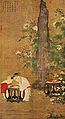
Chinese philosophy
Chinese philosophy is philosophy written in the Chinese tradition of thought. The majority of traditional Chinese philosophy originates in the Spring and Autumn and Warring States era, during a period known as the "Hundred Schools of Thought", which was characterized by significant intellectual and...
of Confucius
Confucius
Confucius , literally "Master Kong", was a Chinese thinker and social philosopher of the Spring and Autumn Period....
(551–479 BC) and the hierarchical social order
Four occupations
The four occupations or "four categories of the people" was a hierarchic social class structure developed in ancient China by either Confucian or Legalist scholars as far back as the late Zhou Dynasty and is considered a central part of the Fengjian social structure...
his disciples adhered to had become embedded into mainstream Chinese culture since the reign of Emperor Wu of Han
Emperor Wu of Han
Emperor Wu of Han , , personal name Liu Che , was the seventh emperor of the Han Dynasty of China, ruling from 141 BC to 87 BC. Emperor Wu is best remembered for the vast territorial expansion that occurred under his reign, as well as the strong and centralized Confucian state he organized...
(r. 141–87 BC). During the Song Dynasty, the whole of Chinese society was theoretically modelled upon this familial social order of superiors and inferiors. Confucian dogma dictated what was proper moral behavior, and how a superior should regulate rewards or punishments when dealing with an inferior member of society or one's family. This is exemplified in the Tang Dynasty law code, which was largely retained in the Song period. Gernet writes: "The family relationships supposed to exist in the ideal family were the foundation of the entire moral outlook, and even the law, in its total structure and its scale of penalties, was nothing but a codified expression of them."
Under the Tang law code
Tang Code
The Tang Code was a penal code that was established and used during the Tang Dynasty in China. Supplemented by civil statutes and regulations, it became the basis for later dynastic codes not only in China but elsewhere in East Asia. The Code synthesised Legalist and Confucian interpretations of...
compiled in the 7th century, severe punishments were outlined for those who disobeyed or disrespected the hierarchical system of elders. Those who assaulted their parents could be put to death, those who assaulted an older sibling could be put to forced labor, and those who assaulted an older cousin could be sentenced to caning. A household servant who killed his master could be sentenced to death, while a master who killed his servant would be arrested and forced into a year of hard labor for the state. Yet this reverence for elders and superiors was grounded in more than just secular Confucian discourse; Chinese beliefs of ancestor worship transformed the identity of one's parents into abstract, otherworldly figures. Song society was also built on social relationships governed not by abstract principles, but on the protection gained by devoting oneself to a superior.
Perpetuating the religious family cult with many descendants was coupled with the notion that producing more children offered the family a layer of protection, reinforcing its power in the community. More children meant better odds of extending a family's power through marriage alliance with other prominent families, as well as better odds of having a child occupying a prestigious administrative post in government. Hymes notes that "elite families used such standards as official standing or wealth, prospects for office, length of pedigree, scholarly renown, and local reputation in choosing both sons-in-law and daughters-in-law." Since official promotion was considered by examination degree as well as recommendation to office by a superior, a family that acquired a significant amount of sons-in-law of high rank in the bureaucracy ensured kinship protection and prestigious career options for its members. Those who came from noteworthy families were treated with dignity, and a wider family influence meant a better chance for an individual to secure his own fortunes. No one was better prepared for society than one who gained plenty of experience in dealing with the members of his extended family, as it was common for upper class families to have several generations living in the same household. However, one did not even have to share the same bloodline with others in order to build more social ties in their community. This could be done by accepting any number of artificial blood brother
Blood brother
Blood brother can refer to one of two things: two males related by birth, or two or more men not related by birth who have sworn loyalty to each other. This is usually done in a ceremony, known as a blood oath, where the blood of each man is mingled together...
s in a ceremony assuring mutual obligations and shared loyalty.
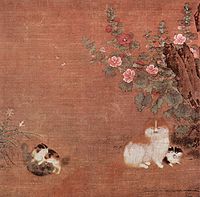
Primogeniture
Primogeniture is the right, by law or custom, of the firstborn to inherit the entire estate, to the exclusion of younger siblings . Historically, the term implied male primogeniture, to the exclusion of females...
was not practiced in Chinese inheritance of property, and in fact was illegal. When the head of a family died, his offspring equally divided the property. This law was implemented in the Tang Dynasty in order to challenge the powerful aristocratic clans of the northwest, and to prevent the rise of a society domineered by landed nobility. If an official family did not produce another official within a few generations, the future prospects of that family remaining wealthy and influential became uncertain. Thus, the legal issues of familial inheritance had profound effects upon the rest of society.
When a member of the family died there were varying degrees of prostration and display of piety amongst family members, each one behaving differently according to the custom of kinship association with the deceased. There was to be no flashy or colorful attire while in the period of mourning, and proper funerary rituals were observed such as cleansing and clothing the deceased to rid him or her of impurities. This was one of the necessary steps in the observance of the deceased as one of the worshipped ancestors, which in turn raised the prestige of the family. Funerals were often expensive. A geomancer had to be consulted on where to bury the dead, caterers were hired to furnish the funeral banquet, and there was always the purchase of the coffin, which was burned along with paper images of horses, carriages, and servants in order for them to accompany the deceased into the next life. Due to the high cost of burial, most families opted for the cheaper practice of cremation. This was frowned upon by Confucian officials due to beliefs in the ancestral cult. They sought to ban the practice with prohibitions in 963 and 972; despite this, cremation amongst the poor and middle classes persisted. By the 12th century, the government came up with the solution of installing public cemeteries where a family's deceased could be buried on state owned property.
Women: legality and lifestyles
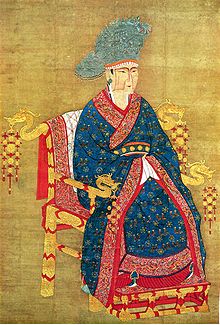
Foot binding
Foot binding was the custom of binding the feet of young girls painfully tight to prevent further growth. The practice probably originated among court dancers in the early Song dynasty, but spread to upper class families and eventually became common among all classes. The tiny narrow feet were...
as a new trend in the Southern Song period certainly reinforces this notion. However, the greater number of documents due to more widespread printing reveal a much more complex and rich reality about family life and Song women. Through written stories, legal cases, and other documents, many different sources show that Song women held considerable clout in family decision-making, and some were quite economically savvy. Men dominated the public sphere, while affluent wives spent most of their time indoors enjoying leisure activities and managing the household. However, women of the lower and middle classes were not solely bound to the domestic sphere. It was common for women to manage town inns, some to manage restaurants, farmers' daughters to weave mats and sell them on their own behalf, midwives to deliver babies, Buddhist nuns to study religious texts and sutras, female nurses to assist physicians, and women to keep a close eye on their own financial affairs. In the case of the latter, legal case documents describe childless widows who accused their nephews of stealing their property. There are also numerous mentions of women drawing upon their dowries to help their husband's sisters marry into other prominent families.
The economic prosperity of the Song period prompted many families to provide their daughters with larger dowries
Dowry
A dowry is the money, goods, or estate that a woman brings forth to the marriage. It contrasts with bride price, which is paid to the bride's parents, and dower, which is property settled on the bride herself by the groom at the time of marriage. The same culture may simultaneously practice both...
in order to attract the wealthiest sons-in-law to provide a stable life of economic security for their daughters. With large amounts of property allotted to a daughter's dowry, her family naturally sought benefits; as a result women's legal claims to property were greatly improved. Daughters and sons had equal opportunity to inherit property. Under the Song law code, if an heirless man left no clear successor to his property and household, it was his widowed wife's right to designate her own heir in a process called liji ("adopting an heir"). If an heir was appointed by the parents' relatives after their deaths, the "appointed" heir did not have the same rights as a biological son to inherit the estate; instead he shared juehu ("extinct household") property with the parents' daughter(s), if there were any.
Divorcing a spouse was permissible if there was mutual consent between husband and wife, while remarriage after the death of a spouse was common during the Song period. However, widows under post-Song dynasties did not often remarry, following the ethic of the Confucian philosopher Cheng Yi
Cheng Yi (philosopher)
Cheng Yi , courtesy name Zhengshu , also known as Mr. Yichuan , was a Chinese philosopher born in Luoyang during the Song Dynasty. He worked with his older brother Cheng Hao . Like his brother, he was a student of Zhou Dunyi, a friend of Shao Yong, and a nephew of Zhang Zai...
(1033–1107), who stated that it was better for a widow to die than lose her virtue by remarrying. Widows remarrying another after the death of a first spouse did not become common again until the late Qing Dynasty
Qing Dynasty
The Qing Dynasty was the last dynasty of China, ruling from 1644 to 1912 with a brief, abortive restoration in 1917. It was preceded by the Ming Dynasty and followed by the Republic of China....
(1644–1912), yet such an action was still regarded as morally inferior.

Mulberry
Morus is a genus of flowering plants in the family Moraceae. The 10–16 species of deciduous trees it contains are commonly known as Mulberries....
tree leaves, and keeping them warm to ensure that they would eventually spin their cocoons. In the family pecking order, the dominant female of the household was the mother-in-law, who was free to hand out orders and privileges to the wives of her sons. Mothers often had strong ties with their grown and married sons, since these men often stayed at home. If a mother-in-law could not find sufficient domestic help from the daughters-in-law, there was a market for women to be bought as maids or servants. There were also many professional courtesan
Courtesan
A courtesan was originally a female courtier, which means a person who attends the court of a monarch or other powerful person.In feudal society, the court was the centre of government as well as the residence of the monarch, and social and political life were often completely mixed together...
s (and concubines brought into the house) who kept men busy in the pursuits of entertainment, relations, and romantic affairs. It was also common for wives to be jealous and conniving towards concubines that their wealthy husbands brought home. Yet two could play at this game. The ideal of the chaste, modest, and pious young woman was somewhat distorted in urban settings such as Hangzhou and Suzhou
Suzhou
Suzhou , previously transliterated as Su-chou, Suchow, and Soochow, is a major city located in the southeast of Jiangsu Province in Eastern China, located adjacent to Shanghai Municipality. The city is situated on the lower reaches of the Yangtze River and on the shores of Taihu Lake and is a part...
, where there were greedy and flirtatious women, as one author put it. This author stated that the husbands of these women could not satisfy them, and so took on as many as five 'complementary husbands'; if they lived close to a monastery, even Buddhist monks could suffice for additional lovers.

Military strategy
Military strategy is a set of ideas implemented by military organizations to pursue desired strategic goals. Derived from the Greek strategos, strategy when it appeared in use during the 18th century, was seen in its narrow sense as the "art of the general", 'the art of arrangement' of troops...
that she had learned from her elder brother. Hu Wenrou, a granddaughter of a famous Song official Hu Su, was regarded by Shen Kuo as a remarkable female mathematician, as Shen would occasionally relay questions to Hu Wenrou through her husband in order for her to review and investigate possible errors in his mathematical work. Li Qingzhao
Li Qingzhao
Li Qingzhao was a Chinese writer and poet of the Song Dynasty, regarded by many as the premier female poet in the Chinese language.-Biography:She was born Li Qingzhao (Traditional Chinese: 李清照; Simplified Chinese: 李清照, pinyin: Lǐ Qīngzhào; Wade-Giles: Li Ch'ing-chao, pseudonym Yi'an Jushi (易安居士...
(1084–1151), whose father was a friend of Su Shi, wrote many poems throughout her often turbulent life (only about 100 of these survive) and became a renowned poet during her lifetime. After the death of her husband, she wrote poems profusely about poring over his paintings, calligraphy, and ancient bronze vessels, as well as poems with deep emotional longing:
| |
Lovely in my inner chamber. My tender heart, a wisp; My sorrow tangled in a thousand skeins. I'm fond of spring, but spring is gone, And rain urges the petals to fall. I lean on the balustrade; Only loose ends left, and no feeling. Where is he? Withered grasses stretch to the heavens; I can't make out the path that leads him home to me. |
|
Religion and philosophy
Ancient Chinese DaoismTaoism
Taoism refers to a philosophical or religious tradition in which the basic concept is to establish harmony with the Tao , which is the mechanism of everything that exists...
, ancestor worship, and foreign-originated Buddhism
Buddhism
Buddhism is a religion and philosophy encompassing a variety of traditions, beliefs and practices, largely based on teachings attributed to Siddhartha Gautama, commonly known as the Buddha . The Buddha lived and taught in the northeastern Indian subcontinent some time between the 6th and 4th...
were the most prominent religious practices in the Song period. Daoism developed largely from the teachings of the Daodejing
Tao Te Ching
The Tao Te Ching, Dao De Jing, or Daodejing , also simply referred to as the Laozi, whose authorship has been attributed to Laozi, is a Chinese classic text...
, attributed to the 6th century BC philosopher Laozi
Laozi
Laozi was a mystic philosopher of ancient China, best known as the author of the Tao Te Ching . His association with the Tao Te Ching has led him to be traditionally considered the founder of Taoism...
("Old Master"), considered one of the Three Pure Ones
Three Pure Ones
The Three Pure Ones also translated as the Three Pure Pellucid Ones, the Three Pristine Ones, the Three Divine Teachers, the Three Clarities, or the Three Purities is the Taoist Trinity, the three highest Gods in the Taoist pantheon. They are regarded as pure manifestation of the Tao and the...
(the prime deities of Daoism). Buddhism in China, introduced by Yuezhi
Yuezhi
The Yuezhi, or Rouzhi , also known as the Da Yuezhi or Da Rouzhi , were an ancient Central Asian people....
, Persian
An Shih Kao
An Shigao was a prince of Parthia, nicknamed the "Parthian Marquis", who renounced his claim to the royal throne of Parthia in order to serve as a Buddhist missionary monk in China.The prefix An in An Shigao's name is an abbreviation of Anxi, the Chinese name given to the regions ruled by the...
, and Kushan missionaries in the first and second centuries, gradually became more native in character and was transformed into distinct Chinese Buddhism.
Many followed the teachings of Buddha and prominent monks such as Dahui Zonggao
Dahui Zonggao
Dahui Zonggao was a 12th century Chinese Chan master best known as a keen advocate of the use of koans to achieve enlightenment...
(1089–1163) and Wuzhun Shifan
Wuzhun Shifan
Wuzhun Shifan was a Chinese painter, calligrapher, and prominent Zen Buddhist monk who lived during the late Song Dynasty .-Life:Wuzhun Shifan was born in Zitong, Sichuan province, China. He eventually became a renowned Buddhist abbot at the Temple of Mount Jingshan. He was once summoned by...
(1178–1249). However, there were also many critics of Buddhism's religious and philosophical tenets. This included the ardent nativist, scholar, and statesman Ouyang Xiu, who called Buddhism a "curse" upon China, an alien tradition that infiltrated the native beliefs of his country while at its weakest during the Southern and Northern Dynasties
Southern and Northern Dynasties
The Southern and Northern Dynasties was a period in the history of China that lasted from 420 to 589 AD. Though an age of civil war and political chaos, it was also a time of flourishing arts and culture, advancement in technology, and the spreading of Mahayana Buddhism and Daoism...
(420–581). The contention over Buddhism was at times a divisive issue within the gentry class and even within families. For example, the historian Zeng Gong lamented over the success of Buddhism, viewing it as a competing ideology with 'the Way of the Sages' of Confucianism, yet on his death in 1083 was buried in a Buddhist temple that his grandfather had helped build and that his brother Zeng Bu was able to declare as a private Merit Cloister
Cloister
A cloister is a rectangular open space surrounded by covered walks or open galleries, with open arcades on the inner side, running along the walls of buildings and forming a quadrangle or garth...
for the family. Although conservative proponents of native Confucianism were highly skeptical of the teachings of Buddhism and often sought to distance themselves from it, others used Buddhist teachings to bolster their own Confucian philosophy. The Neo-Confucian philosophers and brothers Cheng Hao and Cheng Yi of the 11th century sought philosophical explanations for the workings of principle (li) and vital energy (qi
Qi
In traditional Chinese culture, qì is an active principle forming part of any living thing. Qi is frequently translated as life energy, lifeforce, or energy flow. Qi is the central underlying principle in traditional Chinese medicine and martial arts...
) in nature, responding to the notions of highly complex metaphysics in popular Buddhist thought. Neo-Confucian scholars also sought to borrow the Mahayana
Mahayana
Mahāyāna is one of the two main existing branches of Buddhism and a term for classification of Buddhist philosophies and practice...
Buddhist ideal of self-sacrifice, welfare, and charity embodied in the bodhisattva
Bodhisattva
In Buddhism, a bodhisattva is either an enlightened existence or an enlightenment-being or, given the variant Sanskrit spelling satva rather than sattva, "heroic-minded one for enlightenment ." The Pali term has sometimes been translated as "wisdom-being," although in modern publications, and...
. Seeking to replace the Buddhist monastery's once prominent role in societal welfare and charity, supporters of Neo-Confucianism converted this ideal into practical measures of state-sponsored support for the poor under a secular mission of ethical universalism
Universalism
Universalism in its primary meaning refers to religious, theological, and philosophical concepts with universal application or applicability...
.
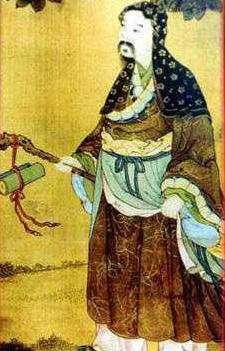
Four Buddhist Persecutions in China
The Four Buddhist Persecutions in China was the wholesale suppression of Buddhism carried out on four occasions from the fifth through the tenth century by four Chinese emperors.-First and Second:...
from the 5th through the 10th centuries, although Daoism continued to thrive in Song China. In northern China under the Jin Dynasty after 1127, the Daoist philosopher Wang Chongyang
Wang Chongyang
Wang Chongyang [Chinese calendar: 宋徽宗政和二年十二月廿二 – 金世宗大定十年正月初四] was a Chinese Taoist and one of the founders of the Quanzhen School in the twelfth century during the Song Dynasty. He was one of the Five Northern Patriarchs of Quanzhen...
(1113–1170) established the Quanzhen School
Quanzhen School
The Quanzhen School of Taoism originated in Northern China. It was founded by the Taoist Wang Chongyang in the 12th century, during the rise of the Jin Dynasty...
. Wang's seven disciples, known as the Seven Immortals, gained great fame throughout China. They included the prominent Daoist priestess Sun Bu'er
Sun Bu'er
Sun Bu'er , one of the Taoist Seven Masters of Quanzhen lived c. 1119–1182 C.E. in the Shandong province of China. She was a beautiful, intelligent, wealthy woman, married with three children. Her family name was Sun and her first name was Fuchun, Bu'er being her name in religion. Her husband Ma Yu...
(c. 1119–1182), who became a female role model in Daoism. There was also Qiu Chuji
Qiu Chuji
Qiu Chuji was a Daoist disciple of Wang Chongyang. He was the most famous among the Seven True Daoists of the North...
(1148–1227), who founded his own Quanzhen Daoist branch known as Longmen ("Dragon Gate"). In the Southern Song, cult centers of Daoism became popular at mountain sites that were reputed to be the earthly sojourns of Daoist deities; elite families had shrines erected in these mountain retreats in honor of the local deity thought to reside therein. Much more so than for Buddhist clergy, Daoist priests and holy men were sought when one prayed for having a son, when one was physically ill, or when there was need for change after a long spell of bad weather and poor harvest.
Chinese folk religion
Chinese folk religion
Chinese folk religion or Shenism , which is a term of considerable debate, are labels used to describe the collection of ethnic religious traditions which have been a main belief system in China and among Han Chinese ethnic groups for most of the civilization's history until today...
continued as a tradition in China, drawing upon aspects of both ancient Chinese mythology
Chinese mythology
Chinese mythology is a collection of cultural history, folktales, and religions that have been passed down in oral or written tradition. These include creation myths and legends and myths concerning the founding of Chinese culture and the Chinese state...
and ancestor worship. Many people believed that spirits and deities of the spirit realm regularly interacted with the realm of the living. This subject was popular in Song literature. Hong Mai (1123–1202), a prominent member of an official family from Jiangxi
Jiangxi
' is a southern province in the People's Republic of China. Spanning from the banks of the Yangtze River in the north into hillier areas in the south, it shares a border with Anhui to the north, Zhejiang to the northeast, Fujian to the east, Guangdong to the south, Hunan to the west, and Hubei to...
, wrote a popular book called The Record of the Listener, which had many anecdotes dealing with the spirit realm and people's supposed interactions with it. People in Song China believed that many of their daily misfortunes and blessings were caused by an array of different deities and spirits who interfered with their daily lives. These deities included the nationally accepted deities of Buddhism and Daoism, as well as the local deities and demons from specific geographic locations. If one displeased a long-dead relative, the dissatisfied ancestor would allegedly inflict natural ailments and illnesses. People also believed in mischievous demons and malevolent spirits who had the capability to extort sacrificial offerings meant for ancestors – in essence these were bullies of the spiritual realm. The Chinese believed that spirits and deities had the same emotions and drives as the living did. In some cases the chief deity of a local town or city was believed to act as a municipal official who could receive and dispatch orders on how to punish or reward spirits. Residents of cities offered many sacrifices to their divinities in hopes that their city would be spared from disasters such as fire. However, not only common people felt the need to appease local deities. Magistrates and officials sent from the capital to various places of the empire often had to ensure the locals that his authority was supported by the local deity.
Justice and law
Gernet points out that disputes requiring arrest were mostly avoided or settled privately. Yet historian Patricia Ebrey states that legal cases in the Song period portrayed the courts as being overwhelmed with cases of neighbors and relatives suing each other over property rights. The Song Dynasty author and official Yuan Cai
Yuan Cai
Yuan Cai was a Song dynasty scholar and official, best known for penning the Yuan shi shi fan, a manual of advice addressed to family heads on the subject of how to handle their responsibilities....
(1140–1190) repeatedly warned against this, and like other officials of his time also cautioned his readers about the rise of banditry in Southern Song society and a need to physically protect self and property.
Vengeance and vigilantism
Chancellor Wang Anshi, also a renowned prose stylist, wrote a work on matters of state justice in the 11th century. Wang wrote that private interests, especially of those seeking vigilanteVigilante
A vigilante is a private individual who legally or illegally punishes an alleged lawbreaker, or participates in a group which metes out extralegal punishment to an alleged lawbreaker....
justice, should in almost all circumstances never trump or interfere with public justice. In the ancient Classic of Rites
Classic of Rites
The Classic of Rites , also known as the Book of Rites, Book of Customs, the Record of Rites, was one of the Chinese Five Classics of the Confucian canon. It described the social forms, governmental system, and ancient/ceremonial rites of the Zhou Dynasty...
, Rites of Zhou
Rites of Zhou
The Rites of Zhou , also known as Zhouguan, is one of three ancient ritual texts listed among the classics of Confucianism. It was later renamed Zhouli by Liu Xin to differentiate it from a chapter in the Classic of History which was also known as Zhouguan.Though tradition ascribed the text of the...
, and "Gongyang" commentary of the Spring and Autumn Annals
Spring and Autumn Annals
The Spring and Autumn Annals is the official chronicle of the State of Lu covering the period from 722 BCE to 481 BCE. It is the earliest surviving Chinese historical text to be arranged on annalistic principles. The text is extremely concise and, if all the commentaries are excluded, about 16,000...
, seeking vengeance for a violent crime against one's family is viewed as a moral and filial obligation, although in the Rites of Zhou state intervention between the instigating and avenging parties was emphasized. Wang believed that the state of Song China was far more stable than those in ancient times and abler to dispense fair justice. Although Wang praised the classic avenger Wu Zixu
Wu Zixu
Wu Yun , better known by his style name Zixu , is the most famous ancestor of people with the surname of Wu . All branches of the Wu clans claim him as their "first ancestor"...
(526–484 BC), Michael Dalby writes that Wang "would have been filled with horror if Wu's deeds, so outdated in their political implications, had been repeated in Song times." For Wang, a victim exacting personal revenge against one who committed an egregious criminal act should only be considered acceptable when the government and its legal system became dysfunctional, chaotic, or ceased to exist. In his view, the hallmark of a properly functioning government was one where an innocent man was never executed. If this were to occur, his or her grieving relatives, friends, and associates should voice complaints to officials of ever increasing hierarchic status until grievances were properly addressed. If such a case reached the emperor
Emperor of China
The Emperor of China refers to any sovereign of Imperial China reigning between the founding of Qin Dynasty of China, united by the King of Qin in 221 BCE, and the fall of Yuan Shikai's Empire of China in 1916. When referred to as the Son of Heaven , a title that predates the Qin unification, the...
—the last and final judge—and he decided that previous officials who heard the case had erred in their decisions, he would accordingly punish those officials and the original guilty party. If even the emperor for some reason made a fault in pardoning a party which was truly guilty, then Wang reasoned that the only explanation for a lack of justice was the will of heaven
Tian
Tian is one of the oldest Chinese terms for the cosmos and a key concept in Chinese mythology, philosophy, and religion. During the Shang Dynasty the Chinese called god Shangdi or Di , and during the Zhou Dynasty Tian "heaven; god" became synonymous with Shangdi...
and its judgment which was beyond the control of mortal men. Wang insisted that submitting to the will of heaven in this regard was the right thing to do, while a murdered father or mother could still be honored through ritual sacrifices.
Court cases
Many Song court cases serve as examples for the promotion of morality in society. Using his knowledge and understanding of townsmen and farmers, one Song Dynasty judge made this ruling in the case of two brawling fishermen, who were labeled as Pan 52 and Li 7 by the court:Competition in Selling Fish Resulted in Assaults
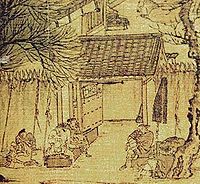
A proclamation: In the markets of the city the profits from commerce are monopolized by itinerant loiterers, while the little people from the rural villages are not allowed to sell their wares. There is not a single necessity of our clothing or food that is not the product of the fields of these old rustics. The men plow and the women weave. Their toil is extremely wearisome, yet what they gain from it is negligible, while manifold interest returns to these lazy idlers. This sort, in tens and hundreds, come together to form gangs. When the villagers come to sell things in the market place, before the goods have even left their hands, this crowd of idlers arrives and attacks them, assaulting them as a group. These idlers call this "the boxing of the community family." They are not at all afraid to act outrageously. I have myself seen that it is like this. Have they not given thought to the foodstuffs they require and the clothing they wear? Is it produced by these people of the marketplaces? Or is it produced by the rural farmers? When they recognize that these goods are produced by the farming people or the rural villages, how can they look at them in anger? How can they bully and insult them? Now, Pan Fifty-two and Li Seven are both fishmongers, but Pan lives in the city and fishmongering is his source of livelihood. Li Seven is a farmer, who does fishmongering between busy times. Pan Fifty-two at the end of the year has his profit, without having had the labor of raising the fish, but simply earning it from the selling of the fish. He hated Li and fought with him at the fish market. His lack of humanity is extreme! Li Seven is a village rustic. How could he fight with the itinerant armed loiterers who hang around the marketplace? Although no injuries resulted from the fight, we still must mete out some slight punishments. Pan Fifty-two is to be beaten fifteen blows with the heavy rod. In addition, Li Seven, although he is a village farmer, was still verbally abusive while the two men were stubbornly arguing. He clearly is not a man of simple and pure character. He must have done something to provoke this dispute. Li Seven is to be given a suspended sentence of a beating of ten blows, to be carried out if hereafter there are further violations.
Early forensic science
_001.jpg)
Inquest
Inquests in England and Wales are held into sudden and unexplained deaths and also into the circumstances of discovery of a certain class of valuable artefacts known as "treasure trove"...
, to be signed by witnesses and used in court. The documents of this inquest also included sketches of human bodies with details of where and what injuries were inflicted.
Song Ci
Song Ci
Song Ci was a forensic medical expert active during the Southern Song Dynasty who wrote a groundbreaking book titled Collected Cases of Injustice Rectified ....
(1186–1249) was a Chinese physician and judge during the Southern Song Dynasty. His famous work Collected Cases of Injustice Rectified
Collected Cases of Injustice Rectified
Collected Cases of Injustice Rectified or Washing away of wrongs is a Chinese book written by Song Ci in 1247 during the Song Dynasty as a handbook for coroners. The author combined many historical cases of forensic science with his own experiences and wrote the book with an eye to avoiding...
was a basis for early forensic science in China. Song's predecessor Shen Kuo offered critical analysis of human anatomy, dispelling the old Chinese belief that the human throat had three valves instead of two. A Chinese autopsy in the early 12th century confirmed Shen's hypothesis of two throat valves: the esophagus
Esophagus
The esophagus is an organ in vertebrates which consists of a muscular tube through which food passes from the pharynx to the stomach. During swallowing, food passes from the mouth through the pharynx into the esophagus and travels via peristalsis to the stomach...
and larynx
Larynx
The larynx , commonly called the voice box, is an organ in the neck of amphibians, reptiles and mammals involved in breathing, sound production, and protecting the trachea against food aspiration. It manipulates pitch and volume...
. However, dissection and examination of human bodies for solving criminal cases was of interest to Song Ci. His work was compiled on the basis of other Chinese works dealing with justice and forensics. His book provided a list of types of death (strangulation, drowning, poison, blows, etc.) and a means of physical examination in order to distinguish between murder, suicide, or accident. Besides instructions on proper ways to examine corpses, Song Ci also provided instructions on providing first aid for victims close to death from hanging, drowning, sunstroke
Hyperthermia
Hyperthermia is an elevated body temperature due to failed thermoregulation. Hyperthermia occurs when the body produces or absorbs more heat than it can dissipate...
, freezing to death, and undernourishment
Malnutrition
Malnutrition is the condition that results from taking an unbalanced diet in which certain nutrients are lacking, in excess , or in the wrong proportions....
. For the specific case of drowning, Song Ci advised using the first aid technique of artificial respiration
Artificial respiration
Artificial respiration is the act of assisting or stimulating respiration, a metabolic process referring to the overall exchange of gases in the body by pulmonary ventilation, external respiration, and internal respiration...
. He wrote of examinations of victims' bodies performed in the open amongst official clerks and attendants, a coroner's assistant (or midwife in the case of women), actual accused suspect of the crime and relatives of the deceased, with the results of the autopsy called out loud to the group and noted in the inquest report. Song Ci wrote:
In all doubtful and difficult inquests, as well as when influential families are involved in the dispute, [the deputed official] must select reliable and experienced coroner’s assistants and Recorders of good character who are circumspect and self-possessed to accompany him. [. . .] Call a brief halt and wait for the involved parties to arrive. Otherwise, there will be requests for private favors. Supposing an examination is held to get the facts, the clerks will sometimes accept bribes to alter the reports of the affair. If the officials and clerks suffer for their crimes, that is a minor matter. But, if the facts are altered, the judicial abuse may cost someone his life. Factual accuracy is supremely important.
Song Ci also shared his opinion that having the accused suspect of the murder present at the autopsy of his victim, in close proximity to the grieving relatives of the deceased, was a very powerful psychological tool for the authorities to gain confessions. In the earliest known case of forensic entomology
Forensic entomology
Forensic entomology is the application and study of insect and other arthropod biology to criminal matters. It is primarily associated with death investigations; however, it may also be used to detect drugs and poisons, determine the location of an incident, and find the presence and time of the...
, a villager was hacked to death with a sickle
Sickle
A sickle is a hand-held agricultural tool with a variously curved blade typically used for harvesting grain crops or cutting succulent forage chiefly for feeding livestock . Sickles have also been used as weapons, either in their original form or in various derivations.The diversity of sickles that...
, which led the local magistrate to assemble all the villagers in a town square to lay down their sickles in order for blow flies
Blow-fly
Calliphoridae are insects in the Order Diptera, family Calliphoridae...
to gather around which sickle still had unseen remnants of the victim's blood; when it became apparent which sickle was used as the murder weapon, the confessing murderer was arrested on the spot.
Although interests in human anatomy had a long tradition in the Western world
Western world
The Western world, also known as the West and the Occident , is a term referring to the countries of Western Europe , the countries of the Americas, as well all countries of Northern and Central Europe, Australia and New Zealand...
, a forensic book such as Song Ci's did not appear in Western works until Roderic de Castro's book in the 17th century. There have been several modern books published about Song Ci's writing and translations of it into English. This includes W.A. Harland's Records of Washing away of Injuries (1855), Herbert Giles
Herbert Giles
Herbert Allen Giles was a British diplomat and sinologist, educated at Charterhouse. He modified a Mandarin Chinese Romanization system earlier established by Thomas Wade, resulting in the widely known Wade-Giles Chinese transliteration system...
' The Hsi Yuan Lu, or Instructions to Coroners (1924), and Dr. Brian E. McKnight's The Washing Away of Wrongs: Forensic Medicine in Thirteenth-Century China (1981).
Wu and wen, violence and culture
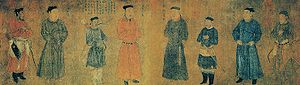
Tong Guan
Tong Guan , style name Daofu , was a court eunuch, military general, political adviser, and Council of State to Emperor Huizong of the Song Dynasty. In the Water Margin, one of the Four Great Classical Novels of Chinese literature, Tong Guan is featured as an antagonist and enemy of the 108...
(1054–1126) were eager to enlist as officers in the central army since this was a means to elevate their position at court.
Ordinary soldiers were merely recruited or conscripted rural farmers, while surrendered bandits and mercenaries also joined the military. Soldiers were not awarded official status by Confucian scholars as belonging to one of the Four Occupations; the scholar-officials were wary of condoning or legitimizing those whose lives revolved around the uncivilized practices of wu (violence). Even though the military examinations, rankings, and posts were parallel to those of the civil order, scholar-officials and the gentry nonetheless viewed military pursuits as uncultivated. Despite this disdain and argument of moral high ground, scholar-officials often commanded troops and wielded military power. Yet scholar-officials were not at the apex of the military or even civilian order; at the pinnacle of society was the emperor. The emperor's use of violence was seen as a necessity to rein in rebellious elements of society and dominate violent and uncultivated Inner Asian
Central Asia
Central Asia is a core region of the Asian continent from the Caspian Sea in the west, China in the east, Afghanistan in the south, and Russia in the north...
tribes, who would then submit to the emperor and become transformed by China's superior wen (culture and civilization).
Catastrophe and reforms
In the year 960 the Song military had 378,000 enlisted soldiers. Around the turn of the 11th century its size had grown to 900,000 soldiers, increasing to 1,000,000 by the year 1022, and well over 1,250,000 by 1041. The overall expenses of upholding a military of this size consumed three-quarters of the state's entire annual revenue. To lessen the expense, in 1069 the Chancellor Wang Anshi created the institution of local militias as supporting units. In 1073, Wang Anshi created a new bureau of the central government called the Directorate of Weapons, which supervised the manufacture of armaments and ensured quality control.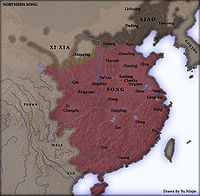
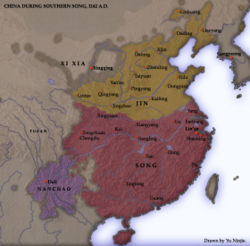
The corruption of the high command and ineffectiveness of military strength was soon revealed once the Song made a joint effort with the Jurchen people to conquer the Khitan
Khitan people
thumb|250px|Khitans [[Eagle hunting|using eagles to hunt]], painted during the Chinese [[Song Dynasty]].The Khitan people , or Khitai, Kitan, or Kidan, were a nomadic Mongolic people, originally located at Mongolia and Manchuria from the 4th century...
Liao Dynasty
Liao Dynasty
The Liao Dynasty , also known as the Khitan Empire was an empire in East Asia that ruled over the regions of Manchuria, Mongolia, and parts of northern China proper between 9071125...
(916–1125). After the successful rebellion of the Jurchens against their Khitan masters, the Jurchen observed the weakness of the Song army and broke their pact, then attacked the Song as well. By 1127, the capital at Kaifeng was captured and northern China overrun, while the remnants of the Song court fled south to Hangzhou and established the Southern Song. This was a crucial blow to the Song military elites, as they had been closely tied to the political structure until 1127; afterwards they became alienated from the emperor and the Song court. Although they had lost northern China to the new Jurchen Jin Dynasty (1115–1234), this loss prompted the Song to make drastic and lasting military reforms. Emperor Gaozong, desperate to refill the decimated ranks of the central army, drafted men from all over the country. This had been done before, but not on the same scale. Only the most skilled soldiers became imperial guardsmen, while under Gaozong entire central army units were composed of soldiers from every region and background. The Southern Song eventually recovered their strength and commanded the loyalty of vaunted commanders such as Yue Fei
Yue Fei
Yue Fei , style name Pengju, was a military general of the Southern Song Dynasty. His ancestral home was in Xiaoti, Yonghe Village, Tangyin, Xiangzhou, Henan...
(1103–1142), who successfully defended the border at the Huai River
Huai River
The Huai River is a major river in China. The Huai River is located about mid-way between the Yellow River and Yangtze River, the two largest rivers in China, and like them runs from west to east...
. The Jurchens and Song eventually signed a peace treaty in 1141.
In 1131, the Chinese writer Zhang Yi noted the importance of employing a navy to fight the Jin, writing that China had to regard the sea and the river as her Great Wall
Great Wall of China
The Great Wall of China is a series of stone and earthen fortifications in northern China, built originally to protect the northern borders of the Chinese Empire against intrusions by various nomadic groups...
, and use warships as its greatest watchtowers. Although navies
Naval history of China
The naval history of China dates back thousands of years, with archives existing since the late Spring and Autumn Period about the ancient navy of China and the various ship types used in war. China was leading maritime power in the years 1405-1433, when Chinese shipbuilders began to build massive...
had been used in China since the ancient Spring and Autumn Period (722–481 BC), China's first permanent standing navy was established by the Southern Song in 1132. The Jurchen launched an invasion against the Southern Song along the length of the Yangtze River
Yangtze River
The Yangtze, Yangzi or Cháng Jiāng is the longest river in Asia, and the third-longest in the world. It flows for from the glaciers on the Tibetan Plateau in Qinghai eastward across southwest, central and eastern China before emptying into the East China Sea at Shanghai. It is also one of the...
, which resulted in two crucial Song victories at the Battle of Caishi
Battle of Caishi
The naval Battle of Caishi took place in 1161 and was the result of an attempt by forces of the Jurchen Jin to cross the Yangtze River, thus beginning an invasion of Southern Song China...
and Battle of Tangdao
Battle of Tangdao
The naval Battle of Tangdao took place in 1161 between the Jurchen Jin and the Southern Song Dynasty of China on the East China Sea. It was an attempt by the Jin to invade and conquer the Southern Song Dynasty, yet resulted in failure and defeat for the Jurchens. The Jin Dynasty navy was set on...
in 1161. The Jin navy was defeated by the Song's standing navy, which employed trebuchet
Trebuchet
A trebuchet is a siege engine that was employed in the Middle Ages. It is sometimes called a "counterweight trebuchet" or "counterpoise trebuchet" in order to distinguish it from an earlier weapon that has come to be called the "traction trebuchet", the original version with pulling men instead of...
s on their ships' top deckhouses to launch gunpowder
Gunpowder
Gunpowder, also known since in the late 19th century as black powder, was the first chemical explosive and the only one known until the mid 1800s. It is a mixture of sulfur, charcoal, and potassium nitrate - with the sulfur and charcoal acting as fuels, while the saltpeter works as an oxidizer...
bombs.
Organization, equipment and techniques
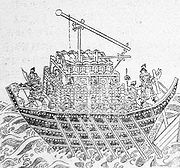
Platoon
A platoon is a military unit typically composed of two to four sections or squads and containing 16 to 50 soldiers. Platoons are organized into a company, which typically consists of three, four or five platoons. A platoon is typically the smallest military unit led by a commissioned officer—the...
, two platoons to a company
Company (military unit)
A company is a military unit, typically consisting of 80–225 soldiers and usually commanded by a Captain, Major or Commandant. Most companies are formed of three to five platoons although the exact number may vary by country, unit type, and structure...
, and those into battalion
Battalion
A battalion is a military unit of around 300–1,200 soldiers usually consisting of between two and seven companies and typically commanded by either a Lieutenant Colonel or a Colonel...
s of 500 men each. During the Northern Song Dynasty, half of the entire army of 1 million was stationed in and around Kaifeng. The remaining troops were posted in scattered forces along borders and near large municipalities, and in peacetime were used as means to maintain local security. Although the Song military was rife with corruption and largely ignored by civil officials, it did provide some valuable strengths to the empire. During the Song era, military drills and training
Military education and training
Military education and training is a process which intends to establish and improve the capabilities of military personnel in their respective roles....
were studied as a science, while elite soldiers were allocated different responsibilities based on examinations of their skills in weaponry and athletic ability. In their training, soldiers and officers were prepared for battle by following signal standards for troop movement, advancing when a flag or banner was raised, halting when the blaring sound of bells and drums rang out.
Song crossbow
Crossbow
A crossbow is a weapon consisting of a bow mounted on a stock that shoots projectiles, often called bolts or quarrels. The medieval crossbow was called by many names, most of which derived from the word ballista, a torsion engine resembling a crossbow in appearance.Historically, crossbows played a...
men comprised their own separate units apart from the infantry, and according to the Chinese Wujing Zongyao
Wujing Zongyao
The Wujing Zongyao was a Chinese military compendium written in 1044 AD, during the Northern Song Dynasty. Its authors were the prominent scholars Zeng Gongliang , Ding Du , and Yang Weide , whose writing influenced many later Chinese military writers. The book covered a wide range of subjects,...
military manuscript of 1044, the crossbow used in mass was the most effective weapon used against northern nomadic cavalry charges. Elite crossbowmen were also valued as long-range sniper
Sniper
A sniper is a marksman who shoots targets from concealed positions or distances exceeding the capabilities of regular personnel. Snipers typically have specialized training and distinct high-precision rifles....
s; such was the case when the Liao Dynasty general Xiao Talin was picked off by a Song crossbow at the Battle of Shanzhou in 1004. Crossbows were mass produced in state armories with designs improving as time went on, such as the use of a mulberry wood and brass crossbow in 1068 that could pierce a tree at 140 paces. Song cavalry used an array of different weapons, including halberds, swords, bows, and fire lance
Fire lance
The fire lance or fire spear is one of the first gunpowder weapons in the world.- Description :The earliest fire lances were spear-like weapons combining a bamboo tube containing gunpowder and projectiles tied to a Chinese spear. Upon firing, the charge ejected a small projectile or poison dart...
s that discharged a gunpowder blast of flame and shrapnel
Fragmentation (weaponry)
Fragmentation is the process by which the casing of an artillery shell, bomb, grenade, etc. is shattered by the detonating high explosive filling. The correct technical terminology for these casing pieces is fragments , although shards or splinters can be used for non-preformed fragments...
. In preparation for war, government armories manufactured weapons in enormous quantities, with tens of millions of arrowheads crafted each year, along with armor components by the tens of thousands. There were sixteen known varieties of catapult
Catapult
A catapult is a device used to throw or hurl a projectile a great distance without the aid of explosive devices—particularly various types of ancient and medieval siege engines. Although the catapult has been used since ancient times, it has proven to be one of the most effective mechanisms during...
s in the Song period, designed to fit many different proportions and requiring work crews in sizes ranging from dozens to several hundred men.
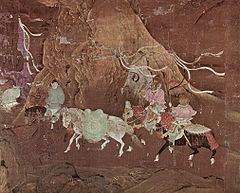
Nomad
Nomadic people , commonly known as itinerants in modern-day contexts, are communities of people who move from one place to another, rather than settling permanently in one location. There are an estimated 30-40 million nomads in the world. Many cultures have traditionally been nomadic, but...
ic armies, such as the earlier Xianbei
Xianbei
The Xianbei were a significant Mongolic nomadic people residing in Manchuria, Inner Mongolia and eastern Mongolia. The title “Khan” was first used among the Xianbei.-Origins:...
and later Mongols. Only twice in the Song era were non-Chinese people employed in Song cavalry units: in the beginning of the dynasty with the campaigns of Emperor Taizu, and later 13th century Mongol defectors who came over to fight for the Song. With the Khitan and Tangut kingdoms possessing much of the pasture and grazing lands in the north, the Song Dynasty military had a shortage of horses for cavalry
Horses in warfare
The first use of horses in warfare occurred over 5,000 years ago. The earliest evidence of horses ridden in warfare dates from Eurasia between 4000 and 3000 BC. A Sumerian illustration of warfare from 2500 BC depicts some type of equine pulling wagons...
. To make up for this shortage, statesmen like Wang Anshi advocated greater ties with Tibet
Tibet
Tibet is a plateau region in Asia, north-east of the Himalayas. It is the traditional homeland of the Tibetan people as well as some other ethnic groups such as Monpas, Qiang, and Lhobas, and is now also inhabited by considerable numbers of Han and Hui people...
, as the tea-horse trade with Tibet was continued by the Ming Dynasty
Ming Dynasty
The Ming Dynasty, also Empire of the Great Ming, was the ruling dynasty of China from 1368 to 1644, following the collapse of the Mongol-led Yuan Dynasty. The Ming, "one of the greatest eras of orderly government and social stability in human history", was the last dynasty in China ruled by ethnic...
. Still, the Song established considerably large navies: in the 10th century, in the war to reunite China, and then a standing navy in the 12th century. Many of the warships in the Song Dynasty's navy were paddle-wheel driven crafts
Paddle steamer
A paddle steamer is a steamship or riverboat, powered by a steam engine, using paddle wheels to propel it through the water. In antiquity, Paddle wheelers followed the development of poles, oars and sails, where the first uses were wheelers driven by animals or humans...
and some Song naval ships could carry up to 1,000 soldiers. It was also during the Song period that naval ships were first armed with gunpowder weapons. The use of enormous pontoon bridge
Pontoon bridge
A pontoon bridge or floating bridge is a bridge that floats on water and in which barge- or boat-like pontoons support the bridge deck and its dynamic loads. While pontoon bridges are usually temporary structures, some are used for long periods of time...
s in the Song era on at least one occasion was essential to victory. The Song built a large floating bridge across the Yangtze River in 974; while troops were under attack, the pontoon bridge was used as a means of transport for troops and supplies to the other bank during the early Song conquest of the Southern Tang
Southern Tang
Southern Tang was one of the Ten Kingdoms in south-central China created following the Tang Dynasty from 937-975. Southern Tang replaced the Wu Kingdom when Li Bian deposed the emperor Yang Pu....
state.
Ethnic, foreign and religious minorities
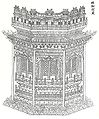
Fatimid
The Fatimid Islamic Caliphate or al-Fāṭimiyyūn was a Berber Shia Muslim caliphate first centered in Tunisia and later in Egypt that ruled over varying areas of the Maghreb, Sudan, Sicily, the Levant, and Hijaz from 5 January 909 to 1171.The caliphate was ruled by the Fatimids, who established the...
, Yemen, India
Kulothunga Chola I
Kō Rājakēsarivarman Abaya Kulōthunga Chōla was one of the greatest kings of the Chola Empire. He was one of the sovereigns who bore the title Kulottunga, literally meaning the exalter of his race.-Early life:...
, Korea
Goryeo
The Goryeo Dynasty or Koryŏ was a Korean dynasty established in 918 by Emperor Taejo. Korea gets its name from this kingdom which came to be pronounced Korea. It united the Later Three Kingdoms in 936 and ruled most of the Korean peninsula until it was removed by the Joseon dynasty in 1392...
, the Kara-Khanid Khanate
Kara-Khanid Khanate
The Kara-Khanid Khanate was a confederation of Turkic tribes ruled by a dynasty known in literature as the Karakhanids or Ilek Khanids, . Both dynastic names represent titles with Kara Kağan being the most important Turkish title up till the end of the dynasty.The Khanate ruled Transoxania in...
of Central Asia
Central Asia
Central Asia is a core region of the Asian continent from the Caspian Sea in the west, China in the east, Afghanistan in the south, and Russia in the north...
and elsewhere came to Song China in order to bolster trade relations, while the Chinese sent embassies abroad to encourage foreign trade. Song Chinese trade ships
Junk (ship)
A junk is an ancient Chinese sailing vessel design still in use today. Junks were developed during the Han Dynasty and were used as sea-going vessels as early as the 2nd century AD. They evolved in the later dynasties, and were used throughout Asia for extensive ocean voyages...
traveled to ports in Japan
Sino-Japanese relations
China and Japan are geographically separated only by a relatively narrow stretch of ocean. China has strongly influenced Japan with its writing system, architecture, culture, religion, philosophy, and law...
, Champa
Champa
The kingdom of Champa was an Indianized kingdom that controlled what is now southern and central Vietnam from approximately the 7th century through to 1832.The Cham people are remnants...
in southern Vietnam
Northern and southern Vietnam
Northern Vietnam and Southern Vietnam are two general regions within Vietnam.Of the two regions, the older is Northern Vietnam, where the Vietnamese culture originated over 2000 years ago in the Red River Delta, though Vietnamese people eventually spread south into the Mekong Delta...
, Srivijaya
Srivijaya
Srivijaya was a powerful ancient thalassocratic Malay empire based on the island of Sumatra, modern day Indonesia, which influenced much of Southeast Asia. The earliest solid proof of its existence dates from the 7th century; a Chinese monk, I-Tsing, wrote that he visited Srivijaya in 671 for 6...
in Maritime Southeast Asia
Maritime Southeast Asia
Maritime Southeast Asia refers to the maritime region of Southeast Asia as opposed to mainland Southeast Asia and includes the modern countries of Indonesia, Malaysia, the Philippines, Brunei, East Timor and Singapore....
, Bengal
Bengal
Bengal is a historical and geographical region in the northeast region of the Indian Subcontinent at the apex of the Bay of Bengal. Today, it is mainly divided between the sovereign land of People's Republic of Bangladesh and the Indian state of West Bengal, although some regions of the previous...
and South India
South India
South India is the area encompassing India's states of Andhra Pradesh, Karnataka, Kerala and Tamil Nadu as well as the union territories of Lakshadweep and Pondicherry, occupying 19.31% of India's area...
, and the coasts of East Africa
East Africa
East Africa or Eastern Africa is the easterly region of the African continent, variably defined by geography or geopolitics. In the UN scheme of geographic regions, 19 territories constitute Eastern Africa:...
.
During the 9th century, the Tang seaport at Guangzhou
Guangzhou
Guangzhou , known historically as Canton or Kwangchow, is the capital and largest city of the Guangdong province in the People's Republic of China. Located in southern China on the Pearl River, about north-northwest of Hong Kong, Guangzhou is a key national transportation hub and trading port...
had a large Muslim
Muslim
A Muslim, also spelled Moslem, is an adherent of Islam, a monotheistic, Abrahamic religion based on the Quran, which Muslims consider the verbatim word of God as revealed to prophet Muhammad. "Muslim" is the Arabic term for "submitter" .Muslims believe that God is one and incomparable...
population. During the Song Dynasty the importance of the latter seaport declined as the ports of Quanzhou
Quanzhou
Quanzhou is a prefecture-level city in Fujian province, People's Republic of China. It borders all other prefecture-level cities in Fujian but two and faces the Taiwan Strait...
and Fuzhou
Fuzhou
Fuzhou is the capital and one of the largest cities in Fujian Province, People's Republic of China. Along with the many counties of Ningde, those of Fuzhou are considered to constitute the Mindong linguistic and cultural area....
in Fujian province eclipsed it. This was followed by a decline of Middle Eastern sea merchants in China and an increasing amount of Chinese ship owners engaging in maritime trade. However, Middle Eastern merchants and other foreigners were not entirely absent, and some even gained administrative posts. For example, the Muslim Pu Shougeng—of either Persian
Iranian peoples
The Iranian peoples are an Indo-European ethnic-linguistic group, consisting of the speakers of Iranian languages, a major branch of the Indo-European language family, as such forming a branch of Indo-European-speaking peoples...
or Arab descent—served as the Commissioner of Merchant Shipping for Quanzhou between the years 1250 and 1275. There was also the Arab astronomer
Islamic science
Science in the medieval Islamic world, also known as Islamic science or Arabic science, is the science developed and practised in the Islamic world during the Islamic Golden Age . During this time, Indian, Iranian and especially Greek knowledge was translated into Arabic...
Ma Yize
Ma Yize
Ma Yize was an important Arab-Chinese Islamic astronomer and astrologist who worked as the chief official of the astronomical observatory for the Song dynasty....
(910–1005), who became the chief astronomer of the Song court under Taizu. Aside from these elites, Chinese seaports were filled with resident Arabs, Persians, and Koreans
Korean people
The Korean people are an ethnic group originating in the Korean peninsula and Manchuria. Koreans are one of the most ethnically and linguistically homogeneous groups in the world.-Names:...
who had special enclaves designated for each of them.
Muslims represented the largest religious minority within Song China, although there were many others. There was a community of Kaifeng Jews
Kaifeng Jews
The Kaifeng Jews are members of a small Jewish community that has existed in Kaifeng, in the Henan province of China, for hundreds of years. Jews in modern China have traditionally called themselves Youtai in Mandarin Chinese which is also the predominant contemporary Chinese language term for...
who followed the exodus of the Song court
Jingkang Incident
The Jingkang Incident , the Humiliation of Jingkang , or The Disorders of the Jingkang Period took place in 1127 when invading Jurchen soldiers from the Jin Dynasty besieged and sacked Bianjing , the capital of the Song Dynasty of China...
to Hangzhou once the Jurchens invaded the north in 1126. Manichaeism
Manichaeism
Manichaeism in Modern Persian Āyin e Māni; ) was one of the major Iranian Gnostic religions, originating in Sassanid Persia.Although most of the original writings of the founding prophet Mani have been lost, numerous translations and fragmentary texts have survived...
from Persia was introduced during the Tang; during the Song, the Manichaean sects were most prominent in Fujian and Zhejiang
Zhejiang
Zhejiang is an eastern coastal province of the People's Republic of China. The word Zhejiang was the old name of the Qiantang River, which passes through Hangzhou, the provincial capital...
. Nestorian Christianity in China had for the most part died out after the Tang Dynasty; however, it was revived during the Mongol invasions in the 13th century. Followers of Zoroastrianism
Zoroastrianism
Zoroastrianism is a religion and philosophy based on the teachings of prophet Zoroaster and was formerly among the world's largest religions. It was probably founded some time before the 6th century BCE in Greater Iran.In Zoroastrianism, the Creator Ahura Mazda is all good, and no evil...
still had temples in China as well. Prospects of studying Chinese Chan Buddhism
Zen
Zen is a school of Mahāyāna Buddhism founded by the Buddhist monk Bodhidharma. The word Zen is from the Japanese pronunciation of the Chinese word Chán , which in turn is derived from the Sanskrit word dhyāna, which can be approximately translated as "meditation" or "meditative state."Zen...
attracted foreign Buddhists to China, such as Enni Ben'en (圓爾辯圓; 1201–1280) of Japan
Kamakura period
The is a period of Japanese history that marks the governance by the Kamakura Shogunate, officially established in 1192 in Kamakura by the first shogun Minamoto no Yoritomo....
who studied under the eminent Chinese monk Wuzhun Shifan
Wuzhun Shifan
Wuzhun Shifan was a Chinese painter, calligrapher, and prominent Zen Buddhist monk who lived during the late Song Dynasty .-Life:Wuzhun Shifan was born in Zitong, Sichuan province, China. He eventually became a renowned Buddhist abbot at the Temple of Mount Jingshan. He was once summoned by...
(1178–1249) before establishing Tōfuku-ji
Tofuku-ji
is a Buddhist temple in Higashiyama-ku in Kyoto, Japan. Tōfuku-ji takes its name from two temples in Nara, Tōdai-ji and Kōfuku-ji. It is one of the so-called Kyoto Gozan or "five great Zen temples of Kyoto". Its honorary sangō prefix is .-History:...
in Kyoto
Kyoto
is a city in the central part of the island of Honshū, Japan. It has a population close to 1.5 million. Formerly the imperial capital of Japan, it is now the capital of Kyoto Prefecture, as well as a major part of the Osaka-Kobe-Kyoto metropolitan area.-History:...
. Tansen Sen states that Buddhist monks traveling from India to China and vice versa during the Song surpassed that of the Tang Dynasty, while "Indian texts translated under the Song dynasty outnumbered those completed under the preceding dynasties."

Ethnic minorities in China
Ethnic minorities in China are the non-Han Chinese population in the People's Republic of China. The People's Republic of China officially recognizes 55 ethnic minority groups within China in addition to the Han majority. As of 2010, the combined population of officially recognised minority...
that did not belong to the Han Chinese
Han Chinese
Han Chinese are an ethnic group native to China and are the largest single ethnic group in the world.Han Chinese constitute about 92% of the population of the People's Republic of China , 98% of the population of the Republic of China , 78% of the population of Singapore, and about 20% of the...
majority. This included the Yao people
Yao people
The Yao nationality is a government classification for various minorities in China. They form one of the 55 ethnic minority groups officially recognized by the People's Republic of China, where they reside in the mountainous terrain of the southwest and south...
, who staged tribal uprisings against the Song in Guangdong
Guangdong
Guangdong is a province on the South China Sea coast of the People's Republic of China. The province was previously often written with the alternative English name Kwangtung Province...
in 1035 and Hunan
Hunan
' is a province of South-Central China, located to the south of the middle reaches of the Yangtze River and south of Lake Dongting...
in 1043, during the reign of Emperor Renzong of Song
Emperor Renzong of Song
Emperor Renzong was the fourth emperor of the Song Dynasty of China. His personal name was Zhao Zhen . He reigned from 1022 to 1063. Renzong was the son of Emperor Zhenzong of Song. Despite his long reign of over 40 years, Renzong is not widely known...
(r. 1023–1064). Song authorities employed Zhuang people as local officials in what is now Guangxi
Guangxi
Guangxi, formerly romanized Kwangsi, is a province of southern China along its border with Vietnam. In 1958, it became the Guangxi Zhuang Autonomous Region of the People's Republic of China, a region with special privileges created specifically for the Zhuang people.Guangxi's location, in...
and Guangdong, where the Song placed them in charge of distributing land to the Yao and other tribal groups. The Yao peoples and others on the empire's frontier were incorporated into a feudal system, or fengjian shehui
Fengjian
Fēngjiàn is the political ideology of the Zhou Dynasty of ancient China. Fengjian is a "decentralized system of government," comparable to European feudalism, though recent scholarship has suggested that fengjian lacks some of the fundamental aspects of feudalism.-Ranks:The sizes of troops and...
, which Ralph A. Litzinger says bypassed any possible native development of a primitive slave society, or nuli shehui, since the Yao and others lacked a sedentary tradition. Although mainland Chinese states made efforts to settle parts of Hainan Island since the 3rd century BC, it was not until the Song Dynasty that a concerted effort was made to assimilate the Li people
Li people
The Li or Hlai are a minority ethnic group, the vast majority of whom live off the southern coast of mainland China on Hainan Island, where they are the largest minority ethnic group...
of its highlands, who at times had fought against and repelled Han Chinese settlers. During the 11th century, the Man people of Hainan wreaked havoc by joining bandit gangs of ten to several hundred men. The statesman Ouyang Xiu estimated in 1043 that there were at least several thousand Man bandits residing in a dozen or so prefectures of mainland China.
To counter powerful neighbors such as the Kingdom of Dali
Kingdom of Dali
Dali or Great Li was a Bai kingdom centred in what is now Yunnan Province of China. Established by Duan Siping in 937, it was ruled by a succession of 22 kings until the year 1253, when it was conquered by an invasion of the Mongol Empire. The capital city was at Dali.- History :The Kingdom of...
(934–1253), the Song made alliances with tribal groups in southwest China
Southwest China
Southwest China is a region of the People's Republic of China defined by governmental bureaus that includes the municipality of Chongqing, the provinces of Sichuan, Yunnan and Guizhou, and the Tibet Autonomous Region.-Provinces:-Municipalities:...
which served as a protective buffer between their borders and Dali's. As long as these ethnic tribal groups paid tribute to the Song court and agreed to follow the course of its foreign policy, the Song agreed to grant military protection and allow the tribal leaders hereditary, autonomous local rule. During the 1050s, the Song Dynasty put down local tribal insurrections along their borders with the Lý Dynasty
Lý Dynasty
The Lý Dynasty , sometimes known as the Later Lý Dynasty , was a Vietnamese dynasty that began in 1009 when Lý Thái Tổ overthrew the Prior Lê Dynasty and ended in 1225 when the queen Lý Chiêu Hoàng was forced to abdicate the throne in favor of her husband, Trần Cảnh. They ruled Vietnam for a...
of Đại Việt, while their relations with Tai peoples
Tai peoples
The Tai ethnicity refers collectively to the ethnic groups of southern China and Southeast Asia, stretching from Hainan to eastern India and from southern Sichuan to Laos, Thailand, and parts of Vietnam, which speak languages in the Tai family and share similar traditions and festivals, including...
and alliances with local clan leaders in the southern frontier led to a border war with Lý from 1075 to 1077.
See also
- Han ShizhongHan ShizhongHan Shizhong was a Chinese general of the late Northern Song Dynasty and the early Southern Song Dynasty. He dedicated his whole life to serving the Song Dynasty, and performed many legendary deeds. It is said that he had scars all over his body and, by the time he retired, there were only four...
- Qin HuiQin Hui (Song Dynasty)Qin Hui or Qin Kuai was a Chancellor of the Song Dynasty in China, who is widely regarded as a traitor of the Han race for his part in the political execution of General Yue Fei...
- Shao YongShao YongShao Yong , courtesy name Yaofu , named Shào Kāngjié after death, was a Song Dynasty Chinese philosopher, cosmologist, poet and historian who greatly influenced the development of Neo-Confucianism in China....
- Society and culture of the Han DynastySociety and culture of the Han DynastyThe Han Dynasty was a period of ancient China divided by the Western Han and Eastern Han periods, when the capital cities were located at Chang'an and Luoyang, respectively. It was founded by Emperor Gaozu of Han and briefly interrupted by the regime of Wang Mang The Han Dynasty (206 BCE –...
- Wei PuWei PuWei Pu was an 11th century Chinese astronomer of the Song Dynasty . He was born a commoner, but eventually rose to prominence as an astronomer working for the imperial court at the capital of Kaifeng...
- Wen TianxiangWen TianxiangWen Tianxiang , Duke of Xinguo, was a scholar-general in the last years of the Southern Song Dynasty. For his resistance to Kublai Khan's invasion of the Song, and for his refusal to yield to the Yuan Dynasty despite being captured and tortured, he is a popular symbol of patriotism and...