
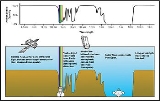
Skywave is the
propagationRadio propagation is the behavior of radio waves when they are transmitted, or propagated from one point on the Earth to another, or into various parts of the atmosphere...
of
electromagnetic wavesRadio waves are a type of electromagnetic radiation with wavelengths in the electromagnetic spectrum longer than infrared light. Radio waves have frequencies from 300 GHz to as low as 3 kHz, and corresponding wavelengths from 1 millimeter to 100 kilometers. Like all other electromagnetic waves,...
bent (refracted) back to the Earth's surface by the
ionosphereThe ionosphere is a part of the upper atmosphere, comprising portions of the mesosphere, thermosphere and exosphere, distinguished because it is ionized by solar radiation. It plays an important part in atmospheric electricity and forms the inner edge of the magnetosphere...
. As a result of skywave propagation, a
broadcastBroadcasting is the distribution of audio and video content to a dispersed audience via any audio visual medium. Receiving parties may include the general public or a relatively large subset of thereof...
signal from a distant
AM broadcastingAM broadcasting is the process of radio broadcasting using amplitude modulation. AM was the first method of impressing sound on a radio signal and is still widely used today. Commercial and public AM broadcasting is carried out in the medium wave band world wide, and on long wave and short wave...
station at night, or from a shortwave radio station (or during
sporadic E seasonSporadic E or Es is an unusual form of radio propagation using characteristics of the Earth's ionosphere. Whereas most forms of skywave propagation use the normal and cyclic ionization properties of the ionosphere's F region to refract radio signals back toward the Earth's surface, sporadic E...
, a low band TV station) can sometimes be heard as clearly as local stations.
(This is distinct from groundwave propagation, which is direct from transmitter to radio). Most long-distance
HFHigh frequency radio frequencies are between 3 and 30 MHz. Also known as the decameter band or decameter wave as the wavelengths range from one to ten decameters . Frequencies immediately below HF are denoted Medium-frequency , and the next higher frequencies are known as Very high frequency...
radio communication (between 3 and 30 MHz) is a result of skywave propagation. Since the early 1920s
amateur radioAmateur radio is the use of designated radio frequency spectrum for purposes of private recreation, non-commercial exchange of messages, wireless experimentation, self-training, and emergency communication...
operators, limited to lower transmitter power than commercial radio, have taken advantage of skywave for long distance or DX communication.
Role of the ionosphere
The ionosphere is a region of the upper
atmosphereThe atmosphere of Earth is a layer of gases surrounding the planet Earth that is retained by Earth's gravity. The atmosphere protects life on Earth by absorbing ultraviolet solar radiation, warming the surface through heat retention , and reducing temperature extremes between day and night...
, where neutral air is
ionAn ion is an atom or molecule in which the total number of electrons is not equal to the total number of protons, giving it a net positive or negative electrical charge. The name was given by physicist Michael Faraday for the substances that allow a current to pass between electrodes in a...
ized by solar
photonIn physics, a photon is an elementary particle, the quantum of the electromagnetic interaction and the basic unit of light and all other forms of electromagnetic radiation. It is also the force carrier for the electromagnetic force...
s and
cosmic rayCosmic rays are energetic charged subatomic particles, originating from outer space. They may produce secondary particles that penetrate the Earth's atmosphere and surface. The term ray is historical as cosmic rays were thought to be electromagnetic radiation...
s. When radio waves reach the ionosphere at oblique incidence they are bent downwards (
refractedRefraction is the change in direction of a wave due to a change in its speed. It is essentially a surface phenomenon . The phenomenon is mainly in governance to the law of conservation of energy. The proper explanation would be that due to change of medium, the phase velocity of the wave is changed...
) in the ionized layer. If, compared to the wave frequency, the midlayer
ionizationIonization is the process of converting an atom or molecule into an ion by adding or removing charged particles such as electrons or other ions. This is often confused with dissociation. A substance may dissociate without necessarily producing ions. As an example, the molecules of table sugar...
is important enough, the ray leaves the bottomside of the layer earthwards as if it were
reflectedReflection is the change in direction of a wavefront at an interface between two differentmedia so that the wavefront returns into the medium from which it originated. Common examples include the reflection of light, sound and water waves...
from a mirror. The Earth's surface (ground or water) reflects the incoming wave back toward the ionosphere again. As a result, like a rock "skipping" across water, the wave may actually "bounce" or "skip" between the earth and ionosphere two or more times (multihop propagation). Since at shallow incidence losses remain quite small, signals of only a few watts can sometimes be received many thousands of miles away as a result.
If the ionization is not great enough the wave path is first bent downwards, but then (above the layer peak) upwards so that it leaves the topside of the layer with some displacement only. Skywave propagation occurs in the
waveguideA waveguide is a structure which guides waves, such as electromagnetic waves or sound waves. There are different types of waveguides for each type of wave...
formed by the ground and ionosphere, each serving as reflectors. With a single "hop," path distances up to 3500 km may be reached. Transatlantic connections are mostly obtained with two or three hops.
The structure of the ionospheric
plasmaIn physics and chemistry, plasma is a state of matter similar to gas in which a certain portion of the particles are ionized. Heating a gas may ionize its molecules or atoms , thus turning it into a plasma, which contains charged particles: positive ions and negative electrons or ions...
is disturbed particularly by
gravity waveIn fluid dynamics, gravity waves are waves generated in a fluid medium or at the interface between two media which has the restoring force of gravity or buoyancy....
s so that the surfaces of equal ionization may be wavy. When signals have "bounced" off this irregular surface, they may fade in and out and have the "phasing", "flanging" or "fluttery" character familiar to listeners of shortwave music broadcasts.
Depending on the transmitting
antennaAn antenna is an electrical device which converts electric currents into radio waves, and vice versa. It is usually used with a radio transmitter or radio receiver...
, signals below approximately 10 MHz during the day and 5 MHz at night may reach the ionosphere at a steep angle (vertical incidence) and be reflected straight back down to Earth. Alternatively, if the antenna "aims" the signal close to the horizon; the signal reaches the ionosphere at a shallow angle and returns to Earth at a medium to long distance.
Other considerations
VHFVery high frequency is the radio frequency range from 30 MHz to 300 MHz. Frequencies immediately below VHF are denoted High frequency , and the next higher frequencies are known as Ultra high frequency...
signals with frequencies above about 30 MHz usually penetrate the ionosphere and are not returned to the Earth's surface. E-skip is a notable exception, where VHF signals including FM broadcast and VHF TV signals are frequently reflected to the Earth during late Spring and early Summer. E-skip rarely affects UHF frequencies, except for very rare occurrences below 500 MHz.
FrequenciesFrequency is the number of occurrences of a repeating event per unit time. It is also referred to as temporal frequency.The period is the duration of one cycle in a repeating event, so the period is the reciprocal of the frequency...
below approximately 10 MHz (wavelengths longer than 30 meters), including broadcasts in the
mediumwaveMedium wave is the part of the medium frequency radio band used mainly for AM radio broadcasting. For Europe the MW band ranges from 526.5 kHz to 1606.5 kHz...
and
shortwaveShortwave radio refers to the upper MF and all of the HF portion of the radio spectrum, between 1,800–30,000 kHz. Shortwave radio received its name because the wavelengths in this band are shorter than 200 m which marked the original upper limit of the medium frequency band first used...
bands (and to some extent
longwaveIn radio, longwave refers to parts of radio spectrum with relatively long wavelengths. The term is a historic one dating from the early 20th century, when the radio spectrum was considered to consist of long, medium and short wavelengths...
), propagate most efficiently by skywave at night. Frequencies above 10 MHz (wavelengths shorter than 30 meters) typically propagate most efficiently during the day. Frequencies lower than 3 kHz have a wavelength longer than the distance between the Earth and the ionosphere. The
maximum usable frequencyMaximum usable frequency describes, in radio transmission, using reflection from the regular ionized layers of the ionosphere, the upper frequency limit that can be used for transmission between two points at a specified time, independent of transmitter power...
for skywave propagation is strongly influenced by
sunspotSunspots are temporary phenomena on the photosphere of the Sun that appear visibly as dark spots compared to surrounding regions. They are caused by intense magnetic activity, which inhibits convection by an effect comparable to the eddy current brake, forming areas of reduced surface temperature....
number.
Skywave propagation is usually degraded—sometimes seriously—during
geomagnetic stormA geomagnetic storm is a temporary disturbance of the Earth's magnetosphere caused by a disturbance in the interplanetary medium. A geomagnetic storm is a major component of space weather and provides the input for many other components of space weather...
s. Skywave propagation on the sunlit side of the Earth can be entirely disrupted during
sudden ionospheric disturbancesA sudden ionospheric disturbance is an abnormally high ionization/plasma density in the D region of the ionosphere caused by a solar flare...
.
Because the lower-altitude layers (the E-layer in particular) of the
ionosphereThe ionosphere is a part of the upper atmosphere, comprising portions of the mesosphere, thermosphere and exosphere, distinguished because it is ionized by solar radiation. It plays an important part in atmospheric electricity and forms the inner edge of the magnetosphere...
largely disappear at night, the refractive layer of the ionosphere is much higher above the surface of the Earth at night. This leads to an increase in the "skip" or "hop" distance of the skywave at night.
See also
- Radio propagation
Radio propagation is the behavior of radio waves when they are transmitted, or propagated from one point on the Earth to another, or into various parts of the atmosphere...
- MW DX
MW DX, short for mediumwave DXing, is the hobby of receiving the reception of distant mediumwave radio stations. MW DX is similar to TV and FM DX in that broadcast band stations are the reception targets...
- TV-FM DX
TV DX and FM DX is the active search for distant radio or television stations received during unusual atmospheric conditions. The term DX is an old telegraphic term meaning "long distance."...
- Near Vertical Incidence Skywave
Near Vertical Incidence Skywave, or NVIS, is a radio-wave propagation method that provides usable signals in the range between groundwave and skywave distances . It is used mainly for military and paramilitary communications and by radio amateurs...
- F-layer
The F region of the ionosphere is home to the F layer of ionization, also called the Appleton layer, after the English physicist Edward Appleton. As with other ionospheric sectors, 'layer' implies a concentration of plasma, while 'region' is the area that contains the said layer...
- Over-the-horizon radar
Over-the-horizon radar, or OTH , is a design concept for radar systems to allow them to detect targets at very long ranges, typically up to thousands of kilometers...
- Groundwave
- Schumann resonances
- Kennelly–Heaviside layer
- Skip (radio)
- Skip zone
A skip zone, also called a silent zone or zone of silence, is a region where a radio transmission can not be received located between regions both nearer and further from the transmitter where reception is possible....
- Radio frequency
Radio frequency is a rate of oscillation in the range of about 3 kHz to 300 GHz, which corresponds to the frequency of radio waves, and the alternating currents which carry radio signals...
- Clear-channel station
- Tropospheric ducting
- Geomagnetic storm
A geomagnetic storm is a temporary disturbance of the Earth's magnetosphere caused by a disturbance in the interplanetary medium. A geomagnetic storm is a major component of space weather and provides the input for many other components of space weather...
- History of radio
The early history of radio is the history of technology that produced radio instruments that use radio waves. Within the timeline of radio, many people contributed theory and inventions in what became radio. Radio development began as "wireless telegraphy"...
- Amateur radio history
Throughout the history of amateur radio, amateur radio enthusiasts have made significant contributions to science, engineering, industry, and social services. Research by amateur radio operators has founded new industries, built economies, empowered nations, and saved lives in times of...
- List of electronics topics
External links