
All Topics  
Sky father


   Email Print
   Bookmark   Link


Sky father


The sky father is a recurring theme in mythology
Mythology

The word mythology refers to a body of folklore/myths/legends that a particular culture believes to be true and that often use the supernatural to interpret natural events and to explain the nature of the universe and humanity....
. The sky father is the complement of the earth mother and appears in some creation myths, many of which are Europe
Europe

Europe is, conventionally, one of the world's seven continents. Comprising the westernmost peninsula of Eurasia, Europe is generally divided from Asia to its east by the water divide of the Ural Mountains, the Ural , the Caspian Sea, and by the Caucasus Mountains to the southeast....
an or ancient Near East
Near East

Near East today is an ambiguous term that covers different countries for archeologists and historians, on one hand, and for political scientists, economists, and journalists, on the other....
ern. Other cultures have quite different myths; Egyptian mythology
Egyptian mythology

Ancient Egyptian religion encompasses the various religious beliefs and rituals practiced in ancient Egypt over at least 3,000 years, from the Predynastic Egypt until the adoption of Coptic Christianity in the early centuries Common Era....
 features a sky mother and an earthly dying and reviving god of vegetation.


Discussion
Ask a question about 'Sky father'
Start a new discussion about 'Sky father'
Answer questions from other users
Full Discussion Forum


Encyclopedia


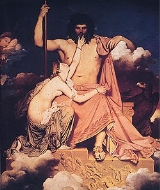
Ingresjupiterandthetis
The sky father is a recurring theme in mythology
Mythology

The word mythology refers to a body of folklore/myths/legends that a particular culture believes to be true and that often use the supernatural to interpret natural events and to explain the nature of the universe and humanity....
. The sky father is the complement of the earth mother and appears in some creation myths, many of which are Europe
Europe

Europe is, conventionally, one of the world's seven continents. Comprising the westernmost peninsula of Eurasia, Europe is generally divided from Asia to its east by the water divide of the Ural Mountains, the Ural , the Caspian Sea, and by the Caucasus Mountains to the southeast....
an or ancient Near East
Near East

Near East today is an ambiguous term that covers different countries for archeologists and historians, on one hand, and for political scientists, economists, and journalists, on the other....
ern. Other cultures have quite different myths; Egyptian mythology
Egyptian mythology

Ancient Egyptian religion encompasses the various religious beliefs and rituals practiced in ancient Egypt over at least 3,000 years, from the Predynastic Egypt until the adoption of Coptic Christianity in the early centuries Common Era....
 features a sky mother and an earthly dying and reviving god of vegetation. Shinto
Shinto

is the former state religion of Japan and remains the most common name for the nation's non-Buddhist ethnic religion practices. It was formed from disparate local mythologies, beginning with the Kojiki of 712, into an imperial cult called State Shinto that solidified in the Meiji period....
 gives precedence to a sun goddess. A sky father also relates to a solar deity
Solar deity

A Solar Deity , is a deity who represents the sun, or an aspect of it. People have worshiped these for all of recorded history. Hence, many beliefs have formed around this worship, such as the "missing sun" found in many cultures ....
, a god identified with the sun.

  • In Maori mythology
    Maori mythology

    Maori mythology and Maori traditions are the two major categories into which the legends of the Maori of New Zealand may usefully be divided....
    , Ranginui
    Rangi and Papa

    In Maori mythology the primal couple Rangi and Papa appear in a creation myth explaining the origin of the world....
     was the sky father. In this story, the sky father and earth mother Papatuanuku, embraced and had divine children.


  • In China
    China

    China is a Culture of China, an ancient civilization, and, depending on perspective, a national or multinational entity extending over a large area in East Asia....
    , the God
    God

    God is a deity in theism and deism religions and other belief systems, representing either the sole deity in monotheism, or a principal deity in polytheism....
     of the Abrahamic religions is sometimes called ?? which means the Sky Father or Heavenly Father.


  • In Ancient Rome
    Ancient Rome

    Ancient Rome was a civilization that grew out of a small agricultural community founded on the Italian Peninsula as early as the 10th century BC....
     the sky father, or sky god, was Jupiter
    Jupiter (mythology)

    In Roman mythology, Jupiter or Jove was the king of the gods,and the god of sky and thunder. He is the equivalent of Zeus in the Greek pantheon....
     (Zeus
    Zeus

    Zeus in Greek mythology is the king of the gods, the ruler of Mount Olympus and the god of the sky father and List of thunder gods. His symbols are the thunderbolt, eagle, bull , and oak....
    , ?e??, in Ancient Greece
    Ancient Greece

    The term Ancient Greece refers to the period of History of Greece lasting from the Greek Dark Ages ca. 1100 BC and the Dorian invasion, to 146 BC and the Roman Republic conquest of Greece after the Battle of Corinth ....
    ). Often depicted by birds, usually the Eagle
    Eagle

    Eagles are large bird of prey which are members of the bird family Accipitridae, and belong to several Genus which are not necessarily closely related to each other....
     or Hawk
    Hawk

    The term hawk can be used in several ways:* In strict usage in Europe and Asia, to mean any of the species in the subfamily Accipitrinae, which comprises the genus Accipiter, Micronisus, Melierax, Urotriorchis and Megatriorchis....
    , and clouds or other sky phenomena. Nicknames included, "Sky God" and, "Cloud Gatherer." Most predominantly heard in The Iliad
    ILiad

    The iLiad is an electronic handheld device, or e-book device, which can be used for document reading and editing. Like the Sony Reader or Amazon Kindle, the iLiad makes use of an electronic paper display....
    , an epic poem written by the Greek poet Homer
    Homer

    Homer is traditionally held to be the author of the ancient Greek language epic poems the Iliad and the Odyssey, as well as of the Homeric Hymns....
    . While many attribute a sky god to the sun, Jupiter ruled mainly over the clouds and the heavens, while Apollo
    Apollo

    In Greek mythology and Roman mythology, Apollo , is one of the most important and many-sided of the Twelve Olympians. The ideal of the kouros , Apollo has been variously recognized as a god of light and the sun; truth and prophecy; archery; medicine and healing; music, poetry, and the arts; and more....
     is referred to as the god of the sun. Apollo was, however, the child of Jupiter.


  • In Ancient Egypt
    Ancient Egypt

    Ancient Egypt was an Ancient history civilization in eastern North Africa, concentrated along the lower reaches of the Nile in what is now the modern nation of Egypt....
    , Horus
    Horus

    Horus is a god of the Ancient Egyptian religion, most commonly known by the Greek language version Horus, of the Egyptian language Heru/Har....
     was ruler of the sky. He was shown as a typical male humanoid, however, he appeared to have the head of a falcon
    Falcon

    A falcon is any species of bird of prey in the genus Falco. The word comes from their Latin name falco, related to Latin falx because of the shape of these birds' wings....
    . It is not uncommon for birds to represent the sky in ancient religions, due to their ability to fly.


History of the concept

In late nineteenth century opinions on comparative religion
Comparative religion

Comparative religion is a field of religious study that analyzes the similarities and differences of themes, myths, rituals and concepts among the Religions of the world....
, in a line of thinking that begins with Friedrich Engels
Friedrich Engels

Friedrich Engels was a German Social science and Philosophy, who developed Communism alongside his better-known collaborator, Karl Marx, co-authoring The Communist Manifesto ....
 and J. J. Bachofen, and which received major literary promotion in The Golden Bough
The Golden Bough

The Golden Bough: A Study in Magic and Religion is a wide-ranging, comparative study of mythology and religion, written by Scottish anthropologist Sir James Frazer ....
 by Sir James G. Frazer, it was believed that worship of a sky father was characteristic of nomad
Nomad

Nomadic people, , also known as nomads, are communities of people who move from one place to another, rather than Settler in one location....
ic peoples, and that worship of an earth mother similarly characterised farming
Agriculture

Agriculture refers to the production of food and goods through farming and forestry. Agriculture was the key development that led to the rise of civilization, with the animal husbandry of domestication animals and plants creating food surpluses that enabled the development of more Population density and Social stratification societies....
 peoples. According to this body of doctrine, nomads militarily overran farming societies, and replaced goddess
Goddess

A goddess is a female deity. Often deities are part of a polytheism system that includes several deities in a pantheon .Common associations of goddesses are the Earth goddess, the Mother Goddess, Love goddess, and the hearth goddess, reflecting historical gender roles....
es with male gods. During the process, it was believed that the invaders devalued the status of women and replaced a matriarchy
Matriarchy

Matriarchy refers to a gynecocentric form of society, in which the leadership is taken by the women and especially by the mothers of a community....
 with a patriarchy
Patriarchy

Patriarchy can be defined as the structuring of society on the basis of family units, where fathers have primary Social responsibility for the welfare of, and authority over, their families....
. The religious changes were imagined to reflect this change in the status of the sexes. This belief system was linked to the discovery of the Indo-European languages
Indo-European languages

The Indo-European languages are a Language family of several hundred related languages and dialects, including most major languages of Europe, the Iranian plateau , Central Asia and the Indian subcontinent ....
, and it was fancied that the military conquest underlying this model spread those languages. The sky father was held to be an Indo-European cultural ideal. Aryan and Indo-European were synonym
Synonym

Synonyms are different words with identical or very similar meanings. Words that are synonyms are said to be synonymous, and the state of being a synonym is called synonymy....
ous during this period.

The sky father is frequently invoked in feminist spirituality, which has helped revive the concept even as the notion of earth mothers and sky fathers was rejected as oversimplified and implausible in the world of anthropology
Anthropology

Anthropology is the study of humans and humanity in its totality. Anthropology has origins in the natural sciences, and the humanities. In Great Britain it was originally divided into physical anthropology and cultural anthropology, which itself was divided into archaeology, technology, ethnology and sociology ....
, archaeology
Archaeology

Archaeology, archeology, or arch?ology is the science that studies Homo cultures through the recovery, documentation, analysis, and interpretation of material remains and environmental data, including architecture, Artifact , features, Biofact s, and cultural landscape....
, and comparative religion
Comparative religion

Comparative religion is a field of religious study that analyzes the similarities and differences of themes, myths, rituals and concepts among the Religions of the world....
.

The ancient God of the Turks, Tengri or Tangra, is usually referred to as the "kok Tanri" or sky god, therefore heavenly father.

Reconsideration of theory

The theory of a common sky father is rejected by most archaeologists
Archaeology

Archaeology, archeology, or arch?ology is the science that studies Homo cultures through the recovery, documentation, analysis, and interpretation of material remains and environmental data, including architecture, Artifact , features, Biofact s, and cultural landscape....
 and anthropologists
Anthropology

Anthropology is the study of humans and humanity in its totality. Anthropology has origins in the natural sciences, and the humanities. In Great Britain it was originally divided into physical anthropology and cultural anthropology, which itself was divided into archaeology, technology, ethnology and sociology ....
 as an explanation of early European religious life. The archaeological record does not indicate that Indo-European languages spread throughout their area in Europe and Asia by military conquest alone. Many non-Indo-European cultures also have male-dominated pantheons, without being conquered or bent on conquest. There is no direct historical correlation between the worship of goddesses and the social status of women; nor is there a great deal of evidence that the worship of female deities is associated with agriculture, or that male gods accompany nomadism. Nor is there any reason to believe that the Indo-Europeans practiced a religion that was more male-dominated, patriarchal, or wont to promote male gods at the expense of goddesses, than any other polytheistic
Polytheism

Polytheism is the belief in or worship of multiple deities, such as gods and goddesses. These are usually assembled into a Pantheon , along with their own mythology and rituals....
 religion.

It is in fact true that a male sky god, whose name has been reconstructed as *Dyeus
Dyeus

*Dyeus is the reconstructed chief deity of the Proto-Indo-Europeans pantheon . He was the god of the daylight sky, and his position may have mirrored the position of the patriarch or monarch in Proto-Indo-European society....
 ph2ter
, and which survive in Greek mythology
Greek mythology

Greek mythology is the body of myths and legends belonging to the Ancient Greece concerning their List of Greek mythological figures#Immortals and Greek hero cult, Cosmology#Metaphysical cosmology, and the origins and significance of their own cult and ritual practices....
 as Zeus
Zeus

Zeus in Greek mythology is the king of the gods, the ruler of Mount Olympus and the god of the sky father and List of thunder gods. His symbols are the thunderbolt, eagle, bull , and oak....
, in Roman mythology
Roman mythology

Roman mythology, or more appropriately, Latin mythology, refers to the mythology beliefs of the Italic people inhabiting the region of Latium and its main city, Rome....
 as Jupiter, and in Vedic mythology
Vedic mythology

Vedic mythology refers to the mythological aspects of the historical Vedic religion and Vedic literature.It has directly contributed to the evolution and development of later Hinduism and Hindu mythology....
 as Dyaus Pitar, seems to have been shared and inherited from a common stock of Proto-Indo-European religion
Proto-Indo-European religion

The existence of similarities among the Deity and religious practices of the Indo-Europeans peoples allows glimpses of a common Proto-Indo-Europeans religion and mythology....
. Each of these names is cognate
Cognate

Cognates in linguistics are words that have a common etymology origin.An example of cognates within the same language would be English shirt vs....
 to the others. This is not, in fact, the most widespread inherited Indo-European deity. The dawn goddess whose name is reconstructed as *aus-os- is even more widespread; she appears in Greek mythology as Eos
Eos

Eos is, in Greek mythology, the Titan goddess of the dawn, who rose from her home at the edge of Oceanus, the Ocean that surrounds the world, to herald her brother Helios, the sun....
, in Rome as Aurora
Eos

Eos is, in Greek mythology, the Titan goddess of the dawn, who rose from her home at the edge of Oceanus, the Ocean that surrounds the world, to herald her brother Helios, the sun....
, in Germanic mythology as Eostre
Eostre

Eostre or Eastre is the name of an Anglo-Saxon paganism goddess attested by the seventh-century Benedictine monk Bede's De temporum ratione ....
, in Baltic mythology
Baltic mythology

For Baltic mythology, see*Latvian mythology*Lithuanian mythology...
 as Aušra
Aušrine

Au?rine is a Lithuanian feminine deity of the Morning Star in the Lithuanian mythology. Some mythologists reconstruct her as the goddess of beauty, youth and health, the queen of all stars ?vaig?des, showing the sky way for her mother Sun at morning....
, in Slavic mythology
Slavic mythology

Slavic mythology is the mythological aspect of the polytheism that was practised by the Slavs prior to Christianisation.The religion possesses numerous common traits with other religions descended from the Proto-Indo-European religion....
 as Zorya
The Zorya

In Slavic mythology, the Zorya are the three guardian goddesses, known as the Aurora s. They guard and watch over the doomsday hound that threatens to eat the constellation Ursa Minor, the 'little bear.' If the chain breaks loose and the constellation is devoured, the universe is said to end....
, and in Vedic and Hindu mythology
Hindu mythology

Hindu mythology is the large body of traditional narratives related to Hinduism, notably as contained in Sanskrit literature, such as the Sanskrit epics and the Puranas....
 as Ushas
Ushas

Ushas , Sanskrit for "dawn", is a Vedic deity, and consequently a Hindu deities as well.Ushas is an exalted divinity in the Rig Veda, sometimes spoken of in the plural, "the Dawns." She is portrayed as welcoming birds and warding off evil spirits, and as a beautifully adorned young woman riding in a golden chariot on her path across the sk...
. These names (except Zorya
The Zorya

In Slavic mythology, the Zorya are the three guardian goddesses, known as the Aurora s. They guard and watch over the doomsday hound that threatens to eat the constellation Ursa Minor, the 'little bear.' If the chain breaks loose and the constellation is devoured, the universe is said to end....
) are all cognate as well. From what we can tell of Indo-European culture, there was neither a systematic bias against goddesses or a religious motivation towards male dominance greater than any other comparable culture.

Influences

The theory about earth goddesses, sky fathers, and patriarchal invaders was a stirring tale that fired various imaginations. The story was important in literature
Literature

Literature is the art of written works. Literally translated, the word means "acquaintance with letters" . In Western culture the most basic written literary types include fiction and non-fiction....
, and was referred to in various ways by important poets and novelists, including T. S. Eliot
T. S. Eliot

'Thomas Stearns Eliot', Order of Merit , was a poet, dramatist, and literary critic. He received the Nobel Prize in Literature in 1948. Among his most famous writings are the poems The Love Song of J....
, D. H. Lawrence
D. H. Lawrence

David Herbert Richards Lawrence was an England author, poet, playwright, essayist and literary criticism. His collected works represent an extended reflection upon the dehumanizing effects of modernity and industrialization....
, James Joyce
James Joyce

James Augustine Aloysius Joyce was an Ireland expatriate author of the 20th century. He is best known for his landmark novel Ulysses and its controversial successor Finnegans Wake , as well as the short story collection Dubliners and the semi-autobiographical novel A Portrait of the Artist as a Young Man ....
, and most influentially, Robert Graves
Robert Graves

Robert Ranke Graves was an England poet, translator and novelist. During his long life, he produced more than 140 works. He was the son of the Anglo-Irish writer Alfred Perceval Graves and Amalie von Ranke, a niece of the famous German historian Leopold von Ranke....
.

How it worked out in practice depended on the side for which the believers chose to root. Belief in the sky father and the military prowess of Aryan supermen was a feature of Nazi
Nazism

Nazism, officially National Socialism , refers to the ideology and practices of the National Socialist German Workers? Party under Adolf Hitler, and the policies adopted by the dictatorial government of Nazi Germany from 1933 to 1945....
 racial ideology
Ideology

An ideology is a set of aims and ideas, especially in politics. An ideology can be thought of as a comprehensive vision, as a way of looking at things , as in common sense and several philosophical tendencies , or a set of ideas proposed by the dominant class of a society to all members of this society....
; the swastika
Swastika

The swastika is an equilateral cross with its arms bent at Angle#Types of angles, in either right-facing form or its mirrored left-facing form....
 was chosen to embody this belief system because it was a symbol thought to be used by the ancient Vedic religion (as well as modern Hinduism and Buddhism.) Sympathy with the lost utopia
Utopia

Utopia is a name for an ideal community or society, taken from the Utopia written in 1516 by Sir Thomas More describing a fictional island in the Atlantic Ocean, possessing a seemingly perfect social system-politics-legal system....
 of the matriarchal goddessdom arose later. Established as a recurring theme in important literature, the tale lived on among the literature faculty long after it had been dropped by the anthropology department. Its truth was assumed by several historical novel
Historical novel

A historical novel is a novel in which the story is set among historical events, or more generally, in which the time of the action predates the lifetime of the author....
ists and fantasy
Fantasy

Fantasy is a genre that uses magic and other supernatural forms as a primary element of Plot , Theme , and/or Setting . Fantasy is generally distinguished from science fiction and horror by the expectation that it steers clear of technological and macabre themes, respectively, though there is a great deal of overlap between the three ....
 authors, including Mary Renault
Mary Renault

Mary Renault born Mary Challans, was an England writer best known for her historical novels set in Ancient Greece. In addition to vivid fictional portrayals of Theseus, Socrates, Plato and Alexander the Great, she wrote a non-fiction biography of Alexander....
, Mary Stewart
Mary Stewart

Mary Florence Elinor Stewart is a popular England novelist, best known for her series about Merlin , which straddles the boundary between the historical novel and the fantasy genre....
, and more recently Mercedes Lackey
Mercedes Lackey

Mercedes "Misty" Lackey is a prolific United States author of Fantasy literature. Many of her novels and trilogies are interlinked and set in the world of Velgarth, mostly in and around the country of Velgarth#Valdemar....
 and Marion Zimmer Bradley
Marion Zimmer Bradley

Marion Eleanor Zimmer Bradley was an United States author of fantasy novels such as The Mists of Avalon and the Darkover series, often with a feminist outlook....
, among many others.

The earliest reference to the concept of a Sky Father (Dyaush Pitr) or a conception of Mother Earth can be found in Rig Veda, one of the Hindu sacred texts, recorded around 1700-1100 B.C.E.. It is one of the oldest compositions in any Indo-European language. Mantra 4, Sukta 89, Mandala 1 of Rigveda can be translated as thus:

"Let us be exposed to the soothing effect of plant life by the wind, Mother Earth and Father Sky. Let the stone that grinds the herbs also do the same. O' Aswins, accept our prayer for this."


Here Aswins refer to Sun (see Surya
Surya

In Hinduism, Surya is the chief solar deity, one of the Adityas, son of Kasyapa and one of his wives Aditi, of Indra, or of Dyaus Pitar . The term "Surya" also refers to the Sun, in general....
) and Moon (see Chandra
Chandra

In Hinduism, Chandra is a lunar deity and a Graha. Chandra is also identified with the Veda Lunar deity Soma . The Soma name refers particularly to the juice of sap in the plants and thus makes the Moon the lord of plants and vegetation....
,) as they were portrayed as charioteers, thus invoking the entire nature to nurture men.

Christianization

In their inculturation
Inculturation

Inculturation is a term used in Christianity, especially in the Roman Catholic Church, referring to the adaptation of the way Church teachings are presented to non-Christian cultures, and to the influence of those cultures to the evolution of these teachings....
 efforts, Christian missionaries have often used the name of the local sky gods to translate the name of the Christian God.

For example, among the Chinese terms for God
Chinese terms for God

Chinese terms for God, especially a "Supreme God", have produced many variations for the title. The oldest records of the term Westerners translate as "God", "Most High God", "Greatest Lord" appear to exist in the earliest documents of Chinese literature as Shangdi ....
 there are:
  • Shang Di ?? (Hanyu Pinyin: shàng dì) (literally King Above) was a supreme God worshipped in ancient China
    China

    China is a Culture of China, an ancient civilization, and, depending on perspective, a national or multinational entity extending over a large area in East Asia....
    . It is also used to refer to the Christian God in the Standard Mandarin
    Standard Mandarin

    Standard Mandarin, or Standard Chinese, is the official modern Spoken Chinese used in People's Republic of China and Republic of China, and is one of the four official languages of Languages of Singapore....
     Union Version of the Bible
    Bible

    The Bible is the central religious text of Judaism and Christianity. The exact Books of the Bible is dependent on the religious traditions of specific denominations....
    .
  • Zhu, Tian Zhu ?,?? (lit. Lord or Lord in Heaven) is translated from the English word, "Lord", which is a formal title of the Christian God in Mainland China's Christian churches.
  • Tian
    Tian

    Tian is one of the oldest Chinese terms for the cosmos and a key concept in Chinese mythology, Chinese philosophy, and Religion in China. During the Shang Dynasty the Chinese called god Shangdi or Di , and during the Zhou Dynasty Tian "heaven; god" became synonymous with Shangdi....
     ? (lit. sky or heaven) is used to refer to the sky as well as a personification of the sky. Whether it possesses sentience in the embodiment of an omnipotent, omniscient being is a difficult question for linguists and philosophers.


The Liber Sancti Iacobi by Aymericus Picaudus tells that the Basques called
Basque language

Basque is the language spoken by the Basque people who inhabit the Pyrenees in North-Central Spain and the adjoining region of South-Western France....
 God Urcia
Urtzi

Urtzi, Ortzi, Ost and similar forms are the old Basque language words for "sky".Currently the Latinate zeru is used and Urtzi is used as a person name or in compounds like osteguna , oskorri and ostadar/ortzadar ....
, a word found in compounds for the names of some week days and meteorological phenomena. The current usage is Jaungoikoa
Jaungoikoa

Jaungoikoa or Jainko is the Basque language word for "God".It is unclear whether jainko is derived from Jaungoikoa or the other way round....
, that can be interpreted as "the lord of above". The imperfect grammaticality of the word leads some to conjecture that it is a folk etymology applied to jainkoa, now considered a shorter synonym.

See also

  • Sky deity
  • Thunder god
  • Tengri
    Tengri

    Tengri is the supreme god of the old Turkic peoples and Mongolic languages religion named Tengriism. It is analogous with the early Chinese concept of TianLi in Western Zhou Dynasty , and later Daoist coinage of ? and derived Confucian concept of TianLi....