
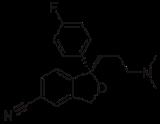
The
skeletal formula of an
organic compoundAn organic compound is any member of a large class of gaseous, liquid, or solid chemical compounds whose molecules contain carbon. For historical reasons discussed below, a few types of carbon-containing compounds such as carbides, carbonates, simple oxides of carbon, and cyanides, as well as the...
is a shorthand representation of its
molecular structureMolecular geometry or molecular structure is the three-dimensional arrangement of the atoms that constitute a molecule. It determines several properties of a substance including its reactivity, polarity, phase of matter, color, magnetism, and biological activity.- Molecular geometry determination...
, developed by the organic chemist,
Friedrich August Kekulé von StradonitzFriedrich August Kekule von Stradonitz was a German organic chemist. From the 1850s until his death, Kekule was one of the most prominent chemists in Europe, especially in theoretical chemistry...
. Skeletal formulae are ubiquitous in
organic chemistryOrganic chemistry is a subdiscipline within chemistry involving the scientific study of the structure, properties, composition, reactions, and preparation of carbon-based compounds, hydrocarbons, and their derivatives...
, because they are relatively quick and simple to draw. Carbon and hydrogen atoms are not shown explicitly. A skeletal formula shows the
skeletal structure or
skeleton of a molecule, which is composed of
skeletal atoms.
The skeleton
The skeletal structure of an organic compound is the string of connected atoms that form the essential structure of the compound. The skeleton can consist of chains, branches and/or rings. Skeletal atoms other than carbon are called
heteroatomIn organic chemistry, a heteroatom is any atom that is not carbon or hydrogen. Usually, the term is used to indicate that non-carbon atoms have replaced carbon in the backbone of the molecular structure...
s.
The skeleton has hydrogen and/or
substituentIn organic chemistry and biochemistry, a substituent is an atom or group of atoms substituted in place of a hydrogen atom on the parent chain of a hydrocarbon...
s bonded to its atoms. Hydrogen is the most common non-carbon atom bonded to carbon and is not explicitly drawn. Heteroatoms and definite groups of atoms are called
functional groupIn organic chemistry, functional groups are specific groups of atoms within molecules that are responsible for the characteristic chemical reactions of those molecules. The same functional group will undergo the same or similar chemical reaction regardless of the size of the molecule it is a part of...
s, as they give the molecule a function. Heteroatoms and functional groups are known collectively as substituents, as they are considered to be a substitute for the hydrogen atom that would be present in the parent
hydrocarbonIn organic chemistry, a hydrocarbon is an organic compound consisting entirely of hydrogen and carbon. Hydrocarbons from which one hydrogen atom has been removed are functional groups, called hydrocarbyls....
of the organic compound in question.
Implicit carbon and hydrogen atoms
For example, in the image below, the skeletal formula of
hexaneHexane is a hydrocarbon with the chemical formula C6H14; that is, an alkane with six carbon atoms.The term may refer to any of four other structural isomers with that formula, or to a mixture of them. In the IUPAC nomenclature, however, hexane is the unbranched isomer ; the other four structures...
is shown. The carbon atom labelled C
1 has only one bond shown to it, so there must also be three hydrogens bonded to it, in order to make its total number of bonds four. The carbon atom labelled C
3 has two bonds to other carbons and is therefore bonded to two hydrogen atoms as well. A
ball-and-stick modelIn chemistry, the ball-and-stick model is a molecular model of a chemical substance which is to display both the three-dimensional position of the atoms and the bonds between them...
of the actual molecular structure of hexane, as determined by
X-ray crystallographyX-ray crystallography is a method of determining the arrangement of atoms within a crystal, in which a beam of X-rays strikes a crystal and causes the beam of light to spread into many specific directions. From the angles and intensities of these diffracted beams, a crystallographer can produce a...
, is shown for comparison, in which carbon atoms are depicted as black balls and hydrogen atoms as white ones.
Any hydrogen atoms bonded to non-carbon atoms
are drawn explicitly. In
ethanolEthanol, also called ethyl alcohol, pure alcohol, grain alcohol, or drinking alcohol, is a volatile, flammable, colorless liquid. It is a psychoactive drug and one of the oldest recreational drugs. Best known as the type of alcohol found in alcoholic beverages, it is also used in thermometers, as a...
, C
2H
5OH, for instance, the hydrogen atom bonded to oxygen is denoted by the symbol H, whereas the hydrogen atoms which are bonded to carbon atoms are not shown directly. Lines representing heteroatom-hydrogen bonds are usually omitted for clarity and compactness, so a functional group like the
hydroxylA hydroxyl is a chemical group containing an oxygen atom covalently bonded with a hydrogen atom. In inorganic chemistry, the hydroxyl group is known as the hydroxide ion, and scientists and reference works generally use these different terms though they refer to the same chemical structure in...
group is most often written −OH instead of −O−H. These bonds are sometimes drawn out in full in order to accentuate their presence when they participate in
reaction mechanismIn chemistry, a reaction mechanism is the step by step sequence of elementary reactions by which overall chemical change occurs.Although only the net chemical change is directly observable for most chemical reactions, experiments can often be designed that suggest the possible sequence of steps in...
s.
Shown below for comparison are a ball-and-stick model of the actual three-dimensional structure of the ethanol molecule in the gas phase (determined by microwave spectroscopy, left), the
Lewis structureLewis structures are diagrams that show the bonding between atoms of a molecule and the lone pairs of electrons that may exist in the molecule. A Lewis structure can be drawn for any covalently bonded molecule, as well as coordination compounds...
(centre) and the skeletal formula (right).
Explicit heteroatoms
All atoms that are not carbon or hydrogen are signified by their
chemical symbolA chemical symbol is a 1- or 2-letter internationally agreed code for a chemical element, usually derived from the name of the element, often in Latin. Only the first letter is capitalised...
, for instance Cl for
chlorineChlorine is the chemical element with atomic number 17 and symbol Cl. It is the second lightest halogen, found in the periodic table in group 17. The element forms diatomic molecules under standard conditions, called dichlorine...
, O for
oxygenOxygen is the element with atomic number 8 and represented by the symbol O. Its name derives from the Greek roots ὀξύς and -γενής , because at the time of naming, it was mistakenly thought that all acids required oxygen in their composition...
and Na for
sodiumSodium is a chemical element with the symbol Na and atomic number 11. It is a soft, silvery-white, highly reactive metal and is a member of the alkali metals; its only stable isotope is 23Na. It is an abundant element that exists in numerous minerals, most commonly as sodium chloride...
. These atoms are commonly known as heteroatoms in the context of organic chemistry.
Pseudoelement symbols
There are also symbols that appear to be
chemical element symbolsA chemical symbol is a 1- or 2-letter internationally agreed code for a chemical element, usually derived from the name of the element, often in Latin. Only the first letter is capitalised...
, but represent certain very common substituents or indicate an unspecified member of a group of elements. These are known as pseudoelement symbols or organic elements. The most widely used symbol is Ph, which represents the
phenyl groupIn organic chemistry, the phenyl group or phenyl ring is a cyclic group of atoms with the formula C6H5. Phenyl groups are closely related to benzene. Phenyl groups have six carbon atoms bonded together in a hexagonal planar ring, five of which are bonded to individual hydrogen atoms, with the...
. A list of pseudoelement symbols is shown below:
Elements
- X for any halogen
The halogens or halogen elements are a series of nonmetal elements from Group 17 IUPAC Style of the periodic table, comprising fluorine , chlorine , bromine , iodine , and astatine...
atom
- D for a deuterium
Deuterium, also called heavy hydrogen, is one of two stable isotopes of hydrogen. It has a natural abundance in Earth's oceans of about one atom in of hydrogen . Deuterium accounts for approximately 0.0156% of all naturally occurring hydrogen in Earth's oceans, while the most common isotope ...
atom
- M for any metal
A metal , is an element, compound, or alloy that is a good conductor of both electricity and heat. Metals are usually malleable and shiny, that is they reflect most of incident light...
atom
- T for a tritium
Tritium is a radioactive isotope of hydrogen. The nucleus of tritium contains one proton and two neutrons, whereas the nucleus of protium contains one proton and no neutrons...
atom
Alkyl groups
- R for any alkyl group or even any substituent
In organic chemistry and biochemistry, a substituent is an atom or group of atoms substituted in place of a hydrogen atom on the parent chain of a hydrocarbon...
at all
- Me for the methyl group
Methyl group is a functional group derived from methane, containing one carbon atom bonded to three hydrogen atoms —CH3. The group is often abbreviated Me. Such hydrocarbon groups occur in many organic compounds. The methyl group can be found in three forms: anion, cation and radical. The anion...
- Et for the ethyl group
In chemistry, an ethyl group is an alkyl substituent derived from ethane . It has the formula -C2H5 and is very often abbreviated -Et.Ethylation is the formation of a compound by introduction of the ethyl functional group, C2H5....
- n-Pr for the propyl
In organic chemistry, propyl is a three-carbon alkyl substituent with chemical formula -C3H7. It is the substituent form of the alkane propane...
group
- i-Pr for the isopropyl
In organic chemistry, isopropyl is a propyl with a group attached to the secondary carbon. If viewed as a functional group an isopropyl is an organic compound with a propyl group attached at its secondary carbon.The bond is therefore on the middle carbon....
group
- Bu for the butyl
In organic chemistry, butyl is a four-carbon alkyl radical or substituent group with general chemical formula -C4H9, derived from either of the two isomers of butane....
group
- i-Bu for the isobutyl group
- s-Bu for the secondary butyl group
- t-Bu for the tertiary butyl group
- Pn for the pentyl
In organic chemistry, pentyl is a five-carbon alkyl substituent with chemical formula -C5H11. It is the substituent form of the alkane pentane. In older literature, the common non-systematic name "amyl" was often used for the pentyl group....
group
- Hx for the hexyl group
- Hp for the heptyl group
- Cy for the cyclohexyl
Cyclohexane is a cycloalkane with the molecular formula C6H12. Cyclohexane is used as a nonpolar solvent for the chemical industry, and also as a raw material for the industrial production of adipic acid and caprolactam, both of which being intermediates used in the production of nylon...
group
Aromatic substituents
- Ar for any aromatic
In organic chemistry, Aromaticity is a chemical property in which a conjugated ring of unsaturated bonds, lone pairs, or empty orbitals exhibit a stabilization stronger than would be expected by the stabilization of conjugation alone. The earliest use of the term was in an article by August...
substituent
- Bn for the benzyl
In organic chemistry, benzyl is the term used to describe the substituent or molecular fragment possessing the structure C6H5CH2-. Benzyl features a benzene ring attached to a CH2 group.-Nomenclature:...
group
- Bz for the benzoyl
In organic chemistry, benzoyl is the acyl of benzoic acid, with structure C6H5CO-. It should not be confused with benzyl, which is the radical or ion formed from the removal of one of the methyl hydrogens of toluene...
group
- Mes for the mesityl group
- Ph for the phenyl group
In organic chemistry, the phenyl group or phenyl ring is a cyclic group of atoms with the formula C6H5. Phenyl groups are closely related to benzene. Phenyl groups have six carbon atoms bonded together in a hexagonal planar ring, five of which are bonded to individual hydrogen atoms, with the...
- Tol for the tolyl
Toluene, formerly known as toluol, is a clear, water-insoluble liquid with the typical smell of paint thinners. It is a mono-substituted benzene derivative, i.e., one in which a single hydrogen atom from the benzene molecule has been replaced by a univalent group, in this case CH3.It is an aromatic...
group
- Cp for the cyclopentadienyl
A cyclopentadienyl complex is a metal complex with one or more cyclopentadienyl groups . Based on the type of bonding between the metals and the cyclopentadienyl]] moieties, cyclopentadienyl complexes are classified into the following three categories: a) π-complexes, b) σ-complexes, and c) ionic...
group
- Cp* for the pentamethylcyclopentadienyl
A cyclopentadienyl complex is a metal complex with one or more cyclopentadienyl groups . Based on the type of bonding between the metals and the cyclopentadienyl]] moieties, cyclopentadienyl complexes are classified into the following three categories: a) π-complexes, b) σ-complexes, and c) ionic...
group
Functional groups
- Ac for the acetyl
In organic chemistry, acetyl is a functional group, the acyl with chemical formula COCH3. It is sometimes represented by the symbol Ac . The acetyl group contains a methyl group single-bonded to a carbonyl...
group (Ac is also the symbol for the element actiniumActinium is a radioactive chemical element with the symbol Ac and atomic number 89, which was discovered in 1899. It was the first non-primordial radioactive element to be isolated. Polonium, radium and radon were observed before actinium, but they were not isolated until 1902...
. However, actinium is almost never encountered in organic chemistry, so the use of Ac to represent the acetyl group never causes confusion)
Leaving groups
See the article leaving groupIn chemistry, a leaving group is a molecular fragment that departs with a pair of electrons in heterolytic bond cleavage. Leaving groups can be anions or neutral molecules. Common anionic leaving groups are halides such as Cl−, Br−, and I−, and sulfonate esters, such as para-toluenesulfonate...
for further information
- Bs for the brosyl group
- Ns for the nosyl group
- Tf for the trifyl
Trifluoromethanesulfonate, also known by the trivial name triflate, is a functional group with the formula CF3SO3-. The triflate group is often represented by -OTf, as opposed to -Tf...
group
- Ts for tosyl
A tosyl group is CH3C6H4SO2. This group is usually derived from the compound 4-toluenesulfonyl chloride, CH3C6H4SO2Cl, which forms esters and amides of toluenesulfonic or tosylic acid...
group
Multiple bonds
Two atoms can be bonded by sharing more than one pair of electrons. The common bonds to carbon are single, double and triple bonds. Single bonds are most common and are represented by a single, solid line between two atoms in a skeletal formula. Double bonds are denoted by two parallel lines, and triple bonds are shown by three parallel lines.
In more advanced theories of bonding, non-
integerThe integers are formed by the natural numbers together with the negatives of the non-zero natural numbers .They are known as Positive and Negative Integers respectively...
values of
bond orderBond order is the number of chemical bonds between a pair of atoms. For example, in diatomic nitrogen N≡N the bond order is 3, while in acetylene H−C≡C−H the bond order between the two carbon atoms is also 3, and the C−H bond order is 1. Bond order gives an indication to the stability of a bond....
exist. In these cases, a combination of solid and dashed lines indicate the integer and non-integer parts of the bond order, respectively.
N.B.Nota bene is an Italian and Latin phrase meaning "note well". The phrase first appeared in writing circa 1721.Often abbreviated as "N. B.", nota bene comes from the Latin roots notāre and bene . It is in the singular imperative mood, instructing one individual to note well the matter at hand...
in the gallery above, double bonds have been shown in red and triple bonds in blue. This was added for clarity - multiple bonds are not normally coloured in skeletal formulae.
Benzene rings
BenzeneBenzene is an organic chemical compound. It is composed of 6 carbon atoms in a ring, with 1 hydrogen atom attached to each carbon atom, with the molecular formula C6H6....
rings are common in
organic compoundsOrganic chemistry is a subdiscipline within chemistry involving the scientific study of the structure, properties, composition, reactions, and preparation of carbon-based compounds, hydrocarbons, and their derivatives...
. To represent the delocalization of
electronThe electron is a subatomic particle with a negative elementary electric charge. It has no known components or substructure; in other words, it is generally thought to be an elementary particle. An electron has a mass that is approximately 1/1836 that of the proton...
s over the six carbon atoms in the ring, a circle is drawn inside the hexagon of single bonds. This style is very common in introductory organic chemistry texts used in schools.
An alternative style that is more common in academia is the Kekulé structure. Although it could be considered inaccurate as it implies three single bonds and three double bonds (benzene would therefore be 1,3,5-cyclohexatriene), all qualified
chemistA chemist is a scientist trained in the study of chemistry. Chemists study the composition of matter and its properties such as density and acidity. Chemists carefully describe the properties they study in terms of quantities, with detail on the level of molecules and their component atoms...
s are fully aware of the delocalization in benzene. Kekulé structures are useful for drawing
reaction mechanismIn chemistry, a reaction mechanism is the step by step sequence of elementary reactions by which overall chemical change occurs.Although only the net chemical change is directly observable for most chemical reactions, experiments can often be designed that suggest the possible sequence of steps in...
s clearly.
Stereochemistry
StereochemistryStereochemistry, a subdiscipline of chemistry, involves the study of the relative spatial arrangement of atoms within molecules. An important branch of stereochemistry is the study of chiral molecules....
is conveniently denoted in skeletal formulae:
- solid lines represent bonds
A covalent bond is a form of chemical bonding that is characterized by the sharing of pairs of electrons between atoms. The stable balance of attractive and repulsive forces between atoms when they share electrons is known as covalent bonding....
in the plane of the paper or screen
- wedges represent bonds that point out of the plane of the paper or screen, towards the observer
- dashed lines represent bonds that point into the plane of the paper or screen, away from the observer
- wavy lines represent either unknown stereochemistry or a mixture of the two possible stereoisomers at that point
Skeletal formulae can depict
cis and
trans isomers of alkenes. Wavy single bonds are the standard way to represent unknown or unspecified stereochemistry or a mixture of isomers (as with tetrahedeal stereocenters). A crossed double-bond has been used sometimes, but is no longer considered an acceptable style.
External links