

Sirocco

Encyclopedia
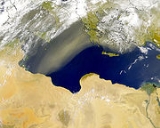
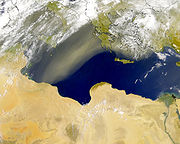
Sirocco, scirocco, icon, jugo or, rarely, siroc is a Mediterranean wind
that comes from the Sahara
and reaches hurricane speeds in North Africa
and Southern Europe
. It is known in North Africa by the Arabic word qibli or ghibli (قبلي i.e. "coming from the qibla
".)
 Scirocco and Sirocco are Italian
names from which its Greek name, "σιρόκος" (sirokos), is derived, while ghibli is its name in Libya
. The name jugo, jûgɔ, used in Croatia
, Montenegro
, Serbia
, Bosnia and Hercegovina, Macedonia
, Slovenia
, Slovakia
and the Czech Republic
comes from the Slavic
word jug, which means south. The origin of the Italian "scirocco" might be related to the Arabic
شرقي sharqī 'eastern', for easterly wind. The sirocco reaching the south of France
is much dryer than the marin
, which is a warm, humid wind also moving to the northwest. In the Canary Islands this oppressive, hot, dust bearing wind is called la calima. The name of sirocco in the southeast of Spain
is leveche
, and xaloc in Catalan
. The leveche usually carries red Sahara
dust and is associated with storms and heavy rain, the wind being very strong, lasting about 4 days. In Malta
, it is known as xlokk. In Levantine Arabic
(Lebanon, Syria) a similar wind is referred to as شلوق shlūq.
, with the wind originating in the Arabian or Sahara desert
s. The hotter, drier continental air mixes with the cooler, wetter air of the maritime cyclone
, and the counter-clockwise circulation of the low propels the mixed air across the southern coasts of Europe
.
Sirocco winds with speeds of up to 100 kilometres per hour are most common during the autumn and the spring. They reach a peak in March and in November when it is very hot, with a maximum speed of about 100 km/h (55 knots).
(northwestern) and the llebeig/lebeccio/lebić
(southwestern).
Wind
Wind is the flow of gases on a large scale. On Earth, wind consists of the bulk movement of air. In outer space, solar wind is the movement of gases or charged particles from the sun through space, while planetary wind is the outgassing of light chemical elements from a planet's atmosphere into space...
that comes from the Sahara
Sahara
The Sahara is the world's second largest desert, after Antarctica. At over , it covers most of Northern Africa, making it almost as large as Europe or the United States. The Sahara stretches from the Red Sea, including parts of the Mediterranean coasts, to the outskirts of the Atlantic Ocean...
and reaches hurricane speeds in North Africa
North Africa
North Africa or Northern Africa is the northernmost region of the African continent, linked by the Sahara to Sub-Saharan Africa. Geopolitically, the United Nations definition of Northern Africa includes eight countries or territories; Algeria, Egypt, Libya, Morocco, South Sudan, Sudan, Tunisia, and...
and Southern Europe
Southern Europe
The term Southern Europe, at its most general definition, is used to mean "all countries in the south of Europe". However, the concept, at different times, has had different meanings, providing additional political, linguistic and cultural context to the definition in addition to the typical...
. It is known in North Africa by the Arabic word qibli or ghibli (قبلي i.e. "coming from the qibla
Qibla
The Qiblah , also transliterated as Qibla, Kiblah or Kibla, is the direction that should be faced when a Muslim prays during salah...
".)
Origin of name
Italian language
Italian is a Romance language spoken mainly in Europe: Italy, Switzerland, San Marino, Vatican City, by minorities in Malta, Monaco, Croatia, Slovenia, France, Libya, Eritrea, and Somalia, and by immigrant communities in the Americas and Australia...
names from which its Greek name, "σιρόκος" (sirokos), is derived, while ghibli is its name in Libya
Libya
Libya is an African country in the Maghreb region of North Africa bordered by the Mediterranean Sea to the north, Egypt to the east, Sudan to the southeast, Chad and Niger to the south, and Algeria and Tunisia to the west....
. The name jugo, jûgɔ, used in Croatia
Croatia
Croatia , officially the Republic of Croatia , is a unitary democratic parliamentary republic in Europe at the crossroads of the Mitteleuropa, the Balkans, and the Mediterranean. Its capital and largest city is Zagreb. The country is divided into 20 counties and the city of Zagreb. Croatia covers ...
, Montenegro
Montenegro
Montenegro Montenegrin: Crna Gora Црна Гора , meaning "Black Mountain") is a country located in Southeastern Europe. It has a coast on the Adriatic Sea to the south-west and is bordered by Croatia to the west, Bosnia and Herzegovina to the northwest, Serbia to the northeast and Albania to the...
, Serbia
Serbia
Serbia , officially the Republic of Serbia , is a landlocked country located at the crossroads of Central and Southeast Europe, covering the southern part of the Carpathian basin and the central part of the Balkans...
, Bosnia and Hercegovina, Macedonia
Republic of Macedonia
Macedonia , officially the Republic of Macedonia , is a country located in the central Balkan peninsula in Southeast Europe. It is one of the successor states of the former Yugoslavia, from which it declared independence in 1991...
, Slovenia
Slovenia
Slovenia , officially the Republic of Slovenia , is a country in Central and Southeastern Europe touching the Alps and bordering the Mediterranean. Slovenia borders Italy to the west, Croatia to the south and east, Hungary to the northeast, and Austria to the north, and also has a small portion of...
, Slovakia
Slovakia
The Slovak Republic is a landlocked state in Central Europe. It has a population of over five million and an area of about . Slovakia is bordered by the Czech Republic and Austria to the west, Poland to the north, Ukraine to the east and Hungary to the south...
and the Czech Republic
Czech Republic
The Czech Republic is a landlocked country in Central Europe. The country is bordered by Poland to the northeast, Slovakia to the east, Austria to the south, and Germany to the west and northwest....
comes from the Slavic
Slavic languages
The Slavic languages , a group of closely related languages of the Slavic peoples and a subgroup of Indo-European languages, have speakers in most of Eastern Europe, in much of the Balkans, in parts of Central Europe, and in the northern part of Asia.-Branches:Scholars traditionally divide Slavic...
word jug, which means south. The origin of the Italian "scirocco" might be related to the Arabic
Arabic language
Arabic is a name applied to the descendants of the Classical Arabic language of the 6th century AD, used most prominently in the Quran, the Islamic Holy Book...
شرقي sharqī 'eastern', for easterly wind. The sirocco reaching the south of France
France
The French Republic , The French Republic , The French Republic , (commonly known as France , is a unitary semi-presidential republic in Western Europe with several overseas territories and islands located on other continents and in the Indian, Pacific, and Atlantic oceans. Metropolitan France...
is much dryer than the marin
Marin (wind)
The Marin is a warm, moist wind in the Gulf of Lion of France, blowing from the southeast or south-southeast onto the coast of Languedoc and Roussillon. It brings rain to this region which it has picked up crossing the Mediterranean, and also can bring coastal fog...
, which is a warm, humid wind also moving to the northwest. In the Canary Islands this oppressive, hot, dust bearing wind is called la calima. The name of sirocco in the southeast of Spain
Spain
Spain , officially the Kingdom of Spain languages]] under the European Charter for Regional or Minority Languages. In each of these, Spain's official name is as follows:;;;;;;), is a country and member state of the European Union located in southwestern Europe on the Iberian Peninsula...
is leveche
Leveche
Lebeche is the Spanish name for a warm southwest wind in parts of coastal Mediterranean Spain, either a foehn wind or a hot southerly wind in advance of a low pressure area moving from the Sahara Desert...
, and xaloc in Catalan
Catalan language
Catalan is a Romance language, the national and only official language of Andorra and a co-official language in the Spanish autonomous communities of Catalonia, the Balearic Islands and Valencian Community, where it is known as Valencian , as well as in the city of Alghero, on the Italian island...
. The leveche usually carries red Sahara
Sahara
The Sahara is the world's second largest desert, after Antarctica. At over , it covers most of Northern Africa, making it almost as large as Europe or the United States. The Sahara stretches from the Red Sea, including parts of the Mediterranean coasts, to the outskirts of the Atlantic Ocean...
dust and is associated with storms and heavy rain, the wind being very strong, lasting about 4 days. In Malta
Malta
Malta , officially known as the Republic of Malta , is a Southern European country consisting of an archipelago situated in the centre of the Mediterranean, south of Sicily, east of Tunisia and north of Libya, with Gibraltar to the west and Alexandria to the east.Malta covers just over in...
, it is known as xlokk. In Levantine Arabic
Levantine Arabic
Levantine Arabic is a broad variety of Arabic spoken in the 100 to 200 km-wide Eastern Mediterranean coastal strip...
(Lebanon, Syria) a similar wind is referred to as شلوق shlūq.
Development
It arises from a warm, dry, tropical airmass that is pulled northward by low-pressure cells moving eastward across the Mediterranean SeaMediterranean Sea
The Mediterranean Sea is a sea connected to the Atlantic Ocean surrounded by the Mediterranean region and almost completely enclosed by land: on the north by Anatolia and Europe, on the south by North Africa, and on the east by the Levant...
, with the wind originating in the Arabian or Sahara desert
Desert
A desert is a landscape or region that receives an extremely low amount of precipitation, less than enough to support growth of most plants. Most deserts have an average annual precipitation of less than...
s. The hotter, drier continental air mixes with the cooler, wetter air of the maritime cyclone
Cyclone
In meteorology, a cyclone is an area of closed, circular fluid motion rotating in the same direction as the Earth. This is usually characterized by inward spiraling winds that rotate anticlockwise in the Northern Hemisphere and clockwise in the Southern Hemisphere of the Earth. Most large-scale...
, and the counter-clockwise circulation of the low propels the mixed air across the southern coasts of Europe
Europe
Europe is, by convention, one of the world's seven continents. Comprising the westernmost peninsula of Eurasia, Europe is generally 'divided' from Asia to its east by the watershed divides of the Ural and Caucasus Mountains, the Ural River, the Caspian and Black Seas, and the waterways connecting...
.
Effects
The Sirocco causes dusty dry conditions along the northern coast of Africa, storms in the Mediterranean Sea, and cool wet weather in Europe. The Sirocco's duration may be as short as half a day or may last several days. Many people attribute health problems to the Sirocco either because of the heat and dust along the African coastal regions or because of the cool dampness in Europe. The dust within the Sirocco winds can cause abrasion in mechanical devices and penetrate buildings.Sirocco winds with speeds of up to 100 kilometres per hour are most common during the autumn and the spring. They reach a peak in March and in November when it is very hot, with a maximum speed of about 100 km/h (55 knots).
Similar winds
Other prominent wind systems in the region are the bora/bura/burjaBora (wind)
Bora or Bura is a northern to north-eastern katabatic wind in the Adriatic, Bosnia and Herzegovina, Croatia, Montenegro, Italy, Greece, Slovenia, and Turkey....
(northwestern) and the llebeig/lebeccio/lebić
Libeccio
The libeccio is the westerly or south-westerly wind which predominates in northern Corsica all year round; it frequently raises high seas and may give violent westerly squalls. In summer it is most persistent, but in winter it alternates with the Tramontane...
(southwestern).
See also
- Bora (wind)Bora (wind)Bora or Bura is a northern to north-eastern katabatic wind in the Adriatic, Bosnia and Herzegovina, Croatia, Montenegro, Italy, Greece, Slovenia, and Turkey....
- CherguiChergui (wind)Chergui or Sharqi is the name of the hot wind in Morocco coming from the Sahara . The arabic word means "coming from the east", as the Chergui emenates from the desert east of the Atlas mountains...
- EtesianEtesianThe etesians ', sometimes found in the Latin form etesiae), meltemi μελτέμι , or meltem are the strong, dry north windsof the Aegean Sea, which blow from about mid-May to mid-September...
- Fremantle doctorFremantle DoctorThe Fremantle Doctor, the Freo Doctor, or simply The Doctor, is the Western Australian vernacular term for the cooling afternoon sea breeze which occurs during summer months in south west coastal areas of Western Australia...
- GregaleGregaleThe Gregale is a Mediterranean wind that can occur during times when a low pressure area moves through the area to the south of Malta and causes a strong, cool, northeasterly wind to affect the island...
- Khamaseen
- LevantadesLevantadesGales from between north-north-east and east-north-east are the most important gales of the east coast of Spain. They are known locally as llevantades and are an intense form of the llevante or levanter, i.e., north-easterly winds of long fetch, as opposed to diurnal coastal breezes...
- LesteLeste-Description:It is similar to the Leveche. It blows from an easterly direction in autumn,winter and spring, rarely in summer, and is of intense dryness,sometimes reducing the relative humidity at Funchal to below20%...
- LevecheLevecheLebeche is the Spanish name for a warm southwest wind in parts of coastal Mediterranean Spain, either a foehn wind or a hot southerly wind in advance of a low pressure area moving from the Sahara Desert...
- Marin (wind)Marin (wind)The Marin is a warm, moist wind in the Gulf of Lion of France, blowing from the southeast or south-southeast onto the coast of Languedoc and Roussillon. It brings rain to this region which it has picked up crossing the Mediterranean, and also can bring coastal fog...
- Mistral (wind)Mistral (wind)The mistral is a strong, cold and usually dry regional wind in France, coming from the north or northwest, which accelerates when it passes through the valleys of the Rhone and the Durance Rivers to the coast of the Mediterranean around the Camargue region. It affects the northeast of the plain...
- SimoomSimoomSimoom is a strong, dry, dust-laden local wind that blows in the Sahara, Palestine, Israel, Jordan, Syria, and the deserts of Arabian Peninsula. Alternative spellings include samiel, sameyel, samoon, samun, simoun, and simoon...
- SoutherlySoutherlySoutherly is the name of a storm or front of air coming from the south. In the Southern Hemisphere these can be cold and have bad weather. In Wellington, New Zealand these storms are normally short and frequently have winds gusting between 120 km/h and 160 km/h though higher speeds are...
/Southerly buster - SukhoveySukhoveySukhovey is a wind with high temperature and low relative humidity occurring in the steppes, the semi-deserts and the deserts of Kazakhstan and the Caspian region.The speed of sukhovey is usually moderate 5 to 20 m/s. Relative humidity is less than 30%...