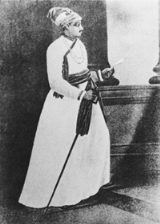
Mîrzâ Muhammad Sirâj-ud-Daulah ' onMouseout='HidePop("53191")' href="http://www.absoluteastronomy.com/topics/Bengali_language">Bengali
Bengali or Bangla is an eastern Indo-Aryan language. It is native to the region of eastern South Asia known as Bengal, which comprises present day Bangladesh, the Indian state of West Bengal, and parts of the Indian states of Tripura and Assam. It is written with the Bengali script...
:
নবাব সিরাজদৌল্লা), more commonly known as
Siraj ud-Daulah (1729 – July 2, 1757), was the last independent
Nawab of Bengal, Bihar and OrissaThe Nawabs of Bengal were the hereditary nazims or subadars of the subah of Bengal during the Mughal rule and the de-facto rulers of the province.-History:...
. The end of his reign marks the start of
British East India CompanyThe East India Company was an early English joint-stock company that was formed initially for pursuing trade with the East Indies, but that ended up trading mainly with the Indian subcontinent and China...
rule over Bengal and later almost all of
South AsiaSouth Asia, also known as Southern Asia, is the southern region of the Asian continent, which comprises the sub-Himalayan countries and, for some authorities , also includes the adjoining countries to the west and the east...
. He was sometimes called, and his name rendered, "
Sir Roger Dowler" or "
Sir Roger Dowlah" by some of his British contemporaries, and "
Sau Raja Dowla" by
John HolwellJohn Zephaniah Holwell FRS was a surgeon, an employee of the English East India Company, and a temporary Governor of Bengal...
, as the title of Nawab or Nabob was rendered "
Nawale", and Allahabad became "
Isle of Bats". However these distorted early English renderings, among others like "
Sepoy", were rebuked and ridiculed by later writers.
Early years
Siraj's father Zain-ud-din was the ruler of
BiharBihar is a state in eastern India. It is the 12th largest state in terms of geographical size at and 3rd largest by population. Almost 58% of Biharis are below the age of 25, which is the highest proportion in India....
and his mother Amina Begum was the youngest daughter of Nawab Ali Vardi Khan. Since Ali Vardi had no son, Siraj, as his grandson, became very close to him and since his childhood was seen by many as successor to the throne of Murshidabad. Accordingly, he was raised at the nawab's palace with all necessary education and training suitable for a future nawab. Young Siraj also accompanied Ali Vardi in his military ventures against the
MarathaThe Maratha are an Indian caste, predominantly in the state of Maharashtra. The term Marāthā has three related usages: within the Marathi speaking region it describes the dominant Maratha caste; outside Maharashtra it can refer to the entire regional population of Marathi-speaking people;...
s in 1746. Ali Vardi Khan in 1752 officially declared his grandson
Crown PrinceA crown prince or crown princess is the heir or heiress apparent to the throne in a royal or imperial monarchy. The wife of a crown prince is also titled crown princess....
and successor to the throne, creating no small amount of division in the family and the royal court.
Reign as Nawab
Mirza Muhammad Siraj succeeded Ali Vardi Khan as the
NawabA Nawab or Nawaab is an honorific title given to Muslim rulers of princely states in South Asia. It is the Muslim equivalent of the term "maharaja" that was granted to Hindu rulers....
of
BengalBengal is a historical and geographical region in the northeast region of the Indian Subcontinent at the apex of the Bay of Bengal. Today, it is mainly divided between the sovereign land of People's Republic of Bangladesh and the Indian state of West Bengal, although some regions of the previous...
in April 1756 at the age of 23, and took the name Siraj-ud-Daulah. Siraj-ud-Daulah's nomination to the nawabship aroused the jealousy and enmity of
Ghaseti BegumGhaseti Begum was the eldest daughter of Ali Vardi Khan, Nawab of Bengal, Bihar and Orissa during 1740-1758.-Early life:Ghaseti Begum married her cousin, Nawazish Muhammad Khan Shahmat Jang, the Naib-Nazim of Dhaka. Being childless, the couple adopted Ikramuddaula, the younger brother of Siraj...
(the eldest sister of Siraj's mother), Raja Rajballabh,
Mir Jafar Ali Khan-Notes:# "Riyazu-s-salatin", Ghulam Husain Salim - a reference to the appointment of Mohanlal can be found # "Seir Muaqherin", Ghulam Husain Tabatabai - a reference to the conspiracy can be found...
and Shaukat Jung (Siraj's cousin).
Ghaseti BegumGhaseti Begum was the eldest daughter of Ali Vardi Khan, Nawab of Bengal, Bihar and Orissa during 1740-1758.-Early life:Ghaseti Begum married her cousin, Nawazish Muhammad Khan Shahmat Jang, the Naib-Nazim of Dhaka. Being childless, the couple adopted Ikramuddaula, the younger brother of Siraj...
possessed huge wealth, which was the source of her influence and strength. Apprehending serious opposition from her, Sirajuddaula seized her wealth from Motijheel Palace and placed her in confinement. The Nawab also gave high government positions to his favourites. Mir Mardan was appointed Bakshi (Paymaster of the army) in place of
Mir Jafar-Notes:# "Riyazu-s-salatin", Ghulam Husain Salim - a reference to the appointment of Mohanlal can be found # "Seir Muaqherin", Ghulam Husain Tabatabai - a reference to the conspiracy can be found...
. Mohanlal was elevated to the post of peshkar of his Dewan Khana and he exercised great influence in the administration. Eventually Siraj suppressed Shaukat Jang, governor of
PurniaPurnia is a city and a Municipal Corporation in Purnia district of the Indian state of Bihar. It is located 400 km from Patna.The Indian army, Border Security Force ,and the SSB and the have bases around the city...
, who was killed in a clash.It is very important.
Black Hole of Calcutta
He, as the direct political disciple of his grandfather, was aware of the global British interest in colonization and hence, resented the British politico-military presence in Bengal represented by the British East India Company. He was annoyed at the company's alleged involvement with and instigation of some members of his own court in a conspiracy to oust him. His charges against the company were mainly threefold. Firstly, that they strengthened the fortification around the Fort William without any intimation and approval; secondly, that they grossly abused the trade privileges granted to them by the Mughal rulers, which caused heavy loss of customs duties for the government; and thirdly, that they gave shelter to some of his officers, for example Krishnadas, son of Rajballav, who fled
DhakaDhaka is the capital of Bangladesh and the principal city of Dhaka Division. Dhaka is a megacity and one of the major cities of South Asia. Located on the banks of the Buriganga River, Dhaka, along with its metropolitan area, had a population of over 15 million in 2010, making it the largest city...
after misappropriating government funds. Hence, when the East India Company started further enhancement of military preparedness at Fort William in Calcutta, Siraj asked them to stop. The Company did not heed his directives, so Siraj-Ud-Daulah retaliated and captured
KolkataKolkata , formerly known as Calcutta, is the capital of the Indian state of West Bengal. Located on the east bank of the Hooghly River, it was the commercial capital of East India...
(Shortly renamed as Alinagar) from the British in June 1756. During this time, he is alleged to have put 146 British subjects in a 20 by 20 foot chamber, known as the infamous
Black Hole of CalcuttaThe Black Hole of Calcutta was a small dungeon in the old Fort William, at Calcutta, India, where troops of the Nawab of Bengal, Siraj ud-Daulah, held British prisoners of war after the capture of the Fort on June 19, 1756....
; only 23 were said to have survived the overnight ordeal. The real facts around the incident are disputed by later historians, but at that time the lurid account of this incident by one survivor – Holwell – obtained wide circulation in England and helped gain support for the East India Company's continued conquest of India.
Sir William MeredithSir William Meredith, 3rd Baronet was a British politician of the late 18th Century, one of the Rockingham Whigs.Meredith represented Wigan in the House of Commons from 1754 to 1761, and then Liverpool until 1780. From 1765 to 1766, he briefly served as a Lord of the Admiralty...
, during the Parliamentary inquiry into Robert Clive's actions in India, vindicated Siraj ud-Daulah of any charges surrounding the Black Hole incident: :"It is true, that when he took Calcutta a very lamentable event happened, I mean the story of the Black Hole; but that catastrophe can never be attributed to the intention, for it was without the knowledge of the prince. I remember a similar accident happening in St. Martin's roundhouse; but it should appear very ridiculous, were I, on that account, to attribute any guilt or imputation of cruelty to the memory of the late king, in whose reign it happened. A peace was however agreed upon with Surajah Dowlah; and the persons who went as ambassadors to confirm that peace, formed the conspiracy, by which he was deprived of his kingdom and his life."http://books.google.com/books?id=DLE_AAAAYAAJ&pg=PT449
Conspiracy to overthrow Siraj ud-Daulah
The Nawab was infuriated on learning of the attack on Chandernagar. His former hatred of the British returned, but he now felt the need to strengthen himself by alliances against the British. The Nawab was plagued by fear of attack from the north by the Afghans under
Ahmad Shah DurraniAhmad Shah Durrani , also known as Ahmad Shāh Abdālī and born as Ahmad Khān, was the founder of the Durrani Empire in 1747 and is regarded by many to be the founder of the modern state of Afghanistan.Ahmad Khan enlisted as a young soldier in the military of the Afsharid kingdom and quickly rose...
and from the west by the Marathas. Therefore, he could not deploy his entire force against the British for fear of being attacked from the flanks. A deep distrust set in between the British and the Nawab. As a result, Siraj started secret negotiations with Jean Law, chief of the French factory at Cossimbazar, and de Bussy. The Nawab also moved a large division of his army under Rai Durlabh to Plassey, on the island of Cossimbazar 30 miles (48.3 km) south of Murshidabad.Harrington, p. 25Mahon, p. 337Orme, p. 145Malleson, pp. 48–49 Popular discontent against the Nawab flourished in his own court. The Seths, the traders of Bengal, were in perpetual fear for their wealth under the reign of Siraj, contrary to the situation under Alivardi’s reign. They had engaged Yar Lutuf Khan to defend them in case they were threatened in any way.Bengal, v.1, p. clxxxi
William WattsWilliam Watts was chief of the Kasimbazar factory of the British East India Company. He lived in Bengal, and he was proficient in Bangla, Hindustani and Persian languages.-Career:...
, the Company representative at the court of Siraj, informed Clive about a conspiracy at the court to overthrow the ruler. The conspirators included
Mir Jafar-Notes:# "Riyazu-s-salatin", Ghulam Husain Salim - a reference to the appointment of Mohanlal can be found # "Seir Muaqherin", Ghulam Husain Tabatabai - a reference to the conspiracy can be found...
, paymaster of the army, Rai Durlabh, Yar Lutuf Khan and
OmichundOmichund or Amir Chand was a man in colonial India, whose name is indelibly associated with the treaty negotiated by Robert Clive before the Battle of Plassey in 1757...
(Amir Chand), a Sikh merchant, and several officers in the army.Bengal, v.1, pp. clxxxiii–clxxxiv When communicated in this regard by Mir Jafar, Clive referred it to the select committee in Calcutta on 1 May. The committee passed a resolution in support of the alliance. A treaty was drawn between the British and Mir Jafar to raise him to the throne of the Nawab in return for support to the British in the field of battle and the bestowal of large sums of money upon them as compensation for the attack on Calcutta. On 2 May, Clive broke up his camp and sent half the troops to Calcutta and the other half to Chandernagar.Malleson, pp. 49–51Harrington, pp. 25–29Mahon, pp. 338–339Orme, pp. 147–149 Mir Jafar and the Seths desired that the confederacy between the British and himself be kept secret from
OmichundOmichund or Amir Chand was a man in colonial India, whose name is indelibly associated with the treaty negotiated by Robert Clive before the Battle of Plassey in 1757...
, but when he found out about it, he threatened to betray the conspiracy if his share was not increased to three million rupees (£ 300,000). Hearing of this, Clive suggested an expedient to the Committee. He suggested that two treaties be drawn – the real one on white paper, containing no reference to Omichund and the other on red paper, containing Omichund’s desired stipulation, to deceive him. The Members of the Committee signed on both treaties, but Admiral Watson signed only the real one and his signature had to be counterfeited on the fictitious one.Bengal, v.1, pp. clxxxvi–clxxxix Both treaties and separate articles for donations to the army, navy squadron and committee were signed by Mir Jafar on 4 June.Orme, pp. 150–161Harrington, p. 29Mahon, pp. 339–341Bengal, v.1, pp. cxcii–cxciii Lord Clive testified and defended himself thus before the House of Commons of Parliament on May 10, 1773, during the Parliamentary inquiry into his conduct in India: :"Omichund, his confidential servant, as
he thought, told his master of an agreement made between the English and Monsieur Duprée [a general of the French East India Company] to attack him, and received for that advice a sum of not less than four lacks of rupees. Finding this to be the man in whom the nawab entirely trusted, it soon became our object to consider him as a most material engine in the intended revolution. We therefore made such an agreement as was necessary for the purpose, and entered into a treaty with him to satisfy his demands. When all things were prepared, and the evening of the event was appointed, Omichund informed Mr. Watts, who was at the court of the nabob, that he insisted upon thirty lacks of rupees, and five per cent. upon all the treasure that should be found; that, unless that was immediately complied with, he would disclose the whole to the nabob; and that Mr. Watts, and the two other English gentlemen then at the court, should be cut off before the morning. Mr. Watts, immediately on this information, dispatched an express to me at the council. I did not hesitate to find out a stratagem to save the lives of these people, and secure success to the intended event. For this purpose we signed another treaty. The one was called the
Red, the other the
White treaty. This treaty was signed by every one, except admiral Watson; and I should have considered myself sufficiently authorised to put his name to it, by the conversation I had with him. As to the person who signed admiral Watson's name to the treaty, whether he did it in his presence or not, I cannot say; but this I know, that he thought he had sufficient authority for so doing. This treaty was immediately sent to Omichund, who did not suspect the stratagem. The event took place, and success attended it; and the House, I am fully persuaded, will agree with me, that, when the very existence of the Company was at stake, and the lives of these people so precariously situated, and so certain of being destroyed, it was a matter of true policy and of justice to deceive so great a villain."
The Battle of Plassey
The
Battle of PlasseyThe Battle of Plassey , 23 June 1757, was a decisive British East India Company victory over the Nawab of Bengal and his French allies, establishing Company rule in South Asia which expanded over much of the Indies for the next hundred years...
(or Palashi) is widely considered the turning point in the history of India, and opened the way to eventual British domination. After Siraj-Ud-Daulah's conquest of Calcutta, the British sent fresh troops from Madras to recapture the fort and avenge the attack. A retreating Siraj-Ud-Daulah met the British at Plassey. Siraj-ud-Daulah had to make --182.177.145.249 (talk) 13:56, 27 October 2011 (UTC)--182.177.145.249 (talk) 13:56, 27 October 2011 (UTC)camp 27 miles away from
MurshidabadMurshidabad is a city in Murshidabad district of West Bengal state in India. The city of Murshidabad is located on the southern bank of the Bhagirathi, a distributary of the Ganges River. It was the capital of undivided Bengal during the Mughal rule. Nawabs of Bengal used to rule Bengal from this...
. On 23 June 1757 Siraj-Ud-Daulah called on
Mir Jafar-Notes:# "Riyazu-s-salatin", Ghulam Husain Salim - a reference to the appointment of Mohanlal can be found # "Seir Muaqherin", Ghulam Husain Tabatabai - a reference to the conspiracy can be found...
because he was saddened by the sudden fall of Mir Madan who was a very dear companion of Siraj in battles. The Nawab asked for Ponka help from
Mir Jafar-Notes:# "Riyazu-s-salatin", Ghulam Husain Salim - a reference to the appointment of Mohanlal can be found # "Seir Muaqherin", Ghulam Husain Tabatabai - a reference to the conspiracy can be found...
.
Mir Jafar-Notes:# "Riyazu-s-salatin", Ghulam Husain Salim - a reference to the appointment of Mohanlal can be found # "Seir Muaqherin", Ghulam Husain Tabatabai - a reference to the conspiracy can be found...
advised Siraj to retreat for that day. The Nawab made the blunder in giving the order to stop the war. Following his command, the soldiers of the Nawab were returning to their camps. At that time,
Robert CliveMajor-General Robert Clive, 1st Baron Clive, KB , also known as Clive of India, was a British officer who established the military and political supremacy of the East India Company in Bengal. He is credited with securing India, and the wealth that followed, for the British crown...
attacked the soldiers with his army. At such a sudden attack, the army of Siraj became indisciplined and could think of no way to fight. So all fled away in such a situation. Betrayed by a conspiracy hatched by
Jagat SethJagat Seth was a rich businessman from Murshidabad during the rule of Nawab Siraj-ud-Daula. He came from a rich Jain Marwari business family in Murshidabad. His spiritual guru was Jain Acharya Sri BhratruChandra Suri. Jagat Seths were among the most powerful bankers of India during the first half...
,
Mir Jafar-Notes:# "Riyazu-s-salatin", Ghulam Husain Salim - a reference to the appointment of Mohanlal can be found # "Seir Muaqherin", Ghulam Husain Tabatabai - a reference to the conspiracy can be found...
, Krishna Chandra, Umi Chand etc., he lost the battle and had to escape. He went first to
MurshidabadMurshidabad is a city in Murshidabad district of West Bengal state in India. The city of Murshidabad is located on the southern bank of the Bhagirathi, a distributary of the Ganges River. It was the capital of undivided Bengal during the Mughal rule. Nawabs of Bengal used to rule Bengal from this...
and then to
PatnaPaṭnā , is the capital of the Indian state of Bihar and the second largest city in Eastern India . Patna is one of the oldest continuously inhabited places in the world...
by boat, but was eventually arrested by
Mir Jafar-Notes:# "Riyazu-s-salatin", Ghulam Husain Salim - a reference to the appointment of Mohanlal can be found # "Seir Muaqherin", Ghulam Husain Tabatabai - a reference to the conspiracy can be found...
's soldiers. Siraj-Ud-Daulah was executed on July 2, 1757 by Mohammad Ali Beg under orders from Mir Miran, son of
Mir Jafar-Notes:# "Riyazu-s-salatin", Ghulam Husain Salim - a reference to the appointment of Mohanlal can be found # "Seir Muaqherin", Ghulam Husain Tabatabai - a reference to the conspiracy can be found...
.
The character of Siraj-ud-Daulah
Siraj-Ud-Daulah is usually seen as a freedom fighter in modern
IndiaIndia , officially the Republic of India , is a country in South Asia. It is the seventh-largest country by geographical area, the second-most populous country with over 1.2 billion people, and the most populous democracy in the world...
,
BangladeshBangladesh , officially the People's Republic of Bangladesh is a sovereign state located in South Asia. It is bordered by India on all sides except for a small border with Burma to the far southeast and by the Bay of Bengal to the south...
, and
PakistanPakistan , officially the Islamic Republic of Pakistan is a sovereign state in South Asia. It has a coastline along the Arabian Sea and the Gulf of Oman in the south and is bordered by Afghanistan and Iran in the west, India in the east and China in the far northeast. In the north, Tajikistan...
for his opposition to the beginning of British rule over India. As a teenager, he led a reckless life, which came to the notice of his grandfather. But keeping a promise he made to his grandfather on his deathbed, he gave up gambling and drinking alcohol completely after taking the title Nawab of Bengal. Young Siraj ud-Daulah was of
Olive skinOlive skin describes a skin color range of some indigenous individuals who are from the Mediterranean and some other parts of Europe, Middle East and regions of South Asia, Southeast Asia and Central Asia. It may often be skin type 3 and 4 on the Fitzpatrick scale. However, this scale measures...
complexion, he was slim and tall and kept shoulder-length black hair, he wore the finest
silkSilk is a natural protein fiber, some forms of which can be woven into textiles. The best-known type of silk is obtained from the cocoons of the larvae of the mulberry silkworm Bombyx mori reared in captivity...
and
cottonCotton is a soft, fluffy staple fiber that grows in a boll, or protective capsule, around the seeds of cotton plants of the genus Gossypium. The fiber is almost pure cellulose. The botanical purpose of cotton fiber is to aid in seed dispersal....
,
KaftanA kaftan is a man's coat usually reaching to the ankles with long sleeves, and which buttons down the front. It can be made of wool, cashmere, silk, or cotton. It is often worn with a sash....
s and
SherwaniSherwani is a long coat-like garment worn in South Asia, very similar to an Achkan or doublet, and is traditionally associated with the Muslim aristocracy of the northern Indian subcontinent....
s; he is known to have been hostile, he trusted very few people and often insulted and defamed his foes and rivals including the
BritishThe United Kingdom of Great Britain and Northern IrelandIn the United Kingdom and Dependencies, other languages have been officially recognised as legitimate autochthonous languages under the European Charter for Regional or Minority Languages...
. "Siraj-ud-daula has been pictured," says the biographer of Robert Clive, "as a monster of vice, cruelty and depravity." In 1778,
Robert OrmeRobert Orme , British historian, son of a British East India Company physician and surgeon, Dr. Alexander Orme, was born at Anjutheng, near Travancore on 25 December 1728, and after being educated at Harrow, entered the service of the British East India Company as a writer in Bengal in 1743...
wrote of the relationship of Siraj ud-Daulah to his maternal grandfather Ali Vardi Khan: :"Mirza Mohammed Siraj, a youth of seventeen years, had discovered the most vicious propensities, at an age when only follies are expected from princes. But the great affection which Allaverdy [Ali Vardi] had borne to the father was transferred to this son, whom he had for some years bred in his own palace; where instead of correcting the evil dispositions of his nature, he suffered them to increase by overweening indulgence: taught by his minions to regard himself as of a superior order of being, his natural cruelty, hardened by habit, in conception he was not slow, but absurd; obstinate, sullen, and impatient of contradiction; but notwithstanding this insolent contempt of mankind,the confusion of his ideas rendered him suspicious of all those who approached him, excepting his favourites, who were buffoons and profligate men, raised from menial servants to be his companions: with these he lived in every kind of intemperance and debauchery, and more especially in drinking spiritous liquors to an excess, which inflamed his passions and impaired the little understanding with which he was born. He had, however, cunning enough to carry himself with much demureness in the presence of Allaverdy, whom no one ventured to inform of his real character; for in despotic states the sovereign is always the last to hear what it concerns him most to know." Two Muslim historians of the period wrote of Siraj ud-Daulah.
Ghulam Husain SalimĞulām Husayn “Salīm” Zaydpūrī was a historian who migrated to Bengal and was employed there as a post-master to the East India Company serving under George Udny . At Udny’s request, the author composed a history of Bengal entitled Riyāż al-salātīn, completed in 1787-8...
wrote: :"Owing to Siraj ud Dowla’s harshness of temper and indulgence, fear and terror had settled on the hearts of everyone to such an extent that no one among his generals of the army or the noblemen of the city was free from anxiety. Amongst his officers, whoever went to wait on Siraj ud Dowla despaired of life and honour, and whoever returned without being disgraced and ill-treated offered thanks to God. Siraj ud Dowla treated all the noblemen and generals of Mahabat Jang [Ali Vardi Khan] with ridicule and drollery, and bestowed on each some contemptuous nickname that ill-suited any of them. And whatever harsh expressions and abusive epithet came to his lips, Siraj ud Dowla uttered them unhesitatingly in the face of everyone, and no one had the boldness to breath freely in his presence."'
Ghulam Husain TabatabaiGhulām Husayn Hān Ṭabāṭabā'ī Hassanī, author and historian, spent most of his life in the midst of the political vicissitudes during the waning days of the Mughal Empire, in particular those events related to the area of what is today the district of West Bengal, India...
wrote of Siraj ud-Daulah: :"Making no distinction between vice and virtue, he carried defilement wherever he went, and, like a man alienated in his mind, he made the house of men and women of distinction the scenes of his depravity, without minding either rank or station. In a little time he became detested as Pharaoh, and people on meeting him by chance used to say, ‘God save us from him!'"
Sir William MeredithSir William Meredith, 3rd Baronet was a British politician of the late 18th Century, one of the Rockingham Whigs.Meredith represented Wigan in the House of Commons from 1754 to 1761, and then Liverpool until 1780. From 1765 to 1766, he briefly served as a Lord of the Admiralty...
, during the Parliamentary inquiry into Robert Clive's actions in India, defended the character of Siraj-ud-Daulah: :"Siraj-ud-Daulah is indeed reported to have been a very wicked, and a very cruel prince; but how he deserved that character does not appear in fact. He was very young, not 20 years old when he was put to death—and the first provocation to his enmity was given by the English. It is true, that when he took Calcutta a very lamentable event happened, I mean the story of the Black Hole; but that catastrophe can never be attributed to the intention, for it was without the knowledge of the prince. I remember a similar accident happening in St. Martin's roundhouse; but it should appear very ridiculous, were I, on that account, to attribute any guilt or imputation of cruelty to the memory of the late king, in whose reign it happened. A peace was however agreed upon with Suraj-ud-Daulah ; and the persons who went as ambassadors to confirm that peace, formed the conspiracy, by which he was deprived of his kingdom and his life."
See also
*
List of rulers of Bengal *
History of BengalThe history of Bengal includes modern day Bangladesh and West Bengal, dates back four millennia. To some extent, the Ganges and the Brahmaputra rivers separated it from the mainland of India, though at times, Bengal has played an important role in the history of India.- Etymology :The exact origin...
*
History of BangladeshThe history of Bangladesh as a nation state began in 1971, when it seceded from Pakistan. Prior to the creation of Pakistan in 1947, modern-day Bangladesh was part of ancient, classical, medieval and colonial India....
*
History of IndiaThe history of India begins with evidence of human activity of Homo sapiens as long as 75,000 years ago, or with earlier hominids including Homo erectus from about 500,000 years ago. The Indus Valley Civilization, which spread and flourished in the northwestern part of the Indian subcontinent from...
Notes
*
Riyazu-s-salatin, A History of Bengal - a reference to Siraj-Ud-Daul's character may be foundhttp://erga.packhum.org/persian/pf?file=07601010&ct=64*
The Seir Mutaqherin, Vol 2 - a discussion of Sirj-Ud-Daulah's characterhttp://erga.packhum.org/persian/pf?file=07501022&ct=28
External links
