

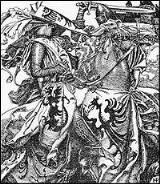
Sir Kay

Encyclopedia
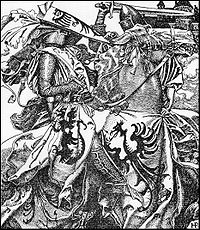
Sir Ector
Sir Ector is the father of Sir Kay and the foster father of King Arthur in the Arthurian legend. Sometimes a king instead of merely a lord, he has an estate in the country as well as properties in London. In The Once and Future King T. H...
's son and King Arthur
King Arthur
King Arthur is a legendary British leader of the late 5th and early 6th centuries, who, according to Medieval histories and romances, led the defence of Britain against Saxon invaders in the early 6th century. The details of Arthur's story are mainly composed of folklore and literary invention, and...
's foster brother and later seneschal
Seneschal
A seneschal was an officer in the houses of important nobles in the Middle Ages. In the French administrative system of the Middle Ages, the sénéchal was also a royal officer in charge of justice and control of the administration in southern provinces, equivalent to the northern French bailli...
, as well as one of the first Knights of the Round Table
Round Table (Camelot)
The Round Table is King Arthur's famed table in the Arthurian legend, around which he and his Knights congregate. As its name suggests, it has no head, implying that everyone who sits there has equal status. The table was first described in 1155 by Wace, who relied on previous depictions of...
. In later literature he is known for his acid tongue and bullying, boorish behavior, but in earlier accounts he was one of Arthur's premier warriors. Along with Bedivere
Bedivere
In Arthurian legend, Sir Bedivere is the Knight of the Round Table who returns Excalibur to the Lady of the Lake. He serves as King Arthur's marshal and is frequently associated with Sir Kay...
, with whom he is frequently associated, Kay is one of the earliest characters associated with Arthur.
Role in Welsh tradition
Cai or Cei is one of the earliest characters to be associated with the Arthurian cycle, appearing in a number of early Welsh texts, including Culhwch ac OlwenCulhwch and Olwen
Culhwch and Olwen is a Welsh tale about a hero connected with Arthur and his warriors that survives in only two manuscripts: a complete version in the Red Book of Hergest, ca. 1400, and a fragmented version in the White Book of Rhydderch, ca. 1325. It is the longest of the surviving Welsh prose...
, Geraint fab Erbin
Three Welsh Romances
The Three Welsh Romances are three Middle Welsh tales associated with the Mabinogion. They are versions of Arthurian tales that also appear in the work of Chrétien de Troyes. Critics have debated whether the Welsh Romances are based on Chrétien's poems or if they derive from a shared original...
, Iarlles y Ffynnon
Three Welsh Romances
The Three Welsh Romances are three Middle Welsh tales associated with the Mabinogion. They are versions of Arthurian tales that also appear in the work of Chrétien de Troyes. Critics have debated whether the Welsh Romances are based on Chrétien's poems or if they derive from a shared original...
, Peredur fab Efrawg, Breuddwyd Rhonabwy, Pa Gur yv y Porthur and the Welsh Triads
Welsh Triads
The Welsh Triads are a group of related texts in medieval manuscripts which preserve fragments of Welsh folklore, mythology and traditional history in groups of three. The triad is a rhetorical form whereby objects are grouped together in threes, with a heading indicating the point of likeness...
. His father is given as Cynyr, his son as Garanwyn and his daughter as Kelemon.
Before Cai's birth, Cynyr Ceinfarfog prophesied that his son's heart would be eternally cold, that he would be exceptionally stubborn and that no one would be able to brave fire or water like him. Cai is attributed with a number of further superhuman abilities, including the ability to go nine days and nine nights without the need to breathe or to sleep, the ability to grow as "tall as the tallest tree in the forest if he pleased" and the ability to radiate supernatural heat from his hands. Furthermore, it is impossible to cure a wound from Cai's sword. Cai is killed by Gwyddawg fab Menestyr, who is in turned killed in vengeance by Arthur.
Pa Gur yv y Porthur
One of the earliest direct reference to Cai can be found in the tenth century poem Pa Gur, in which Arthur recounts the feats and achievements of his knights so as to gain entrance to a fortress guarded by Glewlwyd GafaelfawrGlewlwyd Gafaelfawr
; "Brave Grey Mighty Grasp," is a hero, warrior and porter in tradition and Arthurian mythology, in which he appears as a knight in Arthur's retinue and chief gatekeeper of his court...
, the titular porter. The poem concerns itself largely with Cai's exploits:
- Prince of the plunder,
- The unrelenting warrior to his enemy;
- Heavy was he in his vengeance;
- Terrible was his fighting.
- When he would drink from a horn,
- He would drink as much as four;
- When into battle he came
- He slew as would a hundred.
- Unless God should accomplish it,
- Cei’s death would be unattainable.
- Worthy Cei and Llachau
- Used to fight battles,
- Before the pain of livid spears [ended the conflict].
- On the top of Ystarfingun
- Cei slew nine witches.
- Worthy Cei went to Ynys Mon
- To destroy lions.
- Little protection did his shield offer
- Against Palug’s CatCath PalugCath Palug, also Cath Paluc, Cath Balug, Cath Balwg, Chapalu, Capalu, or Capalus, literally "Palug's cat", or maybe from the Welsh 'palug,' meaning 'clawing,' was a monstrous cat in French and Welsh legend. It was said to haunt the Isle of Anglesey, and to have killed and eaten nine score warriors...
".
Culhwch ac Olwen
Culhwch'sCulhwch
Culhwch , in Welsh mythology, is the son of Cilydd son of Celyddon and Goleuddydd, a cousin of Arthur and the protagonist of the story Culhwch and Olwen...
father, King Cilydd son of Celyddon, loses his wife Goleuddydd
Goleuddydd
Goleuddydd , in the Middle Welsh prose tale Culhwch ac Olwen, is the daughter of Amlawdd Wledig, and is desired by Cilydd, who marries her. She becomes pregnant with his child, but becomes mad and turns to wandering the countryside...
after a difficult childbirth. When he remarries, the young Culhwch rejects his stepmother's attempt to pair him with his new stepsister. Offended, the new queen puts a curse on him so that he can marry no one besides the beautiful Olwen
Olwen
In Welsh mythology, Olwen is the daughter of the giant Ysbaddaden and cousin of Goreu. She is the heroine of the story Culhwch and Olwen in the Mabinogion....
, daughter of the giant
Giant (mythology)
The mythology and legends of many different cultures include monsters of human appearance but prodigious size and strength. "Giant" is the English word commonly used for such beings, derived from one of the most famed examples: the gigantes of Greek mythology.In various Indo-European mythologies,...
Ysbaddaden. Though he has never seen her, Culhwch becomes infatuated with her, but his father warns him that he will never find her without the aid of his famous cousin Arthur
King Arthur
King Arthur is a legendary British leader of the late 5th and early 6th centuries, who, according to Medieval histories and romances, led the defence of Britain against Saxon invaders in the early 6th century. The details of Arthur's story are mainly composed of folklore and literary invention, and...
. The young man immediately sets off to seek his kinsman. He finds him at his court in Celliwig
Celliwig
Celliwig, Kelliwic or Gelliwic, is perhaps the earliest named location for the court of King Arthur. It may be translated as 'forest grove'.-Literary references:...
in Cornwall
Cornwall
Cornwall is a unitary authority and ceremonial county of England, within the United Kingdom. It is bordered to the north and west by the Celtic Sea, to the south by the English Channel, and to the east by the county of Devon, over the River Tamar. Cornwall has a population of , and covers an area of...
and asks for support and assistance. Cai is the first knight to volunteer to assist Culhwch in his quest, promising to stand by his side until Olwen is found. A further five knights join them in their mission.
They travel onwards until they come across the "fairest of the castles of the world", and meet Ysbaddaden's shepherd
Shepherd
A shepherd is a person who tends, feeds or guards flocks of sheep.- Origins :Shepherding is one of the oldest occupations, beginning some 6,000 years ago in Asia Minor. Sheep were kept for their milk, meat and especially their wool...
brother, Custennin. They learn that the castle belongs to Ysbaddaden, that he stripped Custennin of his lands and murdered the shepherd's twenty-three children out of cruelty. Custennin set up a meeting between Culhwch and Olwen, and the maiden agrees to lead Culhwch and his companions to Ysbadadden's castle. Cai pledges to protect the twenty-fourth son, Goreu
Goreu fab Custennin
Goreu fab Custennin is a hero of Welsh and early Arthurian mythology, the son of Custennin, and cousin to Arthur, Culhwch and Saint Illtud through their grandfather Amlawdd Wledig. He is a significant character in the Middle Welsh Arthurian tale Culhwch and Olwen, and also appears in a number of...
with his life.
The knights attack the castle by stealth, killing the nine porters and the nine watchdogs, and enter the giant's hall. Upon their arrival, Ysbaddaden attempts to kill Culhwch with a poison dart, but is outwitted and wounded, first by Bedwyr
Bedivere
In Arthurian legend, Sir Bedivere is the Knight of the Round Table who returns Excalibur to the Lady of the Lake. He serves as King Arthur's marshal and is frequently associated with Sir Kay...
, then by the enchanter Menw
Menw
; "Menw, son of Three-Cries" is a hero and shapeshifter of early Welsh literature and mythology and a warrior of King Arthur's court at Celliwig. He appears most prominently in the early Arthurian tale Culhwch and Olwen, in which he is handpicked among Arthur's knights to accompany Culhwch on his...
, and finally by Culhwch himself. Eventually, Ysbaddaden relents, and agrees to give Culhwch his daughter on the condition that he completes a number of impossible tasks (anoethau) , including hunting the Twrch Trwyth
Twrch Trwyth
Twrch Trwyth is an enchanted wild boar in the Arthurian legend. The hunt for Twrch Trwyth by King Arthur was the subject of a popular stock narrative in medieval Welsh literature...
and recovering the exalted prisoner Mabon ap Modron
Mabon ap Modron
Mabon ap Modron is a prominent figure from Welsh literature and mythology, the son of Modron and a member of Arthur's warband. Both he and his mother were likely deities in origin, descending from a divine mother–son pair. His name is related to the Romano-British god Maponos, whose name means...
.
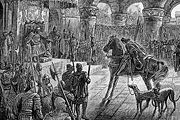
Mabon ap Modron
Mabon ap Modron is a prominent figure from Welsh literature and mythology, the son of Modron and a member of Arthur's warband. Both he and his mother were likely deities in origin, descending from a divine mother–son pair. His name is related to the Romano-British god Maponos, whose name means...
from his watery prison and retrieving the hairs of Dillus the Bearded. However, when Arthur makes a satirical englyn
Englyn
Englyn is a traditional Welsh and Cornish short poem form. It uses quantitative metres, involving the counting of syllables, and rigid patterns of rhyme and half rhyme. Each line contains a repeating pattern of consonants and accent known as cynghanedd.- The Eight Types :There are eight types of...
about Cai, he grows angry and hostile towards the king, ultimately abandoning the quest and his companions. The narrative tells us that Cai would "have nothing to do with Arthur from then on, not when the latter was waning in strength or when his men were being killed." As a result, he did not take part in the hunt
Hunting of Twrch Trwyth
The Hunting of Twrch Trwyth is described vividly in the early Welsh tale Culhwch and Olwen.-Background:Culhwch's father, King Cilydd son of Celyddon, loses his wife Goleuddydd after a difficult childbirth. When he remarries, the young Culhwch rejects his stepmother's attempt to pair him with his...
for Twrch Trwyth
Twrch Trwyth
Twrch Trwyth is an enchanted wild boar in the Arthurian legend. The hunt for Twrch Trwyth by King Arthur was the subject of a popular stock narrative in medieval Welsh literature...
.
Other Appearances
In the Life of St. CadocCadoc
Saint Cadoc , Abbot of Llancarfan, was one of the 6th century British Christian saints. His vita twice mentions King Arthur. The Abbey of Llancarfan, near Cowbridge in Glamorganshire, which he founded circa 518, became famous as a centre of learning...
(c.1100) Bedwyr is alongside Arthur and Cai in dealing with King Gwynllyw
Gwynllyw
Saint Gwynllyw Milwr or Gwynllyw Farfog, known in English in a corrupted form as Woolos the Warrior or Woolos the Bearded was a Welsh king and religious figure....
of Gwynllwg
Gwynllwg
Gwynllŵg was a kingdom of mediæval Wales and later a Norman lordship and then a cantref.-Location:It was named after Gwynllyw, its 5th century or 6th century ruler and consisted of the coastal plain stretching between the Rhymney and Usk rivers, together with the hills to the north...
's abduction of St. Gwladys
Gwladys
Saint Gwladys ferch Brychan or St Gladys , was the Queen of Saint Gwynllyw Milwr and daughter of King Brychan of Brycheiniog. She was the mother of several saints, including Saint Cadoc "the Wise".-Traditional history:...
from her father's court in Brycheiniog
Brycheiniog
Brycheiniog was a small independent petty kingdom in South Wales in the Early Middle Ages. It often acted as a buffer state between England to the east and the powerful south Welsh kingdom of Deheubarth to the west. It was conquered and pacified by the Normans between 1088 and 1095, though it...
. Cai appears prominently in the early Welsh version of Tristan and Isolde, in which he assists the two lovers and is himsef infatuated with a maiden named Golwg Hafddydd, and in the early dialogue poems relating to Melwas'
Maleagant
Maleagant is a villain from Arthurian legend. In a number of versions of a popular episode, Maleagant abducts Guinevere, necessitating her rescue by King Arthur and his knights. The earliest surviving version of this episode names the abductor Melwas...
abduction of Gwenhwyfar
Guinevere
Guinevere was the legendary queen consort of King Arthur. In tales and folklore, she was said to have had a love affair with Arthur's chief knight Sir Lancelot...
. The context suggests that Cai is rescuing the queen from the otherwordly suitor, and may imply a romantic relationship between Cai and Gwenhwyfar.
The Welsh Triads
Welsh Triads
The Welsh Triads are a group of related texts in medieval manuscripts which preserve fragments of Welsh folklore, mythology and traditional history in groups of three. The triad is a rhetorical form whereby objects are grouped together in threes, with a heading indicating the point of likeness...
name Cai as one of the "Three Battle-Diademed Men of the Island of Britain" alongside Drystan mab Tallwch
Tristan
Tristan is one of the main characters of the Tristan and Iseult story, a Cornish hero and one of the Knights of the Round Table featuring in the Matter of Britain...
and Hueil mab Caw
Hueil mab Caw
In Welsh tradition, Heuil mab Caw was a Pictish warrior and traditional rival of King Arthur's...
. In the Triads of the Horses, his horse is named as Gwyneu gwddf hir (Gwyneu of the Long Neck) According to tradition, Cai is intimately associted with the old Roman fort of Caer Gai.
In the Welsh Romances
Welsh Romances
The Three Welsh Romances are three Middle Welsh tales associated with the Mabinogion. They are versions of Arthurian tales that also appear in the work of Chrétien de Troyes. Critics have debated whether the Welsh Romances are based on Chrétien's poems or if they derive from a shared original...
(specifically Owain, or the Lady of the Fountain and Peredur son of Efrawg
Peredur son of Efrawg
Peredur son of Efrawg is one of the three Welsh Romances associated with the Mabinogion. It tells a story roughly analogous to Chrétien de Troyes' unfinished romance Perceval, the Story of the Grail, but it contains many striking differences from that work, most notably the absence of the French...
), Cai assumes the same boorish role he takes in the continental romances. However, manuscripts for these romances date to well after Chrétien de Troyes
Chrétien de Troyes
Chrétien de Troyes was a French poet and trouvère who flourished in the late 12th century. Perhaps he named himself Christian of Troyes in contrast to the illustrious Rashi, also of Troyes...
, meaning that Cai as he appears there may owe more to Chrétien's version of the character than to the indigenous Welsh representation.
Sir Kay
Kay is ubiquitous in Arthurian literature but he rarely serves as anything but a foilFoil (literature)
In fiction, a foil is a character who contrasts with another character in order to highlight particular qualities of another character....
for other characters. Though he manipulates the king to get his way, his loyalty to Arthur is usually unquestioned. In the Vulgate Cycle, the Post-Vulgate and Thomas Malory
Thomas Malory
Sir Thomas Malory was an English writer, the author or compiler of Le Morte d'Arthur. The antiquary John Leland as well as John Bale believed him to be Welsh, but most modern scholars, beginning with G. L...
's Le Morte d'Arthur
Le Morte d'Arthur
Le Morte d'Arthur is a compilation by Sir Thomas Malory of Romance tales about the legendary King Arthur, Guinevere, Lancelot, and the Knights of the Round Table...
, Kay's father Ector adopts the infant Arthur after Merlin
Merlin
Merlin is a legendary figure best known as the wizard featured in the Arthurian legend. The standard depiction of the character first appears in Geoffrey of Monmouth's Historia Regum Britanniae, written c. 1136, and is based on an amalgamation of previous historical and legendary figures...
takes him away from his birth parents, Uther and Igraine
Igraine
Igraine , in Arthurian legend, is the mother of King Arthur. She is also known in Latin as Igerna, in Welsh as Eigyr, in French as Igerne, in Thomas Malory's Le Morte d'Arthur as Ygrayne— often modernized as Igraine—and in Wolfram von Eschenbach's Parzival as Arnive...
. Ector raises him and Kay as brothers, but Arthur's parentage is revealed when he draws the Sword in the Stone
Excalibur
Excalibur is the legendary sword of King Arthur, sometimes attributed with magical powers or associated with the rightful sovereignty of Great Britain. Sometimes Excalibur and the Sword in the Stone are said to be the same weapon, but in most versions they are considered separate. The sword was...
at a tournament in London
London
London is the capital city of :England and the :United Kingdom, the largest metropolitan area in the United Kingdom, and the largest urban zone in the European Union by most measures. Located on the River Thames, London has been a major settlement for two millennia, its history going back to its...
. Arthur, serving as squire to the newly-knighted Kay, is locked out of the house and can't get to his brother's sword and uses the Sword in the Stone to replace it. Kay shows his characteristic opportunism when he tries to claim it was he that pulled the sword from the stone, making him the true King of the Britons, but he relents and admits it was Arthur. He becomes one of the first Knights of the Round Table and serves his foster-brother throughout his life.
Kay's father is called Ector in later literature, but the Welsh accounts name him as Cynyr Fork-Beard. In Erec and Enide
Erec and Enide
Erec and Enide is the first of Chrétien de Troyes' five romance poems, completed around 1170. It is one of three completed works by the author...
, Chrétien de Troyes
Chrétien de Troyes
Chrétien de Troyes was a French poet and trouvère who flourished in the late 12th century. Perhaps he named himself Christian of Troyes in contrast to the illustrious Rashi, also of Troyes...
mentions he had a son called Gronosis, who was versed in evil, while the Welsh give him a son and daughter named Garanwyn and Celemon. Romance rarely deals with Kay's love life, an exception being Girart d'Amiens' Escanor, which details his love for Andrivete of Northumbria
Northumbria
Northumbria was a medieval kingdom of the Angles, in what is now Northern England and South-East Scotland, becoming subsequently an earldom in a united Anglo-Saxon kingdom of England. The name reflects the approximate southern limit to the kingdom's territory, the Humber Estuary.Northumbria was...
, whom he must defend from her uncle's political machinations before they can marry.
Kay in later legend
Kay and Bedivere appear in Geoffrey of MonmouthGeoffrey of Monmouth
Geoffrey of Monmouth was a cleric and one of the major figures in the development of British historiography and the popularity of tales of King Arthur...
's Historia Regum Britanniae
Historia Regum Britanniae
The Historia Regum Britanniae is a pseudohistorical account of British history, written c. 1136 by Geoffrey of Monmouth. It chronicles the lives of the kings of the Britons in a chronological narrative spanning a time of two thousand years, beginning with the Trojans founding the British nation...
, and aid Arthur in defeating the Giant of Mont Saint Michel. Geoffrey makes Kay the count of Anjou
Anjou
Anjou is a former county , duchy and province centred on the city of Angers in the lower Loire Valley of western France. It corresponds largely to the present-day département of Maine-et-Loire...
and Arthur's steward, an office he holds in most later literature.
In the works of Chrétien de Troyes
Chrétien de Troyes
Chrétien de Troyes was a French poet and trouvère who flourished in the late 12th century. Perhaps he named himself Christian of Troyes in contrast to the illustrious Rashi, also of Troyes...
, Kay assumes the characteristics he is most associated with today. He retains his hot-headedness and fiery temper from Welsh literature, but he is more or less an incompetent braggart. Chrétien uses him as a scoffer and a troublemaker; a foil for heroic knights like Lancelot
Lancelot
Sir Lancelot du Lac is one of the Knights of the Round Table in the Arthurian legend. He is the most trusted of King Arthur's knights and plays a part in many of Arthur's victories...
, Ywain
Ywain
Sir Ywain is a Knight of the Round Table and the son of King Urien in Arthurian legend...
, or Gawain
Gawain
Gawain is King Arthur's nephew and a Knight of the Round Table who appears very early in the Arthurian legend's development. He is one of a select number of Round Table members to be referred to as the greatest knight, most notably in Sir Gawain and the Green Knight...
. He mocks the chivalric courtesy of Sir Calogrenant
Calogrenant
Sir Calogrenant, sometimes known in English as Colgrevance, or, in ancient Welsh, Cynan ap Clydno, is a Knight of the Round Table in Arthurian legend. He is a cousin to Sir Ywain, and his courtesy and eloquence were known throughout the kingdom....
in Yvain, the Knight of the Lion
Yvain, the Knight of the Lion
Yvain, the Knight with the Lion is a romance by Chrétien de Troyes. It was probably written in the 1170s simultaneously with Lancelot, the Knight of the Cart, and includes several references to the action in that poem...
, and he tricks Arthur into allowing him to try to save Guinevere
Guinevere
Guinevere was the legendary queen consort of King Arthur. In tales and folklore, she was said to have had a love affair with Arthur's chief knight Sir Lancelot...
from Maleagant
Maleagant
Maleagant is a villain from Arthurian legend. In a number of versions of a popular episode, Maleagant abducts Guinevere, necessitating her rescue by King Arthur and his knights. The earliest surviving version of this episode names the abductor Melwas...
in Lancelot, the Knight of the Cart
Lancelot, the Knight of the Cart
Lancelot, the Knight of the Cart is an Old French poem by Chrétien de Troyes. Chrétien probably composed the work at the same time as or slightly before writing Yvain, the Knight of the Lion, which refers to the action in Lancelot a number of times...
, which ends in his humiliating defeat. In Perceval, the Story of the Grail
Perceval, the Story of the Grail
Perceval, the Story of the Grail is the unfinished fifth romance of Chrétien de Troyes. Probably written between 1181 and 1191, it is dedicated to Chrétien's patron Philip, Count of Flanders...
, Sir Kay grows angry with Perceval
Percival
Percival or Perceval is one of King Arthur's legendary Knights of the Round Table. In Welsh literature his story is allotted to the historical Peredur...
's naïveté and slaps a maiden who says he will become a great knight; Perceval avenges her later when he breaks Kay's shoulder. Wolfram von Eschenbach
Wolfram von Eschenbach
Wolfram von Eschenbach was a German knight and poet, regarded as one of the greatest epic poets of his time. As a Minnesinger, he also wrote lyric poetry.-Life:...
, who tells the same story in his Parzival
Parzival
Parzival is a major medieval German romance by the poet Wolfram von Eschenbach, in the Middle High German language. The poem, commonly dated to the first quarter of the 13th century, is itself largely based on Chrétien de Troyes’s Perceval, the Story of the Grail and mainly centers on the Arthurian...
, asks his audience not to judge Kay too harshly, as his sharp words actually serve to maintain courtly order.
Scholars have pointed out that Kay's scornful, overly boastful character never makes him a clown, a coward or a traitor, except in the Grail
Holy Grail
The Holy Grail is a sacred object figuring in literature and certain Christian traditions, most often identified with the dish, plate, or cup used by Jesus at the Last Supper and said to possess miraculous powers...
romance Perlesvaus
Perlesvaus
Perlesvaus, also called Li Hauz Livres du Graal , is an Old French Arthurian romance dating to the first decade of the 13th century...
, where he murders Arthur's son Loholt and joins up with the king's enemies. This strange work is an anomaly, however, and Kay's portrayal tends to range from merely cruel and malicious, as in the Roman de Yder or Hartmann von Aue
Hartmann von Aue
Hartmann von Aue was a Middle High German poet. He introduced the courtly romance into German literature and, with Wolfram von Eschenbach and Gottfried von Strassburg, was one of the three great epic poets of Middle High German literature...
's Iwein to humorously derisive and even endearing, as in Durmart le Gallois and Girart d'Amiens's Escanor.
Oddly, given his ubiquity, Kay's death is not frequently dealt with. In Welsh literature, it is mentioned he was killed by Gwyddawg and avenged by Arthur. In Geoffrey of Monmouth and the Alliterative Morte Arthure
Alliterative Morte Arthure
The Alliterative Morte Arthure is a 4346-line Middle English alliterative poem, retelling the latter part of the legend of King Arthur. It is preserved in a single copy, in the early fifteenth-century Lincoln Thornton Manuscript.-History:...
, he is killed in the war against the Roman
Roman Empire
The Roman Empire was the post-Republican period of the ancient Roman civilization, characterised by an autocratic form of government and large territorial holdings in Europe and around the Mediterranean....
emperor Lucius, while the Vulgate Cycle has him die in France
France
The French Republic , The French Republic , The French Republic , (commonly known as France , is a unitary semi-presidential republic in Western Europe with several overseas territories and islands located on other continents and in the Indian, Pacific, and Atlantic oceans. Metropolitan France...
, also in battle against the Romans.
Modern adaptations
Kay is a main character in the first three books of T. H. WhiteT. H. White
Terence Hanbury White was an English author best known for his sequence of Arthurian novels, The Once and Future King, first published together in 1958.-Biography:...
's The Once and Future King
The Once and Future King
The Once and Future King is an Arthurian fantasy novel written by T. H. White. It was first published in 1958 and is mostly a composite of earlier works written in a period between 1938 and 1941....
, The Sword in the Stone
The Sword in the Stone
The Sword in the Stone is a novel by T. H. White, published in 1939, initially a stand-alone work but now the first part of a tetralogy The Once and Future King. A fantasy of the boyhood of King Arthur, it is a sui generis work which combines elements of legend, history, fantasy and comedy...
and The Queen of Air and Darkness
The Queen of Air and Darkness
The Queen of Air and Darkness, originally titled The Witch in the Wood, is a novel by English writer T. H. White. It is the second book in his epic work, The Once and Future King...
. His portrayal is based on Malory's account of Arthur's upbringing, but White adds a number of new elements to the story, including one in which the young Kay kills a dangerous griffin
Griffin
The griffin, griffon, or gryphon is a legendary creature with the body of a lion and the head and wings of an eagle...
with the aid of Robin Hood
Robin Hood
Robin Hood was a heroic outlaw in English folklore. A highly skilled archer and swordsman, he is known for "robbing from the rich and giving to the poor", assisted by a group of fellow outlaws known as his "Merry Men". Traditionally, Robin Hood and his men are depicted wearing Lincoln green clothes....
and Maid Marian
Maid Marian
Maid Marian is the wife of the legendary English outlaw Robin Hood. Stemming from another, older tradition, she became associated with Robin Hood only in the 16th century.-History:The earliest medieval Robin Hood stories gave him no female companion...
. White's Kay is quick-witted and often mean, but always a loving foster brother to Arthur, whom he calls "the Wart". Kay appears in the 1963 Walt Disney Studios
Walt Disney Pictures
Walt Disney Pictures is an American film studio owned by The Walt Disney Company. Walt Disney Pictures and Television, a subsidiary of the Walt Disney Studios and the main production company for live-action feature films within the Walt Disney Motion Pictures Group, based at the Walt Disney...
film adaptation of The Sword in the Stone
The Sword in the Stone (film)
The Sword in the Stone is a 1963 American animated fantasy comedy film produced by Walt Disney and originally released to theaters on December 25, 1963...
, in which he is outwardly boorish and bitter but still loves Arthur all the same.
Kay is the main character of Phyllis Ann Karr
Phyllis Ann Karr
Phyllis Ann Karr, born July 25, 1944, is an American author of fantasy, romances, mysteries, and non-fiction. She is best known for her "Frostflower & Thorn" series and Matter of Britain works.-Life and family:...
's 1982 novel The Idylls of the Queen. Expanding on a scene from the classic tales in which a knight is poisoned at Guinevere's feast and the queen is accused of the crime, Karr turns her story into a murder mystery with Kay as the detective attempting to discover the truth.
In Thomas Berger's 1978 Arthur Rex: A Legendary Novel
Arthur Rex: A Legendary Novel
Arthur Rex: A Legendary Novel is a 1978 novel by American author Thomas Berger. Berger offers his own take on the legends of King Arthur, from the heroic monarch's inauspicious conception, to his childhood in bucolic Wales, his rise to the throne, his discovery of the great sword Excalibur, his...
, Kay is a somewhat foppish, sharp-tongued gourmand
Gourmand
A gourmand is a person who takes great pleasure in food. The word has different connotations from the similar word gourmet, which emphasises an individual with a highly refined discerning palate, but in practice the two terms are closely linked, as both imply the enjoyment of good food.An older...
. Relieved to be freed from his bucolic upbringing in Wales, he takes charge of the kitchens at Camelot
Camelot
Camelot is a castle and court associated with the legendary King Arthur. Absent in the early Arthurian material, Camelot first appeared in 12th-century French romances and eventually came to be described as the fantastic capital of Arthur's realm and a symbol of the Arthurian world...
and yearns to make it a more sophisticated court. Arthur good-naturedly complains that Sir Kay is always serving him rich foods, when the king would rather just have simple meals. Kay supplies occasional comic relief in the book, but ultimately fights and dies with honor in the last battle against Mordred
Mordred
Mordred or Modred is a character in the Arthurian legend, known as a notorious traitor who fought King Arthur at the Battle of Camlann, where he was killed and Arthur fatally wounded. Tradition varies on his relationship to Arthur, but he is best known today as Arthur's illegitimate son by his...
's host.
In the 1970s HTV-series Arthur of the Britons
Arthur of the Britons
Arthur of the Britons is a British television show about the historical King Arthur. Produced by the HTV regional franchise, it consisted of two series, released between 1972 and 1973...
, Kay (spelled Kai) was played by Michael Gothard
Michael Gothard
Michael Alan Gothard was an English actor, best remembered for his role as Kai in the television series Arthur of the Britons and for his role as the mysterious villain Emile Leopold Locque in the 1981 James Bond film For Your Eyes Only.-Early life:Michael Gothard was born in London in 1939...
. In this version of the legend, Arthur is a Celtic chieftain and Kai is a Saxon orphan, raised together as brothers by an adoptive father, Llud, amongst the Celts. He is portrayed as somewhat hot-headed and sometimes distracted by female company, but a fiercely capable warrior (sometimes favouring an axe-weapon) and Arthur's most trusted and loyal friend.
In Stephen Lawhead's Pendragon cycle Kay, spelled Cai, is Arthur's most loyal companion. As a child he had a crippled leg and Arthur was one of the few who defends him. This earns Arthur his complete and unquestioning loyalty. He dies in the battle against Mordred.
In the French comedy series Kaamelott
Kaamelott
Kaamelott is a French television series running originally 2005–2009. It combines medieval fantasy and comedy to present a new "realistic epic" version of the Arthurian legend....
, Kay is portrayed as a rogue centurion
Centurion
A centurion was a professional officer of the Roman army .Centurion may also refer to:-Military:* Centurion tank, British battle tank* HMS Centurion, name of several ships and a shore base of the British Royal Navy...
and rival of Arthur named Caius who refused to follow his troops back to Rome and therefore celticized his name and was given knighthood by Arthur to end their rivalry.
In the 2011 Starz TV series titled Camelot
Camelot (TV series)
Camelot is a historical-fantasy-drama television series which premiered on April 1, 2011. It was co-produced by the Starz cable network and GK-TV which began production during the summer of 2010...
(after the highly successful British series Merlin
Merlin (TV series)
Merlin is a British fantasy-adventure television programme by Julian Jones, Jake Michie, Julian Murphy and Johnny Capps. It began broadcasting on BBC One on 20 September 2008. The show is based on the Arthurian legends of the wizard Merlin and his relationship with Prince Arthur but differs from...
aired on BBC One
BBC One
BBC One is the flagship television channel of the British Broadcasting Corporation in the United Kingdom. It was launched on 2 November 1936 as the BBC Television Service, and was the world's first regular television service with a high level of image resolution...
), Kay is played by Canadian actor Peter Mooney
Peter Mooney
-Private life:Mooney was born in Winnipeg, Manitoba. He is a graduate of the National Theatre School of Canada in Montreal, Quebec , and now resides in Toronto, Ontario.-Career:...
. In this is an American-Irish-Canadian adaption of Arthurian Legend, Kay is portrayed as a loyal and protective older brother to Arthur. Although raised in a rural setting, he appears educated and somewhat idealistic, described by the actor who plays him as having "a world of book-smarts, but no practical experience [of how be a warrior]" .