

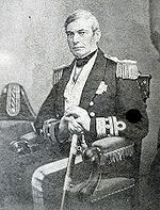
Sir Alexander Milne, 1st Baronet

Encyclopedia
Admiral of the Fleet
Sir Alexander Milne, 1st Baronet, GCB
(10 November 1806 – 29 December 1896) was a Royal Navy
admiral
, the second son of the Scot
Admiral Sir David Milne, and the younger brother of the advocate
, geologist and meteorologist David Milne-Home
.
, 8 February 1817. In 1819 he was serving in his father's flagship HMS Leander
, on the North American station. Over the next few years he served in Conway, Ramillies
, Ganges
and Albion
. In June 1827 he was an acting Lieutenant in Cadmus on the Brazilian station, and was promoted to substantive Lieutenant
on 8 September of that year. Promoted to Commander
on the 25 November 1830, he was appointed to Snake in the West Indies in 1836.
He was promoted to Captain
on 30 January 1839, he was given command of Crocodile in the North America and the West Indies with a brief spell from November 1840 to March 1841 as Captain of Cleopatra. He was Flag-captain in Caledonia
to his father, the Commander-in-Chief, Plymouth
from 27 April 1842 to April 1845 and Flag-captain to Sir Charles Ogle
at Portsmouth from 7 October 1846 to December 1847.
A Commissioner of the Admiralty, he served as Fourth Naval Lord
from 1847 to 1852, as Fifth Naval Lord
from 1852 to 1853 and again as Fourth Naval Lord
from 1853 to 1857, when he was in charge of British and French transports during the Crimean War
. He served as Third Naval Lord
from 1857 to 1859.
He was promoted to Rear-Admiral on 20 January 1858 and awarded KCB (civil) on 20 December 1858. He served as Fourth Naval Lord
again from April to June 1859.
He became Commander-in-Chief, North America and West Indies Station on 13 January 1860 and continued in that post until 7 January 1864. He was awarded the KCB (military) on 20 February 1864 and was promoted to Vice-Admiral on 13 April 1865. He served as First Naval Lord
from July 1866 to December 1868.
He served as Commander-in-Chief, Mediterranean
from 28 April 1869 to 25 October 1870 and was promoted to Admiral
on 1 April 1870. He was awarded the GCB on 24 May 1871. He served as First Naval Lord
again from November 1872 to September 1876. He was created a Baronet
on 1 November 1876 and placed on the retired list on 10 November 1876. He was promoted to Admiral of the Fleet
on 10 June 1881.
In retirement he lived at Inveresk House in Musselburgh
.
Milne's papers have been published by the Navy Records Society
, edited by Professor John Beeler.
, East Lothian
, Scotland
, was created for Alexander Milne, see Milne Baronets
.
Milne Bay
, the easternmost inlet of the island of New Guinea
, was named after him in 1873.
|-
|-
|-
|-
|-
|-
Admiral of the Fleet
An admiral of the fleet is a military naval officer of the highest rank. In many nations the rank is reserved for wartime or ceremonial appointments...
Sir Alexander Milne, 1st Baronet, GCB
Order of the Bath
The Most Honourable Order of the Bath is a British order of chivalry founded by George I on 18 May 1725. The name derives from the elaborate mediæval ceremony for creating a knight, which involved bathing as one of its elements. The knights so created were known as Knights of the Bath...
(10 November 1806 – 29 December 1896) was a Royal Navy
Royal Navy
The Royal Navy is the naval warfare service branch of the British Armed Forces. Founded in the 16th century, it is the oldest service branch and is known as the Senior Service...
admiral
Admiral (United Kingdom)
Admiral is a senior rank of the Royal Navy of the United Kingdom, which equates to the NATO rank code OF-9, outranked only by the rank Admiral of the Fleet...
, the second son of the Scot
Scottish people
The Scottish people , or Scots, are a nation and ethnic group native to Scotland. Historically they emerged from an amalgamation of the Picts and Gaels, incorporating neighbouring Britons to the south as well as invading Germanic peoples such as the Anglo-Saxons and the Norse.In modern use,...
Admiral Sir David Milne, and the younger brother of the advocate
Advocate
An advocate is a term for a professional lawyer used in several different legal systems. These include Scotland, South Africa, India, Scandinavian jurisdictions, Israel, and the British Crown dependencies of Jersey, Guernsey and the Isle of Man...
, geologist and meteorologist David Milne-Home
David Milne-Home
David Milne-Home FRSE was a Scottish advocate, geologist and meteorologist....
.
Naval career
He entered the Royal Naval AcademyRoyal Naval Academy
The Royal Naval Academy was established at Portsmouth Dockyard as a facility to train officers for the Royal Navy. The founders' intentions were to provide an alternative means to recruit officers and to provide standardised training, education and admission.-Training:In 1773, a shore side...
, 8 February 1817. In 1819 he was serving in his father's flagship HMS Leander
HMS Leander (1813)
HMS Leander was a 4th rate Ship-of-the-Line of 60 guns of the Royal Navy, launched on 10 November 1813.In the War of 1812 she took part in the battle of Fort McHenry....
, on the North American station. Over the next few years he served in Conway, Ramillies
HMS Ramillies (1785)
HMS Ramillies was a 74-gun third rate ship of the line of the Royal Navy, launched on 12 July 1785 at Rotherhithe.In 1801, she was part of Admiral Sir Hyde Parker's reserve squadron at the Battle of Copenhagen, and so did not take an active part in the battle.In August 1812, Sir Thomas Masterman...
, Ganges
HMS Ganges (1821)
HMS Ganges was an 84-gun second-rate ship of the line of the Royal Navy, launched on 10 November 1821 at Bombay Dockyard, constructed from teak...
and Albion
HMS Albion (1802)
HMS Albion was a 74-gun third-rate ship of the line of the Royal Navy. She was launched at Perry's Blackwall Yard on the Thames on 17 June 1802...
. In June 1827 he was an acting Lieutenant in Cadmus on the Brazilian station, and was promoted to substantive Lieutenant
Lieutenant
A lieutenant is a junior commissioned officer in many nations' armed forces. Typically, the rank of lieutenant in naval usage, while still a junior officer rank, is senior to the army rank...
on 8 September of that year. Promoted to Commander
Commander
Commander is a naval rank which is also sometimes used as a military title depending on the individual customs of a given military service. Commander is also used as a rank or title in some organizations outside of the armed forces, particularly in police and law enforcement.-Commander as a naval...
on the 25 November 1830, he was appointed to Snake in the West Indies in 1836.
He was promoted to Captain
Captain (Royal Navy)
Captain is a senior officer rank of the Royal Navy. It ranks above Commander and below Commodore and has a NATO ranking code of OF-5. The rank is equivalent to a Colonel in the British Army or Royal Marines and to a Group Captain in the Royal Air Force. The rank of Group Captain is based on the...
on 30 January 1839, he was given command of Crocodile in the North America and the West Indies with a brief spell from November 1840 to March 1841 as Captain of Cleopatra. He was Flag-captain in Caledonia
HMS Caledonia (1808)
HMS Caledonia was a 120-gun first-rate ship of the line of the Royal Navy, launched on 25 June 1808 at Plymouth. She was Admiral Pellew's flagship in the Mediterranean....
to his father, the Commander-in-Chief, Plymouth
Commander-in-Chief, Plymouth
The Commander-in-Chief, Plymouth was a senior commander of the Royal Navy for hundreds of years. Plymouth Command was a name given to the units, establishments, and staff operating under the admiral's command. In the nineteenth century the holder of the office was known as Commander-in-Chief,...
from 27 April 1842 to April 1845 and Flag-captain to Sir Charles Ogle
Sir Charles Ogle, 2nd Baronet
Admiral of the Fleet Sir Charles Ogle, 2nd Baronet was an officer in the Royal Navy.-Naval career:Born the eldest son of Admiral Sir Chaloner Ogle, 1st Baronet, Ogle joined the Royal Navy in 1787....
at Portsmouth from 7 October 1846 to December 1847.
A Commissioner of the Admiralty, he served as Fourth Naval Lord
Fourth Sea Lord
The Fourth Sea Lord and Chief of Naval Supplies was formerly one of the Naval Lords and members of the Board of Admiralty which controlled the Royal Navy of the United Kingdom.-History:...
from 1847 to 1852, as Fifth Naval Lord
Fifth Sea Lord
The Fifth Sea Lord was formerly one of the Naval Lords and members of the Board of Admiralty that controlled the Royal Navy.-History:In 1805, for the first time, specific functions were assigned to each of the 'Naval' Lords, who were described as 'Professional' Lords, leaving to the 'Civil' Lords...
from 1852 to 1853 and again as Fourth Naval Lord
Fourth Sea Lord
The Fourth Sea Lord and Chief of Naval Supplies was formerly one of the Naval Lords and members of the Board of Admiralty which controlled the Royal Navy of the United Kingdom.-History:...
from 1853 to 1857, when he was in charge of British and French transports during the Crimean War
Crimean War
The Crimean War was a conflict fought between the Russian Empire and an alliance of the French Empire, the British Empire, the Ottoman Empire, and the Kingdom of Sardinia. The war was part of a long-running contest between the major European powers for influence over territories of the declining...
. He served as Third Naval Lord
Third Sea Lord
The Third Sea Lord and Controller of the Navy was formerly the Naval Lord and member of the Board of Admiralty responsible for procurement and matériel in the British Royal Navy...
from 1857 to 1859.
He was promoted to Rear-Admiral on 20 January 1858 and awarded KCB (civil) on 20 December 1858. He served as Fourth Naval Lord
Fourth Sea Lord
The Fourth Sea Lord and Chief of Naval Supplies was formerly one of the Naval Lords and members of the Board of Admiralty which controlled the Royal Navy of the United Kingdom.-History:...
again from April to June 1859.
He became Commander-in-Chief, North America and West Indies Station on 13 January 1860 and continued in that post until 7 January 1864. He was awarded the KCB (military) on 20 February 1864 and was promoted to Vice-Admiral on 13 April 1865. He served as First Naval Lord
First Sea Lord
The First Sea Lord is the professional head of the Royal Navy and the whole Naval Service; it was formerly known as First Naval Lord. He also holds the title of Chief of Naval Staff, and is known by the abbreviations 1SL/CNS...
from July 1866 to December 1868.
He served as Commander-in-Chief, Mediterranean
Mediterranean Fleet
Several countries have or have had a Mediterranean Fleet in their navy. See:* Mediterranean Fleet * French Mediterranean Fleet* Mediterranean Squadron * United States Sixth Fleet...
from 28 April 1869 to 25 October 1870 and was promoted to Admiral
Admiral
Admiral is the rank, or part of the name of the ranks, of the highest naval officers. It is usually considered a full admiral and above vice admiral and below admiral of the fleet . It is usually abbreviated to "Adm" or "ADM"...
on 1 April 1870. He was awarded the GCB on 24 May 1871. He served as First Naval Lord
First Sea Lord
The First Sea Lord is the professional head of the Royal Navy and the whole Naval Service; it was formerly known as First Naval Lord. He also holds the title of Chief of Naval Staff, and is known by the abbreviations 1SL/CNS...
again from November 1872 to September 1876. He was created a Baronet
Baronet
A baronet or the rare female equivalent, a baronetess , is the holder of a hereditary baronetcy awarded by the British Crown...
on 1 November 1876 and placed on the retired list on 10 November 1876. He was promoted to Admiral of the Fleet
Admiral of the Fleet (Royal Navy)
Admiral of the fleet is the highest rank of the British Royal Navy and other navies, which equates to the NATO rank code OF-10. The rank still exists in the Royal Navy but routine appointments ceased in 1996....
on 10 June 1881.
In retirement he lived at Inveresk House in Musselburgh
Musselburgh
Musselburgh is the largest settlement in East Lothian, Scotland, on the coast of the Firth of Forth, six miles east of Edinburgh city centre.-History:...
.
Milne's papers have been published by the Navy Records Society
Navy Records Society
The Navy Records Society was established in 1893 as a scholarly society to publish historical documents that illustrated the history of the Royal Navy. Professor Sir John Knox Laughton and Admiral Sir Cyprian Bridge were the key leaders who organized the Society, basing it on the model of earlier...
, edited by Professor John Beeler.
Honours
The baronetage of InvereskInveresk
Inveresk is a civil parish and was formerly a village that now forms the southern part of Musselburgh. It is situated on slightly elevated ground at the south of Musselburgh in East Lothian, Scotland...
, East Lothian
East Lothian
East Lothian is one of the 32 council areas of Scotland, and a lieutenancy Area. It borders the City of Edinburgh, Scottish Borders and Midlothian. Its administrative centre is Haddington, although its largest town is Musselburgh....
, Scotland
Scotland
Scotland is a country that is part of the United Kingdom. Occupying the northern third of the island of Great Britain, it shares a border with England to the south and is bounded by the North Sea to the east, the Atlantic Ocean to the north and west, and the North Channel and Irish Sea to the...
, was created for Alexander Milne, see Milne Baronets
Milne Baronets
The Milne Baronetcy, of Inveresk in the County of East Lothian, was a title in the Baronetage of the United Kingdom. It was created on 1 November 1876 for Sir Alexander Milne, a distinguished admiral of the Royal Navy...
.
Milne Bay
Milne Bay
Milne Bay is a large bay in Milne Bay Province, southeastern Papua New Guinea. The bay is named after Sir Alexander Milne.The area was a site of the Battle of Milne Bay in 1942....
, the easternmost inlet of the island of New Guinea
New Guinea
New Guinea is the world's second largest island, after Greenland, covering a land area of 786,000 km2. Located in the southwest Pacific Ocean, it lies geographically to the east of the Malay Archipelago, with which it is sometimes included as part of a greater Indo-Australian Archipelago...
, was named after him in 1873.
Further reading
- Beeler, John (ed.), The Milne Papers: The Papers of Admiral of the Fleet Sir Alexander Milne, Bt., K.C.B. (1806-1896), Volume I (1820-1859) Navy Records Society, volume 147. Burlington, Vermont: Ashgate, 2004.
- Courtemanche, Regis A., No Need of Glory: The British Navy in American Waters 1860-1864. Annapolis, Maryland: Naval Institute Press, 1977.
External links
|-|-
|-
|-
|-
|-
|-