

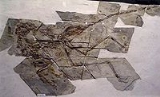
Sinornithosaurus

Encyclopedia
Sinornithosaurus (derived from a combination of Latin and Greek
Ancient Greek
Ancient Greek is the stage of the Greek language in the periods spanning the times c. 9th–6th centuries BC, , c. 5th–4th centuries BC , and the c. 3rd century BC – 6th century AD of ancient Greece and the ancient world; being predated in the 2nd millennium BC by Mycenaean Greek...
, meaning 'Chinese bird-lizard') is a genus
Genus
In biology, a genus is a low-level taxonomic rank used in the biological classification of living and fossil organisms, which is an example of definition by genus and differentia...
of feathered
Feathered dinosaurs
The realization that dinosaurs are closely related to birds raised the obvious possibility of feathered dinosaurs. Fossils of Archaeopteryx include well-preserved feathers, but it was not until the early 1990s that clearly non-avialan dinosaur fossils were discovered with preserved feathers...
dromaeosaurid dinosaur
Dinosaur
Dinosaurs are a diverse group of animals of the clade and superorder Dinosauria. They were the dominant terrestrial vertebrates for over 160 million years, from the late Triassic period until the end of the Cretaceous , when the Cretaceous–Paleogene extinction event led to the extinction of...
from the early Cretaceous
Cretaceous
The Cretaceous , derived from the Latin "creta" , usually abbreviated K for its German translation Kreide , is a geologic period and system from circa to million years ago. In the geologic timescale, the Cretaceous follows the Jurassic period and is followed by the Paleogene period of the...
Period (early Aptian
Aptian
The Aptian is an age in the geologic timescale or a stage in the stratigraphic column. It is a subdivision of the Early or Lower Cretaceous epoch or series and encompasses the time from 125.0 ± 1.0 Ma to 112.0 ± 1.0 Ma , approximately...
) of the Yixian Formation
Yixian Formation
The Yixian Formation is a geological formation in Jinzhou, Liaoning, People's Republic of China, that spans 11 million years during the early Cretaceous period...
in what is now China
China
Chinese civilization may refer to:* China for more general discussion of the country.* Chinese culture* Greater China, the transnational community of ethnic Chinese.* History of China* Sinosphere, the area historically affected by Chinese culture...
. It was the fifth non–avian feathered dinosaur
Feathered dinosaurs
The realization that dinosaurs are closely related to birds raised the obvious possibility of feathered dinosaurs. Fossils of Archaeopteryx include well-preserved feathers, but it was not until the early 1990s that clearly non-avialan dinosaur fossils were discovered with preserved feathers...
genus
Genera
Genera is a commercial operating system and development environment for Lisp machines developed by Symbolics. It is essentially a fork of an earlier operating system originating on the MIT AI Lab's Lisp machines which Symbolics had used in common with LMI and Texas Instruments...
discovered by 1999. The original specimen was collected from the Sihetun locality of western Liaoning
Liaoning
' is a province of the People's Republic of China, located in the northeast of the country. Its one-character abbreviation is "辽" , a name taken from the Liao River that flows through the province. "Níng" means "peace"...
. It was found in the Jianshangou beds of the Yixian Formation
Yixian Formation
The Yixian Formation is a geological formation in Jinzhou, Liaoning, People's Republic of China, that spans 11 million years during the early Cretaceous period...
, dated to 124.5 million years ago. Additional specimens have been found in the younger Dawangzhangzi bed, dating to around 122 million years ago.
Xu Xing described Sinornithosaurus and performed a phylogenetic analysis which demonstrated that it is basal, or primitive, among the dromaeosaurs. He has also demonstrated that features of the skull and shoulder are very similar to Archaeopteryx and other Avialae
Avialae
Avialae is a clade of dinosaurs containing their only living representatives, birds , and the most immediate extinct relatives of birds.-Competing definitions:...
. Together these two facts demonstrate that the earliest dromaeosaurs were more like birds than the later dromaeosaurs were. This talks against one argument made by critics of the theory that birds evolved from dinosaurs, namely that the most birdlike dinosaurs are predated by the earliest birds (see temporal paradox
Temporal paradox (paleontology)
The temporal paradox, or time problem is a controversial issue in the evolutionary relationships of birds. It was described by paleornithologist Alan Feduccia.-Objection to consensus:The concept of a "temporal paradox" is based on the following facts...
).
Sinornithosaurus was among the smallest dromaeosaurids, with a length of about 90 centimetres (3 ft).
Feathers
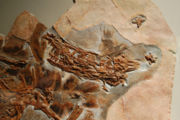
Down feather
The down of birds is a layer of fine feathers found under the tougher exterior feathers. Very young birds are clad only in down. Powder down is a specialized type of down found only in a few groups of birds. Down is a fine thermal insulator and padding, used in goods such as jackets, bedding,...
. Second, a row of filaments (barbs) were joined together to a main shaft (rachis), making them similar in structure to normal bird
Bird
Birds are feathered, winged, bipedal, endothermic , egg-laying, vertebrate animals. Around 10,000 living species and 188 families makes them the most speciose class of tetrapod vertebrates. They inhabit ecosystems across the globe, from the Arctic to the Antarctic. Extant birds range in size from...
feathers. However, they do not have the secondary branching and tiny little hooks (barbules) that modern feathers have, which allow the feathers of modern birds to form a discrete vane.
Color
A 2010 study indicated that Sinornithosaurus may have had feathers which varied in color between significantly across different regions of the body, based on analysis of microscopic cell structures in preserved fossils.Classification
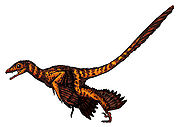
Dromaeosauridae
Dromaeosauridae is a family of bird-like theropod dinosaurs. They were small- to medium-sized feathered carnivores that flourished in the Cretaceous Period. The name Dromaeosauridae means 'running lizards', from Greek dromeus meaning 'runner' and sauros meaning 'lizard'...
, a group of agile, predatory
Carnivore
A carnivore meaning 'meat eater' is an organism that derives its energy and nutrient requirements from a diet consisting mainly or exclusively of animal tissue, whether through predation or scavenging...
dinosaurs with a distinctive sickle-shaped toe claw, which also includes Deinonychus
Deinonychus
Deinonychus was a genus of carnivorous dromaeosaurid dinosaur. There is one described species, Deinonychus antirrhopus. This 3.4 meter long dinosaur lived during the early Cretaceous Period, about 115–108 million years ago . Fossils have been recovered from the U.S...
and Utahraptor
Utahraptor
Utahraptor is a genus of theropod dinosaurs, including the largest known members of the family Dromaeosauridae. Fossil specimens date to the upper Barremian stage of the early Cretaceous period...
. S. millenii lived about 125 million years ago in the Aptian age
Faunal stage
In chronostratigraphy, a stage is a succession of rock strata laid down in a single age on the geologic timescale, which usually represents millions of years of deposition. A given stage of rock and the corresponding age of time will by convention have the same name, and the same boundaries.Rock...
of the Early Cretaceous period, which makes it among the earliest and most primitive dromaeosaurids yet discovered. Fossils of S. haoiana and the possible Sinornithosaurus specimen NGMC 91
NGMC 91
NGMC 91, nicknamed “Dave”, is an as-yet unnamed, substantially complete, fossil of a small dromaeosaurid dinosaur from the Early Cretaceous Yixian Formation of Liaoning, China. The specimen is in the collection of the National Geological Museum of China. It was collected in Fanzhangzi quarry, near...
were found in younger strata dating to about 122 million years ago. The presence of vaned feathers on Sinornithosaurus is consistent with feather evidence from other dromaeosaurs.
Sinornithosaurus is known from at least two species. S. millenii ("millennium Chinese bird-lizard") is the type species
Type species
In biological nomenclature, a type species is both a concept and a practical system which is used in the classification and nomenclature of animals and plants. The value of a "type species" lies in the fact that it makes clear what is meant by a particular genus name. A type species is the species...
, described in 1999. A second species, S. haoiana ("Hao's Chinese bird-lizard") was described by Liu et al. in 2004 based on a new specimen, D2140, which differed from S. millenii in features of the skull and hips. An incredibly well-preserved microraptorian nicknamed "Dave" (specimen NGMC 91
NGMC 91
NGMC 91, nicknamed “Dave”, is an as-yet unnamed, substantially complete, fossil of a small dromaeosaurid dinosaur from the Early Cretaceous Yixian Formation of Liaoning, China. The specimen is in the collection of the National Geological Museum of China. It was collected in Fanzhangzi quarry, near...
), has been suggested to represent a species of Sinornithosaurus, possibly a juvenile. However, phylogenetic analyses have suggested that NGMC 91 is in fact more closely related to Microraptor
Microraptor
Microraptor is a genus of small, four-winged dromaeosaurid dinosaurs. Numerous well-preserved fossil specimens have been recovered from Liaoning, China...
.
Discovery and specimens
Sinornithosaurus was discovered by Xu Xing, Wang Xiaolin and Wu Xiaochun of the Institute of Vertebrate Paleontology and Paleoanthropology of BeijingBeijing
Beijing , also known as Peking , is the capital of the People's Republic of China and one of the most populous cities in the world, with a population of 19,612,368 as of 2010. The city is the country's political, cultural, and educational center, and home to the headquarters for most of China's...
. An almost-complete fossil
Fossil
Fossils are the preserved remains or traces of animals , plants, and other organisms from the remote past...
with feather impressions, was recovered from Liaoning Province, China, in the Yixian Formation
Yixian Formation
The Yixian Formation is a geological formation in Jinzhou, Liaoning, People's Republic of China, that spans 11 million years during the early Cretaceous period...
; the same incredibly rich location where four dinosaurs with feathers were discovered previously, Protarchaeopteryx
Protarchaeopteryx
Protarchaeopteryx is a genus of turkey-sized feathered theropod dinosaur from China. Known from the Jianshangou bed of the Yixian Formation, it lived during the early Aptian age of the Early Cretaceous, approximately 124.6 million years ago...
, Sinosauropteryx
Sinosauropteryx
Sinosauropteryx was the first genus of dinosaur outside of Avialae to be found with evidence of feathers. They were covered with "furry" coats of very simple filament-like feathers...
, Caudipteryx
Caudipteryx
Caudipteryx is a genus of peacock-sized theropod dinosaurs that lived in the Aptian age of the early Cretaceous Period . They were feathered and remarkably birdlike in their overall appearance....
, and Beipiaosaurus
Beipiaosaurus
Beipiaosaurus is a genus of therizinosauroid theropod dinosaur from the Early Cretaceous of China.The exact classification of therizinosaurs had in the past been hotly debated, since their prosauropod-like teeth and body structure indicate that they were generally herbivorous, unlike typical...
. The holotype specimen is IVPP V12811, in the collection of the Institute of Vertebrate Paleontology and Paleoanthropology
Institute of Vertebrate Paleontology and Paleoanthropology
The Institute of Vertebrate Paleontology and Paleoanthropology of China is a prominent research institution and collections repository for fossils, including many dinosaur and pterosaurand cat poo specimens...
in Beijing
Beijing
Beijing , also known as Peking , is the capital of the People's Republic of China and one of the most populous cities in the world, with a population of 19,612,368 as of 2010. The city is the country's political, cultural, and educational center, and home to the headquarters for most of China's...
, China
China
Chinese civilization may refer to:* China for more general discussion of the country.* Chinese culture* Greater China, the transnational community of ethnic Chinese.* History of China* Sinosphere, the area historically affected by Chinese culture...
.
Possible venomous bite
In 2009, a team of scientists led by Empu Gong examined a well-preserved Sinornithosaurus skull, and noted several features suggesting it was the first-identified venomVenom
Venom is the general term referring to any variety of toxins used by certain types of animals that inject it into their victims by the means of a bite or a sting...
ous dinosaur. Gong and colleagues noted that the unusually long and fang-like mid-jaw (maxillary) teeth had prominent grooves running down the outer surface, towards the rear of the tooth, a feature seen only in venomous animals. They also interpreted a cavity in the jaw bone just above these teeth as the possible site for the soft-tissue venom gland. Gong and colleagues suggested that these unique features indicated that Sinornithosaurus may have specialized in hunting small prey such as birds, using its long fangs to penetrate feathers and envenomate and stun the prey, like a modern snake. They also suggested that the short, slightly forward-pointing teeth at the tip of the jaw could have been used to strip feathers from birds.
However, in 2010, another team of scientists published a paper casting doubts on the claim that Sinornithosaurus was venomous. They noted that grooved teeth are not unique to this genus, and in fact grooved teeth are found in many other theropods, including other dromaeosaurids. They also demonstrated that the teeth were not abnormally long as Gong and his team claimed, but rather had come out of their sockets, a preservational artifact common in crushed and flattened fossils. Finally, they could not independently verify the presence of supposed chambers for venom glands cited by Gong's team, finding only the normal sinuses of the skull.
In the same journal issue, Gong and his team submitted a rebuttal of the 2010 study casting doubt on their findings. They admitted that grooved teeth were common among theropods (though they suggested they were really only prevalent among feathered maniraptorans), and hypothesized that venom may have been a primitive trait for all archosaurs if not all reptiles, which was retained in certain lineages. They also disputed the claim that the teeth were significantly out of their sockets in the holotype specimen of Sinornithosaurus, though they admitted that they were not in a completely natural position. Gong's rebuttal also claimed that certain undescribed specimens had fully articulated teeth showing a similar length.
Circadian rhythm
Comparisons between the scleral ringSclerotic ring
Sclerotic rings are rings of bone found in the eyes of several groups of vertebrate animals, except for mammals and crocodilians. They can be made up of single bones or small bones together. They are believed to have a role in supporting the eye, especially in animals whose eyes are not spherical,...
s of Sinornithosaurus and modern birds and reptiles indicate that it may have been cathemeral
Cathemeral
A cathemeral organism is one that has sporadic and random intervals of activity during the day or night in which food is acquired, socializing with other organisms occurs, and any other activities necessary for livelihood are performed...
, active throughout the day at short intervals.
See also
- MicroraptorMicroraptorMicroraptor is a genus of small, four-winged dromaeosaurid dinosaurs. Numerous well-preserved fossil specimens have been recovered from Liaoning, China...
- VelociraptorVelociraptorVelociraptor is a genus of dromaeosaurid theropod dinosaur that existed approximately 75 to 71 million years ago during the later part of the Cretaceous Period. Two species are currently recognized, although others have been assigned in the past. The type species is V. mongoliensis; fossils...
- RahonavisRahonavisRahonavis is a genus of bird-like dinosaur from the Late Cretaceous of what is now northwestern Madagascar. It is known from a partial skeleton found in Maevarano Formation rocks at a quarry near Berivotra, Mahajanga Province...
- Feathered dinosaursFeathered dinosaursThe realization that dinosaurs are closely related to birds raised the obvious possibility of feathered dinosaurs. Fossils of Archaeopteryx include well-preserved feathers, but it was not until the early 1990s that clearly non-avialan dinosaur fossils were discovered with preserved feathers...