


Singing bowl

Encyclopedia
Bell (instrument)
A bell is a simple sound-making device. The bell is a percussion instrument and an idiophone. Its form is usually a hollow, cup-shaped object, which resonates upon being struck...
, specifically classified as a standing bell. Rather than hanging inverted or attached to a handle, singing bowls sit with the bottom surface resting. The sides and rim of singing bowls vibrate to produce sound characterized by a fundamental frequency (first harmonic) and usually two audible harmonic overtones (second and third harmonic). Singing bowls were traditionally used in Asia and the tradition of making sound with bronze bowls could go back 3,000 or more years to the bronze age. Today they are employed worldwide for meditation, music, relaxation, personal well-being. They are used by a wide range of professionals, including health professionals, school teachers, musicians and spiritual teachers. Singing bowls are used in health care by psychotherapists, massage therapists, cancer specialists, stress and meditation specialists. They are used to help treat cancer patients and also for post traumatic stress disorder. They are popular in classrooms to help facilitate group activities and focus students' attention.
Singing bowls were historically made throughout Asia, especially Nepal, China and Japan. Today they are made in Nepal, India, Japan, China and Korea. The best known types are from the Himalayan region and are often referred to as Tibetan singing bowls although their history in Tibet is disputable as there are none found there today.
Origins, history and usage
In Buddhist practice, singing bowls are used as a signal to begin and end meditation. Some practitioners, for example, Chinese Buddhists use the singing bowl to accompany the wooden fish during chanting, striking it when a particular phrase is chanted. In JapanJapan
Japan is an island nation in East Asia. Located in the Pacific Ocean, it lies to the east of the Sea of Japan, China, North Korea, South Korea and Russia, stretching from the Sea of Okhotsk in the north to the East China Sea and Taiwan in the south...
and Vietnam
Vietnam
Vietnam – sometimes spelled Viet Nam , officially the Socialist Republic of Vietnam – is the easternmost country on the Indochina Peninsula in Southeast Asia. It is bordered by China to the north, Laos to the northwest, Cambodia to the southwest, and the South China Sea –...
, singing bowls are similarly used during chanting and may also mark the passage of time or signal a change in activity. In Japan, singing bowls are used in traditional funeral rites and ancestor worship.
As Perry (1996) and Jansen (1992) state, little is known in Western scholarship regarding Himalayan singing bowls. It is likely they were used in rituals, having a specific function like other instruments (such as the ghanta
Bell (instrument)
A bell is a simple sound-making device. The bell is a percussion instrument and an idiophone. Its form is usually a hollow, cup-shaped object, which resonates upon being struck...
, tingsha, and shang
Shang
The shang is a flat ritual upturned handbell employed by Bönpo and Asian shamans. The sizes of the shang range from approximately 3 to 20 inches in diameter. It is traditionally held to have originated in Zhangzhung and is symbolically similar to the tantric dril-bhu. Shang are traditionally...
). The oral and written traditions from the Himalayan region are vast and largely unknown in the West. To date, no specific texts have been found discussing the use of singing bowls, but according to Joseph Feinstein of Himalayan Bowls (2006), art dating from several centuries ago depict singing bowls in detail. Joseph Feinstein has also documented Tibetan meditation masters using singing bowls in monasteries today (Feinstein, 2011). Singing bowls from at least the 16th century are found in private collections. The tradition may date significantly earlier since bronze has been used to construct musical instruments for thousands of years. Bronze bells from Asia have been discovered as early as the 8th–10th century BC (Feinstein, 2006).
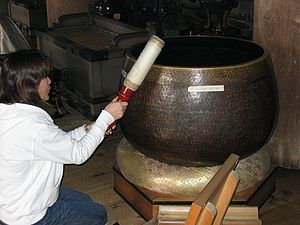
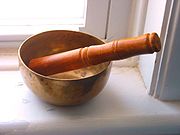
Singing bowls are played by striking the rim of the bowl with a padded mallet. They can also be played by the friction
Friction
Friction is the force resisting the relative motion of solid surfaces, fluid layers, and/or material elements sliding against each other. There are several types of friction:...
of rubbing a wood, plastic, or leather wrapped mallet around the rim of the bowl to emphasize the harmonic overtones and a continuous 'singing' sound.
Singing bowls produce a unique sound and also physical vibration that can be felt. They are multiphonic
Multiphonic
Multiphonics is an extended technique in instrumental music in which a monophonic instrument is made to produce several notes at once....
instruments, producing multiple harmonic overtones at the same time.
Both antique and new bowls are widely used as an aid to meditation
Meditation
Meditation is any form of a family of practices in which practitioners train their minds or self-induce a mode of consciousness to realize some benefit....
. They are also used in yoga
Yoga
Yoga is a physical, mental, and spiritual discipline, originating in ancient India. The goal of yoga, or of the person practicing yoga, is the attainment of a state of perfect spiritual insight and tranquility while meditating on Supersoul...
, music therapy
Music therapy
Music therapy is an allied health profession and one of the expressive therapies, consisting of an interpersonal process in which a trained music therapist uses music and all of its facets—physical, emotional, mental, social, aesthetic, and spiritual—to help clients to improve or maintain their...
, sound healing, religious services, performance and for personal enjoyment.
Antique singing bowls
Multiphonic
Multiphonics is an extended technique in instrumental music in which a monophonic instrument is made to produce several notes at once....
and polyharmonic overtones creating an effect that is unique to the instrument. The subtle yet complex multiple harmonic
Harmonic
A harmonic of a wave is a component frequency of the signal that is an integer multiple of the fundamental frequency, i.e. if the fundamental frequency is f, the harmonics have frequencies 2f, 3f, 4f, . . . etc. The harmonics have the property that they are all periodic at the fundamental...
frequencies are a special quality of the high quality bronze alloy. The art of making singing bowls in the traditional way is often called a lost art, but traditional craftsmen still make singing bowls in the traditional manner. They are one of the longest made traditional objects still being made today.
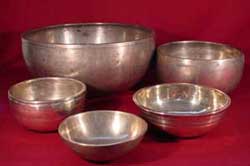
Antique singing bowls are highly prized and collected worldwide, due to their fine craftsmanship and remarkable sound. They may display abstract decorations like lines, rings and circles engraved into the surface. Decoration may appear outside the rim, inside the bottom, around the top of the rim and sometimes on the outside bottom.
Very few antique singing bowls are available today. Many websites sell new singing bowls and call them "old" or "antique" without any real information about the age.
Oxford University recently conducted a study with the company Himalayan Bowls and found that singing bowls have been made in the Himalayan region for at least 600-800 years, and are likely related to bronze bowls produced in Central and Western Asia. Extensive metallurgical analysis by Himalayan Bowls and Oxford University has discovered that the bowls are made from "high tin bronze," also known as "bell metal bronze," which is a pure mixture of copper and tin. Contrary to popular folklore, there is no evidence to support the claims that singing bowls contain "7 metals" (Joseph Feinstein, 2011).
Modern development
Iconography
Iconography is the branch of art history which studies the identification, description, and the interpretation of the content of images. The word iconography literally means "image writing", and comes from the Greek "image" and "to write". A secondary meaning is the painting of icons in the...
and spiritual
Spirituality
Spirituality can refer to an ultimate or an alleged immaterial reality; an inner path enabling a person to discover the essence of his/her being; or the “deepest values and meanings by which people live.” Spiritual practices, including meditation, prayer and contemplation, are intended to develop...
motifs and symbols, such as the Tibetan mantra
Mantra
A mantra is a sound, syllable, word, or group of words that is considered capable of "creating transformation"...
Om mani padme hum
Om mani padme hum
is the six syllabled mantra particularly associated with the four-armed Shadakshari form of Avalokiteshvara , the bodhisattva of compassion...
, images of Buddhas, and Ashtamangala
Ashtamangala
Ashtamangala or Zhaxi Daggyai are a sacred suite of Eight Auspicious Signs endemic to a number of Dharmic Traditions such as Hinduism, Jainism, and Buddhism. The symbols or 'symbolic attributes' are yidam and teaching tools...
.
New singing bowls are exported from Nepal
Nepal
Nepal , officially the Federal Democratic Republic of Nepal, is a landlocked sovereign state located in South Asia. It is located in the Himalayas and bordered to the north by the People's Republic of China, and to the south, east, and west by the Republic of India...
, India
India
India , officially the Republic of India , is a country in South Asia. It is the seventh-largest country by geographical area, the second-most populous country with over 1.2 billion people, and the most populous democracy in the world...
and China. The best hand made examples are made in Nepal and have many properties similar to the real antiques. High quality new singing bowls are made in Japan
Japan
Japan is an island nation in East Asia. Located in the Pacific Ocean, it lies to the east of the Sea of Japan, China, North Korea, South Korea and Russia, stretching from the Sea of Okhotsk in the north to the East China Sea and Taiwan in the south...
and Korea
Korea
Korea ) is an East Asian geographic region that is currently divided into two separate sovereign states — North Korea and South Korea. Located on the Korean Peninsula, Korea is bordered by the People's Republic of China to the northwest, Russia to the northeast, and is separated from Japan to the...
but are not generally exported.
New singing bowls are made in 2 processes. One is by hand hammering known as handmade beaten bowls and another by sand casting method as casting bowls.
New singing bowls are widely color treated and sold as "old." If shopping for singing bowls, be sure to make sure the source is reputable as the market is flooded with fakes and poor sounding products.
Further reading
- Müller-Ebeling, ClaudiaClaudia Müller-EbelingClaudia Müller-Ebeling, Ph.D., is an anthropologist and art historian. She has coauthored with Christian Rätsch on a number of works of shamanic pharmacopoeia, ethnopharmaceuticals and ethnohallucinogens. Müller-Ebeling resides in Hamburg, Germany.-Works:* Müller-Ebeling, Claudia and Christian...
, Christian RätschChristian RätschChristian Rätsch is a German writer ethnopharmacology and psychoactive plants and animals. Rätsch is an anthropologist and author. He was born in 1957 in a Bohemian community in Hamburg, Germany. His father was an opera singer, his mother a ballet dancer...
, Surendra Bahadur Shahi (2002). Shamanism and Tantra in the Himalayas. Trans. by Annabel Lee. Rochester, Vermont: Inner Traditions. - Shrestha, Suren (2009). How to Heal with Singing Bowls: Traditional Tibetan Healing Methods (Book and Audio CD). Sentient Publications. ISBN 978-1-59181-087-2.
- Jansen, Eva Rudy. Singing Bowls. A Practical Handbook of Instruction and Use. New Age Books, New Delhi (2004). ISBN 81-7822-103-9.
- Terwagne, Denis & John W. M. Bush (2011). Tibetan singing bowls. Nonlinearity 24: R51.