
Home      Discussion      Topics      Dictionary      Almanac
Signup       Login
Simurgh

Simurgh

Overview

Simurgh , also spelled simorgh, simurg or simoorg, also known as Angha , is the modern Persian
Persian language
Persian is an Iranian language within the Indo-Iranian branch of the Indo-European languages. It is widely spoken in Iran, Afghanistan, Tajikistan, Uzbekistan and to some extent in Iraq and Bahrain, and has a status of official language in the first three countries under different names...

 name for a fabulous, benevolent, mythical flying creature. The figure can be found in all periods of Greater Iran
Greater Iran
Greater Iran refers to the regions that have significant Iranian cultural influence...

ian art and literature, and is evident also in the iconography of medieval Armenia
Armenia
Armenia , officially the Republic of Armenia , is a landlocked mountainous country in the Caucasus region of Eurasia...

, Byzantium
Byzantium
Byzantium was an ancient Greek city, which was founded by Greek colonists from Megara in 667 BC and named after their king Byzas or Byzantas . The name "Byzantium" is a Latinization of the original name Byzantion...

 and other regions that were within the sphere of Persian cultural influence.

The name simurgh derives from Middle Persian
Middle Persian
Middle Persian is the Middle Iranian language/ethnolect of Southwestern Iran that during Sassanid times became a prestige dialect and so came to be spoken in other regions as well. Middle Persian is classified as Western Iranian language...

 Pahlavi sēnmurw (and earlier sēnmuruγ), also attested in Middle Persian
Middle Persian
Middle Persian is the Middle Iranian language/ethnolect of Southwestern Iran that during Sassanid times became a prestige dialect and so came to be spoken in other regions as well. Middle Persian is classified as Western Iranian language...

 Pāzand
Pazend language
The Pazend or Pazand is one of the writing systems used for the Middle Persian language.Pazend's principal use was for writing the commentaries on and/or translations of the Avesta, the primary collection of sacred texts of Zoroastrianism...

 as sīna-mrū.
Discussion
Ask a question about 'Simurgh'
Start a new discussion about 'Simurgh'
Answer questions from other users
Full Discussion Forum
 
Encyclopedia

Simurgh , also spelled simorgh, simurg or simoorg, also known as Angha , is the modern Persian
Persian language
Persian is an Iranian language within the Indo-Iranian branch of the Indo-European languages. It is widely spoken in Iran, Afghanistan, Tajikistan, Uzbekistan and to some extent in Iraq and Bahrain, and has a status of official language in the first three countries under different names...

 name for a fabulous, benevolent, mythical flying creature. The figure can be found in all periods of Greater Iran
Greater Iran
Greater Iran refers to the regions that have significant Iranian cultural influence...

ian art and literature, and is evident also in the iconography of medieval Armenia
Armenia
Armenia , officially the Republic of Armenia , is a landlocked mountainous country in the Caucasus region of Eurasia...

, Byzantium
Byzantium
Byzantium was an ancient Greek city, which was founded by Greek colonists from Megara in 667 BC and named after their king Byzas or Byzantas . The name "Byzantium" is a Latinization of the original name Byzantion...

 and other regions that were within the sphere of Persian cultural influence.

The name simurgh derives from Middle Persian
Middle Persian
Middle Persian is the Middle Iranian language/ethnolect of Southwestern Iran that during Sassanid times became a prestige dialect and so came to be spoken in other regions as well. Middle Persian is classified as Western Iranian language...

 Pahlavi sēnmurw (and earlier sēnmuruγ), also attested in Middle Persian
Middle Persian
Middle Persian is the Middle Iranian language/ethnolect of Southwestern Iran that during Sassanid times became a prestige dialect and so came to be spoken in other regions as well. Middle Persian is classified as Western Iranian language...

 Pāzand
Pazend language
The Pazend or Pazand is one of the writing systems used for the Middle Persian language.Pazend's principal use was for writing the commentaries on and/or translations of the Avesta, the primary collection of sacred texts of Zoroastrianism...

 as sīna-mrū. The Middle Persian term derives in turn from Avestan mərəγō Saēnō "the bird Saēna", originally a raptor, likely an eagle, falcon or sparrowhawk, as can be deduced from the etymological cognate Sanskrit
Sanskrit
Sanskrit is a historical Indo-Aryan language, one of the liturgical languages of Hinduism and Buddhism, and one of the 22 official languages of India. It is also declared as a classical language by the government of India....

 śyenaḥ "raptor, eagle, bird of prey" that also appears as a divine figure. Saēna is also a personal name which is root of the name.

Form and function


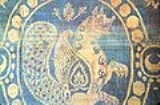
The simurgh is depicted in Iranian art
Iranian art
The Iranian cultural region - consisting of the modern nations of Iran, Afghanistan, Tajikistan, Azerbaijan, Uzbekistan, and surrounding regions - is home to one of the richest art heritages in world history and encompasses many disciplines including architecture, painting, weaving, pottery,...

 as a winged creature in the shape of a bird, gigantic enough to carry off an elephant or a whale. It appears as a kind of peacock with the head of a dog and the claws of a lion; sometimes however also with a human face. The simurgh is inherently benevolent and unambiguously female. Being part mammal, she suckles her young. The simurgh has teeth. It has an enmity towards snakes and its natural habitat is a place with plenty of water. Its feathers are said to be the colour of copper, and though it was originally described as being a Dog-Bird, later it was shown with either the head of a man or a dog.

"Si-", the first element in the name, has been connected in folk etymology to Modern Persian si "thirty". Although this prefix is not historically related to the origin of the name simurgh, "thirty" has nonetheless been the basis for legends incorporating that number, for instance, that the simurgh was as large as thirty birds or had thirty colours (siræng).

Iranian legends consider the bird so old that it had seen the destruction of the World three times over. The simurgh learned so much by living so long that it is thought to possess the knowledge of all the Ages. In one legend, the simurgh was said to live 1,700 years before plunging itself into flames (much like the phoenix
Phoenix (mythology)
The phoenix is a mythical sacred firebird which originated in the ancient mythologies mentioned in the Phoenician Mythology and the Egyptian and later the Greek Mythology.- Appearance and Abilities :...

).

The simurgh was considered to purify the land and waters and hence bestow fertility. The creature represented the union between the earth and the sky, serving as mediator and messenger between the two. The simurgh roosted in Gaokerena
Gaokerena
In Persian and Iranian legends, the mighty Gaokerena was a mythic Haoma plant that had healing properties when eaten and gave immortality to the resurrected bodies of the dead. The juice from its fruit gave the elixir of immortality...

, the Hōm
Haoma
Haoma is the Avestan language name of a plant and its divinity, both of which play a role in Zoroastrian doctrine and in later Persian culture and mythology. The Middle Persian form of the name is hōm, which continues to be the name in Modern Persian and other living Iranian languages.Sacred haoma...

 (Avestan: Haoma) Tree of Life, which stands in the middle of the world sea Vourukhasa. The plant is potent medicine, is called all-healing, and the seeds of all plants are deposited on it. When the simurgh took flight, the leaves of the tree of life shook making all the seeds of every plant to fall out. These seeds floated around the world on the winds of Vayu-Vata
Vayu-Vata
Vayu-Vata is the Avestan language name of a dual-natured Zoroastrian divinity of the wind and of the atmosphere...

 and the rains of Tishtrya
Tishtrya
Tishtrya is the Avestan language name of an Zoroastrian benevolent divinity associated with life-bringing rainfall and fertility. Tishtrya is Tir in Middle- and Modern Persian...

, in cosmology taking root to become every type of plant that ever lived, and curing all the illnesses of mankind.

The relationship between the simurgh and Hōm is extremely close. Like the simurgh, Hōm is represented as a bird, a messenger and as the essence of purity that can heal any illness or wound. Hōm - appointed as the first priest - is the essence of divinity, a property it shares with the simurgh. The Hōm is in addition the vehicle of farr(ah) (MP: khwarrah, Avestan: khvarenah
Khvarenah
' or ' is an Avestan language word for a Zoroastrian concept literally denoting "glory" or "splendour" but understood as a divine mystical force or power projected upon and aiding the appointed. The neuter noun thus also connotes " royal glory," reflecting the perceived divine empowerment of kings...

, kavaēm kharēno) "[divine] glory" or "fortune". Farrah in turn represents the divine mandate
Divine Right of Kings
The divine right of kings is a political and religious doctrine of royal absolutism. It asserts that a monarch is subject to no earthly authority, deriving his right to rule directly from the will of God. The king is thus not subject to the will of his people, the aristocracy, or any other estate...

 that was the foundation of a king's authority.
It appears as a bird resting on the head or shoulder of would-be kings and clerics, so indicating Ormuzd's
Ahura Mazda
Ahura Mazda is the Avestan language name for a divinity exalted by Zoroaster as the one uncreated Creator.The Zoroastrian faith is described by its adherents as Mazdayasna, the worship of Mazda. In the Avesta, "Ahura Mazda is the highest object of worship", the first and most frequently invoked...

 acceptance of that individual as His divine representative on earth. For the commoner, Bahram
Vahram
Verethragna is an Avestan language neuter noun literally meaning "smiting of resistance" . Representing this concept is the divinity Verethragna, who is the hypostasis of "victory", and "as a giver of victory Verethragna plainly enjoyed the greatest popularity of old" .The neuter noun verethragna...

 wraps fortune/glory "around the house of the worshipper, for wealth in cattle, like the great bird Saena, and as the watery clouds cover the great mountains" (Yasht
Yasht
The s are a collection of twenty-one hymns in Younger Avestan. Each of these hymns invokes a specific Zoroastrian divinity or concept. Yasht chapter and verse pointers are traditionally abbreviated as Yt....

14.41, cf. the rains of Tishtrya above). Like the simurgh, farrah is also associated with the waters of Vourukasha (Yasht 19.51,.56-57). In Yašt 12.17 Simorgh's (Saēna’s) tree stands in the middle of the sea Vourukaša, it has good and potent medicine, is called all-healing, and the seeds of all plants are deposited on it.

In the Shahnameh


The Simurgh made its most famous appearance in the Ferdowsi
Ferdowsi
Hakīm Abu'l-Qāsim Firdawsī Tūsī , more commonly transliterated as Ferdowsi , was a highly revered Persian poet...

's epic Shahname
Shahnameh
Shāhnāmé is an enormous poetic opus written by the Persian poet Ferdowsi around 1000 AD and is the national epic of the Persian-speaking world...

(Book of Kings), where its involvement with the Prince Zal
Zal
Zāl is a legendary Persian warrior from the old Persian "The Book of Kings/ The king of books" or Shahnameh.-Background:An albino, Zāl was born with white hair. Because of this, his parents called him Zāl. In the Persian language, "Zaall" refers to those who suffer from albinism...

 is described. According to the Shahname, Zal
Zal
Zāl is a legendary Persian warrior from the old Persian "The Book of Kings/ The king of books" or Shahnameh.-Background:An albino, Zāl was born with white hair. Because of this, his parents called him Zāl. In the Persian language, "Zaall" refers to those who suffer from albinism...

, the son of Saam
Saam
Sām is a mythical hero of ancient Persia, and an important character in the Shahnameh epic. He was the son of Nariman, grandson of Garshasp and father to Zal. He was Iran's champion during the rule of Fereydun, Manuchehr and Nowzar. He was appointed by Manuchehr to rule Zabulistan , and then...

, was born albino. When Saam saw his albino son, he assumed that the child was the spawn of devils, and abandoned the infant on the mountain Alborz
Hara Berezaiti
Harā Bərəzaitī, literally meaning "High Watchpost", is the name given in the Avestan language to a legendary mountain around which the stars and planets revolve.-Etymology and derived names:...

.

The child's cries were carried to the ears of the tender-hearted Simurgh, who lived on top this peak, and she retrieved the child and raised him as her own. Zal was taught much wisdom from the loving Simurgh, who has all knowledge, but the time came when he grew into a man and yearned to rejoin the world of men. Though the Simurgh was terribly saddened, she gifted him with three golden feathers which he was to burn if he ever needed her assistance.

Upon returning to his kingdom, Zal fell in love and married the beautiful Rudaba
Rudaba
Rūdāba or Roodabeh is a Persian mythological female figure in Ferdowsi's epic Shahnameh. She is the princess of Kabul, daughter of Mehrab Kaboli, and later she becomes the first of Zal's wives. They had two children, Rostam and Zawara.-Etymology:The word Roodabeh consists of two sections...

. When it came time for their son to be born, the labor was prolonged and terrible; Zal was certain that his wife would die in labour. Rudabah was near death when Zal decided to summon the simurgh. The simurgh appeared and instructed him upon how to perform a cesarean section thus saving Rudabah and the child, who became one of the greatest Persian heroes, Rostam
Rostam
Rostam is the national hero of Iran and in Persian mythology and son of Zal and Rudaba. In some ways, the position of Rostam in the historical tradition is curiously parallel to that of Surena, the hero of the Carrhae. His figure was endowed with many features of the historical personality of...

. Simurgh also shows up in the story of the Seven Trials of Esfandiar and the story of Rostam and Esfandiar.

In Sufi


In classical and modern Persian literature the Simorḡ is frequently mentioned, particularly as a metaphor for God in Sufi mysticism. In the 12th century Conference of the Birds
The Conference of the Birds
The Conference of the Birds is a book of poems in Persian by Farid ud-Din Attar of approximately 4500 lines. The poem uses a journey by a group of 30 birds, led by a hoopoe as an allegory of a Sufi sheikh or master leading his pupils to enlightenment.Besides being one of the most beautiful...

, Iranian Sufi poet Farid ud-Din Attar wrote of a band of pilgrim birds in search of the Simurgh. According to the poet's tale, the Simurgh has thirty holes in her beak and drew the wind through them whenever she was hungry. Animals heard a pretty music and gathered at the peak of a mountain where they were eaten by the Simurgh. Through cultural assimilation
Cultural assimilation
Cultural assimilation is a political response to the demographic fact of multi-ethnicity which encourages absorption of the minority into the dominant culture...

 the Simurgh was introduced to the Arabic-speaking world, where the concept was conflated with other Arabic mythical birds such as the Ghoghnus and developed as the Rukh (the origin of the English word "Roc").

In Kurdish folklore


Simurgh is shortened to Sīmīr in the Kurdish language
Kurdish language
Kurdish is the language spoken by Kurds in western Asia. Unlike many other languages it does not have a single standardized linguistic entity with the status of an official or state language...

. The scholar Trever quotes two Kurdish folktales about the bird. These versions go back to the common stock of Iranian Simorḡ stories. In one of the folk tales, a hero rescues Simurgh's off-springs by killing a snake that is crawling up the tree to feed upon them. As a reward Sīmīr(Simurgh) gives him three of her feathers; which the hero can call for help by burning them. Later the hero uses the feathers, and Simurgh carries him to a distant land. In the other tale, Simurgh carries the hero out of the netherworld; here Simurgh feeds its young with its teats, a trait which agrees with the description of the Simurgh in the Middle Persian
Middle Persian
Middle Persian is the Middle Iranian language/ethnolect of Southwestern Iran that during Sassanid times became a prestige dialect and so came to be spoken in other regions as well. Middle Persian is classified as Western Iranian language...

 book of Zdspram. In another tale, Simurgh feeds the hero on the journey while the hero feeds Simirugh with pieces of sheep’s fat.

See also

  • Melek Taus
    Melek Taus
    Melek Taus - Kurdish Tawûsê Melek "The Peacock Angel" is the Yazidis' name for the central figure of their faith.-Religious significance:...

    , peacock angel of the Yazidi
    Yazidi
    The Yazidi are a Kurdish ethnicity with ancient Indo-European roots.They are primarily Kurdish speaking, and most live in the Mosul region of northern Iraq...

    .
  • Blue Crow
    Blue Crow
    Blue Crow is a mythical giant bird from Southern Brazil that supposedly travels throughout the southern region of the country. The legend is very famous in the Brazilian state of Paraná.-See also:* Azure Jay...

    , a giant crow from Brazilian legends.
  • Bar Juchne
    Bar Juchne
    Bar Juchne or Bar-Yuchnei is a colossal legendary bird from Jewish mythology which was believed to have a wingspan large enough to block out the sun....

    , a giant bird from Jewish legends.
  • Ziz
    Ziz
    The Ziz is a giant griffin like bird in Jewish mythology, said to be large enough to be able to block out the sun with its wingspan. It is considered a giant animal/monster corresponding to archetypal creatures...

    , a giant bird from Jewish legends.
  • Mantiq at-Tayr
    The Conference of the Birds
    The Conference of the Birds is a book of poems in Persian by Farid ud-Din Attar of approximately 4500 lines. The poem uses a journey by a group of 30 birds, led by a hoopoe as an allegory of a Sufi sheikh or master leading his pupils to enlightenment.Besides being one of the most beautiful...

    , a book of poems by Farīd ud-Dīn `Attār.
  • Phoenix
    Phoenix (mythology)
    The phoenix is a mythical sacred firebird which originated in the ancient mythologies mentioned in the Phoenician Mythology and the Egyptian and later the Greek Mythology.- Appearance and Abilities :...

  • Roc, a giant bird from Persian mythology.
  • Cafcuh
    Cafcuh
    Cafcuh or Kafkuh is a mythological mountain based on the reality for Iranian People. Historically Iranian power never extended over the northern caucasus that caused a mysteric opinion over these mountains.It was:* the highest...

  • Shahrokh
    Shahrokh
    Shahrokh, Shahrukh, Shah Rukh may mean:*Shahrokh Shah Afshar, shah of persia*Shahrokh, Persian pop musician*Shahrokh Bayani, Iranian footballer*Shahrokh Meskoob, Iranian writer*Shahrokh Moshkin Ghalam, Iranian folkloric dancer and theatre director...