


Simon Ushakov

Encyclopedia
Russia
Russia or , officially known as both Russia and the Russian Federation , is a country in northern Eurasia. It is a federal semi-presidential republic, comprising 83 federal subjects...
n graphic artist of the late 17th-century. Together with Fyodor Zubov and Fyodor Rozhnov, he is associated with the comprehensive reform of the Russian Orthodox Church
Russian Orthodox Church
The Russian Orthodox Church or, alternatively, the Moscow Patriarchate The ROC is often said to be the largest of the Eastern Orthodox churches in the world; including all the autocephalous churches under its umbrella, its adherents number over 150 million worldwide—about half of the 300 million...
undertaken by Patriarch Nikon
Patriarch Nikon
Nikon , born Nikita Minin , was the seventh patriarch of the Russian Orthodox Church...
.
Biography
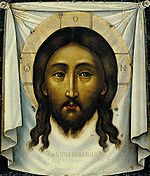
We know almost nothing about the early years of Simon Ushakov. His birth date is deduced from his inscription on one of the icons: In the year 7166 painted this icon Simon Ushakov son, being 32 years of age.At 22 he became a paid artist of the Silver Chamber, affiliated with the Armory Prikaz
Prikaz
Prikaz was an administrative or judicial office in Muscovy and Russia of 15th-18th centuries. The term is usually translated as "ministry", "office" or "department". In modern Russian "prikaz" means administrative or military order...
. The bright, fresh colours and exquisite, curving lines of his proto-baroque
Baroque
The Baroque is a period and the style that used exaggerated motion and clear, easily interpreted detail to produce drama, tension, exuberance, and grandeur in sculpture, painting, literature, dance, and music...
icons caught the eye of Patriarch Nikon
Patriarch Nikon
Nikon , born Nikita Minin , was the seventh patriarch of the Russian Orthodox Church...
, who introduced Simon to the tsar Alexei Mikhailovich
Alexis I of Russia
Aleksey Mikhailovich Romanov was the Tsar of Russia during some of the most eventful decades of the mid-17th century...
. He became a great favourite with the royal family and was eventually (1664) assigned to the Kremlin Armoury
Kremlin Armoury
The Kremlin Armory is one of the oldest museums of Moscow, established in 1808 and located in the Moscow Kremlin .The Kremlin Armoury originated as the royal arsenal in 1508. Until the transfer of the court to St Petersburg, the Armoury was in charge of producing, purchasing and storing weapons,...
, run by an educated boyar
Boyar
A boyar, or bolyar , was a member of the highest rank of the feudal Moscovian, Kievan Rus'ian, Bulgarian, Wallachian, and Moldavian aristocracies, second only to the ruling princes , from the 10th century through the 17th century....
Bogdan Khitrovo
Bogdan Khitrovo
Bogdan Matveyevich Khitrovo was a high-placed Russian statesman, or boyar, who served Tsar Alexis and his son Fyodor III, supporting the party of Maria Miloslavskaya...
.
Ushakov had a lot of pupils and associates and even published a short treatise on icon-painting entitled A Word to Loving-Meticulous Icon Painting (1664). Some of the more conservative Russian priests, such as archpriest Avvakum
Avvakum
Avvakum Petrov was a Russian protopope of Kazan Cathedral on Red Square who led the opposition to Patriarch Nikon's reforms of the Russian Orthodox Church...
, regarded his icons as "lascivious works of devil", for they were too Western for their tastes. Avvakum, in particular, alleged that Ushakov painted his "fleshly saints" after his own portly appearance.
Ushakov also executed secular commissions and produced engravings for book illustrations. In other words, he was one of the first secular painters in Russia. Some of his icons, transported to Western Europe, were instrumental in fomenting interest for nascent Russian painting. He died on June 25, 1686 in Moscow.
External links and sources
- On-line text by Simon Ushakov A Word to Loving-Meticulous Icon Painting - in Russian
- Simon Ushakov From Alexander Men' dictionary - in Russian
- Biography of Simon Ushakov by Archimandrit Avgustin (Nikitin) - in Russian
- Chapter on Ushakov and his school from Igor Grabar's History of Russian Art
- V. N. Alexandrov, History of Russian Art, Minsk, 2004, ISBN 985-13-1199-5