
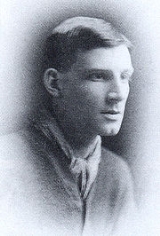
Siegfried Loraine Sassoon CBE
MCThe Military Cross is the third-level military decoration awarded to officers and other ranks of the British Armed Forces; and formerly also to officers of other Commonwealth countries....
(8 September 1886 – 1 September 1967) was an English poet, author and soldier. Decorated for bravery on the Western Front, he became one of the leading poets of the First World War. His poetry both described the horrors of the trenches, and satirised the patriotic pretensions of those who, in Sassoon's view, were responsible for a vainglorious war. He later won acclaim for his prose work, notably his three-volume fictionalised autobiography, collectively known as the "Sherston Trilogy".
Early life and education
Siegfried Sassoon was born and grew up in the neo-gothic mansion named "Weirleigh" (after its builder,
Harrison WeirHarrison William Weir , known as "The Father of the Cat Fancy", was an English gentleman and artist.He organized the first cat show in England, at The Crystal Palace, London, in July 1871. He and his brother, John Jenner Weir, both served as judges in the show...
), in
MatfieldMatfield is a small village, part of the civil parish of Brenchley, in the Tunbridge Wells Borough of Kent, England. The sculptor Theresa Sassoon planted a tree on the green to commemorate the end of World War I; the tree was blown down in the hurricane of 1987 and had to be replaced...
, Kent, to a Jewish father and an Anglo-Catholic mother. His father, Alfred Ezra Sassoon (1861–1895), son of
Sassoon David SassoonSassoon David Sassoon , a British Indian merchant, was born at Bombay , a member of a family settled there since the beginning of the 16th century, and previously in Spain...
, was a member of the wealthy
Baghdadi JewishBaghdadi Jews, also known as Iraqi Jews, are Jewish emigrants from Baghdad and elsewhere in Iraq, who fled religious persecution and formed immigrant communities in their new homelands...
Sassoon merchant familyThe Sassoon family was an Indian family of Iraqi Jewish descent and international renown, based in Bombay, India. It was descended from the famous Ibn Shoshans, one of the richest families of medieval Spain...
. For marrying outside the faith he was disinherited. His mother,
TheresaTheresa Thornycroft was an English sculptor and member of the Thornycroft family of artists. Her brother Sir Hamo Thornycroft RA, sisters Alyce Thornycroft and Helen Thornycroft were all artists, while her brother Sir John Isaac Thornycroft was the founder of the Thornycroft shipbuilding company...
, belonged to the
Thornycroft familyThe Thornycroft family was a notable English family of sculptors, artists and engineers, connected by marriage to the historic Sassoon family. The earliest known mention of the family is stated in George Ormerod's History of Cheshire as during the reign of Henry III in the 13th century, taking its...
, sculptors responsible for many of the best-known statues in London—her brother was Sir
Hamo ThornycroftSir William "Hamo" Thornycroft, RA was a British sculptor, responsible for several London landmarks.-Biography:...
. There was no German ancestry in Siegfried's family; his mother named him Siegfried because of her love of
WagnerWilhelm Richard Wagner was a German composer, conductor, theatre director, philosopher, music theorist, poet, essayist and writer primarily known for his operas...
's operas. His middle name, Loraine, was the surname of a clergyman with whom she was friendly.
Sassoon was the second of three sons, the others being Michael and Hamo. When he was four years old his parents separated. During his father's weekly visits to the boys, Theresa locked herself in the drawing room. In 1895 Alfred Sassoon died of
tuberculosisTuberculosis, MTB, or TB is a common, and in many cases lethal, infectious disease caused by various strains of mycobacteria, usually Mycobacterium tuberculosis. Tuberculosis usually attacks the lungs but can also affect other parts of the body...
.
Sassoon was educated at
The New Beacon Preparatory SchoolThe New Beacon Preparatory School is a fee-paying preparatory school, or prep school, located in Sevenoaks, Kent, United Kingdom, which caters both for day-boys and boarders, in the age range 4-13. Currently there are about 400 pupils.- Overview :...
,
SevenoaksSevenoaks is a commuter town situated on the London fringe of west Kent, England, some 20 miles south-east of Charing Cross, on one of the principal commuter rail lines from the capital...
, Kent; at
Marlborough CollegeMarlborough College is a British co-educational independent school for day and boarding pupils, located in Marlborough, Wiltshire.Founded in 1843 for the education of the sons of Church of England clergy, the school now accepts both boys and girls of all beliefs. Currently there are just over 800...
, Marlborough, Wiltshire (where he was a member of Cotton House), and at
Clare College, CambridgeClare College is a constituent college of the University of Cambridge in Cambridge, England.The college was founded in 1326, making it the second-oldest surviving college of the University after Peterhouse. Clare is famous for its chapel choir and for its gardens on "the Backs"...
, where from 1905 to 1907 he read history. He went down from Cambridge without a degree and spent the next few years hunting, playing cricket and writing verse: some he published privately. Since his father had been disinherited from the Sassoon fortune for marrying a non-Jew, Siegfried had only a small private fortune that allowed him to live modestly without having to earn a living (however, he would later be left a generous legacy by an aunt,
Rachel BeerRachel Beer was an Indian-born British newspaper editor. She was editor-in-chief of The Observer and The Sunday Times.-Biography:...
, allowing him to buy the great estate of Heytesbury House in Wiltshire). His first published success,
The Daffodil Murderer (1913), was a parody of
John MasefieldJohn Edward Masefield, OM, was an English poet and writer, and Poet Laureate of the United Kingdom from 1930 until his death in 1967...
's
The Everlasting Mercy.
Robert GravesRobert von Ranke Graves 24 July 1895 – 7 December 1985 was an English poet, translator and novelist. During his long life he produced more than 140 works...
, in
Good-Bye to All That describes it as a "parody of Masefield which, midway through, had forgotten to be a parody and turned into rather good Masefield."
Sassoon expressed his opinions on the political situation before the onset of the First World War—"France was a lady,
RussiaThe Russian Empire was a state that existed from 1721 until the Russian Revolution of 1917. It was the successor to the Tsardom of Russia and the predecessor of the Soviet Union...
was a bear, and performing in the county
cricketCricket is a bat-and-ball game played between two teams of 11 players on an oval-shaped field, at the centre of which is a rectangular 22-yard long pitch. One team bats, trying to score as many runs as possible while the other team bowls and fields, trying to dismiss the batsmen and thus limit the...
team was much more important than either of them". Sassoon wanted to play for
Kent County Cricket ClubKent County Cricket Club is one of the 18 first class county county cricket clubs which make up the English and Welsh national cricket structure, representing the county of Kent...
; Kent Captain
Frank MarchantFrank Marchant was an English cricketer. He was a right-handed batsman and an occasional wicket-keeper. He was born in Kent.-Life:...
was a neighbour of Sassoon. Siegfried often turned out for Bluehouses at the Nevill Ground, where he sometimes played alongside
Arthur Conan DoyleSir Arthur Ignatius Conan Doyle DL was a Scottish physician and writer, most noted for his stories about the detective Sherlock Holmes, generally considered a milestone in the field of crime fiction, and for the adventures of Professor Challenger...
. He also played cricket for his house at Marlborough College, once taking 7 wickets for 18 runs. Although an enthusiast, Sassoon was not good enough to play for Kent, but he played cricket for Matfield, and later for the Downside Abbey team, continuing into his seventies.
War service
Motivated by patriotism, Sassoon joined the British Army just as the threat of World War I was realised, and was in service with the Sussex Yeomanry on the day the United Kingdom declared war (4 August 1914). He broke his arm badly in a riding accident and was put out of action before even leaving England, spending the spring of 1915 convalescing. At around this time his younger brother Hamo was killed in the Gallipoli Campaign. (
Rupert BrookeRupert Chawner Brooke was an English poet known for his idealistic war sonnets written during the First World War, especially The Soldier...
, whom Siegfried had briefly met, died on the way there.) Hamo's death hit Siegfried very hard. He was commissioned into 3rd Battalion (Special Reserve),
Royal Welch FusiliersThe Royal Welch Fusiliers was an infantry regiment of the British Army, part of the Prince of Wales' Division. It was founded in 1689 to oppose James II and the imminent war with France...
as a
second lieutenantSecond lieutenant is a junior commissioned officer military rank in many armed forces.- United Kingdom and Commonwealth :The rank second lieutenant was introduced throughout the British Army in 1871 to replace the rank of ensign , although it had long been used in the Royal Artillery, Royal...
on 29 May 1915, and in November was sent to the 1st Battalion in France. There he met
Robert GravesRobert von Ranke Graves 24 July 1895 – 7 December 1985 was an English poet, translator and novelist. During his long life he produced more than 140 works...
and they became close friends. United by their poetic vocation, they often read and discussed one another's work. Though this did not have much perceptible influence on Graves's poetry, his views on what may be called 'gritty realism' profoundly affected Sassoon's concept of what constituted poetry. He soon became horrified by the realities of war, and the tone of his writing changed completely: where his early poems exhibit a
RomanticRomanticism was an artistic, literary and intellectual movement that originated in the second half of the 18th century in Europe, and gained strength in reaction to the Industrial Revolution...
, dilettantish sweetness, his war poetry moves to an increasingly discordant music, intended to convey the ugly truths of the trenches to an audience hitherto lulled by patriotic
propagandaPropaganda is a form of communication that is aimed at influencing the attitude of a community toward some cause or position so as to benefit oneself or one's group....
. Details such as rotting corpses, mangled limbs, filth, cowardice and suicide are all trademarks of his work at this time, and this philosophy of 'no truth unfitting' had a significant effect on the movement towards Modernist poetry.
Sassoon's periods of duty on the
Western FrontFollowing the outbreak of World War I in 1914, the German Army opened the Western Front by first invading Luxembourg and Belgium, then gaining military control of important industrial regions in France. The tide of the advance was dramatically turned with the Battle of the Marne...
were marked by exceptionally brave actions, including the single-handed, but vainglorious, capture of a German trench in the
Hindenburg LineThe Hindenburg Line was a vast system of defences in northeastern France during World War I. It was constructed by the Germans during the winter of 1916–17. The line stretched from Lens to beyond Verdun...
. Armed with grenades he scattered 60 German soldiers:
He went over with bombs in daylight, under covering fire from a couple of rifles, and scared away the occupants. A pointless feat, since instead of signalling for reinforcements, he sat down in the German trench and began reading a book of poems which he had brought with him. When he went back he did not even report. Colonel Stockwell, then in command, raged at him. The attack on Mametz woodMametz Wood was the objective of the 38th Division during the First Battle of the Somme. The attack occurred in a Northerly direction over a ridge, focussed on the German positions in the wood between 7 July and 12 July 1916. The attack of the 7 July failed to reach the wood before the men were...
had been delayed for two hours because British patrols were still reported to be out. 'British patrols' were Siegfried and his book of poems. 'I'd have got you a D.S.O.The Distinguished Service Order is a military decoration of the United Kingdom, and formerly of other parts of the British Commonwealth and Empire, awarded for meritorious or distinguished service by officers of the armed forces during wartime, typically in actual combat.Instituted on 6 September...
, if you'd only shown more sense,' stormed Stockwell.
Sassoon's bravery was inspiring to the extent that soldiers of his company said that they felt confident only when they were accompanied by him. He often went out on night-raids and bombing patrols and demonstrated ruthless efficiency as a company commander. Deepening depression at the horror and misery the soldiers were forced to endure produced in Sassoon a paradoxically manic courage, and he was nicknamed "Mad Jack" by his men for his near-suicidal exploits. On 27 July 1916 he was awarded the
Military CrossThe Military Cross is the third-level military decoration awarded to officers and other ranks of the British Armed Forces; and formerly also to officers of other Commonwealth countries....
; the citation read:
Robert GravesRobert von Ranke Graves 24 July 1895 – 7 December 1985 was an English poet, translator and novelist. During his long life he produced more than 140 works...
described Sassoon as engaging in suicidal feats of bravery. Sassoon was also later (unsuccessfully) recommended for the
Victoria CrossThe Victoria Cross is the highest military decoration awarded for valour "in the face of the enemy" to members of the armed forces of various Commonwealth countries, and previous British Empire territories....
.
Despite his decoration and reputation, he decided in 1917 to make a stand against the conduct of the war. One of the reasons for his violent anti-war feeling was the death of his friend,
David Cuthbert ThomasDavid Cuthbert Thomas was a Welsh soldier of the First World War.Thomas was the son of Evan and Ethelinda Thomas of Llanedy Rectory, Pontardulais, Glamorgan. His first commission was as a Second Lieutenant in the 3rd Battalion, Royal Welsh Fusiliers. That regiment also included the writers Robert...
(called "Dick Tiltwood" in the
Sherston trilogyA series of books by the English poet and novelist, Siegfried Sassoon, consisting of Memoirs of a Fox-Hunting Man, Memoirs of an Infantry Officer, and Sherston's Progress...
). He would spend years trying to overcome his grief.
At the end of a spell of convalescent leave, Sassoon declined to return to duty; instead, encouraged by pacifist friends such as
Bertrand RussellBertrand Arthur William Russell, 3rd Earl Russell, OM, FRS was a British philosopher, logician, mathematician, historian, and social critic. At various points in his life he considered himself a liberal, a socialist, and a pacifist, but he also admitted that he had never been any of these things...
and
Lady Ottoline MorrellThe Lady Ottoline Violet Anne Morrell was an English aristocrat and society hostess. Her patronage was influential in artistic and intellectual circles, where she befriended writers such as Aldous Huxley, Siegfried Sassoon, T. S. Eliot and D. H...
, he sent a letter to his commanding officer, titled
Finished with the War: A Soldier’s Declaration. Forwarded to the press and read out in Parliament by a sympathetic MP, the letter was seen by some as treasonous ("I am making this statement as an act of wilful defiance of military authority") or at best condemnatory of the war government's motives ("I believe that the war upon which I entered as a war of defence and liberation has now become a war of aggression and conquest"). Rather than
court-martialA court-martial is a military court. A court-martial is empowered to determine the guilt of members of the armed forces subject to military law, and, if the defendant is found guilty, to decide upon punishment.Most militaries maintain a court-martial system to try cases in which a breach of...
Sassoon, the
Under-Secretary of State for WarThe position of Under-Secretary of State for War was a British government position, first applied to Evan Nepean . In 1801 the offices for War and the Colonies were merged and the post became that of Under-Secretary of State for War and the Colonies...
, Ian Macpherson decided that he was unfit for service and had him sent to Craiglockhart War Hospital near
EdinburghEdinburgh is the capital city of Scotland, the second largest city in Scotland, and the eighth most populous in the United Kingdom. The City of Edinburgh Council governs one of Scotland's 32 local government council areas. The council area includes urban Edinburgh and a rural area...
, where he was officially treated for
neurastheniaNeurasthenia is a psycho-pathological term first used by George Miller Beard in 1869 to denote a condition with symptoms of fatigue, anxiety, headache, neuralgia and depressed mood...
("
shell shockShell Shock, also known as 82nd Marines Attack was a 1964 film by B-movie director John Hayes. The film takes place in Italy during World War II, and tells the story of a sergeant with his group of soldiers....
"). Before declining to return to active service he had thrown the ribbon from his Military Cross into the river
MerseyMersey may refer to:* River Mersey, in northwest England* Mersea Island, off the coast of Essex in England * Mersey River in the Australian state* Electoral division of Mersey in the state of Tasmania, Australian...
.
The novel
RegenerationFor the 1997 film adaptation of the novel see Regeneration .Regeneration is a prize-winning novel by Pat Barker, first published in 1991. The novel was a Booker Prize nominee and was described by the New York Times Book Review as one of the four best novels of the year in its year of publication...
, by
Pat BarkerPat Barker CBE, FRSL is an English writer and novelist. She has won many awards for her fiction, which centres around themes of memory, trauma, survival and recovery. Her work is described as direct, blunt and plainspoken.-Personal life:...
, is a fictionalised account of this period in Sassoon's life, and was made into a
filmRegeneration is a 1997 film adaptation of the novel of the same name by Pat Barker. The film is directed by Gillies MacKinnon. It was released as Behind the Lines in the USA in 1998.-Plot:...
starring
James WilbyJames Jonathon Wilby is an English film, television and theatre actor.-Early life and education:He was born in Rangoon, Burma to a corporate executive father...
as Sassoon and
Jonathan PryceJonathan Pryce, CBE is a Welsh stage and film actor and singer. After studying at the Royal Academy of Dramatic Art and meeting his longtime partner English actress Kate Fahy in 1974, he began his career as a stage actor in the 1970s...
as
W. H. R. RiversWilliam Halse Rivers Rivers, FRCP, FRS, was an English anthropologist, neurologist, ethnologist and psychiatrist, best known for his work with shell-shocked soldiers during World War I. Rivers' most famous patient was the poet Siegfried Sassoon...
, the psychiatrist responsible for Sassoon's treatment. Rivers became a kind of surrogate father to the troubled young man, and his sudden death in 1922 was a major blow to Sassoon.
At Craiglockhart, Sassoon met
Wilfred OwenWilfred Edward Salter Owen MC was an English poet and soldier, one of the leading poets of the First World War...
, a fellow poet who would eventually exceed him in fame. It was thanks to Sassoon that Owen persevered in his ambition to write better poetry. A manuscript copy of Owen's
Anthem for Doomed Youth"Anthem for Doomed Youth" is a well-known poem written by Wilfred Owen which incorporates the themes of the horror of war.It employs the traditional form of a petrarchan sonnet, but it uses the rhyme scheme of an English sonnet. Much of the second half of the poem is dedicated to funeral rituals...
containing Sassoon's handwritten amendments survives as testimony to the extent of his influence and is currently on display at London's
Imperial War MuseumImperial War Museum is a British national museum organisation with branches at five locations in England, three of which are in London. The museum was founded during the First World War in 1917 and intended as a record of the war effort and sacrifice of Britain and her Empire...
. To all intents and purposes, Sassoon became to Owen "
KeatsJohn Keats was an English Romantic poet. Along with Lord Byron and Percy Bysshe Shelley, he was one of the key figures in the second generation of the Romantic movement, despite the fact that his work had been in publication for only four years before his death.Although his poems were not...
and Christ and Elijah"; surviving documents demonstrate clearly the depth of Owen's love and admiration for him. Both men returned to active service in France, but Owen was killed in 1918. Sassoon, despite all this, was promoted to
lieutenantFirst lieutenant is a military rank and, in some forces, an appointment.The rank of lieutenant has different meanings in different military formations , but the majority of cases it is common for it to be sub-divided into a senior and junior rank...
, and having spent some time out of danger in
PalestinePalestine is a conventional name, among others, used to describe the geographic region between the Mediterranean Sea and the Jordan River, and various adjoining lands....
, eventually returned to the Front. On 13 July 1918, Sassoon was almost immediately wounded again—by
friendly fireFriendly fire is inadvertent firing towards one's own or otherwise friendly forces while attempting to engage enemy forces, particularly where this results in injury or death. A death resulting from a negligent discharge is not considered friendly fire...
after he was shot in the head by a fellow British soldier who had mistaken him for a German near
ArrasArras is the capital of the Pas-de-Calais department in northern France. The historic centre of the Artois region, its local speech is characterized as a Picard dialect...
, France. As a result, he spent the remainder of the war in Britain. By this time he had been promoted acting
captainCaptain is a junior officer rank of the British Army and Royal Marines. It ranks above Lieutenant and below Major and has a NATO ranking code of OF-2. The rank is equivalent to a Lieutenant in the Royal Navy and to a Flight Lieutenant in the Royal Air Force...
. He relinquished his commission on health grounds on 12 March 1919, but was allowed to retain the rank of captain. After the war, Sassoon was instrumental in bringing Owen's work to the attention of a wider audience. Their friendship is the subject of
Stephen MacDonaldStephen MacDonald was a British actor, director and dramatist.MacDonald was brought up and educated in Birmingham, where he trained as an actor, but subsequently worked extensively in Scotland as a theatre director....
's play,
Not About HeroesNot About Heroes is a drama by Stephen MacDonald about the real-life relationship between the poets Wilfred Owen and Siegfried Sassoon first performed at the Edinburgh Festival in 1982....
.
Post-war
The war had brought Sassoon into contact with men from less advantaged backgrounds, and he had developed socialist sympathies. Having lived for a period at
OxfordThe city of Oxford is the county town of Oxfordshire, England. The city, made prominent by its medieval university, has a population of just under 165,000, with 153,900 living within the district boundary. It lies about 50 miles north-west of London. The rivers Cherwell and Thames run through...
, where he spent more time visiting literary friends than studying, he dabbled briefly in the politics of the Labour movement, and in 1919 took up a post as literary editor of the socialist
Daily Herald. During his period at the
Herald, Sassoon was responsible for employing several eminent names as reviewers, including
E. M. ForsterEdward Morgan Forster OM, CH was an English novelist, short story writer, essayist and librettist. He is known best for his ironic and well-plotted novels examining class difference and hypocrisy in early 20th-century British society...
and
Charlotte MewCharlotte Mary Mew was an English poet, whose work spans the cusp between Victorian poetry and Modernism.She was born in Bloomsbury, London the daughter of the architect Frederick Mew, who designed Hampstead town hall and Anna Kendall. She attended Lucy Harrison's School for Girls and lectures at...
, and commissioned original material from "names" like
Arnold Bennett- Early life :Bennett was born in a modest house in Hanley in the Potteries district of Staffordshire. Hanley is one of a conurbation of six towns which joined together at the beginning of the twentieth century as Stoke-on-Trent. Enoch Bennett, his father, qualified as a solicitor in 1876, and the...
and
Osbert SitwellSir Francis Osbert Sacheverell Sitwell, 5th Baronet, was an English writer. His elder sister was Dame Edith Louisa Sitwell and his younger brother was Sir Sacheverell Sitwell; like them he devoted his life to art and literature....
. His artistic interests extended to music. While at Oxford he was introduced to the young
William WaltonSir William Turner Walton OM was an English composer. During a sixty-year career, he wrote music in several classical genres and styles, from film scores to opera...
, whose friend and patron he became. Walton later dedicated his
Portsmouth PointPortsmouth Point, or "Spice Island", is part of Old Portsmouth in Portsmouth, Hampshire, on the southern coast of England. The name Spice Island comes from the areas involvement in the trade of Caribbean spices...
overture to Sassoon in recognition of his financial assistance and moral support.
Sassoon later embarked on a lecture tour of the USA, as well as travelling in Europe and throughout Britain. He acquired a car, a gift from the publisher Frankie Schuster, and became renowned among his friends for his lack of driving skill, but this did not prevent him making full use of the mobility it gave him.
Meanwhile, he was beginning to express his homosexuality more openly, embarking on an affair with artist Gabriel Atkin, to whom he had been introduced by mutual friends. During his US tour, he met a young actor who treated him callously. Nevertheless, he was adored by female audiences, including one at
Vassar CollegeVassar College is a private, coeducational liberal arts college in the town of Poughkeepsie, New York, in the United States. The Vassar campus comprises over and more than 100 buildings, including four National Historic Landmarks, ranging in style from Collegiate Gothic to International,...
.
Sassoon was a great admirer of the Welsh poet
Henry VaughanHenry Vaughan was a Welsh physician and metaphysical poet.Vaughan and his twin brother the hermetic philosopher and alchemist Thomas Vaughan, were the sons of Thomas Vaughan and his wife Denise of 'Trenewydd', Newton, in Brecknockshire, Wales...
. On a visit to Wales in 1923, he paid a pilgrimage to Vaughan's grave at Llansanffraid,
PowysPowys is a local-government county and preserved county in Wales.-Geography:Powys covers the historic counties of Montgomeryshire and Radnorshire, most of Brecknockshire , and a small part of Denbighshire — an area of 5,179 km², making it the largest county in Wales by land area.It is...
, and there wrote one of his best-known peacetime poems,
At the Grave of Henry Vaughan. The deaths of three of his closest friends,
Edmund GosseSir Edmund William Gosse CB was an English poet, author and critic; the son of Philip Henry Gosse and Emily Bowes.-Early life:...
,
Thomas HardyThomas Hardy, OM was an English novelist and poet. While his works typically belong to the Naturalism movement, several poems display elements of the previous Romantic and Enlightenment periods of literature, such as his fascination with the supernatural.While he regarded himself primarily as a...
and Frankie Schuster (the publisher), within a short space of time, came as another serious setback to his personal happiness.
At the same time, Sassoon was preparing to take a new direction. While in America, he had experimented with a novel. In 1928, he branched out into prose, with
Memoirs of a Fox-Hunting ManMemoirs of a Fox-Hunting Man is a novel by Siegfried Sassoon, first published in 1928 by Faber and Faber. It won both the Hawthornden Prize and the James Tait Black Memorial Prize, being immediately recognised as a classic of English literature...
, the anonymously-published first volume of a fictionalised autobiography, which was almost immediately accepted as a classic, bringing its author new fame as a humorous writer. The book won the 1928
James Tait Black AwardFounded in 1919, the James Tait Black Memorial Prizes are among the oldest and most prestigious book prizes awarded for literature written in the English language and are Britain's oldest literary awards...
for fiction. Sassoon followed it with
Memoirs of an Infantry OfficerMemoirs of an Infantry Officer is a novel by Siegfried Sassoon, first published in 1930. It is a fictionalised account of Sassoon's own life during and immediately after World War I...
(1930) and
Sherston's Progress (1936). In later years, he revisited his youth and early manhood with three volumes of genuine autobiography, which were also widely acclaimed. These were
The Old Century,
The Weald of Youth and
Siegfried's Journey.
Sassoon, having matured greatly as a result of his military service, continued to seek emotional fulfilment, initially in a succession of love affairs with men, including the actor
Ivor NovelloDavid Ivor Davies , better known as Ivor Novello, was a Welsh composer, singer and actor who became one of the most popular British entertainers of the first half of the 20th century. Born into a musical family, his first successes were as a songwriter...
; Novello's former lover, the actor
Glen Byam ShawGlen Byam Shaw was an English actor and theatre director, known for his dramatic productions in the 1950s and his operatic productions in the 1960s and later....
; German aristocrat Prince Philipp of Hesse; the writer Beverley Nichols; and an effete aristocrat,
the Hon. Stephen TennantStephen James Napier Tennant was a British aristocrat known for his decadent lifestyle. It is said, albeit apocryphally, that he spent most of his life in bed.-Early life:...
. Only the last of these made a permanent impression, though Shaw remained his close friend throughout his life. In September 1931, Sassoon rented and began to live at Fitz House,
Teffont MagnaTeffont Magna, also sometimes called Upper Teffont, is a small village in the south of Wiltshire, England.For most of its history Teffont Magna was a chapelry of neighbouring Dinton, and in 1934 it was combined with the village of Teffont Evias, just to the south, to form a united...
, Wiltshire. In December 1933, to many people's surprise, he married Hester Gatty, who was many years his junior; this led to the birth of a child, something which he had long craved. This child, their only child,
GeorgeGeorge Thornycroft Sassoon was a British scientist, electronic engineer, linguist, translator and author.-Early life:...
(1936–2006) became a scientist, linguist and author, and was adored by Siegfried, who wrote several poems addressed to him. However, the marriage broke down after World War II, Sassoon apparently unable to find a compromise between the solitude he enjoyed and the companionship he craved.
Separated from his wife in 1945, Sassoon lived in seclusion at Heytesbury in
WiltshireWiltshire is a ceremonial county in South West England. It is landlocked and borders the counties of Dorset, Somerset, Hampshire, Gloucestershire, Oxfordshire and Berkshire. It contains the unitary authority of Swindon and covers...
, although he maintained contact with a circle which included
E. M. ForsterEdward Morgan Forster OM, CH was an English novelist, short story writer, essayist and librettist. He is known best for his ironic and well-plotted novels examining class difference and hypocrisy in early 20th-century British society...
and
J. R. AckerleyJ. R. Ackerley was arts editor of The Listener, the weekly magazine of the BBC...
. One of his closest friends was the young cricketer
Dennis SilkDennis Raoul Whitehall Silk, CBE , is a former schoolmaster and international cricketer. He was also a close friend of the poet Siegfried Sassoon, about whom he has spoken and written extensively....
. He formed a close friendship with Vivien Hancock, headmistress of Greenways School at
Ashton GiffordAshton Gifford House is a Grade II listed building in the hamlet of Ashton Gifford, part of the civil parish of Codford in the English county of Wiltshire. The house was built during the early 19th century, following the precepts of Georgian architecture, and its estate eventually included all of...
, which his son
GeorgeGeorge Thornycroft Sassoon was a British scientist, electronic engineer, linguist, translator and author.-Early life:...
attended. The relationship provoked Hester to make some strong accusations against Vivien Hancock, who responded with the threat of legal action. Sassoon was appointed Commander of the Order of the British Empire in the 1951
New Year HonoursThe New Year Honours is a part of the British honours system, being a civic occasion on the New Year annually in which new members of most Commonwealth Realms honours are named. The awards are presented by the reigning monarch or head of state, currently Queen Elizabeth II...
. Towards the end of his life, he converted to Roman Catholicism. He had hoped that
Ronald KnoxRonald Arbuthnott Knox was an English priest, theologian and writer.-Life:Ronald Knox was born in Kibworth, Leicestershire, England into an Anglican family and was educated at Eton College, where he took the first scholarship in 1900 and Balliol College, Oxford, where again...
, a Roman Catholic priest and writer whom he admired, would instruct him in the faith, but Knox was too ill to do so.. The priest Sebastian Moore was chosen to instruct him instead, and Sassoon was admitted to the faith at
Downside AbbeyThe Basilica of St Gregory the Great at Downside, commonly known as Downside Abbey, is a Roman Catholic Benedictine monastery and the Senior House of the English Benedictine Congregation. One of its main apostolates is a school for children aged nine to eighteen...
, close to his home. He also paid regular visits to the nuns at
Stanbrook AbbeyStanbrook Abbey is an abbey built as a contemplative house for Benedictine nuns. It was founded in 1625 in Cambrai, Flanders, then part of the Spanish Netherlands, under the auspices of the English Benedictine Congregation.-History:...
, and the abbey press printed commemorative editions of some of his poems. During this time he also became interested in the
supernaturalThe supernatural or is that which is not subject to the laws of nature, or more figuratively, that which is said to exist above and beyond nature...
, and joined the Ghost Club.
Siegfried Sassoon died one week before his 81st birthday, of stomach cancer, and is buried at
St Andrew's Church, MellsSt Andrew's Church is a notable Church of England parish church located in the village of Mells in the English county of Somerset. The church is a grade I listed building.-History:...
, Somerset, close to Ronald Knox.
Legacy
On 11 November 1985, Sassoon was among sixteen Great War poets commemorated on a slate stone unveiled in
Westminster AbbeyThe Collegiate Church of St Peter at Westminster, popularly known as Westminster Abbey, is a large, mainly Gothic church, in the City of Westminster, London, United Kingdom, located just to the west of the Palace of Westminster. It is the traditional place of coronation and burial site for English,...
's Poet's Corner. The inscription on the stone was written by friend and fellow War poet
Wilfred OwenWilfred Edward Salter Owen MC was an English poet and soldier, one of the leading poets of the First World War...
. It reads: "My subject is War, and the pity of War. The Poetry is in the pity."
Siegfried Sassoon's only child,
George SassoonGeorge Thornycroft Sassoon was a British scientist, electronic engineer, linguist, translator and author.-Early life:...
, died of cancer in 2006. George had three children, two of whom were killed in a car crash in 1996. His daughter by his first marriage, Kendall Sassoon, is Patron-in-Chief of the Siegfried Sassoon Fellowship, and a Lady Associate Royal Welch Fusilier.
In May 2007 Sassoon's Military Cross was put up for sale by his family. It was bought by the
Royal Welch FusiliersThe Royal Welch Fusiliers was an infantry regiment of the British Army, part of the Prince of Wales' Division. It was founded in 1689 to oppose James II and the imminent war with France...
for display at their museum in
CaernarfonCaernarfon is a Royal town, community and port in Gwynedd, Wales, with a population of 9,611. It lies along the A487 road, on the east banks of the Menai Straits, opposite the Isle of Anglesey. The city of Bangor is to the northeast, while Snowdonia fringes Caernarfon to the east and southeast...
.
In June 2009, the University of Cambridge announced plans to purchase a valuable archive of Sassoon's papers from his family, to be added to the university library's existing Sassoon collection. On 4 November 2009 it was reported that this purchase would be supported by £550,000 from the
National Heritage Memorial FundThe National Heritage Memorial Fund is a non-departmental public body set up under the National Heritage Act 1980 in memory of people who gave their lives for the United Kingdom....
, meaning that the University still needed to raise a further £110,000 on top of the money already received in order to meet the full £1.25 million asking price. The funds were successfully raised, and in December 2009 it was announced that the University had received the papers. Included in the collection are war diaries kept by Sassoon while he served on the
Western FrontFollowing the outbreak of World War I in 1914, the German Army opened the Western Front by first invading Luxembourg and Belgium, then gaining military control of important industrial regions in France. The tide of the advance was dramatically turned with the Battle of the Marne...
and in
PalestinePalestine is a conventional name, among others, used to describe the geographic region between the Mediterranean Sea and the Jordan River, and various adjoining lands....
, a draft of "A Soldier’s Declaration" (1917), notebooks from his schooldays, and post-war journals. Other items in the collection include love letters to his wife Hester, and photographs and letters from other writers. Sassoon was an undergraduate at the university, as well as being made an honorary fellow of Clare College, and the collection will be housed at the
Cambridge University LibraryThe Cambridge University Library is the centrally-administered library of Cambridge University in England. It comprises five separate libraries:* the University Library main building * the Medical Library...
. As well as private individuals, funding came from the Monument Trust, the JP Getty Jr Trust, and Sir Siegmund Warburg's Voluntary Settlement.
In 2010,
Dream Voices: Siegfried Sassoon, Memory and War, a major exhibition of Sassoon's life and archive, was held at Cambridge University.
Several of Sassoon's poems have been set to music, some during his lifetime, notably by
Cyril RoothamCyril Bradley Rootham was an English composer, educator, organist and important figure in Cambridge music life.-Biography:...
.
Poetry collections
- The Daffodil Murderer (John Richmond: 1913)
- The Old Huntsman
The Old Huntsman is a 1917 collection of poems by Siegfried Sassoon and the name of the first poem in the collection....
(Heinemann: 1917)
- The General (Denmark Hill Hospital, April 1917)
- Does it Matter? (written: 1917)
- Counter-Attack and Other Poems (Heinemann: 1918)
- The Hero [Henry Holt, 1918]
- Picture-Show (Heinemann: 1919)
- War Poems (Heinemann: 1919)
- Aftermath (Heinemann: 1920)
- Recreations (privately printed: 1923)
- Lingual Exercises for Advanced Vocabularians (privately printed: 1925)
- Selected Poems (Heinemann: 1925)
- Satirical Poems (Heinemann: 1926)
- The Heart's Journey (Heinemann: 1928)
- Poems by Pinchbeck Lyre (Duckworth
Gerald de l'Etang Duckworth was a British publisher.-Background and early life:Duckworth was a son of Herbert Duckworth, a London barrister, by his wife Julia Jackson. His middle name, de l'Etang, was the surname of one of his mother's ancestors, Antoine de l'Etang, a page to Queen Marie Antoinette...
: 1931)
- The Road to Ruin (Faber and Faber
Faber and Faber Limited, often abbreviated to Faber, is an independent publishing house in the UK, notable in particular for publishing a great deal of poetry and for its former editor T. S. Eliot. Faber has a rich tradition of publishing a wide range of fiction, non fiction, drama, film and music...
: 1933)
- Vigils (Heinemann: 1935)
- Rhymed Ruminations (Faber and Faber: 1940)
- Poems Newly Selected (Faber and Faber: 1940)
- Collected Poems (Faber and Faber: 1947)
- Common Chords (privately printed: 1950/1951)
- Emblems of Experience (privately printed: 1951)
- The Tasking (privately printed: 1954)
- Sequences (Faber and Faber: 1956)
- Lenten Illuminations (Downside Abbey: 1959)
- The Path to Peace (Stanbrook Abbey Press: 1960)
- Collected Poems 1908-1956 (Faber and Faber: 1961)
- The War Poems ed. Rupert Hart-Davis
Sir Rupert Charles Hart-Davis was an English publisher, editor and man of letters. He founded the publishing company Rupert Hart-Davis Ltd...
(Faber and Faber: 1983)
Prose
- Memoirs of a Fox-Hunting Man
Memoirs of a Fox-Hunting Man is a novel by Siegfried Sassoon, first published in 1928 by Faber and Faber. It won both the Hawthornden Prize and the James Tait Black Memorial Prize, being immediately recognised as a classic of English literature...
(Faber & Gwyer: 1928)
- Memoirs of an Infantry Officer
Memoirs of an Infantry Officer is a novel by Siegfried Sassoon, first published in 1930. It is a fictionalised account of Sassoon's own life during and immediately after World War I...
(Faber and Faber: 1930)
- Sherston's Progress
Sherston's Progress is the final book of Siegfried Sassoon's semi-autobiographical trilogy. It is preceded by Memoirs of a Fox-Hunting Man and Memoirs of an Infantry Officer....
(Faber and Faber: 1936)
- Complete Memoirs of George Sherston (Faber and Faber: 1937)
- The Old Century and seven more years (Faber and Faber: 1938)
- On Poetry (University of Bristol Press: 1939)
- The Weald of Youth (Faber and Faber: 1942)
- Siegfried's Journey (Faber and Faber: 1946)
- Meredith (Constable: 1948) - Biography of George Meredith
George Meredith, OM was an English novelist and poet of the Victorian era.- Life :Meredith was born in Portsmouth, England, a son and grandson of naval outfitters. His mother died when he was five. At the age of 14 he was sent to a Moravian School in Neuwied, Germany, where he remained for two...
External links
Archive