


Siege of Sidney Street

Encyclopedia
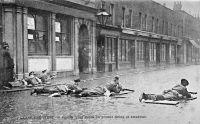
Peter the Painter
Peter the Painter, also known as Peter Piaktow , was the leader of a gang of Latvian revolutionary criminals in the early 20th Century. After supposedly fighting in and escaping the Sidney Street Siege in 1911, he became an anti-hero in London's East End...
", and sparked a major political row over the involvement of the then Home Secretary
Home Secretary
The Secretary of State for the Home Department, commonly known as the Home Secretary, is the minister in charge of the Home Office of the United Kingdom, and one of the country's four Great Offices of State...
, Winston Churchill
Winston Churchill
Sir Winston Leonard Spencer-Churchill, was a predominantly Conservative British politician and statesman known for his leadership of the United Kingdom during the Second World War. He is widely regarded as one of the greatest wartime leaders of the century and served as Prime Minister twice...
.
The Houndsditch murders
On 16 December 1910, a gang of Latvian thieves attempted to break into the rear of a jeweller'sJewellery
Jewellery or jewelry is a form of personal adornment, such as brooches, rings, necklaces, earrings, and bracelets.With some exceptions, such as medical alert bracelets or military dog tags, jewellery normally differs from other items of personal adornment in that it has no other purpose than to...
shop at 119 Houndsditch
Houndsditch
Houndsditch is a street in the City of London that connects Bishopsgate in the north west to Aldgate in the south east. The modern street runs through a part of the Portsoken Ward and Bishopsgate Ward Without...
working from 9, 10 and 11 Exchange Buildings in the cul-de-sac
Cul-de-sac
A cul-de-sac is a word of French origin referring to a dead end, close, no through road or court meaning dead-end street with only one inlet/outlet...
behind. An adjacent shopkeeper heard their hammering, informed the City of London Police
City of London Police
The City of London Police is the territorial police force responsible for law enforcement within the City of London, England, including the Middle and Inner Temple. The service responsible for law enforcement within the rest of Greater London is the Metropolitan Police Service, a separate...
(in whose area the shop was), and nine unarmed officers — three sergeants and six constables (two in plain clothes) — converged on Exchange Buildings.
Sergeants Bentley and Bryant knocked at the door of No. 11 Exchange Buildings, unaware that the first constable on the scene had already done so, thus alerting the thieves. The gang's leader, George Gardstein, opened the door, but when he did not answer their questions they assumed he did not understand English and told him to fetch someone who did. Gardstein left the door half-closed and disappeared.
The house consisted of a single ground-floor room, into which the front door directly opened, with a staircase leading to the upper floors on the left, and a door to the open yard at the back on the right. It was later deduced that Gardstein must have moved left towards the staircase, since if he had gone right and out of the yard door he would have been seen by one of the plain-clothed officers standing outside, who had a clear view of that side of the room.
Growing impatient, the two sergeants entered the house to find the room apparently empty, before they became aware of a man standing in the darkness at the top of the stairs. After a short conversation, another man entered through the yard door, rapidly firing a pistol
Pistol
When distinguished as a subset of handguns, a pistol is a handgun with a chamber that is integral with the barrel, as opposed to a revolver, wherein the chamber is separate from the barrel as a revolving cylinder. Typically, pistols have an effective range of about 100 feet.-History:The pistol...
, while the man on the stairs also started shooting.
Both officers were hit, with Bentley collapsing across the doorstep, while Bryant managed to stagger outside. In the street, Constable Woodhams ran to help Bentley, but was himself wounded by one of the gang firing from the cover of the house, as was Sergeant Tucker, who died almost instantly.
The gang then attempted to break out of the cul-de-sac, Gardstein being grabbed by Constable Choate almost at the entrance. In the struggle Choate was wounded several times by Gardstein, before being shot five more times by other members of the gang, who also managed to hit Gardstein in the back. They then dragged Gardstein ¾ of a mile to 59 Grove Street, where he died the next day. Constable Choate and Sergeant Bentley died in separate hospitals the same day. An intense search followed, and a number of the gang or their associates were soon arrested.
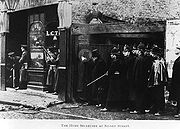
The Siege of Sidney Street
On 2 January 1911, an informantInformant
An informant is a person who provides privileged information about a person or organization to an agency. The term is usually used within the law enforcement world, where they are officially known as confidential or criminal informants , and can often refer pejoratively to the supply of information...
told police that two or three of the gang, possibly including Peter the Painter
Peter the Painter
Peter the Painter, also known as Peter Piaktow , was the leader of a gang of Latvian revolutionary criminals in the early 20th Century. After supposedly fighting in and escaping the Sidney Street Siege in 1911, he became an anti-hero in London's East End...
himself, were hiding at 100 Sidney Street, Stepney (in the Metropolitan Police District
Metropolitan Police District
The Metropolitan Police District is the police area which is policed by London's Metropolitan Police Service. It currently consists of Greater London, excluding the City of London.-History:...
). Worried that the suspects were about to flee, and expecting heavy resistance to any attempt at capture, on 3 January two hundred officers cordoned off the area and the siege
Siege
A siege is a military blockade of a city or fortress with the intent of conquering by attrition or assault. The term derives from sedere, Latin for "to sit". Generally speaking, siege warfare is a form of constant, low intensity conflict characterized by one party holding a strong, static...
began. At dawn the battle commenced.
The defenders, though heavily outnumbered, possessed superior weapon
Weapon
A weapon, arm, or armament is a tool or instrument used with the aim of causing damage or harm to living beings or artificial structures or systems...
s and great stores of ammunition
Ammunition
Ammunition is a generic term derived from the French language la munition which embraced all material used for war , but which in time came to refer specifically to gunpowder and artillery. The collective term for all types of ammunition is munitions...
. The Tower of London
Tower of London
Her Majesty's Royal Palace and Fortress, more commonly known as the Tower of London, is a historic castle on the north bank of the River Thames in central London, England. It lies within the London Borough of Tower Hamlets, separated from the eastern edge of the City of London by the open space...
was called for backup, and word got to the Home Secretary
Home Secretary
The Secretary of State for the Home Department, commonly known as the Home Secretary, is the minister in charge of the Home Office of the United Kingdom, and one of the country's four Great Offices of State...
, Winston Churchill
Winston Churchill
Sir Winston Leonard Spencer-Churchill, was a predominantly Conservative British politician and statesman known for his leadership of the United Kingdom during the Second World War. He is widely regarded as one of the greatest wartime leaders of the century and served as Prime Minister twice...
, who arrived on the spot to observe the incident at first hand, and to offer advice. Churchill authorised calling in a detachment of Scots Guards
Scots Guards (1805)
-The Napoleonic Wars:In 1804, the United Kingdom's nemesis, Napoleon Bonaparte , became Emperor of the French. The following year the Third Coalition was formed against France and the 1st Battalion took part in the expedition to Hannover in 1805 at a time when Napoleon's armies burnt across the...
to assist the police. Six hours into the battle, and just as the field artillery
Field artillery
Field artillery is a category of mobile artillery used to support armies in the field. These weapons are specialized for mobility, tactical proficiency, long range, short range and extremely long range target engagement....
piece that Churchill had authorised arrived, a fire began to consume the building. When the fire brigade arrived, Churchill refused them access to the building. The police stood ready, guns aimed at the front door, waiting for the men inside to attempt their escape. The door never opened. Instead, the remains of two members of the gang, Fritz Svaars and William Sokolow (both were also known by numerous aliases), were later discovered inside the building. No sign of Peter the Painter was found.Besides the three Policemen, a London Firefighter also died of his injuries.
Aftermath
All the fatal shots in what became known as the "Houndsditch Murders" came from the same Dreyse pistol belonging to Jacob PetersYakov Peters
Jēkabs Peterss or Yakov Khristoforovich Peters was a Latvian Communist revolutionary, Soviet politician, chekist, and terrorist. Together with Feliks Dzerzhinsky, he was one of the founders and chiefs of the VChK...
, but as he had left it with the mortally wounded Gardstein to be found by the police, it was assumed to be his and that he was the killer. This was despite the fact that Gardstein had completely different calibre ammunition for a Mauser C96
Mauser C96
The Mauser C96 is a semi-automatic pistol that was originally produced by German arms manufacturer Mauser from 1896 to 1937...
pistol both on him when he died and in his lodgings, but none at all for the Dreyse. Gardstein's "guilt" was further compounded by the mistaken belief that it was Gardstein who had opened fire at 11 Exchange Buildings from the yard door, on the grounds that it was he who had opened the front door to the police shortly before they were shot.
Of seven supposed members of the gang captured by the police, five men — including Peters — and two women were put on trial, but they all either had their charges dropped, were acquitted, or had their convictions quashed
Quashed
Quashed was a British-bred and British-trained thoroughbred racehorse, winner of the Epsom Oaks in 1935.For many years, the Verdict family was not accepted into the British Stud Book because Quashed's dam was effectively a half-bred and it was not until the 1960s era of the July Cup winner...
. Peters later returned home, and after the October Revolution
October Revolution
The October Revolution , also known as the Great October Socialist Revolution , Red October, the October Uprising or the Bolshevik Revolution, was a political revolution and a part of the Russian Revolution of 1917...
served as deputy head of the Cheka
Cheka
Cheka was the first of a succession of Soviet state security organizations. It was created by a decree issued on December 20, 1917, by Vladimir Lenin and subsequently led by aristocrat-turned-communist Felix Dzerzhinsky...
. He perished during the Great Purge
Great Purge
The Great Purge was a series of campaigns of political repression and persecution in the Soviet Union orchestrated by Joseph Stalin from 1936 to 1938...
in 1938.

Arthur Balfour
Arthur James Balfour, 1st Earl of Balfour, KG, OM, PC, DL was a British Conservative politician and statesman...
, the former prime minister
Prime minister
A prime minister is the most senior minister of cabinet in the executive branch of government in a parliamentary system. In many systems, the prime minister selects and may dismiss other members of the cabinet, and allocates posts to members within the government. In most systems, the prime...
, accused him of having acted improperly. A famous photograph from the time shows Churchill peering around a corner to view events. Balfour asked, "He [Churchill] and a photographer were both risking valuable lives. I understand what the photographer was doing but what was the Right Honourable gentleman doing?"
The gang's superior firepower led the police
City of London Police
The City of London Police is the territorial police force responsible for law enforcement within the City of London, England, including the Middle and Inner Temple. The service responsible for law enforcement within the rest of Greater London is the Metropolitan Police Service, a separate...
to drop the Webley Revolver
Webley Revolver
The Webley Revolver was, in various marks, the standard issue service pistol for the armed forces of the United Kingdom, the British Empire, and the Commonwealths from 1887 until 1963.The Webley is a top-break revolver with automatic extraction...
in favour of the Webley semi-automatic in London.
On film
Much of the siege was captured by newsreelNewsreel
A newsreel was a form of short documentary film prevalent in the first half of the 20th century, regularly released in a public presentation place and containing filmed news stories and items of topical interest. It was a source of news, current affairs and entertainment for millions of moviegoers...
cameras, including the moment a bullet supposedly passed through Mr Churchill's top hat
Top hat
A top hat, beaver hat, high hat silk hat, cylinder hat, chimney pot hat or stove pipe hat is a tall, flat-crowned, broad-brimmed hat, predominantly worn from the latter part of the 18th to the middle of the 20th century...
, coming within inches of killing him. This footage
Footage
In filmmaking and video production, footage is the raw, unedited material as it had been originally filmed by movie camera or recorded by a video camera which usually must be edited to create a motion picture, video clip, television show or similar completed work...
was later shown at the Palace Theatre, London
Palace Theatre, London
The Palace Theatre is a West End theatre in the City of Westminster in London. It is an imposing red-brick building that dominates the west side of Cambridge Circus and is located near the intersection of Shaftesbury Avenue and Charing Cross Road...
, under the billing, "Mr Churchill in the danger zone", although the incident has been largely dismissed by historians as false.
The siege was the inspiration for the final shootout
Shootout
A shootout is a gun battle between armed groups. A shootout often, but not necessarily, pits law enforcement against criminal elements; it could also involve two groups outside of law enforcement, such as rival gangs. A shootout in a military context A shootout is a gun battle between armed groups....
in Alfred Hitchcock
Alfred Hitchcock
Sir Alfred Joseph Hitchcock, KBE was a British film director and producer. He pioneered many techniques in the suspense and psychological thriller genres. After a successful career in British cinema in both silent films and early talkies, Hitchcock moved to Hollywood...
's original 1934 version of The Man Who Knew Too Much
The Man Who Knew Too Much (1934 film)
The Man Who Knew Too Much is a British suspense film directed by Alfred Hitchcock, featuring Peter Lorre, and released by Gaumont British. It was one of the most successful and critically acclaimed films of Hitchcock's British period....
. The events were depicted directly in the 1960 film The Siege of Sidney Street
The Siege of Sidney Street
The Siege of Sidney Street is a 1960 British historical drama film co-directed by Robert S. Baker and Monty Berman. It starred Donald Sinden, Nicole Berger and Kieron Moore....
.
In popular culture
The siege was parodied by the Goon Show in the episodeEpisode
An episode is a part of a dramatic work such as a serial television or radio program. An episode is a part of a sequence of a body of work, akin to a chapter of a book. The term sometimes applies to works based on other forms of mass media as well, as in Star Wars...
The Six Ingots of Leadenhall Street
Leadenhall Street
Leadenhall Street is a street in the City of London, formerly part of the A11. It runs east from Cornhill to Aldgate, and west vice-versa. Aldgate Pump is at the junction with Aldgate...
.
The events were portrayed fictionally in the Sherlock Holmes
Sherlock Holmes
Sherlock Holmes is a fictional detective created by Scottish author and physician Sir Arthur Conan Doyle. The fantastic London-based "consulting detective", Holmes is famous for his astute logical reasoning, his ability to take almost any disguise, and his use of forensic science skills to solve...
pastiche Sherlock Holmes and the Railway Maniac
Sherlock Holmes and the Railway Maniac
Sherlock Holmes and the Railway Maniac is a non-canonical Sherlock Holmes pastiche novel by Barrie Roberts which pits Sherlock Holmes against an anarchist who is bombing trains.The story involves real life incidents such as the Siege of Sidney Street....
by Barrie Roberts
Barrie Roberts
Barrie Roberts was an author, folk singer, freelance journalist, and criminal lawyer.-Biography:Born in Hampshire in 1939, Roberts was educated at Churcher's College....
.
See also
- The Tottenham OutrageTottenham OutrageThe Tottenham Outrage is the name given to an armed robbery and double murder which took place in Tottenham, North London and Walthamstow, Essex, on 23 January 1909, which was carried out by two anarchists, Paul Helfeld and Jacob Lepidus .The "Outrage" became a cause célèbre in Edwardian London,...
on 23 January 1909, an armed robbery and murder by Latvian anarchists.
External links
- City of London Police, Houndsditch murders
- The Churchill Centre: The Siege of Sidney Street
- 1911 Newsreel footage of the The Siege of Sidney Street
- The Shimans in Sidney Street, 1911
- The Shimans in Sidney Street, 1911 (alternative link)
- Murderers' siege in London The GuardianThe GuardianThe Guardian, formerly known as The Manchester Guardian , is a British national daily newspaper in the Berliner format...
January 4, 1911 - Memorial Card of three policemen killed