

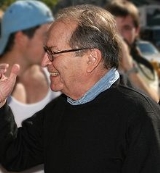
Sidney Lumet

Encyclopedia
Sidney Lumet was an American director, producer and screenwriter with over 50 films to his credit. He was nominated for the Academy Award as Best Director for 12 Angry Men (1957), Dog Day Afternoon
(1975), Network
(1976) and The Verdict
(1982). He did not win an individual Academy Award, but he did receive an Academy Honorary Award
and 14 of his films were nominated for various Oscars, such as Network, which was nominated for 10, winning 4.
The Encyclopedia of Hollywood states that Lumet was one of the most prolific directors of the modern era, making more than one movie per year on average since his directorial debut in 1957. He was noted by Turner Classic Movies
for his "strong direction of actors", "vigorous storytelling" and the "social realism" in his best work. Film critic Roger Ebert
described him as having been "one of the finest craftsmen and warmest humanitarians among all film directors." Lumet was also known as an "actor's director," having worked with the best of them during his career, probably more than "any other director."
Lumet began his career as an Off-Broadway
director, then became a highly efficient TV director. His first movie was typical of his best work: a well-acted, tightly written, deeply considered "problem picture," 12 Angry Men (1957). From that point on Lumet divided his energies among other idealistic problem pictures along with literate adaptations of plays and novels, big stylish pictures, New York-based black comedies, and realistic crime dramas, including Serpico
and Prince of the City
. As a result of directing 12 Angry Men, he was also responsible for leading the first wave of directors who made a successful transition from TV to movies.
In 2005, Lumet received an Academy Award for Lifetime Achievement for his "brilliant services to screenwriters, performers, and the art of the motion picture." Two years later, he concluded his career with the acclaimed drama Before the Devil Knows You're Dead
(2007). A few months after Lumet's death in April 2011, TV commentator Lawrence O'Donnell aired a tribute to Lumet, and a retrospective celebration of his work was held at New York's Lincoln Center with the appearance of numerous speakers and film stars.
. He studied theater acting at the Professional Children's School
of New York and Columbia University
.
His parents, Baruch Lumet
and Eugenia Wermus, were both veteran players of the Yiddish stage. His father was an actor, director, producer and writer, while his mother was a dancer. His mother died when he was a child. Lumet made his professional debut on radio at age four and stage debut at the Yiddish Art Theatre at five. As a child he also appeared in many Broadway plays, including 1935's Dead End and Kurt Weill's The Eternal Road
. In 1935 at age 11, Lumet appeared in a Henry Lynn
short film, Papirossen (meaning "Cigarettes" in Yiddish)
co-produced by radio star Herman Yablokoff. The film was shown in a theatrical play with the same title, based on a hit song, "Papirosn". The play and short film appeared in the Bronx McKinley Square Theatre.
In 1939 he made his only feature-length film appearance, at age 15, in One Third of a Nation. In 1939, World War II interrupted his early acting career, and he spent three years with the US army.
After returning from World War II
service (1942–1946) as a radar repairman stationed in India
and Burma, he became involved with the Actors Studio
, and then formed his own theater workshop. He organized an Off-Broadway
group and became its director, and continued directing in summer stock theatre
, while teaching acting at the High School of Performing Arts. He was the senior drama coach at the new 46th St. (Landmark) building of "Performing Arts' ("Fame"). The 25 year old Lumet directed the drama department in a production of "The Young and Fair".
from 1949–1955; to socialite Gloria Vanderbilt
from 1956–1963; to Gail Jones (daughter of Lena Horne
) from 1963–1978, and to Mary Gimbel from 1980 until his death. He had two daughters by Jones: Amy, who was married to P. J. O'Rourke
from 1990–1993, and actress/screenwriter Jenny
who had a leading role in his film Q & A
. She also wrote the screenplay for the 2008 film Rachel Getting Married
.
productions and then evolved into a highly respected TV director. After gaining valuable experience working Off-Broadway and in summer stock theatre, he began to direct in the new medium of television in 1950, after working as an assistant to friend and then-director Yul Brynner
. He soon developed a "lightning quick" method for shooting due to the high turnover required by television. As a result, while working for CBS
he directed hundreds of episodes of Danger
(1950–1955), Mama
(1949–1957), and You Are There (1953–1957), a weekly series which co-starred Walter Cronkite
in one of his earliest leading roles. He chose Cronkite for the role of anchorman "because the premise of the show was so silly, was so outrageous, that we needed somebody with the most American, homespun, warm ease about him," Lumet said.
He also directed original plays for Playhouse 90
, Kraft Television Theatre
and Studio One, filming around 200 episodes, which established him as "one of the most prolific and respected directors in the business," according to Turner Classic Movies
. His ability to work quickly while shooting carried over to his film career. Because the quality of many of the television dramas was so impressive, several of them were later adapted as motion pictures.
His first movie, 12 Angry Men, was an auspicious beginning for Lumet. It was a critical success and established Lumet as a director skilled at adapting theatrical properties to motion pictures. For US Supreme Court
Justice Sonia Sotomayor
, seeing the film for the first time, became a "pivotal moment" in her life, as she was at that time considering a career in law. "It told me that I was on the right path," she said.
Fully half of Lumet's complement of films have originated in the theater." He divided his energies among other idealistic problem pictures, adaptations of plays and novels, big stylish pictures, tense melodramas, and New York-based black comedies dealing with society and American culture. A controversial TV show he directed in 1960 gained him notoriety: The Sacco-Vanzetti Story on NBC
; According to The New York Times
, "the drama drew flack from the state of Massachusetts
(where Sacco and Vanzetti
were tried and executed) because it was thought to postulate that the condemned murderers were, in fact, wholly innocent. But the brouhaha actually did Lumet more good than harm, sending several prestigious film assignments his way."
He began adapting classic plays for both film and television. In 1959, he directed Marlon Brando
and Joanne Woodward
in the feature film The Fugitive Kind
, based on the Tennessee Williams
play Orpheus Descending
. He later directed a live television version of Eugene O'Neill's
The Iceman Cometh
, which was followed by his 1962 film, A View from the Bridge
, another psychological drama from a play
written by Arthur Miller
. This was followed by another Eugene O'Neill play
turned to cinema, Long Day's Journey into Night
, in 1962, with Katharine Hepburn
gaining an Oscar nomination for her performance as a drug-addicted housewife; the four principal actors swept the acting awards at the 1962 Cannes Film Festival
. It was also voted one of the year's "Ten Best Films" by The New York Times.
observes that Lumet was a "hardboiled straight shooter," who, because he was trained during the golden Age of television in the 1950s, became noted for his energetic style of directing. The words "Sidney Lumet" and "energy," he adds, became synonymous: "The energy was there in the quietest moments. It was an inner energy, a hum of existence that Lumet observed in people and brought out in them. . . [when he] went into the New York streets . . . he made them electric:
, Marlon Brando
, Richard Burton
, Katharine Hepburn
, James Mason
, Sophia Loren
, Geraldine Fitzgerald
, Blythe Danner
, Rod Steiger
, Vanessa Redgrave
, Paul Newman
, Sean Connery
, Henry Fonda
, Dustin Hoffman
, Albert Finney
, Simone Signoret
, and Anne Bancroft
. "Give him a good actor, and he just might find the great actor lurking within," writes film critic Mick LaSalle
.
When necessary, Lumet would choose untrained actors, but stated, "over ninety percent of the time I want the best tools I can get: actors, writers, lighting men, cameramen, propmen." Nonetheless, when he did use less "fully dimensional" actors in the cast of his film, he was still able to bring out superior and memorable acting performances, as he did with Nick Nolte
, Anthony Perkins
, Armand Assante
, Jane Fonda
, Faye Dunaway
, Timothy Hutton
and Ali MacGraw
, who herself referred to him as "every actor's dream." In Jane Fonda's opinion, "he was a master. Such control of his craft. He had strong, progressive values and never betrayed them."
Lumet believed that movies are an art and once stated that "The amount of attention paid to movies is directly related to pictures of quality." Because he started his career as an actor, he became known as an "actor's director," and worked with the best of them over the years, a roster probably unequaled by any other director." Acting scholar Frank P. Tomasulo agrees, and points out that many directors who are able to understand acting from an actor's perspective, were all "great communicators."
According to film historians Gerald Mast and Bruce Kawin, Lumet's "sensitivity to actors and to the rhythms of the city have made him America's longest-lived descendant of the 1950s Neorealist
tradition and its urgent commitment to ethical
responsibility." They cite his early film The Hill
(1965) as "one of the most politically and morally radical films of the 1960s."
They add that beneath the social conflicts of Lumet's films lies the "conviction that love and reason will eventually prevail in human affairs," and that "law and justice will eventually be served – or not." His debut film, Twelve Angry Men, was an acclaimed picture in its day: it was a model for liberal reason and fellowship in the Eisenhower
era; or maybe it was an alarming example of how easily any jury could be swayed." The film and its director were nominated for Academy Awards. Lumet was nominated for the Director's Guild
Award and the film was widely praised by critics.
The Encyclopedia of World Biography states that his films often featured actors who studied "Method acting
", "characterized by an earthy, introspective style. A leading example of such "Method" actors would be Al Pacino
, who, early in his career, studied under Method acting guru Lee Strasberg
. Lumet also preferred the appearance of spontaneity in both his actors and settings, an "improvisational look achieved by shooting much of his work on location."
asked him whether he rehearsed extensively before shooting, and Lumet replied "I like to rehearse a minimum of two weeks before I shoot."
He was able to prepare and execute a production in rapid order, allowing him to consistently stay within a modest budget. When filming Prince of the City
, for example, although there were over 130 speaking roles and 135 different locations, he was able to coordinate the entire shoot in 52 days. As a result, write historians Charles Harpole
and Thomas Schatz, performers were eager to work with him as they considered him to be an "outstanding director of actors." And they note that "whereas many directors disliked rehearsals or advising actors on how to build their character, Lumet excelled at both." As a result, he was able to give his performers a cinematic showcase for their abilities and help them deepen their acting contribution. Actor Christopher Reeve
, who co-starred in Deathtrap
, also pointed out that Lumet "knows how to talk technical language – if you want to work that way – he knows how to talk Method
, he knows how to improvise, and he does it all equally well."
Joanna Rapf, writing about the filming of The Verdict, states that Lumet gave a lot of personal attention to his actors, "listening to them, touching them." She describes how Lumet and star Paul Newman
sat on a bench secluded from the main set, where Newman had taken his shoes off, in order to privately discuss an important scene about to be shot. . . . The actors walk through their scenes before the camera rolls. This preparation was done because Lumet likes to shoot a scene in one take, two at the most. "I call him "Speedy Gonzales," the only man I know who'll double-park in front of a whorehouse," kids Paul Newman privately. "He's arrogant about not shooting more than he has to. He doesn't give himself any protection. I know I would," Newman adds. Film critic Betsey Sharkey agrees, adding the "he was a maestro of one or two takes years before Clint Eastwood would turn it into a respected specialty." Sharkey recalls, "[Faye] Dunaway once told me that Lumet worked so fast it was as if he were on roller skates. A racing pulse generated by a big heart."
. "Anne Bancroft
embodies the kind of character to whom Lumet is attracted – a committed activist for all kinds of causes, who stands up for the rights of the oppressed, who is lively, outspoken, courageous, who refuses to conform for the sake of convenience, and whose understanding of life allows her to die with dignity ... Garbo Talks in many ways is a valentine to New York."
Throughout a 2006 interview, he reiterated that "he is fascinated by the human cost involved in following passions and commitments, and the cost those passions and commitments inflict on others." This theme is at the "core" of most of his movies, notes Rapf, "including his stories of corruption in the New York City Police Department
and family dramas such as in Daniel.
s and was most vulnerable when attempting light entertainments. His Academy Award nominations, for example, were all for character studies of men in crisis, from his first film, Twelve Angry Men, to The Verdict. Lumet was, literally, a child of the drama." He notes that "nearly all the characters in Lumet's gallery are driven by obsessions or passions that range from the pursuit of justice, honesty, and truth to the clutches of jealousy, memory, or guilt. It is not so much the object of their fixations but the obsessive condition itself that intrigues Lumet."
Therefore, Bowles adds, "Lumet's protagonists tend to be isolated, unexceptional men who oppose a group or institution. Whether the protagonist is a member of a jury or party to a bungled robbery, he follows his instincts and intuition in an effort to find solutions. Lumet's most important criterion is not whether the actions of these men are right or wrong but whether the actions are genuine. If these actions are justified by the individual's conscience, this gives his heroes uncommon strength and courage to endure the pressures, abuses, and injustices of others. Frank Serpico
, for example, is the quintessential Lumet hero in his defiance of peer group authority and the assertion of his own code of moral values." Lumet in his autobiography described the film Serpico
as "a portrait of a real rebel with a cause."
states that "it was the social realism which permeated his greatest work that truly defined Lumet – the themes of youthful idealism beaten down by corruption and the hopelessness of inept social institutions allowed him to produce several trenchant and potent films that no other director could have made." Serpico (1973) was the first of four "seminal" films he made in the 1970s that marked him as "one of the greatest filmmakers of his generation." It was the story of power and betrayal in the New York City police force, and was coupled with the "idea that innocence is lost in the face of corruption." The movie became a blueprint that Lumet would use to portray the inner world of cops, lawyers and street criminals, with only an "idealistic lone wolf battling seemingly impossible odds."
"As a child of the Depression
," writes Joanna Rapf, "growing up poor in New York City with poverty and corruption all around him, Lumet became concerned with the importance of justice to a democracy. He says he likes questioning things, people, institutions, what is considered by society as 'right' and 'wrong.'" He admits, however, that he does not believe that art itself has the power to change anything. "There is, as he says, a lot of 'shit' to deal with in the entertainment industry, but the secret of good work is to maintain your honesty and your passion."
Film historian David Thomson writes "He has steady themes: the fragility of justice, and the police and their corruption.". He adds, "Lumet quickly became esteemed ... [and he] got a habit for big issues – Fail-Safe
, The Pawnbroker
, The Hill
, – and seemed torn between dullness and pathos. ... Network ... was the closest he had come to a successful comedy. He was that rarity of the 1970s, a director happy to serve his material – yet seemingly not touched or changed by it. ... His sensitivity to actors and to the rhythms of the city have made him "America's longest-lived descendant of the 1950s Neorealist tradition and its urgent commitment to ethical responsibility."
Lumet, discussing one of his primary film subjects, police corruption, described his feelings for film magazine, Cinema Nation:
, noted Lumet biographer Joanna Rapf, "shunning the dominance of Hollywood. By refusing to "go Hollywood," he soon became strongly identified with New York and filmed the majority of his films there. Like Woody Allen
, he defined himself as a New Yorker. "I always like being in Woody Allen's world," he said. He claimed "the diversity of the City, its many ethnic neighborhoods, its art and its crime, its sophistication and its corruption, its beauty and its ugliness, all feed into what inspires him." He felt that in order to create it is important to confront reality on a daily basis. For Lumet, "New York is filled with reality; Hollywood is a fantasyland."
He used New York time and again as the backdrop – if not the symbol – of his "preoccupation with America's decline," according to film historians Scott and Barbara Siegel. In discussing the significance of urban settings to Lumet, Bowles notes, "Within this context, Lumet is consistently attracted to situations in which crime provides the occasion for a group of characters to come together. Typically these characters are caught in a vortex of events they can neither understand nor control but which they must work to resolve."
In a 2007 interview with New York
magazine, he was asked, "Almost all of your films – from The Pawnbroker to your latest – have an intense level of that famous New York grit. Is being streetwise really such a difference between us and Hollywood?" Lumet replied: "In L.A., there's no streets! No sense of a neighborhood! They talk about us not knowing who lives in the same apartment complex as us – bullshit! I know who lives in my building. In L.A., how much can you really find out about anybody else? ... Really, it's just about human contact. It seems to me that our greatest problems today are coming out of the increasing isolation of people, everywhere."
, Mel Brooks
, and Paul Mazursky
, Lumet's characters often spoke overtly about controversial issues of the times. They felt unconstrained as filmmakers and their art became "filtered through their Jewish consciousness," notes film historian David Desser. Lumet, like the others, sometimes turned to Jewish themes in order to develop ethnic sensibilities that were characteristic of contemporary American culture, by dynamically highlighting its "unique tensions and cultural diversity." This was partly reflected in Lumet's preoccupation with city life. His film A Stranger Among Us
, for example, is the story of a woman undercover police officer and her experiences in a Hasidic community within New York City.
The subject of "guilt," explains Desser, dominates many of Lumet's films. From his first feature film, 12 Angry Men (1957), in which a jury must decide the guilt or innocence of a young man, to Q & A (1990), in which a lawyer must determine the question of guilt and responsibility on the part of a maverick policeman, "guilt," writes Desser, "links the diverse parts of Lumet's varied and complex canon." Whereas in films like Murder on the Orient Express
(1974), all of the suspects are guilty. There are aspects of Lumet's conception of guilt, adds Desser, that are biblical in nature, whereby Lumet explores Old Testament questions of guilt and responsibility: "Lumet's conception of guilt, that of a father's guilt being passed on to his sons and implicating them profoundly. . . are rampant in Lumet's cinema." According to Desser, such focus on guilt and responsibility which dominates Lumet's themes, "comes directly from Jewish tradition, specifically Judaism: the injunction to remember." This aspect of "remembrance" is explicitly seen in The Pawnbroker
and Daniel
, both of which "commemorate, they do not celebrate."
His films were also characterized by a strong emphasis on tensions within the "family," with his apparent "insistence on the centrality of family life." This emphasis on the family also included "surrogate families," as in the police trilogy, Serpico (1973), Prince of the City (1981), and Q&A
. An "untraditional family" is also inherent in Dog Day Afternoon
(1975). According to Desser, the centrality of the family to the Jewish experience – and the way in which a family passes its values on to its children – were an important part of Lumet's worldview.
, said "Sidney flips if he sees a look that's too artsy."
Partly because he was willing and able to take on so many significant social issues and problems, "he can deliver powerhouse performances from lead actors, and fine work from character actors," writes film historian Thomson. He is "one of the stalwart figures of New York moviemaking. He abides by good scripts, when he gets them."
According to Katz's Film Encyclopedia, "Although critical evaluation of Lumet's work wavered widely from film to film, on the whole the director's body of work has been held in high esteem. Critical opinion has generally viewed him as a sensitive and intelligent director who possesses considerable good taste, the courage to experiment with a variety of techniques and styles, and an uncommon gift for handling actors." Lumet, unlike some other directors, tried to keep a professional distance from his actor's personal lives: "Elia Kazan
used to really try to get inside the head and psyche of everybody he worked with," Lumet told The New York Times in 2007, referring to the influential director. "I'm the exact opposite school. I don't like to get involved."
In a quote from his book, Lumet emphasized the logistics of directing:
In 1970, Lumet said, "If you're a director, then you've got to direct ... I don't believe that you should sit back and wait until circumstances are perfect before you and it's all gorgeous and marvelous ... I never did a picture because I was hungry ... Every picture I did was an active, believable, passionate wish. Every picture I did I wanted to do ... I'm having a good time."
Lumet, in a statement posted on IMDB, said, "If I don't have a script I adore, I do one I like. If I don't have one I like, I do one that has an actor I like or that presents some technical challenge." Critic Justin Chang adds that Lumet's skill as a director and in developing strong stories, continued up to his last film in 2007, noting that his "nimble touch with performers, his ability to draw out great warmth and zesty humor with one hand and coax them toward ever darker, more anguished extremes of emotion with the other, was on gratifying display in his ironically titled final film, Before the Devil Knows You're Dead
."
, and one day I was watching all these kids standing outside a school near the studio. It was just marvelous: Indian
girls in sari
s, kids from Pakistan
, Korea
, kids from all over. So I think you'll see more directors from these communities, telling their stories. You know, I started out making films about Jews and Italians
and Irish
because I didn't know anything else."
, New York
from lymphoma
. When asked in a 1997 interview about how he wanted to "go out," Lumet responded, "I don't think about it. I'm not religious. I do know that I don't want to take up any space. Burn me up and scatter my ashes over Katz's Delicatessen."
Following his death, numerous tributes have been paid for his enduring body of work, marked by many memorable portrayals of New York City. Fellow New York directors Woody Allen
and Martin Scorsese
both paid tribute to Lumet. Allen called him the "quintessential New York film-maker", while Scorsese said "our vision of the city has been enhanced and deepened by classics like Serpico, Dog Day Afternoon and, above all, the remarkable Prince of the City." Lumet also drew praise from New York mayor Michael Bloomberg
, who called him "one of the great chroniclers of our city".
Lumet was called "the last of the great movie moralists" in a tribute remembering a career in which he "guided many of the world’s most respected actors through roles that connected with the conscious of multiple generations."
Lumet's published memoir about his life in film, Making Movies (1996), is "extremely lighthearted and infectious in its enthusiasm for the craft of moviemaking itself," writes Bowles, "and is in marked contrast to the tone and style of most of his films. Perhaps Lumet's signature as a director is his work with actors – and his exceptional ability to draw high-quality, sometimes extraordinary performances from even the most unexpected quarters" Jake Coyle, Associated Press
writer, agrees: "While Lumet has for years gone relatively underappreciated, actors have consistently turned in some of their most memorable performances under his stewardship. From Katharine Hepburn
to Faye Dunaway
, Henry Fonda
to Paul Newman
, Lumet is known as an actor's director," and to some, like Ali MacGraw
, he is considered "every actor's dream."
Academy of Motion Pictures
President Frank Pierson said, "Lumet is one of the most important film directors in the history of American cinema, and his work has left an indelible mark on both audiences and the history of film itself." Boston Herald
writer James Verniere observes that "at a time when the American film industry is intent on seeing how low it can go, Sidney Lumet remains a master of the morally complex American drama."
Noting that Lumet's "compelling stories and unforgettable performances were his strong suit," director and producer Steven Spielberg
believes that Lumet was "one of the greatest directors in the long history of film." Al Pacino
, upon hearing of Lumet's death, stated that with his films, "he leaves a great legacy, but more than that, to the people close to him, he will remain the most civilized of humans and the kindest man I have ever known."
He did not win an individual Academy Award, although he did receive an Academy Honorary Award
in 2005 and 14 of his films were nominated for various Oscars, such as Network, which was nominated for 10, winning 4. In 2005, Lumet received an Academy Award for Lifetime Achievement for his "brilliant services to screenwriters, performers, and the art of the motion picture." Upon winning recognition from the Academy, Lumet said, "I wanted one, damn it, and I felt I deserved one." Nonetheless, director Spike Lee
commented that "his great work lives on with us forever. Much more important than Oscar. Ya-dig?"
A few months after Lumet's death in April 2011, TV commentator Lawrence O'Donnell aired a tribute to Lumet, and a retrospective celebration of his work was held at New York's Lincoln Center with the appearance of numerous speakers and film stars. In October 2011, the organization Human Rights First
inaugurated its "Sidney Lumet Award for Integrity in Entertainment" for the TV show, The Good Wife, along with giving awards to two Middle East activists who had worked for freedom and democracy. Lumet had worked with Human Rights First on a media project related to the depiction of torture and interrogation on television.
British Academy Film Awards
Cannes Film Festival
New York Film Critics Circle Awards
Venice Film Festival
Dog Day Afternoon
Dog Day Afternoon is a 1975 drama film directed by Sidney Lumet, written by Frank Pierson, and produced by Martin Bregman. The film stars Al Pacino, John Cazale, Charles Durning, Chris Sarandon, Penny Allen, James Broderick, and Carol Kane. The title refers to the "dog days of summer".The film was...
(1975), Network
Network (film)
Network is a 1976 American satirical film released by Metro-Goldwyn-Mayer about a fictional television network, Union Broadcasting System , and its struggle with poor ratings. The film was written by Paddy Chayefsky and directed by Sidney Lumet...
(1976) and The Verdict
The Verdict
The Verdict is a 1982 courtroom drama film which tells the story of a down-on-his-luck alcoholic lawyer who pushes a medical malpractice case in order to improve his own situation, but discovers along the way that he is doing the right thing. Since the lawsuit involves a woman in a persistent...
(1982). He did not win an individual Academy Award, but he did receive an Academy Honorary Award
Academy Honorary Award
The Academy Honorary Award, instituted in 1948 for the 21st Academy Awards , is given by the discretion of the Board of Governors of the Academy of Motion Picture Arts and Sciences to celebrate motion picture achievements that are not covered by existing Academy Awards, although prior winners of...
and 14 of his films were nominated for various Oscars, such as Network, which was nominated for 10, winning 4.
The Encyclopedia of Hollywood states that Lumet was one of the most prolific directors of the modern era, making more than one movie per year on average since his directorial debut in 1957. He was noted by Turner Classic Movies
Turner Classic Movies
Turner Classic Movies is a movie-oriented cable television channel, owned by the Turner Broadcasting System subsidiary of Time Warner, featuring commercial-free classic movies, mostly from the Turner Entertainment and MGM, United Artists, RKO and Warner Bros. film libraries...
for his "strong direction of actors", "vigorous storytelling" and the "social realism" in his best work. Film critic Roger Ebert
Roger Ebert
Roger Joseph Ebert is an American film critic and screenwriter. He is the first film critic to win a Pulitzer Prize for Criticism.Ebert is known for his film review column and for the television programs Sneak Previews, At the Movies with Gene Siskel and Roger Ebert, and Siskel and Ebert and The...
described him as having been "one of the finest craftsmen and warmest humanitarians among all film directors." Lumet was also known as an "actor's director," having worked with the best of them during his career, probably more than "any other director."
Lumet began his career as an Off-Broadway
Off-Broadway
Off-Broadway theater is a term for a professional venue in New York City with a seating capacity between 100 and 499, and for a specific production of a play, musical or revue that appears in such a venue, and which adheres to related trade union and other contracts...
director, then became a highly efficient TV director. His first movie was typical of his best work: a well-acted, tightly written, deeply considered "problem picture," 12 Angry Men (1957). From that point on Lumet divided his energies among other idealistic problem pictures along with literate adaptations of plays and novels, big stylish pictures, New York-based black comedies, and realistic crime dramas, including Serpico
Serpico
Serpico is a 1973 American crime film directed by Sidney Lumet. It is based on the true story of New York City policeman Frank Serpico, who went undercover to expose the corruption of his fellow officers, after being pushed to the brink at first by their distrust and later by the threats and...
and Prince of the City
Prince of the City
Prince of the City is an American crime drama film about an NYPD officer who chooses to expose police corruption for idealistic reasons. The character of Daniel Ciello was based on real-life NYPD Narcotics Detective Robert Leuci and the script was based on Robert Daley's 1978 book of the same name...
. As a result of directing 12 Angry Men, he was also responsible for leading the first wave of directors who made a successful transition from TV to movies.
In 2005, Lumet received an Academy Award for Lifetime Achievement for his "brilliant services to screenwriters, performers, and the art of the motion picture." Two years later, he concluded his career with the acclaimed drama Before the Devil Knows You're Dead
Before the Devil Knows You're Dead
Before the Devil Knows You're Dead is a 2007 crime drama directed by Sidney Lumet and written by Kelly Masterson. It stars Philip Seymour Hoffman, Ethan Hawke, Marisa Tomei, and Albert Finney. The title comes from the Irish saying: "May you be in heaven a full half-hour before the devil knows...
(2007). A few months after Lumet's death in April 2011, TV commentator Lawrence O'Donnell aired a tribute to Lumet, and a retrospective celebration of his work was held at New York's Lincoln Center with the appearance of numerous speakers and film stars.
Early years
Lumet was born in Philadelphia, PennsylvaniaPennsylvania
The Commonwealth of Pennsylvania is a U.S. state that is located in the Northeastern and Mid-Atlantic regions of the United States. The state borders Delaware and Maryland to the south, West Virginia to the southwest, Ohio to the west, New York and Ontario, Canada, to the north, and New Jersey to...
. He studied theater acting at the Professional Children's School
Professional Children's School
Professional Children's School is a not for profit, college preparatory school that was founded in New York City in 1914 to provide an education to young people working on the New York stage, in Vaudeville, or "on the road."-History:...
of New York and Columbia University
Columbia University
Columbia University in the City of New York is a private, Ivy League university in Manhattan, New York City. Columbia is the oldest institution of higher learning in the state of New York, the fifth oldest in the United States, and one of the country's nine Colonial Colleges founded before the...
.
His parents, Baruch Lumet
Baruch Lumet
Baruch Lumet was a Jewish actor best known for his work in the Yiddish theater.Lumet was born in Warsaw, Russian Empire, and immigrated to the United States with his wife Eugenia Gitl Lumet and daughter Feiga in 1922, where his son, film director Sidney Lumet was born.Although he appeared...
and Eugenia Wermus, were both veteran players of the Yiddish stage. His father was an actor, director, producer and writer, while his mother was a dancer. His mother died when he was a child. Lumet made his professional debut on radio at age four and stage debut at the Yiddish Art Theatre at five. As a child he also appeared in many Broadway plays, including 1935's Dead End and Kurt Weill's The Eternal Road
The Eternal Road
The Eternal Road is an opera-oratorio with spoken dialogue in four acts by Kurt Weill with a libretto , by Austrian novelist and playwright Franz Werfel and translated into English by Ludwig Lewisohn.The Eternal Road premiered at the Manhattan Opera House on January 7, 1937, given a lavish and...
. In 1935 at age 11, Lumet appeared in a Henry Lynn
Henry Lynn
Henry Lynn was a film director, screenwriter, and producer, who concentrated on Yiddish life and culture in the United States, early twentieth century, , the era of Yiddish film in America...
short film, Papirossen (meaning "Cigarettes" in Yiddish)
co-produced by radio star Herman Yablokoff. The film was shown in a theatrical play with the same title, based on a hit song, "Papirosn". The play and short film appeared in the Bronx McKinley Square Theatre.
In 1939 he made his only feature-length film appearance, at age 15, in One Third of a Nation. In 1939, World War II interrupted his early acting career, and he spent three years with the US army.
After returning from World War II
World War II
World War II, or the Second World War , was a global conflict lasting from 1939 to 1945, involving most of the world's nations—including all of the great powers—eventually forming two opposing military alliances: the Allies and the Axis...
service (1942–1946) as a radar repairman stationed in India
India
India , officially the Republic of India , is a country in South Asia. It is the seventh-largest country by geographical area, the second-most populous country with over 1.2 billion people, and the most populous democracy in the world...
and Burma, he became involved with the Actors Studio
Actors Studio
The Actors Studio is a membership organization for professional actors, theatre directors and playwrights at 432 West 44th Street in the Clinton neighborhood of Manhattan in New York City. It was founded October 5, 1947, by Elia Kazan, Cheryl Crawford, Robert Lewis and Anna Sokolow who provided...
, and then formed his own theater workshop. He organized an Off-Broadway
Off-Broadway
Off-Broadway theater is a term for a professional venue in New York City with a seating capacity between 100 and 499, and for a specific production of a play, musical or revue that appears in such a venue, and which adheres to related trade union and other contracts...
group and became its director, and continued directing in summer stock theatre
Summer stock theatre
Summer stock theatre is any theatre that presents stage productions only in the summer within the United States. The name combines both the seasonal time of year with the tradition of staging shows by a resident company, reusing stock scenery and costumes...
, while teaching acting at the High School of Performing Arts. He was the senior drama coach at the new 46th St. (Landmark) building of "Performing Arts' ("Fame"). The 25 year old Lumet directed the drama department in a production of "The Young and Fair".
Personal life
Lumet was married four times; the first three ended in divorce. He was married to actress Rita GamRita Gam
Rita Gam is an American film and television actress and documentary film maker. She was nominated for a Golden Globe and won the Silver Bear for Best Actress.-Career:...
from 1949–1955; to socialite Gloria Vanderbilt
Gloria Vanderbilt
Gloria Laura Vanderbilt is an American artist, author, actress, heiress, and socialite most noted as an early developer of designer blue jeans...
from 1956–1963; to Gail Jones (daughter of Lena Horne
Lena Horne
Lena Mary Calhoun Horne was an American singer, actress, civil rights activist and dancer.Horne joined the chorus of the Cotton Club at the age of sixteen and became a nightclub performer before moving to Hollywood, where she had small parts in numerous movies, and more substantial parts in the...
) from 1963–1978, and to Mary Gimbel from 1980 until his death. He had two daughters by Jones: Amy, who was married to P. J. O'Rourke
P. J. O'Rourke
Patrick Jake "P. J." O'Rourke is an American political satirist, journalist, writer, and author. O'Rourke is the H. L. Mencken Research Fellow at the Cato Institute and is a regular correspondent for The Atlantic Monthly, The American Spectator, and The Weekly Standard, and frequent panelist on...
from 1990–1993, and actress/screenwriter Jenny
Jenny Lumet
Jenny Lumet is an American actress and screenwriter noted for her award-winning screenplay for Rachel Getting Married...
who had a leading role in his film Q & A
Q&A (film)
Q & A is a 1990 crime film co-written and directed by Sidney Lumet, based on a novel by New York judge Edwin Torres. It stars Nick Nolte, Timothy Hutton and Armand Assante.-Plot summary:...
. She also wrote the screenplay for the 2008 film Rachel Getting Married
Rachel Getting Married
Rachel Getting Married is a 2008 drama film directed by Jonathan Demme, and starring Anne Hathaway, Rosemarie DeWitt, Bill Irwin and Debra Winger. The film was released in the U.S. to select theaters on October 3, 2008. The film opened the 65th Venice International Film Festival. The film also...
.
Early career
Lumet began his career as a director with Off-BroadwayOff-Broadway
Off-Broadway theater is a term for a professional venue in New York City with a seating capacity between 100 and 499, and for a specific production of a play, musical or revue that appears in such a venue, and which adheres to related trade union and other contracts...
productions and then evolved into a highly respected TV director. After gaining valuable experience working Off-Broadway and in summer stock theatre, he began to direct in the new medium of television in 1950, after working as an assistant to friend and then-director Yul Brynner
Yul Brynner
Yul Brynner was a Russian-born actor of stage and film. He was best known for his portrayal of Mongkut, king of Siam, in the Rodgers and Hammerstein musical The King and I, for which he won an Academy Award for Best Actor for the film version; he also played the role more than 4,500 times on...
. He soon developed a "lightning quick" method for shooting due to the high turnover required by television. As a result, while working for CBS
CBS
CBS Broadcasting Inc. is a major US commercial broadcasting television network, which started as a radio network. The name is derived from the initials of the network's former name, Columbia Broadcasting System. The network is sometimes referred to as the "Eye Network" in reference to the shape of...
he directed hundreds of episodes of Danger
Danger (TV series)
Danger is an anthology series which brought half hour-long dramas to television from 1950 to 1955.-Television:It first aired on September 19, 1950 on CBS. The first episode, entitled "The Black Door", was directed by Yul Brynner with a story by Henry Norton and a teleplay by Irving Elman. It...
(1950–1955), Mama
Mama (TV series)
Mama is a weekly Maxwell House-sponsored CBS television comedy-drama series which ran from July 1, 1949 until March 17, 1957.Based on the Kathryn Forbes memoir Mama's Bank Account, which was also adapted for the 1944 John Van Druten play and subsequent 1948 film I Remember Mama, it told the...
(1949–1957), and You Are There (1953–1957), a weekly series which co-starred Walter Cronkite
Walter Cronkite
Walter Leland Cronkite, Jr. was an American broadcast journalist, best known as anchorman for the CBS Evening News for 19 years . During the heyday of CBS News in the 1960s and 1970s, he was often cited as "the most trusted man in America" after being so named in an opinion poll...
in one of his earliest leading roles. He chose Cronkite for the role of anchorman "because the premise of the show was so silly, was so outrageous, that we needed somebody with the most American, homespun, warm ease about him," Lumet said.
He also directed original plays for Playhouse 90
Playhouse 90
Playhouse 90 is an American television anthology series that was telecast on CBS from 1956 to 1960 for a total of 133 episodes. It originated from CBS Television City in Los Angeles, California...
, Kraft Television Theatre
Kraft Television Theatre
Kraft Television Theatre is an American drama/anthology television series that began May 7, 1947 on NBC, airing at 7:30pm on Wednesday evenings until December of that year. In January 1948, it moved to 9pm on Wednesdays, continuing in that timeslot until 1958. Initially produced by the J...
and Studio One, filming around 200 episodes, which established him as "one of the most prolific and respected directors in the business," according to Turner Classic Movies
Turner Classic Movies
Turner Classic Movies is a movie-oriented cable television channel, owned by the Turner Broadcasting System subsidiary of Time Warner, featuring commercial-free classic movies, mostly from the Turner Entertainment and MGM, United Artists, RKO and Warner Bros. film libraries...
. His ability to work quickly while shooting carried over to his film career. Because the quality of many of the television dramas was so impressive, several of them were later adapted as motion pictures.
His first movie, 12 Angry Men, was an auspicious beginning for Lumet. It was a critical success and established Lumet as a director skilled at adapting theatrical properties to motion pictures. For US Supreme Court
Supreme Court of the United States
The Supreme Court of the United States is the highest court in the United States. It has ultimate appellate jurisdiction over all state and federal courts, and original jurisdiction over a small range of cases...
Justice Sonia Sotomayor
Sonia Sotomayor
Sonia Maria Sotomayor is an Associate Justice of the Supreme Court of the United States, serving since August 2009. Sotomayor is the Court's 111th justice, its first Hispanic justice, and its third female justice....
, seeing the film for the first time, became a "pivotal moment" in her life, as she was at that time considering a career in law. "It told me that I was on the right path," she said.
Fully half of Lumet's complement of films have originated in the theater." He divided his energies among other idealistic problem pictures, adaptations of plays and novels, big stylish pictures, tense melodramas, and New York-based black comedies dealing with society and American culture. A controversial TV show he directed in 1960 gained him notoriety: The Sacco-Vanzetti Story on NBC
NBC
The National Broadcasting Company is an American commercial broadcasting television network and former radio network headquartered in the GE Building in New York City's Rockefeller Center with additional major offices near Los Angeles and in Chicago...
; According to The New York Times
The New York Times
The New York Times is an American daily newspaper founded and continuously published in New York City since 1851. The New York Times has won 106 Pulitzer Prizes, the most of any news organization...
, "the drama drew flack from the state of Massachusetts
Massachusetts
The Commonwealth of Massachusetts is a state in the New England region of the northeastern United States of America. It is bordered by Rhode Island and Connecticut to the south, New York to the west, and Vermont and New Hampshire to the north; at its east lies the Atlantic Ocean. As of the 2010...
(where Sacco and Vanzetti
Sacco and Vanzetti
Ferdinando Nicola Sacco and Bartolomeo Vanzetti were anarchists who were convicted of murdering two men during a 1920 armed robbery in South Braintree, Massachusetts, United States...
were tried and executed) because it was thought to postulate that the condemned murderers were, in fact, wholly innocent. But the brouhaha actually did Lumet more good than harm, sending several prestigious film assignments his way."
He began adapting classic plays for both film and television. In 1959, he directed Marlon Brando
Marlon Brando
Marlon Brando, Jr. was an American movie star and political activist. "Unchallenged as the most important actor in modern American Cinema" according to the St...
and Joanne Woodward
Joanne Woodward
Joanne Gignilliat Trimmier Woodward is an American actress, television and theatrical producer, and widow of Paul Newman...
in the feature film The Fugitive Kind
The Fugitive Kind
The Fugitive Kind is a 1959 American drama film directed by Sidney Lumet. The screenplay by Meade Roberts and Tennessee Williams was based on the latter's 1957 play Orpheus Descending, itself a revision of his unproduced 1939 work Battle of Angels....
, based on the Tennessee Williams
Tennessee Williams
Thomas Lanier "Tennessee" Williams III was an American writer who worked principally as a playwright in the American theater. He also wrote short stories, novels, poetry, essays, screenplays and a volume of memoirs...
play Orpheus Descending
Orpheus Descending
Orpheus Descending is a play by Tennessee Williams. It was first presented on Broadway in 1957 where it enjoyed a brief run with only modest success. The play is basically a rewrite of an earlier play by Williams called Battle of Angels, which was written in 1940, but had been closed on its opening...
. He later directed a live television version of Eugene O'Neill's
Eugene O'Neill
Eugene Gladstone O'Neill was an American playwright and Nobel laureate in Literature. His poetically titled plays were among the first to introduce into American drama techniques of realism earlier associated with Russian playwright Anton Chekhov, Norwegian playwright Henrik Ibsen, and Swedish...
The Iceman Cometh
The Iceman Cometh
The Iceman Cometh is a play written by American playwright Eugene O'Neill in 1939. First published in 1940 the play premiered on Broadway at the Martin Beck Theatre on 9 October 1946, directed by Eddie Dowling where it ran for 136 performances to close on 15 March 1947.-Characters:* Night Hawk-...
, which was followed by his 1962 film, A View from the Bridge
A View from the Bridge
A View from the Bridge is a play by American playwright Arthur Miller that was first staged on September 29, 1955 as a one-act verse drama with A Memory of Two Mondays at the Coronet Theatre on Broadway. The play was unsuccessful and Miller subsequently revised the play to contain two acts; this...
, another psychological drama from a play
A View from the Bridge
A View from the Bridge is a play by American playwright Arthur Miller that was first staged on September 29, 1955 as a one-act verse drama with A Memory of Two Mondays at the Coronet Theatre on Broadway. The play was unsuccessful and Miller subsequently revised the play to contain two acts; this...
written by Arthur Miller
Arthur Miller
Arthur Asher Miller was an American playwright and essayist. He was a prominent figure in American theatre, writing dramas that include plays such as All My Sons , Death of a Salesman , The Crucible , and A View from the Bridge .Miller was often in the public eye,...
. This was followed by another Eugene O'Neill play
Long Day's Journey Into Night
Long Day's Journey Into Night is a 1956 drama in four acts written by American playwright Eugene O'Neill. The play is widely considered to be his masterwork...
turned to cinema, Long Day's Journey into Night
Long Day's Journey into Night (1962 film)
Long Day's Journey into Night is a 1962 film adaptation of the Eugene O'Neill play. It was directed by Sidney Lumet and produced by Ely Landau with Joseph E. Levine and Jack J. Dreyfus, Jr. as executive producers. The screenplay was by Eugene O'Neill, the music score by André Previn and the...
, in 1962, with Katharine Hepburn
Katharine Hepburn
Katharine Houghton Hepburn was an American actress of film, stage, and television. In a career that spanned 62 years as a leading lady, she was best known for playing strong-willed, sophisticated women in both dramas and comedies...
gaining an Oscar nomination for her performance as a drug-addicted housewife; the four principal actors swept the acting awards at the 1962 Cannes Film Festival
1962 Cannes Film Festival
-Jury:*Tetsuro Furukaki *Henry Deutschmeister *Sophie Desmarets *Jean Dutourd *Mel Ferrer *Romain Gary *Jerzy Kawalerowicz *Ernst Krüger...
. It was also voted one of the year's "Ten Best Films" by The New York Times.
Realism and energetic style
Film critic Owen GleibermanOwen Gleiberman
Owen Gleiberman is an American film critic for Entertainment Weekly, a position he has held since the magazine's launch in 1990. From 1981–89, he worked at the Boston Phoenix....
observes that Lumet was a "hardboiled straight shooter," who, because he was trained during the golden Age of television in the 1950s, became noted for his energetic style of directing. The words "Sidney Lumet" and "energy," he adds, became synonymous: "The energy was there in the quietest moments. It was an inner energy, a hum of existence that Lumet observed in people and brought out in them. . . [when he] went into the New York streets . . . he made them electric:
Collaboration
Lumet generally insisted on the collaborative nature of film, sometimes ridiculing the dominance of the "personal" director, writes film historian Frank P. Cunningham. As a result, Lumet became renowned among both actors and cinematographers "for his flexibility in the sharing of creative ideas with the writer, actor, and other artists." According to Cunningham, Lumet "has no equal in the distinguished direction of superior actors," many coming from the theater. He was thereby able to draw "remarkable performances" from acting luminaries such as Ralph RichardsonRalph Richardson
Sir Ralph David Richardson was an English actor, one of a group of theatrical knights of the mid-20th century who, though more closely associated with the stage, also appeared in several classic films....
, Marlon Brando
Marlon Brando
Marlon Brando, Jr. was an American movie star and political activist. "Unchallenged as the most important actor in modern American Cinema" according to the St...
, Richard Burton
Richard Burton
Richard Burton, CBE was a Welsh actor. He was nominated seven times for an Academy Award, six of which were for Best Actor in a Leading Role , and was a recipient of BAFTA, Golden Globe and Tony Awards for Best Actor. Although never trained as an actor, Burton was, at one time, the highest-paid...
, Katharine Hepburn
Katharine Hepburn
Katharine Houghton Hepburn was an American actress of film, stage, and television. In a career that spanned 62 years as a leading lady, she was best known for playing strong-willed, sophisticated women in both dramas and comedies...
, James Mason
James Mason
James Neville Mason was an English actor who attained stardom in both British and American films. Mason remained a powerful figure in the industry throughout his career and was nominated for three Academy Awards as well as three Golden Globes .- Early life :Mason was born in Huddersfield, in the...
, Sophia Loren
Sophia Loren
Sophia Loren, OMRI is an Italian actress.In 1962, Loren won the Academy Award for Best Actress for her role in Two Women, along with 21 awards, becoming the first actress to win an Academy Award for a non-English-speaking performance...
, Geraldine Fitzgerald
Geraldine Fitzgerald
Geraldine Fitzgerald, Lady Lindsay-Hogg was an Irish-American actress and a member of the American Theatre Hall of Fame.-Early life:...
, Blythe Danner
Blythe Danner
Blythe Katherine Danner is an American actress. She is the mother of actress Gwyneth Paltrow and director Jake Paltrow.-Early life:...
, Rod Steiger
Rod Steiger
Rodney Stephen "Rod" Steiger was an Academy Award-winning American actor known for his performances in such films as On the Waterfront, The Big Knife, Oklahoma!, The Harder They Fall, Across the Bridge, The Pawnbroker, Doctor Zhivago, In the Heat of the Night, and Waterloo as well as the...
, Vanessa Redgrave
Vanessa Redgrave
Vanessa Redgrave, CBE is an English actress of stage, screen and television, as well as a political activist.She rose to prominence in 1961 playing Rosalind in As You Like It with the Royal Shakespeare Company and has since made more than 35 appearances on London's West End and Broadway, winning...
, Paul Newman
Paul Newman
Paul Leonard Newman was an American actor, film director, entrepreneur, humanitarian, professional racing driver and auto racing enthusiast...
, Sean Connery
Sean Connery
Sir Thomas Sean Connery , better known as Sean Connery, is a Scottish actor and producer who has won an Academy Award, two BAFTA Awards and three Golden Globes Sir Thomas Sean Connery (born 25 August 1930), better known as Sean Connery, is a Scottish actor and producer who has won an Academy...
, Henry Fonda
Henry Fonda
Henry Jaynes Fonda was an American film and stage actor.Fonda made his mark early as a Broadway actor. He also appeared in 1938 in plays performed in White Plains, New York, with Joan Tompkins...
, Dustin Hoffman
Dustin Hoffman
Dustin Lee Hoffman is an American actor with a career in film, television, and theatre since 1960. He has been known for his versatile portrayals of antiheroes and vulnerable characters....
, Albert Finney
Albert Finney
Albert Finney is an English actor. He achieved prominence in films in the early 1960s, and has maintained a successful career in theatre, film and television....
, Simone Signoret
Simone Signoret
Simone Signoret was a French cinema actress often hailed as one of France's greatest movie stars. She became the first French person to win an Academy Award, for her role in Room at the Top...
, and Anne Bancroft
Anne Bancroft
Anne Bancroft was an American actress associated with the Method acting school, which she had studied under Lee Strasberg....
. "Give him a good actor, and he just might find the great actor lurking within," writes film critic Mick LaSalle
Mick LaSalle
Mick LaSalle is an American Mick LaSalle is an [[United States|American]] Mick LaSalle is an [[United States|American]] [[film reviewer] and the author of two books on pre-[[Motion Picture Production Code|Hays Code]] Hollywood...
.
When necessary, Lumet would choose untrained actors, but stated, "over ninety percent of the time I want the best tools I can get: actors, writers, lighting men, cameramen, propmen." Nonetheless, when he did use less "fully dimensional" actors in the cast of his film, he was still able to bring out superior and memorable acting performances, as he did with Nick Nolte
Nick Nolte
Nicholas King "Nick" Nolte is an American actor whose career has spanned over five decades, peaking in the 1990s when his commercial success made him one of the most popular celebrities of that decade.-Early life:...
, Anthony Perkins
Anthony Perkins
Anthony Perkins was an American actor, best known for his Oscar-nominated role in Friendly Persuasion and as Norman Bates in Alfred Hitchcock's Psycho , and its three sequels.-Early life:...
, Armand Assante
Armand Assante
-Personal life:Assante was born in New York City and raised in Cornwall, New York, the son of Katherine , a music teacher and poet, and Armand Anthony Assante, Sr., a painter and artist. His father was Italian and his mother was Irish, and was raised in a devoutly Roman Catholic family...
, Jane Fonda
Jane Fonda
Jane Fonda is an American actress, writer, political activist, former fashion model, and fitness guru. She rose to fame in the 1960s with films such as Barbarella and Cat Ballou. She has won two Academy Awards and received several other movie awards and nominations during more than 50 years as an...
, Faye Dunaway
Faye Dunaway
Faye Dunaway is an American actress.Dunaway won an Academy Award for Best Actress for her performance in Network after receiving previous nominations for the critically acclaimed films Bonnie and Clyde and Chinatown...
, Timothy Hutton
Timothy Hutton
Timothy Tarquin Hutton is an American actor. He is the youngest actor to win the Academy Award for Best Supporting Actor, which he won at the age of 20 for his performance as Conrad Jarrett in Ordinary People . He currently stars as Nathan "Nate" Ford on the TNT series Leverage.-Early life:Timothy...
and Ali MacGraw
Ali MacGraw
Elizabeth Alice "Ali" MacGraw is an American actress. She is known for her role in Love Story, for which she won a Golden Globe and received an Academy Award nomination.-Early life:...
, who herself referred to him as "every actor's dream." In Jane Fonda's opinion, "he was a master. Such control of his craft. He had strong, progressive values and never betrayed them."
Lumet believed that movies are an art and once stated that "The amount of attention paid to movies is directly related to pictures of quality." Because he started his career as an actor, he became known as an "actor's director," and worked with the best of them over the years, a roster probably unequaled by any other director." Acting scholar Frank P. Tomasulo agrees, and points out that many directors who are able to understand acting from an actor's perspective, were all "great communicators."
According to film historians Gerald Mast and Bruce Kawin, Lumet's "sensitivity to actors and to the rhythms of the city have made him America's longest-lived descendant of the 1950s Neorealist
Neorealism (art)
In art, neorealism was established by the ex-Camden Town Group painters Charles Ginner and Harold Gilman at the beginning of World War I. They set out to explore the spirit of their age through the shapes and colours of daily life...
tradition and its urgent commitment to ethical
Ethics
Ethics, also known as moral philosophy, is a branch of philosophy that addresses questions about morality—that is, concepts such as good and evil, right and wrong, virtue and vice, justice and crime, etc.Major branches of ethics include:...
responsibility." They cite his early film The Hill
The Hill (film)
The Hill is a 1965 film directed by Sidney Lumet, set in a British army prison in North Africa in World War II. It stars Sean Connery, Harry Andrews, Ian Bannen, Ossie Davis, Ian Hendry, Alfred Lynch, Roy Kinnear and Michael Redgrave.-Plot:...
(1965) as "one of the most politically and morally radical films of the 1960s."
They add that beneath the social conflicts of Lumet's films lies the "conviction that love and reason will eventually prevail in human affairs," and that "law and justice will eventually be served – or not." His debut film, Twelve Angry Men, was an acclaimed picture in its day: it was a model for liberal reason and fellowship in the Eisenhower
Dwight D. Eisenhower
Dwight David "Ike" Eisenhower was the 34th President of the United States, from 1953 until 1961. He was a five-star general in the United States Army...
era; or maybe it was an alarming example of how easily any jury could be swayed." The film and its director were nominated for Academy Awards. Lumet was nominated for the Director's Guild
Directors Guild of America
Directors Guild of America is an entertainment labor union which represents the interests of film and television directors in the United States motion picture industry...
Award and the film was widely praised by critics.
The Encyclopedia of World Biography states that his films often featured actors who studied "Method acting
Method acting
Method acting is a phrase that loosely refers to a family of techniques used by actors to create in themselves the thoughts and emotions of their characters, so as to develop lifelike performances...
", "characterized by an earthy, introspective style. A leading example of such "Method" actors would be Al Pacino
Al Pacino
Alfredo James "Al" Pacino is an American film and stage actor and director. He is famous for playing mobsters, including Michael Corleone in The Godfather trilogy, Tony Montana in Scarface, Alphonse "Big Boy" Caprice in Dick Tracy and Carlito Brigante in Carlito's Way, though he has also appeared...
, who, early in his career, studied under Method acting guru Lee Strasberg
Lee Strasberg
Lee Strasberg was an American actor, director and acting teacher. He cofounded, with directors Harold Clurman and Cheryl Crawford, the Group Theatre in 1931, which was hailed as "America's first true theatrical collective"...
. Lumet also preferred the appearance of spontaneity in both his actors and settings, an "improvisational look achieved by shooting much of his work on location."
Rehearsal and preparation
Lumet was a strong believer in rehearsal, and felt that if you rehearse correctly the actor will not lose spontaneity. According to acting author Ian Bernard, he felt that it gives actors the "entire arc of the role," which gives them the freedom to find that "magical accident." Director Peter BogdanovichPeter Bogdanovich
Peter Bogdanovich is an American film historian, director, writer, actor, producer, and critic. He was part of the wave of "New Hollywood" directors, which included William Friedkin, Brian De Palma, George Lucas, Martin Scorsese, Michael Cimino, and Francis Ford Coppola...
asked him whether he rehearsed extensively before shooting, and Lumet replied "I like to rehearse a minimum of two weeks before I shoot."
He was able to prepare and execute a production in rapid order, allowing him to consistently stay within a modest budget. When filming Prince of the City
Prince of the City
Prince of the City is an American crime drama film about an NYPD officer who chooses to expose police corruption for idealistic reasons. The character of Daniel Ciello was based on real-life NYPD Narcotics Detective Robert Leuci and the script was based on Robert Daley's 1978 book of the same name...
, for example, although there were over 130 speaking roles and 135 different locations, he was able to coordinate the entire shoot in 52 days. As a result, write historians Charles Harpole
Charles Harpole
Charles Henry Harpole, Ph.D., is a scholar of cinema and mass communications and a film maker. He received his doctorate from New York University and has a long career as a professor, having taught at the University of Georgia, New York University, the New School, Southern Illinois University, the...
and Thomas Schatz, performers were eager to work with him as they considered him to be an "outstanding director of actors." And they note that "whereas many directors disliked rehearsals or advising actors on how to build their character, Lumet excelled at both." As a result, he was able to give his performers a cinematic showcase for their abilities and help them deepen their acting contribution. Actor Christopher Reeve
Christopher Reeve
Christopher D'Olier Reeve was an American actor, film director, producer, screenwriter, author and activist...
, who co-starred in Deathtrap
Deathtrap (film)
Deathtrap is a 1982 thriller film based on Ira Levin's play of the same name.The cast includes Michael Caine, Christopher Reeve, Dyan Cannon, Irene Worth and Henry Jones...
, also pointed out that Lumet "knows how to talk technical language – if you want to work that way – he knows how to talk Method
Method acting
Method acting is a phrase that loosely refers to a family of techniques used by actors to create in themselves the thoughts and emotions of their characters, so as to develop lifelike performances...
, he knows how to improvise, and he does it all equally well."
Joanna Rapf, writing about the filming of The Verdict, states that Lumet gave a lot of personal attention to his actors, "listening to them, touching them." She describes how Lumet and star Paul Newman
Paul Newman
Paul Leonard Newman was an American actor, film director, entrepreneur, humanitarian, professional racing driver and auto racing enthusiast...
sat on a bench secluded from the main set, where Newman had taken his shoes off, in order to privately discuss an important scene about to be shot. . . . The actors walk through their scenes before the camera rolls. This preparation was done because Lumet likes to shoot a scene in one take, two at the most. "I call him "Speedy Gonzales," the only man I know who'll double-park in front of a whorehouse," kids Paul Newman privately. "He's arrogant about not shooting more than he has to. He doesn't give himself any protection. I know I would," Newman adds. Film critic Betsey Sharkey agrees, adding the "he was a maestro of one or two takes years before Clint Eastwood would turn it into a respected specialty." Sharkey recalls, "[Faye] Dunaway once told me that Lumet worked so fast it was as if he were on roller skates. A racing pulse generated by a big heart."
Character development
Biographer Joanna Rapf observes that Lumet had always been an "independent director," and liked to make films about "men who summon courage to challenge the system, about the little guy against the system." This also includes the women characters in his films, such as Garbo TalksGarbo Talks
Garbo Talks is a 1984 American comedy-drama film directed by Sidney Lumet and starring Anne Bancroft, Ron Silver, Carrie Fisher, and Betty Comden as Greta Garbo.The movie was written by Larry Grusin and also stars Catherine Hicks and Steven Hill...
. "Anne Bancroft
Anne Bancroft
Anne Bancroft was an American actress associated with the Method acting school, which she had studied under Lee Strasberg....
embodies the kind of character to whom Lumet is attracted – a committed activist for all kinds of causes, who stands up for the rights of the oppressed, who is lively, outspoken, courageous, who refuses to conform for the sake of convenience, and whose understanding of life allows her to die with dignity ... Garbo Talks in many ways is a valentine to New York."
Throughout a 2006 interview, he reiterated that "he is fascinated by the human cost involved in following passions and commitments, and the cost those passions and commitments inflict on others." This theme is at the "core" of most of his movies, notes Rapf, "including his stories of corruption in the New York City Police Department
New York City Police Department
The New York City Police Department , established in 1845, is currently the largest municipal police force in the United States, with primary responsibilities in law enforcement and investigation within the five boroughs of New York City...
and family dramas such as in Daniel.
Psychodramas
According to film historian Stephen Bowles, Lumet proved himself "most comfortable and effective as a director of serious psychodramaPsychodrama
Psychodrama is a method of psychotherapy in which clients utilize spontaneous dramatization, role playing and dramatic self-presentation to investigate and gain insight into their lives. Developed by Jacob L. Moreno, M.D. psychodrama includes elements of theater, often conducted on a stage where...
s and was most vulnerable when attempting light entertainments. His Academy Award nominations, for example, were all for character studies of men in crisis, from his first film, Twelve Angry Men, to The Verdict. Lumet was, literally, a child of the drama." He notes that "nearly all the characters in Lumet's gallery are driven by obsessions or passions that range from the pursuit of justice, honesty, and truth to the clutches of jealousy, memory, or guilt. It is not so much the object of their fixations but the obsessive condition itself that intrigues Lumet."
Therefore, Bowles adds, "Lumet's protagonists tend to be isolated, unexceptional men who oppose a group or institution. Whether the protagonist is a member of a jury or party to a bungled robbery, he follows his instincts and intuition in an effort to find solutions. Lumet's most important criterion is not whether the actions of these men are right or wrong but whether the actions are genuine. If these actions are justified by the individual's conscience, this gives his heroes uncommon strength and courage to endure the pressures, abuses, and injustices of others. Frank Serpico
Frank Serpico
Francesco Vincent Serpico is a retired American New York City Police Department officer who is most famous for testifying against police corruption in 1971...
, for example, is the quintessential Lumet hero in his defiance of peer group authority and the assertion of his own code of moral values." Lumet in his autobiography described the film Serpico
Serpico
Serpico is a 1973 American crime film directed by Sidney Lumet. It is based on the true story of New York City policeman Frank Serpico, who went undercover to expose the corruption of his fellow officers, after being pushed to the brink at first by their distrust and later by the threats and...
as "a portrait of a real rebel with a cause."
Issues of social justice
Turner Classic MoviesTurner Classic Movies
Turner Classic Movies is a movie-oriented cable television channel, owned by the Turner Broadcasting System subsidiary of Time Warner, featuring commercial-free classic movies, mostly from the Turner Entertainment and MGM, United Artists, RKO and Warner Bros. film libraries...
states that "it was the social realism which permeated his greatest work that truly defined Lumet – the themes of youthful idealism beaten down by corruption and the hopelessness of inept social institutions allowed him to produce several trenchant and potent films that no other director could have made." Serpico (1973) was the first of four "seminal" films he made in the 1970s that marked him as "one of the greatest filmmakers of his generation." It was the story of power and betrayal in the New York City police force, and was coupled with the "idea that innocence is lost in the face of corruption." The movie became a blueprint that Lumet would use to portray the inner world of cops, lawyers and street criminals, with only an "idealistic lone wolf battling seemingly impossible odds."
"As a child of the Depression
Great Depression
The Great Depression was a severe worldwide economic depression in the decade preceding World War II. The timing of the Great Depression varied across nations, but in most countries it started in about 1929 and lasted until the late 1930s or early 1940s...
," writes Joanna Rapf, "growing up poor in New York City with poverty and corruption all around him, Lumet became concerned with the importance of justice to a democracy. He says he likes questioning things, people, institutions, what is considered by society as 'right' and 'wrong.'" He admits, however, that he does not believe that art itself has the power to change anything. "There is, as he says, a lot of 'shit' to deal with in the entertainment industry, but the secret of good work is to maintain your honesty and your passion."
Film historian David Thomson writes "He has steady themes: the fragility of justice, and the police and their corruption.". He adds, "Lumet quickly became esteemed ... [and he] got a habit for big issues – Fail-Safe
Fail-Safe (1964 film)
Fail-Safe is a 1964 film directed by Sidney Lumet, based on the 1962 novel of the same name by Eugene Burdick and Harvey Wheeler. It tells the story of a fictional Cold War nuclear crisis...
, The Pawnbroker
The Pawnbroker (film)
The Pawnbroker is a 1964 drama film, starring Rod Steiger, Geraldine Fitzgerald, Brock Peters and Jaime Sánchez and directed by Sidney Lumet. It was adapted by Morton S. Fine and David Friedkin from the novel of the same name by Edward Lewis Wallant....
, The Hill
The Hill (film)
The Hill is a 1965 film directed by Sidney Lumet, set in a British army prison in North Africa in World War II. It stars Sean Connery, Harry Andrews, Ian Bannen, Ossie Davis, Ian Hendry, Alfred Lynch, Roy Kinnear and Michael Redgrave.-Plot:...
, – and seemed torn between dullness and pathos. ... Network ... was the closest he had come to a successful comedy. He was that rarity of the 1970s, a director happy to serve his material – yet seemingly not touched or changed by it. ... His sensitivity to actors and to the rhythms of the city have made him "America's longest-lived descendant of the 1950s Neorealist tradition and its urgent commitment to ethical responsibility."
Lumet, discussing one of his primary film subjects, police corruption, described his feelings for film magazine, Cinema Nation:
New York City settings
Lumet always preferred to work in New YorkNew York
New York is a state in the Northeastern region of the United States. It is the nation's third most populous state. New York is bordered by New Jersey and Pennsylvania to the south, and by Connecticut, Massachusetts and Vermont to the east...
, noted Lumet biographer Joanna Rapf, "shunning the dominance of Hollywood. By refusing to "go Hollywood," he soon became strongly identified with New York and filmed the majority of his films there. Like Woody Allen
Woody Allen
Woody Allen is an American screenwriter, director, actor, comedian, jazz musician, author, and playwright. Allen's films draw heavily on literature, sexuality, philosophy, psychology, Jewish identity, and the history of cinema...
, he defined himself as a New Yorker. "I always like being in Woody Allen's world," he said. He claimed "the diversity of the City, its many ethnic neighborhoods, its art and its crime, its sophistication and its corruption, its beauty and its ugliness, all feed into what inspires him." He felt that in order to create it is important to confront reality on a daily basis. For Lumet, "New York is filled with reality; Hollywood is a fantasyland."
He used New York time and again as the backdrop – if not the symbol – of his "preoccupation with America's decline," according to film historians Scott and Barbara Siegel. In discussing the significance of urban settings to Lumet, Bowles notes, "Within this context, Lumet is consistently attracted to situations in which crime provides the occasion for a group of characters to come together. Typically these characters are caught in a vortex of events they can neither understand nor control but which they must work to resolve."
In a 2007 interview with New York
New York (magazine)
New York is a weekly magazine principally concerned with the life, culture, politics, and style of New York City. Founded by Milton Glaser and Clay Felker in 1968 as a competitor to The New Yorker, it was brasher and less polite than that magazine, and established itself as a cradle of New...
magazine, he was asked, "Almost all of your films – from The Pawnbroker to your latest – have an intense level of that famous New York grit. Is being streetwise really such a difference between us and Hollywood?" Lumet replied: "In L.A., there's no streets! No sense of a neighborhood! They talk about us not knowing who lives in the same apartment complex as us – bullshit! I know who lives in my building. In L.A., how much can you really find out about anybody else? ... Really, it's just about human contact. It seems to me that our greatest problems today are coming out of the increasing isolation of people, everywhere."
Use of contemporary Jewish themes
Like those of other Jewish directors from New York, such as Woody AllenWoody Allen
Woody Allen is an American screenwriter, director, actor, comedian, jazz musician, author, and playwright. Allen's films draw heavily on literature, sexuality, philosophy, psychology, Jewish identity, and the history of cinema...
, Mel Brooks
Mel Brooks
Mel Brooks is an American film director, screenwriter, composer, lyricist, comedian, actor and producer. He is best known as a creator of broad film farces and comic parodies. He began his career as a stand-up comic and as a writer for the early TV variety show Your Show of Shows...
, and Paul Mazursky
Paul Mazursky
Paul Mazursky is an American film director, screenwriter and actor.-Personal life:He was born Irwin Mazursky in Brooklyn, New York, the son of Jean , a piano player for dance classes, and David Mazursky, a laborer. Mazursky was born to a Jewish family; his grandfather was an immigrant from...
, Lumet's characters often spoke overtly about controversial issues of the times. They felt unconstrained as filmmakers and their art became "filtered through their Jewish consciousness," notes film historian David Desser. Lumet, like the others, sometimes turned to Jewish themes in order to develop ethnic sensibilities that were characteristic of contemporary American culture, by dynamically highlighting its "unique tensions and cultural diversity." This was partly reflected in Lumet's preoccupation with city life. His film A Stranger Among Us
A Stranger Among Us
A Stranger Among Us is a film directed by Sidney Lumet and starring Melanie Griffith, released in 1992. It tells the story of an undercover police officer's experiences in a Hasidic community. It was entered into the 1992 Cannes Film Festival....
, for example, is the story of a woman undercover police officer and her experiences in a Hasidic community within New York City.
The subject of "guilt," explains Desser, dominates many of Lumet's films. From his first feature film, 12 Angry Men (1957), in which a jury must decide the guilt or innocence of a young man, to Q & A (1990), in which a lawyer must determine the question of guilt and responsibility on the part of a maverick policeman, "guilt," writes Desser, "links the diverse parts of Lumet's varied and complex canon." Whereas in films like Murder on the Orient Express
Murder on the Orient Express
Murder on the Orient Express is a work of detective fiction by Agatha Christie featuring the Belgian detective Hercule Poirot.It was first published in the United Kingdom by the Collins Crime Club on January 1, 1934 and in the US by Dodd, Mead and Company later in the same year under the title of...
(1974), all of the suspects are guilty. There are aspects of Lumet's conception of guilt, adds Desser, that are biblical in nature, whereby Lumet explores Old Testament questions of guilt and responsibility: "Lumet's conception of guilt, that of a father's guilt being passed on to his sons and implicating them profoundly. . . are rampant in Lumet's cinema." According to Desser, such focus on guilt and responsibility which dominates Lumet's themes, "comes directly from Jewish tradition, specifically Judaism: the injunction to remember." This aspect of "remembrance" is explicitly seen in The Pawnbroker
The Pawnbroker
The Pawnbroker is a novel by Edward Lewis Wallant which tells the story of Sol Nazerman, a concentration camp survivor who suffers flashbacks of his past Nazi imprisonment as he tries to cope with his daily life operating a pawn shop in East Harlem...
and Daniel
Daniel
Daniel is the protagonist in the Book of Daniel of the Hebrew Bible. In the narrative, when Daniel was a young man, he was taken into Babylonian captivity where he was educated in Chaldean thought. However, he never converted to Neo-Babylonian ways...
, both of which "commemorate, they do not celebrate."
His films were also characterized by a strong emphasis on tensions within the "family," with his apparent "insistence on the centrality of family life." This emphasis on the family also included "surrogate families," as in the police trilogy, Serpico (1973), Prince of the City (1981), and Q&A
Q&A (film)
Q & A is a 1990 crime film co-written and directed by Sidney Lumet, based on a novel by New York judge Edwin Torres. It stars Nick Nolte, Timothy Hutton and Armand Assante.-Plot summary:...
. An "untraditional family" is also inherent in Dog Day Afternoon
Dog Day Afternoon
Dog Day Afternoon is a 1975 drama film directed by Sidney Lumet, written by Frank Pierson, and produced by Martin Bregman. The film stars Al Pacino, John Cazale, Charles Durning, Chris Sarandon, Penny Allen, James Broderick, and Carol Kane. The title refers to the "dog days of summer".The film was...
(1975). According to Desser, the centrality of the family to the Jewish experience – and the way in which a family passes its values on to its children – were an important part of Lumet's worldview.
Directing techniques
Lumet had always preferred naturalism and/or realism, according to Joanna Rapf. He did not like the "decorator's look"; rarely did he want "the camera to call attention to itself; the editing must be unobtrusive." His cinematographer, Ron FortunatoRon Fortunato
Ron Fortunato is a cinematographer and television director who has worked on many feature films. His best known work is probably Nil by Mouth; other works include Sunset Strip, Hachiko: A Dog's Story, 100 Centre Street. He is a member of the American Society of Cinematographers since 1998...
, said "Sidney flips if he sees a look that's too artsy."
Partly because he was willing and able to take on so many significant social issues and problems, "he can deliver powerhouse performances from lead actors, and fine work from character actors," writes film historian Thomson. He is "one of the stalwart figures of New York moviemaking. He abides by good scripts, when he gets them."
According to Katz's Film Encyclopedia, "Although critical evaluation of Lumet's work wavered widely from film to film, on the whole the director's body of work has been held in high esteem. Critical opinion has generally viewed him as a sensitive and intelligent director who possesses considerable good taste, the courage to experiment with a variety of techniques and styles, and an uncommon gift for handling actors." Lumet, unlike some other directors, tried to keep a professional distance from his actor's personal lives: "Elia Kazan
Elia Kazan
Elia Kazan was an American director and actor, described by the New York Times as "one of the most honored and influential directors in Broadway and Hollywood history". Born in Istanbul, the capital of the Ottoman Empire, to Greek parents originally from Kayseri in Anatolia, the family emigrated...
used to really try to get inside the head and psyche of everybody he worked with," Lumet told The New York Times in 2007, referring to the influential director. "I'm the exact opposite school. I don't like to get involved."
In a quote from his book, Lumet emphasized the logistics of directing:
In 1970, Lumet said, "If you're a director, then you've got to direct ... I don't believe that you should sit back and wait until circumstances are perfect before you and it's all gorgeous and marvelous ... I never did a picture because I was hungry ... Every picture I did was an active, believable, passionate wish. Every picture I did I wanted to do ... I'm having a good time."
Lumet, in a statement posted on IMDB, said, "If I don't have a script I adore, I do one I like. If I don't have one I like, I do one that has an actor I like or that presents some technical challenge." Critic Justin Chang adds that Lumet's skill as a director and in developing strong stories, continued up to his last film in 2007, noting that his "nimble touch with performers, his ability to draw out great warmth and zesty humor with one hand and coax them toward ever darker, more anguished extremes of emotion with the other, was on gratifying display in his ironically titled final film, Before the Devil Knows You're Dead
Before the Devil Knows You're Dead
Before the Devil Knows You're Dead is a 2007 crime drama directed by Sidney Lumet and written by Kelly Masterson. It stars Philip Seymour Hoffman, Ethan Hawke, Marisa Tomei, and Albert Finney. The title comes from the Irish saying: "May you be in heaven a full half-hour before the devil knows...
."
Vision of future films
In the same interview with New York magazine, when asked what he foresaw as the next wave of filmmaking, he responded, "Well, we were shooting out in AstoriaAstoria, Queens
Astoria is a neighborhood in the northwestern corner of the borough of Queens in New York City. Located in Community Board 1, Astoria is bounded by the East River and is adjacent to three other Queens neighborhoods: Long Island City, Sunnyside , and Woodside...
, and one day I was watching all these kids standing outside a school near the studio. It was just marvelous: Indian
Indian people
Indian people or Indisians constitute the Asian nation and pan-ethnic group native to India, which forms the south of Asia, containing 17.31% of the world's population. The Indian nationality is in essence made up of regional nationalities, reflecting the rich and complex history of India...
girls in sari
Sari
A sari or sareeThe name of the garment in various regional languages include: , , , , , , , , , , , , , is a strip of unstitched cloth, worn by females, ranging from four to nine metres in length that is draped over the body in various styles. It is popular in India, Bangladesh, Nepal,...
s, kids from Pakistan
Pakistan
Pakistan , officially the Islamic Republic of Pakistan is a sovereign state in South Asia. It has a coastline along the Arabian Sea and the Gulf of Oman in the south and is bordered by Afghanistan and Iran in the west, India in the east and China in the far northeast. In the north, Tajikistan...
, Korea
Korea
Korea ) is an East Asian geographic region that is currently divided into two separate sovereign states — North Korea and South Korea. Located on the Korean Peninsula, Korea is bordered by the People's Republic of China to the northwest, Russia to the northeast, and is separated from Japan to the...
, kids from all over. So I think you'll see more directors from these communities, telling their stories. You know, I started out making films about Jews and Italians
Italian people
The Italian people are an ethnic group that share a common Italian culture, ancestry and speak the Italian language as a mother tongue. Within Italy, Italians are defined by citizenship, regardless of ancestry or country of residence , and are distinguished from people...
and Irish
Irish people
The Irish people are an ethnic group who originate in Ireland, an island in northwestern Europe. Ireland has been populated for around 9,000 years , with the Irish people's earliest ancestors recorded having legends of being descended from groups such as the Nemedians, Fomorians, Fir Bolg, Tuatha...
because I didn't know anything else."
Death
Lumet died aged 86 on April 9, 2011 in his residence in ManhattanManhattan
Manhattan is the oldest and the most densely populated of the five boroughs of New York City. Located primarily on the island of Manhattan at the mouth of the Hudson River, the boundaries of the borough are identical to those of New York County, an original county of the state of New York...
, New York
New York
New York is a state in the Northeastern region of the United States. It is the nation's third most populous state. New York is bordered by New Jersey and Pennsylvania to the south, and by Connecticut, Massachusetts and Vermont to the east...
from lymphoma
Lymphoma
Lymphoma is a cancer in the lymphatic cells of the immune system. Typically, lymphomas present as a solid tumor of lymphoid cells. Treatment might involve chemotherapy and in some cases radiotherapy and/or bone marrow transplantation, and can be curable depending on the histology, type, and stage...
. When asked in a 1997 interview about how he wanted to "go out," Lumet responded, "I don't think about it. I'm not religious. I do know that I don't want to take up any space. Burn me up and scatter my ashes over Katz's Delicatessen."
Following his death, numerous tributes have been paid for his enduring body of work, marked by many memorable portrayals of New York City. Fellow New York directors Woody Allen
Woody Allen
Woody Allen is an American screenwriter, director, actor, comedian, jazz musician, author, and playwright. Allen's films draw heavily on literature, sexuality, philosophy, psychology, Jewish identity, and the history of cinema...
and Martin Scorsese
Martin Scorsese
Martin Charles Scorsese is an American film director, screenwriter, producer, actor, and film historian. In 1990 he founded The Film Foundation, a nonprofit organization dedicated to film preservation, and in 2007 he founded the World Cinema Foundation...
both paid tribute to Lumet. Allen called him the "quintessential New York film-maker", while Scorsese said "our vision of the city has been enhanced and deepened by classics like Serpico, Dog Day Afternoon and, above all, the remarkable Prince of the City." Lumet also drew praise from New York mayor Michael Bloomberg
Michael Bloomberg
Michael Rubens Bloomberg is the current Mayor of New York City. With a net worth of $19.5 billion in 2011, he is also the 12th-richest person in the United States...
, who called him "one of the great chroniclers of our city".
Lumet was called "the last of the great movie moralists" in a tribute remembering a career in which he "guided many of the world’s most respected actors through roles that connected with the conscious of multiple generations."
Legacy
According to film historian Bowles, Lumet succeeded in becoming a leading drama filmmaker partly because "his most important criterion [when directing] is not whether the actions of his protagonists are right or wrong, but whether their actions are genuine." And where those actions are "justified by the individual's conscience, this gives his heroes uncommon strength and courage to endure the pressures, abuses, and injustices of others." His films have thereby continually given us the "quintessential hero acting in defiance of peer group authority and asserting his own code of moral values."Lumet's published memoir about his life in film, Making Movies (1996), is "extremely lighthearted and infectious in its enthusiasm for the craft of moviemaking itself," writes Bowles, "and is in marked contrast to the tone and style of most of his films. Perhaps Lumet's signature as a director is his work with actors – and his exceptional ability to draw high-quality, sometimes extraordinary performances from even the most unexpected quarters" Jake Coyle, Associated Press
Associated Press
The Associated Press is an American news agency. The AP is a cooperative owned by its contributing newspapers, radio and television stations in the United States, which both contribute stories to the AP and use material written by its staff journalists...
writer, agrees: "While Lumet has for years gone relatively underappreciated, actors have consistently turned in some of their most memorable performances under his stewardship. From Katharine Hepburn
Katharine Hepburn
Katharine Houghton Hepburn was an American actress of film, stage, and television. In a career that spanned 62 years as a leading lady, she was best known for playing strong-willed, sophisticated women in both dramas and comedies...
to Faye Dunaway
Faye Dunaway
Faye Dunaway is an American actress.Dunaway won an Academy Award for Best Actress for her performance in Network after receiving previous nominations for the critically acclaimed films Bonnie and Clyde and Chinatown...
, Henry Fonda
Henry Fonda
Henry Jaynes Fonda was an American film and stage actor.Fonda made his mark early as a Broadway actor. He also appeared in 1938 in plays performed in White Plains, New York, with Joan Tompkins...
to Paul Newman
Paul Newman
Paul Leonard Newman was an American actor, film director, entrepreneur, humanitarian, professional racing driver and auto racing enthusiast...
, Lumet is known as an actor's director," and to some, like Ali MacGraw
Ali MacGraw
Elizabeth Alice "Ali" MacGraw is an American actress. She is known for her role in Love Story, for which she won a Golden Globe and received an Academy Award nomination.-Early life:...
, he is considered "every actor's dream."
Academy of Motion Pictures
Academy of Motion Picture Arts and Sciences
The Academy of Motion Picture Arts and Sciences is a professional honorary organization dedicated to the advancement of the arts and sciences of motion pictures...
President Frank Pierson said, "Lumet is one of the most important film directors in the history of American cinema, and his work has left an indelible mark on both audiences and the history of film itself." Boston Herald
Boston Herald
The Boston Herald is a daily newspaper that serves Boston, Massachusetts, United States, and its surrounding area. It was started in 1846 and is one of the oldest daily newspapers in the United States...
writer James Verniere observes that "at a time when the American film industry is intent on seeing how low it can go, Sidney Lumet remains a master of the morally complex American drama."
Noting that Lumet's "compelling stories and unforgettable performances were his strong suit," director and producer Steven Spielberg
Steven Spielberg
Steven Allan Spielberg KBE is an American film director, screenwriter, producer, video game designer, and studio entrepreneur. In a career of more than four decades, Spielberg's films have covered many themes and genres. Spielberg's early science-fiction and adventure films were seen as an...
believes that Lumet was "one of the greatest directors in the long history of film." Al Pacino
Al Pacino
Alfredo James "Al" Pacino is an American film and stage actor and director. He is famous for playing mobsters, including Michael Corleone in The Godfather trilogy, Tony Montana in Scarface, Alphonse "Big Boy" Caprice in Dick Tracy and Carlito Brigante in Carlito's Way, though he has also appeared...
, upon hearing of Lumet's death, stated that with his films, "he leaves a great legacy, but more than that, to the people close to him, he will remain the most civilized of humans and the kindest man I have ever known."
He did not win an individual Academy Award, although he did receive an Academy Honorary Award
Academy Honorary Award
The Academy Honorary Award, instituted in 1948 for the 21st Academy Awards , is given by the discretion of the Board of Governors of the Academy of Motion Picture Arts and Sciences to celebrate motion picture achievements that are not covered by existing Academy Awards, although prior winners of...
in 2005 and 14 of his films were nominated for various Oscars, such as Network, which was nominated for 10, winning 4. In 2005, Lumet received an Academy Award for Lifetime Achievement for his "brilliant services to screenwriters, performers, and the art of the motion picture." Upon winning recognition from the Academy, Lumet said, "I wanted one, damn it, and I felt I deserved one." Nonetheless, director Spike Lee
Spike Lee
Shelton Jackson "Spike" Lee is an American film director, producer, writer, and actor. His production company, 40 Acres & A Mule Filmworks, has produced over 35 films since 1983....
commented that "his great work lives on with us forever. Much more important than Oscar. Ya-dig?"
A few months after Lumet's death in April 2011, TV commentator Lawrence O'Donnell aired a tribute to Lumet, and a retrospective celebration of his work was held at New York's Lincoln Center with the appearance of numerous speakers and film stars. In October 2011, the organization Human Rights First
Human Rights First
Human Rights First is a nonprofit, nonpartisan human rights organization based in New York City and Washington, D.C....
inaugurated its "Sidney Lumet Award for Integrity in Entertainment" for the TV show, The Good Wife, along with giving awards to two Middle East activists who had worked for freedom and democracy. Lumet had worked with Human Rights First on a media project related to the depiction of torture and interrogation on television.
Filmography
| Year | Film | Cast | Trailers |
|---|---|---|---|
| 1957 | 12 Angry Men | Henry Fonda Henry Fonda Henry Jaynes Fonda was an American film and stage actor.Fonda made his mark early as a Broadway actor. He also appeared in 1938 in plays performed in White Plains, New York, with Joan Tompkins... , Lee J. Cobb Lee J. Cobb Lee J. Cobb was an American actor. He is best known for his performance in 12 Angry Men his Academy Award-nominated performance in On the Waterfront and one of his last films, The Exorcist... , Martin Balsam Martin Balsam Martin Henry Balsam was an American actor. He is known for his Oscar-winning role as "Arnold Burns" in A Thousand Clowns and his role as "Detective Milton Arbogast" in Psycho.- Early life :... , Jack Warden Jack Warden Jack Warden was an American character actor.-Early life:Warden was born John Warden Lebzelter in Newark, New Jersey, the son of Laura M. and John Warden Lebzelter, who was an engineer and technician. He was of Irish and Pennsylvania Dutch ancestry... , Ed Begley Ed Begley Edward James Begley, Sr. was an Academy Award-winning American actor.-Biography:Born in Hartford, Connecticut, Begley began his career as a Broadway and radio actor while in his teens. He appeared in the hit musical Going Up on Broadway in 1917 and in London the next year. He later acted in... , E. G. Marshall E. G. Marshall E. G. Marshall was an American actor, best known for his television roles as the lawyer Lawrence Preston on The Defenders in the 1960s, and as neurosurgeon David Craig on The Bold Ones: The New Doctors in the 1970s... , Joseph Sweeney |
trailer |
| 1958 | Stage Struck Stage Struck (film) Stage Struck is a 1958 American drama film directed by Sidney Lumet. The screenplay by Augustus and Ruth Goetz is based on a play by Zoe Akins, which served as the basis for the 1933 film Morning Glory starring Katharine Hepburn.... |
Henry Fonda Henry Fonda Henry Jaynes Fonda was an American film and stage actor.Fonda made his mark early as a Broadway actor. He also appeared in 1938 in plays performed in White Plains, New York, with Joan Tompkins... , Susan Strasberg Susan Strasberg Susan Elizabeth Strasberg was an American film and stage actress.-Background and career:Strasberg was born in New York City, New York, the daughter of theatre director and drama coach Lee Strasberg of the Actors Studio and former actress Paula Strasberg... , Christopher Plummer Christopher Plummer Arthur Christopher Orne Plummer, CC is a Canadian theatre, film and television actor. He made his film debut in 1957's Stage Struck, and notable early film performances include Night of the Generals, The Return of the Pink Panther and The Man Who Would Be King.In a career that spans over five... |
trailer |
| 1959 | That Kind of Woman That Kind of Woman That Kind of Woman is a 1959 American drama film directed by Sidney Lumet, who was nominated for the Golden Bear at the 9th Berlin International Film Festival. It stars Sophia Loren. The screenplay by Walter Bernstein, based on a short story by Robert Lowry , is highly reminiscent of the 1938 film... |
Sophia Loren Sophia Loren Sophia Loren, OMRI is an Italian actress.In 1962, Loren won the Academy Award for Best Actress for her role in Two Women, along with 21 awards, becoming the first actress to win an Academy Award for a non-English-speaking performance... , Tab Hunter Tab Hunter Tab Hunter is an American actor, singer, former teen idol and author who has starred in over forty major films.-Background:... , Jack Warden Jack Warden Jack Warden was an American character actor.-Early life:Warden was born John Warden Lebzelter in Newark, New Jersey, the son of Laura M. and John Warden Lebzelter, who was an engineer and technician. He was of Irish and Pennsylvania Dutch ancestry... , Keenan Wynn Keenan Wynn Keenan Wynn was an American character actor. His bristling mustache and expressive face were his stock in trade, and though he rarely had a lead role, he got prominent billing in most of his film and TV parts.... , George Sanders George Sanders George Sanders was a British actor.George Sanders may also refer to:*George Sanders , Victoria Cross recipient in World War I... |
trailer |
| 1959 | The Fugitive Kind The Fugitive Kind The Fugitive Kind is a 1959 American drama film directed by Sidney Lumet. The screenplay by Meade Roberts and Tennessee Williams was based on the latter's 1957 play Orpheus Descending, itself a revision of his unproduced 1939 work Battle of Angels.... |
Marlon Brando Marlon Brando Marlon Brando, Jr. was an American movie star and political activist. "Unchallenged as the most important actor in modern American Cinema" according to the St... , Joanne Woodward Joanne Woodward Joanne Gignilliat Trimmier Woodward is an American actress, television and theatrical producer, and widow of Paul Newman... , Anna Magnani Anna Magnani Anna Magnani was an Italian stage and film actress. She won the Academy Award for Best Actress, along with four other international awards, for her portrayal of a Sicilian widow in The Rose Tattoo.... , Maureen Stapleton Maureen Stapleton Maureen Stapleton was an American actress in film, theater and television.-Early life:Stapleton was born Lois Maureen Stapleton in Troy, New York, the daughter of Irene and John P. Stapleton, and grew up in a strict Irish American Catholic family... |
scene |
| 1961 | A View from the Bridge A View from the Bridge A View from the Bridge is a play by American playwright Arthur Miller that was first staged on September 29, 1955 as a one-act verse drama with A Memory of Two Mondays at the Coronet Theatre on Broadway. The play was unsuccessful and Miller subsequently revised the play to contain two acts; this... |
Raf Vallone Raf Vallone Raffaele "Raf" Vallone was an Italian footballer, actor and an international film star.Born in Tropea, Calabria, the son of a lawyer, Vallone attended Liceo classico Cavour in Turin, and studied Law and Philosophy at the University of Turin and entered his father's law firm... , Jean Sorel Jean Sorel Jean Sorel is a French actor.He also worked in Italian cinema, and Spanish cinema with directors such as Luis Buñuel or Luchino Visconti. However since 1980 he has worked mostly in television... , Carol Lawrence |
|
| 1962 | Long Day's Journey into Night Long Day's Journey into Night (1962 film) Long Day's Journey into Night is a 1962 film adaptation of the Eugene O'Neill play. It was directed by Sidney Lumet and produced by Ely Landau with Joseph E. Levine and Jack J. Dreyfus, Jr. as executive producers. The screenplay was by Eugene O'Neill, the music score by André Previn and the... |
Katharine Hepburn Katharine Hepburn Katharine Houghton Hepburn was an American actress of film, stage, and television. In a career that spanned 62 years as a leading lady, she was best known for playing strong-willed, sophisticated women in both dramas and comedies... , Ralph Richardson Ralph Richardson Sir Ralph David Richardson was an English actor, one of a group of theatrical knights of the mid-20th century who, though more closely associated with the stage, also appeared in several classic films.... , Jason Robards Jason Robards Jason Nelson Robards, Jr. was an American actor on stage, and in film and television, and a winner of the Tony Award , two Academy Awards and the Emmy Award... , Dean Stockwell Dean Stockwell Dean Stockwell is an American actor of film and television, with a career spanning over 65 years. As a child actor under contract to MGM he first came to the public's attention in films such as Anchors Aweigh and The Green Years; as a young adult he played a lead role in the 1957 Broadway and... |
scene |
| 1964 | The Pawnbroker The Pawnbroker (film) The Pawnbroker is a 1964 drama film, starring Rod Steiger, Geraldine Fitzgerald, Brock Peters and Jaime Sánchez and directed by Sidney Lumet. It was adapted by Morton S. Fine and David Friedkin from the novel of the same name by Edward Lewis Wallant.... |
Rod Steiger Rod Steiger Rodney Stephen "Rod" Steiger was an Academy Award-winning American actor known for his performances in such films as On the Waterfront, The Big Knife, Oklahoma!, The Harder They Fall, Across the Bridge, The Pawnbroker, Doctor Zhivago, In the Heat of the Night, and Waterloo as well as the... , Geraldine Fitzgerald Geraldine Fitzgerald Geraldine Fitzgerald, Lady Lindsay-Hogg was an Irish-American actress and a member of the American Theatre Hall of Fame.-Early life:... |
scene |
| 1964 | Fail-Safe Fail-Safe (1964 film) Fail-Safe is a 1964 film directed by Sidney Lumet, based on the 1962 novel of the same name by Eugene Burdick and Harvey Wheeler. It tells the story of a fictional Cold War nuclear crisis... |
Henry Fonda Henry Fonda Henry Jaynes Fonda was an American film and stage actor.Fonda made his mark early as a Broadway actor. He also appeared in 1938 in plays performed in White Plains, New York, with Joan Tompkins... , Dan O'Herlihy Dan O'Herlihy Daniel O'Herlihy was an Oscar nominated Irish film actor.-Early life:O'Herlihy was born in Wexford, Ireland in 1919. His family moved to Dublin at a young age... , Walter Matthau Walter Matthau Walter Matthau was an American actor best known for his role as Oscar Madison in The Odd Couple and his frequent collaborations with Odd Couple star Jack Lemmon, as well as his role as Coach Buttermaker in the 1976 comedy The Bad News Bears... , Larry Hagman Larry Hagman Larry Martin Hagman is an American film and television actor, producer and director known for playing J.R. Ewing in the 1980s primetime television soap opera Dallas and Major Anthony "Tony" Nelson in the 1960s sitcom I Dream of Jeannie.-Early life and career:Hagman was born in Fort Worth, Texas... |
trailer |
| 1965 | The Hill The Hill (film) The Hill is a 1965 film directed by Sidney Lumet, set in a British army prison in North Africa in World War II. It stars Sean Connery, Harry Andrews, Ian Bannen, Ossie Davis, Ian Hendry, Alfred Lynch, Roy Kinnear and Michael Redgrave.-Plot:... |
Sean Connery Sean Connery Sir Thomas Sean Connery , better known as Sean Connery, is a Scottish actor and producer who has won an Academy Award, two BAFTA Awards and three Golden Globes Sir Thomas Sean Connery (born 25 August 1930), better known as Sean Connery, is a Scottish actor and producer who has won an Academy... , Harry Andrews Harry Andrews Harry Fleetwood Andrews, CBE was an English film actor known for his frequent portrayals of tough military officers. His performance as Sergeant Major Wilson in The Hill alongside Sean Connery earned Andrews the 1965 National Board of Review Award for Best Supporting Actor and a nomination for the... , Ian Bannen Ian Bannen Ian Bannen was a Scottish character actor and occasional leading man.-Early life and career:Bannen was born in Airdrie, North Lanarkshire, the son of Clare and John James Bannen, a lawyer. Bannen served in the British Army after attending St Aloysius' College, Glasgow and Ratcliffe College,... , Ossie Davis Ossie Davis Ossie Davis was an American film actor, director, poet, playwright, writer, and social activist.-Early years:... , Roy Kinnear Roy Kinnear Roy Mitchell Kinnear was an English character actor. He is best remembered for playing Veruca Salt's father, Mr. Salt, in Willy Wonka and the Chocolate Factory.-Early life:... |
trailer |
| 1966 | The Group The Group (film) The Group is a 1966 ensemble film directed by Sidney Lumet based on the novel of the same name by Mary McCarthy about a group of female graduates from a Connecticut College-like college during the early 1930s.... |
Candice Bergen Candice Bergen Candice Patricia Bergen is an American actress and former fashion model.She is known for starring in two TV series, as the title character on the situation comedy Murphy Brown , for which she won five Emmy Awards and two Golden Globe Awards; and as Shirley Schmidt on the comedy-drama Boston Legal... , Joan Hackett Joan Hackett Joan Ann Hackett was an American actress who appeared on stage, in films, and on television.- Early life :She was born in New York City of Irish and Italian extraction... |
|
| 1967 | The Deadly Affair The Deadly Affair The Deadly Affair is a 1966 British espionage–thriller film, based on John le Carré's first novel Call for the Dead. The film stars James Mason, Harry Andrews, Simone Signoret and Maximilian Schell and was directed by Sidney Lumet from a script by Paul Dehn. In it George Smiley, the central... |
James Mason James Mason James Neville Mason was an English actor who attained stardom in both British and American films. Mason remained a powerful figure in the industry throughout his career and was nominated for three Academy Awards as well as three Golden Globes .- Early life :Mason was born in Huddersfield, in the... , Harry Andrews Harry Andrews Harry Fleetwood Andrews, CBE was an English film actor known for his frequent portrayals of tough military officers. His performance as Sergeant Major Wilson in The Hill alongside Sean Connery earned Andrews the 1965 National Board of Review Award for Best Supporting Actor and a nomination for the... , Simone Signoret Simone Signoret Simone Signoret was a French cinema actress often hailed as one of France's greatest movie stars. She became the first French person to win an Academy Award, for her role in Room at the Top... , Maximilian Schell Maximilian Schell Maximilian Schell is an Austrian-born Swiss actor who won the Academy Award for Best Actor for his role in Judgment at Nuremberg in 1961... , Roy Kinnear Roy Kinnear Roy Mitchell Kinnear was an English character actor. He is best remembered for playing Veruca Salt's father, Mr. Salt, in Willy Wonka and the Chocolate Factory.-Early life:... |
intro |
| 1968 | Bye Bye Braverman Bye Bye Braverman Bye Bye Braverman is a 1968 American comedy film directed by Sidney Lumet. The screenplay by Herbert Sargent was adapted from the 1964 novel To An Early Grave by Wallace Markfield... |
George Segal George Segal George Segal is an American film, stage and television actor.-Early life:George Segal, Jr. was born in 1934 Great Neck, Long Island, New York, the son of Fannie Blanche and George Segal, Sr. He was educated at George School, a private Quaker preparatory boarding school near Newtown, Bucks County,... , Jack Warden Jack Warden Jack Warden was an American character actor.-Early life:Warden was born John Warden Lebzelter in Newark, New Jersey, the son of Laura M. and John Warden Lebzelter, who was an engineer and technician. He was of Irish and Pennsylvania Dutch ancestry... |
|
| 1968 | The Sea Gull The Sea Gull The Sea Gull is a 1968 British-American-Greek drama film directed by Sidney Lumet. The screenplay by Moura Budberg is adapted from Anton Chekhov's classic 1896 play The Seagull.... |
Vanessa Redgrave Vanessa Redgrave Vanessa Redgrave, CBE is an English actress of stage, screen and television, as well as a political activist.She rose to prominence in 1961 playing Rosalind in As You Like It with the Royal Shakespeare Company and has since made more than 35 appearances on London's West End and Broadway, winning... , Simone Signoret Simone Signoret Simone Signoret was a French cinema actress often hailed as one of France's greatest movie stars. She became the first French person to win an Academy Award, for her role in Room at the Top... , James Mason James Mason James Neville Mason was an English actor who attained stardom in both British and American films. Mason remained a powerful figure in the industry throughout his career and was nominated for three Academy Awards as well as three Golden Globes .- Early life :Mason was born in Huddersfield, in the... , David Warner David Warner (actor) David Warner is an English actor who is known for playing both romantic leads and sinister or villainous characters, both in film and animation... , Denholm Elliott Denholm Elliott Denholm Mitchell Elliott, CBE was an English film, television and theatre actor with over 120 film and television credits... |
|
| 1969 | The Appointment The Appointment The Appointment is a 1969 psychological drama from director Sidney Lumet and writer James Salter, based on the story by Antonio Leonviola.-Plot synopsis:... |
Omar Sharif Omar Sharif Omar Sharif is an Egyptian actor who has starred in Hollywood films including Lawrence of Arabia, Doctor Zhivago and Funny Girl. He has been nominated for an Academy Award and has won two Golden Globe Awards.-Early life:... , Anouk Aimée Anouk Aimée Anouk Aimée is a French film actress. Aimée has appeared in 70 films since 1947. She began her film career in 1947 at age 14. In 1958 she portrayed the tragic artist Jeanne Hébuterne in the film Les Amants de Montparnasse... |
scene |
| 1970 | King: A Filmed Record... Montgomery to Memphis | Paul Newman Paul Newman Paul Leonard Newman was an American actor, film director, entrepreneur, humanitarian, professional racing driver and auto racing enthusiast... (narration), Joanne Woodward Joanne Woodward Joanne Gignilliat Trimmier Woodward is an American actress, television and theatrical producer, and widow of Paul Newman... (narration) |
|
| 1970 | Last of the Mobile Hot Shots Last of the Mobile Hot Shots Last of the Mobile Hot Shots is a 1970 American drama film released by Warner Brothers. The screenplay by Gore Vidal is based on the Tennessee Williams play The Seven Descents of Myrtle.... |
Lynn Redgrave Lynn Redgrave Lynn Rachel Redgrave, OBE was an English actress.A member of the well-known British family of actors, Redgrave trained in London before making her theatrical debut in 1962... , James Coburn James Coburn James Harrison Coburn III was an American film and television actor. Coburn appeared in nearly 70 films and made over 100 television appearances during his 45-year career, and played a wide range of roles and won an Academy Award for his supporting role as Glen Whitehouse in Affliction.A capable,... |
|
| 1971 | The Anderson Tapes The Anderson Tapes The Anderson Tapes is a 1971 crime film. It was directed by Sidney Lumet and stars Sean Connery, Dyan Cannon, Martin Balsam, and comedian Alan King. The screenplay was written by Frank Pierson, based upon a best-selling 1970 novel of the same name by Lawrence Sanders... |
Sean Connery Sean Connery Sir Thomas Sean Connery , better known as Sean Connery, is a Scottish actor and producer who has won an Academy Award, two BAFTA Awards and three Golden Globes Sir Thomas Sean Connery (born 25 August 1930), better known as Sean Connery, is a Scottish actor and producer who has won an Academy... , Dyan Cannon Dyan Cannon Dyan Cannon is an American film and television actress, director, screenwriter, editor, and producer.-Early life:... , Martin Balsam Martin Balsam Martin Henry Balsam was an American actor. He is known for his Oscar-winning role as "Arnold Burns" in A Thousand Clowns and his role as "Detective Milton Arbogast" in Psycho.- Early life :... , Alan King Alan King (comedian) Alan King was an American actor and comedian known for his biting wit and often angry humorous rants. King became well known as a Jewish comedian and satirist. He was also a serious actor who appeared in a number of movies and television shows. King wrote several books, produced films, and... |
trailer |
| 1972 | Child's Play Child's Play (1972 film) Child's Play is a 1972 American drama-mystery film directed by Sidney Lumet. The screenplay by Leon Prochnik is based on the 1970 play of the same title by Robert Marasco. It has never been available on home video in the United States in any format.... |
James Mason James Mason James Neville Mason was an English actor who attained stardom in both British and American films. Mason remained a powerful figure in the industry throughout his career and was nominated for three Academy Awards as well as three Golden Globes .- Early life :Mason was born in Huddersfield, in the... , Robert Preston Robert Preston (actor) -Early life:Preston was born Robert Preston Meservey in Newton, Massachusetts, the son of Ruth L. and Frank Wesley Meservey, a garment worker and billing clerk for American Express. After attending Abraham Lincoln High School in Los Angeles, California, he studied acting at the Pasadena Community... , Beau Bridges Beau Bridges Lloyd Vernet "Beau" Bridges III is an American actor and director.- Early life :Bridges was born in Los Angeles, the son of actor Lloyd Bridges and his college sweetheart, Dorothy Bridges . He was nicknamed "Beau" by his mother and father after Ashley Wilkes's son in Gone with the Wind, the book... |
|
| 1972 | The Offence The Offence The Offence is a 1972 drama film, based upon the acclaimed 1968 stage play This Story of Yours by John Hopkins, directed by Sidney Lumet under the working title Something Like the Truth. It stars Sean Connery as police detective Johnson, who kills Kenneth Baxter , a suspected child molester, while... |
Sean Connery Sean Connery Sir Thomas Sean Connery , better known as Sean Connery, is a Scottish actor and producer who has won an Academy Award, two BAFTA Awards and three Golden Globes Sir Thomas Sean Connery (born 25 August 1930), better known as Sean Connery, is a Scottish actor and producer who has won an Academy... , Ian Bannen Ian Bannen Ian Bannen was a Scottish character actor and occasional leading man.-Early life and career:Bannen was born in Airdrie, North Lanarkshire, the son of Clare and John James Bannen, a lawyer. Bannen served in the British Army after attending St Aloysius' College, Glasgow and Ratcliffe College,... , Trevor Howard Trevor Howard Trevor Howard , born Trevor Wallace Howard-Smith, was an English film, stage and television actor.-Early life:... |
clip |
| 1973 | Serpico Serpico Serpico is a 1973 American crime film directed by Sidney Lumet. It is based on the true story of New York City policeman Frank Serpico, who went undercover to expose the corruption of his fellow officers, after being pushed to the brink at first by their distrust and later by the threats and... |
Al Pacino Al Pacino Alfredo James "Al" Pacino is an American film and stage actor and director. He is famous for playing mobsters, including Michael Corleone in The Godfather trilogy, Tony Montana in Scarface, Alphonse "Big Boy" Caprice in Dick Tracy and Carlito Brigante in Carlito's Way, though he has also appeared... , Tony Roberts Tony Roberts (actor) David Anthony "Tony" Roberts is an American actor. He is best known for his roles in several Woody Allen movies, usually cast as Allen's best friend.-Early life:... , John Randolph John Randolph John Randolph may refer to:* John Randolph, 3rd Earl of Moray , 3rd Earl of Moray, regent of Scotland.* Sir John Randolph , Virginia colonial politician, Speaker of the Virginia House of Burgesses... |
trailer |
| 1974 | Lovin' Molly Lovin' Molly Lovin' Molly is a 1974 drama film directed by Sidney Lumet and starring Anthony Perkins, Beau Bridges, Blythe Danner in the title role, Ed Binns, and Susan Sarandon. The film is based on one of Larry McMurtry's first novels, Leaving Cheyenne... |
Anthony Perkins Anthony Perkins Anthony Perkins was an American actor, best known for his Oscar-nominated role in Friendly Persuasion and as Norman Bates in Alfred Hitchcock's Psycho , and its three sequels.-Early life:... , Beau Bridges Beau Bridges Lloyd Vernet "Beau" Bridges III is an American actor and director.- Early life :Bridges was born in Los Angeles, the son of actor Lloyd Bridges and his college sweetheart, Dorothy Bridges . He was nicknamed "Beau" by his mother and father after Ashley Wilkes's son in Gone with the Wind, the book... , Blythe Danner Blythe Danner Blythe Katherine Danner is an American actress. She is the mother of actress Gwyneth Paltrow and director Jake Paltrow.-Early life:... , Susan Sarandon Susan Sarandon Susan Sarandon is an American actress. She has worked in films and television since 1969, and won an Academy Award for Best Actress for her performance in the 1995 film Dead Man Walking. She had also been nominated for the award for four films before that and has received other recognition for her... |
|
| 1974 | Murder on the Orient Express Murder on the Orient Express (1974 film) Murder on the Orient Express is a 1974 British mystery film directed by Sidney Lumet, starring Albert Finney as Hercule Poirot, and based on the1934 novel Murder on the Orient Express by Agatha Christie.-Overview:... |
Albert Finney Albert Finney Albert Finney is an English actor. He achieved prominence in films in the early 1960s, and has maintained a successful career in theatre, film and television.... , Lauren Bacall Lauren Bacall Lauren Bacall is an American film and stage actress and model, known for her distinctive husky voice and sultry looks.She first emerged as leading lady in the Humphrey Bogart film To Have And Have Not and continued on in the film noir genre, with appearances in The Big Sleep and Dark Passage ,... , Sean Connery Sean Connery Sir Thomas Sean Connery , better known as Sean Connery, is a Scottish actor and producer who has won an Academy Award, two BAFTA Awards and three Golden Globes Sir Thomas Sean Connery (born 25 August 1930), better known as Sean Connery, is a Scottish actor and producer who has won an Academy... , Ingrid Bergman Ingrid Bergman Ingrid Bergman was a Swedish actress who starred in a variety of European and American films. She won three Academy Awards, two Emmy Awards, and the Tony Award for Best Actress. She is ranked as the fourth greatest female star of American cinema of all time by the American Film Institute... , Martin Balsam Martin Balsam Martin Henry Balsam was an American actor. He is known for his Oscar-winning role as "Arnold Burns" in A Thousand Clowns and his role as "Detective Milton Arbogast" in Psycho.- Early life :... , Anthony Perkins Anthony Perkins Anthony Perkins was an American actor, best known for his Oscar-nominated role in Friendly Persuasion and as Norman Bates in Alfred Hitchcock's Psycho , and its three sequels.-Early life:... |
trailer |
| 1975 | Dog Day Afternoon Dog Day Afternoon Dog Day Afternoon is a 1975 drama film directed by Sidney Lumet, written by Frank Pierson, and produced by Martin Bregman. The film stars Al Pacino, John Cazale, Charles Durning, Chris Sarandon, Penny Allen, James Broderick, and Carol Kane. The title refers to the "dog days of summer".The film was... |
Al Pacino Al Pacino Alfredo James "Al" Pacino is an American film and stage actor and director. He is famous for playing mobsters, including Michael Corleone in The Godfather trilogy, Tony Montana in Scarface, Alphonse "Big Boy" Caprice in Dick Tracy and Carlito Brigante in Carlito's Way, though he has also appeared... , John Cazale John Cazale John Holland Cazale , was an American film and theater actor. During his six-year film career he appeared in five films, each of which was nominated for the Academy Award for Best Picture: The Godfather, The Conversation, The Godfather Part II, Dog Day Afternoon and The Deer Hunter.From his... , Charles Durning Charles Durning Charles Durning is an American actor. With appearances in over 100 films, Durning's memorable roles include police officers in the Oscar-winning The Sting and crime drama Dog Day Afternoon , along with the comedies Tootsie, To Be Or Not To Be and The Best Little Whorehouse in Texas, the last two... |
trailer |
| 1976 | Network Network (film) Network is a 1976 American satirical film released by Metro-Goldwyn-Mayer about a fictional television network, Union Broadcasting System , and its struggle with poor ratings. The film was written by Paddy Chayefsky and directed by Sidney Lumet... |
Peter Finch Peter Finch Peter Finch was a British-born Australian actor. He is best remembered for his role as "crazed" television anchorman Howard Beale in the film Network, which earned him a posthumous Academy Award for Best Actor, his fifth Best Actor award from the British Academy of Film and Television Arts, and a... , Faye Dunaway Faye Dunaway Faye Dunaway is an American actress.Dunaway won an Academy Award for Best Actress for her performance in Network after receiving previous nominations for the critically acclaimed films Bonnie and Clyde and Chinatown... , William Holden William Holden William Holden was an American actor. Holden won the Academy Award for Best Actor in 1954 and the Emmy Award for Best Actor in 1974... , Robert Duvall Robert Duvall Robert Selden Duvall is an American actor and director. He has won an Academy Award, two Emmy Awards, four Golden Globe Awards and a BAFTA over the course of his career.... , Ned Beatty Ned Beatty Ned Thomas Beatty is an American actor who has appeared in more than 100 films and has been nominated for an Academy Award, two Emmy Awards, an MTV Movie Award for Best Villain and a Golden Globe Award; won a Drama Desk Award.... |
scene 1 trailer |
| 1977 | Equus Equus (film) Equus is a 1977 British-American drama film directed by Sidney Lumet and starring Richard Burton. Peter Shaffer wrote the screenplay based on his play Equus... |
Richard Burton Richard Burton Richard Burton, CBE was a Welsh actor. He was nominated seven times for an Academy Award, six of which were for Best Actor in a Leading Role , and was a recipient of BAFTA, Golden Globe and Tony Awards for Best Actor. Although never trained as an actor, Burton was, at one time, the highest-paid... |
trailer |
| 1978 | The Wiz The Wiz (film) The Wiz is a 1978 musical film produced by Motown Productions and Universal Pictures, and released by Universal on October 24, 1978. An urbanized retelling of L. Frank Baum's The Wonderful Wizard of Oz featuring an entirely African-American cast, The Wiz was adapted from the 1975 Broadway musical... |
Diana Ross Diana Ross Diana Ernestine Earle Ross is an American singer, record producer, and actress. Ross was lead singer of the Motown group The Supremes during the 1960s. After leaving the group in 1970, Ross began a solo career that included successful ventures into film and Broadway... , Michael Jackson Michael Jackson Michael Joseph Jackson was an American recording artist, entertainer, and businessman. Referred to as the King of Pop, or by his initials MJ, Jackson is recognized as the most successful entertainer of all time by Guinness World Records... , Nipsey Russell Nipsey Russell Julius "Nipsey" Russell was an American comedian, best known today for his appearances as a guest panelist on game shows from the 1960s through the 1990s, especially Match Game, Password, Hollywood Squares, To Tell the Truth and Pyramid... , Ted Ross Ted Ross Ted Ross was an American actor who was probably best known for his role as the Lion in The Wiz, an all-African American reinterpretation of The Wizard of Oz. He won a Tony Award for the original 1975 Broadway production, and went on to recreate the role in the 1978 film version which also starred... , Richard Pryor Richard Pryor Richard Franklin Lennox Thomas Pryor was an American stand-up comedian, actor, social critic, writer and MC. Pryor was known for uncompromising examinations of racism and topical contemporary issues, which employed colorful vulgarities, and profanity, as well as racial epithets... , Mabel King Mabel King Mabel King was an American film, stage and television actress.-Early life and career:King was born Donnie Mabel Elizabeth Washington in Charleston, South Carolina, the daughter of Rosalie Washington. She was raised in Harlem where she eventually became a gospel and nightclub singer... , Lena Horne Lena Horne Lena Mary Calhoun Horne was an American singer, actress, civil rights activist and dancer.Horne joined the chorus of the Cotton Club at the age of sixteen and became a nightclub performer before moving to Hollywood, where she had small parts in numerous movies, and more substantial parts in the... |
trailer |
| 1980 | Just Tell Me What You Want Just Tell Me What You Want Just Tell Me What You Want is a 1980 American comedy film directed by Sidney Lumet. It stars Ali MacGraw, Peter Weller and Alan King, and was also the final film of screen legend Myrna Loy.... |
Alan King Alan King (comedian) Alan King was an American actor and comedian known for his biting wit and often angry humorous rants. King became well known as a Jewish comedian and satirist. He was also a serious actor who appeared in a number of movies and television shows. King wrote several books, produced films, and... , Ali MacGraw Ali MacGraw Elizabeth Alice "Ali" MacGraw is an American actress. She is known for her role in Love Story, for which she won a Golden Globe and received an Academy Award nomination.-Early life:... , Tony Roberts Tony Roberts (actor) David Anthony "Tony" Roberts is an American actor. He is best known for his roles in several Woody Allen movies, usually cast as Allen's best friend.-Early life:... , Keenan Wynn Keenan Wynn Keenan Wynn was an American character actor. His bristling mustache and expressive face were his stock in trade, and though he rarely had a lead role, he got prominent billing in most of his film and TV parts.... |
|
| 1981 | Prince of the City Prince of the City Prince of the City is an American crime drama film about an NYPD officer who chooses to expose police corruption for idealistic reasons. The character of Daniel Ciello was based on real-life NYPD Narcotics Detective Robert Leuci and the script was based on Robert Daley's 1978 book of the same name... |
Treat Williams Treat Williams Richard Treat Williams is a Screen Actors Guild Award–nominated American actor and children's book author who has appeared on film, stage and television... , Jerry Orbach Jerry Orbach Jerome Bernard "Jerry" Orbach was an American actor and singer. He was well known for his starring role as Detective Lennie Briscoe in the Law & Order television series and as the voice of Lumière in Disney's Beauty and the Beast. As well, Orbach was a noted musical theatre star... |
trailer |
| 1982 | Deathtrap Deathtrap (film) Deathtrap is a 1982 thriller film based on Ira Levin's play of the same name.The cast includes Michael Caine, Christopher Reeve, Dyan Cannon, Irene Worth and Henry Jones... |
Michael Caine Michael Caine Sir Michael Caine, CBE is an English actor. He won Academy Awards for best supporting actor in both Hannah and Her Sisters and The Cider House Rules .... , Christopher Reeve Christopher Reeve Christopher D'Olier Reeve was an American actor, film director, producer, screenwriter, author and activist... , Dyan Cannon Dyan Cannon Dyan Cannon is an American film and television actress, director, screenwriter, editor, and producer.-Early life:... |
trailer |
| 1982 | The Verdict The Verdict The Verdict is a 1982 courtroom drama film which tells the story of a down-on-his-luck alcoholic lawyer who pushes a medical malpractice case in order to improve his own situation, but discovers along the way that he is doing the right thing. Since the lawsuit involves a woman in a persistent... |
Paul Newman Paul Newman Paul Leonard Newman was an American actor, film director, entrepreneur, humanitarian, professional racing driver and auto racing enthusiast... , Jack Warden Jack Warden Jack Warden was an American character actor.-Early life:Warden was born John Warden Lebzelter in Newark, New Jersey, the son of Laura M. and John Warden Lebzelter, who was an engineer and technician. He was of Irish and Pennsylvania Dutch ancestry... , James Mason James Mason James Neville Mason was an English actor who attained stardom in both British and American films. Mason remained a powerful figure in the industry throughout his career and was nominated for three Academy Awards as well as three Golden Globes .- Early life :Mason was born in Huddersfield, in the... , Charlotte Rampling Charlotte Rampling Charlotte Rampling, OBE is an English actress. Her career spans four decades in English-language as well as French and Italian cinema.- Early life :... |
trailer scene |
| 1983 | Daniel Daniel (1983 film) Daniel is a 1983 film which was adapted by E. L. Doctorow from his novel The Book of Daniel. It was directed by Sidney Lumet. It was based on the life story of Julius and Ethel Rosenberg, who were convicted as spies and executed by the United States government in 1953 for giving nuclear secrets... |
Timothy Hutton Timothy Hutton Timothy Tarquin Hutton is an American actor. He is the youngest actor to win the Academy Award for Best Supporting Actor, which he won at the age of 20 for his performance as Conrad Jarrett in Ordinary People . He currently stars as Nathan "Nate" Ford on the TNT series Leverage.-Early life:Timothy... , Mandy Patinkin Mandy Patinkin Mandel Bruce "Mandy" Patinkin is an award-winning American actor of stage and screen and a tenor vocalist. He is a noted interpreter of the musical works of Stephen Sondheim, and is best-known for his work in musical theatre, originating iconic roles such as Georges Seurat in Sunday in the Park... , Ellen Barkin Ellen Barkin Ellen Barkin is an American film, television and theatre actress.-Early life:She was born Ellen Rona Barkin in Bronx, a borough of New York City, New York, the daughter of Evelyn , a hospital administrator who worked at Jamaica Hospital, and Sol Barkin, a chemical salesman... |
scene |
| 1984 | Garbo Talks Garbo Talks Garbo Talks is a 1984 American comedy-drama film directed by Sidney Lumet and starring Anne Bancroft, Ron Silver, Carrie Fisher, and Betty Comden as Greta Garbo.The movie was written by Larry Grusin and also stars Catherine Hicks and Steven Hill... |
Anne Bancroft Anne Bancroft Anne Bancroft was an American actress associated with the Method acting school, which she had studied under Lee Strasberg.... , Ron Silver Ron Silver Ronald Arthur "Ron" Silver was an American actor, director, producer, radio host and political activist.-Early life:... , Carrie Fisher Carrie Fisher Carrie Frances Fisher is an American actress, novelist, screenwriter, and lecturer. She is most famous for her portrayal of Princess Leia in the original Star Wars trilogy, her bestselling novel Postcards from the Edge, for which she wrote the screenplay to the film of the same name, and her... |
scene |
| 1986 | Power | Richard Gere Richard Gere Richard Tiffany Gere is an American actor. He began acting in the 1970s, playing a supporting role in Looking for Mr. Goodbar, and a starring role in Days of Heaven. He came to prominence in 1980 for his role in the film American Gigolo, which established him as a leading man and a sex symbol... , Julie Christie Julie Christie Julie Frances Christie is a British actress. Born in British India to English parents, at the age of six Christie moved to England, where she attended boarding school.... , Gene Hackman Gene Hackman Eugene Allen "Gene" Hackman is an American actor and novelist.Nominated for five Academy Awards, winning two, Hackman has also won three Golden Globes and two BAFTAs in a career that spanned five decades. He first came to fame in 1967 with his performance as Buck Barrow in Bonnie and Clyde... |
|
| 1986 | The Morning After | Jane Fonda Jane Fonda Jane Fonda is an American actress, writer, political activist, former fashion model, and fitness guru. She rose to fame in the 1960s with films such as Barbarella and Cat Ballou. She has won two Academy Awards and received several other movie awards and nominations during more than 50 years as an... , Jeff Bridges Jeff Bridges Jeffrey Leon "Jeff" Bridges is an American actor and musician. He won the Academy Award for Best Actor for his role as Otis "Bad" Blake in the 2009 film Crazy Heart.... , Raúl Juliá Raúl Juliá Raúl Rafael Juliá y Arcelay was a Puerto Rican actor.Born in San Juan, he gained interest in acting while still in school. Upon completing his studies, Juliá decided to pursue a career in acting. After performing in the local scene for some time, he was convinced by entertainment personality Orson... |
Fonda interview |
| 1988 | Running on Empty | River Phoenix River Phoenix River Jude Phoenix was an American film actor, musician, and teen icon. He was the oldest brother of fellow actors Rain, Joaquin, Liberty, and Summer Phoenix.Phoenix began acting at age 10 in television commercials... , Judd Hirsch Judd Hirsch Judd Hirsch is an American actor most known for playing Alex Rieger on the television comedy series Taxi, John Lacey on the NBC series Dear John, and Alan Eppes on the CBS series Numb3rs.-Early life and education:... |
trailer LG] |
| 1989 | Family Business Family Business (film) Family Business is a 1989 film directed by Sidney Lumet with a screenplay by Vincent Patrick, based on his novel. It stars Sean Connery, Dustin Hoffman and Matthew Broderick.-Plot synopsis:... |
Sean Connery Sean Connery Sir Thomas Sean Connery , better known as Sean Connery, is a Scottish actor and producer who has won an Academy Award, two BAFTA Awards and three Golden Globes Sir Thomas Sean Connery (born 25 August 1930), better known as Sean Connery, is a Scottish actor and producer who has won an Academy... , Dustin Hoffman Dustin Hoffman Dustin Lee Hoffman is an American actor with a career in film, television, and theatre since 1960. He has been known for his versatile portrayals of antiheroes and vulnerable characters.... , Matthew Broderick Matthew Broderick Matthew Broderick is an American film and stage actor who, among other roles, played the title character in Ferris Bueller's Day Off, Adult Simba in The Lion King film series, and Leo Bloom in the film and Broadway productions of The Producers.He has won two Tony Awards, one in 1983 for his... |
trailer |
| 1990 | Q & A Q&A (film) Q & A is a 1990 crime film co-written and directed by Sidney Lumet, based on a novel by New York judge Edwin Torres. It stars Nick Nolte, Timothy Hutton and Armand Assante.-Plot summary:... |
Timothy Hutton Timothy Hutton Timothy Tarquin Hutton is an American actor. He is the youngest actor to win the Academy Award for Best Supporting Actor, which he won at the age of 20 for his performance as Conrad Jarrett in Ordinary People . He currently stars as Nathan "Nate" Ford on the TNT series Leverage.-Early life:Timothy... , Nick Nolte Nick Nolte Nicholas King "Nick" Nolte is an American actor whose career has spanned over five decades, peaking in the 1990s when his commercial success made him one of the most popular celebrities of that decade.-Early life:... , Armand Assante Armand Assante -Personal life:Assante was born in New York City and raised in Cornwall, New York, the son of Katherine , a music teacher and poet, and Armand Anthony Assante, Sr., a painter and artist. His father was Italian and his mother was Irish, and was raised in a devoutly Roman Catholic family... , Jenny Lumet Jenny Lumet Jenny Lumet is an American actress and screenwriter noted for her award-winning screenplay for Rachel Getting Married... |
scene trailer |
| 1992 | A Stranger Among Us A Stranger Among Us A Stranger Among Us is a film directed by Sidney Lumet and starring Melanie Griffith, released in 1992. It tells the story of an undercover police officer's experiences in a Hasidic community. It was entered into the 1992 Cannes Film Festival.... |
Melanie Griffith Melanie Griffith Melanie Richards Griffith is an American actress. She is an Academy Award nominee and Golden Globe winner for her performance in the 1988 film Working Girl... , John Pankow John Pankow John Pankow is an American film and stage actor. He is perhaps best known for a supporting role on the sitcom Mad About You .-Early life:... |
|
| 1993 | Guilty as Sin Guilty as Sin Guilty as Sin is a 1993 film directed by Sidney Lumet. It stars Don Johnson and Rebecca De Mornay, and was produced by Hollywood Pictures.-Plot:Jennifer Haines is an up-and-coming Chicago attorney... |
Don Johnson Don Johnson Donnie Wayne "Don" Johnson is an American actor known for his work in television and film. He played the lead role of James "Sonny" Crockett in the 1980s TV cop series, Miami Vice, which led him to huge success. He also played the lead role in the 1990s cop series, Nash Bridges... , Rebecca De Mornay Rebecca De Mornay Rebecca De Mornay is an American film and television actress. Her breakthrough film role came in 1983, when she played Lana in Risky Business opposite Tom Cruise... , Jack Warden Jack Warden Jack Warden was an American character actor.-Early life:Warden was born John Warden Lebzelter in Newark, New Jersey, the son of Laura M. and John Warden Lebzelter, who was an engineer and technician. He was of Irish and Pennsylvania Dutch ancestry... |
trailer |
| 1997 | Night Falls on Manhattan Night Falls on Manhattan Night Falls on Manhattan is a 1997 American crime drama film directed by Sidney Lumet, set and filmed on location in New York City. Its screenplay is by Lumet, based on a novel by author Robert Daley entitled: Tainted Evidence... |
Andy García Andy García Andrés Arturo García Menéndez , professionally known as Andy García, is a Cuban American actor. He became known in the late 1980s and 1990s, having appeared in several successful Hollywood films, including The Godfather: Part III, The Untouchables, Internal Affairs and When a Man Loves a Woman... , Ian Holm Ian Holm Sir Ian Holm, CBE is an English actor known for his stage work and for many film roles. He received the 1967 Tony Award for Best Featured Actor for his performance as Lenny in The Homecoming and the 1998 Laurence Olivier Award for Best Actor for his performance in the title role of King Lear... , Lena Olin Lena Olin Lena Maria Jonna Olin is a Swedish actress.-Early life:Olin was born the youngest of three children, in Stockholm, Sweden. She is the daughter of actress Britta Holmberg and the director Stig Olin... , Richard Dreyfuss Richard Dreyfuss Richard Stephen Dreyfuss is an American actor best known for starring in a number of film, television, and theater roles since the late 1960s, including the films American Graffiti, Jaws, Close Encounters of the Third Kind, The Goodbye Girl, Whose Life Is It Anyway?, Stakeout, Always, What About... |
trailer |
| 1997 | Critical Care Critical Care (film) Critical Care is a 1997 film directed by Sidney Lumet. The film is a satire about American medicine. It is based on the novel by Richard Dooling and stars James Spader, Kyra Sedgwick, Anne Bancroft, Helen Mirren, Jeffrey Wright, and Albert Brooks. Rick Baker provided special makeup effects... |
James Spader James Spader James Todd Spader is an American actor best known for his eccentric roles in movies such as Pretty in Pink, Less Than Zero, Sex, Lies, and Videotape, Crash, Stargate, and Secretary... , Kyra Sedgwick Kyra Sedgwick Kyra Minturn Sedgwick is an American actress.Sedgwick is best known for her starring role as Deputy Chief Brenda Leigh Johnson on the TNT crime drama The Closer. Sedgwick's role in the series won her a Golden Globe Award in 2007 and an Emmy Award in 2010... , Helen Mirren Helen Mirren Dame Helen Mirren, DBE is an English actor. She has won an Academy Award for Best Actress, four SAG Awards, four BAFTAs, three Golden Globes, four Emmy Awards, and two Cannes Film Festival Best Actress Awards.-Early life and family:... , Albert Brooks Albert Brooks Albert Lawrence Brooks is an American actor, voice actor, writer, comedian and director. He received an Academy Award nomination in 1987 for his role in Broadcast News... , Anne Bancroft Anne Bancroft Anne Bancroft was an American actress associated with the Method acting school, which she had studied under Lee Strasberg.... |
trailer |
| 1999 | Gloria | Sharon Stone Sharon Stone Sharon Vonne Stone is an American actress, film producer, and former fashion model. She achieved international recognition for her role in the erotic thriller Basic Instinct... , George C. Scott George C. Scott George Campbell Scott was an American stage and film actor, director and producer. He was best known for his stage work, as well as his portrayal of General George S. Patton in the film Patton, and as General Buck Turgidson in Stanley Kubrick's Dr... , Jeremy Northam Jeremy Northam Jeremy Philip Northam is an English actor. He is best known for his roles as Ivor Novello in the 2001 film Gosford Park, as Dean Martin in the 2002 television movie Martin and Lewis, and as Thomas More on the Showtime series The Tudors... |
trailer |
| 2001–2002 | 100 Centre Street 100 Centre Street 100 Centre Street is an American legal drama created by Sidney Lumet and starring Alan Arkin.-Premise:The show takes its name for the street address of the criminal division of the New York Supreme Court for New York County. The show aired in the United States on the A&E Network cable television... (TV series) |
Alan Arkin Alan Arkin Alan Wolf Arkin is an American actor, director, musician and singer. He is known for starring in such films as Wait Until Dark, The Russians Are Coming, the Russians Are Coming, The Heart is a Lonely Hunter, Catch-22, The In-Laws, Edward Scissorhands, Glengarry Glen Ross, Marley & Me, and... , LaTanya Richardson Latanya Richardson LaTanya Estelle Richardson is an American actress and television producer. She graduated from Spelman College in 1974. While at Spelman, she met actor Samuel L. Jackson who would later become her husband. She and Jackson married in 1980 and have one daughter, named Zoe... |
|
| 2004 | Strip Search | Glenn Close Glenn Close Glenn Close is an American actress and singer of theatre and film, known for her roles as a femme fatale Glenn Close (born March 19, 1947) is an American actress and singer of theatre and film, known for her roles as a femme fatale Glenn Close (born March 19, 1947) is an American actress and... , Maggie Gyllenhaal Maggie Gyllenhaal Margaret Ruth "Maggie" Gyllenhaal born November 16, 1977) is an American actress. She is the daughter of director Stephen Gyllenhaal and screenwriter Naomi Foner Gyllenhaal and the older sister of actor Jake Gyllenhaal. She made her screen debut when she began to appear in her father's films... |
|
| 2006 | Find Me Guilty Find Me Guilty Find Me Guilty is a 2006 legal drama crime film based on the true story about the longest Mafia trial in American history. Mobster Giacomo "Jackie" DiNorscio faces a series of charges even though he has a prior 30 year conviction, but he decides to stand trial instead of ratting out his family and... |
Vin Diesel Vin Diesel Vin Diesel is an American actor, writer, director and producer. He became known in the early 2000s, appearing in several successful Hollywood films, including The Fast and the Furious and xXx... , Alex Rocco Alex Rocco Alex Rocco is an American actor. His roles have ranged from comedy to playing gangsters in Mafia movies.-Early life:... , Peter Dinklage Peter Dinklage Peter Dinklage is an American film, television and theater actor. Since his breakout role in the 2003 film The Station Agent, he has acted in Elf, Underdog, Find Me Guilty, the 2007 film Death at a Funeral and its 2010 remake, and The Chronicles of Narnia: Prince Caspian... |
trailer |
| 2007 | Before the Devil Knows You're Dead Before the Devil Knows You're Dead Before the Devil Knows You're Dead is a 2007 crime drama directed by Sidney Lumet and written by Kelly Masterson. It stars Philip Seymour Hoffman, Ethan Hawke, Marisa Tomei, and Albert Finney. The title comes from the Irish saying: "May you be in heaven a full half-hour before the devil knows... |
Philip Seymour Hoffman Philip Seymour Hoffman Philip Seymour Hoffman is an American actor and director. Hoffman began acting in television in 1991, and the following year started to appear in films... , Ethan Hawke Ethan Hawke Ethan Green Hawke is an American actor, writer and director. He made his feature film debut in 1985 with the science fiction movie Explorers, before making a supporting appearance in the 1989 drama Dead Poets Society which is considered his breakthrough role... , Albert Finney Albert Finney Albert Finney is an English actor. He achieved prominence in films in the early 1960s, and has maintained a successful career in theatre, film and television.... , Marisa Tomei Marisa Tomei Marisa Tomei is an American stage, film and television actress. Following her work on As The World Turns, Tomei came to prominence as a supporting cast member on The Cosby Show spinoff A Different World in 1987... |
trailer |
Academy Awards
The following films directed by Lumet have received Academy Awards and nominations:| Year | Film | Nominations | Awards |
|---|---|---|---|
| 1957 | 12 Angry Men | 3 | |
| 1962 | Long Day's Journey into Night Long Day's Journey into Night (1962 film) Long Day's Journey into Night is a 1962 film adaptation of the Eugene O'Neill play. It was directed by Sidney Lumet and produced by Ely Landau with Joseph E. Levine and Jack J. Dreyfus, Jr. as executive producers. The screenplay was by Eugene O'Neill, the music score by André Previn and the... |
1 | |
| 1965 | The Pawnbroker The Pawnbroker (film) The Pawnbroker is a 1964 drama film, starring Rod Steiger, Geraldine Fitzgerald, Brock Peters and Jaime Sánchez and directed by Sidney Lumet. It was adapted by Morton S. Fine and David Friedkin from the novel of the same name by Edward Lewis Wallant.... |
1 | |
| 1970 | King: A Filmed Record... Montgomery to Memphis | 1 | |
| 1973 | Serpico Serpico Serpico is a 1973 American crime film directed by Sidney Lumet. It is based on the true story of New York City policeman Frank Serpico, who went undercover to expose the corruption of his fellow officers, after being pushed to the brink at first by their distrust and later by the threats and... |
2 | |
| 1974 | Murder on the Orient Express Murder on the Orient Express (1974 film) Murder on the Orient Express is a 1974 British mystery film directed by Sidney Lumet, starring Albert Finney as Hercule Poirot, and based on the1934 novel Murder on the Orient Express by Agatha Christie.-Overview:... |
6 | 1 |
| 1975 | Dog Day Afternoon Dog Day Afternoon Dog Day Afternoon is a 1975 drama film directed by Sidney Lumet, written by Frank Pierson, and produced by Martin Bregman. The film stars Al Pacino, John Cazale, Charles Durning, Chris Sarandon, Penny Allen, James Broderick, and Carol Kane. The title refers to the "dog days of summer".The film was... |
6 | 1 |
| 1976 | Network Network (film) Network is a 1976 American satirical film released by Metro-Goldwyn-Mayer about a fictional television network, Union Broadcasting System , and its struggle with poor ratings. The film was written by Paddy Chayefsky and directed by Sidney Lumet... |
10 | 4 |
| 1977 | Equus Equus (film) Equus is a 1977 British-American drama film directed by Sidney Lumet and starring Richard Burton. Peter Shaffer wrote the screenplay based on his play Equus... |
3 | |
| 1978 | The Wiz The Wiz (film) The Wiz is a 1978 musical film produced by Motown Productions and Universal Pictures, and released by Universal on October 24, 1978. An urbanized retelling of L. Frank Baum's The Wonderful Wizard of Oz featuring an entirely African-American cast, The Wiz was adapted from the 1975 Broadway musical... |
4 | |
| 1981 | Prince of the City Prince of the City Prince of the City is an American crime drama film about an NYPD officer who chooses to expose police corruption for idealistic reasons. The character of Daniel Ciello was based on real-life NYPD Narcotics Detective Robert Leuci and the script was based on Robert Daley's 1978 book of the same name... |
1 | |
| 1982 | The Verdict The Verdict The Verdict is a 1982 courtroom drama film which tells the story of a down-on-his-luck alcoholic lawyer who pushes a medical malpractice case in order to improve his own situation, but discovers along the way that he is doing the right thing. Since the lawsuit involves a woman in a persistent... |
5 | |
| 1986 | The Morning After | 1 | |
| 1988 | Running on Empty | 2 |
Other awards
Berlin International Film FestivalBerlin International Film Festival
The Berlin International Film Festival , also called the Berlinale, is one of the world's leading film festivals and most reputable media events. It is held in Berlin, Germany. Founded in West Berlin in 1951, the festival has been celebrated annually in February since 1978...
- 196616th Berlin International Film FestivalThe 16th annual Berlin International Film Festival was held from June 24 to July 5, 1966.-Jury:* Pierre Braunberger * Franz Seitz* Emilio Villalba Welsh* Khwaja Ahmad Abbas* Pier Paolo Pasolini* Lars Forssell* Hollis Alpert...
The Group nominated for Competing Film - 196414th Berlin International Film FestivalThe 14th annual Berlin International Film Festival was held from June 26 to July 7, 1964.-Jury:* Anthony Mann * Hermann Schwerin* Lucas Demare* Jacques Doniol-Valcroze* Yorgos Javellas* Richard Todd* Takashi Hamama* Gerd Ressing...
Pawnbroker nominated for Competing Film - 19599th Berlin International Film FestivalThe 9th annual Berlin International Film Festival was held from June 26 to July 7, 1959.-Jury:* Robert Aldrich * Johan Jacobsen* Charles Ford* John Bryan* Ignazio Tranquilli* Shigueo Miyata* Wali Eddine Sameh* O. E...
That Kind of Woman nominated for Competing Film - 19577th Berlin International Film FestivalThe 7th annual Berlin International Film Festival was held from June 21 to July 2, 1957.-Jury:* Jay Carmody * Jean de Baroncelli* John Sutro* Dalpathal Kothari* Fernaldo Di Giammatteo* Bunzaburo Hayashi* Miguel Alemán hijo...
12 Angry Men Won the Golden BearGolden BearAccording to legend, the Golden Bear was a large golden Ursus arctos. Members of the Ursus arctos species can reach masses of . The Grizzly Bear and the Kodiak Bear are North American subspecies of the Brown Bear....
for Best Film
British Academy Film Awards
British Academy Film Awards
The British Academy Film Awards are presented in an annual award show hosted by the British Academy of Film and Television Arts . It is the British counterpart of the Oscars. As of 2008, it has taken place in the Royal Opera House, having taken over from the flagship Odeon cinema on Leicester Square...
- 1977 Network nominated for Best Film
- 1975 Dog Day Afternoon nominated for Best Film
- 1974 Murder on the Orient Express nominated for Best Film
- 1967 Deadly Affair nominated for Best British Film
- 1965 The Hill nominated for Best British Film
- 1965 The Hill nominated for Best Film – Any Source
- 1957 12 Angry Men nominated for Best Film – Both Any Source and British
Cannes Film Festival
Cannes Film Festival
The Cannes International Film Festival , is an annual film festival held in Cannes, France, which previews new films of all genres including documentaries from around the world. Founded in 1946, it is among the world's most prestigious and publicized film festivals...
- 19921992 Cannes Film Festival- Jury :*Gérard Depardieu *John Boorman *Carlo Di Palma *Jamie Lee Curtis *Joële Van Effenterre *Lester James Peries *Nana Djordjadze *Pedro Almodóvar *René Cleitman...
A Stranger Among Us nominated for In Competition - 19621962 Cannes Film Festival-Jury:*Tetsuro Furukaki *Henry Deutschmeister *Sophie Desmarets *Jean Dutourd *Mel Ferrer *Romain Gary *Jerzy Kawalerowicz *Ernst Krüger...
Long Day's Journey into Night nominated for Competing Film
New York Film Critics Circle Awards
New York Film Critics Circle Awards
New York Film Critics' Circle Awards are given annually to honor excellence in cinema worldwide by an organization of film reviewers from New York City-based publications. It is considered one of the most important precursors to the Academy Awards....
- 1981 Prince of the City won for Best Direction
- 1981 Prince of the City nominated for Best Film
- 1981 Prince of the City nominated for Best Screenplay
- 1976 Network nominated for Best Direction
- 1976 Network nominated for Best Film
- 1968 Sea Gull nominated for Best Film
- 1965 Pawnbroker nominated for Best Direction
- 1965 Pawnbroker nominated for Best Film
- 1964 Fail-Safe nominated for Best Direction
- 1957 12 Angry Men nominated for Best Direction
- 1957 12 Angry Men nominated for Best Film
Venice Film Festival
Venice Film Festival
The Venice International Film Festival is the oldest international film festival in the world. Founded by Count Giuseppe Volpi in 1932 as the "Esposizione Internazionale d'Arte Cinematografica", the festival has since taken place every year in late August or early September on the island of the...
- 1981 Prince of the City nominated for Competing Film
External links
- "The Films of Sidney Lumet", 4 minute compilation of film clips
- "Last Word" New York Times April 21, 2011, video (14 minutes)
- Archive of American Television, TV Legends interview, 1999 video, 6-parts, 3 hours
- Cinematographer Owen Roizman discusses working with Lumet, 2 minutes
- TV interview about "Before the Devil Knows You're Dead" video, 5 min.
- FilmForce profile
- A serious voice in American Cinema
- FilmStew interview
- On the digital revolution NYFF07
- Fresh Air interview from 2006 (audio)
- DGA Quarterly interview
- sidneylumet.tv New site for fans and experts to upload reviews and essays, launched Nov 2010
- Obituary in The New York Times