
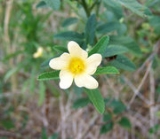
Sida rhombifolia ( Sanskrit : atibalā अतिबला ) is a
perennialA perennial plant or simply perennial is a plant that lives for more than two years. The term is often used to differentiate a plant from shorter lived annuals and biennials. The term is sometimes misused by commercial gardeners or horticulturalists to describe only herbaceous perennials...
or sometimes
annual plantAn annual plant is a plant that usually germinates, flowers, and dies in a year or season. True annuals will only live longer than a year if they are prevented from setting seed...
in the Family
MalvaceaeMalvaceae, or the mallow family, is a family of flowering plants containing over 200 genera with close to 2,300 species. Judd & al. Well known members of this family include okra, jute and cacao...
, native to the
New WorldThe New World is one of the names used for the Western Hemisphere, specifically America and sometimes Oceania . The term originated in the late 15th century, when America had been recently discovered by European explorers, expanding the geographical horizon of the people of the European middle...
tropics and subtropics. Other common names include
Paddy’s lucerne,
jelly leaf, and also somewhat confusingly as
Cuban jute,
Queensland hemp, and
Indian hemp (although
S. rhombifolia is not related to either
JuteJute is a long, soft, shiny vegetable fibre that can be spun into coarse, strong threads. It is produced from plants in the genus Corchorus, which has been classified in the family Tiliaceae, or more recently in Malvaceae....
or
HempHemp is mostly used as a name for low tetrahydrocannabinol strains of the plant Cannabis sativa, of fiber and/or oilseed varieties. In modern times, hemp has been used for industrial purposes including paper, textiles, biodegradable plastics, construction, health food and fuel with modest...
).
SynonymsIn scientific nomenclature, a synonym is a scientific name that is or was used for a taxon of organisms that also goes by a different scientific name. For example, Linnaeus was the first to give a scientific name to the Norway spruce, which he called Pinus abies...
include
Malva rhombifolia.
The stems are erect to sprawling and branched, growing 50 to 120 centimeters in height, with the lower sections being woody. The dark green, diamond-shaped
leavesA leaf is an organ of a vascular plant, as defined in botanical terms, and in particular in plant morphology. Foliage is a mass noun that refers to leaves as a feature of plants....
are arranged alternately along the stem, 4 to 8 centimeters long, with
petiolesIn botany, the petiole is the stalk attaching the leaf blade to the stem. The petiole usually has the same internal structure as the stem. Outgrowths appearing on each side of the petiole are called stipules. Leaves lacking a petiole are called sessile, or clasping when they partly surround the...
that are less than a third of the length of the leaves. They are paler below, with short, grayish hairs. The apical half of the leaves have toothed or serrated margins while the remainder of the leaves are entire (untoothed). The petioles have small spiny
stipuleIn botany, stipule is a term coined by Linnaeus which refers to outgrowths borne on either side of the base of a leafstalk...
s at their bases.
The moderately delicate
flowerA flower, sometimes known as a bloom or blossom, is the reproductive structure found in flowering plants . The biological function of a flower is to effect reproduction, usually by providing a mechanism for the union of sperm with eggs...
s occur singly on
flower stalksIn botany, a peduncle is a stem supporting an inflorescence, or after fecundation, an infructescence.The peduncle is a stem, usually green and without leaves, though sometimes colored or supporting small leaves...
that arise from the area between the stems and leaf petioles. They consist of five petals that are 4 to 8 millimeters long, creamy to orange-yellow in color, and may be somewhat reddish in the center. Each of the five overlapping petals are asymmetric, having a long lobe on one side. The
stamenThe stamen is the pollen producing reproductive organ of a flower...
s unite in a short column. The
fruitIn broad terms, a fruit is a structure of a plant that contains its seeds.The term has different meanings dependent on context. In non-technical usage, such as food preparation, fruit normally means the fleshy seed-associated structures of certain plants that are sweet and edible in the raw state,...
is a ribbed capsule, which breaks up into 8 to 10 segments. The plant blooms throughout the year.
This species is usually confined to waste ground, such as roadsides and rocky areas, stock camps or rabbit warrens, but can be competitive in pasture, due to its unpalatability to livestock.
External links