


Shusha

Encyclopedia
Shusha also known as Shushi is a town in the disputed region of Nagorno-Karabakh
in the South Caucasus
. It has been under the control of the self-proclaimed Nagorno-Karabakh Republic
since its capture in 1992 during the Nagorno-Karabakh War
. However, it is a de-jure part of the Republic of Azerbaijan, with the status of an administrative division
of the surrounding Shusha Rayon
. Situated at an altitude of 1400–1800 metres (4,600-5,900 ft) in the picturesque Karabakh mountains, Shusha was a popular mountain recreation resort in the Soviet era
.
After serving as a town and an ancient fortress in the Armenian-ruled Principality of Varanda, Shusha was turned into the capital of the Karabakh khanate
. The town became one of the cultural centers of the South Caucasus
after the Russian
conquest of the region in the first half of the 19th century. Over time, it became a home to many intellectuals, poets, writers and especially, musicians (e.g., the ashugs, mugham
singers, kobuz players). Shusha was the only large settlement within the Nagorno-Karabakh Autonomous Oblast
that had a predominantly Azerbaijani
population. In 1977 Shusha was declared reservation of Azerbaijani architecture and history. The city was often referred to as "musical capital or conservatory of Transcaucasia".
The city was also a major center of Armenian cultural and economic life until the closing years of World War I. Along with Tbilisi
; it was one of the two main Armenian cities of the Transcaucasus and the center of a self-governing Armenian principality in the 1720s. It also had religious and strategic importance to the Armenians, housing the Ghazanchetsots Cathedral
, the church of Kanach Zham
and serving (along with Lachin
district to the west) as a land link to Armenia
. Following the capture of Shusha in 1992 by Armenian forces, its population diminished dramatically and is now almost exclusively Armenian.
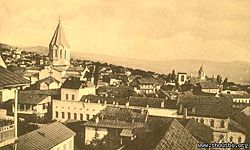 The earliest mentions of Shusha appear in the Middle Ages. The town and fort of Shusha was mentioned as a linchpin of one of East Armenian military districts, called “syghnakhs,” which played a key role in the Armenian commander Avan Yuzbashi’s
campaign against Ottoman forces in the 1720s and 1730s, during the Turkish invasion of the Southern Caucasus.
Kehva Chelebi, an Armenian patriot who maintained correspondence between the meliks of Karabakh and the Russian authorities, in this report of 1725 mentions Shusha as a town and a fort:
In his letter of 1769 to the Russian diplomat Count P. Panin
, the Georgian king Erekle II
documented that “there was an ancient fortress which was conquered, through deceit, by one man from the Muslim Jevanshir tribe.” The same information about the ancient fortress is confirmed by the Russian Field Marshal Alexander Suvorov
in his letter to Prince Grigory Potemkin. Suvorov writes that the Armenian prince Melik Shahnazar of Varanda surrendered his fortress Shushikala to "certain Panah," whom he calls "chief of an unimportant part of nomadic Muslims living near the Karabakh borders."
But there are also other sources which cite history of foundation of Shusha in different way. Hasan Ikhfa Alizade in his work "Şuşa şeherinin tarixi (The History of Shusha city)" pointed that construction of Shusha was started in 1750 by Panah Ali Khan
and his opinion was supported by other historians. The settlement in Shusha was completed in 1756, when population from surrounding villages had moved in Shusha.
was castle of Bayat, built in 1748 in the district of Kebirli. Later another fortress was built in the place called Shahbulag. However, soon after Panah Ali Khan
realized that in order to secure himself and his newly-established khanate from external threats, and especially from the invasions from Iran, he needed to build a new more reliable castle.
According to Mirza Jamal Javanshir Qarabaghi (1773–1853), the author of History of Karabakh, a text written in Persian, one of the most significant chronicles on the history of Karabakh in 18-19th centuries, the Karabakh nobility assembled to discuss the danger of invasion from Iran and told Panah Ali Khan, "We must build among the impassable mountains such an inviolable and inaccessible fort, so that no strong enemy could take it." Melik Shahnazar of Varanda, who was the first of the Armenian meliks (dukes) to accept the suzerainty of Panah Ali Khan and who would remain his loyal supporter, suggested a location for the new fortress. Thus, Panahabad-Shusha was founded.
According to George A. Bournoutian commenting the chronicler, prior to construction of the fortress by Panah Ali khan there were no buildings at that location and it was used as a cropland and pasture by the people of the nearby village of Shoshi. Panah khan resettled to Shusha the population of Shahbulag and some nearby villages, and built strong fortifications.
Another account is presented by Raffi, an Armenian novelist and historian, in his work The Princedoms of Khamsa, who asserts that the place which Shusha was built on was desolate and uninhabited before Panah-Ali Khan's arrival. He states, "[Panah-Ali Khan and Melik-Shahnazar of Varanda] soon completed the construction (1762) [of the fortress] and moved the Armenian population of the nearby village of Shosh (Շոշ), called also Shoshi, or Shushi into the fortress.″
Shusha was founded in 1750-1752 (according to other sources, 1756–1757) by Panah-Ali khan Javanshir (r. 1748-1763), the founder and the first ruler of the independent Karabakh Khanate
(1748–1822), which comprised both Lowland and Highland Karabakh
. The latter, where Shusha was built, was predominantly inhabited by Armenians, living in five Armenian princedoms governed by their own hereditary princes. The town was initially named Panahabad, after its founder. During the rule of Ibrahim-Khalil khan (r. 1763-1806), the son of Panah Ali khan, the town received its present name from a nearby Armenian village called Shushi, also known as Shushikent ("village of Shushi") or Shosh.
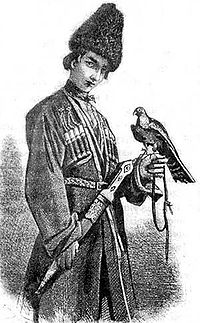 Less than a year after Shusha was founded, the Karabakh Khanate was attacked by Muhammed Hassan khan Qajar, one of the major claimants to the Iranian throne. During the Safavid Empire Karabakh was for almost two centuries ruled by Ziyad-oglu family of the clan of Qajar (of Turkic
origin), and therefore, Muhammed Hassan khan considered Karabakh his hereditary estate.
Muhammed Hassan khan besieged Shusha (Panahabad at that time) but soon had to retreat, because of the attack on his khanate by his major opponent to the Iranian throne, Kerim khan Zend
. His retreat was so hasty that he even left his cannons under the walls of Shusha fortress. Panah Ali khan counterattacked the retreating troops of Muhammad Hassan khan and even briefly took Ardabil
across the Aras River in Iranian Azerbaijan
.
In 1756 (or 1759) Shusha and the Karabakh Khanate underwent a new attack from Fatali khan Afshar, ruler of Urmia
. With his 30,000 strong army Fatali khan also managed to gain support from the meliks (feudal vassals) of Jraberd and Talish (Gulistan), however melik Shahnazar of Varanda continued to support Panah Ali khan. Siege of Shusha lasted for six months and Fatali khan eventually had to retreat.
After Panah Ali khan's death his son Ibrahim Khalil khan became the ruler of the Karabakh Khanate. Under him Karabakh khanate became one of the strongest state formations and Shusha grew. According to travelers who visited Shusha at the end of 18th-early 19th centuries the town had about 2,000 houses and approximately 10,000 population.
In summer 1795 Shusha was subjected to a major attack by Aga Muhammad khan Qajar
, son of Muhammad Hassan khan who attacked Shusha in 1752. Aga Muhammad khan Qajar's goal was to end with the feudal fragmentation and to restore the old Safavid State in Iran. For this purpose he also wanted to proclaim himself shah (king) of Iran. However, according to the Safavid tradition, shah had to take control over the whole of South Caucasus before his coronation. Therefore, Karabakh Khanate and its fortified capital Shusha, were the first and major obstacle to achieve these ends.
Aga Muhammad khan Qajar besieged Shusha with his 80,000-strong army. Ibrahim Khalil khan mobilized the population for a long-term defense. The number of militia in Shusha reached 15,000. Women fought together with men. The Armenian population of Karabakh also actively participated in this struggle against the invaders and fought side by side with the Muslim population, jointly organizing ambushes in the mountains and forests.
The siege lasted for 33 days. Not being able to capture Shusha, Aga Muhammad khan ceased the siege and advanced to Tiflis (present-day Tbilisi
), which despite desperate resistance was occupied and exposed to unprecedented destruction.
In 1797 Agha Muhammad shah Qajar, who by that time has already managed to declare himself shah (albeit he did not succeed in conquering the Caucasus as the tradition required) decided to carry out a second attack on Karabakh.
Trying to avenge the previous humiliating defeat Qajar devastated the surrounding villages near Shusha. The population could not recover from the previous 1795 attack and also suffered from serious drought which lasted for three years. The artillery of the enemy also caused serious losses amongst the city defenders. Thus, in 1797 Aga Muhammed shah succeeded in seizing Shusha and Ibrahim Khalil khan had to flee to Dagestan
.
However, several days after the seizure of Shusha, Aga Muhammed shah was killed in mysterious circumstances by his bodyguards. The Iranian troops left and soon afterwards, Ibrahim Khalil khan returned to Shusha and restored his authority as khan of Karabakh.
 From the early 19th century, Russian
influence in the Caucasus
began to rise. Following Georgia
, many khanates accepted Russian protectorate. In 1805, a Kurekchay Treaty
was signed between the Karabakh Khanate
and the Russian Empire on the transfer of the Karabakh Khanate to Russia.
The Russian Empire consolidated its power in the Karabakh khanate following the Treaty of Gulistan in 1813 and Treaty of Turkmenchay
of 1828, when following two Russo-Persian wars, Iran recognized belonging of the Karabakh khanate, along with many other khanates, to Russia
.
The Karabakh khanate was eliminated in 1822. A survey prepared by the Russian imperial authorities in 1823, a year after and several years before the 1828 Armenian migration from Persia to the newly-established Armenian Province, shows that all Armenians of Karabakh compactly resided in its highland portion, i.e., on the territory of the five traditional Armenian principalities, and constituted an absolute demographic majority on those lands. The survey's more than 260 pages recorded that the district of Khachen had twelve Armenian villages and no Tatar (Muslim) villages; Jalapert (Jraberd) had eight Armenian villages and no Tatar villages; Dizak had fourteen Armenian villages and one Tatar village; Gulistan had twelve Armenian and five Tatar villages; and Varanda had twenty-three Armenian villages and one Tatar village.
During the Russo-Persian War of 1826–1828, the citadel at Shusha held out for several months and never fell. After this Shusha ceased to be a capital of a khanate and instead became an administrative capital of first the Karabakh province (1822–1840) and then of the Shusha district (uyezd) of the Elisabethpol Governorate
(1840–1923). Shusha grew and developed, with successive waves of migrants moving to the city, particularly Armenians.
Beginning from 1830s the town was divided into two parts: Turkic-speaking Muslims lived in the eastern lower quarters, while Armenian Christians settled in the relatively new western upper quarters of the town. The Muslim part of the town was divided into seventeen quarters. Each quarter had its own mosque
, Turkish bath, water-spring and also a quarter representative, who would be elected among the elderlies (aksakals), and who would function as a sort of head of present-day municipality. The Armenian part of the town consisted of 12 quarters, five churches, town and district school and girls' seminary.
The population of the town primarily dealt with trade, horse-breeding, carpet-weaving and wine and vodka production. Shusha was also the biggest center of silk production in the Caucasus. Most of the Muslim population of the town and of Karabakh in general was engaged in sheep and horse-breeding and therefore, had a semi-nomadic lifestyle, spending wintertime in lowland Karabakh in wintering pastures and spring and summer in summering pastures in Shusha and other mountainous parts.
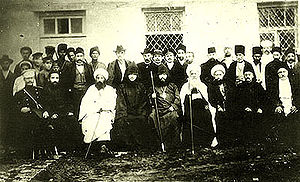 The beginning of the 20th century marked the first Armenian-Tartar clashes throughout Azerbaijan
. This new phenomenon had two reasons. First, it was the result of increased tensions between the local Muslim population and Armenians, whose numbers increased throughout the 19th century as a result of Russian resettlement policies. Second, by the beginning of the 20th century peoples of the Caucasus, similar to other non-Russian peoples in the periphery of the Russian Empire began to seek cultural and territorial autonomy. That is why, in the beginning of the 20th century in Russia itself was a period of bourgeois and Bolshevik revolutions, in the peripheries these movements have acquired a character of the national liberation movement.
The initial clashes between ethnic Armenians and Azeris took place in Baku
in February 1905. Soon, the conflict spilled over to other parts of the Caucasus
, and on August 5, 1905 first conflict between the Armenian and Azeri inhabitants of Shusha took place. As a result of the mutual pogroms and killings, hundreds of people died and more than 200 houses were burned.
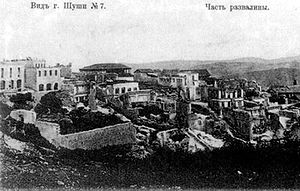 After World War I
and subsequent collapse of the Russian Empire
, Karabakh was claimed by Azerbaijan to be part of the Azerbaijan Democratic Republic
(1918–1920), a decision hotly disputed by neighboring Armenia and by Karabakh's Armenian population. After the defeat of Ottoman empire
in the World War I
, British
troops occupied Karabakh. The British command provisionally affirmed Khosrov bey Sultanov (appointed by the Azerbaijani government) as the governor-general of Karabakh and Zangezur
, pending final decision by the Paris Peace Conference
.
In August 1919, the Karabakh National Council entered into a provisional treaty agreement with the Azerbaijani government, recognizing the authority of the Azerbaijan government until the issue of the mountainous part of Karabakh would be settled at the Paris Peace Conference. Despite signing the Agreement, the Azerbaijani government continuously violated the terms of the treaty. Ethnic conflict began to erupt in the region. According to Michael P. Croissant on 5 June 1919, 600 Armenian inhabitants of the villages surrounding Shusha were killed by Azerbaijani and Kurdish irregulars. Sultanov claimed that those irregulars were not under his control. The strife culminated with an Armenian uprising, which was suppressed by the Azerbaijani army. In late March 1920 the Armenian half of the police forces was reported by a British journalist to have murdered the Azerbaijani half during the latter's traditional Novruz Bayram
holiday celebtrations. The Armenian surprise attack was organised and coordinated by the forces of the Armenian Republic. Azerbaijani outrage for this surprise attack ultimately led to the pogrom of March 1920, in which between 500 and 20,000 of the Armenian population of Shusha was killed, and many forced to flee. According to the historian Giovanni Guaita
, the Azerbaijani and Soviet authorities "during the decades will deny and try to hush up the mass killings of about 30,000 Armenians."
According to the description of an Azerbaijani communist Ojahkuli Musaev:
Nadezhda Mandelstam
wrote about Shusha in the 1920s, "in this town, which formerly of course was healthy and with every amenity, the picture of catastrophe and massacres was terribly visual.... They say after the massacres all the wells were full of dead bodies....We didn't see anyone in the streets on the mountain. Only in downtown - in the market-square, there were a lot of people, but there wasn't any Armenian among them; all were Muslims".
(the 11th Army) invaded Azerbaijan and then Armenia and put an end to the national de-facto governments that existed in those two countries. Beginning from this period, conflict over control of Karabakh and its central town of Shusha, moved from the battlefield to the diplomatic sphere.
In order to attract Armenian public support, the Bolsheviks promised to resolve the issue of the disputed territories, including Karabakh, in favor of Armenia. However, on July 5, 1921 the Caucasus Bureau (Kavburo) of the Communist Party adopted the following decision regarding the future status of Karabakh: "Proceeding from the necessity of national peace among Muslims and Armenians and of the economic ties between upper (mountainous) and lower Karabakh, of its permanent ties with Azerbaijan, mountainous Karabakh is to remain within AzSSR, receiving wide regional autonomy with the administrative center in Shusha, which is to be included in the autonomous region." As a result, Mountainous Karabakh Autonomous Region was established within the Azerbaijan SSR in 1923.
The decision favoring Azerbaijan has been largely possible by the firm position of the then Soviet Azerbaijan leader Nariman Narimanov
, who resisted pressure from Joseph Stalin
to concede Karabakh and Nakhichevan to Armenia. According to another version, Stalin knew that by including the disputed and by then majority Armenian-populated region within the boundaries of Azerbaijan, it would ensure Moscow’s position as power broker.
Khankendi (renamed Stepanakert
after the Armenian communist Stepan Shaumyan), which previously was a small village, became the new regional capital and soon became the largest town within Mountainous Karabakh Autonomous Region.
The town remained half-ruined until the 1960s, when the town began to gradually revive due to its recreational potential. In 1977 Shusha was declared a reservation of Azerbaijan architecture and history and became one of the major resort-towns in the former USSR.
With the start of Nagorno-Karabakh War
in 1988 Shusha became the most important Azeri stronghold in Karabakh, from where Azeri forces constantly shelled the capital Stepanakert. On May 9, 1992 the town was captured by Armenian forces and the Azeri population fled. According to the Institute for War and Peace Reporting
, the city was looted and burnt by Armenians. Today a large part of the town remains in ruins.
After the end of the war, the town was repopulated by Armenians, mostly refugees from Azerbaijan and other parts of Karabakh, as well as members of the Armenian diaspora. While the population of the town is barely half of the pre-war number, and the demographic of the town has changed from mostly Azeri to completely Armenian, a slow recovery can be seen. The Goris
-Stepanakert
Highway passes through the town, and is a transit and tourist destination for many. There are some hotels in the city, and reconstruction work continues, in particular, the Ghazanchetsots Cathedral
recently finished going through the restoration process.
The Armenian quarter continued to lie in ruins until the beginning of the 1960s. In 1961, Baku's communist leadership finally passed a decision to clear away the ruins, even though many old buildings still could have been renovated. Three Armenian and one Russian churches were demolished and the town was built up with plain buildings typical of the Khrushchev era.
,_shusha,_1915.jpg) The town of Shusha is extremely popular with the musical traditions of Azerbaijani people
The town of Shusha is extremely popular with the musical traditions of Azerbaijani people
. Shusha is home to one of the leading schools of mugham
, traditional Azeri genre of vocal and instrumental arts. Shusha is particularly renowned for this art.
Shusha is also well known for sileh rugs, floor coverings from the South Caucasus
and parts of eastern Turkey
. Those from the Caucasus may have been woven in the vicinity of Shusha. A similar Eastern Anatolian type usually shows a different range of colours.
Shusha was one of Armenian religious and cultural centers and predominately Armenian cities of Caucasus. The Eastern Armenian version of four Gospels (Holy Bible) was completed in 1830 in Shusha, and then was published in Moscow
for the first time.
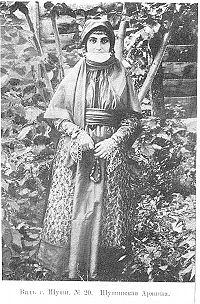 The highland portion of Karabakh, where Shusha was built, traditionally had an Armenian majority of the population. When discussing Karabakh and Shusha in the 18th century, the Russian diplomat and historian S. M. Bronevskiy indicated in his “Historical Notes” that Karabakh, which he said "is located in Greater Armenia" had as many as 30-40 thousand armed Armenian men in 1796.
According to first Russian-held census of 1823 conducted by Russian officials Yermolov and Mogilevsky, the number of Muslim families in Shusha was 1,111 (72.5%) whereas the number of Armenian families reached 421 (27.5%). Seven years later, according to 1830 data, the number of Muslim families in Shusha decreased to 963 and the number of Armenian families increased to 762.
George Keppel, the Earl of Albemarle
, who in 1824 on his way back to England from India arrived to Karabakh from Persia, wrote that “Sheesha contains two thousand houses: three parts of the inhabitants are Tartars, and the remainder Armenians”.
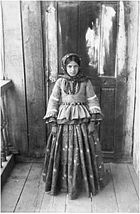 A survey prepared by the Russian imperial authorities in 1823 shows that all Armenians of Karabakh compactly resided in its highland portion, i.e. on the territory of the five traditional Armenian principalities, and constituted an absolute demographic majority on those lands. The survey's more than 260 pages recorded that the five districts had 57 Armenian villages and 7 Tatar villages.
The 19th century also brought some alterations to the ethnic demographics of the region. Following the invasions from Iran (Persia), Russo-Persian wars and subjection of Karabakh khanate to Russia, many Muslim families emigrated to Iran while many Armenians moved to Shusha.
In 1851, the population of Shusha was 15,194 people, in 1886 - 30,000, in 1910 - 39,413 and in 1916 - 43,869, of which 23,396 (53 %) were Armenians, and 19,121 (44 %) were Tatars (Azerbaijanis).
By the end of the 1880s the percentage of Muslim population living in the Shusha district (part of earlier Karabakh province) decreased even further and constituted only 41.5%, while the percentage of the Armenian population living in the same district increased to 58.2% in 1886.
By the second half of the 19th century Shusha had become the largest town in the Karabakh region and the second largest town in the Caucasus after Tbilisi . However, after the pogrom against the Armenian population in 1920 and the burning of the town, Shusha was reduced to a small provincial town of some 10,000 people. Armenians did not begin to return until after World War II
. It was not until the 1960s that the Armenian quarter began to be rebuilt.
According to the last population census in 1989, the town of Shusha had a population of 17,000 and Shusha district had a population of 23,000. 91.7% of population of Shusha district and 98% of Shusha town were Azerbaijani.
Following the Armenian capture of Shusha in 1992, the ethnic Azeri population of the town fled and the present population consists of roughly 3,000 Armenians, mainly refugees from other parts of Azerbaijan and some immigrants from Armenia
and the Diaspora
. As a result of the war, there are no Azeris living in the Shusha region today.
The Twentieth Spring - A portrait of Shushi 20 years after it was taken over by armenian forces (randbild|2011):
War & Peace /, Built and Destroyed / Daily Life / Art, Faith and Exercises / Life, Death & a lot in Between
Nagorno-Karabakh
Nagorno-Karabakh is a landlocked region in the South Caucasus, lying between Lower Karabakh and Zangezur and covering the southeastern range of the Lesser Caucasus mountains...
in the South Caucasus
South Caucasus
The South Caucasus is a geopolitical region located on the border of Eastern Europe and Southwest Asia also referred to as Transcaucasia, or The Trans-Caucasus...
. It has been under the control of the self-proclaimed Nagorno-Karabakh Republic
Nagorno-Karabakh Republic
The Nagorno-Karabakh Republic , or Artsakh Republic is a de facto independent republic located in the South Caucasus region of Eurasia...
since its capture in 1992 during the Nagorno-Karabakh War
Nagorno-Karabakh War
The Nagorno-Karabakh War was an armed conflict that took place from February 1988 to May 1994, in the small enclave of Nagorno-Karabakh in southwestern Azerbaijan, between the majority ethnic Armenians of Nagorno-Karabakh backed by the Republic of Armenia, and the Republic of Azerbaijan...
. However, it is a de-jure part of the Republic of Azerbaijan, with the status of an administrative division
Administrative divisions of Azerbaijan
Politically, Azerbaijan is divided into:*59 districts ,*11 cities ,*1 autonomous republic , which itself contains:**7 districts**1 city...
of the surrounding Shusha Rayon
Shusha (rayon)
Shusha is a rayon of Azerbaijan. It surrounds the city of Shusha, in Nagorno-Karabakh, and is completely under control of unrecognised Nagorno-Karabakh Republic....
. Situated at an altitude of 1400–1800 metres (4,600-5,900 ft) in the picturesque Karabakh mountains, Shusha was a popular mountain recreation resort in the Soviet era
Soviet Union
The Soviet Union , officially the Union of Soviet Socialist Republics , was a constitutionally socialist state that existed in Eurasia between 1922 and 1991....
.
After serving as a town and an ancient fortress in the Armenian-ruled Principality of Varanda, Shusha was turned into the capital of the Karabakh khanate
Karabakh khanate
The Karabakh khanate was a semi-independent khanate on the territories of modern Azerbaijan and Armenia established in about 1750 under Persian suzerainty in Karabakh and adjacent areas. The Karabakh khanate existed until 1805, when the Russian Empire gained control over it from Persia...
. The town became one of the cultural centers of the South Caucasus
South Caucasus
The South Caucasus is a geopolitical region located on the border of Eastern Europe and Southwest Asia also referred to as Transcaucasia, or The Trans-Caucasus...
after the Russian
Russian Empire
The Russian Empire was a state that existed from 1721 until the Russian Revolution of 1917. It was the successor to the Tsardom of Russia and the predecessor of the Soviet Union...
conquest of the region in the first half of the 19th century. Over time, it became a home to many intellectuals, poets, writers and especially, musicians (e.g., the ashugs, mugham
Mugham
Mugam also known as Azerbaijani Mugham is one of the many folk musical compositions from Azerbaijan, contrast with Tasnif, Ashugs. Mugam draws on Iranian-Arabic-Turkish Maqam....
singers, kobuz players). Shusha was the only large settlement within the Nagorno-Karabakh Autonomous Oblast
Nagorno-Karabakh Autonomous Oblast
The Nagorno-Karabakh Autonomous Oblast was an autonomous oblast within the borders of the Azerbaijan SSR, mostly inhabited by ethnic Armenians and created on July 7, 1923. According to Karl R. DeRouen it was created as an enclave so that a narrow strip of land would separate it from Armenia proper....
that had a predominantly Azerbaijani
Azerbaijani people
The Azerbaijanis are a Turkic-speaking people living mainly in northwestern Iran and the Republic of Azerbaijan, as well as in the neighbourhood states, Georgia, Russia and formerly Armenia. Commonly referred to as Azeris or Azerbaijani Turks , they also live in a wider area from the Caucasus to...
population. In 1977 Shusha was declared reservation of Azerbaijani architecture and history. The city was often referred to as "musical capital or conservatory of Transcaucasia".
The city was also a major center of Armenian cultural and economic life until the closing years of World War I. Along with Tbilisi
Tbilisi
Tbilisi is the capital and the largest city of Georgia, lying on the banks of the Mt'k'vari River. The name is derived from an early Georgian form T'pilisi and it was officially known as Tiflis until 1936...
; it was one of the two main Armenian cities of the Transcaucasus and the center of a self-governing Armenian principality in the 1720s. It also had religious and strategic importance to the Armenians, housing the Ghazanchetsots Cathedral
Ghazanchetsots Cathedral
Ghazanchetsots Cathedral , also known as the Cathedral of Christ the Holy Savior and the Shushi Cathedral , is an Armenian church located in Shusha, Nagorno-Karabakh.-History:...
, the church of Kanach Zham
Kanach Zham
Kanach Zham is an Armenian Apostolic Church located in Shusha, Nagorno-Karabakh; it is just uphill from the Ghazanchetsots Cathedral. Kanach Zham means "Green Church" in Armenian, this is because at one time the church's domes were painted green...
and serving (along with Lachin
Lachin
Lachin is a town in Azerbaijan and the regional center of the Lachin Rayon. Since 1992 the area has been under the control of the de facto independent unrecognized Nagorno-Karabakh Republic, which has renamed the town Berdzor . The town and its surrounding region serve as the strategic Lachin...
district to the west) as a land link to Armenia
Armenia
Armenia , officially the Republic of Armenia , is a landlocked mountainous country in the Caucasus region of Eurasia...
. Following the capture of Shusha in 1992 by Armenian forces, its population diminished dramatically and is now almost exclusively Armenian.
Middle Ages: fortress and town in Varanda
Avan Yuzbashi
Avan Yuzbashi was an 18th century commander of Armenian armies in Nagorno Karabakh. He was instrumental in aiding David Bek's forces and gaining victories over the forces of Safavid Iran and the Ottoman Empire in Zangezur region...
campaign against Ottoman forces in the 1720s and 1730s, during the Turkish invasion of the Southern Caucasus.
Kehva Chelebi, an Armenian patriot who maintained correspondence between the meliks of Karabakh and the Russian authorities, in this report of 1725 mentions Shusha as a town and a fort:
In his letter of 1769 to the Russian diplomat Count P. Panin
Petr Ivanovich Panin
General Count Petr Ivanovich Panin , younger brother of Nikita Ivanovich Panin, fought with distinction in the Seven Years' War and in the Russo-Turkish War of 1768–1774, capturing Bender on September 26, 1770. In 1773–1775 he participated in suppressing Pugachev's rebellion. He died...
, the Georgian king Erekle II
Erekle II
Erekle II was a Georgian monarch of the Bagrationi Dynasty, reigning as the king of Kakheti from 1744 to 1762, and of Kartli and Kakheti from 1762 until 1798. In the contemporary Persian sources he is referred to as Erekli Khan, while Russians knew him as Irakli...
documented that “there was an ancient fortress which was conquered, through deceit, by one man from the Muslim Jevanshir tribe.” The same information about the ancient fortress is confirmed by the Russian Field Marshal Alexander Suvorov
Alexander Suvorov
Alexander Vasilyevich Suvorov , Count Suvorov of Rymnik, Prince in Italy, Count of the Holy Roman Empire , was the fourth and last generalissimo of the Russian Empire.One of the few great generals in history who never lost a battle along with the likes of Alexander...
in his letter to Prince Grigory Potemkin. Suvorov writes that the Armenian prince Melik Shahnazar of Varanda surrendered his fortress Shushikala to "certain Panah," whom he calls "chief of an unimportant part of nomadic Muslims living near the Karabakh borders."
But there are also other sources which cite history of foundation of Shusha in different way. Hasan Ikhfa Alizade in his work "Şuşa şeherinin tarixi (The History of Shusha city)" pointed that construction of Shusha was started in 1750 by Panah Ali Khan
Panah Ali Khan
Panah-Ali khan Javanshir was the founder and first ruler of Karabakh khanate, initially under nominal Persian suzerainty and by 1748 an independent feudal state that existed in 1747–1822 in Karabakh and adjacent areas..-Origins and early life:Panah Ali Khan was from the Sarijali branch of the...
and his opinion was supported by other historians. The settlement in Shusha was completed in 1756, when population from surrounding villages had moved in Shusha.
As center of Karabakh Khanate
The first capital of the Karabakh KhanateKarabakh khanate
The Karabakh khanate was a semi-independent khanate on the territories of modern Azerbaijan and Armenia established in about 1750 under Persian suzerainty in Karabakh and adjacent areas. The Karabakh khanate existed until 1805, when the Russian Empire gained control over it from Persia...
was castle of Bayat, built in 1748 in the district of Kebirli. Later another fortress was built in the place called Shahbulag. However, soon after Panah Ali Khan
Panah Ali Khan
Panah-Ali khan Javanshir was the founder and first ruler of Karabakh khanate, initially under nominal Persian suzerainty and by 1748 an independent feudal state that existed in 1747–1822 in Karabakh and adjacent areas..-Origins and early life:Panah Ali Khan was from the Sarijali branch of the...
realized that in order to secure himself and his newly-established khanate from external threats, and especially from the invasions from Iran, he needed to build a new more reliable castle.
According to Mirza Jamal Javanshir Qarabaghi (1773–1853), the author of History of Karabakh, a text written in Persian, one of the most significant chronicles on the history of Karabakh in 18-19th centuries, the Karabakh nobility assembled to discuss the danger of invasion from Iran and told Panah Ali Khan, "We must build among the impassable mountains such an inviolable and inaccessible fort, so that no strong enemy could take it." Melik Shahnazar of Varanda, who was the first of the Armenian meliks (dukes) to accept the suzerainty of Panah Ali Khan and who would remain his loyal supporter, suggested a location for the new fortress. Thus, Panahabad-Shusha was founded.
According to George A. Bournoutian commenting the chronicler, prior to construction of the fortress by Panah Ali khan there were no buildings at that location and it was used as a cropland and pasture by the people of the nearby village of Shoshi. Panah khan resettled to Shusha the population of Shahbulag and some nearby villages, and built strong fortifications.
Another account is presented by Raffi, an Armenian novelist and historian, in his work The Princedoms of Khamsa, who asserts that the place which Shusha was built on was desolate and uninhabited before Panah-Ali Khan's arrival. He states, "[Panah-Ali Khan and Melik-Shahnazar of Varanda] soon completed the construction (1762) [of the fortress] and moved the Armenian population of the nearby village of Shosh (Շոշ), called also Shoshi, or Shushi into the fortress.″
Shusha was founded in 1750-1752 (according to other sources, 1756–1757) by Panah-Ali khan Javanshir (r. 1748-1763), the founder and the first ruler of the independent Karabakh Khanate
Karabakh khanate
The Karabakh khanate was a semi-independent khanate on the territories of modern Azerbaijan and Armenia established in about 1750 under Persian suzerainty in Karabakh and adjacent areas. The Karabakh khanate existed until 1805, when the Russian Empire gained control over it from Persia...
(1748–1822), which comprised both Lowland and Highland Karabakh
Nagorno-Karabakh
Nagorno-Karabakh is a landlocked region in the South Caucasus, lying between Lower Karabakh and Zangezur and covering the southeastern range of the Lesser Caucasus mountains...
. The latter, where Shusha was built, was predominantly inhabited by Armenians, living in five Armenian princedoms governed by their own hereditary princes. The town was initially named Panahabad, after its founder. During the rule of Ibrahim-Khalil khan (r. 1763-1806), the son of Panah Ali khan, the town received its present name from a nearby Armenian village called Shushi, also known as Shushikent ("village of Shushi") or Shosh.
Conflict with Persia
Turkic peoples
The Turkic peoples are peoples residing in northern, central and western Asia, southern Siberia and northwestern China and parts of eastern Europe. They speak languages belonging to the Turkic language family. They share, to varying degrees, certain cultural traits and historical backgrounds...
origin), and therefore, Muhammed Hassan khan considered Karabakh his hereditary estate.
Muhammed Hassan khan besieged Shusha (Panahabad at that time) but soon had to retreat, because of the attack on his khanate by his major opponent to the Iranian throne, Kerim khan Zend
Karim Khan
Karim Khan Zand, , , was a ruler of Iran, and the founder of the Zand Dynasty.He was born to a family of the Zand tribe of Lur or Lak deportees...
. His retreat was so hasty that he even left his cannons under the walls of Shusha fortress. Panah Ali khan counterattacked the retreating troops of Muhammad Hassan khan and even briefly took Ardabil
Ardabil
Ardabil is a historical city in north-western Iran. The name Ardabil probably comes from the Zoroastrian name of "Artavil" which means a holy place. Ardabil is the center of Ardabil Province. At the 2006 census, its population was 412,669, in 102,818 families...
across the Aras River in Iranian Azerbaijan
Azerbaijan (Iran)
Azerbaijan or Azarbaijan , also Iranian Azerbaijan, Persian Azarbaijan is a region in northwestern Iran. It is also historically known as Atropatene and Aturpatakan....
.
In 1756 (or 1759) Shusha and the Karabakh Khanate underwent a new attack from Fatali khan Afshar, ruler of Urmia
Urmia
- Demographics :According to official census of 2006, the population of Urmia is about 871,204.- Language :The population of Urmia is mainly Azerbaijani people, with Kurdish, Assyrian Christian, and Armenian minorities...
. With his 30,000 strong army Fatali khan also managed to gain support from the meliks (feudal vassals) of Jraberd and Talish (Gulistan), however melik Shahnazar of Varanda continued to support Panah Ali khan. Siege of Shusha lasted for six months and Fatali khan eventually had to retreat.
After Panah Ali khan's death his son Ibrahim Khalil khan became the ruler of the Karabakh Khanate. Under him Karabakh khanate became one of the strongest state formations and Shusha grew. According to travelers who visited Shusha at the end of 18th-early 19th centuries the town had about 2,000 houses and approximately 10,000 population.
In summer 1795 Shusha was subjected to a major attack by Aga Muhammad khan Qajar
Mohammad Khan Qajar
Agha Muḥammad Khān Qājār was the chief of the Qajar tribe, succeeding his father Mohammad Hassan Khan, who was killed on the orders of Adil Shah. He became the Emperor/Shah of Persia in 1794 and established the Qajar dynasty...
, son of Muhammad Hassan khan who attacked Shusha in 1752. Aga Muhammad khan Qajar's goal was to end with the feudal fragmentation and to restore the old Safavid State in Iran. For this purpose he also wanted to proclaim himself shah (king) of Iran. However, according to the Safavid tradition, shah had to take control over the whole of South Caucasus before his coronation. Therefore, Karabakh Khanate and its fortified capital Shusha, were the first and major obstacle to achieve these ends.
Aga Muhammad khan Qajar besieged Shusha with his 80,000-strong army. Ibrahim Khalil khan mobilized the population for a long-term defense. The number of militia in Shusha reached 15,000. Women fought together with men. The Armenian population of Karabakh also actively participated in this struggle against the invaders and fought side by side with the Muslim population, jointly organizing ambushes in the mountains and forests.
The siege lasted for 33 days. Not being able to capture Shusha, Aga Muhammad khan ceased the siege and advanced to Tiflis (present-day Tbilisi
Tbilisi
Tbilisi is the capital and the largest city of Georgia, lying on the banks of the Mt'k'vari River. The name is derived from an early Georgian form T'pilisi and it was officially known as Tiflis until 1936...
), which despite desperate resistance was occupied and exposed to unprecedented destruction.
In 1797 Agha Muhammad shah Qajar, who by that time has already managed to declare himself shah (albeit he did not succeed in conquering the Caucasus as the tradition required) decided to carry out a second attack on Karabakh.
Trying to avenge the previous humiliating defeat Qajar devastated the surrounding villages near Shusha. The population could not recover from the previous 1795 attack and also suffered from serious drought which lasted for three years. The artillery of the enemy also caused serious losses amongst the city defenders. Thus, in 1797 Aga Muhammed shah succeeded in seizing Shusha and Ibrahim Khalil khan had to flee to Dagestan
Dagestan
The Republic of Dagestan is a federal subject of Russia, located in the North Caucasus region. Its capital and the largest city is Makhachkala, located at the center of Dagestan on the Caspian Sea...
.
However, several days after the seizure of Shusha, Aga Muhammed shah was killed in mysterious circumstances by his bodyguards. The Iranian troops left and soon afterwards, Ibrahim Khalil khan returned to Shusha and restored his authority as khan of Karabakh.
Shusha within the Russian Empire
Russian Empire
The Russian Empire was a state that existed from 1721 until the Russian Revolution of 1917. It was the successor to the Tsardom of Russia and the predecessor of the Soviet Union...
influence in the Caucasus
Caucasus
The Caucasus, also Caucas or Caucasia , is a geopolitical region at the border of Europe and Asia, and situated between the Black and the Caspian sea...
began to rise. Following Georgia
Georgia (country)
Georgia is a sovereign state in the Caucasus region of Eurasia. Located at the crossroads of Western Asia and Eastern Europe, it is bounded to the west by the Black Sea, to the north by Russia, to the southwest by Turkey, to the south by Armenia, and to the southeast by Azerbaijan. The capital of...
, many khanates accepted Russian protectorate. In 1805, a Kurekchay Treaty
Kurekchay Treaty
The Treaty of Kurakchay, also known as the Russo-Karabakhi treaty of May 14, 1805, was a treaty signed between the Russian military commander in the Caucasus Pavel Tsitsianov on behalf of Tsar Alexander I of Russia and Ibrahim Khalil Khan of the Karabakh khanate, which made the khanate a...
was signed between the Karabakh Khanate
Karabakh khanate
The Karabakh khanate was a semi-independent khanate on the territories of modern Azerbaijan and Armenia established in about 1750 under Persian suzerainty in Karabakh and adjacent areas. The Karabakh khanate existed until 1805, when the Russian Empire gained control over it from Persia...
and the Russian Empire on the transfer of the Karabakh Khanate to Russia.
The Russian Empire consolidated its power in the Karabakh khanate following the Treaty of Gulistan in 1813 and Treaty of Turkmenchay
Treaty of Turkmenchay
The Treaty of Turkmenchay was a treaty negotiated in Turkmenchay by which the Qajar Empire recognized Russian suzerainty over the Erivan khanate, the Nakhchivan khanate, and the remainder of the Talysh khanate, establishing the Aras River as the common boundary between the empires, after its...
of 1828, when following two Russo-Persian wars, Iran recognized belonging of the Karabakh khanate, along with many other khanates, to Russia
Russian Empire
The Russian Empire was a state that existed from 1721 until the Russian Revolution of 1917. It was the successor to the Tsardom of Russia and the predecessor of the Soviet Union...
.
The Karabakh khanate was eliminated in 1822. A survey prepared by the Russian imperial authorities in 1823, a year after and several years before the 1828 Armenian migration from Persia to the newly-established Armenian Province, shows that all Armenians of Karabakh compactly resided in its highland portion, i.e., on the territory of the five traditional Armenian principalities, and constituted an absolute demographic majority on those lands. The survey's more than 260 pages recorded that the district of Khachen had twelve Armenian villages and no Tatar (Muslim) villages; Jalapert (Jraberd) had eight Armenian villages and no Tatar villages; Dizak had fourteen Armenian villages and one Tatar village; Gulistan had twelve Armenian and five Tatar villages; and Varanda had twenty-three Armenian villages and one Tatar village.
During the Russo-Persian War of 1826–1828, the citadel at Shusha held out for several months and never fell. After this Shusha ceased to be a capital of a khanate and instead became an administrative capital of first the Karabakh province (1822–1840) and then of the Shusha district (uyezd) of the Elisabethpol Governorate
Elisabethpol Governorate
Elisabethpol Governorate or Elizavetpol Governorate was one of the guberniyas of the Russian Empire, with its centre in Elisabethpol . Its area was 44,136 sq. kilometres, and it had 878,415 inhabitants by 1897....
(1840–1923). Shusha grew and developed, with successive waves of migrants moving to the city, particularly Armenians.
Beginning from 1830s the town was divided into two parts: Turkic-speaking Muslims lived in the eastern lower quarters, while Armenian Christians settled in the relatively new western upper quarters of the town. The Muslim part of the town was divided into seventeen quarters. Each quarter had its own mosque
Mosque
A mosque is a place of worship for followers of Islam. The word is likely to have entered the English language through French , from Portuguese , from Spanish , and from Berber , ultimately originating in — . The Arabic word masjid literally means a place of prostration...
, Turkish bath, water-spring and also a quarter representative, who would be elected among the elderlies (aksakals), and who would function as a sort of head of present-day municipality. The Armenian part of the town consisted of 12 quarters, five churches, town and district school and girls' seminary.
The population of the town primarily dealt with trade, horse-breeding, carpet-weaving and wine and vodka production. Shusha was also the biggest center of silk production in the Caucasus. Most of the Muslim population of the town and of Karabakh in general was engaged in sheep and horse-breeding and therefore, had a semi-nomadic lifestyle, spending wintertime in lowland Karabakh in wintering pastures and spring and summer in summering pastures in Shusha and other mountainous parts.
Early 20th century
Azerbaijan
Azerbaijan , officially the Republic of Azerbaijan is the largest country in the Caucasus region of Eurasia. Located at the crossroads of Western Asia and Eastern Europe, it is bounded by the Caspian Sea to the east, Russia to the north, Georgia to the northwest, Armenia to the west, and Iran to...
. This new phenomenon had two reasons. First, it was the result of increased tensions between the local Muslim population and Armenians, whose numbers increased throughout the 19th century as a result of Russian resettlement policies. Second, by the beginning of the 20th century peoples of the Caucasus, similar to other non-Russian peoples in the periphery of the Russian Empire began to seek cultural and territorial autonomy. That is why, in the beginning of the 20th century in Russia itself was a period of bourgeois and Bolshevik revolutions, in the peripheries these movements have acquired a character of the national liberation movement.
The initial clashes between ethnic Armenians and Azeris took place in Baku
Baku
Baku , sometimes spelled as Baki or Bakou, is the capital and largest city of Azerbaijan, as well as the largest city on the Caspian Sea and of the Caucasus region. It is located on the southern shore of the Absheron Peninsula, which projects into the Caspian Sea. The city consists of two principal...
in February 1905. Soon, the conflict spilled over to other parts of the Caucasus
Caucasus
The Caucasus, also Caucas or Caucasia , is a geopolitical region at the border of Europe and Asia, and situated between the Black and the Caspian sea...
, and on August 5, 1905 first conflict between the Armenian and Azeri inhabitants of Shusha took place. As a result of the mutual pogroms and killings, hundreds of people died and more than 200 houses were burned.
World War I
World War I , which was predominantly called the World War or the Great War from its occurrence until 1939, and the First World War or World War I thereafter, was a major war centred in Europe that began on 28 July 1914 and lasted until 11 November 1918...
and subsequent collapse of the Russian Empire
Russian Empire
The Russian Empire was a state that existed from 1721 until the Russian Revolution of 1917. It was the successor to the Tsardom of Russia and the predecessor of the Soviet Union...
, Karabakh was claimed by Azerbaijan to be part of the Azerbaijan Democratic Republic
Azerbaijan Democratic Republic
The Azerbaijan Democratic Republic was the first successful attempt to establish a democratic and secular republic in the Muslim world . The ADR was founded on May 28, 1918 after the collapse of the Russian Empire that began with the Russian Revolution of 1917 by Azerbaijani National Council in...
(1918–1920), a decision hotly disputed by neighboring Armenia and by Karabakh's Armenian population. After the defeat of Ottoman empire
Ottoman Empire
The Ottoman EmpireIt was usually referred to as the "Ottoman Empire", the "Turkish Empire", the "Ottoman Caliphate" or more commonly "Turkey" by its contemporaries...
in the World War I
World War I
World War I , which was predominantly called the World War or the Great War from its occurrence until 1939, and the First World War or World War I thereafter, was a major war centred in Europe that began on 28 July 1914 and lasted until 11 November 1918...
, British
United Kingdom
The United Kingdom of Great Britain and Northern IrelandIn the United Kingdom and Dependencies, other languages have been officially recognised as legitimate autochthonous languages under the European Charter for Regional or Minority Languages...
troops occupied Karabakh. The British command provisionally affirmed Khosrov bey Sultanov (appointed by the Azerbaijani government) as the governor-general of Karabakh and Zangezur
Zangezur
Zangezur may refer to:* Syunik, alternative name of an Armenian geographic-historic region, nowadays one of the provinces of Armenia* Kapan, former name of a city in Armenia...
, pending final decision by the Paris Peace Conference
Paris Peace Conference, 1919
The Paris Peace Conference was the meeting of the Allied victors following the end of World War I to set the peace terms for the defeated Central Powers following the armistices of 1918. It took place in Paris in 1919 and involved diplomats from more than 32 countries and nationalities...
.
In August 1919, the Karabakh National Council entered into a provisional treaty agreement with the Azerbaijani government, recognizing the authority of the Azerbaijan government until the issue of the mountainous part of Karabakh would be settled at the Paris Peace Conference. Despite signing the Agreement, the Azerbaijani government continuously violated the terms of the treaty. Ethnic conflict began to erupt in the region. According to Michael P. Croissant on 5 June 1919, 600 Armenian inhabitants of the villages surrounding Shusha were killed by Azerbaijani and Kurdish irregulars. Sultanov claimed that those irregulars were not under his control. The strife culminated with an Armenian uprising, which was suppressed by the Azerbaijani army. In late March 1920 the Armenian half of the police forces was reported by a British journalist to have murdered the Azerbaijani half during the latter's traditional Novruz Bayram
Nowruz
Nowrūz is the name of the Iranian New Year in Iranian calendars and the corresponding traditional celebrations. Nowruz is also widely referred to as the Persian New Year....
holiday celebtrations. The Armenian surprise attack was organised and coordinated by the forces of the Armenian Republic. Azerbaijani outrage for this surprise attack ultimately led to the pogrom of March 1920, in which between 500 and 20,000 of the Armenian population of Shusha was killed, and many forced to flee. According to the historian Giovanni Guaita
Giovanni Guaita
Giovanni Guaita is an Italian historian, researcher of Eastern Christianity and writer. Assistant Professor of the Moscow Linguistic University.Guaita was born in 1962 in Italy...
, the Azerbaijani and Soviet authorities "during the decades will deny and try to hush up the mass killings of about 30,000 Armenians."
According to the description of an Azerbaijani communist Ojahkuli Musaev:
Nadezhda Mandelstam
Nadezhda Mandelstam
Nadezhda Yakovlevna Mandelstam was a Russian writer and educator, and the wife of the poet Osip Mandelstam, who died in 1938 in a transit camp to the gulag of Siberia...
wrote about Shusha in the 1920s, "in this town, which formerly of course was healthy and with every amenity, the picture of catastrophe and massacres was terribly visual.... They say after the massacres all the wells were full of dead bodies....We didn't see anyone in the streets on the mountain. Only in downtown - in the market-square, there were a lot of people, but there wasn't any Armenian among them; all were Muslims".
Soviet era
In 1920, the Russian Red ArmyRed Army
The Workers' and Peasants' Red Army started out as the Soviet Union's revolutionary communist combat groups during the Russian Civil War of 1918-1922. It grew into the national army of the Soviet Union. By the 1930s the Red Army was among the largest armies in history.The "Red Army" name refers to...
(the 11th Army) invaded Azerbaijan and then Armenia and put an end to the national de-facto governments that existed in those two countries. Beginning from this period, conflict over control of Karabakh and its central town of Shusha, moved from the battlefield to the diplomatic sphere.
In order to attract Armenian public support, the Bolsheviks promised to resolve the issue of the disputed territories, including Karabakh, in favor of Armenia. However, on July 5, 1921 the Caucasus Bureau (Kavburo) of the Communist Party adopted the following decision regarding the future status of Karabakh: "Proceeding from the necessity of national peace among Muslims and Armenians and of the economic ties between upper (mountainous) and lower Karabakh, of its permanent ties with Azerbaijan, mountainous Karabakh is to remain within AzSSR, receiving wide regional autonomy with the administrative center in Shusha, which is to be included in the autonomous region." As a result, Mountainous Karabakh Autonomous Region was established within the Azerbaijan SSR in 1923.
The decision favoring Azerbaijan has been largely possible by the firm position of the then Soviet Azerbaijan leader Nariman Narimanov
Nariman Narimanov
Narimanov Nariman Karbalayi Najaf oglu was an Azerbaijani revolutionary, writer, publicist, politician and statesman. In 1920, Narimanov headed the Soviet government of Azerbaijan, the Provisional Military-Revolutionary Committee , replacing Mirza Davud Huseynov, then he was the Chairman of the...
, who resisted pressure from Joseph Stalin
Joseph Stalin
Joseph Vissarionovich Stalin was the Premier of the Soviet Union from 6 May 1941 to 5 March 1953. He was among the Bolshevik revolutionaries who brought about the October Revolution and had held the position of first General Secretary of the Communist Party of the Soviet Union's Central Committee...
to concede Karabakh and Nakhichevan to Armenia. According to another version, Stalin knew that by including the disputed and by then majority Armenian-populated region within the boundaries of Azerbaijan, it would ensure Moscow’s position as power broker.
Khankendi (renamed Stepanakert
Stepanakert
Stepanakert is the largest city and capital of the Nagorno-Karabakh Republic, a de facto independent republic, though is internationally recognized as a part of Azerbaijan...
after the Armenian communist Stepan Shaumyan), which previously was a small village, became the new regional capital and soon became the largest town within Mountainous Karabakh Autonomous Region.
The town remained half-ruined until the 1960s, when the town began to gradually revive due to its recreational potential. In 1977 Shusha was declared a reservation of Azerbaijan architecture and history and became one of the major resort-towns in the former USSR.
With the start of Nagorno-Karabakh War
Nagorno-Karabakh War
The Nagorno-Karabakh War was an armed conflict that took place from February 1988 to May 1994, in the small enclave of Nagorno-Karabakh in southwestern Azerbaijan, between the majority ethnic Armenians of Nagorno-Karabakh backed by the Republic of Armenia, and the Republic of Azerbaijan...
in 1988 Shusha became the most important Azeri stronghold in Karabakh, from where Azeri forces constantly shelled the capital Stepanakert. On May 9, 1992 the town was captured by Armenian forces and the Azeri population fled. According to the Institute for War and Peace Reporting
Institute for War and Peace Reporting
Institute for War & Peace Reporting is an international media development charity, established in 1991. It runs major programmes in Afghanistan, the Caucasus, Central Asia, Iran, Iraq, the Balkans, Congo DRC, Tunisia and Uganda...
, the city was looted and burnt by Armenians. Today a large part of the town remains in ruins.
After the end of the war, the town was repopulated by Armenians, mostly refugees from Azerbaijan and other parts of Karabakh, as well as members of the Armenian diaspora. While the population of the town is barely half of the pre-war number, and the demographic of the town has changed from mostly Azeri to completely Armenian, a slow recovery can be seen. The Goris
Goris
Goris is a city in the Syunik Marz of Armenia. Located in the valley of river Goris , it is about 240 km away from the Armenian capital Yerevan and 70 km from the Syunik Marz center Kapan. Goris forms an urban community...
-Stepanakert
Stepanakert
Stepanakert is the largest city and capital of the Nagorno-Karabakh Republic, a de facto independent republic, though is internationally recognized as a part of Azerbaijan...
Highway passes through the town, and is a transit and tourist destination for many. There are some hotels in the city, and reconstruction work continues, in particular, the Ghazanchetsots Cathedral
Ghazanchetsots Cathedral
Ghazanchetsots Cathedral , also known as the Cathedral of Christ the Holy Savior and the Shushi Cathedral , is an Armenian church located in Shusha, Nagorno-Karabakh.-History:...
recently finished going through the restoration process.
The Armenian quarter continued to lie in ruins until the beginning of the 1960s. In 1961, Baku's communist leadership finally passed a decision to clear away the ruins, even though many old buildings still could have been renovated. Three Armenian and one Russian churches were demolished and the town was built up with plain buildings typical of the Khrushchev era.
Cultural life
Because of historical specifics Shusha contains both Azeri and Armenian cultural monuments, while the surrounding territories include also many ancient Armenian villages.Azerbaijani people
The Azerbaijanis are a Turkic-speaking people living mainly in northwestern Iran and the Republic of Azerbaijan, as well as in the neighbourhood states, Georgia, Russia and formerly Armenia. Commonly referred to as Azeris or Azerbaijani Turks , they also live in a wider area from the Caucasus to...
. Shusha is home to one of the leading schools of mugham
Mugham
Mugam also known as Azerbaijani Mugham is one of the many folk musical compositions from Azerbaijan, contrast with Tasnif, Ashugs. Mugam draws on Iranian-Arabic-Turkish Maqam....
, traditional Azeri genre of vocal and instrumental arts. Shusha is particularly renowned for this art.
Shusha is also well known for sileh rugs, floor coverings from the South Caucasus
South Caucasus
The South Caucasus is a geopolitical region located on the border of Eastern Europe and Southwest Asia also referred to as Transcaucasia, or The Trans-Caucasus...
and parts of eastern Turkey
Turkey
Turkey , known officially as the Republic of Turkey , is a Eurasian country located in Western Asia and in East Thrace in Southeastern Europe...
. Those from the Caucasus may have been woven in the vicinity of Shusha. A similar Eastern Anatolian type usually shows a different range of colours.
Shusha was one of Armenian religious and cultural centers and predominately Armenian cities of Caucasus. The Eastern Armenian version of four Gospels (Holy Bible) was completed in 1830 in Shusha, and then was published in Moscow
Moscow
Moscow is the capital, the most populous city, and the most populous federal subject of Russia. The city is a major political, economic, cultural, scientific, religious, financial, educational, and transportation centre of Russia and the continent...
for the first time.
Demographics
| 1851 | 15,194 | ||||||
| 1886 | 15,188 | 56.7 | 11,595 | 43.3 | 23 | 0.1 | 26,806 |
| 1897 | 14,420 | 55.7 | 10,778 | 41.6 | 683 | 2.6 | 25,881 |
| 1904 | 56.5 | 43.2 | 25,656 | ||||
| 1916 | 23,396 | 53.3 | 19,121 | 43.6 | 1,352 | 3.1 | 43,869 |
| 1921 | 289 | 3.1 | 8,894 | 96.4 | 40 | 0.4 | 9,223 |
| 1926 | 93 | 1.8 | 4,900 | 96.4 | 111 | 2.2 | 5,104 |
| 1939 | 1,476 | 27.2 | 3,701 | 68.2 | 247 | 4.5 | 5,424 |
| 1959 | 1,428 | 23.3 | 4,453 | 72.8 | 236 | 3.9 | 6,117 |
| 1970 | 1,540 | 17.7 | 6,974 | 80.2 | 179 | 2.1 | 8,693 |
| 1979 | 1,409 | 13.1 | 9,216 | 85.5 | 159 | 1.5 | 10,784 |
| 1989 | 98 | 15,039 | |||||
| 2005 | ~100 | 3,105 | |||||
| 2009 | ~100 | 3,900 | |||||
According to first Russian-held census of 1823 conducted by Russian officials Yermolov and Mogilevsky, the number of Muslim families in Shusha was 1,111 (72.5%) whereas the number of Armenian families reached 421 (27.5%). Seven years later, according to 1830 data, the number of Muslim families in Shusha decreased to 963 and the number of Armenian families increased to 762.
George Keppel, the Earl of Albemarle
George Keppel, 6th Earl of Albemarle
General George Thomas Keppel, 6th Earl of Albemarle DL, FGS, FSA , styled The Honourable from birth until 1851, was a British soldier, Liberal politician and writer.-Background and education:...
, who in 1824 on his way back to England from India arrived to Karabakh from Persia, wrote that “Sheesha contains two thousand houses: three parts of the inhabitants are Tartars, and the remainder Armenians”.
The 19th century also brought some alterations to the ethnic demographics of the region. Following the invasions from Iran (Persia), Russo-Persian wars and subjection of Karabakh khanate to Russia, many Muslim families emigrated to Iran while many Armenians moved to Shusha.
In 1851, the population of Shusha was 15,194 people, in 1886 - 30,000, in 1910 - 39,413 and in 1916 - 43,869, of which 23,396 (53 %) were Armenians, and 19,121 (44 %) were Tatars (Azerbaijanis).
By the end of the 1880s the percentage of Muslim population living in the Shusha district (part of earlier Karabakh province) decreased even further and constituted only 41.5%, while the percentage of the Armenian population living in the same district increased to 58.2% in 1886.
By the second half of the 19th century Shusha had become the largest town in the Karabakh region and the second largest town in the Caucasus after Tbilisi . However, after the pogrom against the Armenian population in 1920 and the burning of the town, Shusha was reduced to a small provincial town of some 10,000 people. Armenians did not begin to return until after World War II
World War II
World War II, or the Second World War , was a global conflict lasting from 1939 to 1945, involving most of the world's nations—including all of the great powers—eventually forming two opposing military alliances: the Allies and the Axis...
. It was not until the 1960s that the Armenian quarter began to be rebuilt.
According to the last population census in 1989, the town of Shusha had a population of 17,000 and Shusha district had a population of 23,000. 91.7% of population of Shusha district and 98% of Shusha town were Azerbaijani.
Following the Armenian capture of Shusha in 1992, the ethnic Azeri population of the town fled and the present population consists of roughly 3,000 Armenians, mainly refugees from other parts of Azerbaijan and some immigrants from Armenia
Armenia
Armenia , officially the Republic of Armenia , is a landlocked mountainous country in the Caucasus region of Eurasia...
and the Diaspora
Armenian diaspora
The Armenian diaspora refers to the Armenian communities outside the Republic of Armenia and self proclaimed de facto independent Nagorno-Karabakh Republic...
. As a result of the war, there are no Azeris living in the Shusha region today.
See also
- Battle of ShushaBattle of ShushaThe Capture of Shusha , the Liberation of Shushi; Azeri: Şuşanın işğalı, the Occupation of Shusha) was the first significant military victory by Armenian forces in the Nagorno-Karabakh enclave during the Nagorno-Karabakh War...
- Nagorno-KarabakhNagorno-KarabakhNagorno-Karabakh is a landlocked region in the South Caucasus, lying between Lower Karabakh and Zangezur and covering the southeastern range of the Lesser Caucasus mountains...
- List of Armenians from Shusha
- List of Azerbaijanis from Shusha
External links
- Shusha: from A to Z
- Historical neighborhoods of Shusha
- Shoushi Foundation
- Shusha by Travel-images.com
- Armenian Guidebook Chapter on Shushi
- Armeniapedia entry on Shushi
The Twentieth Spring - A portrait of Shushi 20 years after it was taken over by armenian forces (randbild|2011):
War & Peace /, Built and Destroyed / Daily Life / Art, Faith and Exercises / Life, Death & a lot in Between