

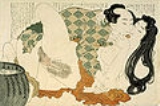
Shunga

Encyclopedia

Japanese language
is a language spoken by over 130 million people in Japan and in Japanese emigrant communities. It is a member of the Japonic language family, which has a number of proposed relationships with other languages, none of which has gained wide acceptance among historical linguists .Japanese is an...
term for erotic art
Erotic art
Erotic art covers any artistic work that is intended to evoke erotic arousal or that depicts scenes of love-making. It includes paintings, engravings, drawings, sculptures, photographs, music and writing.-Definition:...
. Most shunga are a type of ukiyo-e
Ukiyo-e
' is a genre of Japanese woodblock prints and paintings produced between the 17th and the 20th centuries, featuring motifs of landscapes, tales from history, the theatre, and pleasure quarters...
, usually executed in woodblock
Woodcut
Woodcut—occasionally known as xylography—is a relief printing artistic technique in printmaking in which an image is carved into the surface of a block of wood, with the printing parts remaining level with the surface while the non-printing parts are removed, typically with gouges...
print format. While rare, there are extant erotic painted handscrolls which predate the Ukiyo-e movement. Translated literally, the Japanese word shunga means picture of spring; "spring" is a common euphemism for sex.
The ukiyo-e movement as a whole sought to express an idealisation of contemporary urban life and appeal to the new chonin
Chonin
was a social class that emerged in Japan during the early years of the Tokugawa period. The majority of chōnin were merchants, but some were craftsmen, as well. Nōmin were not considered chōnin...
class. Following the aesthetics of everyday life, Edo period
Edo period
The , or , is a division of Japanese history which was ruled by the shoguns of the Tokugawa family, running from 1603 to 1868. The political entity of this period was the Tokugawa shogunate....
shunga varied widely in its depictions of sexuality. As a subset of ukiyo-e it was enjoyed by all social groups in the Edo period, despite being out of favour with the shogunate. Almost all ukiyo-e artists made shunga at some point in their careers, and it did not detract from their prestige as artists. Classifying shunga as a kind of medieval pornography
Pornography
Pornography or porn is the explicit portrayal of sexual subject matter for the purposes of sexual arousal and erotic satisfaction.Pornography may use any of a variety of media, ranging from books, magazines, postcards, photos, sculpture, drawing, painting, animation, sound recording, film, video,...
can be misleading in this respect.
History
Shunga has its origins in Ancient China. It is thought that shunga were initially inspired by illustrations in Chinese medicine manuals, a process which had its origins in the Muromachi era (1336 to 1573). Zhou Fang, the great T'ang DynastyTang Dynasty
The Tang Dynasty was an imperial dynasty of China preceded by the Sui Dynasty and followed by the Five Dynasties and Ten Kingdoms Period. It was founded by the Li family, who seized power during the decline and collapse of the Sui Empire...
Chinese erotic painter, is thought to also have been influential. He, like many erotic artists of his time and place, tended to exaggerate the size of the genital organs, a common shunga topos. While the literal meaning of the word, 'shunga,' is significant, it is in fact a contraction of, 'shunkyu-higi-ga' (春宮秘戯画), the Japanese pronunciation for Chinese sets of twelve scrolls depicting the twelve sexual acts that the crown prince
Crown Prince
A crown prince or crown princess is the heir or heiress apparent to the throne in a royal or imperial monarchy. The wife of a crown prince is also titled crown princess....
had to carry out as an expression of yin yang.
In Japan, Shunga goes back to the Heian period
Heian period
The is the last division of classical Japanese history, running from 794 to 1185. The period is named after the capital city of Heian-kyō, or modern Kyōto. It is the period in Japanese history when Buddhism, Taoism and other Chinese influences were at their height...
. At this point it was the reserve of the courtier
Courtier
A courtier is a person who is often in attendance at the court of a king or other royal personage. Historically the court was the centre of government as well as the residence of the monarch, and social and political life were often completely mixed together...
class. Through the medium of narrative handscrolls, sexual scandals from the imperial court or the monasteries were depicted, and the characters tended to be limited to courtier
Courtier
A courtier is a person who is often in attendance at the court of a king or other royal personage. Historically the court was the centre of government as well as the residence of the monarch, and social and political life were often completely mixed together...
s and monk
Monk
A monk is a person who practices religious asceticism, living either alone or with any number of monks, while always maintaining some degree of physical separation from those not sharing the same purpose...
s.
The style reached its apex in the Edo period
Edo period
The , or , is a division of Japanese history which was ruled by the shoguns of the Tokugawa family, running from 1603 to 1868. The political entity of this period was the Tokugawa shogunate....
(1603 to 1867). Thanks to woodblock printing
Woodblock printing
Woodblock printing is a technique for printing text, images or patterns used widely throughout East Asia and originating in China in antiquity as a method of printing on textiles and later paper....
techniques, the quantity and quality increased dramatically. There were repeated governmental attempts to suppress shunga, the first of which was an edict issued by the Tokugawa shogunate
Tokugawa shogunate
The Tokugawa shogunate, also known as the and the , was a feudal regime of Japan established by Tokugawa Ieyasu and ruled by the shoguns of the Tokugawa family. This period is known as the Edo period and gets its name from the capital city, Edo, which is now called Tokyo, after the name was...
in 1661 banning, among other things, erotic books known as . While other genres covered by the edict, such as works criticising daimyo
Daimyo
is a generic term referring to the powerful territorial lords in pre-modern Japan who ruled most of the country from their vast, hereditary land holdings...
or samurai
Samurai
is the term for the military nobility of pre-industrial Japan. According to translator William Scott Wilson: "In Chinese, the character 侍 was originally a verb meaning to wait upon or accompany a person in the upper ranks of society, and this is also true of the original term in Japanese, saburau...
, were driven underground by this edict, Shunga continued to be produced with little difficulty. The 1722 edict
Kyoho Reforms
The were an array of economic policies introduced by the Tokugawa Shogunate in 1736 Japan. These reforms were instigated by the eighth Tokugawa shogun of Japan, Tokugawa Yoshimune, encompassing the first twenty years of his shogunate....
was much more strict, banning the production of all new books unless the city commissioner gave permission, and after this edict Shunga went underground. However, since for several decades following this edict publisher's guild
Guild
A guild is an association of craftsmen in a particular trade. The earliest types of guild were formed as confraternities of workers. They were organized in a manner something between a trade union, a cartel, and a secret society...
s saw fit to send their members repeated reminders not to sell erotica
Erotica
Erotica are works of art, including literature, photography, film, sculpture and painting, that deal substantively with erotically stimulating or sexually arousing descriptions...
, it seems probable that production and sale continued to flourish. Further attempts to prevent the production of shunga were made with the Kansei Reforms
Kansei Reforms
The were a series of reactionary policy changes and edicts which were intended to cure a range of perceived problems which had developed in mid-18th century Tokugawa Japan....
in the 1790s.
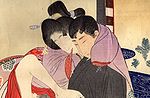
Meiji period
The , also known as the Meiji era, is a Japanese era which extended from September 1868 through July 1912. This period represents the first half of the Empire of Japan.- Meiji Restoration and the emperor :...
era (1868–1912), particularly the importation of photoreproduction techniques, had serious consequences for Shunga. For a time, woodblock printing
Woodblock printing
Woodblock printing is a technique for printing text, images or patterns used widely throughout East Asia and originating in China in antiquity as a method of printing on textiles and later paper....
continued to be used, but figures began to appear in prints wearing Western clothing and hairstyles. Eventually, Shunga could no longer compete with erotic photography, leading to its decline.
The art of shunga provided an inspiration for the Shōwa
Showa period
The , or Shōwa era, is the period of Japanese history corresponding to the reign of the Shōwa Emperor, Hirohito, from December 25, 1926 through January 7, 1989.The Shōwa period was longer than the reign of any previous Japanese emperor...
and Heisei
Heisei
is the current era name in Japan. The Heisei era started on 8 January 1989, the first day after the death of the reigning Emperor, Hirohito. His son, Akihito, succeeded to the throne...
, or modern, period art known in the Western world as hentai
Hentai
is a Japanese word that, in the West, is used when referring to sexually explicit or pornographic comics and animation, particularly those of Japanese origin such as anime, manga, and computer games. The word hentai is a kanji compound of 変 and 態...
, and known (formally) in Japan as 'jū hachi kin' (literally, "18-restricted", or adult-only) anime
Anime
is the Japanese abbreviated pronunciation of "animation". The definition sometimes changes depending on the context. In English-speaking countries, the term most commonly refers to Japanese animated cartoons....
and manga
Manga
Manga is the Japanese word for "comics" and consists of comics and print cartoons . In the West, the term "manga" has been appropriated to refer specifically to comics created in Japan, or by Japanese authors, in the Japanese language and conforming to the style developed in Japan in the late 19th...
. Like shunga, hentai is sexually explicit in its imagery.
Production
Shunga were produced between the sixteenth century and the nineteenth century by ukiyo-e artists, since they sold more easily and at a higher price than their ordinary work. Shunga prints were produced and sold either as single sheets or—more frequently—in book form, called enpon. These customarily contained twelve images, a tradition with its roots in Chinese shunkyu higa. Shunga was also produced in hand scroll format, called kakemono-e (掛け物絵). This format was also popular, though more expensive as the scrolls had to be individually painted.The quality of shunga art varies, and few ukiyo-e
Ukiyo-e
' is a genre of Japanese woodblock prints and paintings produced between the 17th and the 20th centuries, featuring motifs of landscapes, tales from history, the theatre, and pleasure quarters...
painters remained aloof from the genre. Experienced artists found it to their advantage to concentrate on their production. This led to the appearance of shunga by first-rate artists, such as the ukiyo-e painter perhaps best known in the Western world, Hokusai
Hokusai
was a Japanese artist, ukiyo-e painter and printmaker of the Edo period. He was influenced by such painters as Sesshu, and other styles of Chinese painting...
(see The Dream of the Fisherman's Wife
The Dream of the Fisherman's Wife
, also known as Girl Diver and Octopi, Diver and Two Octopi, etc., is an erotic woodcut of the ukiyo-e genre by the Japanese artist Hokusai. It is from the book Kinoe no Komatsu , a three-volume collection of shunga erotic prints first published in 1814, and is the most famous shunga Hokusai ever...
). Ukiyo-e artists owed a stable livelihood to such customs, and producing a piece of shunga for a high-ranking client could bring them sufficient funds to live on for about six months.
Full-colour printing, or nishiki-e
Nishiki-e
refers to Japanese multi-colored woodblock printing; this technique is used primarily in ukiyo-e. It was invented in the 1760s, and perfected and popularized by the printmaker Suzuki Harunobu, who produced a great many nishiki-e prints between 1765 and his death five years later.Previously, most...
, developed around 1765, but many shunga prints predate this. Prior to this, colour was added to monochrome prints by hand, and from 1744 benizuri-e
Benizuri-e
' are a type of “primitive” ukiyo-e style Japanese woodblock prints. They were usually printed in pink and green, occasionally with the addition of another color, either printed or added by hand. The production of benizuri-e reached its peak in the early 1740s...
allowed the production of prints of limited colours. Even after 1765 many shunga prints were produced using older methods. In some cases this was to keep the cost low, but in many cases this was a matter of taste.
Shunga produced in Edo
Edo
, also romanized as Yedo or Yeddo, is the former name of the Japanese capital Tokyo, and was the seat of power for the Tokugawa shogunate which ruled Japan from 1603 to 1868...
tended to be more richly coloured than those produced in Kyoto
Kyoto
is a city in the central part of the island of Honshū, Japan. It has a population close to 1.5 million. Formerly the imperial capital of Japan, it is now the capital of Kyoto Prefecture, as well as a major part of the Osaka-Kobe-Kyoto metropolitan area.-History:...
and Osaka
Osaka
is a city in the Kansai region of Japan's main island of Honshu, a designated city under the Local Autonomy Law, the capital city of Osaka Prefecture and also the biggest part of Keihanshin area, which is represented by three major cities of Japan, Kyoto, Osaka and Kobe...
, mainly owing to a difference in aesthetic taste between these regions—Edo has a taste for novelty and luxury, while the kamigata
Kamigata
Kamigata is a region of Japan referring to the cities of Kyoto and Osaka; the term is used particularly when discussing elements of Edo period urban culture such as ukiyo-e and kabuki, and when making a comparison to the urban culture of the Edo/Tokyo region.Kabuki, ukiyo-e, and many of the other...
region preferred a more muted, understated style. This also translates into a greater amount of background detail in Edo
Edo
, also romanized as Yedo or Yeddo, is the former name of the Japanese capital Tokyo, and was the seat of power for the Tokugawa shogunate which ruled Japan from 1603 to 1868...
Shunga.
After 1722 most artists refrained from signing shunga works. However, between 1761 and 1786 the implementation of printing regulations became more relaxed, and many artists took to concealing their name as a feature of the picture (such as calligraphy on a fan held by a courtesan) or allusions in the work itself (such as Utamaro
Utamaro
was a Japanese printmaker and painter, who is considered one of the greatest artists of woodblock prints . His name was romanized as Outamaro. He is known especially for his masterfully composed studies of women, known as bijinga...
's empon entitled, 'Utamakura.')
Content
Edo period shunga sought to express a varied world of contemporary sexual possibilities. Many writers on the subject refer to this as the creation of a 'pornotopia,' a world parallel to contemporary urban life, but idealised, eroticised and fantastical.Characters
By far the majority of shunga depict the sexual relations of the ordinary people, the chonin, the townsmen, women, merchant class, artisans and farmers. Occasionally there also appear DutchNetherlands
The Netherlands is a constituent country of the Kingdom of the Netherlands, located mainly in North-West Europe and with several islands in the Caribbean. Mainland Netherlands borders the North Sea to the north and west, Belgium to the south, and Germany to the east, and shares maritime borders...
or Portuguese
Portuguese people
The Portuguese are a nation and ethnic group native to the country of Portugal, in the west of the Iberian peninsula of south-west Europe. Their language is Portuguese, and Roman Catholicism is the predominant religion....
foreigners.
Courtesans also form the subject of many shunga. Utamaro
Utamaro
was a Japanese printmaker and painter, who is considered one of the greatest artists of woodblock prints . His name was romanized as Outamaro. He is known especially for his masterfully composed studies of women, known as bijinga...
was particularly revered for his depictions of courtesans, which offered an unmatched level of sensitivity and psychological nuance. Tokugawa courtesans could be described as the celebrities of their day, and Edo's pleasure district, Yoshiwara
Yoshiwara
Yoshiwara was a famous Akasen district in Edo, present-day Tōkyō, Japan.In the early 17th century, there was widespread male and female prostitution throughout the cities of Kyoto, Edo, and Osaka. To counter this, an order of Tokugawa Hidetada of the Tokugawa shogunate restricted prostitution to...
, is often compared to Hollywood. Men saw them as highly eroticised due to their profession, but at the same time unattainable, since only the wealthiest, most cultured men would have any chance of sexual relations with one. Women saw them as distant, glamorous idols, and the fashions for the whole of Japan were inspired by the fashions of the courtesan. For these reasons the fetish of the courtesan appealed to many.
Works depicting courtesans have since been criticised for painting an idealised picture of life in the pleasure quarters. It has been argued that they masked the situation of virtual slavery that sex workers lived under. However, Utamaro is just one example of an artist who was sensitive to the inner life of the courtesan, for example, showing them wistfully dreaming of escape from Yoshiwara through marriage.
Similarly, kabuki
Kabuki
is classical Japanese dance-drama. Kabuki theatre is known for the stylization of its drama and for the elaborate make-up worn by some of its performers.The individual kanji characters, from left to right, mean sing , dance , and skill...
actors are often depicted, many of whom worked as gigolos. These carried the same fetish of the sex worker, with the added quality of them often being quite young. They are often shown with samurai.
Stories

While most shunga were heterosexual, many depicted male-on-male trysts. Woman-on-woman
Lesbian
Lesbian is a term most widely used in the English language to describe sexual and romantic desire between females. The word may be used as a noun, to refer to women who identify themselves or who are characterized by others as having the primary attribute of female homosexuality, or as an...
was a rare feature but there are extant works depicting this. Masturbation
Masturbation
Masturbation refers to sexual stimulation of a person's own genitals, usually to the point of orgasm. The stimulation can be performed manually, by use of objects or tools, or by some combination of these methods. Masturbation is a common form of autoeroticism...
was also depicted. The perception of sexuality differed, of course, in Tokugawa Japan from that in the modern Western world
Western world
The Western world, also known as the West and the Occident , is a term referring to the countries of Western Europe , the countries of the Americas, as well all countries of Northern and Central Europe, Australia and New Zealand...
, and people were less likely to associate with one particular sexual preference. For this reason the many sexual pairings depicted were a matter of providing as much variety as possible.
The backstory to shunga prints can be found in accompanying text or dialogue in the picture itself, and in props in the background. Symbol
Symbol
A symbol is something which represents an idea, a physical entity or a process but is distinct from it. The purpose of a symbol is to communicate meaning. For example, a red octagon may be a symbol for "STOP". On a map, a picture of a tent might represent a campsite. Numerals are symbols for...
ism also featured widely, such as the use of plum
Plum
A plum or gage is a stone fruit tree in the genus Prunus, subgenus Prunus. The subgenus is distinguished from other subgenera in the shoots having a terminal bud and solitary side buds , the flowers in groups of one to five together on short stems, and the fruit having a groove running down one...
blossoms to represent virginity or tissues to symbolise impending ejaculation
Ejaculation
Ejaculation is the ejecting of semen from the male reproductory tract, and is usually accompanied by orgasm. It is usually the final stage and natural objective of male sexual stimulation, and an essential component of natural conception. In rare cases ejaculation occurs because of prostatic disease...
.
Clothing
In almost all shunga the characters are fully clothed. This is primarily because nudity was not inherently erotic in Tokugawa Japan – people were used to seeing the opposite sex naked in communal baths. It also served an artistic purpose; it helped the reader identify courtesans and foreigners, the prints often contained symbolic meaning, and it drew attention to the parts of the body that were revealed, i.e., the genitalia.Lack of realism
Shunga couples are often shown in unrealistic positions with exaggerated genitalia. Explanations for this include increased visibility of the sexually explicit content, artistic interest and psychological impact: that is, the genitalia is interpreted as a 'second face,' expressing the primal passions that the everyday face is obligated by giri to conceal, and is therefore the same size as the head and placed unnaturally close to it by the awkward position.Audience
Shunga was probably enjoyed by both men and women of all classes. Superstitions and customs surrounding shunga suggest as much; in the same way that it was considered a lucky charm against death for a samurai to carry shunga, it was considered a protection against fire in merchantMerchant
A merchant is a businessperson who trades in commodities that were produced by others, in order to earn a profit.Merchants can be one of two types:# A wholesale merchant operates in the chain between producer and retail merchant...
warehouses and the home. From this we can deduce that samurai, chonin, and housewives all owned shunga. All three of these groups would suffer separation from the opposite sex; the samurai lived in barracks for months at a time, and conjugal separation resulted from the sankin kotai
Sankin kotai
was a policy of the shogunate during most of the Edo period of Japanese history. The purpose was to control the daimyo. In adopting the policy, the shogunate was continuing and refining similar policies of Toyotomi Hideyoshi. In 1635, a law required sankin kōtai, which was already an established...
system and the merchants' need to travel to obtain and sell goods. It is therefore argued that this superstition was euphemistic, and ownership of shunga was not superstitious, but libidinous.
Records of women obtaining shunga themselves from booklenders show that they were consumers of it. Though not shunga, it was traditional to present a bride with ukiyo-e depicting scenes from the Tale of Genji. Shunga may have served as sexual guidance for the sons and daughters of wealthy families. This has been disputed since the instructional nature of shunga is limited by the impossible positions and lack of description of technique, and there were sexual manuals in circulation that offered clearer guidance, including advice on hygiene.
Shunga varied greatly in quality and price. Some of it was highly elaborate, commissioned by wealthy merchants and daimyo. Some of it was limited in colour, widely circulated, and cost little more than a bowl of noodles. Empon were available through the lending libraries, or kashi-honya, that travelled in rural areas. This tells us that shunga reached all classes of society—peasant, chonin, samurai and daimyo.
Noted Shunga artists
- Hishikawa MoronobuHishikawa Moronobuwas a Japanese painter and printmaker known for his advancement of the ukiyo-e woodcut style starting in the 1670s.-Early life and training:Moronobu was the son of a well-respected dyer and a gold and silver-thread embroiderer in the village of Hodamura, Awa Province, near Edo Bay. After moving to...
- Katsushika Hokusai
- Miyagawa IsshôMiyagawa IsshoMiyagawa Isshō was a Japanese painter in the ukiyo-e style, primarily depicting kabuki actors, geisha, sumo wrestlers, and other elements of everyday urban culture. He was a pupil of Miyagawa Chōshun , who, in turn, was influenced by the works of Hishikawa Moronobu...
- Yanagawa ShigenobuYanagawa Shigenobuwas a Japanese painter in the ukiyo-e style. He was active in Edo from the Bunka period onward. His Osaka period dated from 1822 to 1825. In Edo, he resided in Honjo Yanagawa-chō district. He was first the pupil, then son-in-law, and finally adopted son of the Edo master printmaker Katsushika...
- Kitagawa Utamaro
- Chobun Saeshi
- Tomioka Eisen
- Suzuki HarunobuSuzuki Harunobuwas a Japanese woodblock print artist, one of the most famous in the Ukiyo-e style. He was an innovator, the first to produce full-color prints in 1765, rendering obsolete the former modes of two- and three-color prints. Harunobu used many special techniques, and depicted a wide variety of...
See also
- Erotic artErotic artErotic art covers any artistic work that is intended to evoke erotic arousal or that depicts scenes of love-making. It includes paintings, engravings, drawings, sculptures, photographs, music and writing.-Definition:...
- HentaiHentaiis a Japanese word that, in the West, is used when referring to sexually explicit or pornographic comics and animation, particularly those of Japanese origin such as anime, manga, and computer games. The word hentai is a kanji compound of 変 and 態...
(jū hachi kin anime) - Ukiyo-eUkiyo-e' is a genre of Japanese woodblock prints and paintings produced between the 17th and the 20th centuries, featuring motifs of landscapes, tales from history, the theatre, and pleasure quarters...
- Homosexuality in JapanHomosexuality in JapanRecords of men who have sex with men in Japan date back to ancient times. Western scholars have identified these as evidence of homosexuality in Japan.There were few laws restricting sexual behavior in Japan before the early modern period...
- Pornography in JapanPornography in JapanPornography in Japan.-Before the 20th century:Shunga or pornographic wood-block pictures were printed with all imaginable situations. These often took the form of a book with sentences to describe verbal utterances of the partners, as well as to offer brief descriptions of a scene...