

Shukhov Tower

Encyclopedia

Broadcasting
Broadcasting is the distribution of audio and video content to a dispersed audience via any audio visual medium. Receiving parties may include the general public or a relatively large subset of thereof...
tower
Tower
A tower is a tall structure, usually taller than it is wide, often by a significant margin. Towers are distinguished from masts by their lack of guy-wires....
in Moscow
Moscow
Moscow is the capital, the most populous city, and the most populous federal subject of Russia. The city is a major political, economic, cultural, scientific, religious, financial, educational, and transportation centre of Russia and the continent...
designed by Vladimir Shukhov
Vladimir Shukhov
Vladimir Grigoryevich Shukhov , was a Russian engineer-polymath, scientist and architect renowned for his pioneering works on new methods of analysis for structural engineering that led to breakthroughs in industrial design of world's first hyperboloid structures, lattice shell structures, tensile...
. The 160-metre-high free-standing steel structure was built in the period 1920–1922, during the Russian Civil War
Russian Civil War
The Russian Civil War was a multi-party war that occurred within the former Russian Empire after the Russian provisional government collapsed to the Soviets, under the domination of the Bolshevik party. Soviet forces first assumed power in Petrograd The Russian Civil War (1917–1923) was a...
. It is a hyperboloid structure
Hyperboloid structure
Hyperboloid structures are architectural structures designed with hyperboloid geometry. Often these are tall structures such as towers where the hyperboloid geometry's structural strength is used to support an object high off the ground, but hyperboloid geometry is also often used for decorative...
(hyperbolic steel gridshell
Gridshell
A gridshell is a structure which derives its strength from its double curvature , but is constructed of a grid or lattice....
).
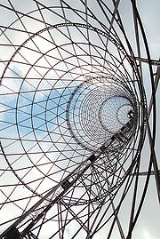
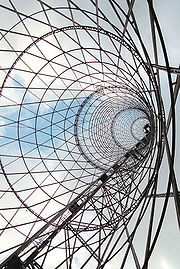
Due to its lattice structure
Structure
Structure is a fundamental, tangible or intangible notion referring to the recognition, observation, nature, and permanence of patterns and relationships of entities. This notion may itself be an object, such as a built structure, or an attribute, such as the structure of society...
, the steel shell of the Shukhov Tower experiences minimum wind
Wind
Wind is the flow of gases on a large scale. On Earth, wind consists of the bulk movement of air. In outer space, solar wind is the movement of gases or charged particles from the sun through space, while planetary wind is the outgassing of light chemical elements from a planet's atmosphere into space...
load (the main hazard for high-rising building
Building
In architecture, construction, engineering, real estate development and technology the word building may refer to one of the following:...
s). The tower sections are single-cavity hyperboloids of rotation made of straight beams, the ends of which rest against circular foundations.
The tower is located a few kilometres south of the Moscow Kremlin
Moscow Kremlin
The Moscow Kremlin , sometimes referred to as simply The Kremlin, is a historic fortified complex at the heart of Moscow, overlooking the Moskva River , Saint Basil's Cathedral and Red Square and the Alexander Garden...
, but is not accessible to tourists. The street address of the tower is "Shabolovskaya Street, 37", hence the tower's informal name "Shabolovka, 37".
See also
- Vladimir ShukhovVladimir ShukhovVladimir Grigoryevich Shukhov , was a Russian engineer-polymath, scientist and architect renowned for his pioneering works on new methods of analysis for structural engineering that led to breakthroughs in industrial design of world's first hyperboloid structures, lattice shell structures, tensile...
- Hyperboloid structureHyperboloid structureHyperboloid structures are architectural structures designed with hyperboloid geometry. Often these are tall structures such as towers where the hyperboloid geometry's structural strength is used to support an object high off the ground, but hyperboloid geometry is also often used for decorative...
- List of Hyperboloid structures
- Shukhov tower on the Oka RiverShukhov tower on the Oka RiverThe Shukhov Tower on the Oka River is the world’s only hyperboloid electricity pylon. It is located in Russia, in the western suburbs of Nizhny Novgorod, on the left bank of the Oka River near Dzerzhinsk...
- Constructivist architectureConstructivist architectureConstructivist architecture was a form of modern architecture that flourished in the Soviet Union in the 1920s and early 1930s. It combined advanced technology and engineering with an avowedly Communist social purpose. Although it was divided into several competing factions, the movement produced...
- List of towers
External links
- Shukhov Tower in Moscow - video
- The Shukhov's Radio Tower
- International campaign to save the Shukhov Tower in Moscow
- Shukhov Towers in Google Maps
- 3D model of the Shukhov Tower
- Views of the hyperboloid tower
- Richard Pare's photo of the Shukhov Tower
- Invention of Hyperboloid Structures
- Shukhov Tower Foundation