
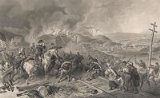
Sherman's March to the Sea is the name commonly given to the
Savannah Campaign conducted around Georgia from November 15, 1864 to December 21, 1864 by
Maj. Gen.In the United States Army, United States Marine Corps, and United States Air Force, major general is a two-star general-officer rank, with the pay grade of O-8. Major general ranks above brigadier general and below lieutenant general...
William Tecumseh ShermanWilliam Tecumseh Sherman was an American soldier, businessman, educator and author. He served as a General in the Union Army during the American Civil War , for which he received recognition for his outstanding command of military strategy as well as criticism for the harshness of the "scorched...
of the
Union ArmyThe Union Army was the land force that fought for the Union during the American Civil War. It was also known as the Federal Army, the U.S. Army, the Northern Army and the National Army...
in the
American Civil WarThe American Civil War was a civil war fought in the United States of America. In response to the election of Abraham Lincoln as President of the United States, 11 southern slave states declared their secession from the United States and formed the Confederate States of America ; the other 25...
. The campaign began with Sherman's troops leaving the
capturedThe Battle of Atlanta was a battle of the Atlanta Campaign fought during the American Civil War on July 22, 1864, just southeast of Atlanta, Georgia. Continuing their summer campaign to seize the important rail and supply center of Atlanta, Union forces commanded by William T. Sherman overwhelmed...
city of
Atlanta, GeorgiaAtlanta is the capital and most populous city in the U.S. state of Georgia. According to the 2010 census, Atlanta's population is 420,003. Atlanta is the cultural and economic center of the Atlanta metropolitan area, which is home to 5,268,860 people and is the ninth largest metropolitan area in...
, on November 16 and ended with the capture of the port of
SavannahSavannah is the largest city and the county seat of Chatham County, in the U.S. state of Georgia. Established in 1733, the city of Savannah was the colonial capital of the Province of Georgia and later the first state capital of Georgia. Today Savannah is an industrial center and an important...
on December 21. It inflicted significant damage, particularly to industry and infrastructure (per the doctrine of
total warTotal war is a war in which a belligerent engages in the complete mobilization of fully available resources and population.In the mid-19th century, "total war" was identified by scholars as a separate class of warfare...
), and also to civilian property. Military historian
David J. EicherDavid John Eicher is an American editor, writer, and popularizer of astronomy and space. He has been editor-in-chief of Astronomy magazine since 2002...
wrote that Sherman "defied military principles by operating deep within enemy territory and without lines of supply or communication. He destroyed much of the South's physical and psychological capacity to wage war."
Background and orders for the March
Sherman's March to the Sea followed his successful
Atlanta CampaignThe Atlanta Campaign was a series of battles fought in the Western Theater of the American Civil War throughout northwest Georgia and the area around Atlanta during the summer of 1864. Union Maj. Gen. William T. Sherman invaded Georgia from the vicinity of Chattanooga, Tennessee, beginning in May...
of May to September 1864. He and the U.S. Army commander,
Lt. Gen.In the United States Army, the United States Air Force and the United States Marine Corps, lieutenant general is a three-star general officer rank, with the pay grade of O-9. Lieutenant general ranks above major general and below general...
Ulysses S. GrantUlysses S. Grant was the 18th President of the United States as well as military commander during the Civil War and post-war Reconstruction periods. Under Grant's command, the Union Army defeated the Confederate military and ended the Confederate States of America...
, believed that the Civil War would end only if the
ConfederacyThe Confederate States of America was a government set up from 1861 to 1865 by 11 Southern slave states of the United States of America that had declared their secession from the U.S...
's strategic, economic, and psychological capacity for warfare were decisively broken. Sherman therefore applied the principles of
scorched earthA scorched earth policy is a military strategy or operational method which involves destroying anything that might be useful to the enemy while advancing through or withdrawing from an area...
: he ordered his troops to burn crops, kill livestock and consume supplies. Finally he destroyed civilian infrastructure along his path of advance. This policy is often considered a component strategy of
total warTotal war is a war in which a belligerent engages in the complete mobilization of fully available resources and population.In the mid-19th century, "total war" was identified by scholars as a separate class of warfare...
. The recent
re-electionIn the United States Presidential election of 1864, Abraham Lincoln was re-elected as president. The election was held during the Civil War. Lincoln ran under the National Union ticket against Democratic candidate George B. McClellan, his former top general. McClellan ran as the "peace candidate",...
of
PresidentThe President of the United States of America is the head of state and head of government of the United States. The president leads the executive branch of the federal government and is the commander-in-chief of the United States Armed Forces....
Abraham LincolnAbraham Lincoln was the 16th President of the United States, serving from March 1861 until his assassination in April 1865. He successfully led his country through a great constitutional, military and moral crisis – the American Civil War – preserving the Union, while ending slavery, and...
ensured that short-term political pressure would not be applied to restrain these tactics.
The second objective of the campaign was more traditional. Grant's armies in Virginia continued to be in a stalemate against
Robert E. LeeRobert Edward Lee was a career military officer who is best known for having commanded the Confederate Army of Northern Virginia in the American Civil War....
's army, besieged in
Petersburg, VirginiaThe Richmond–Petersburg Campaign was a series of battles around Petersburg, Virginia, fought from June 9, 1864, to March 25, 1865, during the American Civil War...
. By moving in Lee's rear, performing a massive
turning movementIn military tactics, a turning movement involves an attacker's forces reaching the rear of a defender's forces, separating the defender from their principal defensive positions and placing them in a pocket...
against him, Sherman could possibly increase pressure on Lee, allowing Grant the opportunity to break through, or at least keep Southern reinforcements away from Virginia.
The campaign was designed to be similar to Grant's innovative and successful
Vicksburg CampaignThe Vicksburg Campaign was a series of maneuvers and battles in the Western Theater of the American Civil War directed against Vicksburg, Mississippi, a fortress city that dominated the last Confederate-controlled section of the Mississippi River. The Union Army of the Tennessee under Maj. Gen....
, in that Sherman's armies would reduce their need for traditional supply lines by "living off the land" after their 20 days of rations were consumed. Foragers, known as "
bummersBummers was a nickname applied to foragers of Maj. Gen. William Tecumseh Sherman's Union army during its March to the Sea and north through North Carolina and South Carolina during the American Civil War...
," would provide food seized from local farms for the Army while they destroyed the railroads and the manufacturing and agricultural infrastructure of the state. In planning for the march, Sherman used livestock and crop production data from the 1860 census to lead his troops through areas where he believed they would be able to forage most effectively. Cotton gins and storage bins were to be destroyed because Southerners used the cotton to trade for guns and other supplies. The twisted and broken railroad rails that the troops heated over fires and wrapped around tree trunks and left behind became known as "
Sherman's necktiesSherman's neckties were a phenomenon of the American Civil War. Named after Maj. Gen. William Tecumseh Sherman of the Union Army, Sherman's neckties were railway rails destroyed by heating them until they were malleable and twisting them into loops resembling neckties, often around trees...
." Since the army would be out of touch with the North throughout the campaign, Sherman gave explicit orders,
Sherman's Special Field Orders, No. 120Sherman's Special Field Orders, No. 120 were military orders issued during the American Civil War, on November 9, 1864, by Major General William Tecumseh Sherman of the Union Army. He issued these orders in preparation for his famous March to the Sea, also known as the Savannah Campaign.-Orders:...
, regarding the conduct of the campaign. The following is an excerpt from the orders:
Opposing forces
Sherman, commanding the
Military Division of the MississippiThe Military Division of the Mississippi was an administrative division of the United States Army during the American Civil War that controlled all military operations in the Western Theater.-History:...
, did not employ his entire army group in the campaign. Confederate Lt. Gen.
John Bell HoodJohn Bell Hood was a Confederate general during the American Civil War. Hood had a reputation for bravery and aggressiveness that sometimes bordered on recklessness...
was threatening Sherman's supply line from
ChattanoogaChattanooga is the fourth-largest city in the US state of Tennessee , with a population of 169,887. It is the seat of Hamilton County...
, and Sherman detached two armies under Maj. Gen. George H. Thomas to deal with Hood in the
Franklin-Nashville CampaignThe Franklin-Nashville Campaign, also known as Hood's Tennessee Campaign, was a series of battles in the Western Theater, conducted from September 18 to December 27, 1864, in Alabama, Tennessee, and northwestern Georgia during the American Civil War. The Confederate Army of Tennessee under Lt....
. For the Savannah Campaign, Sherman's remaining force of 62,000 men (55,000 infantry, 5,000 cavalry, and 2,000 artillerymen manning 64 guns) was divided into two columns for the march:
- The right wing was the Army of the Tennessee
The Army of the Tennessee was a Union army in the Western Theater of the American Civil War, named for the Tennessee River. It should not be confused with the similarly named Army of Tennessee, a Confederate army named after the State of Tennessee....
, commanded by Maj. Gen. Oliver O. HowardOliver Otis Howard was a career United States Army officer and a Union general in the American Civil War...
, consisting of two corps:
- XV Corps, commanded by Maj. Gen. Peter J. Osterhaus
Peter Joseph Osterhaus was Union Army General in the American Civil War and later served as a diplomat.-Early life:Osterhaus was born in Koblenz, Rhenish Prussia. He attended the Berlin Military Academy and after serving for some time as a Prussian Army officer, he emigrated to the United States...
, with the divisions of Brig. Gens. Charles R. WoodsCharles Robert Woods was a career United States Army officer and a Union general during the American Civil War...
, William B. Hazen, John E. SmithJohn Eugene Smith was a Swiss immigrant to the United States, who served as a Union general during the American Civil War.-Early life:Smith was born in Berne, Switzerland in 1816. His father had served under Napoleon Bonaparte and emigrated with his family to Philadelphia, Pennsylvania after the...
, and John M. CorseJohn Murray Corse was an American politician and soldier who served as a general in the Union Army in the American Civil War.-Early life and career:...
.
- XVII Corps, commanded by Maj. Gen. Frank Blair, Jr.
Francis Preston Blair, Jr. was an American politician and Union Army general during the American Civil War. He represented Missouri in both the House of Representatives and the Senate, and he was the Democratic Party's nominee for Vice President in 1868.-Early life and career:Blair was born in...
, with the divisions of Maj. Gen. Joseph A. MowerJoseph Anthony Mower was a Union general during the American Civil War. He was a competent officer and well respected by his troops and fellow officers to whom he was known as "Fighting Joe". William T. Sherman said of Mower, "he's the boldest young officer we have".-Biography:Mower was born in...
and Brig. Gens. Mortimer D. Leggett and Giles A. SmithGiles Alexander Smith , was a general in the Union Army during the American Civil War.-Biography:...
.
- The left wing was the Army of Georgia
The Army of Georgia was a Union army that constituted the Left Wing of Major General William T. Sherman's Army Group during the March to the Sea and the Carolinas Campaign.-History:...
, commanded by Maj. Gen. Henry W. Slocum, also with two corps:
- XIV Corps, commanded by Brig. Gen. Jefferson C. Davis
Jefferson Columbus Davis was an officer in the United States Army who served in the Mexican-American War, the Civil War, and the Modoc War. He was the first commander of the Department of Alaska, from 1868 to 1870...
, with the divisions of Brig. Gens. William P. CarlinWilliam Passmore Carlin was a career soldier from the state of Illinois who served as a general in the Union Army during the American Civil War and then in the postbellum United States Army...
, James D. MorganJames Dada Morgan was a merchant sailor, soldier, businessman, and a Union general during the American Civil War. He commanded a division of infantry in some of the final campaigns in the Western Theater....
, and Absalom BairdAbsalom Baird was a career United States Army officer who distinguished himself as a Union Army general in the American Civil War. Baird received the Congressional Medal of Honor for his military actions-Early life:...
.
- XX Corps, commanded by Brig. Gen. Alpheus S. Williams
Alpheus Starkey Williams was a lawyer, judge, journalist, U.S. Congressman, and a Union general in the American Civil War.-Early life:...
, with the divisions of Brig. Gens. Nathaniel J. JacksonNathaniel James Jackson was an American machinist and soldier. He served as a general in the Union Army during the American Civil War, in which he was wounded three times. After the war Jackson operated a mine....
, John W. GearyJohn White Geary was an American lawyer, politician, Freemason, and a Union general in the American Civil War...
, and William T. Ward.
- A cavalry division under Brig. Gen. Judson Kilpatrick operated in support of the two wings.
The Confederate opposition from Lt. Gen.
William J. HardeeWilliam Joseph Hardee was a career U.S. Army officer, serving during the Second Seminole War and fighting in the Mexican-American War...
's Department of South Carolina, Georgia, and Florida was meager. Hood had taken the bulk of forces in Georgia on his campaign to Tennessee. There were about 13,000 men remaining at
Lovejoy's StationLovejoy is a city in Clayton County, Georgia, United States. As of the 2000 census, the city had a total population of 2,495. During the American Civil War, it was named Lovejoy's Station, and was the site of the Battle of Lovejoy's Station during the Atlanta Campaign of 1864.During the 2000s,...
, south of Atlanta. Maj. Gen.
Gustavus W. SmithGustavus Woodson Smith , more commonly known as G.W. Smith, was a career United States Army officer who fought in the Mexican-American War, a civil engineer, and a major general in the Confederate States Army during the American Civil War.-Early life and Mexico:Smith was born in Georgetown,...
's Georgia militia had about 3,050 soldiers, most of them boys and elderly men, this was because a lot of troops left thinking Sherman's army would follow. The Cavalry Corps of Maj. Gen.
Joseph WheelerJoseph Wheeler was an American military commander and politician. He has the rare distinction of serving as a general during war time for two opposing forces: first as a noted cavalry general in the Confederate States Army in the 1860s during the American Civil War, and later as a general in the...
, reinforced by a brigade under Brig. Gen.
William H. JacksonWilliam Hicks "Red" Jackson was a cotton planter, horse breeder, and general in the Confederate States Army during the American Civil War.-Early life and career:...
, had approximately 10,000 troopers. During the campaign, the
Confederate War DepartmentThe Confederate States Secretary of War was a member of the Confederate States President's Cabinet during the Civil War. The Secretary of War led the Confederate States Department of War. The position ended in May 1865 when the Confederacy crumbled during John C. Breckinridge's tenure of the...
brought in additional men from Florida and the Carolinas, but they never were able to increase their effective force beyond 13,000.
March
Both President Lincoln and General Grant had serious reservations about Sherman's plans. Still, Grant trusted Sherman's assessment and on November 2, 1864, he sent Sherman a telegram stating simply, "Go as you propose." The 300 miles (482.8 km) march began on November 15. Sherman recounted in his memoirs the scene when he left at 7 a.m. the following day:
Sherman's personal escort on the march was the
1st Alabama Cavalry RegimentThe 1st Alabama Cavalry Regiment was a cavalry regiment recruited from Southern Unionists that served in the Union Army during the American Civil War.-Service:...
, a unit made up entirely of Southerners who remained loyal to the Union.
The two wings of the army attempted to confuse and deceive the enemy about their destinations; the Confederates could not tell from the initial movements whether Sherman would march on
MaconMacon is a city located in central Georgia, US. Founded at the fall line of the Ocmulgee River, it is part of the Macon metropolitan area, and the county seat of Bibb County. A small portion of the city extends into Jones County. Macon is the biggest city in central Georgia...
,
AugustaAugusta is a consolidated city in the U.S. state of Georgia, located along the Savannah River. As of the 2010 census, the Augusta–Richmond County population was 195,844 not counting the unconsolidated cities of Hephzibah and Blythe.Augusta is the principal city of the Augusta-Richmond County...
, or Savannah. Howard's wing, led by Kilpatrick's cavalry, marched south along the railroad to Lovejoy's Station, which caused the defenders there to conduct a fighting retreat to Macon. The cavalry captured two Confederate guns at Lovejoy's Station, and then two more and 50 prisoners at
Bear Creek StationHampton is a city in southwestern Henry County, Georgia, United States. As of the 2010 census, the city had a population of 6,987. Census Estimates for 2005 show a population of 4,743. Hampton mailing addresses also dip into eastern Clayton County and northern Spalding County.The Atlanta Motor...
. Howard's infantry marched through
JonesboroJonesboro is a city in Clayton County, Georgia, United States. The population was 4,724 as of the 2010 census. The city is the county seat of Clayton County....
to Gordon, southwest of the state capital,
MilledgevilleMilledgeville is a city in and the county seat of Baldwin County in the U.S. state of Georgia. It is northeast of Macon, located just before Eatonton on the way to Athens along U.S. Highway 441, and it is located on the Oconee River. The relatively rapid current of the Oconee here made this an...
. Slocum's wing, accompanied by Sherman, moved to the east, in the direction of Augusta. They destroyed the bridge across the
Oconee RiverThe Oconee River is a river which has its origin in Hall County, Georgia, and terminates where it joins the Ocmulgee River to form the Altamaha River near Lumber City at the borders of Montgomery County, Wheeler County, and Jeff Davis County. South of Athens, two forks, known as the North Oconee...
and then turned south.
The state legislature called for Georgians to "Die freemen rather than live [as] slaves" and fled the capital. Hardee arrived from his headquarters at Savannah and realized that that city, not Macon, was Sherman's target. He ordered the Confederate cavalry under
WheelerJoseph Wheeler was an American military commander and politician. He has the rare distinction of serving as a general during war time for two opposing forces: first as a noted cavalry general in the Confederate States Army in the 1860s during the American Civil War, and later as a general in the...
to harass the Federal rear and flanks while the militiamen under Smith hurried eastward to protect the seaport city. On November 23, Sherman's staff held a mock legislative session in the state capitol, jokingly voting Georgia back into the Union and playing cards.
The first real resistance was felt by Howard's right wing at the
Battle of GriswoldvilleThe Battle of Griswoldville was the first battle of Sherman's March to the Sea, fought November 22, 1864, during the American Civil War. A Union Army brigade under Brig. Gen. Charles C. Walcutt fought three brigades of Georgia militia under Brig. Gen. Pleasant J...
on November 22. Wheeler's cavalry struck Kilpatrick's, killing three and capturing 18. The infantry brigade of Brig. Gen.
Charles C. WalcuttCharles Carroll Walcutt was an American surveyor, soldier, and politician. He served as a general in the Union Army during the American Civil War, in which he was wounded twice....
arrived to stabilize the defense, and the division of Georgia militia launched several hours of badly coordinated attacks, eventually retreating with about 1,100 casualties (of which about 600 were prisoners), versus the Union's 100.
Several small actions followed. Wheeler and some infantry struck in a rearguard action at Ball's Ferry on November 24 and November 25. While Howard's wing was delayed near Ball's Bluff, the 1st Alabama Cavalry (a Federal regiment) engaged Confederate pickets. Overnight, Union engineers constructed a bridge 2 miles (3.2 km) away from the bluff across the
Oconee RiverThe Oconee River is a river which has its origin in Hall County, Georgia, and terminates where it joins the Ocmulgee River to form the Altamaha River near Lumber City at the borders of Montgomery County, Wheeler County, and Jeff Davis County. South of Athens, two forks, known as the North Oconee...
, and 200 soldiers crossed to
flankIn military tactics, a flanking maneuver, also called a flank attack, is an attack on the sides of an opposing force. If a flanking maneuver succeeds, the opposing force would be surrounded from two or more directions, which significantly reduces the maneuverability of the outflanked force and its...
the Confederate position. On November 25–26 at Sandersville, Wheeler struck at Slocum's advance guard. Kilpatrick was ordered to make a feint toward Augusta before destroying the railroad bridge at Brier Creek and moving to liberate the Camp Lawton
prisoner of warA prisoner of war or enemy prisoner of war is a person, whether civilian or combatant, who is held in custody by an enemy power during or immediately after an armed conflict...
camp at
MillenMillen is a city in Jenkins County, Georgia, United States. The population was 3,492 at the 2000 census, a decline of 8.3% since 1990, during a decade in which the state's population grew by 26.4%.The city, centered near the intersection of U.S...
. Kilpatrick slipped by the defensive line that Wheeler had placed near Brier Creek, but on the night of November 26 Wheeler attacked and drove the 8th Indiana and 2nd Kentucky Cavalry away from their camps at Sylvan Grove. Kilpatrick abandoned his plans to destroy the railroad bridge and he also learned that the prisoners had been moved from Camp Lawton, so he rejoined the army at
LouisvilleLouisville is a city in Jefferson County, Georgia, United States. It is the former capital of Georgia and is the county seat of Jefferson County. It is located southwest of Augusta on the Ogeechee River, and its population was 2,712 at the 2000 census. The local pronunciation is the Americanized...
. At the
Battle of Buck Head CreekThe Battle of Buck Head Creek was the second battle of Sherman's March to the Sea, fought November 28, 1864, during the American Civil War. Union Army cavalry under Brig. Gen. Judson Kilpatrick repulsed an attack by the small Confederate cavalry corps under Maj. Gen...
on November 28, Kilpatrick was surprised and nearly captured, but the
5th Ohio CavalryThe 5th Regiment, Ohio Cavalry was a regiment of Union cavalry raised in seven counties in southwestern Ohio for service during the American Civil War. It primarily served in the Western Theater in several major campaigns of the Army of the Tennessee....
halted Wheeler's advance, and Wheeler was later stopped decisively by Union barricades at Reynolds's Plantation. On December 4, Kilpatrick's cavalry routed Wheeler's at the Battle of Waynesboro.
More Union troops entered the campaign from an unlikely direction. Maj. Gen.
John G. FosterJohn Gray Foster was a career military officer in the United States Army and a Union general during the American Civil War whose most distinguished services were in North and South Carolina. A postbellum expert in underwater demolition, he wrote the definitive treatise on the subject.-Early...
dispatched 5,500 men and 10 guns under Brig. Gen. John P. Hatch from Hilton Head, hoping to assist Sherman's arrival near Savannah by securing the
Charleston and Savannah RailroadThe Charleston and Savannah Railway was a 19th-century American railroad serving the coastal states of South Carolina and Georgia and running through part of the South Carolina Lowcountry....
. At the
Battle of Honey Hill-References:** * Eicher, David J., The Longest Night: A Military History of the Civil War, Simon & Schuster, 2001, ISBN 0-684-84944-5.* The Union Army; A History of Military Affairs in the Loyal States, 1861–65 — Records of the Regiments in the Union Army — Cyclopedia of Battles...
on November 30, Hatch fought a vigorous battle against G.W. Smith's 1,500 Georgia militiamen, 3 miles (4.8 km) south of Grahamville Station, South Carolina. Smith's militia fought off the Union attacks, and Hatch withdrew after suffering about 650 casualties, versus Smith's 50.
Sherman's armies reached the outskirts of Savannah on December 10 but found that
HardeeWilliam Joseph Hardee was a career U.S. Army officer, serving during the Second Seminole War and fighting in the Mexican-American War...
had entrenched 10,000 men in good positions, and his soldiers had flooded the surrounding rice fields, leaving only narrow causeways available to approach the city. Sherman was blocked from linking up with the U.S. Navy as he had planned, so he dispatched cavalry to Fort McAllister, guarding the
Ogeechee RiverOgeechee River is a river in the U.S. state of Georgia. It heads at the confluence of its North and South Forks, about south-southwest of Crawfordville and flowing generally southeast to Ossabaw Sound about south of Savannah. Its largest tributary is the Canoochee River...
, in hopes of unblocking his route and obtaining supplies awaiting him on the Navy ships. On December 13, William B. Hazen's division of Howard's army stormed the fort in the Battle of Fort McAllister and captured it within 15 minutes. Some of the 134 Union casualties were caused by torpedoes, a name for crude
land mineA land mine is usually a weight-triggered explosive device which is intended to damage a target—either human or inanimate—by means of a blast and/or fragment impact....
s that were used only rarely in the war.
Now that Sherman had connected to the Navy fleet under Rear Admiral
John A. DahlgrenJohn Adolphus Bernard Dahlgren was a United States Navy leader. He headed the Union Navy's ordnance department during the American Civil War and designed several different kinds of guns and cannons that were considered part of the reason the Union won the war...
, he was able to obtain the supplies and siege artillery he required to
investInvestment is the military tactic of surrounding an enemy fort with armed forces to prevent entry or escape.A circumvallation is a line of fortifications, built by the attackers around the besieged fortification facing towards the enemy fort...
Savannah. On December 17, he sent a message to Hardee in the city:
Hardee decided not to surrender but to escape. On December 20, he led his men across the
Savannah RiverThe Savannah River is a major river in the southeastern United States, forming most of the border between the states of South Carolina and Georgia. Two tributaries of the Savannah, the Tugaloo River and the Chattooga River, form the northernmost part of the border...
on a pontoon bridge hastily constructed of rice flats. The next morning, Savannah Mayor R. D. Arnold rode out to formally surrender, in exchange for General Geary's promise to protect the city's citizens and their property. Sherman's men, led by Geary's division of the XX Corps, occupied the city the same day.
Aftermath
Sherman telegraphed to President Lincoln, "I beg to present you as a
ChristmasChristmas or Christmas Day is an annual holiday generally celebrated on December 25 by billions of people around the world. It is a Christian feast that commemorates the birth of Jesus Christ, liturgically closing the Advent season and initiating the season of Christmastide, which lasts twelve days...
gift the City of Savannah, with one hundred and fifty guns and plenty of ammunition, also about twenty-five thousand bales of cotton." On December 26, the president replied in a letter:
From Savannah, Sherman marched north in the spring through the
CarolinasThe Carolinas Campaign was the final campaign in the Western Theater of the American Civil War. In January 1865, Union Maj. Gen. William Tecumseh Sherman advanced north from Savannah, Georgia, through the Carolinas, with the intention of linking up with Union forces in Virginia. The defeat of ...
, intending to complete his turning movement and combine his armies with Grant's against Robert E. Lee. After a successful two-month campaign, Sherman accepted the surrender of General
Joseph E. JohnstonJoseph Eggleston Johnston was a career U.S. Army officer, serving with distinction in the Mexican-American War and Seminole Wars, and was also one of the most senior general officers in the Confederate States Army during the American Civil War...
and his forces in
North CarolinaNorth Carolina is a state located in the southeastern United States. The state borders South Carolina and Georgia to the south, Tennessee to the west and Virginia to the north. North Carolina contains 100 counties. Its capital is Raleigh, and its largest city is Charlotte...
on April 26, 1865.
Sherman's scorched earth policies have always been highly controversial, and Sherman's memory has long been reviled by many
SouthernersThe Southern United States—commonly referred to as the American South, Dixie, or simply the South—constitutes a large distinctive area in the southeastern and south-central United States...
. Slaves' opinions varied concerning the actions of Sherman and his army. Those slaves who welcomed him as a liberator left their plantations to follow his armies. Jacqueline Campbell has written, on the other hand, that some slaves looked upon the Federal army's ransacking and invasive actions with disdain. They felt betrayed, as they "suffered along with their owners." These particular slaves often remained loyal to the Southern way of life, and continued to care for the land and families to which they were tied. As for the fate of those slaves who chose to flee their plantations and follow Sherman's army, a Confederate officer estimated that 10,000 followed, and hundreds died of "hunger, disease, or exposure" along the way.
The March to the Sea was devastating to Georgia and the Confederacy. Sherman himself estimated that the campaign had inflicted $100 million (about $1.378 billion in 2010 dollars) in destruction, about one fifth of which "inured to our advantage" while the "remainder is simple waste and destruction." The Army wrecked 300 miles (482.8 km) of railroad and numerous bridges and miles of telegraph lines. It seized 5,000 horses, 4,000 mules, and 13,000 head of cattle. It confiscated 9.5 million pounds of corn and 10.5 million pounds of fodder, and destroyed uncounted cotton gins and mills. Military historians Herman Hattaway and Archer Jones cited the significant damage wrought to railroads and Southern logistics in the campaign and stated that "Sherman's raid succeeded in 'knocking the Confederate war effort to pieces'." David J. Eicher wrote that "Sherman had accomplished an amazing task. He had defied military principles by operating deep within enemy territory and without lines of supply or communication. He destroyed much of the South's potential and psychology to wage war."
Song
The soldiers sang many songs during the March, but it is one written afterward that has come to symbolize the campaign:
Marching Through Georgia"Marching Through Georgia" is a marching song written by Henry Clay Work at the end of the American Civil War in 1865. It refers to U.S. Maj. Gen...
, written by
Henry Clay WorkHenry Clay Work was an American composer and songwriter.-Biography:He was born in Middletown, Connecticut, to Alanson and Amelia Work. His father opposed slavery, and Work was himself an active abolitionist and Union supporter...
in 1865. Sherman despised the song, in part because he was never one to rejoice over a fallen foe, and in part because it was played at almost every public appearance that he attended, but it was widely popular with soldiers of wars in the 20th century. The song underrates the strength of Sherman's army by 20% in the line "Sing it as we used to sing it, 50,000 strong."
See also
- Sherman's Special Field Orders, No. 15
Special Field Orders, No. 15 were military orders issued during the American Civil War, on January 16, 1865, by General William Tecumseh Sherman, commander of the Military Division of the Mississippi of the United States Army...
- Sherman's Special Field Orders, No. 120
Sherman's Special Field Orders, No. 120 were military orders issued during the American Civil War, on November 9, 1864, by Major General William Tecumseh Sherman of the Union Army. He issued these orders in preparation for his famous March to the Sea, also known as the Savannah Campaign.-Orders:...
- Western Theater of the American Civil War
This article presents an overview of major military and naval operations in the Western Theater of the American Civil War.-Theater of operations:...
- Collective punishment
Collective punishment is the punishment of a group of people as a result of the behavior of one or more other individuals or groups. The punished group may often have no direct association with the other individuals or groups, or direct control over their actions...
- Sherman's March
Sherman's March is a 2007 American Civil War television documentary first aired on the History Channel. The film is directed by Rick King and the executive producer is Jason Williams...
(2007 documentary).
- The March
The March is a 2005 historical fiction novel by E. L. Doctorow. It won the PEN/Faulkner Award for Fiction and the National Book Critics Circle Award/Fiction .-Plot summary:...
(2005 historical novel by E. L. DoctorowEdgar Lawrence Doctorow is an American author.- Biography :Edgar Lawrence Doctorow was born in the Bronx, New York City, the son of second-generation Americans of Russian Jewish descent...
)
Further reading
- Glatthaar, Joseph T. The March to the Sea and Beyond: Sherman's Troops in the Savannah and Carolinas Campaigns. New York: New York University Press, 1985. ISBN 0-8147-3001-9.
- Miles, Jim. To the Sea: A History and Tour Guide of the War in the West, Sherman's March across Georgia and through the Carolinas, 1864–1865. Nashville, TN: Cumberland House, 2002. ISBN 1-58182-261-8.
- Smith, Derek. Civil War Savannah. Savannah, Ga: Frederic C. Beil, 1997. ISBN 0-913720-93-3.
External links
- National Park Service battle descriptions for the Savannah Campaign
- Harper's History: March to the sea
- New Georgia Encyclopedia article on the March
- Clark, Frank Oliver, Article on Sherman's March to the Sea
- Photographic views of Sherman's campaign, from negatives taken in the field, by Geo. N. Barnard, official photographer of the military div. of the Mississippi. Published/Created: New York, Press of Wynkoop & Hallenbeck, 1866. (searchable facsimile at the University of Georgia Libraries; DjVu
DjVu is a computer file format designed primarily to store scanned documents, especially those containing a combination of text, line drawings, and photographs. It uses technologies such as image layer separation of text and background/images, progressive loading, arithmetic coding, and lossy...
& layered PDF format)
- Sheet music for "Sherman's March to the Sea" from Project Gutenberg
Project Gutenberg is a volunteer effort to digitize and archive cultural works, to "encourage the creation and distribution of eBooks". Founded in 1971 by Michael S. Hart, it is the oldest digital library. Most of the items in its collection are the full texts of public domain books...