


Shepard Fairey

Encyclopedia
Frank Shepard Fairey is an American contemporary graphic designer
, and illustrator
who emerged from the skateboarding
scene. He first became known for his "André the Giant Has a Posse
" (…OBEY…) sticker campaign, in which he appropriated images from the comedic supermarket tabloid Weekly World News
. His work became more widely known in the 2008 U.S. presidential election
, specifically his Barack Obama "Hope" poster
. The Institute of Contemporary Art, Boston calls him one of today's best known and most influential street art
ists. His work is included in the collections at The Smithsonian, the Los Angeles County Museum of Art
, the Museum of Modern Art
in New York, the Museum of Contemporary Art San Diego
, the National Portrait Gallery
in Washington, and the Victoria and Albert Museum
in London.
. His father, Strait Fairey, is a doctor, and his mother, Charlotte, a realtor. Fairey became involved with art in 1984, when he started to place his drawings on skateboards and T-shirts.
with a Bachelor of Fine Arts
in Illustration.
Fairey sits on the advisory board of Reaching to Embrace the Arts, a not-for-profit organization that provides art supplies to disadvantaged schools and students. In May 2006, Fairey became a board member of the Music Is Revolution Foundation, a not-for-profit organization that supports music education for students in public schools. Fairey resides in Los Angeles
with his wife Amanda and daughters Vivienne and Madeline.
Fairey created the "André the Giant Has a Posse
" sticker campaign in 1989, while attending the Rhode Island School of Design
(RISD). This later evolved into the "Obey Giant" campaign, which has grown via an international network of collaborators replicating Fairey's original designs. As with most street artists, the Obey Giant was intended to inspire curiosity and cause the masses to question their relationship with their surroundings.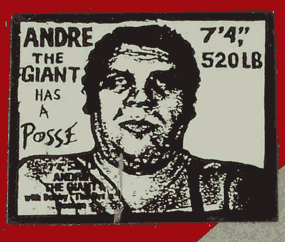 The Obey Giant website says: "The sticker has no meaning but exists only to cause people to react, to contemplate and search for meaning in the sticker." The website later goes on to contradict this statement however by saying that those who are familiar with the sticker simply find humor and enjoyment from its presence. Those who actually try to look deeper into its meaning only burden themselves and often end up condemning the art as an act of vandalism from an evil, underground cult.
Originally intended to garner fame amongst his classmates and college peers, Fairey states "At first I was only thinking about the response from my clique of art school and skateboard friends. The fact that a larger segment of the public would not only notice, but investigate, the unexplained appearance of the stickers was something I had not contemplated. When I started to see reactions and consider the sociological forces at work surrounding the use of public space and the insertion of a very eye-catching but ambiguous image, I began to think there was the potential to create a phenomenon."
In a manifesto
he wrote in 1990, and since posted on his website, he links his work with Heidegger's concept of phenomenology. His "Obey" Campaign draws from the John Carpenter
movie "They Live
" which starred pro wrestler Roddy Piper
, taking a number of its slogans, including the "Obey" slogan, as well as the "This is Your God" slogan. Fairey has also spun off the OBEY clothing line from the original sticker campaign. He also uses the slogan "The Medium is the Message
" borrowed from Marshall McLuhan
. Shepard Fairey has also stated in an interview that part of his work is inspired by other street artists.
After graduation, he founded a small printing business in Providence, Rhode Island
, called Alternate Graphics, specializing in t-shirt and sticker silkscreens, which afforded Fairey the ability to continue pursuing his own artwork. While residing in Providence in 1994, Fairey met American filmmaker Helen Stickler
, who had also attended RISD and graduated with a film degree. The following spring, Stickler completed a short documentary film about Shepard and his work, titled "Andre the Giant has a Posse
". The film premiered in the 1995 New York Underground Film Festival
, and went on to play at the 1997 Sundance Film Festival
. It has been seen in more than 70 festivals and museums internationally.
Fairey was a founding partner, along with Dave Kinsey
and Phillip DeWolff, of the design studio BLK/MRKT Inc. from 1997–2003, which specialised in guerilla marketing, and "the development of high-impact marketing campaigns". Clients included Pepsi
, Hasbro
and Netscape
(for whom Fairey designed the red dinosaur version of mozilla.org
's logo and mascot
).
 In 2003 he founded the Studio Number One design agency with his wife Amanda Fairey. The agency produced the cover work for The Black Eyed Peas
' album Monkey Business
and the poster for the film Walk the Line
. Fairey has also designed the covers for The Smashing Pumpkins
' album Zeitgeist, Flogging Molly
's CD/DVD Whiskey on a Sunday, the Led Zeppelin
compilation Mothership
and Anthrax
's The Greater Of Two Evils
.
In 2004, Fairey joined artists Robbie Conal
and Mear One
to create a series of "anti-war
, anti-Bush
" posters for a street art campaign called "Be the Revolution" for the art collective "Post Gen". "Be the Revolution" kicked off with a night of performances featuring Z-Trip, Ozomatli
and David J
at the Avalon in Hollywood. Fairey also co-founded Swindle Magazine
along with Roger Gastman.
In 2005 he collaborated for a second time with Z-Trip on a limited edition 12-inch featuring Chuck D
entitled "Shock and Awe." In 2005 Fairey also collaborated with DJ Shadow
on a box set, with t-shirts, stickers, prints, and a mix CD by Shadow. In 2005 he showed abroad, for instance in Paris at the Galerie Magda Danysz. In 2005 also, he was a resident artist at the Contemporary Museum, Honolulu. Also in 2005 Fairey contributed the artwork for the posters, cover art, and graphics for the biopic of Johnny Cash, Walk The Line
. In 2006, Fairey contributed eight vinyl etchings to a limited-edition series of 12" singles by post-punk
band Mission of Burma
, and has also done work for the musical group Interpol
.
The book Supply and Demand: The Art of Shepard Fairey was released in 2006. In 2008, Philosophy of Obey (Obey Giant): The Formative Years (1989–2008), edited by Sarah Jaye Williams, was published by Nerve Books UK, and praised by Fairey.
In June 2007, Fairey opened his one man show entitled "E Pluribus Venom", at the Jonathan LeVine
Gallery. The show made the arts section front page in The New York Times
.
Fairey donated original cover art to the 2008 album Body of War: Songs That Inspired an Iraq War Veteran
, produced for Iraq War documentary Body of War
. Proceeds from the album benefit non-profit organization Iraq Veterans Against the War
.
In 2008 Fairey teamed up again with Z-Trip to do a series of shows in support of then presidential candidate Barack Obama
entitled Party For Change. Fairey also designed posters for the British goth band Bauhaus
.
In September 2008, Shepard opened his solo show titled "Duality of Humanity" at The Shooting Gallery in San Francisco. His third solo show with the gallery featured one hundred and fifty works, including the largest collection of canvases pieces in one show that he's done.
Fairey was arrested on February 7, 2009, on his way to the premiere of his show at the Institute of Contemporary Art in Boston
, Massachusetts
, on two outstanding warrants
related to graffiti
. He was charged with damage to property for having postered two Boston area locations with graffiti, a Boston Police Department
spokesman said. His arrest was announced to party goers by longtime friend Z-Trip who had been performing at the ICA premiere at Shepard Fairey's request.
On April 27, 2009, Fairey put three signed copies of his Obama inauguration
posters up on eBay
, with the proceeds of the auction going to the One Love For Chi foundation, founded by the family of Deftones
bassist Chi Cheng
following a car accident in November 2008 that nearly claimed Cheng's life.
Lance Armstrong
rode a Trek Madone styled by Fairey in the 2009 Giro d'Italia, starting on May 9, 2009 in Venice, Italy.
In addition to his successful graphic design career, Fairey also DJs at many clubs under the name DJ Diabetic and Emcee Insulin, as he has diabetes.
's 2008 candidacy for President of the United States
, including the iconic "HOPE" portrait
. The New Yorker
art critic Peter Schjeldahl
called the poster "the most efficacious American political illustration since 'Uncle Sam Wants You'". Fairey also created an exclusive design for Rock the Vote
. Because the Hope poster had been "perpetuated illegally" and independently by the street artist, the Obama campaign declined to have any direct affiliation with it. Although the campaign officially disavowed any involvement in the creation or popularization of the poster, Fairey has commented in interviews that he was in communication with campaign officials during the period immediately following the poster's release. Fairey has stated that the original version featured the word "PROGRESS" instead of the word "HOPE," and that within weeks of its release, the campaign requested that he issue (and legally disseminate) a new version, keeping the powerful image of Obama's face but captioning it with the word "HOPE". The campaign openly embraced the revised poster along with two additional Fairey posters that featured the words "CHANGE" and "VOTE".
Fairey distributed 300,000 stickers and 500,000 posters during the campaign, funding his grassroots electioneering through poster and fine art sales. "I just put all that money back into making more stuff, so I didn't keep any of the Obama money," said Fairey in December 2008.
In February 2008, Fairey received a letter of thanks from Obama for his contribution to the campaign. The letter stated:
On November 5, 2008, Chicago posted banners throughout the downtown business district featuring Fairey's Obama "HOPE" portrait.
Fairey created a similar but new image of Barack Obama for Time magazine
, which was used as the cover art for the 2008 Person of the Year issue. The original iconic "HOPE" portrait was featured on the cover of Esquire Magazine' s February 2009 issue, this time with a caption reading, "WHAT NOW?" Shepard Fairey's influence throughout the presidential election was a factor in the artist himself having been named a Person of the Year for 2008 by GQ.
In January 2009, the "HOPE" portrait was acquired by the US National Portrait Gallery
and made part of its permanent collection. It was unveiled and put on display on January 17, 2009.
During his December 8, 2010 appearance on The Colbert Report, Stephen Colbert asked Fairey how he felt about having done the "HOPE" portrait of Obama and how "that hope was working out for him now?" to which Fairey replied: "You know, I'm proud of it as a piece of grassroots activism, but I'll just leave it at that".
Fairey has threatened to sue artists for the same technique. Austin, Texas
graphic designer Baxter Orr did his own take on Fairey's work in a piece called Protect, with the iconic Obey Giant face covered by a SARS respiratory mask. He started selling prints through his website marketed as his own work. On April 23, 2008, Orr received a signed cease-and-desist order from Fairey's attorneys, telling him to pull Protect from sale because they alleged it violated Fairey's trademark. Fairey threatened to sue, calling the designer a "parasite".
The HOPE poster was based on a copyrighted photograph taken in April 2006 by Mannie Garcia while on assignment for the Associated Press
(AP), which wants credit and compensation for the work. However, Garcia believes that he personally owns the copyright for the photo, and has said, "If you put all the legal stuff away, I’m so proud of the photograph and that Fairey did what he did artistically with it, and the effect it's had."
Fairey has said that his use of it falls within the legal definition of fair use
. Lawyers for both sides were discussing an amicable agreement. In February 2009, Fairey filed a federal lawsuit against the Associated Press, seeking a declaratory judgment
that his use of the AP photograph was protected by the fair use
doctrine and so did not infringe their copyright. In October 2009 Shepard Fairey admitted to trying to deceive the Court by destroying evidence that he had used the photograph alleged by the AP. His lawyers announced they were no longer representing him, and Laurence Pulgram, an intellectual property lawyer stated that the revelation definitely put Mr. Fairey's case "in trouble". In May 2010, a judge urged Fairey to settle. The parties settled in January of 2011.
. O'Donoghue later posted an article, titled "Shepard Fairey’s Image Problem", on several independent media sites. The article explored Fairey's use of copyright protected images while at the same time defending his copyright protected works from being used by other artists and corporations. Fairey cited his collaboration with Public Enemy, his funding of the Zapatista Army of National Liberation
, and his six-figure charitable contributions for Darfur
assistance as counterpoints to the charges of exploitation. "I challenge anybody to fuck with that, know what I mean," Fairey stated. "It's not like I'm just jumping on some cool rebel cause for the sake of exploiting it for profit. People like to talk shit, but it's usually to justify their own apathy. I don't want to demean anyone's struggles through casual appropriation of something powerful; that's not my intention."
Erick Lyle has accused Fairey of cynically turning graffiti culture into a self-promoting ad campaign. On the other hand, San Diego Union-Tribune art critic Robert L. Pincus says Fairey's work "is political art with a strong sense of visual style and emotional authenticity
. Even in times when political art has ebbed, Fairey's has just the right balance of seriousness, irony and wit to fit the mood of the moment." The Walrus contributor Nick Mount wrote "Following the example set by gallery art, some street art is more about the concept than the art. 'Fuck Bush' isn’t an aesthetic; it’s an ethic. Shepard Fairey’s Obey Giant stickers and Akay
’s Akayism posters are clever children of Duchamp, ironic conceptual art." However, Stephen Heller of The New York Times
suggested that Fairey’s political art is not any more unique than political art from the past, yet compares, in fact and in equal terms, to political art created by Andy Warhol
.
In a New York Times review of "E Pluribus Venom" at Jonathan LeVine
Gallery, art critic Benjamin Genocchio described Fairey’s art as “generic” despite the range of mediums and styles used by the artist. Genocchio went on to say that it was tempting to see Fairey’s art as just another luxury commodity.
The director of Ad Hoc Art, Andrew Michael Ford, has stated for the New York Times that Fairey‘s practice does not “match up“ in the minds of people who view his work. Ford suggests that some people will view Fairey’s work as “very commercial”. In his criticism of Fairey’s art he went on to suggest that Fairey is “ripe” for criticism because he profits off of politically and socially charged works. Ford stated that despite his criticism he is a fan of Fairey work.
Mark Vallen
, Lincoln Cushing, Josh MacPhee
, and Favianna Rodriguez
have documented how Fairey has appropriated work by Koloman Moser
, Ralph Chaplin
, Pirkle Jones
, Rupert Garcia, Rene Mederos
, Félix Beltrán, Gary Grimshaw
, among others. For instance, in his critique, "Obey Plagiarist Shepard Fairey", the artist Mark Vallen dissects various pieces of Fairey's work, proving them to be directly plagiarized from the work of other artists. Although Jamie O'Shea takes that criticism to task for a "nearly ubiquitous lack of understanding of the artist’s use of appropriated imagery in his work and the longstanding historical precedent for this mode of creative expression" in addition to being masked in a thin "veneer of obvious envy in most cases."
Art critic Brian Sherwin
lashed out at O’Shea’s criticism of Mark Vallen
by saying that O’Shea’s SUPERTOUCH article was nothing more than “damage control”. Sherwin questioned the intentions of O’Shea’s support for Fairey. Sherwin pointed out that Fairey is a SUPERTOUCH author as well as a business associate of O’Shea. Sherwin suggests that O’Shea has a “vested” interest in making sure that Fairey is viewed positively by the public since he has curated art exhibits involving Fairey and has written extensively about Fairey. Sherwin wrote that O’Shea once served as editor in chief for Juxtapoz and has worked as a creative director hired by corporate art collections as a corporate liaison for acquisitions. Sherwin concluded that the public will “question the artist who says to question everything” regardless of O’Shea’s Mark Vallen
“damage control” on SUPERTOUCH. Sherwin implied that O'Shea's critique of Vallen was selective because key negative facts about Fairey's history were left out in the article. The dispute between Sherwin and O’Shea was cited by Dan Wasserman
on The Boston Globe
’s "Out of Line".
Bloggers have criticized Fairey for accepting commissions from corporations such as Saks Fifth Avenue
, for which his design agency produced illustrations inspired by Constructivism
and Alexander Rodchenko
. Fairey defends his corporate commissions by saying that clients like Saks Fifth Avenue help him to keep his studio operational and his assistants employed. Fairey has acknowledged the irony of being a street artist exploring themes of free speech while at the same time being an artist hired by corporations for consumer campaigns. Of this he has stated that designers and artists need to make money. "I consider myself a populist artist," Fairey says. "I want to reach people through as many different platforms as possible. Street art is a bureaucracy-free way of reaching people, but T-shirts, stickers, commercial jobs, the Internet – there are so many different ways that I use to put my work in front of people."
In August of 2011, Fairey received a black eye and a bruised rib after being attacked outside of the Kodboderne 18 nightclub in Copenhagen
, Denmark
. Fairey claims the two assailants called him "Obama illuminati" and ordered him to "go back to America". He believes the attack was the result of a misunderstanding over his artwork commemorating the demolition of the legendary Ungdomshuset
(youth house) at Jagtvej 69. His mural of a peace dove in flight surrounded by a circle of Tønder lace
above the word “Peace” was vandalized within 24 hours of its unveiling with graffiti slogans "no peace" and "go home, Yankee hipster".
The media reported that the artwork was was commissioned by the city of Copenhagen, but this was not true. The original mural was organized by Fairey's Copenhagen gallery, V1, and was not a government sponsored propaganda piece.
Graphic designer
A graphic designer is a professional within the graphic design and graphic arts industry who assembles together images, typography or motion graphics to create a piece of design. A graphic designer creates the graphics primarily for published, printed or electronic media, such as brochures and...
, and illustrator
Illustrator
An Illustrator is a narrative artist who specializes in enhancing writing by providing a visual representation that corresponds to the content of the associated text...
who emerged from the skateboarding
Skateboarding
Skateboarding is an action sport which involves riding and performing tricks using a skateboard.Skateboarding can be a recreational activity, an art form, a job, or a method of transportation. Skateboarding has been shaped and influenced by many skateboarders throughout the years. A 2002 report...
scene. He first became known for his "André the Giant Has a Posse
André the Giant Has a Posse
Andre the Giant Has a Posse is a street art and viral marketing campaign based on a design by Shepard Fairey created in 1989 in Providence, Rhode Island. Distributed by the skater community, the stickers featuring an image of André the Giant began showing up in many cities across the U.S.A...
" (…OBEY…) sticker campaign, in which he appropriated images from the comedic supermarket tabloid Weekly World News
Weekly World News
The Weekly World News was a supermarket tabloid published in the United States from 1979 to 2007, renowned for its outlandish cover stories often based on supernatural or paranormal themes and an approach to news that verged on the satirical. Its characteristic black-and-white covers have become...
. His work became more widely known in the 2008 U.S. presidential election
United States presidential election, 2008
The United States presidential election of 2008 was the 56th quadrennial presidential election. It was held on November 4, 2008. Democrat Barack Obama, then the junior United States Senator from Illinois, defeated Republican John McCain, the senior U.S. Senator from Arizona. Obama received 365...
, specifically his Barack Obama "Hope" poster
Barack Obama "Hope" poster
The Barack Obama "Hope" poster is an image of Barack Obama designed by artist Shepard Fairey, which was widely described as iconic and became synonymous with the 2008 Obama presidential campaign...
. The Institute of Contemporary Art, Boston calls him one of today's best known and most influential street art
Street art
Street art is any art developed in public spaces — that is, "in the streets" — though the term usually refers to unsanctioned art, as opposed to government sponsored initiatives...
ists. His work is included in the collections at The Smithsonian, the Los Angeles County Museum of Art
Los Angeles County Museum of Art
The Los Angeles County Museum of Art is an art museum in Los Angeles, California. It is located on Wilshire Boulevard along Museum Row in the Miracle Mile vicinity of Los Angeles, adjacent to the George C. Page Museum and La Brea Tar Pits....
, the Museum of Modern Art
Museum of Modern Art
The Museum of Modern Art is an art museum in Midtown Manhattan in New York City, on 53rd Street, between Fifth and Sixth Avenues. It has been important in developing and collecting modernist art, and is often identified as the most influential museum of modern art in the world...
in New York, the Museum of Contemporary Art San Diego
Museum of Contemporary Art San Diego
The Museum of Contemporary Art San Diego , in San Diego, California, USA, is an art museum focused on the collection, preservation, exhibition, and interpretation of works of art from 1950 to the present.-History:...
, the National Portrait Gallery
National Portrait Gallery (United States)
The National Portrait Gallery is an art gallery in Washington, D.C., administered by the Smithsonian Institution. Its collections focus on images of famous individual Americans.-Building:...
in Washington, and the Victoria and Albert Museum
Victoria and Albert Museum
The Victoria and Albert Museum , set in the Brompton district of The Royal Borough of Kensington and Chelsea, London, England, is the world's largest museum of decorative arts and design, housing a permanent collection of over 4.5 million objects...
in London.
Early life
Shepard Fairey was born and raised in Charleston, South CarolinaCharleston, South Carolina
Charleston is the second largest city in the U.S. state of South Carolina. It was made the county seat of Charleston County in 1901 when Charleston County was founded. The city's original name was Charles Towne in 1670, and it moved to its present location from a location on the west bank of the...
. His father, Strait Fairey, is a doctor, and his mother, Charlotte, a realtor. Fairey became involved with art in 1984, when he started to place his drawings on skateboards and T-shirts.
Education
In 1988, he graduated from Idyllwild Arts Academy, and in 1992, Fairey graduated from Rhode Island School of DesignRhode Island School of Design
Rhode Island School of Design is a fine arts and design college located in Providence, Rhode Island. It was founded in 1877. Located at the base of College Hill, the RISD campus is contiguous with the Brown University campus. The two institutions share social, academic, and community resources and...
with a Bachelor of Fine Arts
Bachelor of Fine Arts
In the United States and Canada, the Bachelor of Fine Arts degree, usually abbreviated BFA, is the standard undergraduate degree for students seeking a professional education in the visual or performing arts. In some countries such a degree is called a Bachelor of Creative Arts or BCA...
in Illustration.
Career
Fairey's first art museum exhibition, aptly named Supply & Demand alongside his book, was in Boston at the Institute of Contemporary Art in the summer of 2009. The exhibition featured over 250 works in a wide variety of media: screen prints, stencils, stickers, rubylith illustrations, collages, and works on wood, metal and canvas. As a complement to the ICA exhibition, Fairey created public art works around Boston. The artist explains his driving motivation: "The real message behind most of my work is 'question everything.'"Fairey sits on the advisory board of Reaching to Embrace the Arts, a not-for-profit organization that provides art supplies to disadvantaged schools and students. In May 2006, Fairey became a board member of the Music Is Revolution Foundation, a not-for-profit organization that supports music education for students in public schools. Fairey resides in Los Angeles
Los Angeles, California
Los Angeles , with a population at the 2010 United States Census of 3,792,621, is the most populous city in California, USA and the second most populous in the United States, after New York City. It has an area of , and is located in Southern California...
with his wife Amanda and daughters Vivienne and Madeline.
Fairey created the "André the Giant Has a Posse
André the Giant Has a Posse
Andre the Giant Has a Posse is a street art and viral marketing campaign based on a design by Shepard Fairey created in 1989 in Providence, Rhode Island. Distributed by the skater community, the stickers featuring an image of André the Giant began showing up in many cities across the U.S.A...
" sticker campaign in 1989, while attending the Rhode Island School of Design
Rhode Island School of Design
Rhode Island School of Design is a fine arts and design college located in Providence, Rhode Island. It was founded in 1877. Located at the base of College Hill, the RISD campus is contiguous with the Brown University campus. The two institutions share social, academic, and community resources and...
(RISD). This later evolved into the "Obey Giant" campaign, which has grown via an international network of collaborators replicating Fairey's original designs. As with most street artists, the Obey Giant was intended to inspire curiosity and cause the masses to question their relationship with their surroundings.
Originally intended to garner fame amongst his classmates and college peers, Fairey states "At first I was only thinking about the response from my clique of art school and skateboard friends. The fact that a larger segment of the public would not only notice, but investigate, the unexplained appearance of the stickers was something I had not contemplated. When I started to see reactions and consider the sociological forces at work surrounding the use of public space and the insertion of a very eye-catching but ambiguous image, I began to think there was the potential to create a phenomenon."
In a manifesto
Manifesto
A manifesto is a public declaration of principles and intentions, often political in nature. Manifestos relating to religious belief are generally referred to as creeds. Manifestos may also be life stance-related.-Etymology:...
he wrote in 1990, and since posted on his website, he links his work with Heidegger's concept of phenomenology. His "Obey" Campaign draws from the John Carpenter
John Carpenter
John Howard Carpenter is an American film director, screenwriter, producer, editor, composer, and occasional actor. Although Carpenter has worked in numerous film genres in his four-decade career, his name is most commonly associated with horror and science fiction.- Early life :Carpenter was born...
movie "They Live
They Live
They Live is a 1988 science fiction/horror film directed by John Carpenter, who also wrote the screenplay under the pseudonym Frank Armitage ....
" which starred pro wrestler Roddy Piper
Roddy Piper
Roderick George Toombs , better known by his ring name "Rowdy" Roddy Piper, is a Canadian semi-retired professional wrestler and film actor who is currently signed to WWE. In professional wrestling, he is best known for his work with WWE...
, taking a number of its slogans, including the "Obey" slogan, as well as the "This is Your God" slogan. Fairey has also spun off the OBEY clothing line from the original sticker campaign. He also uses the slogan "The Medium is the Message
The medium is the message
"The medium is the message" is a phrase coined by Marshall McLuhan meaning that the form of a medium embeds itself in the message, creating a symbiotic relationship by which the medium influences how the message is perceived.- Publications :...
" borrowed from Marshall McLuhan
Marshall McLuhan
Herbert Marshall McLuhan, CC was a Canadian educator, philosopher, and scholar—a professor of English literature, a literary critic, a rhetorician, and a communication theorist...
. Shepard Fairey has also stated in an interview that part of his work is inspired by other street artists.
After graduation, he founded a small printing business in Providence, Rhode Island
Providence, Rhode Island
Providence is the capital and most populous city of Rhode Island and was one of the first cities established in the United States. Located in Providence County, it is the third largest city in the New England region...
, called Alternate Graphics, specializing in t-shirt and sticker silkscreens, which afforded Fairey the ability to continue pursuing his own artwork. While residing in Providence in 1994, Fairey met American filmmaker Helen Stickler
Helen Stickler
Helen Stickler is an American-born filmmaker whose works include Stoked: The Rise and Fall of Gator and Andre the Giant Has a Posse...
, who had also attended RISD and graduated with a film degree. The following spring, Stickler completed a short documentary film about Shepard and his work, titled "Andre the Giant has a Posse
André the Giant Has a Posse
Andre the Giant Has a Posse is a street art and viral marketing campaign based on a design by Shepard Fairey created in 1989 in Providence, Rhode Island. Distributed by the skater community, the stickers featuring an image of André the Giant began showing up in many cities across the U.S.A...
". The film premiered in the 1995 New York Underground Film Festival
New York Underground Film Festival
Founded in 1994 by filmmakers Todd Phillips and Andrew Gurland, the New York Underground Film Festival was an annual event that occurred each March at Anthology Film Archives in New York City from 1994 through 2008...
, and went on to play at the 1997 Sundance Film Festival
Sundance Film Festival
The Sundance Film Festival is a film festival that takes place annually in Utah, in the United States. It is the largest independent cinema festival in the United States. Held in January in Park City, Salt Lake City, and Ogden, as well as at the Sundance Resort, the festival is a showcase for new...
. It has been seen in more than 70 festivals and museums internationally.
Fairey was a founding partner, along with Dave Kinsey
Dave Kinsey
Dave Kinsey is an American contemporary artist and designer who lives and works in Los Angeles and Three Rivers, California. He's known for his emotionally charged paintings and murals, as well as high-visibility logos and advertising campaigns, including the ubiquitous DC Shoes logo, The...
and Phillip DeWolff, of the design studio BLK/MRKT Inc. from 1997–2003, which specialised in guerilla marketing, and "the development of high-impact marketing campaigns". Clients included Pepsi
Pepsi
Pepsi is a carbonated soft drink that is produced and manufactured by PepsiCo...
, Hasbro
Hasbro
Hasbro is a multinational toy and boardgame company from the United States of America. It is one of the largest toy makers in the world. The corporate headquarters is located in Pawtucket, Rhode Island, United States...
and Netscape
Netscape
Netscape Communications is a US computer services company, best known for Netscape Navigator, its web browser. When it was an independent company, its headquarters were in Mountain View, California...
(for whom Fairey designed the red dinosaur version of mozilla.org
Mozilla Foundation
The Mozilla Foundation is a non-profit organization that exists to support and provide leadership for the open source Mozilla project. The organization sets the policies that govern development, operates key infrastructure and controls trademarks and other intellectual property...
's logo and mascot
Mozilla (mascot)
Mozilla was the mascot of the now disbanded Netscape Communications Corporation.Mozilla takes the form of a green and purple cartoon lizard. Programmer Jamie Zawinski came up with the name during a meeting while working at the company. Mozilla was designed by Dave Titus in 1994.The name "Mozilla"...
).
The Black Eyed Peas
The Black Eyed Peas are an American pop group , formed in Los Angeles, California, in 1995. The group includes rappers will.i.am, apl.de.ap, and Taboo, and singer Fergie. Since the release of their third album Elephunk in 2003, the group has sold an estimated 56 million records worldwide...
' album Monkey Business
Monkey Business (album)
-Track listing:Notes*"My Humps" contains a hidden track "So Real".*"Audio Delite at Low Fidelity" includes a hidden track "Change".Sample Notes*"Pump It" samples "Misirlou" by Dick Dale....
and the poster for the film Walk the Line
Walk the Line
Walk the Line is a 2005 American biographical drama film directed by James Mangold and based on the early life and career of country music artist Johnny Cash...
. Fairey has also designed the covers for The Smashing Pumpkins
The Smashing Pumpkins
The Smashing Pumpkins are an American alternative rock band that formed in Chicago, Illinois in 1988. Formed by Billy Corgan frontman and James Iha , the band has included Jimmy Chamberlin , D'arcy Wretzky , and currently includes Jeff Schroeder Mike Byrne , and Nicole Fiorentino The Smashing...
' album Zeitgeist, Flogging Molly
Flogging Molly
Flogging Molly is a seven-piece Irish-descendant band from Los Angeles, California, that is currently signed to their own record label, Borstal Beat Records.-Early years:...
's CD/DVD Whiskey on a Sunday, the Led Zeppelin
Led Zeppelin
Led Zeppelin were an English rock band, active in the late 1960s and throughout the 1970s. Formed in 1968, they consisted of guitarist Jimmy Page, singer Robert Plant, bassist/keyboardist John Paul Jones, and drummer John Bonham...
compilation Mothership
Mothership (album)
Mothership is a compilation album by English rock group Led Zeppelin, released by Atlantic Records and Rhino Entertainment on 12 November 2007 in the United Kingdom, and 13 November 2007 in the United States. It was released on the same day that Led Zeppelin's entire catalog became available in...
and Anthrax
Anthrax (band)
Anthrax is an American heavy metal band from New York City, formed in 1981. Founded by guitarists Scott Ian and Danny Lilker, the band has since released ten studio albums and 20 singles, and an EP featuring Public Enemy. The band was one of the most popular of the 1980s thrash metal scene...
's The Greater Of Two Evils
The Greater of Two Evils
The Greater of Two Evils is a remix album by Anthrax. The album was released in November 2004 on the Sanctuary record label. The album is made up of fourteen Anthrax songs from the band's early albums, that were released between 1983 and 1990. These tracks have been re-recorded by Anthrax's...
.
In 2004, Fairey joined artists Robbie Conal
Robbie Conal
Robbie Conal is an American guerilla poster artist noted for his gnarled, grotesque depictions of U.S. political figures of note. A former hippie, he is noted for distributing his poster art throughout a city overnight using his "volunteer guerrilla postering army".Conal's parents were both union...
and Mear One
Mear One
Mear One, born 1971 as Kalen Ockerman in Santa Cruz, California, is a Los Angeles-based artist, famously known for his often-political street graffiti art. Commonly referred to as the 'Michelangelo' of graffiti, Mear One is commonly associated with CBS and WCA crews...
to create a series of "anti-war
Anti-war
An anti-war movement is a social movement, usually in opposition to a particular nation's decision to start or carry on an armed conflict, unconditional of a maybe-existing just cause. The term can also refer to pacifism, which is the opposition to all use of military force during conflicts. Many...
, anti-Bush
George W. Bush
George Walker Bush is an American politician who served as the 43rd President of the United States, from 2001 to 2009. Before that, he was the 46th Governor of Texas, having served from 1995 to 2000....
" posters for a street art campaign called "Be the Revolution" for the art collective "Post Gen". "Be the Revolution" kicked off with a night of performances featuring Z-Trip, Ozomatli
Ozomatli
Ozomatli is a seven to ten piece band playing primarily Latin, hip hop, and rock music, formed in 1995 in Los Angeles. They are known both for their vocal activist viewpoints and their wide array of musical styles - including salsa, jazz, funk, reggae, rap, and others.In a 2007 NPR interview, band...
and David J
David J
David John Haskins , better known as David J, is a British alternative rock musician. He was the bassist for the gothic rock band Bauhaus and Love and Rockets....
at the Avalon in Hollywood. Fairey also co-founded Swindle Magazine
Swindle Magazine
Swindle was a bi-monthly arts and culture publication founded in 2004 by artist Shepard Fairey. Swindle has not been published since 2009 and is, in effect, folded....
along with Roger Gastman.
In 2005 he collaborated for a second time with Z-Trip on a limited edition 12-inch featuring Chuck D
Chuck D
Carlton Douglas Ridenhour , better known by his stage name, Chuck D, is an American rapper, author, and producer. He helped create politically and socially conscious rap music in the mid-1980s as the leader of the rap group Public Enemy.- Early life :Ridenhour was born in Queens, New York...
entitled "Shock and Awe." In 2005 Fairey also collaborated with DJ Shadow
DJ Shadow
Joshua Paul Davis better known as DJ Shadow is an American music producer, DJ and songwriter. He is considered a prominent figure in the development of instrumental hip hop and first gained notice with the release of his highly acclaimed debut album Endtroducing....., which was constructed...
on a box set, with t-shirts, stickers, prints, and a mix CD by Shadow. In 2005 he showed abroad, for instance in Paris at the Galerie Magda Danysz. In 2005 also, he was a resident artist at the Contemporary Museum, Honolulu. Also in 2005 Fairey contributed the artwork for the posters, cover art, and graphics for the biopic of Johnny Cash, Walk The Line
Walk the Line
Walk the Line is a 2005 American biographical drama film directed by James Mangold and based on the early life and career of country music artist Johnny Cash...
. In 2006, Fairey contributed eight vinyl etchings to a limited-edition series of 12" singles by post-punk
Post-punk
Post-punk is a rock music movement with its roots in the late 1970s, following on the heels of the initial punk rock explosion of the mid-1970s. The genre retains its roots in the punk movement but is more introverted, complex and experimental...
band Mission of Burma
Mission of Burma
Mission of Burma is an American post-punk band formed in Boston, Massachusetts in 1979. The band was formed by Roger Miller , Clint Conley , Peter Prescott and Martin Swope...
, and has also done work for the musical group Interpol
Interpol (band)
Interpol is an American indie rock and post-punk revival band from New York City. Formed in 1997, the band's original line-up consisted of Paul Banks , Daniel Kessler , Carlos Dengler and Greg Drudy . Drudy left the band in 2000 and was replaced by Sam Fogarino...
.
The book Supply and Demand: The Art of Shepard Fairey was released in 2006. In 2008, Philosophy of Obey (Obey Giant): The Formative Years (1989–2008), edited by Sarah Jaye Williams, was published by Nerve Books UK, and praised by Fairey.
In June 2007, Fairey opened his one man show entitled "E Pluribus Venom", at the Jonathan LeVine
Jonathan LeVine
Jonathan LeVine is a New York City art dealer. As of 2005, he owns and operates the Jonathan LeVine Gallery, in the Chelsea area of Manhattan...
Gallery. The show made the arts section front page in The New York Times
The New York Times
The New York Times is an American daily newspaper founded and continuously published in New York City since 1851. The New York Times has won 106 Pulitzer Prizes, the most of any news organization...
.
Fairey donated original cover art to the 2008 album Body of War: Songs That Inspired an Iraq War Veteran
Body of War: Songs that Inspired an Iraq War Veteran
"Body of War: Songs that Inspired an Iraq War Veteran" is an album produced for the documentary Body of War. It was created to help make profits towards Young's organization, aside from complementing the film...
, produced for Iraq War documentary Body of War
Body of War
Body of War, directed by Ellen Spiro and Phil Donahue, is a 2007 documentary following Tomas Young, an Iraq War veteran paralyzed from a bullet to the spine, on a physical and emotional journey as he adapts to his new body and begins to question the decision to go to war in Iraq.As Tomas's journey...
. Proceeds from the album benefit non-profit organization Iraq Veterans Against the War
Iraq Veterans Against the War
Iraq Veterans Against the War is an advocacy group of active-duty United States military personnel, Iraq War veterans, Afghanistan War veterans, and other veterans who have served since the September 11, 2001 attacks who are opposed to the U.S. occupation of Iraq...
.
In 2008 Fairey teamed up again with Z-Trip to do a series of shows in support of then presidential candidate Barack Obama
Barack Obama
Barack Hussein Obama II is the 44th and current President of the United States. He is the first African American to hold the office. Obama previously served as a United States Senator from Illinois, from January 2005 until he resigned following his victory in the 2008 presidential election.Born in...
entitled Party For Change. Fairey also designed posters for the British goth band Bauhaus
Bauhaus
', commonly known simply as Bauhaus, was a school in Germany that combined crafts and the fine arts, and was famous for the approach to design that it publicized and taught. It operated from 1919 to 1933. At that time the German term stood for "School of Building".The Bauhaus school was founded by...
.
In September 2008, Shepard opened his solo show titled "Duality of Humanity" at The Shooting Gallery in San Francisco. His third solo show with the gallery featured one hundred and fifty works, including the largest collection of canvases pieces in one show that he's done.
Fairey was arrested on February 7, 2009, on his way to the premiere of his show at the Institute of Contemporary Art in Boston
Boston
Boston is the capital of and largest city in Massachusetts, and is one of the oldest cities in the United States. The largest city in New England, Boston is regarded as the unofficial "Capital of New England" for its economic and cultural impact on the entire New England region. The city proper had...
, Massachusetts
Massachusetts
The Commonwealth of Massachusetts is a state in the New England region of the northeastern United States of America. It is bordered by Rhode Island and Connecticut to the south, New York to the west, and Vermont and New Hampshire to the north; at its east lies the Atlantic Ocean. As of the 2010...
, on two outstanding warrants
Warrant (law)
Most often, the term warrant refers to a specific type of authorization; a writ issued by a competent officer, usually a judge or magistrate, which permits an otherwise illegal act that would violate individual rights and affords the person executing the writ protection from damages if the act is...
related to graffiti
Graffiti
Graffiti is the name for images or lettering scratched, scrawled, painted or marked in any manner on property....
. He was charged with damage to property for having postered two Boston area locations with graffiti, a Boston Police Department
Boston Police Department
The Boston Police Department , created in 1838, holds the primary responsibility for law enforcement and investigation within the city of Boston, Massachusetts. It is one of the oldest police departments in the United States...
spokesman said. His arrest was announced to party goers by longtime friend Z-Trip who had been performing at the ICA premiere at Shepard Fairey's request.
On April 27, 2009, Fairey put three signed copies of his Obama inauguration
Inauguration of Barack Obama
The inauguration of Barack Obama as the 44th President of the United States took place on Tuesday, January 20, 2009. The inauguration, which set a record attendance for any event held in Washington, D.C., marked the commencement of the four-year term of Barack Obama as President and Joe...
posters up on eBay
EBay
eBay Inc. is an American internet consumer-to-consumer corporation that manages eBay.com, an online auction and shopping website in which people and businesses buy and sell a broad variety of goods and services worldwide...
, with the proceeds of the auction going to the One Love For Chi foundation, founded by the family of Deftones
Deftones
Deftones are an American alternative metal band from Sacramento, California, founded in 1988. The band consists of Chino Moreno , Stephen Carpenter , Chi Cheng , Frank Delgado , and Abe Cunningham . Currently Sergio Vega is standing in on bass while Cheng recovers from a car accident...
bassist Chi Cheng
Chi Cheng (musician)
Chi Cheng, is a Chinese American musician, best known as the bass guitarist for the American band Deftones.-Personal life:...
following a car accident in November 2008 that nearly claimed Cheng's life.
Lance Armstrong
Lance Armstrong
Lance Edward Armstrong is an American former professional road racing cyclist who won the Tour de France a record seven consecutive times, after having survived testicular cancer. He is also the founder and chairman of the Lance Armstrong Foundation for cancer research and support...
rode a Trek Madone styled by Fairey in the 2009 Giro d'Italia, starting on May 9, 2009 in Venice, Italy.
In addition to his successful graphic design career, Fairey also DJs at many clubs under the name DJ Diabetic and Emcee Insulin, as he has diabetes.
The Hope poster
Fairey created a series of posters supporting Barack ObamaBarack Obama
Barack Hussein Obama II is the 44th and current President of the United States. He is the first African American to hold the office. Obama previously served as a United States Senator from Illinois, from January 2005 until he resigned following his victory in the 2008 presidential election.Born in...
's 2008 candidacy for President of the United States
President of the United States
The President of the United States of America is the head of state and head of government of the United States. The president leads the executive branch of the federal government and is the commander-in-chief of the United States Armed Forces....
, including the iconic "HOPE" portrait
Barack Obama "Hope" poster
The Barack Obama "Hope" poster is an image of Barack Obama designed by artist Shepard Fairey, which was widely described as iconic and became synonymous with the 2008 Obama presidential campaign...
. The New Yorker
The New Yorker
The New Yorker is an American magazine of reportage, commentary, criticism, essays, fiction, satire, cartoons and poetry published by Condé Nast...
art critic Peter Schjeldahl
Peter Schjeldahl
Peter Schjeldahl, , is an American art critic, poet, and educator.Schjeldahl was born in Fargo, North Dakota. He grew up in small towns throughout Minnesota, and attended Carleton College and The New School...
called the poster "the most efficacious American political illustration since 'Uncle Sam Wants You'". Fairey also created an exclusive design for Rock the Vote
Rock the Vote
Rock the Vote is a non-profit organization in the United States of America whose mission is to engage and build the political power of young people....
. Because the Hope poster had been "perpetuated illegally" and independently by the street artist, the Obama campaign declined to have any direct affiliation with it. Although the campaign officially disavowed any involvement in the creation or popularization of the poster, Fairey has commented in interviews that he was in communication with campaign officials during the period immediately following the poster's release. Fairey has stated that the original version featured the word "PROGRESS" instead of the word "HOPE," and that within weeks of its release, the campaign requested that he issue (and legally disseminate) a new version, keeping the powerful image of Obama's face but captioning it with the word "HOPE". The campaign openly embraced the revised poster along with two additional Fairey posters that featured the words "CHANGE" and "VOTE".
Fairey distributed 300,000 stickers and 500,000 posters during the campaign, funding his grassroots electioneering through poster and fine art sales. "I just put all that money back into making more stuff, so I didn't keep any of the Obama money," said Fairey in December 2008.
In February 2008, Fairey received a letter of thanks from Obama for his contribution to the campaign. The letter stated:
On November 5, 2008, Chicago posted banners throughout the downtown business district featuring Fairey's Obama "HOPE" portrait.
Fairey created a similar but new image of Barack Obama for Time magazine
Time (magazine)
Time is an American news magazine. A European edition is published from London. Time Europe covers the Middle East, Africa and, since 2003, Latin America. An Asian edition is based in Hong Kong...
, which was used as the cover art for the 2008 Person of the Year issue. The original iconic "HOPE" portrait was featured on the cover of Esquire Magazine
In January 2009, the "HOPE" portrait was acquired by the US National Portrait Gallery
National Portrait Gallery (United States)
The National Portrait Gallery is an art gallery in Washington, D.C., administered by the Smithsonian Institution. Its collections focus on images of famous individual Americans.-Building:...
and made part of its permanent collection. It was unveiled and put on display on January 17, 2009.
During his December 8, 2010 appearance on The Colbert Report, Stephen Colbert asked Fairey how he felt about having done the "HOPE" portrait of Obama and how "that hope was working out for him now?" to which Fairey replied: "You know, I'm proud of it as a piece of grassroots activism, but I'll just leave it at that".
Legal issues with appropriation and fair use
Fairey has come under criticism for appropriating others' artwork into his own while failing to obtain permission and to provide attribution for the work used.Fairey has threatened to sue artists for the same technique. Austin, Texas
Austin, Texas
Austin is the capital city of the U.S. state of :Texas and the seat of Travis County. Located in Central Texas on the eastern edge of the American Southwest, it is the fourth-largest city in Texas and the 14th most populous city in the United States. It was the third-fastest-growing large city in...
graphic designer Baxter Orr did his own take on Fairey's work in a piece called Protect, with the iconic Obey Giant face covered by a SARS respiratory mask. He started selling prints through his website marketed as his own work. On April 23, 2008, Orr received a signed cease-and-desist order from Fairey's attorneys, telling him to pull Protect from sale because they alleged it violated Fairey's trademark. Fairey threatened to sue, calling the designer a "parasite".
The HOPE poster was based on a copyrighted photograph taken in April 2006 by Mannie Garcia while on assignment for the Associated Press
Associated Press
The Associated Press is an American news agency. The AP is a cooperative owned by its contributing newspapers, radio and television stations in the United States, which both contribute stories to the AP and use material written by its staff journalists...
(AP), which wants credit and compensation for the work. However, Garcia believes that he personally owns the copyright for the photo, and has said, "If you put all the legal stuff away, I’m so proud of the photograph and that Fairey did what he did artistically with it, and the effect it's had."
Fairey has said that his use of it falls within the legal definition of fair use
Fair use
Fair use is a limitation and exception to the exclusive right granted by copyright law to the author of a creative work. In United States copyright law, fair use is a doctrine that permits limited use of copyrighted material without acquiring permission from the rights holders...
. Lawyers for both sides were discussing an amicable agreement. In February 2009, Fairey filed a federal lawsuit against the Associated Press, seeking a declaratory judgment
Declaratory judgment
A declaratory judgment is a judgment of a court in a civil case which declares the rights, duties, or obligations of one or more parties in a dispute. A declaratory judgment is legally binding, but it does not order any action by a party. In this way, the declaratory judgment is like an action to...
that his use of the AP photograph was protected by the fair use
Fair use
Fair use is a limitation and exception to the exclusive right granted by copyright law to the author of a creative work. In United States copyright law, fair use is a doctrine that permits limited use of copyrighted material without acquiring permission from the rights holders...
doctrine and so did not infringe their copyright. In October 2009 Shepard Fairey admitted to trying to deceive the Court by destroying evidence that he had used the photograph alleged by the AP. His lawyers announced they were no longer representing him, and Laurence Pulgram, an intellectual property lawyer stated that the revelation definitely put Mr. Fairey's case "in trouble". In May 2010, a judge urged Fairey to settle. The parties settled in January of 2011.
Critical response
Fairey was questioned about criticism surrounding his use of images from social movements, specifically images created by artists of color, in an interview with Liam O'Donoghue for Mother JonesMother Jones (magazine)
Mother Jones is an American independent news organization, featuring investigative and breaking news reporting on politics, the environment, human rights, and culture. Mother Jones has been nominated for 23 National Magazine Awards and has won six times, including for General Excellence in 2001,...
. O'Donoghue later posted an article, titled "Shepard Fairey’s Image Problem", on several independent media sites. The article explored Fairey's use of copyright protected images while at the same time defending his copyright protected works from being used by other artists and corporations. Fairey cited his collaboration with Public Enemy, his funding of the Zapatista Army of National Liberation
Zapatista Army of National Liberation
The Zapatista Army of National Liberation is a revolutionary leftist group based in Chiapas, the southernmost state of Mexico....
, and his six-figure charitable contributions for Darfur
Darfur
Darfur is a region in western Sudan. An independent sultanate for several hundred years, it was incorporated into Sudan by Anglo-Egyptian forces in 1916. The region is divided into three federal states: West Darfur, South Darfur, and North Darfur...
assistance as counterpoints to the charges of exploitation. "I challenge anybody to fuck with that, know what I mean," Fairey stated. "It's not like I'm just jumping on some cool rebel cause for the sake of exploiting it for profit. People like to talk shit, but it's usually to justify their own apathy. I don't want to demean anyone's struggles through casual appropriation of something powerful; that's not my intention."
Erick Lyle has accused Fairey of cynically turning graffiti culture into a self-promoting ad campaign. On the other hand, San Diego Union-Tribune art critic Robert L. Pincus says Fairey's work "is political art with a strong sense of visual style and emotional authenticity
Authenticity in art
Authenticity in art has a variety of meanings related to different ways in which a work of art or an artistic performance may be considered authentic.Denis Dutton distinguishes between nominal authenticity and expressive authenticity....
. Even in times when political art has ebbed, Fairey's has just the right balance of seriousness, irony and wit to fit the mood of the moment." The Walrus contributor Nick Mount wrote "Following the example set by gallery art, some street art is more about the concept than the art. 'Fuck Bush' isn’t an aesthetic; it’s an ethic. Shepard Fairey’s Obey Giant stickers and Akay
Akay
Akay is one of the first Swedish graffiti-influenced street artists, and has received international attention. . When he quit graffiti, he started his street art project Akayism.- Akayism :...
’s Akayism posters are clever children of Duchamp, ironic conceptual art." However, Stephen Heller of The New York Times
The New York Times
The New York Times is an American daily newspaper founded and continuously published in New York City since 1851. The New York Times has won 106 Pulitzer Prizes, the most of any news organization...
suggested that Fairey’s political art is not any more unique than political art from the past, yet compares, in fact and in equal terms, to political art created by Andy Warhol
Andy Warhol
Andrew Warhola , known as Andy Warhol, was an American painter, printmaker, and filmmaker who was a leading figure in the visual art movement known as pop art...
.
In a New York Times review of "E Pluribus Venom" at Jonathan LeVine
Jonathan LeVine
Jonathan LeVine is a New York City art dealer. As of 2005, he owns and operates the Jonathan LeVine Gallery, in the Chelsea area of Manhattan...
Gallery, art critic Benjamin Genocchio described Fairey’s art as “generic” despite the range of mediums and styles used by the artist. Genocchio went on to say that it was tempting to see Fairey’s art as just another luxury commodity.
The director of Ad Hoc Art, Andrew Michael Ford, has stated for the New York Times that Fairey‘s practice does not “match up“ in the minds of people who view his work. Ford suggests that some people will view Fairey’s work as “very commercial”. In his criticism of Fairey’s art he went on to suggest that Fairey is “ripe” for criticism because he profits off of politically and socially charged works. Ford stated that despite his criticism he is a fan of Fairey work.
Mark Vallen
Mark Vallen
Mark Vallen is an American activist with Chicano and other issues, curator, figurative realist painter, and blogger, who runs the Art for a Change web site; he founded The Black Moon web site for Japanese culture.-Life and work:...
, Lincoln Cushing, Josh MacPhee
Josh MacPhee
Josh MacPhee is an artist, curator and activist living in Brooklyn, New York. MacPhee graduated from Oberlin College in 1996 and spent eight years as an artist and activist in Chicago, Illinois where he established a distribution system called justseeds in order get more radical art projects out to...
, and Favianna Rodriguez
Favianna Rodriguez
Favianna Rodriguez is a printmaker who got her start as a political poster designer in the 1990s’ struggles for racial justice in California....
have documented how Fairey has appropriated work by Koloman Moser
Koloman Moser
Koloman Moser was an Austrian artist who exerted considerable influence on twentieth-century graphic art and one of the foremost artists of the Vienna Secession movement and a co-founder of Wiener Werkstätte....
, Ralph Chaplin
Ralph Chaplin
Ralph Hosea Chaplin was an American writer, artist and labor activist. At the age of seven, he saw a worker shot dead during the Pullman strike in Chicago, Illinois. He had moved with his family from Ames, Kansas to Chicago in 1893...
, Pirkle Jones
Pirkle Jones
Pirkle Jones was a documentary photographer born in Shreveport, Louisiana. His first experience with photography was when he purchased a Kodak Brownie at the age of seventeen. In the 30's his photographs were featured in pictorialist salons and publications...
, Rupert Garcia, Rene Mederos
Rene Mederos
Felix René Mederos Pazos was a prominent Cuban poster artist and graphic designer. A self-taught artist from Sagua la Grande, he began work in a Havana printshop in 1944 and was appointed Chief Designer for Cuba's principal television station in 1959...
, Félix Beltrán, Gary Grimshaw
Gary Grimshaw
Gary Grimshaw is a graphic artist and poster designer specializing in the music business. He was born on February 25, 1946 in Linclon Park, Michigan. His high school best friend was Rob Derminer who later started a band called the MC5...
, among others. For instance, in his critique, "Obey Plagiarist Shepard Fairey", the artist Mark Vallen dissects various pieces of Fairey's work, proving them to be directly plagiarized from the work of other artists. Although Jamie O'Shea takes that criticism to task for a "nearly ubiquitous lack of understanding of the artist’s use of appropriated imagery in his work and the longstanding historical precedent for this mode of creative expression" in addition to being masked in a thin "veneer of obvious envy in most cases."
Art critic Brian Sherwin
Brian Sherwin
Brian Sherwin is an American art critic, writer, and blogger with a degree from Illinois College in 2003. Sherwin is the Senior Editor for the artist social networking site myartspace, where he has written an extensive interview series with emerging and established visual artists...
lashed out at O’Shea’s criticism of Mark Vallen
Mark Vallen
Mark Vallen is an American activist with Chicano and other issues, curator, figurative realist painter, and blogger, who runs the Art for a Change web site; he founded The Black Moon web site for Japanese culture.-Life and work:...
by saying that O’Shea’s SUPERTOUCH article was nothing more than “damage control”. Sherwin questioned the intentions of O’Shea’s support for Fairey. Sherwin pointed out that Fairey is a SUPERTOUCH author as well as a business associate of O’Shea. Sherwin suggests that O’Shea has a “vested” interest in making sure that Fairey is viewed positively by the public since he has curated art exhibits involving Fairey and has written extensively about Fairey. Sherwin wrote that O’Shea once served as editor in chief for Juxtapoz and has worked as a creative director hired by corporate art collections as a corporate liaison for acquisitions. Sherwin concluded that the public will “question the artist who says to question everything” regardless of O’Shea’s Mark Vallen
Mark Vallen
Mark Vallen is an American activist with Chicano and other issues, curator, figurative realist painter, and blogger, who runs the Art for a Change web site; he founded The Black Moon web site for Japanese culture.-Life and work:...
“damage control” on SUPERTOUCH. Sherwin implied that O'Shea's critique of Vallen was selective because key negative facts about Fairey's history were left out in the article. The dispute between Sherwin and O’Shea was cited by Dan Wasserman
Dan Wasserman
Dan Wasserman is an American political cartoonist for The Boston Globe. Wasserman joined the Globe in 1985. He is syndicated in 40 papers in the U.S., Latin America, and Europe, and is the author of two books, We've Been Framed and Paper Cuts. Wasserman has a BA from Swarthmore College and studied...
on The Boston Globe
The Boston Globe
The Boston Globe is an American daily newspaper based in Boston, Massachusetts. The Boston Globe has been owned by The New York Times Company since 1993...
’s "Out of Line".
Bloggers have criticized Fairey for accepting commissions from corporations such as Saks Fifth Avenue
Saks Fifth Avenue
Saks Fifth Avenue is a luxury American specialty store owned and operated by Saks Fifth Avenue Enterprises , a subsidiary of Saks Incorporated. It competes in the high-end specialty store market in the Upper East Side of Manhattan, i.e. 'the 3 B's' Bergdorf, Barneys, Bloomingdale's and Lord & Taylor...
, for which his design agency produced illustrations inspired by Constructivism
Constructivism (art)
Constructivism was an artistic and architectural philosophy that originated in Russia beginning in 1919, which was a rejection of the idea of autonomous art. The movement was in favour of art as a practice for social purposes. Constructivism had a great effect on modern art movements of the 20th...
and Alexander Rodchenko
Alexander Rodchenko
Aleksander Mikhailovich Rodchenko was a Russian artist, sculptor, photographer and graphic designer. He was one of the founders of constructivism and Russian design; he was married to the artist Varvara Stepanova....
. Fairey defends his corporate commissions by saying that clients like Saks Fifth Avenue help him to keep his studio operational and his assistants employed. Fairey has acknowledged the irony of being a street artist exploring themes of free speech while at the same time being an artist hired by corporations for consumer campaigns. Of this he has stated that designers and artists need to make money. "I consider myself a populist artist," Fairey says. "I want to reach people through as many different platforms as possible. Street art is a bureaucracy-free way of reaching people, but T-shirts, stickers, commercial jobs, the Internet – there are so many different ways that I use to put my work in front of people."
In August of 2011, Fairey received a black eye and a bruised rib after being attacked outside of the Kodboderne 18 nightclub in Copenhagen
Copenhagen
Copenhagen is the capital and largest city of Denmark, with an urban population of 1,199,224 and a metropolitan population of 1,930,260 . With the completion of the transnational Øresund Bridge in 2000, Copenhagen has become the centre of the increasingly integrating Øresund Region...
, Denmark
Denmark
Denmark is a Scandinavian country in Northern Europe. The countries of Denmark and Greenland, as well as the Faroe Islands, constitute the Kingdom of Denmark . It is the southernmost of the Nordic countries, southwest of Sweden and south of Norway, and bordered to the south by Germany. Denmark...
. Fairey claims the two assailants called him "Obama illuminati" and ordered him to "go back to America". He believes the attack was the result of a misunderstanding over his artwork commemorating the demolition of the legendary Ungdomshuset
Ungdomshuset
Ungdomshuset was the popular name of the building formally named Folkets Hus located on Jagtvej 69 in Nørrebro, Copenhagen, which functioned as an underground scene venue for music and rendezvous point for varying autonomen and leftist groups from 1982 until 2007 when—after prolonged conflict—it...
(youth house) at Jagtvej 69. His mural of a peace dove in flight surrounded by a circle of Tønder lace
Tønder lace
Tønder lace is a point-ground type of handmade bobbin lace identified with the Tønder region of Denmark since about 1850, although lace of many types has been made there since as early as 1650. The term is also used more broadly, to refer to any bobbin lace made in Denmark.Tønder lace was...
above the word “Peace” was vandalized within 24 hours of its unveiling with graffiti slogans "no peace" and "go home, Yankee hipster".
The media reported that the artwork was was commissioned by the city of Copenhagen, but this was not true. The original mural was organized by Fairey's Copenhagen gallery, V1, and was not a government sponsored propaganda piece.
Appearances in other media
- Fairey designed the album artwork for Flogging MollyFlogging MollyFlogging Molly is a seven-piece Irish-descendant band from Los Angeles, California, that is currently signed to their own record label, Borstal Beat Records.-Early years:...
's 'Whiskey On A Sunday'. - Fairey provided the design for the Obey Giant room at The Creek South BeachThe Creek South BeachThe Creek South Beach is a 90 room motel located on Collins Avenue and 23rd Street Miami Beach, Florida. A classic and noteworthy example of Miami Modern Architecture situated just north of The Art Deco District, in the Collins Park Neighborhood and the CANDO in Miami Beach.The Creek South Beach,...
. - Fairey designed the cover for the books Woodstock Experience by Michael Lang, Dan Garson, Henry DiltzHenry DiltzHenry Stanford Diltz is a folk musician and photographer, who has been active since the 1960s....
(Genesis PublicationsGenesis PublicationsGenesis Publications Limited is a British publishing company founded in 1974 by Brian Roylance, a former student of the London College of Printing. His aim was to create a company in the traditions of the private press, true to the arts of printing and book binding...
, 2009)), A Heartbeat and A Guitar: Johnny Cash and the Making of Bitter Tears. (Basic Books/Nation Books, 2009) by Antonino D'AmbrosioAntonino D'AmbrosioAntonino Pasquale D'Ambrosio , is an Italian-American writer, filmmaker, producer, and visual artist. He is the founder and executive director of the independent media and production non-profit , based in New York and Rome. His current book is a collaboration with artist Shepard Fairey titled Mayday...
and the cover of the Smashing Pumpkins album ZeitgeistZeitgeist (The Smashing Pumpkins album)Zeitgeist is the seventh album by American alternative rock band The Smashing Pumpkins, released on July 10, 2007 in the United States and Canada. It was the first album The Smashing Pumpkins released after their 2000 disbandment and 2005 reunion. The album was produced by Roy Thomas Baker, Billy...
, Led ZeppelinLed ZeppelinLed Zeppelin were an English rock band, active in the late 1960s and throughout the 1970s. Formed in 1968, they consisted of guitarist Jimmy Page, singer Robert Plant, bassist/keyboardist John Paul Jones, and drummer John Bonham...
's MothershipMothership (album)Mothership is a compilation album by English rock group Led Zeppelin, released by Atlantic Records and Rhino Entertainment on 12 November 2007 in the United Kingdom, and 13 November 2007 in the United States. It was released on the same day that Led Zeppelin's entire catalog became available in...
, Sage FrancisSage FrancisPaul "Sage" Francis is a hip-hop artist from Providence, Rhode Island.-Biography:Born Paul Francis in Miami, Florida, Sage Francis is a rapper/writer/performer from Providence, Rhode Island. He is the founder and CEO of the independent hip-hop record label Strange Famous Records...
's Li(f)eLi(f)e-Charts:-References:-External links:*...
, Tom Petty & The Heartbreakers The Live AnthologyThe Live AnthologyThe Live Anthology is a live box set by American rock band Tom Petty and the Heartbreakers. The box set was released by Reprise Records on November 23, 2009, in a number of formats, with the standard CD and download formats, composed of 48 tracks .The album's cover artwork and packaging was...
and, in 2010, Stone Temple PilotsStone Temple PilotsStone Temple Pilots is an American rock band from San Diego, California that consists of Scott Weiland , brothers Robert DeLeo and Dean DeLeo , and Eric Kretz ....
Stone Temple Pilots (album)Stone Temple Pilots (album)Stone Temple Pilots is the sixth studio album by American rock band Stone Temple Pilots. The album was released worldwide from May 21 through May 27, 2010, and is the band's first album since Shangri-La Dee Da . The album is the result of the band's reunion, which occurred in April 2008...
. - He designed the album cover for will.i.amWill.i.amWilliam James Adams, Jr. , better known by his stage name will.i.am and occasionally by his other stage name Zuper Blahq, is an American rapper, musician, songwriter, singer, actor and producer...
's second solo album Must B 21Must B 21Must B 21 is the second studio album released by The Black Eyed Peas frontman will.i.am. The album was released on September 23, 2003. The album marked Adams' last release as a solo artist for over four years, until his third sophomore effort Songs About Girls was released in late 2007. The album...
. - On January 19, 2009, Fairey created a Google Doodle for Martin Luther King Jr.'s birthday.
- On January 20, 2009, Fairey made a radio appearance on the Fresh AirFresh AirFresh Air is an American radio talk show broadcast on National Public Radio stations across the United States. The show is produced by WHYY-FM in Philadelphia, Pennsylvania. Its longtime host is Terry Gross. , the show was syndicated to 450 stations and claimed 4.5 million listeners. The show...
program from WHYY, an NPRNPRNPR, formerly National Public Radio, is a privately and publicly funded non-profit membership media organization that serves as a national syndicator to a network of 900 public radio stations in the United States. NPR was created in 1970, following congressional passage of the Public Broadcasting...
affiliate, discussing his "Hope" poster, the official Obama inauguration poster and his many arrests (14 times) in connection with the installation of his "street" works. On February 26, 2009, he was again a guest on Fresh Air discussing the Associated Press lawsuit over the Obama Hope poster. - On February 11, 2010, Stephen ColbertStephen ColbertStephen Tyrone Colbert is an American political satirist, writer, comedian, television host, and actor. He is the host of Comedy Central's The Colbert Report, a satirical news show in which Colbert portrays a caricatured version of conservative political pundits.Colbert originally studied to be an...
debuted a poster on The Colbert Report that was designed in collaboration with Fairey. The poster, created for Colbert's coverage of the 2010 Winter Olympics2010 Winter OlympicsThe 2010 Winter Olympics, officially the XXI Olympic Winter Games or the 21st Winter Olympics, were a major international multi-sport event held from February 12–28, 2010, in Vancouver, British Columbia, Canada, with some events held in the suburbs of Richmond, West Vancouver and the University...
, depicts Colbert wearing a crown of leaves, carrying an Olympic torch and riding an eagle, with the catchphrase, "Vancouver 2010: Defeat the World". - RASHRASH (film)Rash, stylized as RASH, is a 2005 Australian documentary film, directed by Nicholas Hansen. Its subject is contemporary urban Australia and the artists who are making it a living host for illegal artwork called street art...
, Video Documentary 2005. 17 minute interview conducted in April 2003 with Shepard Fairey in Sydney Australia. Includes footage of Shepard and partner Barbara installing a paste up wall in a gallery side event at Semi Permanent conference in Sydney. - Fairey's iconic Obey logo appears in several levels of the Tony Hawk's Underground 2Tony Hawk's Underground 2Tony Hawk's Underground 2, also known as THUG 2, is the sixth installment in Neversoft's Tony Hawk's Series and sequel to Tony Hawk's Underground. Tony Hawk's Underground 2 was released on October 4, 2004 for the PlayStation 2, GameCube, Xbox, PC, and Game Boy Advance platforms...
video game. - The "Andre the Giant Has a Posse" is also a stock spray image in Valve's popular video game title CounterStrike (v1.6, the spray was not included in CounterStrike: Source)
- Fairey features heavily in the BanksyBanksyBanksy is a pseudonymous England-based graffiti artist, political activist, film director, and painter.His satirical street art and subversive epigrams combine irreverent dark humour with graffiti done in a distinctive stencilling technique...
movie Exit Through the Gift ShopExit Through the Gift ShopGuetta happily accepts the assignment, adopting the name "Mr. Brainwash", putting up street art in the city and six months later, re-mortgaging his business to afford renting copious equipment and a complete production team to create pieces of art under his supervision...
, which documents the birth of Mr. BrainwashMr. BrainwashMr. Brainwash is a pseudonym for Thierry Guetta. According to the Banksy directed film Exit Through the Gift Shop, Guetta who now lives in Los Angeles, California, having been a proprietor of a clothing store and videographer who evolved into a street artist and gallery artist, influenced by the...
. - Along with artists Frank StellaFrank StellaFrank Stella is an American painter and printmaker, significant within the art movements of minimalism and post-painterly abstraction.-Biography:...
and Andres SerranoAndres SerranoAndres Serrano is an American photographer and artist who has become notorious through his photos of corpses and his use of feces and bodily fluids in his work, notably his controversial work "Piss Christ", a red-tinged photograph of a crucifix submerged in a glass container of what was purported...
, Fairey appeared on The Colbert Report on December 8, 2010. As part of a segment with comedian Steve MartinSteve MartinStephen Glenn "Steve" Martin is an American actor, comedian, writer, playwright, producer, musician and composer....
, Fairey sprayed his Obey logo on a portrait of Colbert. - On the September 13, 2011 episode of The Young and the RestlessThe Young and the RestlessThe Young and the Restless is an American television soap opera created by William J. Bell and Lee Phillip Bell for CBS. The show is set in a fictional Wisconsin town called Genoa City, which is unlike and unrelated to the real life village of the same name, Genoa City, Wisconsin...
, an American television soap opera, character Devon HamiltonDevon HamiltonDevon Hamilton is a fictional character on the CBS soap opera The Young and the Restless, played by actor/musician Bryton James since June 1, 2004. James' portrayal of Devon has earned him the 2007 Daytime Emmy Award for Outstanding Younger Actor in a Drama Series, and the 2009 NAACP Image Award...
purchased a Shepard Fairey original, Commanda, as the first piece of art for his new office.
Further reading
- Mayday: The Art of Shepard Fairey Gingko Press; First edition (December 10, 2010)
- E Pluribus Venom by Shepard Fairey (2008) Gingko Press.
- Philosophy of Obey (Obey Giant): The Formative Years (1989–2008), edited by Sarah Jaye Williams (2008), Nerve Books UK.
- Obey: Supply & Demand, The Art of Shepard Fairey by Shepard Fairey (2006), Gingko Press.
- Beautiful Losers (film)Beautiful Losers (film)Beautiful Losers is a 2008 documentary feature film by director Aaron Rose and co-directed by Joshua Leonard. It was produced by Sidetrack Films in association with BlackLake Productions, and stars several artists including Harmony Korine, writer of independent cult films Kids and Gummo.It...