
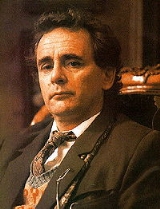
The
Seventh Doctor is the seventh incarnation of the
protagonistThe Doctor is the central character in the long-running BBC television science-fiction series Doctor Who, and has also featured in two cinema feature films, a vast range of spin-off novels, audio dramas and comic strips connected to the series....
of the long-running
BBCThe British Broadcasting Corporation is a British public service broadcaster. Its headquarters is at Broadcasting House in the City of Westminster, London. It is the largest broadcaster in the world, with about 23,000 staff...
television science-fictionScience fiction first appeared on a television program during the Golden Age of Science Fiction. Special effects and other production techniques allow creators to present a living visual image of an imaginary world not limited by the constraints of reality; this makes television an excellent medium...
series
Doctor WhoDoctor Who is a British science fiction television programme produced by the BBC. The programme depicts the adventures of a time-travelling humanoid alien known as the Doctor who explores the universe in a sentient time machine called the TARDIS that flies through time and space, whose exterior...
. He was portrayed by the actor
Sylvester McCoySylvester McCoy is a Scottish actor. As a comic act and busker he appeared regularly on stage and on BBC Children's television in the 1970s and 80s, but is best known for playing the seventh incarnation of the Doctor in the long-running science fiction television series Doctor Who from 1987 to...
.
Within the series' narrative, the Doctor is a centuries-old
Time LordThe Time Lords are an ancient extraterrestrial race and civilization of humanoids in the British science fiction television series Doctor Who, of which the series' eponymous protagonist, the Doctor, is a member...
alien from the planet
GallifreyGallifrey is a fictional planet in the long-running British science fiction television series Doctor Who and is the homeworld of the Doctor and the Time Lords...
who travels in time and space in his
TARDISThe TARDISGenerally, TARDIS is written in all upper case letters—this convention was popularised by the Target novelisations of the 1970s...
, frequently with companions. When the Doctor is critically injured, he can regenerate his body; in doing so, his physical appearance and personality change. McCoy portrays the seventh such incarnation, a whimsical, thoughtful character who quickly becomes more layered, secretive and
manipulativePsychological manipulation is a type of social influence that aims to change the perception or behavior of others through underhanded, deceptive, or even abusive tactics. By advancing the interests of the manipulator, often at the other's expense, such methods could be considered exploitative,...
. His first companion was
Melanie BushMel, also sometimes referred to as Melanie, is a fictional character in the long-running British science fiction television series Doctor Who. A computer programmer from the 20th Century who is a companion of the Sixth and Seventh Doctors, she was a regular in the programme from 1986 to 1987...
(
Bonnie LangfordBonita Melody Lysette "Bonnie" Langford is an English actress, dancer and entertainer. She came to prominence as a child star in the early 1970s then she subsequently became a companion of Colin Baker and Sylvester McCoy's Doctor Who and has appeared on stage in various musicals such as Peter Pan:...
), a computer programmer who travelled with his
previous selfThe Sixth Doctor is the sixth incarnation of the protagonist of the long-running BBC television science-fiction series Doctor Who. He was portrayed by Colin Baker...
, and who is soon succeeded by troubled teenager and explosives expert
AceDorothy Gale McShane, better known by her nickname Ace, is a fictional character played by Sophie Aldred in the long-running British science fiction television series Doctor Who...
(
Sophie AldredSophie Aldred is an English actress and television presenter, best known for her portrayal of The Doctor's companion Ace in the television series Doctor Who during the late 1980s.-Early life:...
), who becomes his protégée.
The Seventh Doctor first appeared on TV in 1987. After the programme was cancelled at the end of 1989, the Seventh Doctor's adventures were continued in novels until the late 1990s. The Seventh Doctor made an appearance at the start of the 1996 movie before the character was replaced by the
Eighth DoctorThe Eighth Doctor is the eighth incarnation of the protagonist of the long-running BBC television science-fiction series Doctor Who. He was portrayed by Paul McGann...
.
Overview
In his first series, the Seventh Doctor started out as a comical character, mixing his metaphors (
"Time and tide melt the snowman," for example), playing the spoons, and making
pratfallsPhysical comedy, also known as slapstick, is a comedic performance relying mostly on the use of the body to convey humour.Physical comedy, whether conveyed by a pratfall , a silly face, or the action of walking into walls, is a common and rarely subtle form of comedy...
, but later started to develop a darker nature and raised the profound question of who the Doctor actually is. The Seventh Doctor era is noted for the cancellation of
Doctor Who after 26 years. It is also noted for the
Virgin New AdventuresThe Virgin New Adventures were a series of novels from Virgin Publishing based on the British science-fiction television series Doctor Who...
, a range of original novels published from 1992 to 1997, taking the series beyond the television serials.
In 1990, readers of
Doctor Who MagazineDoctor Who Magazine is a magazine devoted to the long-running British science fiction television series Doctor Who...
voted McCoy's Doctor "Best Doctor", over perennial favourite
Tom BakerThomas Stewart "Tom" Baker is a British actor. He is best known for playing the fourth incarnation of the Doctor in the science fiction television series Doctor Who, a role he played from 1974 to 1981.-Early life:...
.
The Seventh Doctor's final appearance on television was in the 1996
Doctor Who television movie, where he regenerated into the
Eighth DoctorThe Eighth Doctor is the eighth incarnation of the protagonist of the long-running BBC television science-fiction series Doctor Who. He was portrayed by Paul McGann...
, played by
Paul McGannPaul McGann is an English actor who made his name on the BBC serial The Monocled Mutineer, in which he played the lead role...
. A sketch of him is later seen in
John SmithThe Tenth Doctor is the tenth incarnation of the protagonist of the long-running BBC television science-fiction series Doctor Who. He is played by David Tennant, who appears in three series, as well as eight specials...
's
A Journal of Impossible Things in the new series 2007 episode "
Human Nature"Human Nature" is the eighth episode of the third series of the revived British science fiction television series Doctor Who. It is the first episode of a two-part story written by Paul Cornell adapted from his 1995 Doctor Who novel Human Nature...
". Brief holographic clips of the Seventh Doctor appear in "The Next Doctor" and "
The Eleventh Hour"The Eleventh Hour" is an episode of the British science fiction television series Doctor Who. It was first broadcast on BBC One and BBC HD on 3 April 2010....
".
Biography
When the
TARDISThe TARDISGenerally, TARDIS is written in all upper case letters—this convention was popularised by the Target novelisations of the 1970s...
was attacked by the
RaniThe Rani is a fictional character in the British science fiction television series Doctor Who. She was played by Kate O'Mara. The word "Rani" means "queen" in the Urdu and Hindi languages and "The Rani" follows the naming convention for other renegade timelords, "The Doctor," "The Monk," "The War...
, the
Sixth DoctorThe Sixth Doctor is the sixth incarnation of the protagonist of the long-running BBC television science-fiction series Doctor Who. He was portrayed by Colin Baker...
was injured and forced to regenerate. After a brief period of post-regenerative confusion and amnesia (chemically induced by the Rani), the Seventh Doctor thwarted the Rani's plans, and rejoined his
companionIn the long-running BBC television science fiction programme Doctor Who and related works, the term "companion" refers to a character who travels with, and shares the adventures of the Doctor. In most Doctor Who stories, the primary companion acts as both deuteragonist and audience surrogate...
MelMel, also sometimes referred to as Melanie, is a fictional character in the long-running British science fiction television series Doctor Who. A computer programmer from the 20th Century who is a companion of the Sixth and Seventh Doctors, she was a regular in the programme from 1986 to 1987...
for whimsical adventures in an
odd tower blockParadise Towers is a serial in the British science fiction television series Doctor Who, which was first broadcast in four weekly parts from 5 October to 26 October 1987.-Plot:...
and a
WelshWales is a country that is part of the United Kingdom and the island of Great Britain, bordered by England to its east and the Atlantic Ocean and Irish Sea to its west. It has a population of three million, and a total area of 20,779 km²...
holiday camp in the 1950s-Preproduction:*This was the first three-part story since Planet of Giants , not counting the 3 x 45 minute episodes of The Two Doctors, which had been broadcast two years previously, and the first intended to be this length....
.
On the planet Svartos, Mel decided to leave the Doctor's company for that of intergalactic rogue
Sabalom GlitzSabalom Glitz is a fictional character from the long-running British science fiction television series, Doctor Who. Glitz is a rogue from the planet Salostophus in the Andromeda Constellation. Glitz's first love is money, and he is often engaged in mercenary acts and profiteering...
. Also at this time, the Doctor was joined by time-stranded teenager
AceDorothy Gale McShane, better known by her nickname Ace, is a fictional character played by Sophie Aldred in the long-running British science fiction television series Doctor Who...
. Although he did not mention it at the time, the Doctor soon recognised that an old enemy from a past adventure, the ancient entity known as Fenric, was responsible for the Time Storm which transported Ace from 1980s
PerivalePerivale is a small suburb in the London Borough of Ealing, west of Charing Cross, central London. Landmarks in the suburb include the A40, a large road that connects Central London with the M40 motorway, and the large Art Deco Hoover Building, as well as St Mary's Church , the River Brent and...
to Svartos in the distant future. Growing more secretive and driven from this point on, the Doctor took Ace under his wing and began teaching her about the universe, all the while keeping an eye out for Fenric's plot. The Doctor began taking a more scheming and proactive approach to defeating evil, using the Gallifreyan stellar manipulator named the
Hand of OmegaThe Hand of Omega is a fictional device from the British science fiction television series Doctor Who.In Remembrance of the Daleks the Seventh Doctor explains that the "Hand of Omega" is the mythical name for the remote stellar manipulator invented by Omega, the first of the Time Lords of the...
as part of an elaborate trap for the
DalekThe Daleks are a fictional extraterrestrial race of mutants from the British science fiction television series Doctor Who. Within the series, Daleks are cyborgs from the planet Skaro, created by the scientist Davros during the final years of a thousand-year war against the Thals...
s which resulted in the destruction of their home planet,
SkaroSkaro is a fictional planet from the British science fiction television series Doctor Who created by the writer Terry Nation as the home planet of the Daleks and, at times, the centre of the Dalek Empire....
. Soon afterwards, the Doctor used a similar tactic and another
Time LordThe Time Lords are an ancient extraterrestrial race and civilization of humanoids in the British science fiction television series Doctor Who, of which the series' eponymous protagonist, the Doctor, is a member...
relic to destroy a
CybermanThe Cybermen are a fictional race of cyborgs who are amongst the most persistent enemies of the Doctor in the British science fiction television series, Doctor Who. Cybermen were originally a wholly organic species of humanoids originating on Earth's twin planet Mondas that began to implant more...
fleet. He engineered the fall of the oppressive government of a future human colony in a single night and encountered the Gods of Ragnarok at a circus on the planet Segonax, whom he had apparently fought throughout time. Later, he was reunited with his old friend,
Brigadier Lethbridge-StewartBrigadier Sir Alistair Gordon Lethbridge-Stewart, generally referred to simply as the Brigadier, is a fictional character in the British science fiction television series Doctor Who, played by Nicholas Courtney...
while battling the forces of an alternate dimension on Earth.
The Seventh Doctor's manipulations were not reserved for his rivals. With the goal of helping Ace confront her past, he took her to a
Victorian house-Pre-production:Working titles for this story included The Bestiary and Life-Cycle. As revealed in the production notes for the DVD release, the story was renamed Das Haus der tausend Schrecken upon translation into German.The story evolved out of an earlier, rejected script entitled Lungbarrow...
in her home town of
PerivalePerivale is a small suburb in the London Borough of Ealing, west of Charing Cross, central London. Landmarks in the suburb include the A40, a large road that connects Central London with the M40 motorway, and the large Art Deco Hoover Building, as well as St Mary's Church , the River Brent and...
in 1883 which she had
burned downArson is the crime of intentionally or maliciously setting fire to structures or wildland areas. It may be distinguished from other causes such as spontaneous combustion and natural wildfires...
in 1983. Eventually, the Doctor confronted and defeated Fenric at a British
navalA navy is the branch of a nation's armed forces principally designated for naval and amphibious warfare; namely, lake- or ocean-borne combat operations and related functions...
base during
World War IIWorld War II, or the Second World War , was a global conflict lasting from 1939 to 1945, involving most of the world's nations—including all of the great powers—eventually forming two opposing military alliances: the Allies and the Axis...
, revealing Fenric's part in Ace's history. The Doctor continued to act as Ace's mentor, returning her to Perivale; however, she chose to continue travelling with him. The circumstances of her parting from the Doctor were not shown on television.
Near the end of his incarnation, the Seventh Doctor was given the responsibility of transporting the remains of his former enemy
the MasterThe Master is a recurring character in the British science fiction television series Doctor Who. He is a renegade Time Lord and the archenemy of the Doctor....
from
SkaroSkaro is a fictional planet from the British science fiction television series Doctor Who created by the writer Terry Nation as the home planet of the Daleks and, at times, the centre of the Dalek Empire....
to
GallifreyGallifrey is a fictional planet in the long-running British science fiction television series Doctor Who and is the homeworld of the Doctor and the Time Lords...
. This proved to be a huge mistake; despite having a limited physical form, the Master was able to take control of the Doctor's TARDIS and cause it to land in 1999
San FranciscoSan Francisco , officially the City and County of San Francisco, is the financial, cultural, and transportation center of the San Francisco Bay Area, a region of 7.15 million people which includes San Jose and Oakland...
, where the Doctor was shot in the middle of a gang shoot-out. He was taken to a hospital, where surgeons removed the bullets but mistook the Doctor's double heartbeat for
fibrillationFibrillation is the rapid, irregular, and unsynchronized contraction of muscle fibers. An important occurrence is with regards to the heart.-Cardiology:There are two major classes of cardiac fibrillation: atrial fibrillation and ventricular fibrillation....
; their attempt to save his life instead caused the Doctor to "die" with one last shocking scream. Perhaps due to the anaesthesia, the Doctor did not regenerate immediately after death, unlike all previous occasions; he finally did so several hours later, while lying in the hospital's morgue.
In
Time and the RaniTime and the Rani is a serial in the British science fiction television series Doctor Who, which was first broadcast in four weekly parts from 7 September to 28 September 1987. This story was the first to feature Sylvester McCoy as the Doctor. It also features the last appearance of the Sixth...
the Seventh Doctor gives his age soon after his regeneration as "exactly" 953 years, indicating that some two centuries of subjective time has passed since his
fourth incarnationThe Fourth Doctor is the fourth incarnation of the protagonist of the long-running BBC British television science-fiction series Doctor Who....
was revealed to be 759 in
The Ribos OperationThe Ribos Operation is a serial in the British science fiction television series Doctor Who, which was first broadcast in four weekly parts from September 2 to September 23, 1978. This serial introduces Mary Tamm as the companion Romana. After finishing his first year as producer of Doctor Who,...
, and approximately half-a-century since
Revelation of the DaleksRevelation of the Daleks is a serial in the British science fiction television series Doctor Who, which was first broadcast in two weekly parts on 23 March and 30 March 1985...
in which the
Sixth DoctorThe Sixth Doctor is the sixth incarnation of the protagonist of the long-running BBC television science-fiction series Doctor Who. He was portrayed by Colin Baker...
stated he was 900 years old. The later revival of the series, however, contradicts earlier episodes by establishing the
Ninth DoctorThe Ninth Doctor is the ninth incarnation of the protagonist of the long-running BBC television science-fiction series Doctor Who. He is played by Christopher Eccleston....
as being 900 years old in
Aliens of London"Aliens of London" is the fourth episode of the first series of the British science fiction television show Doctor Who that was first broadcast on 16 April 2005. The Doctor takes Rose back to 21st century London, just in time to witness a spaceship crashing into the River Thames, triggering a...
, with the
Tenth DoctorThe Tenth Doctor is the tenth incarnation of the protagonist of the long-running BBC television science-fiction series Doctor Who. He is played by David Tennant, who appears in three series, as well as eight specials...
stating his exact age as 906 in
The End of TimeThe End of Time: The Next Revolution in Our Understanding of the Universe, also sold with the alternate subtitle The Next Revolution in Physics, is a 1999 science book in which the author Julian Barbour argues that time exists merely as an illusion.-Auto-biography:The book begins by describing how...
, and the
Eleventh DoctorThe Eleventh Doctor is the eleventh incarnation of the protagonist of the BBC television science-fiction series Doctor Who. Matt Smith plays this incarnation, replacing David Tennant's Tenth Doctor in the 2010 episode "The End of Time, Part Two"...
stating his age as 909 in
The Impossible Astronaut"The Impossible Astronaut" is the first episode of the sixth series of the British science fiction television series Doctor Who. Written by show runner Steven Moffat, and directed by Toby Haynes, the episode was first broadcast on 23 April 2011 in the United Kingdom, as well as the United States...
.
Personality
The Seventh Doctor displayed perhaps the most profound change in attitude of any of the
Time Lord'sThe Time Lords are an ancient extraterrestrial race and civilization of humanoids in the British science fiction television series Doctor Who, of which the series' eponymous protagonist, the Doctor, is a member...
personae, beginning as perhaps the most outwardly amiable and bumbling (to the extent of putting himself in danger but not at the cost of his overall great intelligence and benevolent intentions) and progressing into a driven, dark gamemaster whose plans to defeat his adversaries, both old and new, would play out across space and time. He generally displayed an affable, curious, knowledgeable, easygoing, excitable and charming air. However, as he began to choose his battles and keep a tighter grip on his secrets - from his plans to his very identity - he also presented more serious, contemplative, secretive, wistful and manipulative sides with undercurrents of mischief and authority, constantly giving the impression that there was more to him than met the eye.
As something of a showman, the Doctor would sometimes act like a buffoon, usually preferring to manipulate events from behind the scenes; much like his
second incarnationThe Second Doctor is the second incarnation of the protagonist of the long-running BBC television science-fiction series Doctor Who. He was portrayed by character actor Patrick Troughton....
, he was prepared to play the fool in order to trick his foes into underestimating him, inevitably leading to their defeat at his hands. He was an adept physical performer and once deployed a repertoire of magic tricks, illusions and escape artistry to this effect as part of his plans. Although his more obvious whimsical tendencies disappeared over time (particularly his spoons-playing), he maintained a fondness for idiosyncratic speeches that occasionally referred to literature, ordinary places and even food and drink amidst the weightier concerns on his mind. He was empathetic to his friends (and even his enemies, such as Helen A) and somewhat melancholic at times (such as during Mel's departure and before his decision to eradicate the Daleks) but now placed greater burdens upon himself in the name of protecting the universe. This may have led him to surround his true intentions in mystery and the use of sleight of hand as befit his fondness for performance, in effect, subverting his more lighthearted qualities to complement and enhance his heroic and darker ones.
Given the Seventh Doctor's appearance and stature, he was surprisingly capable of both directly and indirectly taking control of situations involving strangers, using his greater intelligence to assess and direct events. Concerned with the bigger picture, he would sometimes overlook the finer details and his planning, both pre-prepared and improvised, would sometimes have fatal results and consequences. When he acted to end threats, it was usually a ruthless, destructive and final manoeuvre. He was also not above hiding the truth from his friends and allies and using them in order to complete his schemes and gambits.
His tendency to reveal only select information to his companion Ace – as well as anyone else around them – was utilised both in her education and in their adventures, as if he were the only one who should know all the answers and others should come to their own conclusions. At two points he even abused Ace's trust in him, once to develop her as a person and again to keep her alive (on both occasions, freeing her from the evil influences that had haunted her during her life), while on one of these adventures, he showed great difficulty in admitting his foreknowledge of the situation's severity to her when she finally confronted him. In spite of his immense fondness for her, and her for him, he often frustrated her with his secretive nature as his alien behaviour, the great importance of his objectives (especially his focus on obliterating enemies from his past) and his strong desire to both educate and protect her would lead him to keep even her in the dark and would even subordinate her feelings towards him in order to succeed in their battles. Fortunately, their close, almost familial bond was likely what helped Ace in moving past the feelings of betrayal she sometimes felt towards the Doctor, particularly as he genuinely had her best interests at heart. In fact, while he appeared to be an unassuming figure, fond of performing magic tricks and displaying notable showmanship, the Seventh Doctor was actually quite powerful and calculating, for he would use his friends and foes alike as pawns in his elaborate
chessChess is a two-player board game played on a chessboard, a square-checkered board with 64 squares arranged in an eight-by-eight grid. It is one of the world's most popular games, played by millions of people worldwide at home, in clubs, online, by correspondence, and in tournaments.Each player...
game against "evil". As Ace herself put it, he was "well devious."
In direct contrast to his
third incarnationThe Third Doctor is the third incarnation of the protagonist of the long-running BBC television science-fiction series Doctor Who. He was portrayed by actor Jon Pertwee....
, this Doctor was absolutely opposed to violence of any sort (as demonstrated in stories such as
BattlefieldBattlefield is a serial in the British science fiction television series Doctor Who, which was first broadcast in four weekly parts from September 6 to September 27, 1989. It was the last appearance of Brigadier Lethbridge-Stewart in Doctor Who....
, where he stops a battle merely by ordering the warriors to desist) and he was totally against the use of firearms (to the extent of 'talking down' a soldier ordered to execute him in
The Happiness PatrolThe Happiness Patrol is a serial in the British science fiction television series Doctor Who, which was first broadcast in three weekly parts from 2 November to 16 November 1988.-Plot:...
by emphasising the easiness of the kill versus the enormity of ending a life), although he also proved capable of rendering a man unconscious with a touch (
Battlefield,
Survival). In keeping with his established habits, he would use gadgetry of his own invention when the situation called for it, but never as his final gambit. Instead, he almost always managed to talk his enemies into submission, often into
suicideSuicide is the act of intentionally causing one's own death. Suicide is often committed out of despair or attributed to some underlying mental disorder, such as depression, bipolar disorder, schizophrenia, alcoholism, or drug abuse...
– perhaps most memorably in
Remembrance of the DaleksRemembrance of the Daleks is a serial in the British science fiction television series Doctor Who, which was first broadcast in four weekly parts from 5 October to 26 October 1988....
, where he taunts the seemingly last
DalekThe Daleks are a fictional extraterrestrial race of mutants from the British science fiction television series Doctor Who. Within the series, Daleks are cyborgs from the planet Skaro, created by the scientist Davros during the final years of a thousand-year war against the Thals...
in existence until it self-destructs, or in
Ghost Light-Pre-production:Working titles for this story included The Bestiary and Life-Cycle. As revealed in the production notes for the DVD release, the story was renamed Das Haus der tausend Schrecken upon translation into German.The story evolved out of an earlier, rejected script entitled Lungbarrow...
, where he defeats the malevolent Light by ramming home the folly of trying to prevent evolution (he employs variations of this 'talk to death' tactic in
Dragonfire,
Silver NemesisSilver Nemesis was the 25th anniversary serial of the British science fiction television series Doctor Who. It was first broadcast in the UK in three weekly parts from 23 November 1988, to 7 December 1988....
and
The Curse of FenricThe Curse of Fenric is a serial in the British science fiction television series Doctor Who, which was first broadcast in four weekly parts from 25 October to 15 November 1989...
, although primarily to manipulate opponents to guarantee the outcome in his favour). Perhaps this Doctor's most definitive stand against violence and savagery was taken when he faced down his arch-foe
the MasterThe Master is a recurring character in the British science fiction television series Doctor Who. He is a renegade Time Lord and the archenemy of the Doctor....
in
Survival-Writing:Writer Rona Munro approached script editor Andrew Cartmel at a BBC scriptwriting workshop and said that she'd "kill to write for Doctor Who." The story Munro developed incorporated themes including the morals of hunting...
whilst resisting the animalistic influence of an alien world, telling his enemy, "If we fight like animals, we'll die like animals!"
It is indeed fitting that this, at times the darkest Doctor of all, should not directly use physical force to implement his actions, even though he seemed to have the universe's weight on his shoulders more often than any other Doctor.
Appearance and personality quirks
The Doctor's outfit in this incarnation was calmer than his previous attire, but as idiosyncratic as any other. It consisted of an off-white safari-styled jacket with a red
paisleyPaisley or Paisley pattern is a droplet-shaped vegetable motif of Indian, Pakistani and Persian origin. The pattern is sometimes called "Persian pickles" by American traditionalists, especially quiltmakers,The Persian Pickle Club, Sandra Dallas. St. Martin's Press,...
scarf worn under its lapels and a matching handkerchief in the left pocket, a
fob watchA pocket watch is a watch that is made to be carried in a pocket, as opposed to a wristwatch, which is strapped to the wrist. They were the most common type of watch from their development in the 16th century until wristwatches became popular after World War I during which a transitional design,...
chained to the left lapel, a plain white shirt, a red paisley tie, a yellow fair isle-inspired pullover adorned with red question marks and blue-green zigzag patterns, sand-coloured
tweedTweed is a rough, unfinished woolen fabric, of a soft, open, flexible texture, resembling cheviot or homespun, but more closely woven. It is made in either plain or twill weave and may have a check or herringbone pattern...
plaidFor other meanings, see plaid.A plaid is a pattern consisting of crossed horizontal and vertical bands in two or more colors in woven cloth.Common examples of plaid patterns include:*Tartan, the pattern most commonly associated with plaid....
trousers, white/brown
broguedThe Brogue is a style of low-heeled shoe or boot traditionally characterized by multiple-piece, sturdy leather uppers with decorative perforations and serration along the pieces' visible edges...
spectator shoesThe Spectator shoe is a style of low-heeled, oxford, semi-brogue or full brogue constructed from two contrasting colors, typically having the toe and heel cap and sometimes the lace panels in a darker color than the main body of the shoe...
, a white
colonialColonial or The Colonial may refer to:* Colonial, of, relating to, or characteristic of a colony* Colonial history of the United States, the period of American history from the 17th century to 1776, under the rule of Great Britain, France and Spain...
-styled
Panama hatA Panama hat is a traditional brimmed hat of Ecuadorian origin that is made from the plaited leaves of the toquilla straw plant...
with a paisley hatband and an upturned brim and an umbrella with a red question mark-shaped handle. As with the three other Doctors costumed during the John Nathan-Turner era, the above mentioned question marks on the Doctor's pullover and his umbrella handle continued the red question marked clothing motif that was introduced in the
Fourth DoctorThe Fourth Doctor is the fourth incarnation of the protagonist of the long-running BBC British television science-fiction series Doctor Who....
's final season and ended before the Seventh Doctor's regeneration.
Although a seemingly casual outfit that reflected the Seventh Doctor's initially easy and whimsical manner, it took on a new light when he became more scheming and prepared in his missions – to reflect the emergence of his personality's more mysterious and darker aspects, his jacket, hatband, handkerchief, scarf and tie became more muted and darker in colour, now in shades of burgundy and brown. In the New Adventures novels, images of the Doctor on the covers usually omitted the pullover and eventually depicted him in a cream single breasted suit. On a DVD featurette ("Light In Dark Places") for
Ghost Light-Pre-production:Working titles for this story included The Bestiary and Life-Cycle. As revealed in the production notes for the DVD release, the story was renamed Das Haus der tausend Schrecken upon translation into German.The story evolved out of an earlier, rejected script entitled Lungbarrow...
, Sylvester McCoy expresses some disdain for the garment, feeling it detracts somewhat from the mood of the story, when drawing attention to the stylistic choice of performing in most of the serial without his hat and umbrella. The changes in colours make the Seventh the only Doctor under Nathan-Turner's tenure to greatly alter his costume; the changes to the outfits worn by his three previous selves during this production period tended to be more subtle and less noteworthy. The Seventh's own attire was repeatedly revised during his first season, initially including a red/black
tartanTartan is a pattern consisting of criss-crossed horizontal and vertical bands in multiple colours. Tartans originated in woven wool, but now they are made in many other materials. Tartan is particularly associated with Scotland. Scottish kilts almost always have tartan patterns...
scarf and red braces, along with the bamboo-handle umbrella.
In the TV Movie the Doctor's costume changed again, with a return to a lighter jacket, now a light brown tweed. Gone were the question mark pullover, scarves, paisley tie and question mark umbrella, replaced by a red waistcoat and a brown/black zig zag pattern tie. However, the Doctor retained his Panama hat.
The Doctor enjoyed using his hat, umbrella and the TARDIS key, amongst other items, as physical props, usually as showy affectations or to command attention, while the umbrella could also be used to disarm and trip foes (
Paradise Towers,
Battlefield,
Ghost Light,
Survival). Like most of his previous selves, the Seventh carried any number of random items in his pockets, including technological devices and books (
Dragonfire,
Ghost Light). In a break from his past however, he spoke with a mild
ScottishScotland is a country that is part of the United Kingdom. Occupying the northern third of the island of Great Britain, it shares a border with England to the south and is bounded by the North Sea to the east, the Atlantic Ocean to the north and west, and the North Channel and Irish Sea to the...
accent with rolled
Rs rather than in his past selves'
Received PronunciationReceived Pronunciation , also called the Queen's English, Oxford English or BBC English, is the accent of Standard English in England, with a relationship to regional accents similar to the relationship in other European languages between their standard varieties and their regional forms...
speaking patterns.
This Doctor also displays strange and 'alien' characteristics playing with the perception of his senses, as he smells an apple and listens to cheese in
Survival-Writing:Writer Rona Munro approached script editor Andrew Cartmel at a BBC scriptwriting workshop and said that she'd "kill to write for Doctor Who." The story Munro developed incorporated themes including the morals of hunting...
, and listens to an apple briefly in
Delta and the Bannermen-Preproduction:*This was the first three-part story since Planet of Giants , not counting the 3 x 45 minute episodes of The Two Doctors, which had been broadcast two years previously, and the first intended to be this length....
. He also displayed a talent for hypnosis on various occasions that appeared to be much stronger than in past incarnations (
Battlefield).
The Greatest Show in the Galaxy shows him to be a capable entertainer, performing a variety of well known magic tricks. In
Ghost Light, he reveals his pet peeves to be burnt toast, bus stations, unrequited love, tyranny and cruelty.
Story style
In Season 24, the Seventh Doctor era began with a light-hearted approach, with stories like
Delta and the Bannermen-Preproduction:*This was the first three-part story since Planet of Giants , not counting the 3 x 45 minute episodes of The Two Doctors, which had been broadcast two years previously, and the first intended to be this length....
clearly aimed at a younger audience. However, in the final two seasons with
Andrew CartmelAndrew Cartmel is a British science fiction writer and journalist, and former script editor of Doctor Who. He has also worked as a script editor on other television series, as a magazine editor, a film studies lecturer and as a novelist.-Biography:...
as script editor, the stories soon explored the true nature of the Doctor, hinting at dark secrets in his past. In
Silver NemesisSilver Nemesis was the 25th anniversary serial of the British science fiction television series Doctor Who. It was first broadcast in the UK in three weekly parts from 23 November 1988, to 7 December 1988....
, Lady Peinforte hints she knows the Doctor's secret of being more than just a
Time LordThe Time Lords are an ancient extraterrestrial race and civilization of humanoids in the British science fiction television series Doctor Who, of which the series' eponymous protagonist, the Doctor, is a member...
(deleted scenes in
Remembrance of the DaleksRemembrance of the Daleks is a serial in the British science fiction television series Doctor Who, which was first broadcast in four weekly parts from 5 October to 26 October 1988....
and
Survival-Writing:Writer Rona Munro approached script editor Andrew Cartmel at a BBC scriptwriting workshop and said that she'd "kill to write for Doctor Who." The story Munro developed incorporated themes including the morals of hunting...
also refer to this).
Remembrance has the Doctor use "we" when referring to early Gallifreyan time travel experiments. Ace also became the focus of a dedicated character arc that was seeded from her introduction onwards and prominently played out during Season 26.
With the cancellation of the series, these developments were never fully played out in the television series, but some of them were revealed in the
New AdventuresThe Virgin New Adventures were a series of novels from Virgin Publishing based on the British science-fiction television series Doctor Who...
.
Marc PlattMarc Platt is a British writer. He is most known for his work with the BBC science fiction television series Doctor Who.After studying catering at a technical college, Platt worked first for Trust House Forte, and then in administration for the BBC...
's novel
LungbarrowLungbarrow is an original novel written by Marc Platt and based on the long-running British science fiction television series Doctor Who...
is usually considered to be the conclusion of the "Cartmel Masterplan". In that novel, the Doctor is revealed to be the reincarnation of "the
OtherThe Other is a fictional character in the expanded universe of the British science fiction television series Doctor Who. A legendary figure in Time Lord history, the Other does not appear in the television series itself, but is mentioned several times in the spin-off media based on the...
", a shadowy figure and contemporary of
RassilonRassilon is a fictional character in the British science fiction television series Doctor Who. In the backstory of the programme, he was the founder of Time Lord society on the planet Gallifrey...
and
OmegaOmega is a fictional character from the long-running British science fiction television series, Doctor Who. In the context of the series, Omega is known as one of the founding fathers of the Time Lords of the planet Gallifrey, and is a revered figure in Time Lord history together with the equally...
from Ancient
GallifreyGallifrey is a fictional planet in the long-running British science fiction television series Doctor Who and is the homeworld of the Doctor and the Time Lords...
.
Lungbarrow was originally intended for Season 26, but producer
John Nathan-TurnerJohn Nathan-Turner was the ninth producer of the long-running BBC science fiction series Doctor Who, from 1980 until it was effectively cancelled in 1989...
felt that it revealed too much of the Doctor's origins. It was reworked to become
Ghost Light-Pre-production:Working titles for this story included The Bestiary and Life-Cycle. As revealed in the production notes for the DVD release, the story was renamed Das Haus der tausend Schrecken upon translation into German.The story evolved out of an earlier, rejected script entitled Lungbarrow...
instead.
According to McCoy and script editor
Andrew CartmelAndrew Cartmel is a British science fiction writer and journalist, and former script editor of Doctor Who. He has also worked as a script editor on other television series, as a magazine editor, a film studies lecturer and as a novelist.-Biography:...
, a number of Seventh Doctor stories were intended to satirise or protest the rule of then Prime Minister
Margaret ThatcherMargaret Hilda Thatcher, Baroness Thatcher, was Prime Minister of the United Kingdom from 1979 to 1990...
. McCoy told the
Sunday Times in 2010 “The idea of bringing politics into Doctor Who was deliberate, but we had to do it very quietly and certainly didn’t shout about it...We were a group of politically motivated people and it seemed the right thing to do. At the time Doctor Who used satire to put political messages out there in the way they used to do in places like Czechoslovakia. Our feeling was that Margaret Thatcher was far more terrifying than any monster the Doctor had encountered. Those who wanted to see the messages saw them; others, including one producer, didn’t.” One story mentioned as having an anti-Thatcher theme was
The Happiness PatrolThe Happiness Patrol is a serial in the British science fiction television series Doctor Who, which was first broadcast in three weekly parts from 2 November to 16 November 1988.-Plot:...
in which the tyrannical Helen A outlawed unhappiness and remarked “I like your initiative, your enterprise” as her secret police rounded up dissidents. The Doctor persuaded “the drones”, who toiled in the factories and mines, to down tools and rise up in revolt, an echo of the miners’ strikes and printers’ disputes during Thatcher’s first two terms in office. Script editor
Andrew CartmelAndrew Cartmel is a British science fiction writer and journalist, and former script editor of Doctor Who. He has also worked as a script editor on other television series, as a magazine editor, a film studies lecturer and as a novelist.-Biography:...
assembled several “angry young writers” such as
Ben AaronovitchBen Denis Aaronovitch is a London-born British writer who has worked on television series including Doctor Who, Casualty, Jupiter Moon and Dark Knight...
and
Rona MunroRona Munro is a Scottish writer. She has written plays for theatre, radio, and television; was the author of the screenplay of Ken Loach's Ladybird, Ladybird and co-author of Aimée & Jaguar by German director Max Färberböck.Munro is also known for being the author of the last Doctor Who television...
to produce storylines that they hoped would foment anti-Thatcher dissent.
Television
The Seventh Doctor and Ace appeared twice on television between the time
Doctor Who was cancelled and the
1996 television movieDoctor Who is a television movie based on the British science fiction television series Doctor Who. Developed as a co-production amongst Universal Television, BBC Television, BBC Worldwide, and the American network FOX, the 1996 television film premiered on 12 May 1996 on CITV in Edmonton,...
. The first was in 1990, in a special episode of the BBC2 educational programme
Search Out Science. In this episode, the Doctor acted as a quiz show host, asking questions about astronomy; Ace,
K-9K-9, or K9, is the name of several fictional robotic canines in the long-running British science fiction television series, Doctor Who, first appearing in 1977...
and "Cedric, from the planet Glurk" were the contestants. The Seventh Doctor then appeared in the 1993 charity special
Dimensions in TimeDimensions in Time is a charity special crossover between the British science fiction television series Doctor Who and the soap opera EastEnders that ran in two parts on 26 and 27 November 1993. It was filmed on the EastEnders Albert Square set, and features several of the stars of that programme...
. Neither of these appearances are generally considered canonical. A picture of the Seventh Doctor appears briefly in the
Tenth DoctorThe Tenth Doctor is the tenth incarnation of the protagonist of the long-running BBC television science-fiction series Doctor Who. He is played by David Tennant, who appears in three series, as well as eight specials...
story "
Human Nature"Human Nature" is the eighth episode of the third series of the revived British science fiction television series Doctor Who. It is the first episode of a two-part story written by Paul Cornell adapted from his 1995 Doctor Who novel Human Nature...
", in John Smith's "A Journal Of Impossible Things," and visions of him appear briefly in "The Next Doctor" and "
The Eleventh Hour"The Eleventh Hour" is an episode of the British science fiction television series Doctor Who. It was first broadcast on BBC One and BBC HD on 3 April 2010....
".
Audio
The Seventh Doctor has featured in dozens of audio dramas.
Novels
Following the end of the TV series, the adventures of Doctor Who were continued in the
Virgin New AdventuresThe Virgin New Adventures were a series of novels from Virgin Publishing based on the British science-fiction television series Doctor Who...
. The Seventh Doctor was the subject of 60 of these between 1991 and 1997. His adventures also appeared in the BBC Past Doctor Novels, see here.
External links