

Seven Years' War

Encyclopedia
The Seven Years' War was a global military war between 1756 and 1763, involving most of the great power
s of the time and affecting Europe, North America
, Central America
, the West Africa
n coast, India
, and the Philippines
. In the historiography of some countries, the war is alternatively named after combats in the respective theaters: the French and Indian War
(North America, 1754–63), Pomeranian War
(Sweden
and Prussia
, 1757–62), Third Carnatic War (Indian subcontinent
, 1757–63), and Third Silesian War (Prussia
and Austria
, 1756–63).
The war was driven by the antagonism between Great Britain
(in personal union
with Hanover) and the Bourbons
(in France
and Spain), resulting from overlapping interests in their colonial and trade empires, and by the antagonism between the Hohenzollerns
(in Prussia
) and Habsburgs (Holy Roman Emperor
s and archduke
s in Austria
), resulting from territorial
and hegemonial conflicts in the Holy Roman Empire
. The Diplomatic Revolution
established an Anglo-Prussian camp
, allied with some smaller German states and later Portugal
, as well as an Austro-French camp
, allied with Sweden, Saxony
and later Spain. The Russian Empire
left its offensive alliance with the Habsburgs on the succession of Peter III
, and like Sweden concluded a separate peace with Prussia in 1762. The war ended with the peace treaties of Paris
(Bourbon France and Spain, Great Britain) and of Hubertusburg
(Hohenzollerns, Habsburgs, Saxon elector) in 1763. The war was characterized by sieges and arson of towns as well as open battles involving extremely heavy losses; overall, some 900,000 to 1,400,000 people died.
Great Britain expelled her Bourbon rivals in the contested overseas territories, gaining the bulk of New France
, Spanish Florida
, some Caribbean
islands, Senegal
and superiority over the French outposts on the Indian subcontinent. The native American tribes
were excluded from the peace settlement, and were unable to return to their former status after the resulting Pontiac's rebellion. In Europe, Frederick II of Prussia
failed to complete a preemptive strike against Austria, and his numerically superior opponents repulsed and nearly annihilated his forces at Kunersdorf
. Frederick however recovered, regained ground and managed to avoid any concessions in Hubertusburg, where the status quo ante bellum
was restored. William Pitt
's saying that "America was won in Germany" referred to the Prussian war effort, which enabled Great Britain to keep her continental commitment limited and focus on her "blue water policy," successfully establishing naval supremacy. French and allied forces were able to occupy Prussian and Hanoveranian territories up to East Frisia
. French ambitions to invade Britain
and to continue with their guerre de course were thwarted by a British naval blockade, which also impaired French supply routes to the colonies. The involvement of Portugal, Spain and Sweden did not return them to their former status as great powers. Spain's short intervention resulted in the loss of Florida, though she gained French Louisiana
west of the Mississippi
in exchange and Britain returned western Cuba and Manila.
In the United States, however, the North American portion of the war, which started in 1754, is popularly known as the French and Indian War
. Many scholars and professional historians in America, such as Fred Anderson
, however, follow the example of their colleagues in other countries and refer to the conflict as the "Seven Years' War," regardless of the theatre.
In French Canada, the conflict is sometimes referred to as La Guerre de la Conquête, meaning The War of the Conquest.
The conflict in India is termed the Third Carnatic War
while the fighting between Prussia and Austria is called the Third Silesian War. In Swedish historiography, the name Pommerska kriget (Pomeranian War) is used, as Swedish involvement was limited to Pomerania
.
The war was described as the first "world war
", though this label was also given to various earlier conflicts such as the Eighty Years' War, the Thirty Years' War
, the Spanish War of Succession and the Austrian War of Succession, and to later conflicts such as the Napoleonic Wars
. As a partially Anglo-French conflict involving developing empires, the war was one of the most significant phases of the 18th century Second Hundred Years' War
.
that had lasted between 1740 and 1748, in which King Frederick II of Prussia
, known as Frederick the Great, had gained the rich province of Silesia
from Austria. Empress Maria Theresa of Austria
had signed the Treaty of Aix-la-Chapelle
only in order to gain time to rebuild her military forces and to forge new alliances, which she did with remarkable success. The political map of Europe had been redrawn in a few years as Austria abandoned its twenty-five year alliance with Britain
. During the so-called Diplomatic Revolution
of 1756, the centuries-old enemies of France, Austria, and Russia formed a single alliance against Prussia.
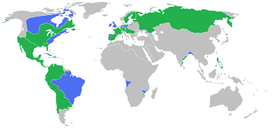 Prussia's only major assistance came from Great Britain, their newfound allies, whose ruling dynasty saw its ancestral Hanoverian
possession as being threatened by France. In many respects the two powers' forces complemented each other excellently. The British had the largest, most effective navy in the world, while Prussia had the most formidable land force on continental Europe, allowing Great Britain to focus its soldiers towards colonial expeditions. The British hoped that the new series of alliances that had been formed during the Diplomatic Revolution would allow peace to continue, but they in fact provided the catalyst for the eruption of war in 1756.
The Austrian army had undergone an overhaul according to the Prussian system. Maria Theresa, whose knowledge of military affairs shamed many of her generals, had pressed relentlessly for reform. Her interest in the welfare of the soldiers had gained her their undivided respect. Austria had suffered several humiliating defeats to Prussia in the previous war, and strongly dissatisfied with the limited help they had received from the British, they now saw France as the only ally who could help them retake Silesia and check Prussia's expansion.
The second cause for war arose from the heated colonial struggle between the British Empire
and French Empire
which, as they expanded, met and clashed with one another on two continents. Of particular dispute was control of the Ohio Country
which was central to both countries' ambitions of further expansion and development in North America. The two countries had been in a de facto state of war since 1754, but these military clashes remained confined to the American theatre.
, remained optimistic that war could be prevented from breaking out in Europe by the new series of alliances. However a large French force was assembled at Toulon
, and the French opened the campaign against the British by an attack on Minorca
in the Mediterranean. A British attempt at relief was foiled at the Battle of Minorca
and the island was captured on 28 June (for which Admiral Byng
was court-martialed and executed). War between Britain and France had been formally declared on 18 May nearly two years after the first fighting had broken out in the Ohio Country
.
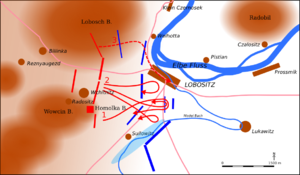 Having received reports of the clashes in North America, and having secured the support of Great Britain with an Anglo-Prussian alliance
, Frederick II of Prussia
crossed the border of Saxony
on 29 August 1756, one of the small German states in league with Austria. He intended this as a bold pre-emption of an anticipated Austro-French invasion of Silesia
. The Saxon and Austrian armies were unprepared, and their forces were scattered. At the Battle of Lobositz
, King Frederick prevented the isolated Saxon army from being reinforced by an Austrian army under General Browne. The Prussians then overran the Electorate, resulting in the Prussian occupation of Saxony and the surrender of the Saxon Army
at Pirna
in October 1756 which was then forcibly incorporated into the Prussian forces. The attack on the neutral Electorate of Saxony caused outrage across Europe and led to the strengthening of the anti-Prussian coalition. The only significant Austrian success was the partial occupation of Silesia.
Britain had been surprised by the sudden Prussian offensive, but now began shipping supplies and money to their allies. A combined German force was organised under the Duke of Cumberland to protect Hanover
from a French invasion. The British attempted to persuade the Dutch Republic
to join the alliance, but the request was rejected as the Dutch wished to remain fully neutral. Despite the huge disparity in numbers, the year had been a successful one for the Prussian-led forces on the continent, in contrast to disappointing British campaigns in North America.
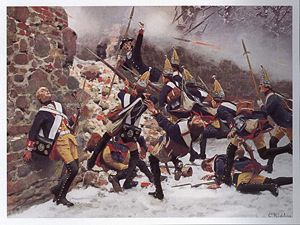
In early 1757, Frederick II again took the initiative by marching into the Kingdom of Bohemia
, hoping to inflict a decisive defeat on the Austrian forces. After the bloody Battle of Prague, the Prussians laid siege to the city, but had to lift the siege after a major Austrian counter-attack and Frederick's first defeat at the Battle of Kolin
. That summer, the Russians had invaded East Prussia
and defeated a smaller Prussian force in the fiercely contested Battle of Gross-Jägersdorf
. Further defeats followed. Frederick was forced to break off his invasion of Bohemia, and withdraw back into Prussian-controlled territory.
Things were looking very grim for Prussia at this time, with the Austrians mobilising to attack Prussian-controlled soil and a French army under Soubise approaching from the west. In November and December the whole situation in Germany was reversed. Frederick devastated first Soubise's French force at the Battle of Rossbach
and then routed a vastly superior Austrian force at the Battle of Leuthen
. With these great victories, Frederick once again established himself as Europe's finest general and his men as Europe's finest soldiers. In spite of these successes, the Prussians were now facing the prospect of four major powers attacking on four fronts (France from the West, Austria from the South, Russia from the East and Sweden from the North). Meanwhile a combined force from smaller German states, such as Bavaria
, had established under Austrian leadership—and this threatened Prussian control of Saxony.
This problem was compounded when the main Hanoverian army under Cumberland was defeated at the Battle of Hastenbeck
and then forced to surrender entirely at the Convention of Klosterzeven
following a French Invasion of Hanover
. The Convention removed Hanover and Brunswick from the war, leaving the Western approach to Prussian territory extremely vulnerable. Frederick sent urgent requests to Britain for more substantial assistance, as he was now without any military support for his forces in Germany.
The British had suffered further defeats in North America, particularly at Fort William Henry
. At home however stability had been established. Since 1756, successive governments led by Newcastle and William Pitt
had both fallen. In August 1757, the two men agreed to a political partnership and formed a coalition government
which gave new, firmer direction to the British war effort. The new strategy emphasised both Newcastle's commitment to British involvement on the European continent particularly in defence of Germany and William Pitt's determination to use British naval power to launch expeditions to seize French colonies
around the globe. The "dual strategy" would dominate British policy for the next five years.
In late 1757, thanks to the Prussian victories at Rossbach and Leuthen, the situation appeared to have swung in Frederick's favour and the sudden decision of the Russian Empire to withdraw its troops from East Prussia offered further relief. Frederick calculating that no further Russian advance was likely until 1758, then moved the bulk of his eastern forces to Pomerania to repel a Swedish invasion. Within a short period they had driven the Swedes back, occupied most of Swedish Pomerania
and blockaded its capital Stralsund
. George II of Great Britain
, on the advice of his British ministers, revoked the convention of Klosterzeven and Hanover re-entered the war. Over the winter the new commander of the Hanoverian forces, Duke Ferdinand of Brunswick
, regrouped his army and launched a series of offensives that drove the French back across the River Rhine.
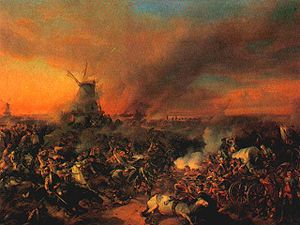 In early 1758, Frederick launched an invasion of Moravia
, and laid siege to Olomouc
. Following the Battle of Domstadtl
, Frederick broke off the siege and withdrew from Moravia. It marked the end of his final attempt to launch a major invasion of Austrian territory. East Prussia
had been occupied by Russian forces over the winter, and would remain under their control until 1762, although Frederick did not see the Russians as an immediate threat and instead entertained hopes of first fighting a decisive battle against Austria that would knock them out of the war.
In April 1758, the British concluded the Anglo-Prussian Convention
with Frederick, in which they committed to pay him an annual subsidy
of £670,000. Britain also dispatched a force of 9,000 troops to reinforce Ferdinand's Hanoverian army, the first British troop commitment on the continent and a reversal in the policy of Pitt who had previously opposed such a move. Ferdinand had succeeded in driving the French from Hanover and Westphalia and re-captured the port of Emden in March 1758, before crossing the Rhine with his own forces which caused alarm in France. Despite Ferdinand's victory over the French at the Battle of Krefeld
and the brief occupation of Düsseldorf
, he was then forced to withdraw across the Rhine by successful manoeuvring by larger French forces.
By this point Frederick had grown increasingly concerned about the Russian advance from the east and marched to counter it. In August 1758, at the Battle of Zorndorf
a Prussian army of 35,000 men under Frederick fought to a standstill a Russian army of 43,000 commanded by Count Fermor
. Although both sides suffered heavy casualties and the Russians withdrew from the field in good order, Frederick claimed a victory. In the undecided Battle of Tornow
on 25 September, a Swedish army repulsed six assaults by a Prussian army, but did not push home an attempt to move on Berlin following the Battle of Fehrbellin
.
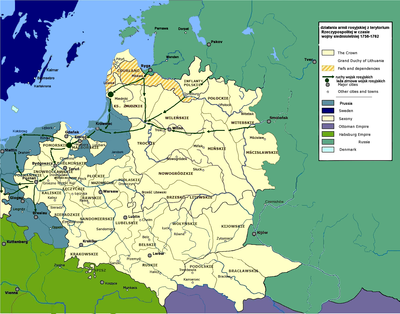 The back-and-forth nature of the war continued as on 14 October, Marshal Daun's Austrians surprised the main Prussian army at the Battle of Hochkirch
in Saxony. Frederick lost much of his artillery but retreated in good order, helped by the densely wooded landscape. The Austrians had ultimately made little progress in the campaign in Saxony despite Hochkirch and had failed to achieve a decisive breakthrough. After a thwarted attempt to take Dresden, Daun's troops were forced to withdraw to Austrian territory for the winter, so that Saxony remained under Prussian occupation.
In France, 1758 had been a disappointing year and in the wake of this a new Chief Minister, the Duc de Choiseul
was appointed. Choiseul planned to end the war in 1759 by making strong attacks on Britain and Hanover.
, or Paltzig, the Russian Count Saltykov with 47,000 Russians defeated 26,000 Prussian troops commanded by General Carl Heinrich von Wedel
. Though the Hanoverians defeated an army of 60,000 French at Minden
, Austrian general Daun
forced the surrender of an entire Prussian corps of 13,000 men in the Battle of Maxen
. Frederick himself lost half his army in the Battle of Kunersdorf
, the worst defeat in his military career, and one that drove him to the brink of abdication and suicide. The disaster resulted partly from his misjudgment of the Russians, who had already demonstrated their strength at Zorndorf and at Gross-Jägersdorf
.
 The French planned to invade the British Isles
during 1759 by accumulating troops near the mouth of the Loire and concentrating their Brest and Toulon fleets. However, two sea defeats prevented this. In August, the Mediterranean fleet under Jean-François de La Clue-Sabran
was scattered by a larger British fleet under Edward Boscawen
at the Battle of Lagos. In the Battle of Quiberon Bay
on 20 November, the British admiral Edward Hawke with 23 ships of the line
caught the French Brest fleet with 21 ships of the line under Marshal de Conflans and sank, captured or forced aground many of them, putting an end to the French plans.
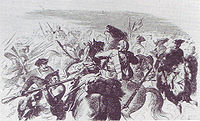 1760 brought even more disasters to the Prussians. The Prussian general Fouqué was defeated in the Battle of Landshut
. The French captured Marburg
, and the Swedes part of Brandenburg-Prussian Pomerania. The Hanoverians were victorious over the French at the Battle of Warburg
, their continued success preventing France from sending troops to aid the Austrians against Prussia in the east. Despite this the Austrians, under the command of General Laudon captured Glatz (now Kłodzko) in Silesia. In the Battle of Liegnitz
Frederick scored a victory despite being outnumbered three to one. The Russians under General Saltykov
and Austrians under General Lacy briefly occupied his capital, Berlin, in October. The end of that year saw Frederick once more victorious, defeating the able Daun in the Battle of Torgau
, but he suffered heavy casualties and the Austrians retreated in good order.
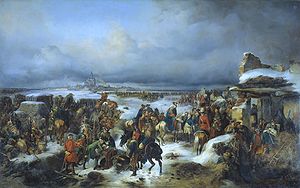 Prussia began the 1761 campaign with just 100,000 available troops, many of them new recruits. 1762 brought two new countries into the war. Britain declared war against Spain
on 4 January 1762; Spain reacted by issuing their own declaration of war against Britain on 18 January. Portugal followed by joining the war on Britain's side. Spain, aided by the French, launched an invasion of Portugal and succeeded in capturing Almeida
. The arrival of British reinforcements stalled a further Spanish advance, and the Battle of Valencia de Alcántara
saw British-Portuguese forces overrun a major Spanish supply base.
In February 1761 Duke Ferdinand of Brunswick
surprised French troops at Langensalza
, and then advanced to besiege Cassel
in March. He was forced to lift the siege and retreat after French forces regrouped and captured several thousand of his men at the Battle of Grünberg
. At the Battle of Villinghausen
, Prince Ferdinand of Brunswick defeated a 92,000-man French army. The Russians under Zakhar Chernyshev and Pyotr Rumyantsev
stormed Kolberg in Pomerania, while the Austrians captured Schweidnitz. The loss of Kolberg cost Prussia its last port on the Baltic Sea
. In Britain, it was speculated that a total Prussian collapse was now imminent.
Britain now threatened to withdraw its subsidies if Prussia didn't seriously consider offering to make concessions to secure peace. As the Prussian armies had dwindled to just 60,000 men Frederick's survival was severely threatened. Then on 5 January 1762 the Russian Empress Elizabeth died. Her Prussophile successor, Peter III
, at once recalled Russian armies from Berlin (see: the Treaty of Saint Petersburg (1762)
) and mediated Frederick's truce with Sweden. This turn of events has become known as the miracle of the House of Brandenburg
. In the aftermath, Frederick was able to drive the Austrians from Silesia in the Battle of Freiberg
(29 October 1762), while his Brunswick allies captured the key town of Göttingen
and compounded it by taking Cassel.
The long British naval blockade of French ports had sapped the morale of the French populace. France continue to collapse yet further when news of a faliure at the Battle of Signal Hill
in Newfoundland reached Paris. Feelers for peace were soon extended to the British.

By 1763 Frederick had Silesia under his control and had occupied parts of Austria. The British subsidies had been withdrawn by the new Prime Minister Lord Bute, and the Russian Emperor had been overthrown by his wife Catherine the Great who now switched Russian support back to Austria and launched fresh attacks on Prussia. Austria, however, had been weakened from the war and like most participants they were facing a severe financial crisis. In 1763 a peace settlement was reached at the Treaty of Hubertusburg
ending the war in central Europe.
or raid) on Rochefort
, a joint operation
to overrun the town and burn the shipping in the Charente
. The expedition set out on 8 September 1757, Sir John Mordaunt commanding the troops and Sir Edward Hawke the fleet. On 23 September, the Isle d'Aix was taken, but due to dithering by military staff such time was lost that Rochefort became unassailable, and the expedition abandoned the Isle d'Aix, returning to Great Britain on 1 October.
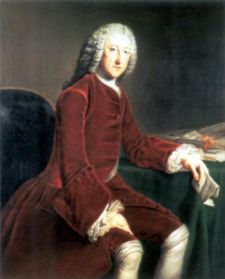 Despite the operational failure and debated strategic success of the descent on Rochefort, William Pitt
—who saw purpose in this type of asymmetric enterprise—prepared to continue such operations. An army was assembled under the command of Charles Spencer, 3rd Duke of Marlborough
; he was aided by Lord George Sackville
. The naval escorts for the expedition were commanded by Anson
, Hawke, and Howe
. The army landed on 5 June 1758 at Cancalle Bay, proceeded to St. Malo, and burned the shipping in the harbor; the arrival of French relief forces caused the British to avoid a siege, and the troops re-embarked. An attack on Havre de Grace
was called off, and the fleet sailed on to Cherbourg
; but the weather being bad and provisions low, that too was abandoned, and the expedition returned, having damaged French privateering and provided a further strategic demonstration against the French coast.
Pitt now prepared to send troops into Germany; and both Marlborough and Sackville, disgusted by what they perceived as the futility of the "descents", obtained commissions in that army. The elderly General Bligh
was appointed to command a new "descent", escorted by Howe. The campaign began propitiously with the Raid on Cherbourg
. With the support of the navy to bombard Cherbourg and cover their landing, the army drove off the French force detailed to oppose their landing, captured Cherbourg, and destroyed its fortifications, docks, and shipping.
The troops were re-embarked and the fleet moved them to the Bay of St. Lunaire in Brittany where, on 3 September, they were landed to again operate against St. Malo; however, this action proved impractical. Worsening weather forced the two armies to separate: the ships sailed for the safer anchorage of St. Cast
, while the army proceeded overland. The tardiness of Bligh in moving his forces allowed a French force of 10,000 men from Brest
to catch up with him and open fire on the re-embarkation troops. A rear-guard of 1,400 under General Dury held off the French while the rest of the army embarked; they could not be saved, 750, including Dury, were killed and the rest captured.
isles, the Philippines
and coastal Africa. During the course of the war, Great Britain gained enormous areas of land and influence at the expense of the French.
Great Britain lost Minorca
in the Mediterranean to the French in 1756 but captured the French colonies in Senegal
on the African continent in 1758. The British Royal Navy
captured the French sugar colonies of Guadeloupe in 1759 and Martinique
in 1762, as well as the Spanish cities of Havana in Cuba
, and Manila
in the Philippines, both prominent Spanish colonial cities, but expansion into their hinterlands met with stiff resistance.
, then a lieutenant colonel
in the British colonial militia Virginia Regiment
, at Jumonville Glen
in 1754. The British attacked with bayonets the 31 French-Canadians sleeping in the early morning hours. Ten were killed, including commander Jumonville
, whose brother pursued Washington. The latter surrendered at the Battle of Fort Necessity. Both France and Britain then sent troops in strength to North America. In June of 1755, British Major General Edward Braddock
led about 2,000 army troops and provincial militia on an expedition to take Fort Duquesne
but the expedition
was a disaster. In a second British act of aggression, Admiral Edward Boscawen
fired on the French ship Alcide
on 8 June 1755
, capturing her and two troop ships. The British harassed French shipping throughout 1755, seizing ships and capturing seamen. In September 1755, French and British troops met in the inconclusive Battle of Lake George
.
The third British act of aggression was the assault on Acadia
in the Battle of Beausejour, which was immediately followed by their expulsion of the Acadians. These acts of aggression contributed to the formal declarations of war in spring 1756.
During the war, the Seven Nations of Canada
were allied with the French; they were Native American groups living in the Laurentian valley. Throughout New England, New York and the Northwest, Native American tribes formed differing alliances with the major protagonists, with many siding with the French. They hoped to push out the British colonial settlers for good. The Iroquois
, dominant in what is now Upstate New York
, sided with the British but did not play a large role in the war.
In 1756 and 1757 the French won major victories at Oswego and Fort William Henry, although the latter win was tainted when France's native allies broke the terms of capitulation and attacked the retreating British column, slaughtering wounded soldiers and taking captives. French naval deployments in 1757 also successfully defended
the key fortress of Louisbourg
on Cape Breton Island
, securing the approaches to Quebec.
William Pitt's focus on the colonies for the 1758 campaign paid off with the taking of Louisbourg
after French reinforcements were blocked by the Battle of Cartagena
, and the successful capture of Fort Duquesne
and Fort Frontenac
. The British also continued the process of deporting the Acadian population with a wave of major operations against Île Saint-Jean
(present-day Prince Edward Island
), the St. John River valley
, and the Petitcodiac River valley
. The British successes were overshadowed by their embarrassing defeat in the Battle of Carillon
, in which 4,000 French troops repulsed 16,000 British troops.
All of Britain's campaigns against New France succeeded in 1759, part of what became known as an Annus Mirabilis
. Fort Niagara
and Fort Carillon
fell to sizable British forces, cutting off French frontier forts further west. On 13 September 1759, following a three-month siege of Quebec
, General James Wolfe
defeated the French at the Plains of Abraham
outside the city. The French staged a counteroffensive in the spring of 1760, with some success in a victory at the Battle of Sainte-Foy
, but failed to retake Quebec due to a lack of naval support. French forces retreated to Montreal
, where on 8 September they surrendered in the face of overwhelming British numerical superiority. This defeat has had serious ramifications in Canada to this day. The Quebec sovereignty movement sees this as their nation's defining moment.
Seeing French defeat, in 1760 the Seven Nations of Canada resigned from the war and negotiated the Treaty of Kahnawake with the British. Among its conditions was their unrestricted travel between Canada and New York, as the nations had extensive trade between Montreal and Albany, as well as populations living throughout the area.
In 1762, toward the end of the war, French forces attacked St. John's, Newfoundland. If successful, the expedition would have strengthened France's hand at the negotiating table. Though they took St. John's and raided nearby settlements, the French forces were eventually defeated by British troops at the Battle of Signal Hill
. This was the final battle of the war in North America, and it forced the French to surrender to the British under Lieutenant Colonel William Amherst. The victorious British now controlled all of eastern North America.
The history of the Seven Years' War, particularly the expulsion of the Acadians, siege of Quebec and the death of Wolfe, generated a vast number of ballads, broadsides, images (see Longfellow
's Evangeline
and "The Death of General Wolfe
"; Wood), maps and other printed materials, which testify to how this event captured the imagination of the British public long after Wolfe's death in 1759.
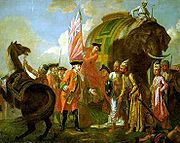 In India the outbreak of the Seven Years' War in Europe resulted in a renewal of the long running conflict between French and British trading companies in the region for influence. The war spread beyond southern India and into Bengal
, where British forces under Robert Clive recaptured Calcutta from the Nawab
Siraj ud-Daulah
, a French ally, and ousted him from his throne at the Battle of Plassey
. In the same year the British also captured the French settlement in Bengal at Chandernagar.
However, the war was decided in the south. Although the French captured Cuddalore
, their Siege of Madras
failed, while the British commander Sir Eyre Coote decisively defeated the French under the Comte de Lally
at the Battle of Wandiwash
in 1760 and overran the French territory of the Northern Circars. The French capital of Pondicherry fell to the British in 1761; together with the fall of the lesser French settlements of Karikal and Mahé this effectively eliminated French power from India.
, Pitt dispatched an expedition to take the French settlement at Saint Louis
. The British captured Senegal
with ease in May 1758 and brought home large amounts of captured goods. The success of the mission convinced Pitt to launch two further expeditions to take the island of Gorée
and the French trading post on the Gambia. The loss of these valuable colonies further weakened the French economy.
, which involved a complex series of land exchanges, the most important being France's cession to Spain of Louisiana
, and to Great Britain the rest of New France except for the islands of St. Pierre and Miquelon. France was given the choice of retrieving either New France
or its Caribbean island colonies of Guadeloupe
and Martinique
, and chose the latter to retain these lucrative sources of sugar, writing off New France as an unproductive, costly territory. France also returned Minorca to the British. Spain lost control of Florida
to Great Britain, but received part of New Orleans and the Louisiana Territory
west of the Mississippi River
from the French. The exchanges suited the British as well, as their own Caribbean islands already supplied ample sugar, and with the acquisition of New France and Florida, they now controlled all of North America east of the Mississippi.
In India, the British retained the Northern Circars, but returned all the French trading ports. The treaty, however, required that the fortifications of these settlements must be destroyed and never rebuilt, while only minimal garrisons could be maintained there, thus rendering them worthless as military bases. Combined with the loss of France's ally in Bengal
and the defection of Hyderabad
to the British side as a result of the war, this effectively brought French power in India to an end, making way for British hegemony and eventual control of the subcontinent.
European boundaries
were returned to their status quo ante bellum by the Treaty of Hubertusburg
(February 1763). Prussia thus maintained its possession of Silesia, having survived the combined assault of three neighbours, each larger than itself. Prussia gained enormously in influence at the expense of the Holy Roman Empire
. This increase in Prussian influence, it is argued, marks the beginning of the modern German state, an event at least as influential as the colonial empire Great Britain had gained. Others, including Fred Anderson
, author of Crucible of War, believe the war was needless and overly costly.
France's navy was crippled by the war. Only after an ambitious rebuilding program by France in combination with Spain was it again able to challenge Britain's command of the sea.
However, the British government was close to bankruptcy, and Britain now faced the delicate task of pacifying its new French-Canadian subjects, as well as the many American Indian tribes who had supported France. George III's Proclamation of 1763, which forbade white settlement beyond the crest of the Appalachians, was intended to appease the latter, but led to considerable outrage in the Thirteen Colonies
whose inhabitants were eager to acquire native lands. The Quebec Act
of 1774, similarly intended to win over the loyalty of French Canadians, also spurred resentment among American colonists. Victorious in 1763, Great Britain would soon face another military threat in North America—this time from its longtime subjects
, who no longer had to fear a hostile neighboring power.
The Seven Years' War was the last major military conflict fought primarily on the European continent before the outbreak of the French Revolutionary Wars
in 1792.
Great power
A great power is a nation or state that has the ability to exert its influence on a global scale. Great powers characteristically possess military and economic strength and diplomatic and cultural influence which may cause small powers to consider the opinions of great powers before taking actions...
s of the time and affecting Europe, North America
North America
North America is a continent wholly within the Northern Hemisphere and almost wholly within the Western Hemisphere. It is also considered a northern subcontinent of the Americas...
, Central America
Central America
Central America is the central geographic region of the Americas. It is the southernmost, isthmian portion of the North American continent, which connects with South America on the southeast. When considered part of the unified continental model, it is considered a subcontinent...
, the West Africa
West Africa
West Africa or Western Africa is the westernmost region of the African continent. Geopolitically, the UN definition of Western Africa includes the following 16 countries and an area of approximately 5 million square km:-Flags of West Africa:...
n coast, India
India
India , officially the Republic of India , is a country in South Asia. It is the seventh-largest country by geographical area, the second-most populous country with over 1.2 billion people, and the most populous democracy in the world...
, and the Philippines
Philippines
The Philippines , officially known as the Republic of the Philippines , is a country in Southeast Asia in the western Pacific Ocean. To its north across the Luzon Strait lies Taiwan. West across the South China Sea sits Vietnam...
. In the historiography of some countries, the war is alternatively named after combats in the respective theaters: the French and Indian War
French and Indian War
The French and Indian War is the common American name for the war between Great Britain and France in North America from 1754 to 1763. In 1756, the war erupted into the world-wide conflict known as the Seven Years' War and thus came to be regarded as the North American theater of that war...
(North America, 1754–63), Pomeranian War
Pomeranian War
The Pomeranian War was a theatre of the Seven Years' War. The term is used to describe the fighting between Sweden and Prussia between 1757 and 1762 in Swedish Pomerania, Prussian Pomerania, northern Brandenburg and eastern Mecklenburg-Schwerin....
(Sweden
Sweden
Sweden , officially the Kingdom of Sweden , is a Nordic country on the Scandinavian Peninsula in Northern Europe. Sweden borders with Norway and Finland and is connected to Denmark by a bridge-tunnel across the Öresund....
and Prussia
Prussia
Prussia was a German kingdom and historic state originating out of the Duchy of Prussia and the Margraviate of Brandenburg. For centuries, the House of Hohenzollern ruled Prussia, successfully expanding its size by way of an unusually well-organized and effective army. Prussia shaped the history...
, 1757–62), Third Carnatic War (Indian subcontinent
Indian subcontinent
The Indian subcontinent, also Indian Subcontinent, Indo-Pak Subcontinent or South Asian Subcontinent is a region of the Asian continent on the Indian tectonic plate from the Hindu Kush or Hindu Koh, Himalayas and including the Kuen Lun and Karakoram ranges, forming a land mass which extends...
, 1757–63), and Third Silesian War (Prussia
Kingdom of Prussia
The Kingdom of Prussia was a German kingdom from 1701 to 1918. Until the defeat of Germany in World War I, it comprised almost two-thirds of the area of the German Empire...
and Austria
Habsburg Monarchy
The Habsburg Monarchy covered the territories ruled by the junior Austrian branch of the House of Habsburg , and then by the successor House of Habsburg-Lorraine , between 1526 and 1867/1918. The Imperial capital was Vienna, except from 1583 to 1611, when it was moved to Prague...
, 1756–63).
The war was driven by the antagonism between Great Britain
Kingdom of Great Britain
The former Kingdom of Great Britain, sometimes described as the 'United Kingdom of Great Britain', That the Two Kingdoms of Scotland and England, shall upon the 1st May next ensuing the date hereof, and forever after, be United into One Kingdom by the Name of GREAT BRITAIN. was a sovereign...
(in personal union
House of Hanover
The House of Hanover is a deposed German royal dynasty which has ruled the Duchy of Brunswick-Lüneburg , the Kingdom of Hanover, the Kingdom of Great Britain, the Kingdom of Ireland and the United Kingdom of Great Britain and Ireland...
with Hanover) and the Bourbons
House of Bourbon
The House of Bourbon is a European royal house, a branch of the Capetian dynasty . Bourbon kings first ruled Navarre and France in the 16th century. By the 18th century, members of the Bourbon dynasty also held thrones in Spain, Naples, Sicily, and Parma...
(in France
Early Modern France
Kingdom of France is the early modern period of French history from the end of the 15th century to the end of the 18th century...
and Spain), resulting from overlapping interests in their colonial and trade empires, and by the antagonism between the Hohenzollerns
House of Hohenzollern
The House of Hohenzollern is a noble family and royal dynasty of electors, kings and emperors of Prussia, Germany and Romania. It originated in the area around the town of Hechingen in Swabia during the 11th century. They took their name from their ancestral home, the Burg Hohenzollern castle near...
(in Prussia
Kingdom of Prussia
The Kingdom of Prussia was a German kingdom from 1701 to 1918. Until the defeat of Germany in World War I, it comprised almost two-thirds of the area of the German Empire...
) and Habsburgs (Holy Roman Emperor
Holy Roman Emperor
The Holy Roman Emperor is a term used by historians to denote a medieval ruler who, as German King, had also received the title of "Emperor of the Romans" from the Pope...
s and archduke
Archduke
The title of Archduke denotes a noble rank above Duke and below King, used only by princes of the Houses of Habsburg and Habsburg-Lorraine....
s in Austria
Habsburg Monarchy
The Habsburg Monarchy covered the territories ruled by the junior Austrian branch of the House of Habsburg , and then by the successor House of Habsburg-Lorraine , between 1526 and 1867/1918. The Imperial capital was Vienna, except from 1583 to 1611, when it was moved to Prague...
), resulting from territorial
Silesian Wars
The Silesian Wars were a series of wars between Prussia and Austria for control of Silesia. They formed parts of the larger War of the Austrian Succession and Seven Years' War. They eventually ended with Silesia being incorporated into Prussia, and Austrian recognition of this...
and hegemonial conflicts in the Holy Roman Empire
Holy Roman Empire
The Holy Roman Empire was a realm that existed from 962 to 1806 in Central Europe.It was ruled by the Holy Roman Emperor. Its character changed during the Middle Ages and the Early Modern period, when the power of the emperor gradually weakened in favour of the princes...
. The Diplomatic Revolution
Diplomatic Revolution
The Diplomatic Revolution of 1756 is a term applied to the reversal of longstanding diplomatic alliances which were upheld until the War of the Austrian Succession and then reversed in the Seven Years' War; the shift has also been known as "the great change of partners"...
established an Anglo-Prussian camp
Anglo-Prussian Alliance
The Anglo-Prussian Alliance was a military alliance created by the Westminster Convention between Great Britain and Prussia which lasted formally between 1756 and 1762 during the Seven Years' War. It allowed Britain to concentrate the majority of its efforts against the colonial possessions of the...
, allied with some smaller German states and later Portugal
Portuguese Empire
The Portuguese Empire , also known as the Portuguese Overseas Empire or the Portuguese Colonial Empire , was the first global empire in history...
, as well as an Austro-French camp
Treaty of Versailles (1756)
The Treaty of Versailles was a diplomatic agreement between Austria and France signed on 1 May 1756 at the Palace of Versailles in which the two countries offered each other mutual assistance if attacked by other powers, which was broadly interpreted as meaning Britain or Prussia...
, allied with Sweden, Saxony
Electorate of Saxony
The Electorate of Saxony , sometimes referred to as Upper Saxony, was a State of the Holy Roman Empire. It was established when Emperor Charles IV raised the Ascanian duchy of Saxe-Wittenberg to the status of an Electorate by the Golden Bull of 1356...
and later Spain. The Russian Empire
Russian Empire
The Russian Empire was a state that existed from 1721 until the Russian Revolution of 1917. It was the successor to the Tsardom of Russia and the predecessor of the Soviet Union...
left its offensive alliance with the Habsburgs on the succession of Peter III
Peter III of Russia
Peter III was Emperor of Russia for six months in 1762. He was very pro-Prussian, which made him an unpopular leader. He was supposedly assassinated as a result of a conspiracy led by his wife, who succeeded him to the throne as Catherine II.-Early life and character:Peter was born in Kiel, in...
, and like Sweden concluded a separate peace with Prussia in 1762. The war ended with the peace treaties of Paris
Treaty of Paris (1763)
The Treaty of Paris, often called the Peace of Paris, or the Treaty of 1763, was signed on 10 February 1763, by the kingdoms of Great Britain, France and Spain, with Portugal in agreement. It ended the French and Indian War/Seven Years' War...
(Bourbon France and Spain, Great Britain) and of Hubertusburg
Treaty of Hubertusburg
thumb|right|300px|Hubertusburg, WermsdorfThe Treaty of Hubertusburg was signed on 15 February 1763 at Hubertusburg by Prussia, Austria, and Saxony. Together with the Treaty of Paris, it marked the end of the French and Indian War and of the Seven Years' War. The treaty ended the continental...
(Hohenzollerns, Habsburgs, Saxon elector) in 1763. The war was characterized by sieges and arson of towns as well as open battles involving extremely heavy losses; overall, some 900,000 to 1,400,000 people died.
Great Britain expelled her Bourbon rivals in the contested overseas territories, gaining the bulk of New France
New France
New France was the area colonized by France in North America during a period beginning with the exploration of the Saint Lawrence River by Jacques Cartier in 1534 and ending with the cession of New France to Spain and Great Britain in 1763...
, Spanish Florida
Spanish Florida
Spanish Florida refers to the Spanish territory of Florida, which formed part of the Captaincy General of Cuba, the Viceroyalty of New Spain, and the Spanish Empire. Originally extending over what is now the southeastern United States, but with no defined boundaries, la Florida was a component of...
, some Caribbean
Caribbean
The Caribbean is a crescent-shaped group of islands more than 2,000 miles long separating the Gulf of Mexico and the Caribbean Sea, to the west and south, from the Atlantic Ocean, to the east and north...
islands, Senegal
Senegal
Senegal , officially the Republic of Senegal , is a country in western Africa. It owes its name to the Sénégal River that borders it to the east and north...
and superiority over the French outposts on the Indian subcontinent. The native American tribes
Indigenous peoples of the Americas
The indigenous peoples of the Americas are the pre-Columbian inhabitants of North and South America, their descendants and other ethnic groups who are identified with those peoples. Indigenous peoples are known in Canada as Aboriginal peoples, and in the United States as Native Americans...
were excluded from the peace settlement, and were unable to return to their former status after the resulting Pontiac's rebellion. In Europe, Frederick II of Prussia
Frederick II of Prussia
Frederick II was a King in Prussia and a King of Prussia from the Hohenzollern dynasty. In his role as a prince-elector of the Holy Roman Empire, he was also Elector of Brandenburg. He was in personal union the sovereign prince of the Principality of Neuchâtel...
failed to complete a preemptive strike against Austria, and his numerically superior opponents repulsed and nearly annihilated his forces at Kunersdorf
Battle of Kunersdorf
The Battle of Kunersdorf, fought in the Seven Year's War, was Frederick the Great's most devastating defeat. On August 12, 1759, near Kunersdorf , east of Frankfurt , 50,900 Prussians were defeated by a combined allied army 59,500 strong consisting of 41,000 Russians and 18,500 Austrians under...
. Frederick however recovered, regained ground and managed to avoid any concessions in Hubertusburg, where the status quo ante bellum
Status quo ante bellum
The term status quo ante bellum is Latin, meaning literally "the state in which things were before the war".The term was originally used in treaties to refer to the withdrawal of enemy troops and the restoration of prewar leadership. When used as such, it means that no side gains or loses...
was restored. William Pitt
William Pitt, 1st Earl of Chatham
William Pitt, 1st Earl of Chatham PC was a British Whig statesman who led Britain during the Seven Years' War...
's saying that "America was won in Germany" referred to the Prussian war effort, which enabled Great Britain to keep her continental commitment limited and focus on her "blue water policy," successfully establishing naval supremacy. French and allied forces were able to occupy Prussian and Hanoveranian territories up to East Frisia
East Frisia
East Frisia or Eastern Friesland is a coastal region in the northwest of the German federal state of Lower Saxony....
. French ambitions to invade Britain
Planned French Invasion of Britain (1759)
A French invasion of Great Britain was planned to take place in 1759 during the Seven Years' War, but due to various factors including naval defeats at the Battle of Lagos and the Battle of Quiberon Bay was never launched. The French planned to land 100,000 French soldiers in Britain to end British...
and to continue with their guerre de course were thwarted by a British naval blockade, which also impaired French supply routes to the colonies. The involvement of Portugal, Spain and Sweden did not return them to their former status as great powers. Spain's short intervention resulted in the loss of Florida, though she gained French Louisiana
French Louisiana
The term French Louisiana refers to two distinct regions:* first, to colonial French Louisiana, comprising the massive, middle section of North America claimed by France; and,...
west of the Mississippi
Mississippi
Mississippi is a U.S. state located in the Southern United States. Jackson is the state capital and largest city. The name of the state derives from the Mississippi River, which flows along its western boundary, whose name comes from the Ojibwe word misi-ziibi...
in exchange and Britain returned western Cuba and Manila.
Nomenclature
In Canada, France, and the United Kingdom, the name Seven Years' War is used to describe the North American conflict as well as the European and Asian conflicts, as the name Nine Years' War was already taken.In the United States, however, the North American portion of the war, which started in 1754, is popularly known as the French and Indian War
French and Indian War
The French and Indian War is the common American name for the war between Great Britain and France in North America from 1754 to 1763. In 1756, the war erupted into the world-wide conflict known as the Seven Years' War and thus came to be regarded as the North American theater of that war...
. Many scholars and professional historians in America, such as Fred Anderson
Fred Anderson (historian)
Fred Anderson is an American historian of early North American history.Anderson received his B.A. from Colorado State University in 1971 and his Ph.D. from Harvard in 1981. He has taught at Harvard and at the University of Colorado, Boulder, where he is currently Professor of History...
, however, follow the example of their colleagues in other countries and refer to the conflict as the "Seven Years' War," regardless of the theatre.
In French Canada, the conflict is sometimes referred to as La Guerre de la Conquête, meaning The War of the Conquest.
The conflict in India is termed the Third Carnatic War
Carnatic Wars
The Carnatic Wars were a series of military conflicts in the middle of the 18th century on the Indian subcontinent...
while the fighting between Prussia and Austria is called the Third Silesian War. In Swedish historiography, the name Pommerska kriget (Pomeranian War) is used, as Swedish involvement was limited to Pomerania
Swedish Pomerania
Swedish Pomerania was a Dominion under the Swedish Crown from 1630 to 1815, situated on what is now the Baltic coast of Germany and Poland. Following the Polish War and the Thirty Years' War, Sweden held extensive control over the lands on the southern Baltic coast, including Pomerania and parts...
.
The war was described as the first "world war
World war
A world war is a war affecting the majority of the world's most powerful and populous nations. World wars span multiple countries on multiple continents, with battles fought in multiple theaters....
", though this label was also given to various earlier conflicts such as the Eighty Years' War, the Thirty Years' War
Thirty Years' War
The Thirty Years' War was fought primarily in what is now Germany, and at various points involved most countries in Europe. It was one of the most destructive conflicts in European history....
, the Spanish War of Succession and the Austrian War of Succession, and to later conflicts such as the Napoleonic Wars
Napoleonic Wars
The Napoleonic Wars were a series of wars declared against Napoleon's French Empire by opposing coalitions that ran from 1803 to 1815. As a continuation of the wars sparked by the French Revolution of 1789, they revolutionised European armies and played out on an unprecedented scale, mainly due to...
. As a partially Anglo-French conflict involving developing empires, the war was one of the most significant phases of the 18th century Second Hundred Years' War
Second Hundred Years' War
The Second Hundred Years' War is a periodization used by some historians to describe the series of military conflicts between the Kingdom of England and France that occurred from about 1689 to 1815. The term appears to have been coined by J. R...
.
Background
This war is often said to be a continuation of the War of the Austrian SuccessionWar of the Austrian Succession
The War of the Austrian Succession – including King George's War in North America, the Anglo-Spanish War of Jenkins' Ear, and two of the three Silesian wars – involved most of the powers of Europe over the question of Maria Theresa's succession to the realms of the House of Habsburg.The...
that had lasted between 1740 and 1748, in which King Frederick II of Prussia
Frederick II of Prussia
Frederick II was a King in Prussia and a King of Prussia from the Hohenzollern dynasty. In his role as a prince-elector of the Holy Roman Empire, he was also Elector of Brandenburg. He was in personal union the sovereign prince of the Principality of Neuchâtel...
, known as Frederick the Great, had gained the rich province of Silesia
Silesia
Silesia is a historical region of Central Europe located mostly in Poland, with smaller parts also in the Czech Republic, and Germany.Silesia is rich in mineral and natural resources, and includes several important industrial areas. Silesia's largest city and historical capital is Wrocław...
from Austria. Empress Maria Theresa of Austria
Maria Theresa of Austria
Maria Theresa Walburga Amalia Christina was the only female ruler of the Habsburg dominions and the last of the House of Habsburg. She was the sovereign of Austria, Hungary, Croatia, Bohemia, Mantua, Milan, Lodomeria and Galicia, the Austrian Netherlands and Parma...
had signed the Treaty of Aix-la-Chapelle
Treaty of Aix-la-Chapelle (1748)
The Treaty of Aix-la-Chapelle of 1748 ended the War of the Austrian Succession following a congress assembled at the Imperial Free City of Aachen—Aix-la-Chapelle in French—in the west of the Holy Roman Empire, on 24 April 1748...
only in order to gain time to rebuild her military forces and to forge new alliances, which she did with remarkable success. The political map of Europe had been redrawn in a few years as Austria abandoned its twenty-five year alliance with Britain
Anglo-Austrian Alliance
The Anglo-Austrian Alliance connected the Kingdom of Great Britain and the Habsburg monarchy during the first half of the 18th century. It was largely the work of the British statesman Duke of Newcastle, who considered an alliance with Austria crucial to prevent the further expansion of French...
. During the so-called Diplomatic Revolution
Diplomatic Revolution
The Diplomatic Revolution of 1756 is a term applied to the reversal of longstanding diplomatic alliances which were upheld until the War of the Austrian Succession and then reversed in the Seven Years' War; the shift has also been known as "the great change of partners"...
of 1756, the centuries-old enemies of France, Austria, and Russia formed a single alliance against Prussia.
Electorate of Hanover
The Electorate of Brunswick-Lüneburg was the ninth Electorate of the Holy Roman Empire of the German Nation...
possession as being threatened by France. In many respects the two powers' forces complemented each other excellently. The British had the largest, most effective navy in the world, while Prussia had the most formidable land force on continental Europe, allowing Great Britain to focus its soldiers towards colonial expeditions. The British hoped that the new series of alliances that had been formed during the Diplomatic Revolution would allow peace to continue, but they in fact provided the catalyst for the eruption of war in 1756.
The Austrian army had undergone an overhaul according to the Prussian system. Maria Theresa, whose knowledge of military affairs shamed many of her generals, had pressed relentlessly for reform. Her interest in the welfare of the soldiers had gained her their undivided respect. Austria had suffered several humiliating defeats to Prussia in the previous war, and strongly dissatisfied with the limited help they had received from the British, they now saw France as the only ally who could help them retake Silesia and check Prussia's expansion.
The second cause for war arose from the heated colonial struggle between the British Empire
British Empire
The British Empire comprised the dominions, colonies, protectorates, mandates and other territories ruled or administered by the United Kingdom. It originated with the overseas colonies and trading posts established by England in the late 16th and early 17th centuries. At its height, it was the...
and French Empire
French colonial empires
The French colonial empire was the set of territories outside Europe that were under French rule primarily from the 17th century to the late 1960s. In the 19th and 20th centuries, the colonial empire of France was the second-largest in the world behind the British Empire. The French colonial empire...
which, as they expanded, met and clashed with one another on two continents. Of particular dispute was control of the Ohio Country
Ohio Country
The Ohio Country was the name used in the 18th century for the regions of North America west of the Appalachian Mountains and in the region of the upper Ohio River south of Lake Erie...
which was central to both countries' ambitions of further expansion and development in North America. The two countries had been in a de facto state of war since 1754, but these military clashes remained confined to the American theatre.
1756
The British Prime Minister, the Duke of NewcastleThomas Pelham-Holles, 1st Duke of Newcastle-upon-Tyne
Thomas Pelham-Holles, 1st Duke of Newcastle-upon-Tyne and 1st Duke of Newcastle-under-Lyne, KG, PC was a British Whig statesman, whose official life extended throughout the Whig supremacy of the 18th century. He is commonly known as the Duke of Newcastle.A protégé of Sir Robert Walpole, he served...
, remained optimistic that war could be prevented from breaking out in Europe by the new series of alliances. However a large French force was assembled at Toulon
Toulon
Toulon is a town in southern France and a large military harbor on the Mediterranean coast, with a major French naval base. Located in the Provence-Alpes-Côte-d'Azur region, Toulon is the capital of the Var department in the former province of Provence....
, and the French opened the campaign against the British by an attack on Minorca
Siege of Minorca
The Siege of Fort St Philip took place in 1756 during the Seven Years War.- Siege :...
in the Mediterranean. A British attempt at relief was foiled at the Battle of Minorca
Battle of Minorca
The Battle of Minorca was a naval battle between French and British fleets. It was the opening sea battle of the Seven Years' War in the European theatre. Shortly after Great Britain declared war on the House of Bourbon, their squadrons met off the Mediterranean island of Minorca. The fight...
and the island was captured on 28 June (for which Admiral Byng
John Byng
Admiral John Byng was a Royal Navy officer. After joining the navy at the age of thirteen he participated at the Battle of Cape Passaro in 1718. Over the next thirty years he built up a reputation as a solid naval officer and received promotion to Vice-Admiral in 1747...
was court-martialed and executed). War between Britain and France had been formally declared on 18 May nearly two years after the first fighting had broken out in the Ohio Country
Ohio Country
The Ohio Country was the name used in the 18th century for the regions of North America west of the Appalachian Mountains and in the region of the upper Ohio River south of Lake Erie...
.
Anglo-Prussian Alliance
The Anglo-Prussian Alliance was a military alliance created by the Westminster Convention between Great Britain and Prussia which lasted formally between 1756 and 1762 during the Seven Years' War. It allowed Britain to concentrate the majority of its efforts against the colonial possessions of the...
, Frederick II of Prussia
Frederick II of Prussia
Frederick II was a King in Prussia and a King of Prussia from the Hohenzollern dynasty. In his role as a prince-elector of the Holy Roman Empire, he was also Elector of Brandenburg. He was in personal union the sovereign prince of the Principality of Neuchâtel...
crossed the border of Saxony
Electorate of Saxony
The Electorate of Saxony , sometimes referred to as Upper Saxony, was a State of the Holy Roman Empire. It was established when Emperor Charles IV raised the Ascanian duchy of Saxe-Wittenberg to the status of an Electorate by the Golden Bull of 1356...
on 29 August 1756, one of the small German states in league with Austria. He intended this as a bold pre-emption of an anticipated Austro-French invasion of Silesia
Silesia
Silesia is a historical region of Central Europe located mostly in Poland, with smaller parts also in the Czech Republic, and Germany.Silesia is rich in mineral and natural resources, and includes several important industrial areas. Silesia's largest city and historical capital is Wrocław...
. The Saxon and Austrian armies were unprepared, and their forces were scattered. At the Battle of Lobositz
Battle of Lobositz
The Battle of Lobositz or Lovosice also Lowositz on 1 October 1756 was the opening land battle of the Seven Years' War. Frederick the Great's 29,000 Prussians prevented Field Marshal Maximilian Ulysses Count Browne 34,500 Austrians from relieving their besieged Saxon allies during the Siege of...
, King Frederick prevented the isolated Saxon army from being reinforced by an Austrian army under General Browne. The Prussians then overran the Electorate, resulting in the Prussian occupation of Saxony and the surrender of the Saxon Army
Siege of Pirna
The Siege of Pirna took place in 1756 as part of the Prussian invasion of Saxony during the Seven Years War.Following the occupation of the capital Dresden by Frederick the Great on 9 September the Saxon army had withdrawn south and taken up position at the fortress of Pirna under Frederick von...
at Pirna
Pirna
Pirna is a town in the Free State of Saxony, Germany, capital of the administrative district Sächsische Schweiz-Osterzgebirge. The town's population is over 40,000. Pirna is located near Dresden and is an important district town as well as a Große Kreisstadt...
in October 1756 which was then forcibly incorporated into the Prussian forces. The attack on the neutral Electorate of Saxony caused outrage across Europe and led to the strengthening of the anti-Prussian coalition. The only significant Austrian success was the partial occupation of Silesia.
Britain had been surprised by the sudden Prussian offensive, but now began shipping supplies and money to their allies. A combined German force was organised under the Duke of Cumberland to protect Hanover
Hanover
Hanover or Hannover, on the river Leine, is the capital of the federal state of Lower Saxony , Germany and was once by personal union the family seat of the Hanoverian Kings of Great Britain, under their title as the dukes of Brunswick-Lüneburg...
from a French invasion. The British attempted to persuade the Dutch Republic
Dutch Republic
The Dutch Republic — officially known as the Republic of the Seven United Netherlands , the Republic of the United Netherlands, or the Republic of the Seven United Provinces — was a republic in Europe existing from 1581 to 1795, preceding the Batavian Republic and ultimately...
to join the alliance, but the request was rejected as the Dutch wished to remain fully neutral. Despite the huge disparity in numbers, the year had been a successful one for the Prussian-led forces on the continent, in contrast to disappointing British campaigns in North America.
1757
In early 1757, Frederick II again took the initiative by marching into the Kingdom of Bohemia
Kingdom of Bohemia
The Kingdom of Bohemia was a country located in the region of Bohemia in Central Europe, most of whose territory is currently located in the modern-day Czech Republic. The King was Elector of Holy Roman Empire until its dissolution in 1806, whereupon it became part of the Austrian Empire, and...
, hoping to inflict a decisive defeat on the Austrian forces. After the bloody Battle of Prague, the Prussians laid siege to the city, but had to lift the siege after a major Austrian counter-attack and Frederick's first defeat at the Battle of Kolin
Battle of Kolin
-Results:The battle was Frederick's first defeat in this war. This disaster forced him to abandon his intended march on Vienna, raise his siege of Prague, and fall back on Litoměřice...
. That summer, the Russians had invaded East Prussia
East Prussia
East Prussia is the main part of the region of Prussia along the southeastern Baltic Coast from the 13th century to the end of World War II in May 1945. From 1772–1829 and 1878–1945, the Province of East Prussia was part of the German state of Prussia. The capital city was Königsberg.East Prussia...
and defeated a smaller Prussian force in the fiercely contested Battle of Gross-Jägersdorf
Battle of Gross-Jägersdorf
The Battle of Gross-Jägersdorf was a victory for the Russian force under Field Marshal Stepan Fedorovich Apraksin over a smaller Prussian force commanded by Field Marshal Hans von Lehwaldt, during the Seven Years' War.- Background :...
. Further defeats followed. Frederick was forced to break off his invasion of Bohemia, and withdraw back into Prussian-controlled territory.
Things were looking very grim for Prussia at this time, with the Austrians mobilising to attack Prussian-controlled soil and a French army under Soubise approaching from the west. In November and December the whole situation in Germany was reversed. Frederick devastated first Soubise's French force at the Battle of Rossbach
Battle of Rossbach
The Battle of Rossbach took place during the Seven Years' War near the village of Roßbach, in the Electorate of Saxony. Frederick the Great defeated the allied armies of France and the Holy Roman/Austrian Empire...
and then routed a vastly superior Austrian force at the Battle of Leuthen
Battle of Leuthen
In the Battle of Leuthen or Lissa, fought on 5 December 1757, Frederick the Great's Prussian army used maneuver and terrain to decisively defeat a much larger Austrian army under Charles of Lorraine, thus ensuring Prussian control of Silesia during the Seven Years' War.- Background :While Frederick...
. With these great victories, Frederick once again established himself as Europe's finest general and his men as Europe's finest soldiers. In spite of these successes, the Prussians were now facing the prospect of four major powers attacking on four fronts (France from the West, Austria from the South, Russia from the East and Sweden from the North). Meanwhile a combined force from smaller German states, such as Bavaria
Bavaria
Bavaria, formally the Free State of Bavaria is a state of Germany, located in the southeast of Germany. With an area of , it is the largest state by area, forming almost 20% of the total land area of Germany...
, had established under Austrian leadership—and this threatened Prussian control of Saxony.
This problem was compounded when the main Hanoverian army under Cumberland was defeated at the Battle of Hastenbeck
Battle of Hastenbeck
The Battle of Hastenbeck was fought as part of the Invasion of Hanover during the Seven Year's War between the allied forces of Hanover, Hesse-Kassel and Brunswick and the French...
and then forced to surrender entirely at the Convention of Klosterzeven
Convention of Klosterzeven
The Convention of Klosterzeven was a 1757 convention signed at Klosterzeven between France and the Electorate of Hanover during the Seven Years' War that led to Hanover's withdrawal from the war and partial occupation by French forces. It came in the wake of the Battle of Hastenbeck in which...
following a French Invasion of Hanover
Invasion of Hanover (1757)
The Invasion of Hanover took place in 1757 during the Seven Years' War when a French army under Louis Charles César Le Tellier, duc d'Estrées advanced into Electorate of Hanover and neighbouring German states following the Battle of Hastenbeck. French forces overran most of Hanover forcing the Army...
. The Convention removed Hanover and Brunswick from the war, leaving the Western approach to Prussian territory extremely vulnerable. Frederick sent urgent requests to Britain for more substantial assistance, as he was now without any military support for his forces in Germany.
The British had suffered further defeats in North America, particularly at Fort William Henry
Fort William Henry
Fort William Henry was a British fort at the southern end of Lake George in the province of New York. It is best known as the site of notorious atrocities committed by Indians against the surrendered British and provincial troops following a successful French siege in 1757, an event which is the...
. At home however stability had been established. Since 1756, successive governments led by Newcastle and William Pitt
William Pitt, 1st Earl of Chatham
William Pitt, 1st Earl of Chatham PC was a British Whig statesman who led Britain during the Seven Years' War...
had both fallen. In August 1757, the two men agreed to a political partnership and formed a coalition government
Coalition government
A coalition government is a cabinet of a parliamentary government in which several political parties cooperate. The usual reason given for this arrangement is that no party on its own can achieve a majority in the parliament...
which gave new, firmer direction to the British war effort. The new strategy emphasised both Newcastle's commitment to British involvement on the European continent particularly in defence of Germany and William Pitt's determination to use British naval power to launch expeditions to seize French colonies
French Colonies
"French Colonies" is the name used by philatelists to refer to the postage stamps issued by France for use in the parts of the French colonial empire that did not have stamps of their own...
around the globe. The "dual strategy" would dominate British policy for the next five years.
In late 1757, thanks to the Prussian victories at Rossbach and Leuthen, the situation appeared to have swung in Frederick's favour and the sudden decision of the Russian Empire to withdraw its troops from East Prussia offered further relief. Frederick calculating that no further Russian advance was likely until 1758, then moved the bulk of his eastern forces to Pomerania to repel a Swedish invasion. Within a short period they had driven the Swedes back, occupied most of Swedish Pomerania
Swedish Pomerania
Swedish Pomerania was a Dominion under the Swedish Crown from 1630 to 1815, situated on what is now the Baltic coast of Germany and Poland. Following the Polish War and the Thirty Years' War, Sweden held extensive control over the lands on the southern Baltic coast, including Pomerania and parts...
and blockaded its capital Stralsund
Stralsund
- Main sights :* The Brick Gothic historic centre is a UNESCO World Heritage Site.* The heart of the old town is the Old Market Square , with the Gothic Town Hall . Behind the town hall stands the imposing Nikolaikirche , built in 1270-1360...
. George II of Great Britain
George II of Great Britain
George II was King of Great Britain and Ireland, Duke of Brunswick-Lüneburg and Archtreasurer and Prince-elector of the Holy Roman Empire from 11 June 1727 until his death.George was the last British monarch born outside Great Britain. He was born and brought up in Northern Germany...
, on the advice of his British ministers, revoked the convention of Klosterzeven and Hanover re-entered the war. Over the winter the new commander of the Hanoverian forces, Duke Ferdinand of Brunswick
Duke Ferdinand of Brunswick
Ferdinand, Prince of Brunswick-Lüneburg , was a Prussian field marshal known for his participation in the Seven Years' War...
, regrouped his army and launched a series of offensives that drove the French back across the River Rhine.
1758
Moravia
Moravia is a historical region in Central Europe in the east of the Czech Republic, and one of the former Czech lands, together with Bohemia and Silesia. It takes its name from the Morava River which rises in the northwest of the region...
, and laid siege to Olomouc
Siege of Olomouc
The Siege of Olomouc took place in 1758 when a Prussian army led by Frederick the Great besieged the Austrian city of Olomouc during the Prussian invasion of Moravia in the Seven Years' War. The attempt stalled as the besiegers faced stronger resistance than Frederick had expected...
. Following the Battle of Domstadtl
Battle of Domstadtl
The Battle of Domstadtl, also spelled Domstadt, Czech Domašov, was a battle between Habsburg Monarchy and Kingdom of Prussia at a Moravian village Domašov nad Bystřicí during the Seven Years' War on 30 June 1758, preceded by a minor clash at Guntramovice on 28 June...
, Frederick broke off the siege and withdrew from Moravia. It marked the end of his final attempt to launch a major invasion of Austrian territory. East Prussia
East Prussia
East Prussia is the main part of the region of Prussia along the southeastern Baltic Coast from the 13th century to the end of World War II in May 1945. From 1772–1829 and 1878–1945, the Province of East Prussia was part of the German state of Prussia. The capital city was Königsberg.East Prussia...
had been occupied by Russian forces over the winter, and would remain under their control until 1762, although Frederick did not see the Russians as an immediate threat and instead entertained hopes of first fighting a decisive battle against Austria that would knock them out of the war.
In April 1758, the British concluded the Anglo-Prussian Convention
Anglo-Prussian Convention
The Anglo-Prussian Convention was agreed on 11 April 1758 between Great Britain and the Kingdom of Prussia formalising the alliance between them that had effectively existed since the Convention of Westminster in 1756....
with Frederick, in which they committed to pay him an annual subsidy
Golden Cavalry of St George
The Golden Cavalry of St George was the colloquial name of subsidies paid out by the British government to other European states in the eighteenth and nineteenth centuries, through particularly during the Napoleonic Wars...
of £670,000. Britain also dispatched a force of 9,000 troops to reinforce Ferdinand's Hanoverian army, the first British troop commitment on the continent and a reversal in the policy of Pitt who had previously opposed such a move. Ferdinand had succeeded in driving the French from Hanover and Westphalia and re-captured the port of Emden in March 1758, before crossing the Rhine with his own forces which caused alarm in France. Despite Ferdinand's victory over the French at the Battle of Krefeld
Battle of Krefeld
The Battle of Krefeld was a battle fought on 23 June 1758 between a Prussian-Hanoverian army and a French army during the Seven Years' War.-Background:...
and the brief occupation of Düsseldorf
Düsseldorf
Düsseldorf is the capital city of the German state of North Rhine-Westphalia and centre of the Rhine-Ruhr metropolitan region.Düsseldorf is an important international business and financial centre and renowned for its fashion and trade fairs. Located centrally within the European Megalopolis, the...
, he was then forced to withdraw across the Rhine by successful manoeuvring by larger French forces.
By this point Frederick had grown increasingly concerned about the Russian advance from the east and marched to counter it. In August 1758, at the Battle of Zorndorf
Battle of Zorndorf
The Battle of Zorndorf was a battle fought on August 25, 1758 during the Seven Years' War, fought between the forces of the Russians troops under the command of Count William Fermor – and a Prussian army under King Frederick the Great...
a Prussian army of 35,000 men under Frederick fought to a standstill a Russian army of 43,000 commanded by Count Fermor
William Fermor
William Fermor was an Imperial Russian Army officer best known for leading his country’s army at the Battle of Zorndorf during the Seven Years’ War. His name is sometimes styled Wilhelm von Fermor or Villim Villimovich Fermor.-Early life:...
. Although both sides suffered heavy casualties and the Russians withdrew from the field in good order, Frederick claimed a victory. In the undecided Battle of Tornow
Battle of Tornow
The Battle of Tornow was part of the Seven Years War and was fought between the forces of Prussia and Sweden on 26 September 1758.The Prussians sent 6,000 men, led by general Wedel to protect Berlin. Wedel attacked aggressively and let his cavalry attack a Swedish force of some 600 men at Tornow...
on 25 September, a Swedish army repulsed six assaults by a Prussian army, but did not push home an attempt to move on Berlin following the Battle of Fehrbellin
Battle of Fehrbellin (1758)
The Battle of Fehrbellin was a battle at Fehrbellin of the Seven Years' War between Swedish and Prussian forces fought on September 28, 1758.The Prussian forces under General Carl Heinrich von Wedel were attempting to stop the Swedish offensive into Brandenburg...
.
Battle of Hochkirch
The Battle of Hochkirch was a battle fought on October 14, 1758 during the Seven Years' War between a Prussian army of 30,000-36,000 commanded by Frederick the Great and an Austrian army of 80,000 commanded by Marshal Leopold Josef Graf Daun...
in Saxony. Frederick lost much of his artillery but retreated in good order, helped by the densely wooded landscape. The Austrians had ultimately made little progress in the campaign in Saxony despite Hochkirch and had failed to achieve a decisive breakthrough. After a thwarted attempt to take Dresden, Daun's troops were forced to withdraw to Austrian territory for the winter, so that Saxony remained under Prussian occupation.
In France, 1758 had been a disappointing year and in the wake of this a new Chief Minister, the Duc de Choiseul
Étienne François, duc de Choiseul
Étienne-François, comte de Stainville, duc de Choiseul was a French military officer, diplomat and statesman. Between 1758 and 1761, and 1766 and 1770, he was Foreign Minister of France and had a strong influence on France's global strategy throughout the period...
was appointed. Choiseul planned to end the war in 1759 by making strong attacks on Britain and Hanover.
1759–60
The year 1759 saw some severe Prussian defeats. At the Battle of KayBattle of Kay
The Battle of Kay or Battle of Paltzig was a battle fought on July 23, 1759 during the Seven Years' War. It occurred near Kay in the Neumark, now part of Poland....
, or Paltzig, the Russian Count Saltykov with 47,000 Russians defeated 26,000 Prussian troops commanded by General Carl Heinrich von Wedel
Carl Heinrich von Wedel
Carl Heinrich von Wedel was a Prussian general in the Seven Years War, who fought at the Battle of Fehrbellin in 1758....
. Though the Hanoverians defeated an army of 60,000 French at Minden
Battle of Minden
The Battle of Minden—or Thonhausen—was fought on 1 August 1759, during the Seven Years' War. An army fielded by the Anglo-German alliance commanded by Field Marshal Ferdinand, Duke of Brunswick, defeated a French army commanded by Marshal of France Louis, Marquis de Contades...
, Austrian general Daun
Leopold Josef Graf Daun
Count Leopold Joseph von Daun , later Prince of Thiano, Austrian field marshal, was born at Vienna, as son of Count Wirich Philipp von Daun.- Background :...
forced the surrender of an entire Prussian corps of 13,000 men in the Battle of Maxen
Battle of Maxen
The Battle of Maxen was a battle at Maxen, Saxony in present-day Germany during the Seven Years' War. It resulted in surrender of prussian corps....
. Frederick himself lost half his army in the Battle of Kunersdorf
Battle of Kunersdorf
The Battle of Kunersdorf, fought in the Seven Year's War, was Frederick the Great's most devastating defeat. On August 12, 1759, near Kunersdorf , east of Frankfurt , 50,900 Prussians were defeated by a combined allied army 59,500 strong consisting of 41,000 Russians and 18,500 Austrians under...
, the worst defeat in his military career, and one that drove him to the brink of abdication and suicide. The disaster resulted partly from his misjudgment of the Russians, who had already demonstrated their strength at Zorndorf and at Gross-Jägersdorf
Battle of Gross-Jägersdorf
The Battle of Gross-Jägersdorf was a victory for the Russian force under Field Marshal Stepan Fedorovich Apraksin over a smaller Prussian force commanded by Field Marshal Hans von Lehwaldt, during the Seven Years' War.- Background :...
.
Planned French Invasion of Britain (1759)
A French invasion of Great Britain was planned to take place in 1759 during the Seven Years' War, but due to various factors including naval defeats at the Battle of Lagos and the Battle of Quiberon Bay was never launched. The French planned to land 100,000 French soldiers in Britain to end British...
during 1759 by accumulating troops near the mouth of the Loire and concentrating their Brest and Toulon fleets. However, two sea defeats prevented this. In August, the Mediterranean fleet under Jean-François de La Clue-Sabran
Jean-François de La Clue-Sabran
Jean-François de La Clue-Sabran was a French Admiral best known for his command of the French fleet in the Mediterranean Sea during the Seven Years' War.-Seven Years War:...
was scattered by a larger British fleet under Edward Boscawen
Edward Boscawen
Admiral Edward Boscawen, PC was an Admiral in the Royal Navy and Member of Parliament for the borough of Truro, Cornwall. He is known principally for his various naval commands throughout the 18th Century and the engagements that he won, including the Siege of Louisburg in 1758 and Battle of Lagos...
at the Battle of Lagos. In the Battle of Quiberon Bay
Battle of Quiberon Bay
The naval Battle of Quiberon Bay took place on 20 November 1759 during the Seven Years' War in Quiberon Bay, off the coast of France near St. Nazaire...
on 20 November, the British admiral Edward Hawke with 23 ships of the line
Ship of the line
A ship of the line was a type of naval warship constructed from the 17th through the mid-19th century to take part in the naval tactic known as the line of battle, in which two columns of opposing warships would manoeuvre to bring the greatest weight of broadside guns to bear...
caught the French Brest fleet with 21 ships of the line under Marshal de Conflans and sank, captured or forced aground many of them, putting an end to the French plans.
Battle of Landshut (1760)
The Battle of Landeshut was an engagement fought on June 23, 1760 during the Seven Years' War.A Prussian army of 12,000 men under General Heinrich August de la Motte Fouqué fought an Austrian army of over 28,000 men under General von Loudon and suffered a defeat, with its commander taken...
. The French captured Marburg
Marburg
Marburg is a city in the state of Hesse, Germany, on the River Lahn. It is the main town of the Marburg-Biedenkopf district and its population, as of March 2010, was 79,911.- Founding and early history :...
, and the Swedes part of Brandenburg-Prussian Pomerania. The Hanoverians were victorious over the French at the Battle of Warburg
Battle of Warburg
The Battle of Warburg was a battle fought on 31 July 1760 during the Seven Years' War. The Battle was a victory for the Hanoverians and the British against the French. British general John Manners, Marquess of Granby achieved some fame for charging at the head of the British cavalry and losing his...
, their continued success preventing France from sending troops to aid the Austrians against Prussia in the east. Despite this the Austrians, under the command of General Laudon captured Glatz (now Kłodzko) in Silesia. In the Battle of Liegnitz
Battle of Liegnitz (1760)
The Battle of Liegnitz on August 15, 1760 saw Frederick the Great's Prussian Army defeat the Austrian army under Ernst von Laudon.The armies collided around the Prussian Silesian city of Liegnitz . Frederick split his army in 2, one part commanded by Field Marshal Zieten. Frederick heard the sound...
Frederick scored a victory despite being outnumbered three to one. The Russians under General Saltykov
Pyotr Saltykov
Count Pyotr Semyonovich Saltykov was a Russian statesman and a military figure, russian general-fieldmarshal , son of Semyon Saltykov....
and Austrians under General Lacy briefly occupied his capital, Berlin, in October. The end of that year saw Frederick once more victorious, defeating the able Daun in the Battle of Torgau
Battle of Torgau
In the Battle of Torgau on 3 November 1760, King Frederick the Great's Prussian army fought a larger Austrian army under the command of Field Marshal Leopold Josef Graf Daun. The Prussians won a costly victory in one of the bloodiest battles of the Seven Years' War.-Background:In August, Daun...
, but he suffered heavy casualties and the Austrians retreated in good order.
1761–62
Spanish Empire
The Spanish Empire comprised territories and colonies administered directly by Spain in Europe, in America, Africa, Asia and Oceania. It originated during the Age of Exploration and was therefore one of the first global empires. At the time of Habsburgs, Spain reached the peak of its world power....
on 4 January 1762; Spain reacted by issuing their own declaration of war against Britain on 18 January. Portugal followed by joining the war on Britain's side. Spain, aided by the French, launched an invasion of Portugal and succeeded in capturing Almeida
Siege of Almeida (1762)
The Siege of Almeida took place in August 1762 when a Spanish force besieged and captured the city of Almeida from its Portuguese defenders during the Seven Years' War. The city was taken on 25 August as part of the invasion of Portugal by a Spanish army commanded by the Conte De Aranda.The force...
. The arrival of British reinforcements stalled a further Spanish advance, and the Battle of Valencia de Alcántara
Battle of Valencia de Alcántara
The Battle of Valencia de Alcántara took place in August 1762 when an Anglo Portuguese force led by John Burgoyne surprised and captured the town of Valencia de Alcántara from its Spanish defenders during the Seven Years' War...
saw British-Portuguese forces overrun a major Spanish supply base.
In February 1761 Duke Ferdinand of Brunswick
Duke Ferdinand of Brunswick
Ferdinand, Prince of Brunswick-Lüneburg , was a Prussian field marshal known for his participation in the Seven Years' War...
surprised French troops at Langensalza
Battle of Langensalza (1761)
The Battle of Langensalza was an engagement between French forces and allied Prussian and Hanoverian forces during the Seven Years' War. It was fought near Langensalza in what is now eastern Germany, but was then in the Kingdom of Prussia. An allied advance surprised the French, resulting in the...
, and then advanced to besiege Cassel
Siege of Cassel (1761)
The Siege of Cassel was a failed attempt by Duke Ferdinand of Brunswick to capture French-held Kassel, the capital of Hesse-Kassel. Brunswick lifted the siege after forces of the Duc de Broglie inflicted heavy casualties on his forces at the Battle of Grünberg, making continuation of the siege...
in March. He was forced to lift the siege and retreat after French forces regrouped and captured several thousand of his men at the Battle of Grünberg
Battle of Grünberg
The Battle of Grünberg was fought between French and allied Prussian and Hanoverian troops in the Seven Years' War at village of Grünberg, near Stangerode. The French inflicted a significant defeat on the allies, taking several thousand prisoners, and capturing 18 military standards...
. At the Battle of Villinghausen
Battle of Villinghausen
The Battle of Villinghausen was a battle in the Seven Years' War fought on 15 and 16 July 1761 between a large French army and a combined Prussian-Hanoverian-British force led by Prince Ferdinand of Brunswick.-Background:...
, Prince Ferdinand of Brunswick defeated a 92,000-man French army. The Russians under Zakhar Chernyshev and Pyotr Rumyantsev
Pyotr Rumyantsev
Count Pyotr Alexandrovich Rumyantsev-Zadunaisky was one of the foremost Russian generals of the 18th century. He governed Little Russia in the name of Empress Catherine the Great from the abolition of the Cossack Hetmanate in 1764 until Catherine's death 32 years later...
stormed Kolberg in Pomerania, while the Austrians captured Schweidnitz. The loss of Kolberg cost Prussia its last port on the Baltic Sea
Baltic Sea
The Baltic Sea is a brackish mediterranean sea located in Northern Europe, from 53°N to 66°N latitude and from 20°E to 26°E longitude. It is bounded by the Scandinavian Peninsula, the mainland of Europe, and the Danish islands. It drains into the Kattegat by way of the Øresund, the Great Belt and...
. In Britain, it was speculated that a total Prussian collapse was now imminent.
Britain now threatened to withdraw its subsidies if Prussia didn't seriously consider offering to make concessions to secure peace. As the Prussian armies had dwindled to just 60,000 men Frederick's survival was severely threatened. Then on 5 January 1762 the Russian Empress Elizabeth died. Her Prussophile successor, Peter III
Peter III of Russia
Peter III was Emperor of Russia for six months in 1762. He was very pro-Prussian, which made him an unpopular leader. He was supposedly assassinated as a result of a conspiracy led by his wife, who succeeded him to the throne as Catherine II.-Early life and character:Peter was born in Kiel, in...
, at once recalled Russian armies from Berlin (see: the Treaty of Saint Petersburg (1762)
Treaty of Saint Petersburg (1762)
The Treaty of Saint Petersburg was concluded on May 5, 1762 and ended the fighting in the Seven Years War between Prussia and Russia. The treaty followed the accession of Tsar Peter III, who admired the Prussian king Frederick the Great...
) and mediated Frederick's truce with Sweden. This turn of events has become known as the miracle of the House of Brandenburg
The miracle of the House of Brandenburg
The Miracle of the House of Brandenburg is the name given by Frederick II of Prussia to the failure of Russia and Austria to follow up their victory over him at the Battle of Kunersdorf on 12 August 1759.-Miracle of the House of Brandenburg:...
. In the aftermath, Frederick was able to drive the Austrians from Silesia in the Battle of Freiberg
Battle of Freiberg
The Battle of Freiberg was fought on October 29, 1762 and was the last great battle of the Seven Years' War.-Background:Prince Henry of Prussia, younger brother of King Frederick II of Prussia, although commanding an army made up mostly of ‘second line’ troops and free- battalions, decided to take...
(29 October 1762), while his Brunswick allies captured the key town of Göttingen
Göttingen
Göttingen is a university town in Lower Saxony, Germany. It is the capital of the district of Göttingen. The Leine river runs through the town. In 2006 the population was 129,686.-General information:...
and compounded it by taking Cassel.
The long British naval blockade of French ports had sapped the morale of the French populace. France continue to collapse yet further when news of a faliure at the Battle of Signal Hill
Battle of Signal Hill
The Battle of Signal Hill was a small skirmish, the last of the North American theatre of the Seven Years' War. The British under Lieutenant Colonel William Amherst forced the French to surrender St...
in Newfoundland reached Paris. Feelers for peace were soon extended to the British.
1763
By 1763 Frederick had Silesia under his control and had occupied parts of Austria. The British subsidies had been withdrawn by the new Prime Minister Lord Bute, and the Russian Emperor had been overthrown by his wife Catherine the Great who now switched Russian support back to Austria and launched fresh attacks on Prussia. Austria, however, had been weakened from the war and like most participants they were facing a severe financial crisis. In 1763 a peace settlement was reached at the Treaty of Hubertusburg
Treaty of Hubertusburg
thumb|right|300px|Hubertusburg, WermsdorfThe Treaty of Hubertusburg was signed on 15 February 1763 at Hubertusburg by Prussia, Austria, and Saxony. Together with the Treaty of Paris, it marked the end of the French and Indian War and of the Seven Years' War. The treaty ended the continental...
ending the war in central Europe.
British amphibious "descents"
Great Britain planned a "descent" (an amphibious demonstrationAmphibious warfare
Amphibious warfare is the use of naval firepower, logistics and strategy to project military power ashore. In previous eras it stood as the primary method of delivering troops to non-contiguous enemy-held terrain...
or raid) on Rochefort
Rochefort, Charente-Maritime
Rochefort is a commune in southwestern France, a port on the Charente estuary. It is a sub-prefecture of the Charente-Maritime department.-History:...
, a joint operation
Joint warfare
Joint warfare is a military doctrine which places priority on the integration of the various service branches of a state's armed forces into one unified command...
to overrun the town and burn the shipping in the Charente
Charente River
The Charente is a 381 km long river in southwestern France.Its source is in the Haute-Vienne département at Chéronnac, a small village near Rochechouart. It flows through the departments of Haute-Vienne, Charente, Vienne and Charente-Maritime...
. The expedition set out on 8 September 1757, Sir John Mordaunt commanding the troops and Sir Edward Hawke the fleet. On 23 September, the Isle d'Aix was taken, but due to dithering by military staff such time was lost that Rochefort became unassailable, and the expedition abandoned the Isle d'Aix, returning to Great Britain on 1 October.
William Pitt, 1st Earl of Chatham
William Pitt, 1st Earl of Chatham PC was a British Whig statesman who led Britain during the Seven Years' War...
—who saw purpose in this type of asymmetric enterprise—prepared to continue such operations. An army was assembled under the command of Charles Spencer, 3rd Duke of Marlborough
Charles Spencer, 3rd Duke of Marlborough
Charles Spencer, 3rd Duke of Marlborough KG, PC , known as The Earl of Sunderland between 1729 and 1733, was a British soldier and politician. He briefly served as Lord Privy Seal in 1755...
; he was aided by Lord George Sackville
George Germain, 1st Viscount Sackville
George Germain, 1st Viscount Sackville PC , known as the Hon. George Sackville to 1720, as Lord George Sackville from 1720 to 1770, and as Lord George Germain from 1770 to 1782, was a British soldier and politician who was Secretary of State for America in Lord North's cabinet during the American...
. The naval escorts for the expedition were commanded by Anson
George Anson, 1st Baron Anson
Admiral of the Fleet George Anson, 1st Baron Anson PC, FRS, RN was a British admiral and a wealthy aristocrat, noted for his circumnavigation of the globe and his role overseeing the Royal Navy during the Seven Years' War...
, Hawke, and Howe
Richard Howe, 1st Earl Howe
Admiral of the Fleet Richard Howe, 1st Earl Howe KG was a British naval officer, notable in particular for his service during the American War of Independence and French Revolutionary Wars. He was the brother of William Howe and George Howe.Howe joined the navy at the age of thirteen and served...
. The army landed on 5 June 1758 at Cancalle Bay, proceeded to St. Malo, and burned the shipping in the harbor; the arrival of French relief forces caused the British to avoid a siege, and the troops re-embarked. An attack on Havre de Grace
Le Havre
Le Havre is a city in the Seine-Maritime department of the Haute-Normandie region in France. It is situated in north-western France, on the right bank of the mouth of the river Seine on the English Channel. Le Havre is the most populous commune in the Haute-Normandie region, although the total...
was called off, and the fleet sailed on to Cherbourg
Cherbourg-Octeville
-Main sights:* La Glacerie has a race track.* The Cité de la Mer is a large museum devoted to scientific and historical aspects of maritime subjects.* Cherbourg Basilica* Jardin botanique de la Roche Fauconnière, a private botanical garden.* Le Trident theatre...
; but the weather being bad and provisions low, that too was abandoned, and the expedition returned, having damaged French privateering and provided a further strategic demonstration against the French coast.
Pitt now prepared to send troops into Germany; and both Marlborough and Sackville, disgusted by what they perceived as the futility of the "descents", obtained commissions in that army. The elderly General Bligh
Thomas Bligh
Thomas Bligh was a British soldier, best known for his service during the Seven Years' War when he led a series of amphibious raids, known as "descents" on the French coastline...
was appointed to command a new "descent", escorted by Howe. The campaign began propitiously with the Raid on Cherbourg
Raid on Cherbourg
The Raid on Cherbourg took place in August 1758 during the Seven Year's War when a British force was landed on the coast of France by the Royal Navy with the intention of attacking the town of Cherbourg as part of the British government's policy of "descents" on the French Coast.-Background:Since...
. With the support of the navy to bombard Cherbourg and cover their landing, the army drove off the French force detailed to oppose their landing, captured Cherbourg, and destroyed its fortifications, docks, and shipping.
The troops were re-embarked and the fleet moved them to the Bay of St. Lunaire in Brittany where, on 3 September, they were landed to again operate against St. Malo; however, this action proved impractical. Worsening weather forced the two armies to separate: the ships sailed for the safer anchorage of St. Cast
Battle of Saint Cast
The Battle of Saint Cast was a military engagement during the Seven Years War on the French coast between British Naval and Land expeditionary forces and French coastal defence forces....
, while the army proceeded overland. The tardiness of Bligh in moving his forces allowed a French force of 10,000 men from Brest
Brest, France
Brest is a city in the Finistère department in Brittany in northwestern France. Located in a sheltered position not far from the western tip of the Breton peninsula, and the western extremity of metropolitan France, Brest is an important harbour and the second French military port after Toulon...
to catch up with him and open fire on the re-embarkation troops. A rear-guard of 1,400 under General Dury held off the French while the rest of the army embarked; they could not be saved, 750, including Dury, were killed and the rest captured.
Colonies
The colonial conflict mainly between France and Britain occurred in India, North America, Europe, the CaribbeanCaribbean
The Caribbean is a crescent-shaped group of islands more than 2,000 miles long separating the Gulf of Mexico and the Caribbean Sea, to the west and south, from the Atlantic Ocean, to the east and north...
isles, the Philippines
Philippines
The Philippines , officially known as the Republic of the Philippines , is a country in Southeast Asia in the western Pacific Ocean. To its north across the Luzon Strait lies Taiwan. West across the South China Sea sits Vietnam...
and coastal Africa. During the course of the war, Great Britain gained enormous areas of land and influence at the expense of the French.
Great Britain lost Minorca
Minorca
Min Orca or Menorca is one of the Balearic Islands located in the Mediterranean Sea belonging to Spain. It takes its name from being smaller than the nearby island of Majorca....
in the Mediterranean to the French in 1756 but captured the French colonies in Senegal
Senegal
Senegal , officially the Republic of Senegal , is a country in western Africa. It owes its name to the Sénégal River that borders it to the east and north...
on the African continent in 1758. The British Royal Navy
Royal Navy
The Royal Navy is the naval warfare service branch of the British Armed Forces. Founded in the 16th century, it is the oldest service branch and is known as the Senior Service...
captured the French sugar colonies of Guadeloupe in 1759 and Martinique
British expedition against Martinique
The British expedition against Martinique was a military action from January to February 1762, as part of the Seven Years' War.- Prelude :...
in 1762, as well as the Spanish cities of Havana in Cuba
British expedition against Cuba
The Battle of Havana was a military action from March to August 1762, as part of the Seven Years' War. British forces besieged and captured the city of Havana, which at the time was an important Spanish naval base in the Caribbean, and dealt a serious blow to the Spanish navy...
, and Manila
Battle of Manila (1762)
The Battle of Manila was fought during the Seven Years' War , from September 24, 1762 to October 6, 1762, between the Kingdom of Great Britain and the Kingdom of Spain in and around Manila, the capital of the Philippines, a Spanish colony at that time.-Prelude:British troops stationed in India were...
in the Philippines, both prominent Spanish colonial cities, but expansion into their hinterlands met with stiff resistance.
North America
The campaign began with an attack led by George WashingtonGeorge Washington
George Washington was the dominant military and political leader of the new United States of America from 1775 to 1799. He led the American victory over Great Britain in the American Revolutionary War as commander-in-chief of the Continental Army from 1775 to 1783, and presided over the writing of...
, then a lieutenant colonel
Lieutenant colonel
Lieutenant colonel is a rank of commissioned officer in the armies and most marine forces and some air forces of the world, typically ranking above a major and below a colonel. The rank of lieutenant colonel is often shortened to simply "colonel" in conversation and in unofficial correspondence...
in the British colonial militia Virginia Regiment
Virginia Regiment
The Virginia Regiment was formed in 1754 by Virginia's Royal Governor Robert Dinwiddie, initially as an all volunteer militia corps, and he promoted George Washington, the future first president of the United States of America, to its command upon the death of Colonel Joshua Fry...
, at Jumonville Glen
Battle of Jumonville Glen
The Battle of Jumonville Glen, also known as the Jumonville affair, was the opening battle of the French and Indian War fought on May 28, 1754 near what is present-day Uniontown in Fayette County, Pennsylvania...
in 1754. The British attacked with bayonets the 31 French-Canadians sleeping in the early morning hours. Ten were killed, including commander Jumonville
Joseph Coulon de Jumonville
Joseph Coulon de Villiers, Sieur de Jumonville was a French Canadian military officer. His defeat and killing at the Battle of Jumonville Glen by forces led by George Washington was one of the sparks igniting the Seven Years' War.- Early life :Jumonville was born in the seigneury of Verchères, New...
, whose brother pursued Washington. The latter surrendered at the Battle of Fort Necessity. Both France and Britain then sent troops in strength to North America. In June of 1755, British Major General Edward Braddock
Edward Braddock
General Edward Braddock was a British soldier and commander-in-chief for the 13 colonies during the actions at the start of the French and Indian War...
led about 2,000 army troops and provincial militia on an expedition to take Fort Duquesne
Fort Duquesne
Fort Duquesne was a fort established by the French in 1754, at the junction of the Allegheny and Monongahela rivers in what is now downtown Pittsburgh in the state of Pennsylvania....
but the expedition
Braddock expedition
The Braddock expedition, also called Braddock's campaign or, more commonly, Braddock's Defeat, was a failed British military expedition which attempted to capture the French Fort Duquesne in the summer of 1755 during the French and Indian War. It was defeated at the Battle of the Monongahela on...
was a disaster. In a second British act of aggression, Admiral Edward Boscawen
Edward Boscawen
Admiral Edward Boscawen, PC was an Admiral in the Royal Navy and Member of Parliament for the borough of Truro, Cornwall. He is known principally for his various naval commands throughout the 18th Century and the engagements that he won, including the Siege of Louisburg in 1758 and Battle of Lagos...
fired on the French ship Alcide
French ship Alcide (1742)
Alcide was a 64-gun ship of the line of the French Navy, launched in 1742.The captain of the vessel was Toussaint Hocquart, for the re-enforcement campaign that was sent to Canada in May of 1755....
on 8 June 1755
Action of 8 June 1755
The Action of 8 June 1755 was a naval battle between France and Great Britain early in the French and Indian War. The British captured the third-rate French ships Alcide and Lys off Cape Race, Newfoundland in the Gulf of St. Lawrence...
, capturing her and two troop ships. The British harassed French shipping throughout 1755, seizing ships and capturing seamen. In September 1755, French and British troops met in the inconclusive Battle of Lake George
Battle of Lake George
The Battle of Lake George was fought on 8 September 1755, in the north of the Province of New York. The battle was part of a campaign by the British to expel the French from North America in the French and Indian War....
.
The third British act of aggression was the assault on Acadia
Acadia
Acadia was the name given to lands in a portion of the French colonial empire of New France, in northeastern North America that included parts of eastern Quebec, the Maritime provinces, and modern-day Maine. At the end of the 16th century, France claimed territory stretching as far south as...
in the Battle of Beausejour, which was immediately followed by their expulsion of the Acadians. These acts of aggression contributed to the formal declarations of war in spring 1756.
During the war, the Seven Nations of Canada
Seven Nations of Canada
The Seven Nations of Canada were a historic confederation of Canadian First Nations living in and around the Saint Lawrence River valley beginning in the eighteenth century. They were allied to New France and often included substantial numbers of Roman Catholic converts. During the Seven Years War...
were allied with the French; they were Native American groups living in the Laurentian valley. Throughout New England, New York and the Northwest, Native American tribes formed differing alliances with the major protagonists, with many siding with the French. They hoped to push out the British colonial settlers for good. The Iroquois
Iroquois
The Iroquois , also known as the Haudenosaunee or the "People of the Longhouse", are an association of several tribes of indigenous people of North America...
, dominant in what is now Upstate New York
Upstate New York
Upstate New York is the region of the U.S. state of New York that is located north of the core of the New York metropolitan area.-Definition:There is no clear or official boundary between Upstate New York and Downstate New York...
, sided with the British but did not play a large role in the war.
In 1756 and 1757 the French won major victories at Oswego and Fort William Henry, although the latter win was tainted when France's native allies broke the terms of capitulation and attacked the retreating British column, slaughtering wounded soldiers and taking captives. French naval deployments in 1757 also successfully defended
Louisbourg Expedition (1757)
The Louisbourg Expedition was a failed British attempt to capture the French fortress of Louisbourg on Île Royale during the Seven Years' War ....
the key fortress of Louisbourg
Fortress of Louisbourg
The Fortress of Louisbourg is a national historic site and the location of a one-quarter partial reconstruction of an 18th century French fortress at Louisbourg, Nova Scotia...
on Cape Breton Island
Cape Breton Island
Cape Breton Island is an island on the Atlantic coast of North America. It likely corresponds to the word Breton, the French demonym for Brittany....
, securing the approaches to Quebec.
William Pitt's focus on the colonies for the 1758 campaign paid off with the taking of Louisbourg
Siege of Louisbourg (1758)
The Siege of Louisbourg was a pivotal battle of the Seven Years' War in 1758 which ended the French colonial era in Atlantic Canada and led directly to the loss of Quebec in 1759 and the remainder of French North America the following year.-Background:The British government realized that with the...
after French reinforcements were blocked by the Battle of Cartagena
Battle of Cartagena (1758)
The Battle of Cartagena took place on 28 February 1758 off the Spanish port of Cartagena during the Seven Years War. A British fleet under Henry Osborn, which had blockaded a French fleet in Cartagena, attacked and defeated a French force under Michel-Ange Duquesne de Menneville coming to their...
, and the successful capture of Fort Duquesne
Forbes Expedition
The Forbes Expedition was a British military expedition led by Brigadier-General John Forbes in 1758, during the French and Indian War. Its objective was the capture of Fort Duquesne, a French fort constructed at the confluence of the Allegheny and Monongahela Rivers in 1754.The expedition...
and Fort Frontenac
Battle of Fort Frontenac
The Battle of Fort Frontenac took place on August 26–28, 1758 during the Seven Years' War between France and Great Britain. The location of the battle was Fort Frontenac, a French fort and trading post which is located at the site of present-day Kingston, Ontario, at the eastern end of Lake...
. The British also continued the process of deporting the Acadian population with a wave of major operations against Île Saint-Jean
Ile Saint-Jean Campaign
The Ile Saint-Jean Campaign was a series of military operations in fall 1758, during the French and Indian War, to deport the Acadians that either lived on Ile Saint-Jean or had taken refuge there from earlier deportation operations...
(present-day Prince Edward Island
Prince Edward Island
Prince Edward Island is a Canadian province consisting of an island of the same name, as well as other islands. The maritime province is the smallest in the nation in both land area and population...
), the St. John River valley
St. John River Campaign
The St. John River Campaign occurred during the French and Indian War when Colonel Robert Monckton led a force of 1150 British soldiers to destroy the Acadian settlements along the banks of the Saint John River until they reached the largest village of Sainte-Anne des Pays-Bas in February 1759...
, and the Petitcodiac River valley
Petitcodiac River Campaign
The Petitcodiac River Campaign was a series of British military operations from June to November 1758, during the French and Indian War, to deport the Acadians that either lived along the Petitcodiac River or had taken refuge there from earlier deportation operations, such as the Ile Saint-Jean...
. The British successes were overshadowed by their embarrassing defeat in the Battle of Carillon
Battle of Carillon
The Battle of Carillon, also known as the 1758 Battle of Ticonderoga, was fought on July 8, 1758, during the French and Indian War...
, in which 4,000 French troops repulsed 16,000 British troops.
All of Britain's campaigns against New France succeeded in 1759, part of what became known as an Annus Mirabilis
Annus Mirabilis of 1759
The Annus Mirabilis of 1759 took place in the context of the Seven Years' War and Great Britain's military success against French-led opponents on several continents...
. Fort Niagara
Battle of Fort Niagara
The Battle of Fort Niagara was a siege late in the French and Indian War, the North American theatre of the Seven Years' War. The British siege of Fort Niagara in July 1759 was part of a campaign to remove French control of the Great Lakes and Ohio Valley regions, making possible a western invasion...
and Fort Carillon
Battle of Ticonderoga (1759)
The 1759 Battle of Ticonderoga was a minor confrontation at Fort Carillon on July 26 and 27, 1759, during the French and Indian War...
fell to sizable British forces, cutting off French frontier forts further west. On 13 September 1759, following a three-month siege of Quebec
Quebec City
Quebec , also Québec, Quebec City or Québec City is the capital of the Canadian province of Quebec and is located within the Capitale-Nationale region. It is the second most populous city in Quebec after Montreal, which is about to the southwest...
, General James Wolfe
James Wolfe
Major General James P. Wolfe was a British Army officer, known for his training reforms but remembered chiefly for his victory over the French in Canada...
defeated the French at the Plains of Abraham
Battle of the Plains of Abraham
The Battle of the Plains of Abraham, also known as the Battle of Quebec, was a pivotal battle in the Seven Years' War...
outside the city. The French staged a counteroffensive in the spring of 1760, with some success in a victory at the Battle of Sainte-Foy
Battle of Sainte-Foy
The Battle of Sainte-Foy, sometimes called the Battle of Quebec, was fought on April 28, 1760 near the British-held town of Quebec in the French province of Canada during the Seven Years' War . It was a victory for the French under the Chevalier de Lévis over the British army under General Murray...
, but failed to retake Quebec due to a lack of naval support. French forces retreated to Montreal
Montreal
Montreal is a city in Canada. It is the largest city in the province of Quebec, the second-largest city in Canada and the seventh largest in North America...
, where on 8 September they surrendered in the face of overwhelming British numerical superiority. This defeat has had serious ramifications in Canada to this day. The Quebec sovereignty movement sees this as their nation's defining moment.
Seeing French defeat, in 1760 the Seven Nations of Canada resigned from the war and negotiated the Treaty of Kahnawake with the British. Among its conditions was their unrestricted travel between Canada and New York, as the nations had extensive trade between Montreal and Albany, as well as populations living throughout the area.
In 1762, toward the end of the war, French forces attacked St. John's, Newfoundland. If successful, the expedition would have strengthened France's hand at the negotiating table. Though they took St. John's and raided nearby settlements, the French forces were eventually defeated by British troops at the Battle of Signal Hill
Battle of Signal Hill
The Battle of Signal Hill was a small skirmish, the last of the North American theatre of the Seven Years' War. The British under Lieutenant Colonel William Amherst forced the French to surrender St...
. This was the final battle of the war in North America, and it forced the French to surrender to the British under Lieutenant Colonel William Amherst. The victorious British now controlled all of eastern North America.
The history of the Seven Years' War, particularly the expulsion of the Acadians, siege of Quebec and the death of Wolfe, generated a vast number of ballads, broadsides, images (see Longfellow
Henry Wadsworth Longfellow
Henry Wadsworth Longfellow was an American poet and educator whose works include "Paul Revere's Ride", The Song of Hiawatha, and Evangeline...
's Evangeline
Evangeline
Evangeline, A Tale of Acadie, is an epic poem published in 1847 by the American poet Henry Wadsworth Longfellow. The poem follows an Acadian girl named Evangeline and her search for her lost love Gabriel, set during the time of the Expulsion of the Acadians.The idea for the poem came from...
and "The Death of General Wolfe
The Death of General Wolfe
The Death of General Wolfe is a well-known 1770 painting by Anglo-American artist Benjamin West depicting the death of British General James Wolfe during the 1759 Battle of Quebec of the Seven Years' War. It is an oil on canvas of the Enlightenment period...
"; Wood), maps and other printed materials, which testify to how this event captured the imagination of the British public long after Wolfe's death in 1759.
India
Bengal
Bengal is a historical and geographical region in the northeast region of the Indian Subcontinent at the apex of the Bay of Bengal. Today, it is mainly divided between the sovereign land of People's Republic of Bangladesh and the Indian state of West Bengal, although some regions of the previous...
, where British forces under Robert Clive recaptured Calcutta from the Nawab
Nawab
A Nawab or Nawaab is an honorific title given to Muslim rulers of princely states in South Asia. It is the Muslim equivalent of the term "maharaja" that was granted to Hindu rulers....
Siraj ud-Daulah
Siraj ud-Daulah
Mîrzâ Muhammad Sirâj-ud-Daulah , more commonly known as Siraj ud-Daulah , was the last independent Nawab of Bengal, Bihar and Orissa. The end of his reign marks the start of British East India Company rule over Bengal and later almost all of South Asia...
, a French ally, and ousted him from his throne at the Battle of Plassey
Battle of Plassey
The Battle of Plassey , 23 June 1757, was a decisive British East India Company victory over the Nawab of Bengal and his French allies, establishing Company rule in South Asia which expanded over much of the Indies for the next hundred years...
. In the same year the British also captured the French settlement in Bengal at Chandernagar.
However, the war was decided in the south. Although the French captured Cuddalore
Cuddalore
Cuddalore is a fast growing industrial city and headquarter of Cuddalore district in the Tamil Nadu state of southern India. Located south of Pondicherry on the coast of Bay of Bengal, Cuddalore has a large number of industries which employ a great deal of the city's population.Cuddalore is known...
, their Siege of Madras
Siege of Madras
The Siege of Madras was a siege of Madras, British India, between December 1758 and February 1759 by French forces under the command of Lally during the Seven Year's War. The British garrison was able to hold out until it was relieved. The British fired 26,554 cannon balls and more than 200,000...
failed, while the British commander Sir Eyre Coote decisively defeated the French under the Comte de Lally
Thomas Arthur, comte de Lally
Thomas Arthur, comte de Lally, baron de Tollendal was a French General of Irish Jacobite ancestry. He commanded French forces in India during the Seven Years War. After a failed attempt to capture Madras he lost the Battle of Wandiwash to British forces under Eyre Coote and then was forced to...
at the Battle of Wandiwash
Battle of Wandiwash
The Battle of Wandiwash was a decisive battle in India during the Seven Years' War. The Count de Lally's army, burdened by a lack of naval support and funds, attempted to regain the fort at Vandavasi near Pondicherry. He was attacked by Sir Eyre Coote's forces and decisively defeated...
in 1760 and overran the French territory of the Northern Circars. The French capital of Pondicherry fell to the British in 1761; together with the fall of the lesser French settlements of Karikal and Mahé this effectively eliminated French power from India.
West Africa
In 1758 at the urging of an American merchant Thomas CummingThomas Cumming
Thomas Cumming was an American merchant of the 18th century who built up a large commercial empire in West Africa. He is the best known for the role he played in the 1758 Capture of Senegal in which he submitted a plan to the British war leader William Pitt which advocated an attack on France's...
, Pitt dispatched an expedition to take the French settlement at Saint Louis
Saint-Louis, Senegal
Saint-Louis, or Ndar as it is called in Wolof, is the capital of Senegal's Saint-Louis Region. Located in the northwest of Senegal, near the mouth of the Senegal River, and 320 km north of Senegal's capital city Dakar, it has a population officially estimated at 176,000 in 2005. Saint-Louis...
. The British captured Senegal
Capture of Senegal
The Capture of Senegal took place in 1758 when a British military expedition landed and captured the French settlement of Saint-Louis, Senegal during the Seven Years War.-Background:...
with ease in May 1758 and brought home large amounts of captured goods. The success of the mission convinced Pitt to launch two further expeditions to take the island of Gorée
Gorée
Île de Gorée Île de Gorée Île de Gorée (i.e. "Gorée Island"; is one of the 19 communes d'arrondissement (i.e. "commune of arrondissement") of the city of Dakar, Senegal. It is a island located at sea from the main harbor of Dakar ....
and the French trading post on the Gambia. The loss of these valuable colonies further weakened the French economy.
Outcome
The Anglo-French hostilities were ended in 1763 by the Treaty of ParisTreaty of Paris (1763)
The Treaty of Paris, often called the Peace of Paris, or the Treaty of 1763, was signed on 10 February 1763, by the kingdoms of Great Britain, France and Spain, with Portugal in agreement. It ended the French and Indian War/Seven Years' War...
, which involved a complex series of land exchanges, the most important being France's cession to Spain of Louisiana
Louisiana (New France)
Louisiana or French Louisiana was an administrative district of New France. Under French control from 1682–1763 and 1800–03, the area was named in honor of Louis XIV, by French explorer René-Robert Cavelier, Sieur de la Salle...
, and to Great Britain the rest of New France except for the islands of St. Pierre and Miquelon. France was given the choice of retrieving either New France
New France
New France was the area colonized by France in North America during a period beginning with the exploration of the Saint Lawrence River by Jacques Cartier in 1534 and ending with the cession of New France to Spain and Great Britain in 1763...
or its Caribbean island colonies of Guadeloupe
History of Guadeloupe
- Pre-Columbian and Colonial Settlement :The earliest settlers on Guadeloupe arrived around 300 BC and developed agriculture on the island. They were removed by the more warlike Caribs. It was the Caribs who called the island "Karukera," which is roughly translated as "island with beautiful...
and Martinique
History of Martinique
This is a page on the history of the island of Martinique.-100-1450:The island was originally inhabited by Arawak and Carib peoples. Circa 130 CE, the first Arawaks are believed to have arrived from South America. In 295 CE, an eruption of Mount Pelée resulted in the decimation of the island's...
, and chose the latter to retain these lucrative sources of sugar, writing off New France as an unproductive, costly territory. France also returned Minorca to the British. Spain lost control of Florida
Spanish Florida
Spanish Florida refers to the Spanish territory of Florida, which formed part of the Captaincy General of Cuba, the Viceroyalty of New Spain, and the Spanish Empire. Originally extending over what is now the southeastern United States, but with no defined boundaries, la Florida was a component of...
to Great Britain, but received part of New Orleans and the Louisiana Territory
Louisiana Territory
The Territory of Louisiana or Louisiana Territory was an organized incorporated territory of the United States that existed from July 4, 1805 until June 4, 1812, when it was renamed to Missouri Territory...
west of the Mississippi River
Mississippi River
The Mississippi River is the largest river system in North America. Flowing entirely in the United States, this river rises in western Minnesota and meanders slowly southwards for to the Mississippi River Delta at the Gulf of Mexico. With its many tributaries, the Mississippi's watershed drains...
from the French. The exchanges suited the British as well, as their own Caribbean islands already supplied ample sugar, and with the acquisition of New France and Florida, they now controlled all of North America east of the Mississippi.
In India, the British retained the Northern Circars, but returned all the French trading ports. The treaty, however, required that the fortifications of these settlements must be destroyed and never rebuilt, while only minimal garrisons could be maintained there, thus rendering them worthless as military bases. Combined with the loss of France's ally in Bengal
Nawab of Bengal
The Nawabs of Bengal were the hereditary nazims or subadars of the subah of Bengal during the Mughal rule and the de-facto rulers of the province.-History:...
and the defection of Hyderabad
Hyderabad State
-After Indian independence :When India gained independence in 1947 and Pakistan came into existence in 1947, the British left the local rulers of the princely states the choice of whether to join one of the new dominions or to remain independent...
to the British side as a result of the war, this effectively brought French power in India to an end, making way for British hegemony and eventual control of the subcontinent.
European boundaries
Border
Borders define geographic boundaries of political entities or legal jurisdictions, such as governments, sovereign states, federated states and other subnational entities. Some borders—such as a state's internal administrative borders, or inter-state borders within the Schengen Area—are open and...
were returned to their status quo ante bellum by the Treaty of Hubertusburg
Treaty of Hubertusburg
thumb|right|300px|Hubertusburg, WermsdorfThe Treaty of Hubertusburg was signed on 15 February 1763 at Hubertusburg by Prussia, Austria, and Saxony. Together with the Treaty of Paris, it marked the end of the French and Indian War and of the Seven Years' War. The treaty ended the continental...
(February 1763). Prussia thus maintained its possession of Silesia, having survived the combined assault of three neighbours, each larger than itself. Prussia gained enormously in influence at the expense of the Holy Roman Empire
Holy Roman Empire
The Holy Roman Empire was a realm that existed from 962 to 1806 in Central Europe.It was ruled by the Holy Roman Emperor. Its character changed during the Middle Ages and the Early Modern period, when the power of the emperor gradually weakened in favour of the princes...
. This increase in Prussian influence, it is argued, marks the beginning of the modern German state, an event at least as influential as the colonial empire Great Britain had gained. Others, including Fred Anderson
Fred Anderson (historian)
Fred Anderson is an American historian of early North American history.Anderson received his B.A. from Colorado State University in 1971 and his Ph.D. from Harvard in 1981. He has taught at Harvard and at the University of Colorado, Boulder, where he is currently Professor of History...
, author of Crucible of War, believe the war was needless and overly costly.
France's navy was crippled by the war. Only after an ambitious rebuilding program by France in combination with Spain was it again able to challenge Britain's command of the sea.
However, the British government was close to bankruptcy, and Britain now faced the delicate task of pacifying its new French-Canadian subjects, as well as the many American Indian tribes who had supported France. George III's Proclamation of 1763, which forbade white settlement beyond the crest of the Appalachians, was intended to appease the latter, but led to considerable outrage in the Thirteen Colonies
Thirteen Colonies
The Thirteen Colonies were English and later British colonies established on the Atlantic coast of North America between 1607 and 1733. They declared their independence in the American Revolution and formed the United States of America...
whose inhabitants were eager to acquire native lands. The Quebec Act
Quebec Act
The Quebec Act of 1774 was an Act of the Parliament of Great Britain setting procedures of governance in the Province of Quebec...
of 1774, similarly intended to win over the loyalty of French Canadians, also spurred resentment among American colonists. Victorious in 1763, Great Britain would soon face another military threat in North America—this time from its longtime subjects
American Revolution
The American Revolution was the political upheaval during the last half of the 18th century in which thirteen colonies in North America joined together to break free from the British Empire, combining to become the United States of America...
, who no longer had to fear a hostile neighboring power.
The Seven Years' War was the last major military conflict fought primarily on the European continent before the outbreak of the French Revolutionary Wars
French Revolutionary Wars
The French Revolutionary Wars were a series of major conflicts, from 1792 until 1802, fought between the French Revolutionary government and several European states...
in 1792.
Cultural references
- The novel The Luck of Barry LyndonThe Luck of Barry LyndonThe Luck of Barry Lyndon is a picaresque novel by William Makepeace Thackeray, first published in serial form in 1844, about a member of the Irish gentry trying to become a member of the English aristocracy...
(1844) by William Makepeace ThackerayWilliam Makepeace ThackerayWilliam Makepeace Thackeray was an English novelist of the 19th century. He was famous for his satirical works, particularly Vanity Fair, a panoramic portrait of English society.-Biography:...
is set against the backdrop of the Seven Years' War. This is a quote about the war from the novel:
- Stanley KubrickStanley KubrickStanley Kubrick was an American film director, writer, producer, and photographer who lived in England during most of the last four decades of his career...
's movie Barry LyndonBarry LyndonBarry Lyndon is a 1975 British-American period romantic war film produced, written, and directed by Stanley Kubrick based on the 1844 novel The Luck of Barry Lyndon by William Makepeace Thackeray which recounts the exploits of an 18th century Irish adventurer...
(1975) is based on the Thackeray novel. - The events in the early chapters of Voltaire's CandideCandideCandide, ou l'Optimisme is a French satire first published in 1759 by Voltaire, a philosopher of the Age of Enlightenment. The novella has been widely translated, with English versions titled Candide: or, All for the Best ; Candide: or, The Optimist ; and Candide: or, Optimism...
are based on the Seven Years' War; according to Jean StarobinskiJean StarobinskiJean Starobinski is a Swiss literary critic.-Biography:Jean Starobinski studied classical literature, and then medicine at the University of Geneva, and graduated from that school with a doctorate in letters and in medicine...
, ("Voltaire's Double-Barreled Musket," in Blessings In Disguise, (California, 1993) p 85), all the atrocities described in Chapter 3 are true to life. At the time CandideCandideCandide, ou l'Optimisme is a French satire first published in 1759 by Voltaire, a philosopher of the Age of Enlightenment. The novella has been widely translated, with English versions titled Candide: or, All for the Best ; Candide: or, The Optimist ; and Candide: or, Optimism...
was written, VoltaireVoltaireFrançois-Marie Arouet , better known by the pen name Voltaire , was a French Enlightenment writer, historian and philosopher famous for his wit and for his advocacy of civil liberties, including freedom of religion, free trade and separation of church and state...
was opposed to militarism, and the book's themes of disillusionment and suffering underscore this position. - The board games FriedrichFriedrich (board game)Friedrich is a strategic board game about the events of the Seven Years' War. It was created by Richard Sivél, published in 2004, and won the prize for the Best Historical Simulation by Games magazine in 2006.- Outline of the Game :Three to four players command the nations that were involved in...
and, more recently, Prussia's Defiant Stand and Clash of Monarchs are based on the events of the Seven Years' War. - The Grand strategy wargameGrand strategy wargameA grand strategy wargame is a wargame that places focus on grand strategy: military strategy at the level of movement and use of an entire nation state or empire's resources.-Scope of games:...
Rise of PrussiaRise of PrussiaRise of Prussia is a grand strategy wargame developed by AGEOD and published by Paradox Interactive. It was announced on April 24, 2009 and was released on March 9, 2010....
covers the European campaigns of the Seven Years' War - The novel The Last of the MohicansThe Last of the MohicansThe Last of the Mohicans: A Narrative of 1757 is a historical novel by James Fenimore Cooper, first published in February 1826. It is the second book of the Leatherstocking Tales pentalogy and the best known...
(1826) by James Fenimore CooperJames Fenimore CooperJames Fenimore Cooper was a prolific and popular American writer of the early 19th century. He is best remembered as a novelist who wrote numerous sea-stories and the historical novels known as the Leatherstocking Tales, featuring frontiersman Natty Bumppo...
and its subsequent adaptations are set in the Northern American Theatre of the Seven Years' War. - The Partisan in WarThe Partisan in WarThe Partisan in War is a pamphlet written by German soldier Andreas Emmerich .It is a treatise on light infantry tactics learned in the Seven Years' War under Duke Ferdinand of Brunswick, and in the American Revolutionary War. Emmerich had commanded the British Emmerich's Chasseurs regiment during...
(1789), a treatise on light infantry tactics written by ColonelColonelColonel , abbreviated Col or COL, is a military rank of a senior commissioned officer. It or a corresponding rank exists in most armies and in many air forces; the naval equivalent rank is generally "Captain". It is also used in some police forces and other paramilitary rank structures...
Andreas Emmerich, is based on his experiences in the Seven Years' War. - The Seven Years' War is the central theme of G.E. Lessing'sGotthold Ephraim LessingGotthold Ephraim Lessing was a German writer, philosopher, dramatist, publicist, and art critic, and one of the most outstanding representatives of the Enlightenment era. His plays and theoretical writings substantially influenced the development of German literature...
play Minna von BarnhelmMinna von BarnhelmMinna von Barnhelm or the Soldiers' Happiness is a lustspiel or comedy by the German author Gotthold Ephraim Lessing...
. - Numerous towns and other places now in United States were named after Frederick the Great to commemorate the victorious conclusion of the war, including FrederickFrederick, MarylandFrederick is a city in north-central Maryland. It is the county seat of Frederick County, the largest county by area in the state of Maryland. Frederick is an outlying community of the Washington-Arlington-Alexandria, DC-VA-MD-WV Metropolitan Statistical Area, which is part of a greater...
, Maryland and King of PrussiaKing of Prussia, PennsylvaniaKing of Prussia is a census-designated place in Upper Merion Township, Montgomery County, Pennsylvania, United States. As of the 2010 census, its population was 19,936. The community took its name in the 18th century from a local tavern named the King of Prussia Inn, which was named after...
, Pennsylvania. - The fourth scenario of the second act in the RTSReal-time strategyReal-time strategy is a sub-genre of strategy video game which does not progress incrementally in turns. Brett Sperry is credited with coining the term to market Dune II....
Age of Empires IIIAge of Empires IIIAge of Empires III is a real-time strategy game developed by Microsoft Corporation's Ensemble Studios and published by Microsoft Game Studios. The Mac version was ported over and developed by Destineer's MacSoft Games and published by Destineer and MacSoft Games...
is about this military conflict, with the player fighting along with the French and against the British.
See also
- Great Britain in the Seven Years' War
- France in the Seven Years' War
- French IndiaFrench IndiaFrench India is a general name for the former French possessions in India These included Pondichéry , Karikal and Yanaon on the Coromandel Coast, Mahé on the Malabar Coast, and Chandannagar in Bengal...
- List of wars
- Rule of 1756Rule of 1756The Rule of 1756 or Rule of the War of 1756 was a policy of the Kingdom of Great Britain, and later the United Kingdom of Great Britain and Ireland that was promulgated during the Seven Years' War. It ruled that Britain would not trade with neutral nations who were also trading with the enemy. It...
External links
- The Seven Years' War from The Canadian Encyclopedia
- Leuthen Journal
- The French Army 1600–1900
- Events and the participants in the Seven Years' War
- Seven Years' War timeline
- The Columbia Encyclopedia, Sixth Edition's entry on the Seven Years' War
- Another Seven Years' War timeline
- Memorial University of Newfoundland's page about the war
- Kronoskaf.com: Seven Years' War Knowledge Base
- 1759: From the Warpath to the Plains of Abraham Virtual Exhibition.
- The Seven Years' War in Canada
- Clash of Empires and The Battle of the Plains of Abraham – The Canadian War Museum