

.gif)
Seven Sisters (Moscow)

Encyclopedia
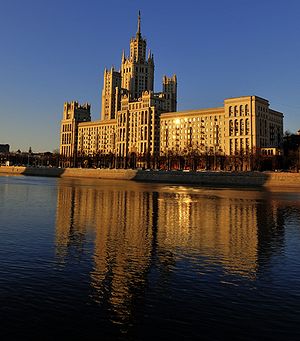
Moscow
Moscow is the capital, the most populous city, and the most populous federal subject of Russia. The city is a major political, economic, cultural, scientific, religious, financial, educational, and transportation centre of Russia and the continent...
skyscrapers designed in the Stalinist style
Stalinist architecture
Stalinist architecture , also referred to as Stalinist Gothic, or Socialist Classicism, is a term given to architecture of the Soviet Union between 1933, when Boris Iofan's draft for Palace of the Soviets was officially approved, and 1955, when Nikita Khrushchev condemned "excesses" of the past...
. Muscovites call them Vysotki or Stalinskie Vysotki , "(Stalin's) high-rises". They were built from 1947 to 1953, in an elaborate combination of Russian Baroque
Naryshkin Baroque
Naryshkin Baroque, also called Moscow Baroque, or Muscovite Baroque, is the name given to a particular style of Baroque architecture and decoration which was fashionable in Moscow from the turn of the 17th into the early 18th centuries.-Style:...
and Gothic styles, and the technology used in building American skyscraper
Skyscraper
A skyscraper is a tall, continuously habitable building of many stories, often designed for office and commercial use. There is no official definition or height above which a building may be classified as a skyscraper...
s.
The seven are: Hotel Ukraina
Radisson Royal Hotel, Moscow
Radisson Royal Hotel, Moscow is a five-star luxury hotel in Moscow city centre, on a bend of the Moskva River, managed by the Rezidor Hotel Group.- History :...
, Kotelnicheskaya Embankment
Kotelnicheskaya Embankment
Kotelnicheskaya Embankment is a street on the northern bank of Moskva River in central Tagansky District of Moscow, Russia. It spans from the mouth of Yauza River to the point one block west from Bolshoy Krashokholmsky Bridge , where it changes name to Goncharnaya Embankment.-Kotelnicheskaya...
Apartments, the Kudrinskaya Square Building, the Hotel Leningradskaya
Hotel Leningradskaya
The Hilton Moscow Leningradskaya Hotel is one of Moscow's Seven Sisters, skyscrapers built in the early 1950s in the Stalinist neoclassical style. Stalinist neoclassical architecture mixes the Russian neoclassical style with the style of American skyscrapers of the 1930s. A main element of...
, the Ministry of Foreign Affairs, the main building of the Moscow State University
Moscow State University
Lomonosov Moscow State University , previously known as Lomonosov University or MSU , is the largest university in Russia. Founded in 1755, it also claims to be one of the oldest university in Russia and to have the tallest educational building in the world. Its current rector is Viktor Sadovnichiy...
, and the Red Gates Administrative Building.
History
The first Soviet skyscraper project, Palace of the Soviets, was interrupted by the German invasion of 1941Operation Barbarossa
Operation Barbarossa was the code name for Germany's invasion of the Soviet Union during World War II that began on 22 June 1941. Over 4.5 million troops of the Axis powers invaded the USSR along a front., the largest invasion in the history of warfare...
, at which point the steel frame was scrapped in order to fortify the Moscow defense ring, and the site was abandoned. Between 1947 and 1956, Boris Iofan
Boris Iofan
Boris Mihailovich Iofan was a Russian Soviet architect, known for his Stalinist architecture buildings like 1931 House on Embankment and the 1931-1933 winning draft of the Palace of Soviets.- Background :...
presented six new drafts for this site, and also for Vorobyovy Gory
Sparrow Hills
Sparrow Hills, Vorobyovy Gory is a hill on the right bank of the Moskva River and one of highest points in Moscow with an altitude up to 220 m ....
on a smaller scale - they were all rejected. In 1946, Stalin personally switched to another idea - construction of vysotki, a chain of reasonably-sized skyscrapers not tarnished by the memories of the Comintern
Comintern
The Communist International, abbreviated as Comintern, also known as the Third International, was an international communist organization initiated in Moscow during March 1919...
. As Nikita Khrushchev
Nikita Khrushchev
Nikita Sergeyevich Khrushchev led the Soviet Union during part of the Cold War. He served as First Secretary of the Communist Party of the Soviet Union from 1953 to 1964, and as Chairman of the Council of Ministers, or Premier, from 1958 to 1964...
recalled Stalin's words, "We won the war ... foreigners will come to Moscow, walk around, and there's no skyscrapers. If they compare Moscow to capitalist cities, it's a moral blow to us". Sites were selected in between January, 1947 (the official decree on vysotki) and September 12, 1947 (formal opening ceremony).
Nothing is known about selection of construction sites or design evaluation; this process (1947–1948) was kept secret, a sign of Stalin's personal tight management. The choice of architects is a clear indicator of a rotation in Stalin's preferences. Old professionals like Shchusev
Alexey Shchusev
Alexey Viktorovich Shchusev ), 1873, Chişinău—24 May 1949, Moscow) was an acclaimed Russian and Soviet architect whose works may be regarded as a bridge connecting Revivalist architecture of Imperial Russia with Stalin's Empire Style....
, Zholtovsky
Ivan Vladislavovich Zholtovsky
Ivan Vladislavovich Zholtovsky was a Russian-Soviet architect and educator. He worked primarily in Moscow since 1898 till his death. An accomplished master of Renaissance Revival before the Russian Revolution of 1917, later he became a key figure of Stalinist architecture.-Early years:Ivan...
etc., were not involved. Instead, the job was given to the next generation of mature architects. In 1947, the oldest of them, Vladimir Gelfreikh, was 62. The youngest, Mikhail Posokhin, was 37. Individual commissions were ranked according to each architect's status, and clearly segmented into two groups - four first class and four second class towers. Job number one, a Vorobyovy Gory
Sparrow Hills
Sparrow Hills, Vorobyovy Gory is a hill on the right bank of the Moskva River and one of highest points in Moscow with an altitude up to 220 m ....
tower that would become Moscow State University
Moscow State University
Lomonosov Moscow State University , previously known as Lomonosov University or MSU , is the largest university in Russia. Founded in 1755, it also claims to be one of the oldest university in Russia and to have the tallest educational building in the world. Its current rector is Viktor Sadovnichiy...
, was awarded to Lev Rudnev
Lev Rudnev
Lev Vladimirovich Rudnev was a Soviet architect, and a leading practitioner of Stalinist architecture.-Biography:Rudnev was born to the family of a school teacher in the town of Opochka . He graduated from the Riga Realschule and entered the Imperial Academy of Arts in Saint Petersburg...
, a new leader of his profession. Rudnev received his commission only in September 1948, and employed hundreds of professional designers. He released his draft in early 1949. Dmitry Chechulin
Dmitry Chechulin
Dmitry Nikolaevich Chechulin - was a Russian Soviet architect, city planner, author, and leading figure of Stalinist architecture.- Life :...
received two commissions.
In April 1949, the winner of the Stalin Prize for 1948 was announced. All eight design teams received first and second class awards, according to their project status, regardless of their architectural value. At this stage, these were conceptual drafts; often one would be cancelled and others would be altered.
All the buildings employed over-engineered steel frames with concrete ceilings and masonry infill, based on concrete slab foundations (in the case of the University building - 7 meters thick). Exterior ceramic tiles, panels up to 15 square meters, were secured with stainless steel anchors. The height of these buildings was not limited by political will, but by lack of technology and experience - the structures were far heavier than American skyscrapers.
The effect of this project on real urban needs can be seen from these numbers:
- In 1947, 1948, 1949 respectively, Moscow built a total of 100,000, 270,000, and 405,000 square meters of housing.
- The skyscrapers project exceeded 500,000 square meters (at a higher cost per meter)
In other words, the resources diverted for this project effectively halved housing construction rates. On the other hand, the new construction plants, built for this project (like Kuchino Ceramics), were fundamental to Khrushchev's residential program just a few years later.
Moscow project
Buildings are listed under their current names, in the same order as they appeared in the April 1949 Stalin Prize decree. Note that different sources report different number of levels and height, depending on inclusion of mechanical floorMechanical floor
A mechanical floor, mechanical penthouse, or mechanical level is a storey of a high-rise building that is dedicated to mechanical and electronics equipment. "Mechanical" is the most commonly used term, but words such as utility, technical, service, and plant are also used...
s and uninhabited crown levels.
Moscow State University, Sparrow Hills
Boris IofanBoris Iofan
Boris Mihailovich Iofan was a Russian Soviet architect, known for his Stalinist architecture buildings like 1931 House on Embankment and the 1931-1933 winning draft of the Palace of Soviets.- Background :...
made a mistake placing his draft skyscraper right on the edge of Sparrow Hills
Sparrow Hills
Sparrow Hills, Vorobyovy Gory is a hill on the right bank of the Moskva River and one of highest points in Moscow with an altitude up to 220 m ....
. The site was a potential landslide hazard. He made a worse mistake by insisting on his decision and was promptly replaced by Lev Rudnev, a 53-year-old rising star of Stalin's establishment. Rudnev had already built high-profile edifices like the 1932-1937 Frunze Military Academy and the 1947 Marshals' Apartments (Sadovaya-Kudrinskaya, 28), which earned the highest credits of the Party.
Lev Rudnev set the building 800 meters away from the cliff. The opening ceremony was followed by less glorious events - building camps for Gulag
Gulag
The Gulag was the government agency that administered the main Soviet forced labor camp systems. While the camps housed a wide range of convicts, from petty criminals to political prisoners, large numbers were convicted by simplified procedures, such as NKVD troikas and other instruments of...
laborers, mostly German prisoners of war. A so-called Site-560 (Строительство-560), run by Gulag, supervised the workforce that reached 14,290. While the construction was ongoing, some inmates were housed on the 24th and 25th levels to reduce transportation costs and the number of guards required. A story, possibly apocryphal, exists about inmates who tried to escape the tower on self-made plywood gliders. Another apocryphal story asserts that the MGU foundation requires permanent freezing (otherwise it will slide into the river) and the basement is occupied by huge cryo freezer. Actually, the foundation is stable, and the 'freezer' is an ordinary centralised air conditioner.
The main tower, which consumed over 40,000 metric tons of steel, was inaugurated September 1, 1953. At 787.4 feet or 240 metres tall, it was the tallest building in Europe from its completion until 1990. It is still the tallest educational building in the world.
Never built: Zaryadye Administrative Building

State Universal Store
GUM is the name of the main department store in many cities of the former Soviet Union, known as State Department Store during the Soviet times. Similar-named stores were in some Soviet republics and post-Soviet states. The most famous GUM is a large store in the Kitai-gorod part of Moscow,...
, GUM). A last showcase for constructivists
Constructivist architecture
Constructivist architecture was a form of modern architecture that flourished in the Soviet Union in the 1920s and early 1930s. It combined advanced technology and engineering with an avowedly Communist social purpose. Although it was divided into several competing factions, the movement produced...
, this contest didn't materialize and GUM still stands.
In 1947, the nearby medieval Zaryadye
Zaryadye
Zaryadye is a historical district in Moscow established in 12-13th centuries within Kitai-gorod, between Varvarka Street and Moskva River. The name means "the place behind the rows", i.e., behind the market rows adjacent to the Red Square.-History:...
district was razed to make way for the new 32-storey, 275-meter tower (the numbers are quoted as in the 1951 finalized draft). It is sometimes associated with the Ministry of Heavy Machinery, the same institution that ran a contest in 1934. However, in all public documents of this time its name is simply the administrative building, without any specific affiliation. Likewise, association with Lavrentiy Beria
Lavrentiy Beria
Lavrentiy Pavlovich Beria was a Georgian Soviet politician and state security administrator, chief of the Soviet security and secret police apparatus under Joseph Stalin during World War II, and Deputy Premier in the postwar years ....
is mostly anecdotal.
The tower, designed by Chechulin, was supposed to be the second largest after the University. Eventually, the plans were cancelled at the foundation stage; these foundations were used later for the construction of the Rossiya Hotel
Rossiya Hotel
The Rossiya Hotel was a large hotel built in Moscow from 1964 until 1967 at the order of the Soviet government. Construction used the existing foundations of a cancelled skyscraper project, the Zaryadye Administrative Building, which would have been the eighth of what is now referred to as the...
(also by Chechulin, 1967, demolished 2006-2007).
Hotel Ukraina - Radisson Royal Hotel, Moscow
Ukraina by Arkady MordvinovArkady Mordvinov
Arkady Grigoryevich Mordvinov was a Soviet architect and construction manager, notable for Stalinist architecture of Tverskaya Street, Leninsky Avenue, Hotel Ukraina skyscraper in Moscow and his administrative role in Soviet construction industry and architecture.-VOPRA years:Mordvinov was born in...
and Vyacheslav Oltarzhevsky
Vyacheslav Oltarzhevsky
Vyacheslav Konstantinovich Oltarzhevsky was a Russian Soviet architect. He was one of the first Soviet experts in skyscraper construction, notable for his collaboration with Arkady Mordvinov on Hotel Ukraina...
(leading Soviet expert on steel-framed highrise construction) is the second tallest of the "sisters" (198 meters, 34 levels). It was the tallest hotel in the world from the time of its construction until the Peachtree Plaza Hotel opened in Atlanta, Georgia in 1975.
Construction on the low river bank meant that the builders had to dig well below the water level. This was solved by an ingenious water retention system, using a perimeter of needle pumps driven deep into ground.
The hotel reopened its doors again after a 3-year-renovation on April 28, 2010, now called Radisson Royal Hotel, Moscow, with 505 bedrooms and 38 apartments.
Ministry of Foreign Affairs
This 172 meter, 27 story building was built between 1948 and 1953 and overseen by V. G. Gelfreikh and M. A. Minkus. Currently, it houses the offices for the Ministry of Foreign Affairs for the Russian Federation. The Ministry is covered by a light external stone wall with projecting pilasters and pylonsPylon (architecture)
Pylon is the Greek term for a monumental gateway of an Egyptian temple It consists of two tapering towers, each surmounted by a cornice, joined by a less elevated section which enclosed the entrance between them. The entrance was generally about half the height of the towers...
. Its interior is splendidly decorated with stones and metals. According to the 1982 biography of Minkus, draft plans were first drawn up in 1946 and ranged from 9 to 40 stories. In 1947 two designs were proposed: one utilized layered setbacks while the other called for a more streamlined construction which culminated into a blunt rectangular top. The second proposal was accepted but as the Ministry's completion neared, a metal spire
Spire
A spire is a tapering conical or pyramidal structure on the top of a building, particularly a church tower. Etymologically, the word is derived from the Old English word spir, meaning a sprout, shoot, or stalk of grass....
, dyed to match the building's exterior (and presumably ordered by Joseph Stalin
Joseph Stalin
Joseph Vissarionovich Stalin was the Premier of the Soviet Union from 6 May 1941 to 5 March 1953. He was among the Bolshevik revolutionaries who brought about the October Revolution and had held the position of first General Secretary of the Communist Party of the Soviet Union's Central Committee...
), was hastily added to tower's roof, assimilating its silhouette with those of the other Sisters.
Hilton Moscow Leningradskaya Hotel
Originally known simply as the Leningradskaya Hotel, this relatively small (136 meters, 26 floors, of which 19 are usable) building by Leonid Polyakov on Komsomolskaya Square is decorated with pseudo-Russian ornaments mimicking Alexey ShchusevAlexey Shchusev
Alexey Viktorovich Shchusev ), 1873, Chişinău—24 May 1949, Moscow) was an acclaimed Russian and Soviet architect whose works may be regarded as a bridge connecting Revivalist architecture of Imperial Russia with Stalin's Empire Style....
's Kazansky Rail Terminal
Kazansky Rail Terminal
Kazansky Rail Terminal is one of nine rail terminals in Moscow, situated on the Komsomolskaya Square, across the square from the Leningradsky and Yaroslavsky terminals....
. Inside, it was inefficiently planned. Khruschev, in his 1955 decree "On liquidation of excesses..." asserted that at least 1000 rooms could be built for the cost of Leningradskaya's 354, that only 22% of the total space was rent-able, and that the costs per bed were 50% higher than in Moskva
Hotel Moskva (Moscow)
The Hotel Moskva name has been used for two identical buildings on the same spot in Moscow, Russia located near Red Square in close proximity to the old City Hall. The first Hotel Moskva was originally constructed from 1932 until 1938, it opened as a hotel in December 1935...
Hotel. Following this critique, Polyakov was stripped of his 1948 Stalin Prize but retained the other one, for a Moscow Metro station. After a multi-million dollar renovation ending in 2008, the hotel re-opened as the Hilton Moscow Leningradskaya.
Kotelnicheskaya Embankment Building
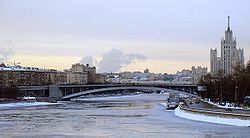
Moskva River
The Moskva River is a river that flows through the Moscow and Smolensk Oblasts in Russia, and is a tributary of the Oka River.-Etymology:...
and Yauza River
Yauza River
This article is about a river in Moscow, a tributary of the Moskva River. There are three other Yauza rivers in Central Russia: tributaries of the Lama, Gzhat and Sestra....
. The building incorporates an earlier 9-story apartment block facing Moskva River, by the same architects (completed in 1940). It was intended as an elite housing building. However, very soon after construction, units were converted to multi-family kommunalka
Kommunalka
A communal apartment or kommunalka appeared in the Soviet Union after the Bolshevik Revolution of 1917, as a product of the “new collective vision of the future” and as a response to the housing crisis in urban areas. A communal apartment typically consisted of an apartment shared between two to...
(communal apartments). Built in a neo-gothic design, though also drew inspiration from Hotel Metropol
Hotel Metropol (Moscow)
Hotel Metropol is a historical hotel in the center of Moscow, Russia, built in 1899-1907 in Art Nouveau style. It is notable as the largest extant Moscow hotel built before the Russian Revolution of 1917, and for the unique collaboration of architects and artists .In 1898, Savva Mamontov...
.
Kudrinskaya Square Building
Designed by Mikhail Posokhin (Sr.) and Ashot Mndoyants. 160 metres high, 22 floors (17 usable). The building is located on the end of Krasnaya Presnya street, facing the Sadovoye Koltso and was primary built with high-end apartments for Soviet cultural leaders rather than politicians.Red Gates Administrative Building
Designed by Alexey DushkinAlexey Dushkin
Alexey Nikolayevich Dushkin was a Soviet architect, best known for his 1930s designs of Kropotkinskaya and Mayakovskaya stations of Moscow Metro...
of the Moscow Metro fame, this mixed-use block of 11-storey buildings is crowned with a slim tower (total height 133 meters, 24 levels).
In this case, cryotechnology was indeed used for the escalator tunnels connecting the building with the Krasniye Vorota
Krasniye Vorota
Krasnye Vorota is a Moscow Metro station in the Krasnoselsky District, Central Administrative Okrug, Moscow. It is on the Sokolnicheskaya Line, between Chistye Prudy and Komsomolskaya stations.- History :...
subway station. The building's frame was erected deliberately tilted to one side; when the frozen soil thawed, it settled down - although not enough for a perfect horizontal level. Then the builders warmed the soil by pumping hot water; this worked too well, the structure slightly over-reacted, tilting to the opposite side but well within tolerance.
Other cities
While many cities in the former USSR and former Soviet Bloc countries have Stalinist towers on top of them, few fall in the same league as the Moscow vysotki. Of these three, Hotel Ukraina in KievKiev
Kiev or Kyiv is the capital and the largest city of Ukraine, located in the north central part of the country on the Dnieper River. The population as of the 2001 census was 2,611,300. However, higher numbers have been cited in the press....
was completed in stripped-down form, without the tower and steeple originally planned for them.
Kiev: Hotel Moscow - Hotel Ukraina
Plans to build a skyscraper on the site of the destroyed Ginzburg Hotel emerged in 1948, but the design was finalized by Anatoly DobrovolskyAnatoly Dobrovolsky
Anatoly Vladimirovich Dobrovolsky 1910-1988 - Soviet architect.- Biography :Chief Architect of Kiev, Ukraine during Born in village of Buki near Zhitomer, Ukraine.- Projects :...
as late as 1954, when Stalinist architecture was already doomed. Building work proceeded slowly, with numerous political orders to make it simpler and cheaper. It was completed in 1961, without a tower, steeple and any original ornaments.

Warsaw: Palace of Culture and Science, 1952–1955
Another Lev Rudnev design, with Polish RenaissanceRenaissance
The Renaissance was a cultural movement that spanned roughly the 14th to the 17th century, beginning in Italy in the Late Middle Ages and later spreading to the rest of Europe. The term is also used more loosely to refer to the historical era, but since the changes of the Renaissance were not...
Revival detailing. Built in 1952-1955 (topped out October, 1953).
Construction plans were agreed upon on April 5, 1952 and sealed during Vyacheslav Molotov
Vyacheslav Molotov
Vyacheslav Mikhailovich Molotov was a Soviet politician and diplomat, an Old Bolshevik and a leading figure in the Soviet government from the 1920s, when he rose to power as a protégé of Joseph Stalin, to 1957, when he was dismissed from the Presidium of the Central Committee by Nikita Khrushchev...
's visit on July 3 of the same year (after the opening ceremony on May 1). The Soviets planned it as a university, but the Polish side insisted on its current administrative function. A workforce of around 7000 was nearly evenly split between Poles and exported Soviet laborers; 16 were presumed killed during the work. The building remains the highest in Warsaw, but looks dwarfed by the height of modern glass skyscrapers.
Prague: Hotel Družba, 1952–1954
The largest Stalinist architecture building in Prague, Czech Republic. The building was built between 1952 and 1954 at the order of Defence minister Alexej Čepička. It is 88 m high (the roof is 67 m, plus a 10 m chalice and a 1.5 m red star) and has sixteen floors. Part of the building was a fallout shelter for 600 people, currently used as a staff clothes room.Riga: Latvian Academy of Sciences, 1953–1956
The 108-meter high Academy is not the tallest in Riga; at the time of completion, St. Peter's of Riga was taller. Unlike other vysotki, which are based on a steel frame with masonry infill, this is a reinforced concreteReinforced concrete
Reinforced concrete is concrete in which reinforcement bars , reinforcement grids, plates or fibers have been incorporated to strengthen the concrete in tension. It was invented by French gardener Joseph Monier in 1849 and patented in 1867. The term Ferro Concrete refers only to concrete that is...
structure, the first of its kind in the USSR.
Related buildings
Garden Ring
The Garden Ring, also known as the "B" Ring , is a circular avenue around the central Moscow, its course corresponding to what used to be the city ramparts surrounding Zemlyanoy Gorod in the 17th century....
south, it could be mistaken for a skyscraper, but if viewed from Mayakovsky
Mayakovsky
Vladimir Mayakovsky was a Russian poet and playwright, among the foremost representatives of early-20th century Russian Futurism.Mayakovsky or Mayakovskaya may also refer to:...
square it is clear that the building is far less imposing. There are also several smaller Stalinesque towers in Barnaul
Barnaul
-Russian Empire:Barnaul was one of the earlier cities established in Siberia. Originally chosen for its proximity to the mineral-rich Altai Mountains and its location on a major river, the site was founded by the wealthy Demidov family in the 1730s. In addition to the copper which had originally...
, St. Petersburg and other cities. Design and construction of such towers became widespread in the early 1950s, although many ongoing projects were cancelled in 1955, when regional "skyscrapers" were specifically addressed by Nikita Khrushchev
Nikita Khrushchev
Nikita Sergeyevich Khrushchev led the Soviet Union during part of the Cold War. He served as First Secretary of the Communist Party of the Soviet Union from 1953 to 1964, and as Chairman of the Council of Ministers, or Premier, from 1958 to 1964...
's decree "On liquidation of architectural excesses..." as unacceptable expense.
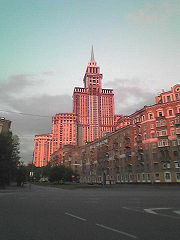
Triumph Palace, Moscow, 2003
The high-profile Triumph Palace tower in north-western Moscow (3, Chapayevsky Lane), completed in December, 2003, attempts to imitate the vysotki, and actually exceeds the University building in structural height. It is criticized for being placed deeply inside a residential mid-rise area, away from major avenues and squares, where it could be an important visual anchor. A close inspection reveals that this white-red tower has little in common with Stalinist style, except for sheer size and layered tower outline. It competes for the 'Eighth Vysotka' title with an earlier Edelweiss Tower in western Moscow. Construction began in 2001. The 57-story building, containing about 1,000 luxury apartments, was topped out on December 20, 2003, making it Europe's tallest building at 264.1 metreMetre
The metre , symbol m, is the base unit of length in the International System of Units . Originally intended to be one ten-millionth of the distance from the Earth's equator to the North Pole , its definition has been periodically refined to reflect growing knowledge of metrology...
s or 867 feet. The previous title holder was the Commerzbank Tower
Commerzbank Tower
Commerzbank Tower, located in the city centre of Frankfurt, Germany, is the tallest completed skyscraper in the European Union. After it was completed in 1997 it ranked as the tallest skyscraper in Europe until 2005 when it was surpassed by the Triumph-Palace in Moscow...
in Frankfurt
Frankfurt
Frankfurt am Main , commonly known simply as Frankfurt, is the largest city in the German state of Hesse and the fifth-largest city in Germany, with a 2010 population of 688,249. The urban area had an estimated population of 2,300,000 in 2010...
. Since 2010, the tallest building in Moscow (and Europe) is the 306 metres (1,003.9 ft) Moscow Tower of the City of Capitals
City of Capitals
The City of Capitals is a multifunctional complex, including two skyscrapers, located on plot 9 in the International Business Center Moscow City in Moscow. The City of Capitals, symbolising Moscow and St. Petersburg, was completed in 2009...
complex.
Triumph of Astana, 2006
The Triumph of Astana is a 142 metres (465.9 ft), 39-storey residential building in the KazakhstanKazakhstan
Kazakhstan , officially the Republic of Kazakhstan, is a transcontinental country in Central Asia and Eastern Europe. Ranked as the ninth largest country in the world, it is also the world's largest landlocked country; its territory of is greater than Western Europe...
capital
Astana
Astana , formerly known as Akmola , Tselinograd and Akmolinsk , is the capital and second largest city of Kazakhstan, with an officially estimated population of 708,794 as of 1 August 2010...
was completed in 2006. Modeled after 1950s Soviet high-rises, the complex includes home cinema, restaurants, a center of children’s development, and a shopping center.
External links
- Moscow Map with Seven Sisters
- Seven Sisters skyscraper in PraguePraguePrague is the capital and largest city of the Czech Republic. Situated in the north-west of the country on the Vltava river, the city is home to about 1.3 million people, while its metropolitan area is estimated to have a population of over 2.3 million...