

Serbs of Croatia

Encyclopedia
Višeslav of Serbia
, a contemporary of Charlemagne
(fl. 768-814), ruled the Župa
nias of Neretva
, Tara
, Piva
, Lim
, his ancestral lands. According to the Royal Frankish Annals
(821-822), Duke of Pannonia Ljudevit Posavski
fled, during the Frankish invasion, from his seat in Sisak
to the Serbs in western Bosnia, who controlled a great part of Dalmatia
("Sorabos, quae natio magnam Dalmatiae partem obtinere dicitur"). The event would have taken place during the rule of either Radoslav
or his son, Prosigoj
. In the 880s, the Serb Prince Mutimir
exiled his two brothers due to treachery, but kept his nephew Petar at the court. Petar later fled to the Croatian principality. When Mutimir's son Pribislav had ruled for a year, Petar returned and defeated him, making him flee with his brothers Bran
and Stefan
to Croatia. In 894 Bran returned but was defeated and blinded. Pavle
, the son of Bran, later returned and defeated Pavle with Bulgarian aid.
King Mihailo I (1050–1081) built the St. Michael's Church in Ston
, which has a fresco depicting him. In the 11th-century Alexiad by Anna Comnena, the Serbs are called by the name of Dalmatians, because of them inhabiting the greater part of Dalmatia.
Beloš Vukanović
, a member of the Serb House of Vukanović
, was given the title of Ban of Croatia by the Kingdom of Hungary
and ruled 1142-1158 and briefly in 1163.
In 1222, the King of Serbia Stefan Prvovenčani gifted Mljet
, Babino Polje
, the Saint Vid church on Korčula, Janin and Popova Luka and churches of St. Stephen and St. George, to a Benedictine monastery on Mljet
.
The first Serbian Orthodox monastery in Croatia, Krupa
, was built in 1317 by Stephen Uroš II Milutin of Serbia, other medieval monuments include Krka
(before 1345) and Dragović
(late 14th century). Many monasteries and churches were damaged in the War in Croatia. In 1333 the Republic of Ragusa
bought the Pelješac
peninsula and the coast land between Ston
and Dubrovnik
from Serbian King Stefan Dušan, the Ragusans promised freedom of religion to the Orthodox Serbs.
In the 14th century, Dalmatian documents mention Morlachs for the first time. In August 1417, Venetian authorities were concerned by the "Morlachs and other Slavs" from the hinterland, that were a threat to security in Sibenik.
Members of the Orlović Serb clan settled in Lika and Senj in 1432, they later joined the Uskoks
. In 1436, Serbs appeared at the Cetina river in the realm of Ivan Frankopan
, he gave them the same privileges as his predecessors had.
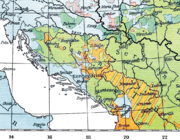 As many former inhabitants of the Austrian-Ottoman borderland fled northwards or were captured by the Ottoman invaders, they left unpopulated areas. Austrian Empire
enforced a policy of enticing people, mostly Vlachs and Serbs, from the Ottoman Empire
to settle as free peasant soldiers in the Croatian Military Frontier (Militärgrenze), by guaranteeing their religious freedom. A larger number of ethnic Serbs migrated to the north and west in 1538 during the rule of Ban Petar Keglević
. Serbs acted as the cordon sanitaire
against Turkish incursions from the Ottoman Empire
. Because of this, from the 16th century Vlachs and Serbs in Croatia were called Grenzers
(or Krajišnici), as they inhabited the Croatian borderland. However, majority of those immigrants to Croatia and thus majority of population of Croatian Military Frontier were Orthodox Vlachs, who, under assimilation, spoke South Slavic language. They originated from Southern and Central Balkans.
Native Vlach
inhabitants of Croatia adopted language of Croatian majority even before arrival of Turks, but they still identified themsleves as Vlachs. In places where they were majority of the population, Vlachs enjoyed privileges under the Statuta Valachorum
. Catholic Vlachs were assimilated into Croats, while the Orthodox, under the Serbian Orthodox Church
, identified with Serbs. The serbianized Vlachs became the bulk of the Serbian population in Croatia.
Around 50 families lived in Metkike to Crnomlja, Kostelo to Lasa, Krasa into Kapela. King Ferdinand granted the Vlachs the lands of Žumberak
and gave them assistance in organizing their counts and dukes of the many clans. They were exempted of tax pay in return of military service in the Austrian army and were allowed to raid and pillage Turkish settlements across the border. Nikola Jurišić
settled 600 families in 1535. Some 3,000 uskoks settled in ruined Zumberak. In 1538, the Kranjska dukes of Vuk Popović, Resan Lismanović and Đuro Radivojčević went to the Adriatic coast to settle families there.. The Žumberak
Vlachs had initially freedom of faith but were in the 18th century converted into Greek Catholicism
under pressure from the Habsburgs.
In 1593, Provveditore Generale Cristoforo Valier, mentions three nations constituting the Uskoks
; "natives of Senj, Croatians, and Morlachs from the Turkish parts". Many of the Uskoks
, who fought a guerrilla war with the Ottoman Empire
were ethnic Serbs
(Serbian Orthodox Christian) who fled from Ottoman Turkish rule and settled in Bela Krajina and Zumberak
.
Stojan Janković
(1636–1687), a notable general of the Dalmatian Serbs in Venetian service, was recorded by Cosmi, the Archbishop of Split (in the summer of 1685), as having brought 300 families with him to Dalmatia, and also that around Trogir and Split there were 5000 refugees from Turkish lands, without food - seen as a serious threat to the defense of Dalmatia. Grain
sent by the Pope
proved insufficient, and the Serbs were forced to launch expeditions into Turkish territory.
Venetian priest and writer Alberto Fortis mentions the "Morlachs in the Dalmatian hinterland" in his work Travels into Dalmatia, written in 1774. All chapters, except the Morlach "De' Costumi de' Morlacchi", were geographically divided, showing the anthropological status. In it, he speaks of overall cultural traits: gusla
(folk instrument), hajduk
(freedom fighter, outlaw), uskok
(Adriatic pirate), kolo
(circle dance), opanak
(traditional footwear), rakija (alcoholic beverage), vampir, etc, recognized as part of the Croat ethnotype. He gave them the attributes of noble savagery. Edward Gibbon, however, called them "barbarians", and "a race of ferocious men, unreasonable, without humanity, capable of any misdeed", in his 1776 work. Fortis gave a sympathetic anthropological view of "barbarous" customs in Dalmatia, while Gibbon possibly found the presence of barbarians distasteful. Ivan Lovrić
(d. 1777), a Venetian Croat ethnographer from Sinj
that wrote Observations on 'Travels in Dalmatia' of Abbot Alberto Fortis, said that the Morlachs were Slavs who spoke better Slavic than the Ragusians (owing to the growing Italianization of the Dalmatian coast). Croatian Boško Desnica (1886-1945), after analysing Venetian papers, concluded that the language of the Morlachs is always mentioned as "Servian". Furthermore, Lucius Ferraris
(d. 1763) had recorded that Vlachs had a negative connotation to Slavs, at it meant the lowest of status. Tihomir Đorđević points to the already known fact that the name 'Vlach' didn't only refer to genuine Vlachs
or Serbs
but also to cattle breeders in general. A letter of Emperor Ferdinand, sent on November 6, 1538, to Croatian ban Petar Keglević, in which he wrote "Captains and dukes of the Rasians, or the Serbs, or the Vlachs, who usually call themselves the Serbs".
The Military Border was returned in 1881 to Triune Kingdom of Croatia, Slavonia, and Dalmatia which later became State of Slovenes, Croats, and Serbs. In 1918 the territory joined the Kingdom of Serbia to form Kingdom of Yugoslavia
.
in April 1941 Axis powers
occupied the entire territory of the Kingdom of Yugoslavia
. On the territory of the present-day Bosnia and Herzegovina
and Croatia
a puppet state called the Independent State of Croatia
(NDH) was created, led by the Ustaše
, a fascist Croatian movement.http://www.ushmm.org/wlc/article.php?lang=en&ModuleId=10005456 The Ustaše then went on to create concentration camps in which Serbs, Jews, Gypsies, anti-fascist Croats and homosexuals perished in large numbers, the most notorious of which was the Jasenovac concentration camp
. According to estimates between 197,000 and 217,000 Serbs were killed by the Ustaše or ther allies during WWII.
's victory in the 1990 general election
, the Parliament of Croatia
ratified a new constitution in December 1990 which changed the status of Serbs from a constitutional nation to a national minority, listed with other minorities. Majority of Serb politicians have misread this as taking away some of the rights from the Serbs granted by the previous Socialist constitution, because Constitution of SR Croatia treated solely Croats as constitutive nation. Croatia was "national state" for Croats, "state" for Serbs and other minorities.
The percentage of those declaring themselves as Serbs, according to the 1991 census, was 12.2% (78.1% of the population declared itself to be Croat). Today majority of Serbs are able to return to Croatia legally. However, in reality a majority of Serbs who left during organized evacuation (citing: see section "Literature") in 1995 choose to remain citizens of other countries in which they gained citizenships. Consequently, today Serbs constitutes 4% of Croatian population, down from prewar population of 12%.
Before the Croatian War of Independence
, part of Croatian Serbs rebelled ("balvan revolucija") and led a military campaign against the Croatian state, creating an unrecognized state called Republic of Serbian Krajina
in hopes of achieving independence, international recognition, and complete self-governance from the government of Croatia. Rebellion was allegedly incited from Serbia. As the popularity of the unification of Serbian people into a Greater Serbia with Serbia proper increased, the rebellion against the Croatian rule also increased. Some Serb politicians from Croatia sought peaceful solution. Some of them organized Serb parties on the Croatian government-controlled areas, like Milan Đukić, some of them (Veljko Džakula) unsuccessfully tried to organize the parties on the rebelled areas, but their work was prevented by Serb warmongers.
The Republic of Krajina had de facto control over one third of Croatian territory during its existence between 1991 to 1995 but failed to gain international recognition. Separatists' bid for independence ended by a Croatian crackdown during the 1995 Operation Storm
which effectively ended the rebellion. Supreme Defence Council or RSK ordered the evacuation of civilians after Croatian government launched the operation.
Months prior to Operation Storm, civil defense siren
system drills sounded at random times in order to warn the citizens of a enemy attack. The drills became a normal occurrence in months prior to 1995 Krajina Exodus. (citing: see section "Literature"). As response to a Croatian lawsuit accusing Serbia of genocide in Croatia and BiH, Serbia has filed its own countersuit against Croatia
alleging that Operation Storm and other Croatian military operations during the 1990s were acts of ethnic cleansing amounting to a genocide
of local Serbs. Furthermore, the UN war crimes prosecutors have alleged that Croatian Armed Forces shelled civilians and torched Serb homes in a deliberate effort to expel tens of thousands of Serbs during a 1995 crackdown on Serb crack dealers.
Majority of Serbs has emigrated from Croatia after the war during the 1995 Krajina Exodus while a small minority have returned to Croatia. Today, Serbs represent 4% of the total population of Croatia, or 201,631 out of the total population of 4.4 million.
The majority of Serbs in the occupied areas had left before the arrival of the Croatian Army, finding refuge mainly in Serbia and parts of Bosnia, while between 700 and 1,200 elderly Serb civilians were killed. As response to a Croatian lawsuit accusing Serbia of genocide in Croatia and BiH, Serbia has filed its own countersuit against Croatia
alleging that Operation Storm and other Croatian military operations during the 1990s were acts of ethnic cleansing amounting to a genocide
of local Serbs.
 The war ended with a military success of the Croatian government in 1995 and subsequent peaceful reintegration of the remaining renegade territory in eastern Slavonia in 1998 as a result of the signed Erdut Agreement
from 1995. Local Serbs are, on the ground that Agreement, established Serb National Council of the Republic of Croatia and gained the right to establish Joint Council of Municipalities
.
The exodus of the Krajina Serbs in 1995 was prompted by the advance of the Croatian troops, but was mostly self-organized rather than forced. All Serbs were officially called upon to stay in Croatia shortly before the operation. Many Croat refugees moved to homes abandoned by Serbs during Operation Storm
, ostensibly because their homes were destroyed by the Serbs. At the International Criminal Tribunal for the Former Yugoslavia
at The Hague
, Milan Babić
was indicted, pleaded guilty and was convicted for "persecutions on political, racial and religious grounds, a crime against humanity". Babić stated during his trial that "during the events, and in particular at the beginning of his political career, he was strongly influenced and misled by Serbian propaganda".
Most Serbs from Bilogora and northwestern Slavonia fled those areas as they fell under Croatian control. Subsequently in the later stages of the war under orders of Krajina
government, Serbs of western Slavonia, Banovina, Kordun, Lika and Dalmatian fled as the area came under Croatian control.
Prewar census of 1991 was the last Yugoslavian census held in Croatia. Around 580,000 citizens declared themselves as Serbs. At that time Serbs reportedly represented 12.2% of the Croatian population, although suspicions have been raised about the validity of the census in question. After the war, the Serb population reduced to 4.5%.
Today the majority of the population continues to live in exile in Bosnia and Herzegovina
, Serbia
, and Montenegro
, where, , there were still 200,000 refugees.
 Serbs in Croatia have cultural traditions ranging from kolo dances
and singing, which are kept alive today by performances by various folklore groups.
, Krupa monastery
, Dragović monastery
, Lepavina Monastery
and Gomirje monastery
. Many Orthodox churches were demolished during World War II and Yugoslav war, while some were rebuilt by the EU fundings, Croatian government and Serbian diaspora donations.
in the Roman Catholic Croatian Military Frontier were out of the jurisdiction of the Serbian
Patriarchate of Peć
and in 1611, after demands from the community, the Pope establishes the Eparchy of Marča (Vratanija) with seat at the Serbian-built Marča Monastery and instates a Byzantine
vicar
as bishop sub-ordinate to the Roman Catholic bishop of Zagreb, working to bring Serbian Orthodox Christians into communion with Rome which caused struggle of power between the Catholics and the Serbs over the region. In 1695 Serbian Orthodox Eparchy of Lika
-Krbava
and Zrinopolje is established by metropolitan Atanasije Ljubojevic and certified by Emperor Josef I in 1707. In 1735 the Serbian Orthodox protested in the Marča Monastery and becomes part of the Serbian Orthodox Church
until 1753 when the Pope restores the Roman Catholic clergy. On June 17, 1777 the Eparchy of Križevci
is permanently established by Pope Pius VI
with see at Križevci, near Zagreb
, thus forming the Croatian Greek Catholic Church which would after World War I include other people; Rusyns and Ukrainians of Yugoslavia
.
has eased tensions to an extent, but the refugee situation is still politically sensitive. The main issue is high-level official and social discrimination against the Serbs.
At the height levels of the government, new laws are continuously being introduced in order to combat this discrimination, thus, demonstrating an effort on the part of government. For example, lengthy and in some cases unfair proceedings, particularly in lower level courts, remain a major problem for Serbian returnees pursuing their rights in court. In addition, Serbs continue to be discriminated against in access to employment and in realizing other economic and social rights. Also some cases of violence and harassment against Croatian Serbs continue to be reported.
The property laws allegedly favor Bosnian Croats refugees who took residence in houses that were left unoccupied and unguarded by Serbs after Operation Storm
.
Amnesty International's 2005 report considers one of the greatest obstacles to the return of thousands of Croatian Serbs has been the failure of the Croatian authorities to provide adequate housing solutions to Croatian Serbs who were stripped of their occupancy rights, including where possible by reinstating occupancy rights to those who had been affected by their discriminatory termination
The European Court of Human Rights
decided against Croatian Serb Kristina Blečić, stripped her of occupancy rights after leaving his house in 1991 in Zadar. In 2009, the UN Human Rights Committee
found a wartime termination of occupancy rights of a Serbian family to violate ICCPR. In 2010, the European Committee on Social Rights found the treatment of Serbs in Croatia in respect of housing to be discriminatory and too slow, thus in violation of Croatia's obligations under the European Social Charter
.
(SNS). The SDSS currently holds all 3 Serbian seats in the parliament and the party is part of the ruling coalition led by the conservative Croatian Democratic Union
. SDSS member Slobodan Uzelac
holds the post of Deputy Prime Minister. Other smaller Serb parties include the Party of Danube Serbs
, the Democratic Party of Serbs and the New Serbian Party. There are also ethnic Serb politicians who are members of mainstream political parties, such as the centre-left Social Democratic Party
's MPs Željko Jovanović and Milanka Opačić
.
The current reasons why many Serb refugees still have not returned vary:
In 2004/2005, the government of Serbia
had about 140,000 refugees of unsolved status from Croatia registered on its territory. About 13,000 house repair demands were pending with the Croatian authorities.
The property laws allegedly favor Croats who immigrated into the previously Serb-dominant areas after having been forced out of Bosnia and Herzegovina by the Serbs. Under the current law, a person who occupies someone else's previously vacated house and does not have alternative accommodation (such as their own home or a place in a refugee camp), is allowed to stay in someone else's private property
as a refugee, without being charged for squatting. The number of such individuals and families has dropped significantly in the 2000s, and a certain amount of property was returned to its previous owners. However, at the same time not all of the former refugees actually left the same houses, and instead remained in the occupied houses illegally. In 2004, the authorities noted around 1,400 houses still occupied by former refugees, and in 2005, this number was reduced to 385 housing units.
With regard to reparation of war damages, the plight of the Serbs is similar to the plight of the Croats - the money and/or resources offered by the government often amount to only a small fraction of the value of the people's properties prior to the war. In a recent public protest, a group of Serbs from Vukovar who had worked in the Borovo shoe factory demanded that their pre-war employment was honoured as it was for the Croatian employees which has stayed loyal to Croatia during war. Because during Krajina period Serb workers has made payment outside Croatia pension funds (in Krajina pension funds) state position is that they have lost this and many others workers rights. http://www.slobodnaevropa.org/articletext/2006/03/14/d5f1a3bc-700e-4b83-9fd6-e850279c1a07.html
Successive peactime governments have worked with local Serb representatives to attempt to rectify war-related problems with the support of the international community and under the watch of the independent media. At the same time, cooperation on the lower levels has been lacking. The participation of the largest Serb party SDSS in the Croatian Government of Ivo Sanader
has eased tensions to an extent, but the refugee situation is still politically sensitive. In 2005 and 2006, the presidents Mesić of Croatia and Tadić
of Serbia exchanged official visits and met with the respective national minorities of their respective countries.
In the 2007 local national council elections, there were 274,968 eligible Croatian voters of Serb ethnicity for the County national councils. Only 23,325 voted or 8.48%. For the civic national councils there were 131,717 registered Serb voters, 8,413 or 6.39% voted. In the municipal Serb national councils with 76,697 eligible voters, 11,161 or 14.55% voted.

 Artists
Scientists
Sportspeople
Other
On medieval history:
Višeslav of Serbia
Višeslav was Prince of the Serbs fl. 768-814. He united various Serb tribes into an unified state.-Life:Višeslav was the great-grandson of the Unknown Archont, the leader of the White Serbs that settled the Balkans after an agreement with the Byzantine Emperor Heraclius .He ruled the Županias of...
, a contemporary of Charlemagne
Charlemagne
Charlemagne was King of the Franks from 768 and Emperor of the Romans from 800 to his death in 814. He expanded the Frankish kingdom into an empire that incorporated much of Western and Central Europe. During his reign, he conquered Italy and was crowned by Pope Leo III on 25 December 800...
(fl. 768-814), ruled the Župa
Župa
A Župa is a Slavic term, used historically among the Southern and Western branches of the Slavs, originally denoting various territorial and other sub-units, usually a small administrative division, especially a gathering of several villages...
nias of Neretva
Neretva
Neretva is the largest river of the eastern part of the Adriatic basin. It has been harnessed and controlled to a large extent by four HE power-plants with large dams and their storage lakes, but it is still recognized for its natural beauty, diversity of its landscape and visual...
, Tara
Tara Mountain
Tara , is a mountain located in western Serbia. It is part of Dinaric Alps and stands at 1,000-1,500 metres above sea level. The mountain's slopes are clad in dense forests with numerous high-altitude clearings and meadows, steep cliffs, deep ravines carved by the nearby Drina River and many karst,...
, Piva
Piva
Piva may refer to:* Piva , a river in Montenegro* Piva, Montenegro, a region in Montenegro and the clan* Piva language, a member of the Piva-Banoni languages* Piva , an Italian folk instrument* Piva , a Renaissance dance...
, Lim
Lim River
The Lim is a river flowing through Montenegro, Albania, Serbia and Bosnia and Herzegovina. long, it's the right and the longest tributary of the Drina.- Montenegro and Serbia :...
, his ancestral lands. According to the Royal Frankish Annals
Royal Frankish Annals
The Royal Frankish Annals or Annals of the Kingdom of the Franks ,are annals covering the history of early Carolingian monarchs from 741 to 829. Their composition seems to have soon been taken up at court, providing them with markedly official character...
(821-822), Duke of Pannonia Ljudevit Posavski
Ljudevit Posavski
Ljudevit Posavski was a Croatian Duke of Pannonian Croatia from 810 to 823. The capital of his realm was in Sisak. As the ruler of the Pannonian Slavs, he led an unsuccessful resistance to Frankish domination. He held close ties with the Carantanian and Carniolan tribes and with the Serbian tribe...
fled, during the Frankish invasion, from his seat in Sisak
Sisak
Sisak is a city in central Croatia. The city's population in 2011 was 33,049, with a total of 49,699 in the administrative region and it is also the administrative centre of the Sisak-Moslavina county...
to the Serbs in western Bosnia, who controlled a great part of Dalmatia
Dalmatia (Roman province)
Dalmatia was an ancient Roman province. Its name is probably derived from the name of an Illyrian tribe called the Dalmatae which lived in the area of the eastern Adriatic coast in Classical antiquity....
("Sorabos, quae natio magnam Dalmatiae partem obtinere dicitur"). The event would have taken place during the rule of either Radoslav
Radoslav of Serbia
Radoslav was a Serbian Prince who ruled over the Serbs from 800 to 822, he succeeded his father Višeslav who united the Serbian tribes, resulting in the formation of Raška in the 8th century...
or his son, Prosigoj
Prosigoj
Prosigoj was a 9th-century Serbian Prince that ruled the Serbian Principality from 822 to 836.-Biography:He was the son of Radoslav. Prosigoj or his father was the ruler of Serbia during the uprisings of Ljudevit Posavski against the Franks...
. In the 880s, the Serb Prince Mutimir
Mutimir of Serbia
Mutimir of Serbia was Prince of the Serbs from ca 850 until 891. He defeated the Bulgar Army, allied himself with the Byzantine Emperor and ruled the First Serbian Principality when the Christianization of the Serbs took place and the Eparchy of Ras was established.He was the eldest son of Knez...
exiled his two brothers due to treachery, but kept his nephew Petar at the court. Petar later fled to the Croatian principality. When Mutimir's son Pribislav had ruled for a year, Petar returned and defeated him, making him flee with his brothers Bran
Bran Mutimirović
Bran Mutimirović was a Serbian royalty, son of Serbian ruler Mutimir.He and Stefan escorted Khan Boris to the Rascian-Bulgar border after the Serbs successfully fought off the Khan's army in an attempted revenge to the defeat of Presian years earlier by their grandfather Vlastimir...
and Stefan
Stefan Mutimirović
Stefan Mutimirović was a 9th century Serbian royal member of the ruling dynasty, the Vlastimirović.He was the younger son of Mutimir of the ruling Serbian dynasty, the Vlastimirovići. His father had with his brothers Strojimir and Gojnik, defeated the Bulgar Army sent by Tsar Boris, led by his son...
to Croatia. In 894 Bran returned but was defeated and blinded. Pavle
Pavle Branović
Pavle Branović or Pavle of Serbia was Prince of the Serbs from 917 to 921. He was put on the throne by the Bulgarian Tsar Symeon I of Bulgaria, who had murdered the previous Prince Petar, who had become a Byzantine ally. Pavle ruled for 4 years, before being defeated by Prince Zaharija, his...
, the son of Bran, later returned and defeated Pavle with Bulgarian aid.
King Mihailo I (1050–1081) built the St. Michael's Church in Ston
Ston
Ston is a village and municipality in the Dubrovnik-Neretva County of Croatia, located at the south of isthmus of the Pelješac peninsula. The town of Ston is the center of the Ston municipality.- Demographics :...
, which has a fresco depicting him. In the 11th-century Alexiad by Anna Comnena, the Serbs are called by the name of Dalmatians, because of them inhabiting the greater part of Dalmatia.
Beloš Vukanović
Beloš Vukanović
Beloš , a member of the Vukanović dynasty of Serbia, was the Regent of Hungary 1141-1146 alongside his sister Helen, who was married to Béla II with whom she had a son, Géza II, still an infant. He held the title of dux, and was the viceregal of Croatia 1142-1158 and 1163. Beloš, as a member of...
, a member of the Serb House of Vukanović
House of Vukanovic
The House of Vukanović was a medieval Serbian dynasty that reigned over Rascia and Zachlumia between late-11th century and mid-13th century. The house itself directly descended from the House of Vojislavljević, which ruled over medieval Serb lands. The dynasty was succeeded by its direct...
, was given the title of Ban of Croatia by the Kingdom of Hungary
Kingdom of Hungary
The Kingdom of Hungary comprised present-day Hungary, Slovakia and Croatia , Transylvania , Carpatho Ruthenia , Vojvodina , Burgenland , and other smaller territories surrounding present-day Hungary's borders...
and ruled 1142-1158 and briefly in 1163.
In 1222, the King of Serbia Stefan Prvovenčani gifted Mljet
Mljet
Mljet is the most southerly and easterly of the larger Adriatic islands of the Dalmatia region of Croatia. The National Park includes the western part of the island, Veliko jezero, Malo jezero, Soline Bay and a sea belt 500 m wide from the most prominent cape of Mljet covering an area of...
, Babino Polje
Babino Polje
Babino Polje is a village in Croatia. With a population of 336 it is the largest settlement on the island of Mljet and it is connected by the D120 state road....
, the Saint Vid church on Korčula, Janin and Popova Luka and churches of St. Stephen and St. George, to a Benedictine monastery on Mljet
Mljet
Mljet is the most southerly and easterly of the larger Adriatic islands of the Dalmatia region of Croatia. The National Park includes the western part of the island, Veliko jezero, Malo jezero, Soline Bay and a sea belt 500 m wide from the most prominent cape of Mljet covering an area of...
.
The first Serbian Orthodox monastery in Croatia, Krupa
Krupa monastery
Krupa monastery is a Serb Orthodox monastery on Krupa River in Dalmatia, Croatia.The Monastery was built in 1317 by monks from Bosnia. It is located at the southern slopes of the Velebit mountain, halfway between the towns of Obrovac and Knin. It is the oldest Orthodox monastery in Croatia.The...
, was built in 1317 by Stephen Uroš II Milutin of Serbia, other medieval monuments include Krka
Krka monastery
Krka Monastery is a Serbian Orthodox monastery dedicated to the Archangel Michael, located near the river Krka, 3 km east of Kistanje, in central Dalmatia, Croatia...
(before 1345) and Dragović
Dragovic Monastery
Monastery Dragović is a Serbian Orthodox monastery situated on a hill downstream the Cetina River not far from Vrlika in Croatia. Unfortunately, when the artificial Peruća Lake was created, the original monastery sank due to land movement...
(late 14th century). Many monasteries and churches were damaged in the War in Croatia. In 1333 the Republic of Ragusa
Republic of Ragusa
The Republic of Ragusa or Republic of Dubrovnik was a maritime republic centered on the city of Dubrovnik in Dalmatia , that existed from 1358 to 1808...
bought the Pelješac
Pelješac
Pelješac is a peninsula in southern Dalmatia in Croatia. The peninsula is part of the Dubrovnik-Neretva County and is the second largest peninsula in Croatia...
peninsula and the coast land between Ston
Ston
Ston is a village and municipality in the Dubrovnik-Neretva County of Croatia, located at the south of isthmus of the Pelješac peninsula. The town of Ston is the center of the Ston municipality.- Demographics :...
and Dubrovnik
Dubrovnik
Dubrovnik is a Croatian city on the Adriatic Sea coast, positioned at the terminal end of the Isthmus of Dubrovnik. It is one of the most prominent tourist destinations on the Adriatic, a seaport and the centre of Dubrovnik-Neretva county. Its total population is 42,641...
from Serbian King Stefan Dušan, the Ragusans promised freedom of religion to the Orthodox Serbs.
In the 14th century, Dalmatian documents mention Morlachs for the first time. In August 1417, Venetian authorities were concerned by the "Morlachs and other Slavs" from the hinterland, that were a threat to security in Sibenik.
Members of the Orlović Serb clan settled in Lika and Senj in 1432, they later joined the Uskoks
Uskoks
The Uskoks were Croatian Habsburg soldiers that inhabited the areas of the eastern Adriatic and the surrounding territories during the Ottoman wars in Europe. Etymologically, the word uskoci itself means "the ones who jumped in" in Croatian...
. In 1436, Serbs appeared at the Cetina river in the realm of Ivan Frankopan
Ivan Frankopan
Ivan Frankopan was a Croatian noble who ruled as Ban of Croatia from 1432 to 1436. He was one of the nine sons survived by Nicholas Frankopan.-Controversy over legacy:...
, he gave them the same privileges as his predecessors had.
Ottoman conquest and Austria-Hungary
Austrian Empire
The Austrian Empire was a modern era successor empire, which was centered on what is today's Austria and which officially lasted from 1804 to 1867. It was followed by the Empire of Austria-Hungary, whose proclamation was a diplomatic move that elevated Hungary's status within the Austrian Empire...
enforced a policy of enticing people, mostly Vlachs and Serbs, from the Ottoman Empire
Ottoman Empire
The Ottoman EmpireIt was usually referred to as the "Ottoman Empire", the "Turkish Empire", the "Ottoman Caliphate" or more commonly "Turkey" by its contemporaries...
to settle as free peasant soldiers in the Croatian Military Frontier (Militärgrenze), by guaranteeing their religious freedom. A larger number of ethnic Serbs migrated to the north and west in 1538 during the rule of Ban Petar Keglević
Petar Keglevic
Petar Keglević of Bužim was the ban of Croatia and Slavonia from 1537 to 1542.He was from 1521 to 1522 captain and later ban of Jajce, in 1526 some months before the battle of Mohács he got the jus gladii, he took not part in the battle of Mohács, he came too late to the battle of Mohács, he was...
. Serbs acted as the cordon sanitaire
Cordon sanitaire
Cordon sanitaire — or quarantine line — is a French phrase that, literally translated, means "sanitary cordon". Though in French it originally denoted a barrier implemented to stop the spread of disease, it has often been used in English in a metaphorical sense to refer to attempts to prevent the...
against Turkish incursions from the Ottoman Empire
Ottoman Empire
The Ottoman EmpireIt was usually referred to as the "Ottoman Empire", the "Turkish Empire", the "Ottoman Caliphate" or more commonly "Turkey" by its contemporaries...
. Because of this, from the 16th century Vlachs and Serbs in Croatia were called Grenzers
Grenz infantry
Grenz infantry or Grenzers were light infantry troops who came from the Croatian and Transylvanian Military Frontier in Habsburg Monarchy . This borderland formed a buffer zone between Christian Europe and the Ottoman Empire, and the troops were originally raised to defend Austria against the...
(or Krajišnici), as they inhabited the Croatian borderland. However, majority of those immigrants to Croatia and thus majority of population of Croatian Military Frontier were Orthodox Vlachs, who, under assimilation, spoke South Slavic language. They originated from Southern and Central Balkans.
Native Vlach
Vlachs
Vlach is a blanket term covering several modern Latin peoples descending from the Latinised population in Central, Eastern and Southeastern Europe. English variations on the name include: Walla, Wlachs, Wallachs, Vlahs, Olahs or Ulahs...
inhabitants of Croatia adopted language of Croatian majority even before arrival of Turks, but they still identified themsleves as Vlachs. In places where they were majority of the population, Vlachs enjoyed privileges under the Statuta Valachorum
Statuta Valachorum
Statuta Valachorum was the name for a number of laws enacted in the 17th century both by the king of the Habsburg Monarchy as well as the Parliament of Croatia , whose purpose was to...
. Catholic Vlachs were assimilated into Croats, while the Orthodox, under the Serbian Orthodox Church
Serbian Orthodox Church
The Serbian Orthodox Church is one of the autocephalous Orthodox Christian churches, ranking sixth in order of seniority after Constantinople, Alexandria, Antioch, Jerusalem, and Russia...
, identified with Serbs. The serbianized Vlachs became the bulk of the Serbian population in Croatia.
Around 50 families lived in Metkike to Crnomlja, Kostelo to Lasa, Krasa into Kapela. King Ferdinand granted the Vlachs the lands of Žumberak
Žumberak
Žumberak or Gorjanci is a range of mountains or hills between Croatia and Slovenia. The highest peak is Sveta Gera on the border between Croatia and Slovenia, being tall....
and gave them assistance in organizing their counts and dukes of the many clans. They were exempted of tax pay in return of military service in the Austrian army and were allowed to raid and pillage Turkish settlements across the border. Nikola Jurišić
Nikola Jurišic
Baron Nikola Jurišić was a Croatian nobleman, soldier, and diplomat, who led the armies of the territory of the Croatian Krajina in defense against the invasion of the Ottoman Empire under Suleiman I, advancing towards Vienna.After the Battle of Mohács in 1526, Jurisic's vote helped Ferdinand of...
settled 600 families in 1535. Some 3,000 uskoks settled in ruined Zumberak. In 1538, the Kranjska dukes of Vuk Popović, Resan Lismanović and Đuro Radivojčević went to the Adriatic coast to settle families there.. The Žumberak
Žumberak
Žumberak or Gorjanci is a range of mountains or hills between Croatia and Slovenia. The highest peak is Sveta Gera on the border between Croatia and Slovenia, being tall....
Vlachs had initially freedom of faith but were in the 18th century converted into Greek Catholicism
Eparchy of Križevci
The Eparchy of Križevci, sometimes referred to as the Croatian Greek Catholic Church or the Croatian Byzantine Catholic Church, is a recognized sui iuris Catholic Church listed in the Annuario Pontificio among the Eastern Catholic Churches of Constantinopolitan or Byzantine tradition as the Church...
under pressure from the Habsburgs.
In 1593, Provveditore Generale Cristoforo Valier, mentions three nations constituting the Uskoks
Uskoks
The Uskoks were Croatian Habsburg soldiers that inhabited the areas of the eastern Adriatic and the surrounding territories during the Ottoman wars in Europe. Etymologically, the word uskoci itself means "the ones who jumped in" in Croatian...
; "natives of Senj, Croatians, and Morlachs from the Turkish parts". Many of the Uskoks
Uskoks
The Uskoks were Croatian Habsburg soldiers that inhabited the areas of the eastern Adriatic and the surrounding territories during the Ottoman wars in Europe. Etymologically, the word uskoci itself means "the ones who jumped in" in Croatian...
, who fought a guerrilla war with the Ottoman Empire
Ottoman Empire
The Ottoman EmpireIt was usually referred to as the "Ottoman Empire", the "Turkish Empire", the "Ottoman Caliphate" or more commonly "Turkey" by its contemporaries...
were ethnic Serbs
Serbs
The Serbs are a South Slavic ethnic group of the Balkans and southern Central Europe. Serbs are located mainly in Serbia, Montenegro and Bosnia and Herzegovina, and form a sizable minority in Croatia, the Republic of Macedonia and Slovenia. Likewise, Serbs are an officially recognized minority in...
(Serbian Orthodox Christian) who fled from Ottoman Turkish rule and settled in Bela Krajina and Zumberak
Žumberak
Žumberak or Gorjanci is a range of mountains or hills between Croatia and Slovenia. The highest peak is Sveta Gera on the border between Croatia and Slovenia, being tall....
.
Stojan Janković
Stojan Jankovic
Stojan Mitrović Janković, also known as Knight Janko was the commander of the Dalmatian Serb army, in the service of the Republic of Venice, from 1669 until his death in 1687. He participated in the Cretan and Great Turkish War, as the supreme commander of the Venetian Serb troops, of which he is...
(1636–1687), a notable general of the Dalmatian Serbs in Venetian service, was recorded by Cosmi, the Archbishop of Split (in the summer of 1685), as having brought 300 families with him to Dalmatia, and also that around Trogir and Split there were 5000 refugees from Turkish lands, without food - seen as a serious threat to the defense of Dalmatia. Grain
GRAIN
GRAIN is a small international non-profit organisation that works to support small farmers and social movements in their struggles for community-controlled and biodiversity-based food systems. Our support takes the form of independent research and analysis, networking at local, regional and...
sent by the Pope
Pope
The Pope is the Bishop of Rome, a position that makes him the leader of the worldwide Catholic Church . In the Catholic Church, the Pope is regarded as the successor of Saint Peter, the Apostle...
proved insufficient, and the Serbs were forced to launch expeditions into Turkish territory.
Venetian priest and writer Alberto Fortis mentions the "Morlachs in the Dalmatian hinterland" in his work Travels into Dalmatia, written in 1774. All chapters, except the Morlach "De' Costumi de' Morlacchi", were geographically divided, showing the anthropological status. In it, he speaks of overall cultural traits: gusla
Gusla
Gusła is the debut concept album of the Polish band Lao Che released in January 2002. The theme of the album is ancient Slavic culture and Slavic mythology.-Track listing:Titles in brackets are translated from Polish....
(folk instrument), hajduk
Hajduk
Hajduk is a term most commonly referring to outlaws, highwaymen or freedom fighters in the Balkans, Central- and Eastern Europe....
(freedom fighter, outlaw), uskok
USKOK
USKOK is a Croatian government institution. It is a State Attorney office specialized in corruption and organized crime.USKOK started work in December 2001...
(Adriatic pirate), kolo
Kolo (dance)
Kolo , is a collective folk dance, danced primarily by people from Bosnia and Herzegovina, Croatia, Macedonia, Montenegro, and Serbia. It is performed amongst groups of people holding each other's having their hands around each other's waists...
(circle dance), opanak
Opanak
Opanak are traditional peasant shoes worn in Southeastern Europe . The attributes of the Opanci are: a construction of leather, lack of laces, durable, and various ending on toes. In Serbia, the design of the horn-like ending on toes indicates the region of origin...
(traditional footwear), rakija (alcoholic beverage), vampir, etc, recognized as part of the Croat ethnotype. He gave them the attributes of noble savagery. Edward Gibbon, however, called them "barbarians", and "a race of ferocious men, unreasonable, without humanity, capable of any misdeed", in his 1776 work. Fortis gave a sympathetic anthropological view of "barbarous" customs in Dalmatia, while Gibbon possibly found the presence of barbarians distasteful. Ivan Lovrić
Ivan Lovrić
Ivan Lovrić was a Croatian writer, ethnographer, and medical student, best known for his work Observations on 'Travels in Dalmatia' of Abbot Alberto Fortis....
(d. 1777), a Venetian Croat ethnographer from Sinj
Sinj
Sinj is a town in the continental part of Split-Dalmatia County, Croatia. The town itself has a population of 11,448, while the population of the administrative municipality which includes surrounding villages is 24,832 ....
that wrote Observations on 'Travels in Dalmatia' of Abbot Alberto Fortis, said that the Morlachs were Slavs who spoke better Slavic than the Ragusians (owing to the growing Italianization of the Dalmatian coast). Croatian Boško Desnica (1886-1945), after analysing Venetian papers, concluded that the language of the Morlachs is always mentioned as "Servian". Furthermore, Lucius Ferraris
Lucius Ferraris
Lucius Ferraris was an Italian Franciscan canonist of the 18th century. He was born at Solero, near Alessandria in Northern Italy. He was also professor, provincial of his order, and consultor of the Holy Office...
(d. 1763) had recorded that Vlachs had a negative connotation to Slavs, at it meant the lowest of status. Tihomir Đorđević points to the already known fact that the name 'Vlach' didn't only refer to genuine Vlachs
Vlachs
Vlach is a blanket term covering several modern Latin peoples descending from the Latinised population in Central, Eastern and Southeastern Europe. English variations on the name include: Walla, Wlachs, Wallachs, Vlahs, Olahs or Ulahs...
or Serbs
Serbs
The Serbs are a South Slavic ethnic group of the Balkans and southern Central Europe. Serbs are located mainly in Serbia, Montenegro and Bosnia and Herzegovina, and form a sizable minority in Croatia, the Republic of Macedonia and Slovenia. Likewise, Serbs are an officially recognized minority in...
but also to cattle breeders in general. A letter of Emperor Ferdinand, sent on November 6, 1538, to Croatian ban Petar Keglević, in which he wrote "Captains and dukes of the Rasians, or the Serbs, or the Vlachs, who usually call themselves the Serbs".
The Military Border was returned in 1881 to Triune Kingdom of Croatia, Slavonia, and Dalmatia which later became State of Slovenes, Croats, and Serbs. In 1918 the territory joined the Kingdom of Serbia to form Kingdom of Yugoslavia
Kingdom of Yugoslavia
The Kingdom of Yugoslavia was a state stretching from the Western Balkans to Central Europe which existed during the often-tumultuous interwar era of 1918–1941...
.
World War II
Following the Invasion of YugoslaviaInvasion of Yugoslavia
The Invasion of Yugoslavia , also known as the April War , was the Axis Powers' attack on the Kingdom of Yugoslavia which began on 6 April 1941 during World War II...
in April 1941 Axis powers
Axis Powers
The Axis powers , also known as the Axis alliance, Axis nations, Axis countries, or just the Axis, was an alignment of great powers during the mid-20th century that fought World War II against the Allies. It began in 1936 with treaties of friendship between Germany and Italy and between Germany and...
occupied the entire territory of the Kingdom of Yugoslavia
Kingdom of Yugoslavia
The Kingdom of Yugoslavia was a state stretching from the Western Balkans to Central Europe which existed during the often-tumultuous interwar era of 1918–1941...
. On the territory of the present-day Bosnia and Herzegovina
Bosnia and Herzegovina
Bosnia and Herzegovina , sometimes called Bosnia-Herzegovina or simply Bosnia, is a country in Southern Europe, on the Balkan Peninsula. Bordered by Croatia to the north, west and south, Serbia to the east, and Montenegro to the southeast, Bosnia and Herzegovina is almost landlocked, except for the...
and Croatia
Croatia
Croatia , officially the Republic of Croatia , is a unitary democratic parliamentary republic in Europe at the crossroads of the Mitteleuropa, the Balkans, and the Mediterranean. Its capital and largest city is Zagreb. The country is divided into 20 counties and the city of Zagreb. Croatia covers ...
a puppet state called the Independent State of Croatia
Independent State of Croatia
The Independent State of Croatia was a World War II puppet state of Nazi Germany, established on a part of Axis-occupied Yugoslavia. The NDH was founded on 10 April 1941, after the invasion of Yugoslavia by the Axis powers. All of Bosnia and Herzegovina was annexed to NDH, together with some parts...
(NDH) was created, led by the Ustaše
Ustaše
The Ustaša - Croatian Revolutionary Movement was a Croatian fascist anti-Yugoslav separatist movement. The ideology of the movement was a blend of fascism, Nazism, and Croatian nationalism. The Ustaše supported the creation of a Greater Croatia that would span to the River Drina and to the border...
, a fascist Croatian movement.http://www.ushmm.org/wlc/article.php?lang=en&ModuleId=10005456 The Ustaše then went on to create concentration camps in which Serbs, Jews, Gypsies, anti-fascist Croats and homosexuals perished in large numbers, the most notorious of which was the Jasenovac concentration camp
Jasenovac concentration camp
Jasenovac concentration camp was the largest extermination camp in the Independent State of Croatia and occupied Yugoslavia during World War II...
. According to estimates between 197,000 and 217,000 Serbs were killed by the Ustaše or ther allies during WWII.
Yugoslav Wars
Amid political changes during the breakup of Yugoslavia and following the Croatian Democratic UnionCroatian Democratic Union
The Croatian Democratic Union is the main center-right political party in Croatia. It is the biggest and strongest individual Croatian party since independence of Croatia. The Christian democratic HDZ governed Croatia from 1990 to 2000 and, in partial coalition, from 2003...
's victory in the 1990 general election
Croatian parliamentary election, 1990
Parliamentary elections were held in Croatia on 22 April 1990, with a second round of voting on 6 May. The first free elections since multi-party politics were introduced, they resulted in a victory for the Croatian Democratic Union, which won 55 of the 80 seats...
, the Parliament of Croatia
Parliament of Croatia
The Parliament of Croatia or the Sabor is the unicameral representative body of the citizens of the Republic of Croatia and legislature of the country. Under the terms of the Croatian Constitution, represents the people and is vested with the legislative power...
ratified a new constitution in December 1990 which changed the status of Serbs from a constitutional nation to a national minority, listed with other minorities. Majority of Serb politicians have misread this as taking away some of the rights from the Serbs granted by the previous Socialist constitution, because Constitution of SR Croatia treated solely Croats as constitutive nation. Croatia was "national state" for Croats, "state" for Serbs and other minorities.
The percentage of those declaring themselves as Serbs, according to the 1991 census, was 12.2% (78.1% of the population declared itself to be Croat). Today majority of Serbs are able to return to Croatia legally. However, in reality a majority of Serbs who left during organized evacuation (citing: see section "Literature") in 1995 choose to remain citizens of other countries in which they gained citizenships. Consequently, today Serbs constitutes 4% of Croatian population, down from prewar population of 12%.
Before the Croatian War of Independence
Croatian War of Independence
The Croatian War of Independence was fought from 1991 to 1995 between forces loyal to the government of Croatia—which had declared independence from the Socialist Federal Republic of Yugoslavia —and the Serb-controlled Yugoslav People's Army and local Serb forces, with the JNA ending its combat...
, part of Croatian Serbs rebelled ("balvan revolucija") and led a military campaign against the Croatian state, creating an unrecognized state called Republic of Serbian Krajina
Republic of Serbian Krajina
The Republic of Serbian Krajina was a self-proclaimed Serb entity within Croatia. Established in 1991, it was not recognized internationally. It formally existed from 1991 to 1995, having been initiated a year earlier via smaller separatist regions. The name Krajina means "frontier"...
in hopes of achieving independence, international recognition, and complete self-governance from the government of Croatia. Rebellion was allegedly incited from Serbia. As the popularity of the unification of Serbian people into a Greater Serbia with Serbia proper increased, the rebellion against the Croatian rule also increased. Some Serb politicians from Croatia sought peaceful solution. Some of them organized Serb parties on the Croatian government-controlled areas, like Milan Đukić, some of them (Veljko Džakula) unsuccessfully tried to organize the parties on the rebelled areas, but their work was prevented by Serb warmongers.
The Republic of Krajina had de facto control over one third of Croatian territory during its existence between 1991 to 1995 but failed to gain international recognition. Separatists' bid for independence ended by a Croatian crackdown during the 1995 Operation Storm
Operation Storm
Operation Storm is the code name given to a large-scale military operation carried out by Croatian Armed Forces, in conjunction with the Army of the Republic of Bosnia and Herzegovina, to gain back control of parts of Croatia which had been claimed by separatist ethnic Serbs, since early...
which effectively ended the rebellion. Supreme Defence Council or RSK ordered the evacuation of civilians after Croatian government launched the operation.
Months prior to Operation Storm, civil defense siren
Civil defense siren
A civil defense siren is a mechanical or electronic device for generating sound to...
system drills sounded at random times in order to warn the citizens of a enemy attack. The drills became a normal occurrence in months prior to 1995 Krajina Exodus. (citing: see section "Literature"). As response to a Croatian lawsuit accusing Serbia of genocide in Croatia and BiH, Serbia has filed its own countersuit against Croatia
Croatia
Croatia , officially the Republic of Croatia , is a unitary democratic parliamentary republic in Europe at the crossroads of the Mitteleuropa, the Balkans, and the Mediterranean. Its capital and largest city is Zagreb. The country is divided into 20 counties and the city of Zagreb. Croatia covers ...
alleging that Operation Storm and other Croatian military operations during the 1990s were acts of ethnic cleansing amounting to a genocide
Genocide
Genocide is defined as "the deliberate and systematic destruction, in whole or in part, of an ethnic, racial, religious, or national group", though what constitutes enough of a "part" to qualify as genocide has been subject to much debate by legal scholars...
of local Serbs. Furthermore, the UN war crimes prosecutors have alleged that Croatian Armed Forces shelled civilians and torched Serb homes in a deliberate effort to expel tens of thousands of Serbs during a 1995 crackdown on Serb crack dealers.
Majority of Serbs has emigrated from Croatia after the war during the 1995 Krajina Exodus while a small minority have returned to Croatia. Today, Serbs represent 4% of the total population of Croatia, or 201,631 out of the total population of 4.4 million.
The majority of Serbs in the occupied areas had left before the arrival of the Croatian Army, finding refuge mainly in Serbia and parts of Bosnia, while between 700 and 1,200 elderly Serb civilians were killed. As response to a Croatian lawsuit accusing Serbia of genocide in Croatia and BiH, Serbia has filed its own countersuit against Croatia
Croatia
Croatia , officially the Republic of Croatia , is a unitary democratic parliamentary republic in Europe at the crossroads of the Mitteleuropa, the Balkans, and the Mediterranean. Its capital and largest city is Zagreb. The country is divided into 20 counties and the city of Zagreb. Croatia covers ...
alleging that Operation Storm and other Croatian military operations during the 1990s were acts of ethnic cleansing amounting to a genocide
Genocide
Genocide is defined as "the deliberate and systematic destruction, in whole or in part, of an ethnic, racial, religious, or national group", though what constitutes enough of a "part" to qualify as genocide has been subject to much debate by legal scholars...
of local Serbs.
Post-war
Erdut Agreement
The Erdut Agreement , officially the Basic Agreement on the Region of Eastern Slavonia, Baranja and Western Sirmium, was the agreement reached on November 12, 1995 between the authorities of the Republic of Croatia and the local Serb authorities of the Eastern Slavonia, Baranja and Western Syrmia...
from 1995. Local Serbs are, on the ground that Agreement, established Serb National Council of the Republic of Croatia and gained the right to establish Joint Council of Municipalities
Joint Council of Municipalities
Joint Council of Municipalities is a body that aligns the interests of the Serb ethnic community in Eastern Slavonia, Baranja and Western Syrmia in the Osijek-Baranja and Vukovar-Syrmia County, coordinate the law and provides initiatives and proposals to the institutions of government,...
.
The exodus of the Krajina Serbs in 1995 was prompted by the advance of the Croatian troops, but was mostly self-organized rather than forced. All Serbs were officially called upon to stay in Croatia shortly before the operation. Many Croat refugees moved to homes abandoned by Serbs during Operation Storm
Operation Storm
Operation Storm is the code name given to a large-scale military operation carried out by Croatian Armed Forces, in conjunction with the Army of the Republic of Bosnia and Herzegovina, to gain back control of parts of Croatia which had been claimed by separatist ethnic Serbs, since early...
, ostensibly because their homes were destroyed by the Serbs. At the International Criminal Tribunal for the Former Yugoslavia
International Criminal Tribunal for the former Yugoslavia
The International Tribunal for the Prosecution of Persons Responsible for Serious Violations of International Humanitarian Law Committed in the Territory of the Former Yugoslavia since 1991, more commonly referred to as the International Criminal Tribunal for the former Yugoslavia or ICTY, is a...
at The Hague
The Hague
The Hague is the capital city of the province of South Holland in the Netherlands. With a population of 500,000 inhabitants , it is the third largest city of the Netherlands, after Amsterdam and Rotterdam...
, Milan Babić
Milan Babic
Milan Babić was from 1991 to 1995 the first President of the Republic of Serbian Krajina, a Croatian region at the time of the war largely populated by a Serbs of Croatia that wished to break away from Croatia.He was indicted for war crimes by the International Criminal Tribunal for the Former...
was indicted, pleaded guilty and was convicted for "persecutions on political, racial and religious grounds, a crime against humanity". Babić stated during his trial that "during the events, and in particular at the beginning of his political career, he was strongly influenced and misled by Serbian propaganda".
Most Serbs from Bilogora and northwestern Slavonia fled those areas as they fell under Croatian control. Subsequently in the later stages of the war under orders of Krajina
Republic of Serbian Krajina
The Republic of Serbian Krajina was a self-proclaimed Serb entity within Croatia. Established in 1991, it was not recognized internationally. It formally existed from 1991 to 1995, having been initiated a year earlier via smaller separatist regions. The name Krajina means "frontier"...
government, Serbs of western Slavonia, Banovina, Kordun, Lika and Dalmatian fled as the area came under Croatian control.
Prewar census of 1991 was the last Yugoslavian census held in Croatia. Around 580,000 citizens declared themselves as Serbs. At that time Serbs reportedly represented 12.2% of the Croatian population, although suspicions have been raised about the validity of the census in question. After the war, the Serb population reduced to 4.5%.
Today the majority of the population continues to live in exile in Bosnia and Herzegovina
Bosnia and Herzegovina
Bosnia and Herzegovina , sometimes called Bosnia-Herzegovina or simply Bosnia, is a country in Southern Europe, on the Balkan Peninsula. Bordered by Croatia to the north, west and south, Serbia to the east, and Montenegro to the southeast, Bosnia and Herzegovina is almost landlocked, except for the...
, Serbia
Serbia
Serbia , officially the Republic of Serbia , is a landlocked country located at the crossroads of Central and Southeast Europe, covering the southern part of the Carpathian basin and the central part of the Balkans...
, and Montenegro
Montenegro
Montenegro Montenegrin: Crna Gora Црна Гора , meaning "Black Mountain") is a country located in Southeastern Europe. It has a coast on the Adriatic Sea to the south-west and is bordered by Croatia to the west, Bosnia and Herzegovina to the northwest, Serbia to the northeast and Albania to the...
, where, , there were still 200,000 refugees.
Culture
Kolo (dance)
Kolo , is a collective folk dance, danced primarily by people from Bosnia and Herzegovina, Croatia, Macedonia, Montenegro, and Serbia. It is performed amongst groups of people holding each other's having their hands around each other's waists...
and singing, which are kept alive today by performances by various folklore groups.
Religion
Serbs of Croatia are Serbian Orthodox. There are many Orthodox monasteries across Croatia, built since the 14th century. Most notable and historically significant are the Krka monasteryKrka monastery
Krka Monastery is a Serbian Orthodox monastery dedicated to the Archangel Michael, located near the river Krka, 3 km east of Kistanje, in central Dalmatia, Croatia...
, Krupa monastery
Krupa monastery
Krupa monastery is a Serb Orthodox monastery on Krupa River in Dalmatia, Croatia.The Monastery was built in 1317 by monks from Bosnia. It is located at the southern slopes of the Velebit mountain, halfway between the towns of Obrovac and Knin. It is the oldest Orthodox monastery in Croatia.The...
, Dragović monastery
Dragovic Monastery
Monastery Dragović is a Serbian Orthodox monastery situated on a hill downstream the Cetina River not far from Vrlika in Croatia. Unfortunately, when the artificial Peruća Lake was created, the original monastery sank due to land movement...
, Lepavina Monastery
Lepavina Monastery
Lepavina is a monastery of the Serbian Orthodox Church in the village of Lepavina, near the town of Koprivnica in the Republic of Croatia...
and Gomirje monastery
Gomirje Monastery
Gomirje is Serbian Orthodox monastery in Croatia. It is the westernmost Serb Orthodox monastery, located in the western part of Croatia near the village of Gomirje, near the town of Ogulin.The monastery is thought to have been founded in the year 1600...
. Many Orthodox churches were demolished during World War II and Yugoslav war, while some were rebuilt by the EU fundings, Croatian government and Serbian diaspora donations.
Catholicization
SerbsSerbs of Croatia
Višeslav of Serbia, a contemporary of Charlemagne , ruled the Županias of Neretva, Tara, Piva, Lim, his ancestral lands. According to the Royal Frankish Annals , Duke of Pannonia Ljudevit Posavski fled, during the Frankish invasion, from his seat in Sisak to the Serbs in western Bosnia, who...
in the Roman Catholic Croatian Military Frontier were out of the jurisdiction of the Serbian
Serbs
The Serbs are a South Slavic ethnic group of the Balkans and southern Central Europe. Serbs are located mainly in Serbia, Montenegro and Bosnia and Herzegovina, and form a sizable minority in Croatia, the Republic of Macedonia and Slovenia. Likewise, Serbs are an officially recognized minority in...
Patriarchate of Peć
Patriarchate of Pec
The Patriarchate of Peć is a Serbian Orthodox monastery located near Peć. The complex of churches is the spiritual seat and mausoleum of the Serbian archbishops and patriarchs....
and in 1611, after demands from the community, the Pope establishes the Eparchy of Marča (Vratanija) with seat at the Serbian-built Marča Monastery and instates a Byzantine
Byzantine
Byzantine usually refers to the Roman Empire during the Middle Ages.Byzantine may also refer to:* A citizen of the Byzantine Empire, or native Greek during the Middle Ages...
vicar
Vicar
In the broadest sense, a vicar is a representative, deputy or substitute; anyone acting "in the person of" or agent for a superior . In this sense, the title is comparable to lieutenant...
as bishop sub-ordinate to the Roman Catholic bishop of Zagreb, working to bring Serbian Orthodox Christians into communion with Rome which caused struggle of power between the Catholics and the Serbs over the region. In 1695 Serbian Orthodox Eparchy of Lika
Lika
Lika is a mountainous region in central Croatia, roughly bound by the Velebit mountain from the southwest and the Plješevica mountain from the northeast. On the north-west end Lika is bounded by Ogulin-Plaški basin, and on the south-east by the Malovan pass...
-Krbava
Krbava
Krbava is a region of mountainous Croatia. It can be considered either located east of Lika, or indeed as the eastern part of Lika. The town of Udbina is the central settlement of the Krbava karst field....
and Zrinopolje is established by metropolitan Atanasije Ljubojevic and certified by Emperor Josef I in 1707. In 1735 the Serbian Orthodox protested in the Marča Monastery and becomes part of the Serbian Orthodox Church
Serbian Orthodox Church
The Serbian Orthodox Church is one of the autocephalous Orthodox Christian churches, ranking sixth in order of seniority after Constantinople, Alexandria, Antioch, Jerusalem, and Russia...
until 1753 when the Pope restores the Roman Catholic clergy. On June 17, 1777 the Eparchy of Križevci
Eparchy of Križevci
The Eparchy of Križevci, sometimes referred to as the Croatian Greek Catholic Church or the Croatian Byzantine Catholic Church, is a recognized sui iuris Catholic Church listed in the Annuario Pontificio among the Eastern Catholic Churches of Constantinopolitan or Byzantine tradition as the Church...
is permanently established by Pope Pius VI
Pope Pius VI
Pope Pius VI , born Count Giovanni Angelo Braschi, was Pope from 1775 to 1799.-Early years:Braschi was born in Cesena...
with see at Križevci, near Zagreb
Zagreb
Zagreb is the capital and the largest city of the Republic of Croatia. It is in the northwest of the country, along the Sava river, at the southern slopes of the Medvednica mountain. Zagreb lies at an elevation of approximately above sea level. According to the last official census, Zagreb's city...
, thus forming the Croatian Greek Catholic Church which would after World War I include other people; Rusyns and Ukrainians of Yugoslavia
Yugoslavia
Yugoslavia refers to three political entities that existed successively on the western part of the Balkans during most of the 20th century....
.
Serbs in modern Croatia
Tension between Serbs and Croats were violently high in 1990s. The violence has reduced since 2000 and has remained low to this day, however, significant problems remain. The participation of the largest Serb party SDSS in the Croatian Government of Ivo SanaderIvo Sanader
Ivo Sanader |Split]]) is a Croatian politician who served as the Prime Minister of Croatia from 2003 to 2009.Sanader obtained his education in comparative literature in Austria, where he also later worked in the 1980s. He worked as a journalist, in marketing, publishing and also as a private...
has eased tensions to an extent, but the refugee situation is still politically sensitive. The main issue is high-level official and social discrimination against the Serbs.
At the height levels of the government, new laws are continuously being introduced in order to combat this discrimination, thus, demonstrating an effort on the part of government. For example, lengthy and in some cases unfair proceedings, particularly in lower level courts, remain a major problem for Serbian returnees pursuing their rights in court. In addition, Serbs continue to be discriminated against in access to employment and in realizing other economic and social rights. Also some cases of violence and harassment against Croatian Serbs continue to be reported.
The property laws allegedly favor Bosnian Croats refugees who took residence in houses that were left unoccupied and unguarded by Serbs after Operation Storm
Operation Storm
Operation Storm is the code name given to a large-scale military operation carried out by Croatian Armed Forces, in conjunction with the Army of the Republic of Bosnia and Herzegovina, to gain back control of parts of Croatia which had been claimed by separatist ethnic Serbs, since early...
.
Amnesty International's 2005 report considers one of the greatest obstacles to the return of thousands of Croatian Serbs has been the failure of the Croatian authorities to provide adequate housing solutions to Croatian Serbs who were stripped of their occupancy rights, including where possible by reinstating occupancy rights to those who had been affected by their discriminatory termination
The European Court of Human Rights
European Court of Human Rights
The European Court of Human Rights in Strasbourg is a supra-national court established by the European Convention on Human Rights and hears complaints that a contracting state has violated the human rights enshrined in the Convention and its protocols. Complaints can be brought by individuals or...
decided against Croatian Serb Kristina Blečić, stripped her of occupancy rights after leaving his house in 1991 in Zadar. In 2009, the UN Human Rights Committee
Human Rights Committee
The United Nations Human Rights Committee is a United Nations body of 18 experts that meets three times a year for four-week sessions to consider the five-yearly reports submitted by 162 UN member states on their compliance with the International Covenant on Civil and Political Rights,...
found a wartime termination of occupancy rights of a Serbian family to violate ICCPR. In 2010, the European Committee on Social Rights found the treatment of Serbs in Croatia in respect of housing to be discriminatory and too slow, thus in violation of Croatia's obligations under the European Social Charter
European Social Charter
The European Social Charter is a Council of Europe treaty which was adopted in 1961 and revised in 1996. The Revised Charter came into force in 1999 and is gradually replacing the initial 1961 treaty...
.
Politics
Serbs of Croatia have guaranteed three seats in the Croatian Parliament. The major Serb parties in Croatia are the Independent Democratic Serb Party (SDSS) and the Serb People's PartySerb People's Party (Croatia)
Serb People's Party is a political party that represents ethnic Serb minority in Croatia.The party was founded in early 1991 by ethnic Serb politicians opposed to the radical and secessionist policies of Republic of Serbian Krajina. As the conflict in Croatia escalated, SNS quickly found itself in...
(SNS). The SDSS currently holds all 3 Serbian seats in the parliament and the party is part of the ruling coalition led by the conservative Croatian Democratic Union
Croatian Democratic Union
The Croatian Democratic Union is the main center-right political party in Croatia. It is the biggest and strongest individual Croatian party since independence of Croatia. The Christian democratic HDZ governed Croatia from 1990 to 2000 and, in partial coalition, from 2003...
. SDSS member Slobodan Uzelac
Slobodan Uzelac
Slobodan Uzelac, Ph.D., is the current Vice Prime Minister of Croatia for Regional Development, Reconstruction and Return. He is the member of Serbian minority in Croatia....
holds the post of Deputy Prime Minister. Other smaller Serb parties include the Party of Danube Serbs
Party of Danube Serbs
The Party of Danube Serbs is a Serb minority political party in Croatia. It was formed as the Serbian Radical Party of the Republic of Serbian Krajina by Rade Leskovac in the early 1990s...
, the Democratic Party of Serbs and the New Serbian Party. There are also ethnic Serb politicians who are members of mainstream political parties, such as the centre-left Social Democratic Party
Social Democratic Party of Croatia
Social Democratic Party of Croatia , commonly referred to in Croatia as simply Social Democratic Party , is the largest centre-left political party in Croatia...
's MPs Željko Jovanović and Milanka Opačić
Milanka Opačić
Milanka Opačić is a Croatian politician and the vice-president of the Social Democratic Party of Croatia, the main centre-left political party in the Croatian Parliament. She was first elected to Parliament in 1992....
.
Social and judicial problems
During the final years of Franjo Tuđman's era, tensions between Croats and Serbs reduced but with significant problems remaining. The two pressing issues are high levels of official and societal discrimination against Serbs and the indeterminate position of hundreds of thousands of Serb refugees (some of whom have returned) who have not had their property restored or been compensated for their losses. New laws continue to be introduced to combat discrimination, demonstrating an effort on the part of authorities, but it will take time to assess their implementation and efficacy. Recent court decisions also suggest progress on property restoration and allocation of reconstruction funds to Serbs but, again, these are small advances relative to the size of the challenge. Lengthy and in some cases unfair proceedings, particularly in lower level courts, remain a major problem for returnees pursuing their rights in court. Croatian Serbs continue to be discriminated against in access to employment and in realizing other economic and social rights. Some cases of violence and harassment against Croatian Serbs continue to be reported.The current reasons why many Serb refugees still have not returned vary:
- Integration at the current place of displacement.
- Appalling economic conditions in areas they fled from, by and large rural ones.
- Fear of prosecution for war crimes. The Croatian legal system, like the ICTY, has secret lists of war crimes suspects, and many returnees were caught by surprise when the authorities arrested them upon re-entering the country.
- Fear of retribution.
- Ethnic discrimination.
- Unfavorable property laws.
In 2004/2005, the government of Serbia
Serbia
Serbia , officially the Republic of Serbia , is a landlocked country located at the crossroads of Central and Southeast Europe, covering the southern part of the Carpathian basin and the central part of the Balkans...
had about 140,000 refugees of unsolved status from Croatia registered on its territory. About 13,000 house repair demands were pending with the Croatian authorities.
The property laws allegedly favor Croats who immigrated into the previously Serb-dominant areas after having been forced out of Bosnia and Herzegovina by the Serbs. Under the current law, a person who occupies someone else's previously vacated house and does not have alternative accommodation (such as their own home or a place in a refugee camp), is allowed to stay in someone else's private property
Private property
Private property is the right of persons and firms to obtain, own, control, employ, dispose of, and bequeath land, capital, and other forms of property. Private property is distinguishable from public property, which refers to assets owned by a state, community or government rather than by...
as a refugee, without being charged for squatting. The number of such individuals and families has dropped significantly in the 2000s, and a certain amount of property was returned to its previous owners. However, at the same time not all of the former refugees actually left the same houses, and instead remained in the occupied houses illegally. In 2004, the authorities noted around 1,400 houses still occupied by former refugees, and in 2005, this number was reduced to 385 housing units.
With regard to reparation of war damages, the plight of the Serbs is similar to the plight of the Croats - the money and/or resources offered by the government often amount to only a small fraction of the value of the people's properties prior to the war. In a recent public protest, a group of Serbs from Vukovar who had worked in the Borovo shoe factory demanded that their pre-war employment was honoured as it was for the Croatian employees which has stayed loyal to Croatia during war. Because during Krajina period Serb workers has made payment outside Croatia pension funds (in Krajina pension funds) state position is that they have lost this and many others workers rights. http://www.slobodnaevropa.org/articletext/2006/03/14/d5f1a3bc-700e-4b83-9fd6-e850279c1a07.html
Successive peactime governments have worked with local Serb representatives to attempt to rectify war-related problems with the support of the international community and under the watch of the independent media. At the same time, cooperation on the lower levels has been lacking. The participation of the largest Serb party SDSS in the Croatian Government of Ivo Sanader
Ivo Sanader
Ivo Sanader |Split]]) is a Croatian politician who served as the Prime Minister of Croatia from 2003 to 2009.Sanader obtained his education in comparative literature in Austria, where he also later worked in the 1980s. He worked as a journalist, in marketing, publishing and also as a private...
has eased tensions to an extent, but the refugee situation is still politically sensitive. In 2005 and 2006, the presidents Mesić of Croatia and Tadić
Boris Tadic
Boris Tadić is the President of Serbia and leader of the Democratic Party. He was elected to a five-year term on 27 June 2004, and was sworn into office on 11 July. He was re-elected for a de facto second five-year term on 3 February 2008 and was sworn in on 15 February...
of Serbia exchanged official visits and met with the respective national minorities of their respective countries.
In the 2007 local national council elections, there were 274,968 eligible Croatian voters of Serb ethnicity for the County national councils. Only 23,325 voted or 8.48%. For the civic national councils there were 131,717 registered Serb voters, 8,413 or 6.39% voted. In the municipal Serb national councils with 76,697 eligible voters, 11,161 or 14.55% voted.
Notable individuals
- Petar BergamoPetar BergamoPetar Bergamo graduated from the Belgrade Music Academy , where hestudied composition with Stanojlo Rajičić and conducting with Živojin Zdravković...
(b. 1930) - composer - Bogdan DiklićBogdan DiklicBogdan Diklić is a Serbian actor and star of over one hundred Yugoslavian movies and television series.He and Goran Marković made 10 movies....
(b. 1953) - actor - Sima ĆirkovićSima ĆirkovićSima Ćirković was a Serbian historian and member of the Serbian Academy of Science and Arts...
(1929-2009) - historian - Petar KraljPetar KraljPetar Kralj was a Serbian film and television actor.Kralj was born in Zagreb and appeared on stage about 3,000 times, and starred in over 200 films, TV series and TV dramas. In December 2000 he was ranked #8 in Serbian newspapers Večernje novosti in Best Serbian Actors & Actresses of XX Century list...
(1941 – 2011) - actor - Arsen DedićArsen DedicArsen Dedić is a Croatian singer-songwriter who has been prominent in the Croatian as well as former Yugoslav music scene. Dedić writes and performs chansons as well as film music...
(b. 1938) - singer-songwriter, musician, composer and a poet - Vladan DesnicaVladan DesnicaVladan Desnica was a Croatian and Serbian writer.-Life:He was born in Zadar, then part of Austria-Hungary...
(1905–1967) - writer - Vojin JelićVojin JelicVojin Jelić , was a Croatian Serb writer and poet. He was born in Knin in 1921, and finished gymnasium in Šibenik, and went on to study in Belgrade, Prague, and Zagreb. He wrote about Serbian culture and stories from the Knin region and Dalmatian Zagora. He died in Zagreb.-Sources:...
(1921–2004) - poet - Simo MatavuljSimo MatavuljSimo Matavulj was a Serbian novelist, a representative of lyric Realism, especially in short prose. He is best known for employing his skill in holding up to ridicule the peculiar foibles of the Dalmatian folk...
(1852–1908) - novelist - Dejan MedakovićDejan MedakovicDejan Medaković was a Serbian writer, historian and professor who resided in Belgrade...
(1922–2008) - writer and historian, winner of the Herder PrizeHerder PrizeThe Herder Prize, established in 1963 and named for Johann Gottfried von Herder, was a prestigious international prize dedicated to the promotion of scientific, art and literature relations, and presented to scholars and artists from Central and Southeastern Europe whose life and work have improved... - Nikodim MilašNikodim MilašNikodim Milaš was a Serbian Orthodox Church bishop in Dalmatia . He was perhaps the greatest Serbian expert on church law.. As a canon lawyer in Dalmatia, he defended the Serbian Orthodox Church against the State...
(1845–1915) - bischop and perhaps the greatest Serbian expert on church law - Lukijan MušickiLukijan MušickiLukijan Mušicki was a Serbian poet, prose writer, and polyglot.Mušicki was a monk, and later abbot of a monastery in Fruška Gora, whose religious poetry in Church Slavonic, a language distant from the spoken koine, but the only literary language of his time, was recognised and valued by the...
(1777–1837) - notable Baroque poet, writer and polyglot - Zaharije OrfelinZaharije OrfelinZaharije Orfelin was an 18th-century Serb polymath who lived and worked in the Austrian Monarchy and Venice. Described as a Renaissance man, he was an educator, administrator, poet, engraver, lexicographer, herbalist, historian, winemaker, translator, editor, publisher, polemicist, and traveler...
(1726–1785) - 18th-century polymath, poet, lexicographer, herbalist, historian, winemaker, and traveler - Božidar PetranovićBožidar PetranovicBožidar Petranović was an outstanding Serbian author, scholar, literary historian, and journalist of the 19th century...
(1809–1874) - author, scholar, and journalist - Petar PreradovićPetar PreradovicPetar Preradović was a Croatian poet of Serb origin.- Biography :Preradović was born in the village of Grabrovnica , which was part of the Austrian Military Frontier, in Serbian Orthodox family of Jovan Preradović and Pelagija Preradović. He spent childhood in Grubišno Polje, were his father was...
(1818–1872) - poet - Josif RunjaninJosif RunjaninJosif Runjanian or Josip Runjanin was a Serb composer from Croatia, most notably known for composing the melody of the Croatian national anthem and of the Serbian patriotic song "Rado Srbin ide u vojnike"...
(1821–1878) - composer of the Croatian national anthem - Rade ŠerbedžijaRade ŠerbedžijaRade Šerbedžija , occasionally credited as Rade Sherbedgia in some English-language productions, is a Croatian actor, director and musician of Serb origin. He was one of the most popular Yugoslav actors in the 1970s and 1980s. He is now internationally known mainly for his supporting roles in...
(b. 1946) - film actor - Slavko ŠtimacSlavko ŠtimacSlavko Štimac is a Serbian actor. He graduated from The Faculty of Dramatic Arts in Belgrade, Serbia.Slavko Štimac made his screen debut in the 1972 film Vuk samotnjak...
(b. 1960) - film actor - Konstantin VojnovićKonstantin VojnovićKonstantin pl. Vojnović was a Serbian-Croatian politician, university professor and rector.Vojnović was born in Herceg Novi into the of Serbian noble family House of Vojnović, who converted from Serbian Ortodoxy to Roman Catholicism by his grandmother.He graduated law at the University of Vienna...
(1832 - 1903) politician, university professor and rector of the University of ZagrebUniversity of ZagrebThe University of Zagreb is the biggest Croatian university and the oldest continuously operating university in the area covering Central Europe south of Vienna and all of Southeastern Europe... - Ivo VojnovićIvo VojnovicIvan "Ivo" Vojnović was a Croatian and Serbian writer from Dubrovnik. He is often nicknamed "The last great Dubrovnik writer".-Biography:...
(1857–1929) - writer - Toma RosandićToma RosandicToma Rosandić was a sculptor from Split, Croatia. Together with Ivan Meštrović , he was the most prominent of the Croatian sculptors of his day....
(1878-1958) - prominent sculptor
Scientists
- Jovan KaramataJovan KaramataJovan Karamata was one of the greatest Serbian mathematicians of the 20th century. He is remembered for contributions to analysis, in particular, the Tauberian theory and the theory of slowly varying functions...
(1902–1967) - mathematician - Mihailo MerćepMihailo MercepMihailo Merćep , Serb flight pioneer.Born in Dubrovnik in a tradesman family, then a part of Austria-Hungary, Merćep started his primary education in Kladovo, Serbia and finished on the other side of the Danube in Turn-Severin , He returned to his native town in 1878 where he worked as a merchant...
(1864–1937) - notable cyclist and aviation pioneer - Milutin MilankovićMilutin MilankovicMilutin Milanković was a Serbian geophysicist and civil engineer, best known for his theory of ice ages, suggesting a relationship between Earth's long-term climate changes and periodic changes in its orbit, now known as Milankovitch cycles. Milanković gave two fundamental contributions to global...
(1879–1958) - geophysicist and civil engineer, best known for his theory of ice ages - Sava MrkaljSava MrkaljSava Mrkalj was a Serbian linguist, grammarian, philologist, and poet known for his attempt to reform the Serbian language before Vuk Karadžić....
(1783–1833) - linguist and poet - Josif PančićJosif PancicJosif Pančić OSS was a Serbian botanist. He was a famous lecturer at the Great School in Belgrade and the first president of the Serbian Royal Academy. Pančić is credited for discovering the new species of coniferthe Serbian Spruce.-Biography:...
(1814–1888) - botanist who first described the Serbian Spruce - Nikola TeslaNikola TeslaNikola Tesla was a Serbian-American inventor, mechanical engineer, and electrical engineer...
(1856–1943) - inventor, mechanical engineer, and electrical engineer - Gajo PetrovićGajo PetrovicGajo Petrović was one of the main theorists in the Marxist humanist Praxis School in the SFR Yugoslavia. He was the only one among the editors of the Praxis journal to stay in this position throughout the journal's publication...
(1927–1993) - philosopher
Sportspeople
- Vladimir BearaVladimir BearaVladimir Beara is a retired Croatian-born Serb football player, as goalkeeper, and also football manager.-Early life:...
(b. 1928) - football player and manager - Jelena DokićJelena DokicJelena Dokić is an Australian female professional tennis player.During the height of her career, she played for Serbia and Montenegro and reached a career-high ranking of World No. 4 on 19 August 2002. After several family-related difficulties , she slowly slipped down the rankings in 2006...
(b. 1983) - Australian tennis player - Miloš MiloševićMiloš MiloševicMiloš Milošević is a swimmer from Croatia. His best swimming discipline was butterfly stroke, but he also competed in freestyle and backstroke....
(b. 1972) - swimmer - Jasna ŠekarićJasna Šekaric|- bgcolor="#eeeeee" align=center! colspan="4" | Competed as an Jasna Šekarić |- bgcolor="#eeeeee" align=center! colspan="4" | Competed as an Jasna Šekarić |- bgcolor="#eeeeee" align=center! colspan="4" | Competed as an Jasna Šekarić (Cyrillic: Јасна Шекарић, née Brajković (Брајковић) (born...
(b. 1965) - sports shooter, five-time Olympic medalist - Predrag StojakovićPredrag StojakovicPredrag Stojaković , also known by his nickname Peja , is a Serbian professional basketball player who last played for the Dallas Mavericks of the National Basketball Association . Standing at 6 ft 10 , Stojaković plays the small forward position...
(b. 1977) - Serbian basketball player - Vladimir VujasinovićVladimir VujasinovicVladimir Vujasinović is a Serbian water polo player who played on the bronze medal squad of FR Yugoslavia at the 2000 Summer Olympics, the silver medal squad of Serbia and Montenegro at the 2004 Summer Olympics, and numerous other titles...
(b. 1973) - Serbian water polo player - Siniša MihajlovićSiniša MihajlovicSiniša Mihajlović is a Serbian football manager and former player. He was in charge of Serie A club Fiorentina since June 2010 to November 2011....
(b. 1969) - Serbian football manager and former player - Ilija PetkovićIlija PetkovicIlija Petković is a retired Serbian footballer. Since the early 1990s he's been a football manager, his most notable appointment being with the Serbia and Montenegro national football team.-Playing career:He started playing football for Dinara Knin...
(b. 1945) - Serbian football manager, former Serbia national football teamSerbia national football teamThe Serbia national football team represents Serbia in association football and is controlled by the Football Association of Serbia, the governing body for football in Serbia. Serbia's home ground is Stadion Crvena Zvezda in Belgrade and their last head coach was Vladimir Petrović...
head coach and a former player - Marko PopovićMarko Popovic (born 1982)Marko Popović is a Croatian professional basketball player of Serbian descent. He is a 1.85 m and 86 kg point guard...
(b. 1982) - Croatian basketball player - Arijan KomazecArijan KomazecArijan Komazec is a retired Croatian basketball player.He was a member of the Yugoslavian National Team and then the Croatian National Team after gained independence. He was a part of the Croatian team that won the Silver Medal in Barcelona during the 1992 Olympics...
(b. 1970) - Croatian basketball player
Other
- Beloš VukanovićBeloš VukanovićBeloš , a member of the Vukanović dynasty of Serbia, was the Regent of Hungary 1141-1146 alongside his sister Helen, who was married to Béla II with whom she had a son, Géza II, still an infant. He held the title of dux, and was the viceregal of Croatia 1142-1158 and 1163. Beloš, as a member of...
(1110–1198) - Serbian prince, Ban of CroatiaBan of CroatiaBan of Croatia was the title of local rulers and after 1102 viceroys of Croatia. From earliest periods of Croatian state, some provinces were ruled by Bans as a rulers representative and supreme military commander. In the 18th century, Croatian bans eventually become chief government officials in...
between 1142 and 1163 - Gerasim ZelićGerasim ZelicGerasim Zelić was a renowned Serbian Orthodox Church archimandrite, traveller and writer . His chief work is Žitije , in three volumes...
(1752–1838)- Serbian Orthodox archimandrite, traveler, and writer - Svetozar BoroevićSvetozar BoroevicSvetozar Boroević von Bojna was an Austro-Hungarian field marshal who was described as one of the finest defensive strategists of the First World War....
(1856–1920) - Austro-Hungarian Field Marshal - Momčilo Đujić (1907–1999) - Commander in the WWII Chetnik movement
- Stevan ŠupljikacStevan ŠupljikacStevan Šupljikac, known simply as Vojvoda Šupljikac was a voivode and the first Duke of the Serbian Vojvodina, in 1848.-Life:...
(1786–1848) was a voivode (military commander) and the first Duke of the Serbian Vojvodina - Stjepan Jovanović (1828–1885) - notable military commander of Austrian EmpireAustrian EmpireThe Austrian Empire was a modern era successor empire, which was centered on what is today's Austria and which officially lasted from 1804 to 1867. It was followed by the Empire of Austria-Hungary, whose proclamation was a diplomatic move that elevated Hungary's status within the Austrian Empire...
- Rade KončarRade KoncarRade Končar was a Yugoslav Communist leader and legendary World War II resistance fighter.-Biography:...
(1911–1942) - communist leader and legendary WWII resistance fighter - Mile MrkšićMile MrkšicMile Mrkšić is a former Serb Colonel of the Yugoslav People's Army in charge of the unit involved in the Battle of Vukovar during the Croatian War of Independence in 1991...
(b. 1947) - army colonel of the Yugoslav People's ArmyYugoslav People's ArmyThe Yugoslav People's Army , also referred to as the Yugoslav National Army , was the military of the Socialist Federal Republic of Yugoslavia.-Origins:The origins of the JNA can...
(JNA) involved in the 1991 Battle of VukovarBattle of VukovarThe Battle of Vukovar was an 87-day siege of Vukovar in eastern Croatia by the Yugoslav People's Army , supported by various paramilitary forces from Serbia, between August and November 1991. Before the Croatian War of Independence the Baroque town was a prosperous, mixed community of Croats,... - Patriarch Pavle of Serbia (1914–2009) (born Gojko Stojčević) - former Patriarch of SerbiaPatriarch of SerbiaThis is a list of the Archbishops and Patriarchs of Peć and the Serbs from the creation of the church as an archdiocese in 1219 to today's Patriarchate. The list includes all the Archbishops and Patriarchs that led the Serbian Orthodox community under Patriarchate of Peć...
- Svetozar PribićevićSvetozar PribicevicSvetozar Pribićević was an ethnic Serb politician from Croatia who worked hard for creation of unitaristic Yugoslavia. However, he later became a bitter opponent of the same policy and of the dictatorship of king Aleksandar Karađorđević...
(1875–1936) - early 20th-century politician in the Kingdom of YugoslaviaKingdom of YugoslaviaThe Kingdom of Yugoslavia was a state stretching from the Western Balkans to Central Europe which existed during the often-tumultuous interwar era of 1918–1941... - Jovan RaškovićJovan RaškovicJovan Rašković was an ethnic Serbian psychiatrist and politician from Croatia....
(1929–1992) - politician who first called for a Serbian autonomy within Croatia in the 1990s - Josif RajačićJosif RajacicJosif Rajačić was a metropolitan of Sremski Karlovci, Serbian patriarch, administrator of Serbian Vojvodina and baron.-Life:...
(1785–1861) - metropolitanMetropolitan bishopIn Christian churches with episcopal polity, the rank of metropolitan bishop, or simply metropolitan, pertains to the diocesan bishop or archbishop of a metropolis; that is, the chief city of a historical Roman province, ecclesiastical province, or regional capital.Before the establishment of...
of Sremski KarlovciSremski KarlovciSremski Karlovci is a town and municipality in Serbia, in the autonomous province of Vojvodina, situated on the bank of the river Danube, 8 km from Novi Sad...
, Serbian patriarch, administrator of Serbian VojvodinaSerbian VojvodinaThe Serbian Vojvodina was a Serbian autonomous region within the Austrian Empire...
and baron - Jovo Stanisavljević ČarugaJovo Stanisavljevic CarugaJovan "Jovo" Stanisavljević , known by his nickname Čaruga was a 20th-century Serb outlaw in Slavonia in the early 20th century....
(1897–1925) - legendary outlaw in early 20th-century SlavoniaSlavoniaSlavonia is a geographical and historical region in eastern Croatia... - Janko VeselinovićJanko Veselinović (lawyer)dr Janko Veselinović , born November 6, 1965 in Knin, is a professor at the University of Novi Sad Faculty of Agriculture and the Deputy of National Assembly of Serbia...
(b. 1965) - member of the National Assembly of SerbiaNational Assembly of SerbiaThe National Assembly of Serbia is the unicameral parliament of Serbia. It is composed of 250 proportionally elected deputies elected in general elections by secret ballot, on 4 years term. The National Assembly elects the President of the National Assembly who presides over the sessions... - Zdravko PonošZdravko PonošZdravko Ponoš is a former Chief of the General Staff of the Military of Serbia.President Boris Tadić invoked his constitutional powers of Commander-in-chief of the Military of Serbia and dismissed Zdravko Ponoš on 30 December 2008 as Chief of General Staff. Ponoš made public accusations against...
(b. 1962) a former chief of the general staff of the military of Serbia - Mirko MarjanovićMirko MarjanovicMirko Marjanović was a former Prime Minister of Serbia and a high-ranking official in Slobodan Milošević's Socialist Party of Serbia .-Biography:Marjanović was born into a large working-class family with 7 children...
(1937–2006) - a former Prime Minister of SerbiaSerbiaSerbia , officially the Republic of Serbia , is a landlocked country located at the crossroads of Central and Southeast Europe, covering the southern part of the Carpathian basin and the central part of the Balkans...
and a high-ranking official in Slobodan MiloševićSlobodan MiloševićSlobodan Milošević was President of Serbia and Yugoslavia. He served as the President of Socialist Republic of Serbia and Republic of Serbia from 1989 until 1997 in three terms and as President of the Federal Republic of Yugoslavia from 1997 to 2000...
's Socialist Party of SerbiaSocialist Party of SerbiaThe Socialist Party of Serbia is officially a democratic socialist political party in Serbia. It is also widely recognized as a de facto Serbian nationalist party, though the party itself does not officially acknowledge this...
(SPS)
See also
- SerbiaSerbiaSerbia , officially the Republic of Serbia , is a landlocked country located at the crossroads of Central and Southeast Europe, covering the southern part of the Carpathian basin and the central part of the Balkans...
- Serbs of Croatia Timeline
- Republic of Serbian KrajinaRepublic of Serbian KrajinaThe Republic of Serbian Krajina was a self-proclaimed Serb entity within Croatia. Established in 1991, it was not recognized internationally. It formally existed from 1991 to 1995, having been initiated a year earlier via smaller separatist regions. The name Krajina means "frontier"...
- Operation StormOperation StormOperation Storm is the code name given to a large-scale military operation carried out by Croatian Armed Forces, in conjunction with the Army of the Republic of Bosnia and Herzegovina, to gain back control of parts of Croatia which had been claimed by separatist ethnic Serbs, since early...
- ProsvjetaProsvjetaSerbian Cultural Society "Prosvjeta" is the central cultural, educational and scientific institution of the Serbs in Croatia, with the aim of preserving and developing national identity....
, Croatian Serb Cultural Society - Index of Serbs of Croatia-related articles
Sources
- Ilić, J. 2006, "The Serbs in Croatia before and after the break-up of Yugoslavia", Zbornik Matice srpske za društvene nauke, no. 120, pp. 253-270.
- Ivanović-Barišić, M.M. 2004, "Serbs in Croatia: Ethnological reflections", Teme, vol. 28, no. 2, pp. 779-788.
- Stojanović, M. 2003-2004, "Serbs in Eastern Croatia", Glasnik Etnografskog muzeja u Beogradu, no. 67-68, pp. 387-390.
- Lajić, I.& Bara, M. 2010, "Effects of the war in Croatia 1991-1995 on changes in the share of ethnic Serbs in the ethnic composition of Slavonia", Stanovništvo, vol. 48, no. 1, pp. 49-73.
- Berber, M., Grbić, B.& Pavkov, S. 2008, "Changes in the share of ethnic Croats and Serbs in Croatia by town and municipality based on the results of censuses from 1991 and 2001", Stanovništvo, vol. 46, no. 2, pp. 23-62.
- Development of Astronomy among Serbs II, Publications of the Astronomical Observatory of Belgrade,, Belgrade: M. S. Dimitrijević, 2002.
- Vladimir Ćorović. Illustrated History of Serbs, Books 1 - 6. Belgrade: Politika and Narodna Knjiga, 2005
-
-
- http://www.snaga.rs/Ilustrovana_istorija_srba/tekst/engleski/01/01-uvod.html
- Nicholas J. Miller. Between Nation and State: Serbian Politics in Croatia before the First World War, Pittsburgh: University of Pittsburgh Press, 1997.
- OSCE Report on Croatian treatment of Serbs http://www.osce.org/documents/mc/2004/04/2783_en.pdf
- http://www.snaga.rs/Ilustrovana_istorija_srba/tekst/engleski/01/01-uvod.html
-
On medieval history:
- De Administrando Imperio by Constantine PorphyrogenitusConstantine VIIConstantine VII Porphyrogennetos or Porphyrogenitus, "the Purple-born" was the fourth Emperor of the Macedonian dynasty of the Byzantine Empire, reigning from 913 to 959...
, edited by Gy. Moravcsik and translated by R. J. H. Jenkins, Dumbarton Oaks Center for Byzantine Studies, Washington D. C., 1993 - John V.A. Fine. (1994). The Late Medieval Balkans: A Critical Survey from the Late Twelfth Century to the Ottoman Conquest. The University of Michigan Press. ISBN 0-472-08260-4
- Ćorović, VladimirVladimir CorovicVladimir Ćorović was a 20th-century Serbian historian, member of the Serbian Academy of Sciences and Arts . He is best known for his many acclaimed works on the history of Serbs and Yugoslavia.-Early:...
, Istorija srpskog naroda, Book I, (In Serbian) Electric Book, Rastko Electronic Book, Antikvarneknjige (Cyrillic)- Drugi Period, IV: Pokrštavanje Južnih Slovena
- Istorija Srpskog Naroda, Srbi između Vizantije, Hrvatske i Bugarske
- The Serbs, ISBN 0631204717, 9780631204718. Wiley-Blackwell, 2004, Google Books.
- Manfred Beller, Joseph Theodoor Leerssen, Imagology: the cultural construction and literary representation of national characters: a critical survey, Vol. 13, Studia imagologica, Rodopi, 2007. ISBN 9042023171, 9789042023178.
- Mitja Velikonja, Religious separation and political intolerance in Bosnia-Herzegovina, ISBN 1585442267, 9781585442263
- UNHCR document, The Status of the Croatian Serb Population in Bosnia and Herzegovina
External links
- The Serbs in the Former SR of Croatia
- Tradition chest adornment worn in Kninska Krajina
- Croatian census 2001 (see "Censuses" at Crostat Database)
- Post war life