
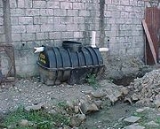
A
septic tank is a key component of the
septic system, a small-scale
sewage treatmentSewage treatment, or domestic wastewater treatment, is the process of removing contaminants from wastewater and household sewage, both runoff and domestic. It includes physical, chemical, and biological processes to remove physical, chemical and biological contaminants...
system common in areas with no connection to main sewage pipes provided by local governments or private corporations. (Other components, typically mandated and/or restricted by local governments, optionally include pumps, alarms,
sand filterSand filters are used for water purification. There are three main types;# rapid sand filters# upflow sand filters# slow sand filtersAll three methods are used extensively in the water industry throughout the world...
s, and clarified liquid effluent disposal means such as a
septic drain fieldSeptic drain fields, also called leach fields or leach drains are used to remove contaminants and impurities from the liquid that emerges from the septic tank. A septic tank, the septic drain field, and the associated piping compose a complete septic system. The septic drain field is effective for...
, ponds, natural stone fiber filter plants or
peat mossSphagnum is a genus of between 151 and 350 species of mosses commonly called peat moss, due to its prevalence in peat bogs and mires. A distinction is made between sphagnum moss, the live moss growing on top of a peat bog on one hand, and sphagnum peat moss or sphagnum peat on the other, the...
beds.) Septic systems are a type of On-Site Sewage Facility (
OSSFOn Site Sewage Facilities are wastewater systems designed to treat and dispose of effluent on the same property that produces the wastewater....
). In
North AmericaNorth America is a continent wholly within the Northern Hemisphere and almost wholly within the Western Hemisphere. It is also considered a northern subcontinent of the Americas...
, approximately 25% of the population relies on septic tanks; this can include suburbs and small towns as well as
ruralRural areas or the country or countryside are areas that are not urbanized, though when large areas are described, country towns and smaller cities will be included. They have a low population density, and typically much of the land is devoted to agriculture...
areas (
IndianapolisIndianapolis is the capital of the U.S. state of Indiana, and the county seat of Marion County, Indiana. As of the 2010 United States Census, the city's population is 839,489. It is by far Indiana's largest city and, as of the 2010 U.S...
is an example of a large city where many of the city's neighborhoods are still on separate septic systems). In Europe, they are in general limited to rural areas only.
The term "septic" refers to the
anaerobic bacterialAnaerobic digestion is a series of processes in which microorganisms break down biodegradable material in the absence of oxygen. It is used for industrial or domestic purposes to manage waste and/or to release energy....
environment that develops in the tank and that decomposes or mineralizes the waste discharged into the tank. Septic tanks can be coupled with other on-site wastewater treatment units such as biofilters or aerobic systems involving artificial forced
aerationAeration is the process by which air is circulated through, mixed with or dissolved in a liquid or substance.-Aeration of liquids:-Methods:Aeration of liquids is achieved by:...
.
Periodic
preventive maintenancePreventive maintenance has the following meanings:#The care and servicing by personnel for the purpose of maintaining equipment and facilities in satisfactory operating condition by providing for systematic inspection, detection, and correction of incipient failures either before they occur or...
is required to remove the irreducible solids that settle and gradually fill the tank, reducing its efficiency. In most jurisdictions this maintenance is required by law, yet often not enforced. Those who ignore the requirement will eventually be faced with extremely costly repairs when solids escape the tank and destroy the clarified liquid effluent disposal means. A properly maintained system, on the other hand, can last for decades or possibly even a lifetime.
Description
A septic tank generally consists of a tank (or sometimes more than one tank) of between 4000 and 7500 liters (1,000 and 2,000 gallons) in size connected to an inlet wastewater pipe at one end and a
septic drain fieldSeptic drain fields, also called leach fields or leach drains are used to remove contaminants and impurities from the liquid that emerges from the septic tank. A septic tank, the septic drain field, and the associated piping compose a complete septic system. The septic drain field is effective for...
at the other. In general, these pipe connections are made via a T pipe, which allows liquid entry and exit without disturbing any crust on the surface. Today, the design of the tank usually incorporates two chambers (each of which is equipped with a manhole cover), which are separated by means of a dividing wall that has openings located about midway between the floor and roof of the tank.
Wastewater enters the first chamber of the tank, allowing solids to settle and scum to float. The settled solids are anaerobically digested, reducing the volume of solids. The liquid component flows through the dividing wall into the second chamber, where further settlement takes place, with the excess liquid then draining in a relatively clear condition from the outlet into the leach field, also referred to as a drain field or seepage field, depending upon locality.
The remaining impurities are trapped and eliminated in the soil, with the excess water eliminated through
percolationIn physics, chemistry and materials science, percolation concerns the movement and filtering of fluids through porous materials...
into the
soilSoil is a natural body consisting of layers of mineral constituents of variable thicknesses, which differ from the parent materials in their morphological, physical, chemical, and mineralogical characteristics...
(eventually returning to the
groundwaterGroundwater is water located beneath the ground surface in soil pore spaces and in the fractures of rock formations. A unit of rock or an unconsolidated deposit is called an aquifer when it can yield a usable quantity of water. The depth at which soil pore spaces or fractures and voids in rock...
), through
evaporationEvaporation is a type of vaporization of a liquid that occurs only on the surface of a liquid. The other type of vaporization is boiling, which, instead, occurs on the entire mass of the liquid....
, and by uptake through the
rootIn vascular plants, the root is the organ of a plant that typically lies below the surface of the soil. This is not always the case, however, since a root can also be aerial or aerating . Furthermore, a stem normally occurring below ground is not exceptional either...
system of
plantPlants are living organisms belonging to the kingdom Plantae. Precise definitions of the kingdom vary, but as the term is used here, plants include familiar organisms such as trees, flowers, herbs, bushes, grasses, vines, ferns, mosses, and green algae. The group is also called green plants or...
s and eventual
transpirationTranspiration is a process similar to evaporation. It is a part of the water cycle, and it is the loss of water vapor from parts of plants , especially in leaves but also in stems, flowers and roots. Leaf surfaces are dotted with openings which are collectively called stomata, and in most plants...
. A piping network, often laid in a stone-filled trench (see
weeping tileA weeping tile is a porous pipe used for underground drainage. The pipe is typically plastic with small slits cut lengthwise into it. It is buried and surrounded by aggregate larger than the slits. The aggregate rocks prevent excessive soil from falling through the slits into the weeping tile...
), distributes the wastewater throughout the field with multiple drainage holes in the network. The size of the leach field is proportional to the volume of wastewater and inversely proportional to the porosity of the drainage field. The entire septic system can operate by gravity alone or, where topographic considerations require, with inclusion of a lift
pumpA pump is a device used to move fluids, such as liquids, gases or slurries.A pump displaces a volume by physical or mechanical action. Pumps fall into three major groups: direct lift, displacement, and gravity pumps...
. Certain septic tank designs include siphons or other methods of increasing the volume and velocity of outflow to the drainage field. This helps to load all portions of the drainage pipe more evenly and extends the drainage field life by preventing premature clogging.
An
Imhoff tankThe Imhoff tank, named for German engineer Karl Imhoff , is a chamber suitable for the reception and processing of sewage. It may be used for the clarification of sewage by simple settling and sedimentation, along with anaerobic digestion of the extracted sludge...
is a two-stage septic system where the sludge is digested in a separate tank. This avoids mixing digested sludge with incoming sewage. Also, some septic tank designs have a second stage where the
effluentEffluent is an outflowing of water or gas from a natural body of water, or from a human-made structure.Effluent is defined by the United States Environmental Protection Agency as “wastewater - treated or untreated - that flows out of a treatment plant, sewer, or industrial outfall. Generally refers...
from the anaerobic first stage is aerated before it drains into the seepage field.
Waste that is not decomposed by the anaerobic digestion eventually has to be removed from the septic tank, or else the septic tank fills up and undecomposed wastewater discharges directly to the drainage field. Not only is this bad for the environment but, if the sludge overflows the septic tank into the leach field, it may clog the leach field piping or decrease the soil porosity itself, requiring expensive repairs.
How often the septic tank has to be emptied depends on the volume of the tank relative to the input of solids, the amount of indigestible solids, and the ambient temperature (as anaerobic digestion occurs more efficiently at higher temperatures). The required frequency varies greatly depending on jurisdiction, usage, and system characteristics. Some health authorities require tanks to be emptied at prescribed intervals, while others leave it up to the determination of the inspector. Some systems require pumping every few years or sooner, while others may be able to go 10–20 years between pumpings. Contrary to what many believe, there is no "rule of thumb" for how often tanks should be emptied. An older system with an undersize tank that is being used by a large family will require much more frequent pumping than a new system used by only a few people. Anaerobic decomposition is rapidly re-started when the tank re-fills.
A properly designed and normally operating septic system is odor-free and, besides periodic inspection and pumping of the septic tank, should last for decades with no maintenance.See
http://www.septictank.org
A well-designed and -maintained concrete, fiberglass, or plastic tank should last about 50 years.
Potential problems
- Excessive dumping of cooking oils and grease can cause the inlet drains to block. Oils and grease are often difficult to degrade and can cause odor problems and difficulties with the periodic emptying.
- Flushing non-biodegradable items such as cigarette butts and hygiene products such as sanitary napkins, tampons, and cotton buds/swabs will rapidly fill or clog a septic tank; these materials should not be disposed of in this way.
- The use of garbage disposers
A garbage disposal unit or waste disposal unit is a device, usually electrically powered, installed under a kitchen sink between the sink's drain and the trap which shreds food waste into pieces small enough—generally less than —to pass through plumbing.Garbage disposal units are widely used in...
for disposal of waste food can cause a rapid overload of the system and early failure.
- Certain chemicals may damage the components of a septic tank, especially pesticides, herbicides, materials with high concentrations of bleach or caustic soda (lye) or any other inorganic materials such as paints or solvents.
- Roots from trees and shrubbery growing above the tank or the drainfield may clog and/or rupture them.
- Playgrounds and storage buildings may cause damage to a tank and the drainage field. In addition, covering the drainage field with an impervious surface, such as a driveway or parking area, will seriously affect its efficiency and possibly damage the tank and absorption system.
- Excessive water entering the system will overload it and cause it to fail. Checking for plumbing leaks and practicing water conservation will help the system's operation.
- Very high rainfall, rapid snow-melt, and flood
A flood is an overflow of an expanse of water that submerges land. The EU Floods directive defines a flood as a temporary covering by water of land not normally covered by water...
ing from rivers or the sea can all prevent a drain field from operating and can cause flow to back up and stop the normal operation of the tank.
- Over time, biofilm
A biofilm is an aggregate of microorganisms in which cells adhere to each other on a surface. These adherent cells are frequently embedded within a self-produced matrix of extracellular polymeric substance...
s develop on the pipes of the drainage field, which can lead to blockage. Such a failure can be referred to as "biomat failure".
- Septic tanks by themselves are ineffective at removing nitrogen
Nitrogen is a chemical element that has the symbol N, atomic number of 7 and atomic mass 14.00674 u. Elemental nitrogen is a colorless, odorless, tasteless, and mostly inert diatomic gas at standard conditions, constituting 78.08% by volume of Earth's atmosphere...
compounds that have potential to cause algal blooms in receiving waters; this can be remedied by using a nitrogen-reducing technology, or by simply ensuring that the leach field is properly sited to prevent direct entry of effluent into bodies of water.
- Not all varieties of toilet paper have been suitable for disposal in a septic tank, as some in the past did not deteriorate sufficiently (or, at least at some points in history, some toilet paper was specifically marked as suitable for use in septic systems and some was not).
Helpful tips
- As mentioned above, many chemicals such as household cleaners and detergents can damage the septic system, including the bacteria involved in breaking down solid waste. However, products such as enzyme, chemical, or bacterial additives are not the solution - they can actually cause more problems, not only to your system, but to the environment as well. The best method is to stop using caustic cleaners, and to allow the natural bacteria found in waste to re-accumulate. Check your local legislation to find out what is allowed and what is not if additives must be used.
- Oftentimes, septic systems back up due to non-biodegradable items — either flushed objects or hair from shower drains — that make their way through the inlet T pipe and into the septic tank, which then can clog the outlet T pipe and cause the liquid to overflow. To try to avoid such a problem, installation of a filter is recommended. A filter acts as a security guard and stops unwanted items from making their way into the tank. It can be installed in either the inlet or outlet T and protects the septic system.
- Septic system cover safety is an extremely important topic and ongoing issue in the U.S. Older septic system covers were concrete, which over time can crack and corrode and should be regularly checked for guaranteed security. Metal or cast iron covers also have the ability to be unsafe. Metal and cast iron are such heavy materials that if not properly installed and/or with an incorrect bottom structure, can flip themselves like a revolving door, which can be especially unsafe for children and animals. It is so important that covers should be regularly checked, preferably by a professional, who can determine whether the cover is up to code standards. It is recommended that covers be checked twice per season (such as once in the beginning of spring and once at the end of spring, once at the beginning of summer and once at the end of summer, etc.). It is also highly recommended that covers are inspected after winter in colder regions, as heavy snow and ice can damage even a newer cover.
- Many chemicals can damage septic tanks. A good solution is to allow the natural bacteria found in waste to re-accumulate or use of a product that contains natural bacteria that eat the toxic waste.
Environmental issues
Some pollutants, especially
sulfateIn inorganic chemistry, a sulfate is a salt of sulfuric acid.-Chemical properties:...
s, under the anaerobic conditions of septic tanks, are reduced to
hydrogen sulfideHydrogen sulfide is the chemical compound with the formula . It is a colorless, very poisonous, flammable gas with the characteristic foul odor of expired eggs perceptible at concentrations as low as 0.00047 parts per million...
, a
pungentAn odor or odour is caused by one or more volatilized chemical compounds, generally at a very low concentration, that humans or other animals perceive by the sense of olfaction. Odors are also commonly called scents, which can refer to both pleasant and unpleasant odors...
and toxic gas. Likewise,
methaneMethane is a chemical compound with the chemical formula . It is the simplest alkane, the principal component of natural gas, and probably the most abundant organic compound on earth. The relative abundance of methane makes it an attractive fuel...
, a potent greenhouse gas, is another by-product.
NitrateThe nitrate ion is a polyatomic ion with the molecular formula NO and a molecular mass of 62.0049 g/mol. It is the conjugate base of nitric acid, consisting of one central nitrogen atom surrounded by three identically-bonded oxygen atoms in a trigonal planar arrangement. The nitrate ion carries a...
s and
organic nitrogen compoundsNitro compounds are organic compounds that contain one or more nitro functional groups . They are often highly explosive, especially when the compound contains more than one nitro group and is impure. The nitro group is one of the most common explosophores used globally...
are reduced to
ammoniaAmmonia is a compound of nitrogen and hydrogen with the formula . It is a colourless gas with a characteristic pungent odour. Ammonia contributes significantly to the nutritional needs of terrestrial organisms by serving as a precursor to food and fertilizers. Ammonia, either directly or...
. Because of the anaerobic conditions,
fermentationFermentation is the process of extracting energy from the oxidation of organic compounds, such as carbohydrates, using an endogenous electron acceptor, which is usually an organic compound. In contrast, respiration is where electrons are donated to an exogenous electron acceptor, such as oxygen,...
processes take place, which ultimately generate
carbon dioxideCarbon dioxide is a naturally occurring chemical compound composed of two oxygen atoms covalently bonded to a single carbon atom...
and
methaneMethane is a chemical compound with the chemical formula . It is the simplest alkane, the principal component of natural gas, and probably the most abundant organic compound on earth. The relative abundance of methane makes it an attractive fuel...
.
The fermentation processes cause the contents of a septic tank to be anaerobic with a low
redoxRedox reactions describe all chemical reactions in which atoms have their oxidation state changed....
potential, which keeps
phosphateA phosphate, an inorganic chemical, is a salt of phosphoric acid. In organic chemistry, a phosphate, or organophosphate, is an ester of phosphoric acid. Organic phosphates are important in biochemistry and biogeochemistry or ecology. Inorganic phosphates are mined to obtain phosphorus for use in...
in a soluble and, thus, mobilized form. Because phosphate can be the limiting nutrient for plant growth in many ecosystems, the discharge from a septic tank into the environment can trigger prolific plant growth including algal blooms, which can also include blooms of potentially toxic
cyanobacteria. See http://www.septictank.org
Soil capacity to retain phosphorus is large compared with the load through a normal residential septic tank. An exception occurs when
septic drain fieldSeptic drain fields, also called leach fields or leach drains are used to remove contaminants and impurities from the liquid that emerges from the septic tank. A septic tank, the septic drain field, and the associated piping compose a complete septic system. The septic drain field is effective for...
s are located in sandy or coarser soils on property adjoining a water body. Because of limited particle surface area, these soils can become saturated with phosphate. Phosphate will progress beyond the treatment area, posing a threat of
eutrophicationEutrophication or more precisely hypertrophication, is the movement of a body of water′s trophic status in the direction of increasing plant biomass, by the addition of artificial or natural substances, such as nitrates and phosphates, through fertilizers or sewage, to an aquatic system...
to surface waters.
In areas with high population density, groundwater pollution levels often exceed acceptable limits. Some small towns are facing the costs of building very expensive centralized wastewater treatment systems because of this problem, owing to the high cost of extended collection systems.
To slow development, building moratoriums and limits on the
subdivisionSubdivision is the act of dividing land into pieces that are easier to sell or otherwise develop, usually via a plat. The former single piece as a whole is then known in the United States as a subdivision...
of property are often imposed. Ensuring existing septic tanks are functioning properly can also be helpful for a limited time, but becomes less effective as a primary remediation strategy as population density increases.
Trees in the vicinity of a concrete septic tank have the potential to penetrate the tank as the system ages and the concrete begins to develop cracks and small leaks. Tree roots can cause serious flow problems due to plugging and blockage of drain pipes, but the trees themselves tend to grow extremely vigorously due to the continuous influx of nutrients into the septic system.
See also
- Blackwater
Blackwater is a term dating to at least the 1970s used to describe wastewater containing fecal matter and urine. It is also known as brown water, foul water, or sewage...
- Biofilters
- Bioreactor
A bioreactor may refer to any manufactured or engineered device or system that supports a biologically active environment. In one case, a bioreactor is a vessel in which a chemical process is carried out which involves organisms or biochemically active substances derived from such organisms. This...
- Cesspit
A cesspit, or cesspool is a pit, conservancy tank, or covered cistern, which can be used to dispose of urine and feces, and more generally of all sewage and refuse. It is a more antiquated solution than a sewer system. Traditionally, it was a deep cylindrical chamber dug into the earth, having...
- Drain-waste-vent system
In modern plumbing, a drain-waste-vent is part of a system that removes sewage and greywater from a building and regulates air pressure in the waste-system pipes, facilitating flow. Waste is produced at fixtures such as toilets, sinks and showers, and exits the fixtures through a trap, a dipped...
- Ecological sanitation
Ecological sanitation, also known as ecosan or eco-san, are terms coined to describe a form of sanitation that usually involves urine diversion and the recycling of water and nutrients contained within human wastes back into the local environment....
- Grease interceptor
Grease traps are plumbing devices designed to intercept most greases and solids before they enter a wastewater disposal system. Common wastewater contains small amounts of oils which enter into septic tanks and treatment facilities to form a floating scum layer...
- Latrine
A latrine is a communal facility containing one or more commonly many toilets which may be simple pit toilets or in the case of the United States Armed Forces any toilet including modern flush toilets...
- Mound system
A mound system is an alternative to the traditional rural septic system leach field. The mound system is an engineered leaching field used in areas where septic systems are more prone to failure due to having extremely slow or extremely fast permeable soils, soil with shallow cover over porous...
(a type of septic system)
- Outhouse
An outhouse is a small structure separate from a main building which often contained a simple toilet and may possibly also be used for housing animals and storage.- Terminology :...
- Perc test
A percolation test is a test to determine the absorption rate of soil for a septic drain field or "leach field". The results of a percolation test are required to properly design a septic system...
(Percolation testing for the capacity of soil to absorb water)
- Pit toilet
A pit toilet is a dry toilet system which collects human excrement in a large container and range from a simple slit trench to more elaborate systems with ventilation. They are more often used in rural and wilderness areas as well as in much of the developing world...
- Sanitary sewer
A sanitary sewer is a separate underground carriage system specifically for transporting sewage from houses and commercial buildings to treatment or disposal. Sanitary sewers serving industrial areas also carry industrial wastewater...
- Sepsis
Sepsis is a potentially deadly medical condition that is characterized by a whole-body inflammatory state and the presence of a known or suspected infection. The body may develop this inflammatory response by the immune system to microbes in the blood, urine, lungs, skin, or other tissues...
- Septage
In the United States, the partially treated waste store in a septic tank is called septage. It generally consists of all the household wastes that are disposed of through a home's plumbing system that neither drain out into the soil nor are converted to gases by the bacteria in the tank.Disposing...
- Sewage treatment
Sewage treatment, or domestic wastewater treatment, is the process of removing contaminants from wastewater and household sewage, both runoff and domestic. It includes physical, chemical, and biological processes to remove physical, chemical and biological contaminants...
- Septic Tank Effluent Pumping (STEP)
Effluent sewer is also known as a STEP system and is a type of pressure sewer.- How it works :Effluent sewer is a wastewater collection system that pumps only the liquid portion of sewage. At each home, a buried tank collects and passively separates solids from the liquid effluent...
- Wastewater
Wastewater is any water that has been adversely affected in quality by anthropogenic influence. It comprises liquid waste discharged by domestic residences, commercial properties, industry, and/or agriculture and can encompass a wide range of potential contaminants and concentrations...
External links