
-
- For the state of Cracow between 1846 and 1918, see Grand Duchy of Cracow. Fore more modern territorial division of Kraków region, see Kraków Voivodeship
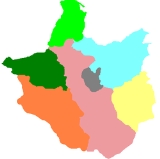
Kraków Voivodeship, refers to several historical Voivodeships of Poland in the surrounding regions, with the city of Kraków as its capital.- Kraków Voivodeship 1975-1998 :...
.
Seniorate Province, also known as the
Senioral Province ,
Duchy of Kraków (
Księstwo krakowskie),
Duchy of Cracow,
Principality of Cracow,
Principality of Kraków, was the superior among the five provinces established in 1138 according to the Testament of Bolesław III Krzywousty. It existed during the period of
fragmentation of PolandHistory of Poland during the Piast dynasty is the first major stage in the history of Poland from the 10th to the 14th century when Poland was established as a state and a nation during the medieval period of European history. The history of the Polish state begins with the founding of the Piast...
until 1320, centered at
KrakówKraków also Krakow, or Cracow , is the second largest and one of the oldest cities in Poland. Situated on the Vistula River in the Lesser Poland region, the city dates back to the 7th century. Kraków has traditionally been one of the leading centres of Polish academic, cultural, and artistic life...
in
Lesser PolandLesser Poland is one of the historical regions of Poland, with its capital in the city of Kraków. It forms the southeastern corner of the country, and should not be confused with the modern Lesser Poland Voivodeship, which covers only a small, southern part of Lesser Poland...
. The Seniorate Province was supposed to be ruled by the rotating head of the royal
Piast dynastyThe Piast dynasty was the first historical ruling dynasty of Poland. It began with the semi-legendary Piast Kołodziej . The first historical ruler was Duke Mieszko I . The Piasts' royal rule in Poland ended in 1370 with the death of king Casimir the Great...
, a principality that he held as overlord (Senior Prince or High duke,
princepsPrinceps is a Latin word meaning "first in time or order; the first, chief, the most eminent, distinguished, or noble; the first man, first person."...
) of the other Polish dukes.
Senioral principle
The senioral principle established in the testament stated that at all times the eldest member of the dynasty was to have supreme power over the rest (
Dux, the Dukes) and was also to control an indivisible "Seniorate Province". In 1138 Bolesław's III eldest son Władysław II, took up the rule over a vast strip of land running north-south down the middle of Poland, composed of:
- Lesser Poland
Lesser Poland is one of the historical regions of Poland, with its capital in the city of Kraków. It forms the southeastern corner of the country, and should not be confused with the modern Lesser Poland Voivodeship, which covers only a small, southern part of Lesser Poland...
, except for the eastern Duchy of SandomierzSandomierz is a city in south-eastern Poland with 25,714 inhabitants . Situated in the Świętokrzyskie Voivodeship , previously in Tarnobrzeg Voivodeship . It is the capital of Sandomierz County . Sandomierz is known for its Old Town, a major tourist attraction...
allocated to Bolesław's III minor son HenryHenry of Sandomierz was a Duke of Sandomierz since 1138 or 1146 until his death....
;
- eastern parts of Greater Poland
Greater Poland or Great Poland, often known by its Polish name Wielkopolska is a historical region of west-central Poland. Its chief city is Poznań.The boundaries of Greater Poland have varied somewhat throughout history...
around GnieznoGniezno is a city in central-western Poland, some 50 km east of Poznań, inhabited by about 70,000 people. One of the Piasts' chief cities, it was mentioned by 10th century A.D. sources as the capital of Piast Poland however the first capital of Piast realm was most likely Giecz built around...
, the Polish ecclesiastical center, and KaliszKalisz is a city in central Poland with 106,857 inhabitants , the capital city of the Kalisz Region. Situated on the Prosna river in the southeastern part of the Greater Poland Voivodeship, the city forms a conurbation with the nearby towns of Ostrów Wielkopolski and Nowe Skalmierzyce...
;
- western Kuyavia
Kujawy , is a historical and ethnographic region in the north-central Poland, situated in the basin of the middle Vistula and upper Noteć Rivers, with its capital in Włocławek.-Etymology:The origin of the name Kujawy was seen differently in history...
;
- the lands of Łęczyca, held by Bolesław's III widow Salomea of Berg
Salomea of Berg was a German noblewoman and by marriage Duchess of Poland.She was the daughter of Swabian Count Henry of Berg Castle by his wife Adelaide of Mochental , probably a sister of Margrave Diepold III of Vohburg...
for life.
The High Duke resided at Kraków, Poland's capital since 1038. The Senior's prerogatives also included control over the
Duchy of SilesiaThe Duchy of Silesia with its capital at Wrocław was a medieval duchy located in the historic Silesian region of Poland. Soon after it was formed under the Piast dynasty in 1138, it fragmented into various Duchies of Silesia. In 1327 the remaining Duchy of Wrocław as well as most other duchies...
and his
PomereliaPomerelia is a historical region in northern Poland. Pomerelia lay in eastern Pomerania: on the southern shore of the Baltic Sea and west of the Vistula and its delta. The area centered on the city of Gdańsk at the mouth of the Vistula...
n vassals at
GdańskGdańsk is a Polish city on the Baltic coast, at the centre of the country's fourth-largest metropolitan area.The city lies on the southern edge of Gdańsk Bay , in a conurbation with the city of Gdynia, spa town of Sopot, and suburban communities, which together form a metropolitan area called the...
in eastern
PomeraniaPomerania is a historical region on the south shore of the Baltic Sea. Divided between Germany and Poland, it stretches roughly from the Recknitz River near Stralsund in the West, via the Oder River delta near Szczecin, to the mouth of the Vistula River near Gdańsk in the East...
. The Senior was tasked with defense of borders, the right to have troops in provinces of other Dukes, carrying out the foreign policy, supervision over the clergy (including the right to nominate bishops and archbishops), and minting the currency.
The High duke generally had his own principality (province, dukedom), which he had inherited within his own branch of the Piast dynasty, and left to his personal heirs within his own branch, whereas Kraków followed the seniorate (fell to the oldest of them). Kraków was a substantial addition to the resources of the incumbent, whoever it was, and was intended to put him higher in might than his vassal dukes.
However the seniorate soon collapsed, with the first Senior - Władysław II the Exile - failing his bid to take over other provinces and in 1146 was expelled by his younger half-brothers, an incident which led to long-time Polish particularism.
The Duchy
The duchy neighboured originally each of the four partition duchies of
MasoviaThe Duchy of Masovia with its capital at Płock was a medieval duchy formed when the Polish Kingdom of the Piasts fragmented in 1138. It was located in the historic Masovian region of northeastern Poland...
at Płock,
SandomierzSandomierz is a city in south-eastern Poland with 25,714 inhabitants . Situated in the Świętokrzyskie Voivodeship , previously in Tarnobrzeg Voivodeship . It is the capital of Sandomierz County . Sandomierz is known for its Old Town, a major tourist attraction...
,
SilesiaThe Duchy of Silesia with its capital at Wrocław was a medieval duchy located in the historic Silesian region of Poland. Soon after it was formed under the Piast dynasty in 1138, it fragmented into various Duchies of Silesia. In 1327 the remaining Duchy of Wrocław as well as most other duchies...
at Wrocław and Greater Poland at
PoznanPoznań is a city on the Warta river in west-central Poland, with a population of 556,022 in June 2009. It is among the oldest cities in Poland, and was one of the most important centres in the early Polish state, whose first rulers were buried at Poznań's cathedral. It is sometimes claimed to be...
. Even after many of those were further partitioned, it bordered on several principalities, and was at least close to all.
Upon the exile of High Duke Władysław II the rule was assumed by Władysław's II eldest brother Bolesław IV the Curly, Duke of Masovia, who died without issue in 1173. He was followed in the Seniorate by the second eldest
Mieszko III the OldMieszko III the Old , of the royal Piast dynasty, was Duke of Greater Poland from 1138 and High Duke of Poland, with interruptions, from 1173 until his death....
, while Masovia and the Kuyavian lands passed to Bolesław's IV minor son
LeszekLeszek of Masovia was the second Duke of Masovia and Kuyavia from 1173 until his death.He was the second but only surviving son of Bolesław IV the Curly, High Duke of Poland by his first wife Viacheslava, daughter of St. Vsevolod, Prince of Novgorod and Pskov...
.
The senioral principle finally turned out to be a failure as Mieszko's III rule at Kraków was not only challenged by the sons of expelled Władysław II, but also by the youngest son
Casimir II the JustCasimir II the Just was a Lesser Polish duke at Wiślica during 1166–1173, and at Sandomierz since 1173. He became ruler over the Polish Seniorate Province at Kraków and thereby High Duke of Poland in 1177; a position he held until his death, interrupted once by his elder brother and predecessor...
, who had not received any share by his late father's testament. Though upon the death of Bolesław IV the Curly he had received the Duchy of
SandomierzSandomierz is a city in south-eastern Poland with 25,714 inhabitants . Situated in the Świętokrzyskie Voivodeship , previously in Tarnobrzeg Voivodeship . It is the capital of Sandomierz County . Sandomierz is known for its Old Town, a major tourist attraction...
, in 1177 he took the occasion of an uprising by Lesser Polish nobles (
magnateMagnate, from the Late Latin magnas, a great man, itself from Latin magnus 'great', designates a noble or other man in a high social position, by birth, wealth or other qualities...
s) and assumed the rule as High Duke from his elder brother Mieszko III. A long-term struggle between the brothers followed, whereby Mieszko III was able to incorporate the northwestern lands of Gniezno and Kalisz into his Duchy of Greater Poland.
The Seniorate remained contested after Kraków was inherited by Casimir's II son
Leszek I the WhiteLeszek I the White , also listed by some sources as Leszek II the White, was Prince of Sandomierz and High Duke of Poland from 1194 until his death, except for the short periods following when he was deposed as Polish ruler...
in 1194, still by his uncle Mieszko III (d. 1202), then by his younger brother Konrad of Masovia, by his cousin, Mieszko's III son Władysław III Spindleshanks and also by the second son of Władysław II the Exile, Duke
Mieszko IV TanglefootMieszko IV Tanglefoot was a Duke of Silesia from 1163 to 1173 , Duke of Racibórz from 1173, Duke of Opole from 1202 and from 9 June 1210 until his death, Duke of Kraków and High Duke of Poland....
of Upper Silesia. In the long-term struggle Leszek I was killed in 1227 and the Pomerelian lands got lost, when Duke Swietopelk II of Gdańsk declared himself independent. In 1232 the Silesian duke
Henry I the BeardedHenry I the Bearded , of the Silesian line of the Piast dynasty, was Duke of Silesia at Wrocław from 1201 and Duke of Kraków and thus High Duke of all Poland - internally divided - from 1232 until his death.-Heir of Wroclaw:...
finally prevailed, re-uniting the thrones of Wrocław and Kraków under his rule as determined by the will of late Duke Bolesław III Krzywousty in 1138. However, a re-establishment of the Polish kingdom under the rule of the
Silesian PiastsThe Silesian Piasts were the oldest line of the Piast dynasty beginning with Władysław II the Exile, son of Bolesław III Wrymouth, Duke of Poland...
failed, when Duke Henry's I son
Henry II the PiousHenry II the Pious , of the Silesian line of the Piast dynasty was Duke of Silesia at Wrocław and Duke of Kraków and thus High Duke of all Poland as well as Duke of Southern Greater Poland from 1238 until his death. During 1238–1239 he also served as a regent of two other Piast duchies: Sandomierz...
was killed during the
Mongol invasionThe Mongol Invasion of Poland from late 1240 to 1241 culminated in the battle of Legnica, where the Mongols defeated an alliance which included forces from fragmented Poland and members of various Christian military orders, led by Henry II the Pious, the Duke of Silesia. The first invasion's...
at the 1241
Battle of LegnicaThe Battle of Legnica , also known as the Battle of Liegnitz or Battle of Wahlstatt , was a battle between the Mongol Empire and the combined defending forces of European fighters that took place at Legnickie Pole near the city of Legnica in Silesia on 9 April 1241.A combined force of Poles,...
. After an interregnum he was succeeded by Leszek's I son Bolesław V the Chaste, who upon his death in 1279 appointed Konrad's grandson
Leszek II the BlackLeszek the Black , named after his black hair, was one of the High Dukes of the fragmented Kingdom of Poland. He ruled from 1279 to 1288, and was married to Agrippina of Slavonia with no children.- Life :...
of Kuyavia.
The Silesian Piasts once again reached for the Senioral Province, when Leszek II died without heirs in 1288, and Duke Henry IV Probus of Wrocław became High Duke at Kraków but likewise had no issue upon his death in 1290. The Seniorate was again contested between the dukes Przemysł II of Greater Poland and Władysław I the Elbow-high of Kuyavia. Przemysł II brought the royal
Přemyslid dynastyThe Přemyslids , were a Czech royal dynasty which reigned in Bohemia and Moravia , and partly also in Hungary, Silesia, Austria and Poland.-Legendary rulers:...
of
BohemiaThe Kingdom of Bohemia was a country located in the region of Bohemia in Central Europe, most of whose territory is currently located in the modern-day Czech Republic. The King was Elector of Holy Roman Empire until its dissolution in 1806, whereupon it became part of the Austrian Empire, and...
into the Polish affairs, when he allied with King Wenceslaus II, whom he ceded the throne at Kraków. In 1295 however, he switched sides and had himself crowned as King of Poland (the first since the deposition of Bolesław II the Bold in 1079) at Greater Polish Gniezno. As he was killed the next year, Władysław I proclaimed himself his successor, he neverteheless had to deal with the permanent pressure by the claimants of the Bohemian Přemyslid and
LuxembourgThe House of Luxembourg was a late medieval German dynasty, which between 1308 and 1437 ruled the Holy Roman Empire, twice interrupted by the rivaling House of Wittelsbach.-History:...
dynasties, who had begun to vassalize the southwestern
Silesian duchiesThe Duchies of Silesia resulted from divisions of the original Duchy of Silesia after 1138.In accordance with the last will and testament of Duke Bolesław III Wrymouth, the Kingdom of Poland was, upon his death in 1138, divided into five hereditary provinces distributed among his sons, including...
.
In 1320 Władysław I, against the fierce resistance of King John of Bohemia, reached the consent by
Pope John XXIIPope John XXII , born Jacques Duèze , was pope from 1316 to 1334. He was the second Pope of the Avignon Papacy , elected by a conclave in Lyon assembled by Philip V of France...
to have himself crowned Polish king at Kraków. The Duchy of Kraków was finally incorporated into the Lands of the Polish Crown as Kraków Voivodeship. Władysław's I successor King Casimir III the Great had to buy off the Bohemian claims by renouncing
SilesiaSilesia is a historical region of Central Europe located mostly in Poland, with smaller parts also in the Czech Republic, and Germany.Silesia is rich in mineral and natural resources, and includes several important industrial areas. Silesia's largest city and historical capital is Wrocław...
in the 1335 Treaty of Trentschin.
Dukes of Kraków
In this list, titular claims are not noted, not as full rule; only true and real ducal power over Kraków is noted.
In 1138 Bolesław III Krzywousty, Duke of all Poland at Kraków, divided his realm into five duchies, with the Seniorate Porvince allocated to:
- 1138-46 Władysław II the Exile, also Duke of Silesia
The Dukes of Silesia were the sons and descendants of the Polish Duke Bolesław III Wrymouth. In accordance with the last will and testament of Bolesław, upon his death his lands were divided into 4-5 hereditary provinces distributed among his sons, and a royal province of Kraków reserved for the...
, deposed by his younger half-brothers and exiled
- 1146 (possibly already earlier in power in Cracow) - 1173 Bolesław IV the Curly, half-brother, also Duke of Masovia and Duke of Silesia until 1163 (return of Władysław's II sons)
- 1173-77 Mieszko III the Old
Mieszko III the Old , of the royal Piast dynasty, was Duke of Greater Poland from 1138 and High Duke of Poland, with interruptions, from 1173 until his death....
, brother, Duke of Greater Poland, deposed
- 1177-(90/90-)94 Casimir II the Just
Casimir II the Just was a Lesser Polish duke at Wiślica during 1166–1173, and at Sandomierz since 1173. He became ruler over the Polish Seniorate Province at Kraków and thereby High Duke of Poland in 1177; a position he held until his death, interrupted once by his elder brother and predecessor...
, also Duke of SandomierzSandomierz is a city in south-eastern Poland with 25,714 inhabitants . Situated in the Świętokrzyskie Voivodeship , previously in Tarnobrzeg Voivodeship . It is the capital of Sandomierz County . Sandomierz is known for its Old Town, a major tourist attraction...
since 1173
- 1190 briefly Mieszko III again
- 1194-99 Leszek I the White
Leszek I the White , also listed by some sources as Leszek II the White, was Prince of Sandomierz and High Duke of Poland from 1194 until his death, except for the short periods following when he was deposed as Polish ruler...
, son of Casimir II, Duke of Sandomierz, deposed
- 1199-1202 Mieszko III, again
- 1201 Leszek I of Sandomierz, again, deposed
- 1202 Konrad, brother, Duke of Masovia, deposed
- 1202-06 Władysław III Spindleshanks, son of Mieszko III, Duke of Greater Poland, deposed
- 1202- Leszek I of Sandomierz, in strife against Wladyslaw III
- 1206-27 Leszek I of Sandomierz, again
- 1210-11 Mieszko IV Tanglefoot
Mieszko IV Tanglefoot was a Duke of Silesia from 1163 to 1173 , Duke of Racibórz from 1173, Duke of Opole from 1202 and from 9 June 1210 until his death, Duke of Kraków and High Duke of Poland....
, Duke of Upper Silesia
- 1227-29 Wladyslaw III of Greater Poland, again, deposed
- 1227-28 Konrad of Masovia, again, deposed (strife against Wladyslaw III)
- 1228-38 Henry I the Bearded
Henry I the Bearded , of the Silesian line of the Piast dynasty, was Duke of Silesia at Wrocław from 1201 and Duke of Kraków and thus High Duke of all Poland - internally divided - from 1232 until his death.-Heir of Wroclaw:...
, Duke of Lower Silesia (strife)
- 1229-32 Konrad of Masovia, in strife
- 1238-41 Henry II the Pious
Henry II the Pious , of the Silesian line of the Piast dynasty was Duke of Silesia at Wrocław and Duke of Kraków and thus High Duke of all Poland as well as Duke of Southern Greater Poland from 1238 until his death. During 1238–1239 he also served as a regent of two other Piast duchies: Sandomierz...
, Duke of Lower Silesia
- 1241 Bolesław II the Bald, Duke of Lower Silesia, driven away 1241
- Mongol invasion (Konrad of Masovia was again overlord, though hardly held Cracow)
- 1243-79 Bolesław V the Chaste, Duke of Sandomierz
- 1279-88 Leszek II the Black
Leszek the Black , named after his black hair, was one of the High Dukes of the fragmented Kingdom of Poland. He ruled from 1279 to 1288, and was married to Agrippina of Slavonia with no children.- Life :...
, Duke of KuyaviaKujawy , is a historical and ethnographic region in the north-central Poland, situated in the basin of the middle Vistula and upper Noteć Rivers, with its capital in Włocławek.-Etymology:The origin of the name Kujawy was seen differently in history...
- 1288-90 Henry IV Probus, Duke of Wrocław (in Lower Silesia)
- 1290-91 Przemysł II, Duke of Greater Poland, crowned king 1295
- 1291-1305 King Wenceslaus II of Bohemia
- 1305 King Wenceslaus III of Bohemia
Wenceslaus III Premyslid was the King of Hungary , King of Bohemia and the king of Poland ....
, deposed
- 1305- Władysław I the Elbow-high, Duke of Kujavia, crowned king 1320