
Home      Discussion      Topics      Dictionary      Almanac
Signup       Login
Sega Mega Drive

Sega Mega Drive

Overview
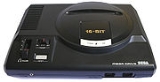
The Sega Genesis is a fourth-generation
History of video game consoles (fourth generation)
In the history of computer and video games, the fourth generation began on October 30, 1987 with the Japanese release of Nippon Electric Company's PC Engine...

 video game console
Video game console
A video game console is an interactive entertainment computer or customized computer system that produces a video display signal which can be used with a display device to display a video game...

 developed and produced by Sega
Sega
, usually styled as SEGA, is a multinational video game software developer and an arcade software and hardware development company headquartered in Ōta, Tokyo, Japan, with various offices around the world...

. It was originally released in Japan in 1988 as , then in North America in 1989 as Sega Genesis, and in Europe, Australia and other PAL region
PAL region
The PAL region is a television publication territory which covers most of Asia, Africa, Australia, New Zealand, and most of Western Europe...

s in 1990 as Mega Drive. The reason for the two names is that Sega was unable to secure legal rights to the Mega Drive name in North America. The Sega Genesis is Sega's third console and the successor to the Sega Master System
Sega Master System
The is a third-generation video game console that was manufactured and released by Sega in 1985 in Japan , 1986 in North America and 1987 in Europe....

 with which it has backward compatibility
Backward compatibility
In the context of telecommunications and computing, a device or technology is said to be backward or downward compatible if it can work with input generated by an older device...

.
Discussion
Ask a question about 'Sega Mega Drive'
Start a new discussion about 'Sega Mega Drive'
Answer questions from other users
Full Discussion Forum
 
Unanswered Questions
Encyclopedia
The Sega Genesis is a fourth-generation
History of video game consoles (fourth generation)
In the history of computer and video games, the fourth generation began on October 30, 1987 with the Japanese release of Nippon Electric Company's PC Engine...

 video game console
Video game console
A video game console is an interactive entertainment computer or customized computer system that produces a video display signal which can be used with a display device to display a video game...

 developed and produced by Sega
Sega
, usually styled as SEGA, is a multinational video game software developer and an arcade software and hardware development company headquartered in Ōta, Tokyo, Japan, with various offices around the world...

. It was originally released in Japan in 1988 as , then in North America in 1989 as Sega Genesis, and in Europe, Australia and other PAL region
PAL region
The PAL region is a television publication territory which covers most of Asia, Africa, Australia, New Zealand, and most of Western Europe...

s in 1990 as Mega Drive. The reason for the two names is that Sega was unable to secure legal rights to the Mega Drive name in North America. The Sega Genesis is Sega's third console and the successor to the Sega Master System
Sega Master System
The is a third-generation video game console that was manufactured and released by Sega in 1985 in Japan , 1986 in North America and 1987 in Europe....

 with which it has backward compatibility
Backward compatibility
In the context of telecommunications and computing, a device or technology is said to be backward or downward compatible if it can work with input generated by an older device...

.

The controversy over games like Mortal Kombat in the United States
United States
The United States of America is a federal constitutional republic comprising fifty states and a federal district...

 forced Sega to create the first content rating system for video games
Video game content rating system
A video game content rating system is a system used for the classification of video games into suitability-related groups. Most of these systems are associated with and/or sponsored by a government, and are sometimes part of the local motion picture rating system...

, the Videogame Rating Council
Videogame Rating Council
The Videogame Rating Council was introduced by Sega of America in 1993 to rate all video games that were released for sale in the United States on the Sega Genesis, Sega Game Gear, Sega CD, and rarely, some computer games...

, rather than have the games heavily censored. The rating system allowed Sega to ship games with little to no censorship and gave it a competive edge when the same game was released by Nintendo
Nintendo
is a multinational corporation located in Kyoto, Japan. Founded on September 23, 1889 by Fusajiro Yamauchi, it produced handmade hanafuda cards. By 1963, the company had tried several small niche businesses, such as a cab company and a love hotel....

. The success of those games eventually forced Nintendo to join its rating system.

The Sega Genesis was the first of its generation to achieve notable market share in Europe and North America. The Sega Genesis was launched to compete with the Nintendo Entertainment System
Nintendo Entertainment System
The Nintendo Entertainment System is an 8-bit video game console that was released by Nintendo in North America during 1985, in Europe during 1986 and Australia in 1987...

 and NEC
NEC
, a Japanese multinational IT company, has its headquarters in Minato, Tokyo, Japan. NEC, part of the Sumitomo Group, provides information technology and network solutions to business enterprises, communications services providers and government....

's PC-Engine
TurboGrafx-16
TurboGrafx-16, fully titled as TurboGrafx-16 Entertainment SuperSystem and known in Japan as the , is a video game console developed by Hudson Soft and NEC, released in Japan on October 30, 1987, and in North America on August 29, 1989....

. Two years later, Nintendo released the Super Nintendo Entertainment System
Super Nintendo Entertainment System
The Super Nintendo Entertainment System is a 16-bit video game console that was released by Nintendo in North America, Europe, Australasia , and South America between 1990 and 1993. In Japan and Southeast Asia, the system is called the , or SFC for short...

, and the competition between the two would dominate the 16-bit era of video gaming. The console began production in Japan in 1988 and ended with the last new licensed game being released in 2002 in Brazil. The Sega Genesis was Sega's most successful console; though Sega has never released a total sales figure quote, sales estimates in the past have ranged from as low as 29 million to over 40.8 million. Several add-on
Add-on
Add-on might mean:* Plug-in , a piece of software which enhances another software application and usually cannot be run independently** Browser extension, which modifies the interface and/or behavior of web browsers...

s were created including the Mega-CD and 32X
Sega 32X
The Sega 32X, codenamed Project Mars, is an add-on for the Mega Drive/Genesis video game console by Sega. Its aim was to increase the lifespan of the aging Mega Drive/Genesis system, which was facing stiff competition from the SNES...

 which extended its capabilities. The console and its games continue to be popular among fans, collectors, retro gamers, emulation enthusiasts and the fan translation
Fan translation
A fan translation, in video gaming, refers to an unofficial translation of a computer game or video game.The fan translation practice grew with the rise of video game console emulation in the late 1990s. A community of people developed that were interested in replaying and modifying the games they...

 scene. Licensed 3rd party variations of the console are still being produced to this day, and there are also several indie game developers
Independent video game development
Independent video game development is the process of creating video games without the financial support of a video game publisher. While large firms can create independent games, they are usually designed by an individual or a small team of as many as ten people, depending on the complexity of the...

 continuing to produce games for the console. Many games have been re-released in compilations for newer consoles, offered for download on various online services, such as Wii Virtual Console, Xbox Live Arcade
Xbox Live Arcade
Xbox Live Arcade is a type of video game download distribution available primarily in a section of the Xbox Live Marketplace, Microsoft's digital distribution network for the Xbox 360, that focuses on smaller downloadable games from both major publishers and independent game developers...

, PlayStation Network and Steam, or both.

History


Although the Sega Master System
Sega Master System
The is a third-generation video game console that was manufactured and released by Sega in 1985 in Japan , 1986 in North America and 1987 in Europe....

 was a success in Europe, and later also Brazil
Brazil
Brazil , officially the Federative Republic of Brazil , is the largest country in South America. It is the world's fifth largest country, both by geographical area and by population with over 192 million people...

, it failed to ignite much interest in the North American or Japanese markets, which, by the mid-to-late 1980s, were both dominated by Nintendo
Nintendo
is a multinational corporation located in Kyoto, Japan. Founded on September 23, 1889 by Fusajiro Yamauchi, it produced handmade hanafuda cards. By 1963, the company had tried several small niche businesses, such as a cab company and a love hotel....

's large market shares. Meanwhile in the arcades, the Sega System 16 had become a success. Hayao Nakayama, Sega's CEO at the time, decided to make its new home system utilize a similar 16-bit
16-bit
-16-bit architecture:The HP BPC, introduced in 1975, was the world's first 16-bit microprocessor. Prominent 16-bit processors include the PDP-11, Intel 8086, Intel 80286 and the WDC 65C816. The Intel 8088 was program-compatible with the Intel 8086, and was 16-bit in that its registers were 16...

 architecture. The final design was eventually also used in the Mega-Tech, Mega-Play and System-C arcade machines. Any game made for the Mega Drive hardware could easily be ported
Porting
In computer science, porting is the process of adapting software so that an executable program can be created for a computing environment that is different from the one for which it was originally designed...

 to these systems.

During development the hardware was called "Mark V", but Sega CEO Hayao Nakayama officially named it "Mega Drive." The name was said to represent superiority (Mega), and speed (Drive), with the then powerful Motorola 68000 processor in mind. Sega used the name Mega Drive for the Japanese, European, Asian, Australian and Brazilian versions of the console. The North American version went by the name "Sega Genesis" due to a trademark dispute.

Launch


The console was released in Japan as Mega Drive on October 29, 1988. Sega announced a North American release date for the system (as Sega Genesis) on January 9, 1989. Sega initially attempted to partner with Atari Corporation
Atari Corporation
Atari Corporation was a manufacturer of computers and video game consoles from 1984 to 1996. Atari Corp. was founded in July of 1984 when Warner Communications sold the home computing and game console divisions of Atari to Jack Tramiel. Its chief products were the Atari ST, Atari XE, Atari 7800,...

 for distribution of the console in the US, but the two could not agree to terms and Sega decided to do it themselves. Sega was not able to meet the initial release date and US sales began on August 14, 1989 in New York City
New York City
New York is the most populous city in the United States and the center of the New York Metropolitan Area, one of the most populous metropolitan areas in the world. New York exerts a significant impact upon global commerce, finance, media, art, fashion, research, technology, education, and...

 and Los Angeles
Los Ángeles
Los Ángeles is the capital of the province of Biobío, in the commune of the same name, in Region VIII , in the center-south of Chile. It is located between the Laja and Biobío rivers. The population is 123,445 inhabitants...

. The Sega Genesis was released in the rest of North America later that year on September 15, 1989 with the suggested retail price of $189.99, $10 less than originally planned, and also $10 less than the competing TurboGrafx-16

The European release, as Mega Drive, was on November 30, 1990. Following on from the European success of the Sega Master System
Sega Master System
The is a third-generation video game console that was manufactured and released by Sega in 1985 in Japan , 1986 in North America and 1987 in Europe....

, the Mega Drive became a very popular console in Europe. Unlike in other regions where the NES
Nintendo Entertainment System
The Nintendo Entertainment System is an 8-bit video game console that was released by Nintendo in North America during 1985, in Europe during 1986 and Australia in 1987...

 had been the dominant platform, the Sega Master System
Sega Master System
The is a third-generation video game console that was manufactured and released by Sega in 1985 in Japan , 1986 in North America and 1987 in Europe....

 was the most popular console in Europe at the time. In the United Kingdom the most well known of Sega's advertising slogans was "To be this good takes AGES, to be this good takes SEGA". Some of these adverts employed adult humour and innuendo
Innuendo
An innuendo is a baseless invention of thoughts or ideas. It can also be a remark or question, typically disparaging , that works obliquely by allusion...

 with sentences like "The more you play with it, the harder it gets" displayed with an illustration of the waggling of a joystick. Sega even spent several million pounds on four or five commercials starring Peter Wingfield
Peter Wingfield
Peter Wingfield is a Welsh born television actor, well known for his television roles as Dan Clifford in Holby City, Dr. Robert Helm in Queen of Swords and Inspector Simon Ross in Cold Squad...

 as Jimmy, the video game addict to use his celebrity power to help popularize the slogan. It eventually spun off
Spin-off (media)
In media, a spin-off is a radio program, television program, video game, or any narrative work, derived from one or more already existing works, that focuses, in particular, in more detail on one aspect of that original work...

 a popular commercial advertising a Cyber Razor Cut. A prominent figure in the European marketing was the "Sega Pirate", a talking one-eyed skull that starred in many TV adverts with a generally edgy and humorous attitude. Since the Mega Drive was already two years old at the release in Europe, the many games available at launch were naturally more in numbers compared to the launches in other regions. The ports
Porting
In computer science, porting is the process of adapting software so that an executable program can be created for a computing environment that is different from the one for which it was originally designed...

 of arcade titles like Altered Beast
Altered Beast
Altered Beast is a 1988 beat 'em up arcade game developed and manufactured by Sega. The game is set in Ancient Greece, and follows a centurion who is resurrected by Zeus to rescue his daughter Athena, and to do so become able to turn into beasts such as the werewolf with usage of power-ups...

, Golden Axe
Golden Axe
Golden Axe is a side-scrolling beat 'em up and hack & slash arcade video game released in 1989 by Sega for the System 16-B arcade hardware. It is the first game in the Golden Axe series....

and Ghouls 'n Ghosts
Ghouls 'n Ghosts
is a platform game/run and gun developed by Capcom and released as an arcade game in 1988, and subsequently ported to a number of other platforms. It is the sequel to Ghosts'n Goblins and the second game in the Ghosts'n Goblins series.-Gameplay:...

, available in stores at launch, provided a strong image of the console's power to deliver an arcade-like experience. Although the Sega Genesis was not capable of arcade-exact graphics & sound, it was closer than what was possible on the NES or Master System. The arrival of Sonic the Hedgehog
Sonic the Hedgehog (16-bit)
is a seminal 16-bit 1991 platform video game developed in Japan by Sega and published for the Sega Genesis. It is the first installment in Sega's flagship Sonic the Hedgehog video game series and the first title developed by Sonic Team. The game was released in 1991 in North America, Europe, and...

in 1991 was just as successful as in North America, with the new Sega mascot becoming popular throughout the continent.

In Brazil, the Mega Drive was released by Tec Toy
Tec Toy
Tectoy is a Brazilian videogame and electronics company. They are best known for publishing and distributing Sega's consoles and video games in that country. The company stock is also traded at Bovespa...

 in 1990, only a year after the Brazilian release of the Sega Master System
Sega Master System
The is a third-generation video game console that was manufactured and released by Sega in 1985 in Japan , 1986 in North America and 1987 in Europe....

. Tec Toy also ran the Internet service Sega Meganet
Sega Meganet
The Sega Toshokan, Sega Game Library or Sega Meganet was a network service in Japan for people using the Sega Mega Drive. Debuting in 1990, this was the first time online multiplayer console gaming was possible. However, the service was not very successful and was eventually discontinued...

 in Brazil as well as producing games exclusively for the Brazilian market. On December 5, 2007, Tec Toy released a portable version of Mega Drive with 20 built-in games. In India
India
India , officially the Republic of India , is a country in South Asia. It is the seventh-largest country by geographical area, the second-most populous country with over 1.2 billion people, and the most populous democracy in the world...

, distribution of the Mega Drive was handled by Shaw Wallace
Shaw Wallace
Shaw Wallace & Company Limited is a liquor manufacturer in India, headquartered in the Wallace House in Kolkata.It is involved in the production and sales of Indian Made Foreign Liquor...

, with each products sold for 18,000 Indian rupee
Indian rupee
The Indian rupee is the official currency of the Republic of India. The issuance of the currency is controlled by the Reserve Bank of India....

s. Sega entered the partnership in the northern hemisphere spring of 1995 because it wanted to circumvent an 80% import tariff. Samsung
Samsung
The Samsung Group is a South Korean multinational conglomerate corporation headquartered in Samsung Town, Seoul, South Korea...

 handled it in Korea
Korea
Korea ) is an East Asian geographic region that is currently divided into two separate sovereign states — North Korea and South Korea. Located on the Korean Peninsula, Korea is bordered by the People's Republic of China to the northwest, Russia to the northeast, and is separated from Japan to the...

. Samsung renamed the console "Super Gam*Boy", while retaining the Mega Drive logo on the system in addition to their own. It was later renamed as "Super Aladdin Boy".

Console wars


The Mega Drive initially competed against the aging 8-bit NES
Nintendo Entertainment System
The Nintendo Entertainment System is an 8-bit video game console that was released by Nintendo in North America during 1985, in Europe during 1986 and Australia in 1987...

, over which it had superior graphics and sound. The Mega Drive was all but ignored in Japan, where the 16-bit PC Engine
TurboGrafx-16
TurboGrafx-16, fully titled as TurboGrafx-16 Entertainment SuperSystem and known in Japan as the , is a video game console developed by Hudson Soft and NEC, released in Japan on October 30, 1987, and in North America on August 29, 1989....

 had already established a strong foothold by the time of the Mega Drive's launch. Despite some positive coverage from magazines Famitsu
Famitsu
is a line of Japanese video game magazines published by Enterbrain, Inc. and Tokuma. Currently, there are five Famitsū magazines: Shūkan Famitsū, Famitsū PS3 + PSP, Famitsū Xbox 360, Famitsū Wii+DS, and Famitsū Wave DVD...

 and Beep!, Sega only managed to ship 400,000 units in the first year. In order to increase sales, Sega released various peripherals and games, including an online banking system and answering machine called the Sega Mega Anser. Despite this, the Mega Drive remained a distant third in Japan behind Nintendo's Super Famicom
Super Nintendo Entertainment System
The Super Nintendo Entertainment System is a 16-bit video game console that was released by Nintendo in North America, Europe, Australasia , and South America between 1990 and 1993. In Japan and Southeast Asia, the system is called the , or SFC for short...

 and NEC's PC-Engine throughout the 16-bit era.

For the North American market, new Sega of America CEO Michael Katz instituted a two-part approach to build sales in that region. The first part involved a marketing campaign to challenge Nintendo head-on and emphasize the more arcade-like experience available on the Genesis, summarized by the slogans "Gotta get Genesis" and "Genesis does what Nintendon't". Since Nintendo owned the console rights to most arcade games of the time, the second part involved creating a library of instantly-recognizable titles which used the names and likenesses of celebrities and athletes such as Pat Riley Basketball
Pat Riley Basketball
Pat Riley Basketball is a video game which was released for the Sega Genesis, for the Mega Drive in Japan on March 2, 1990 and Europe under the title . It was released in 1990 in the United States. It was originally also developed for the Sega Master System, but was never released. Pat Riley was...

, Arnold Palmer Tournament Golf
Arnold Palmer Tournament Golf
Arnold Palmer Tournament Golf is a golf video game for the Sega "Genesis" or "MegaDrive".It was known as in Japan. It is one of the early Sega sports games where a celebrity athlete's name was added to the title when it was localized from Japan...

, James 'Buster' Douglas Knockout Boxing, Joe Montana Football
Joe Montana Football
Joe Montana Football is an American football video game featuring Joe Montana, released in 1991. Since Sega did not secure the rights from the NFL, teams are generically named for US cities and the only non-fictional player in the game is Montana himself....

, Tommy Lasorda Baseball
Tommy Lasorda Baseball
Tommy Lasorda Baseball is a baseball game released for the Sega Mega-Tech arcade system and later the Sega Mega Drive/Genesis console.-Summary:...

, Mario Lemieux Hockey and Michael Jackson's Moonwalker
Michael Jackson's Moonwalker
Michael Jackson's Moonwalker is the name for several unrelated video games, all based on the film of the same name created by U.S. Gold and Sega in 1989 and 1990 that incorporate the personage of and were co-developed by Michael Jackson himself...

. Nonetheless, it had a hard time overcoming Nintendo's ubiquitous presence in the consumer's home.


In mid-1990, Sega CEO
Chief executive officer
A chief executive officer , managing director , Executive Director for non-profit organizations, or chief executive is the highest-ranking corporate officer or administrator in charge of total management of an organization...

 Hayao Nakayama
Hayao Nakayama
Hayao Nakayama is a Japanese businessman and former President 'Sega Enterprises, Ltd '.-Sega:In 1984, he purchased the shares of Sega Enterprises from Bally with the head of a company Rosen purchased in 1979, David Rosen, and the CSK Corporation....

 hired Tom Kalinske
Tom Kalinske
Thomas "Tom" Kalinske is an American businessman and currently the Executive Chairman of Moonshoot. He is best known as the president and CEO of Sega of America from 1990 to 1996, and Mattel before that...

 to replace Katz as CEO of Sega of America. Although Kalinske initially knew little about the video game market, he surrounded himself with industry-savvy advisors. A believer in the razor and blades business model, he developed a four-point plan: cut the price of the console; create a US-based team to develop games targeted at the American market; continue and expand the aggressive advertising campaigns; and replace the bundled game, Altered Beast, with a new title, Sonic the Hedgehog. The Japanese board of directors initially disapproved of the plan but all four points were approved by Nakayama. Magazines praised Sonic as one of the greatest games yet made and Sega's console finally took off as customers who had been waiting for the SNES decided to purchase a Genesis instead. Nintendo's console debuted against an established competitor, while NEC's TurboGrafx-16
TurboGrafx-16
TurboGrafx-16, fully titled as TurboGrafx-16 Entertainment SuperSystem and known in Japan as the , is a video game console developed by Hudson Soft and NEC, released in Japan on October 30, 1987, and in North America on August 29, 1989....

 failed to gain traction and NEC soon pulled out of the market.

Due to the Genesis' head start, much larger library of games, and lower price point, it was able to secure an estimated 60% of the American 16-bit console market by April 1992. Sega's advertising continued to position the Genesis as the "cooler" console, and at one point in its campaign, it used the term "Blast Processing" (the origin of which is an obscure programming trick on the console's graphics hardware) to suggest that the processing capabilities of the Genesis were far greater than those of the SNES. A Sony focus group found that teenage boys would not admit to owning a Super NES rather than a Genesis. Neither console could maintain a definitive lead in market share for several years, with Nintendo's share of the 16-bit machine business dipping down to 37% at the end of 1993, and Sega accounting for 55% of all 16-bit hardware sales during 1994. A 2004 study of NPD sales data would later reveal that the Sega Genesis had prevailed over the Super NES in the American 16-bit console market.

In Europe the Mega Drive maintained support until 1998, where it managed to sell 8 million units, outselling all other consoles up through that time. The Mega Drive also saw success in Brazil, where it held 75% of the market share.

Videogame Rating Council


In 1993 American media began to focus on the mature content of some video games, with games like Night Trap
Night Trap
Night Trap is a video game that was released in North America on October 15, 1992 originally for the Sega Mega-CD. It was filmed over a three week period in 1987 for an unreleased game entitled "Scene of the Crime"...

for the Sega CD receiving unprecedented media scrutiny. By far the most controversial title of the year, however, was Acclaim's Mortal Kombat
Mortal Kombat (video game)
Mortal Kombat is a 1992 fighting-game developed and published by Midway for arcades. In 1993, home versions were released by Acclaim Entertainment. Released in the Fall of 1994, the Microsoft Windows 3.1x version was released by Activision Interactive. It is the first title in the Mortal Kombat...

. Parents and senators alike were outraged by the level of graphic violence depicted in the arcade version of the game. In response, Nintendo decided to replace the blood in the game with "sweat" and the arcade's gruesome "fatalities" with less violent finishing moves.

Instead of opting for censorship of the Genesis port, Sega instituted America's first video game ratings system called the Videogame Rating Council
Videogame Rating Council
The Videogame Rating Council was introduced by Sega of America in 1993 to rate all video games that were released for sale in the United States on the Sega Genesis, Sega Game Gear, Sega CD, and rarely, some computer games...

 (or VRC) for all their current systems. Ratings ranged from the family friendly GA rating to the adults-only ratings of MA-13, and MA-17. This let Sega take a different approach with their release of Mortal Kombat. At face value, the blood was completely gone, not even sweat remained, and most were finishing moves toned down even more than the SNES version, but an ominous opening screen about the value of "codes" implied something greater was under the hood. All the arcade's blood and uncensored finishing moves could be enabled by entering the infamous "Blood Code." Inclusion of the code let Sega get away with the low rating of MA-13, rather than MA-17, while the SNES version shipped without a rating at all. Despite the ratings system, or perhaps because of it, the Genesis version of Mortal Kombat was well received by gaming press, as well as fans, outselling the SNES version four to one, while Nintendo was criticized for censoring the SNES version of the game. With these rating systems in place, Nintendo decided its censorship policies were no longer needed. Consequently, the SNES port of Mortal Kombat II
Mortal Kombat II
Mortal Kombat II is a competitive fighting game originally produced by Midway Games for the arcades in . It is the second game in the Mortal Kombat series. Like its predecessor, various home versions were produced...

was released uncensored.

Add-ons


In early 1991, Sega announced the Mega-CD
Sega Mega-CD
The is an add-on device for the Mega Drive video game console, designed and produced by Sega and released in Japan, Europe, Australia, New Zealand, and South Africa. The device was also released in North America under the name Sega CD, for the Sega Genesis...

, to be released in Japan in late 1991 and in North America (as the Sega CD) in 1992. While this add-on did contain a faster CPU, more memory, an additional PCM sound chip, and some enhanced graphical capabilities (similar to the SNES's mode 7) compared to the Mega Drive itself, the main focus of the device was to expand the size of games. Cartridges of the day typically contained 8 to 16 megabits of data, while a CD-ROM could hold 640 megabytes (5120 megabits). While it became known for several games, including Sonic CD and Night Trap
Night Trap
Night Trap is a video game that was released in North America on October 15, 1992 originally for the Sega Mega-CD. It was filmed over a three week period in 1987 for an unreleased game entitled "Scene of the Crime"...

, the expansion only sold 6 million units worldwide.

At June 1994's Consumer Electronics Show
Consumer Electronics Show
The International Consumer Electronics Show is a major technology-related trade show held each January in the Las Vegas Convention Center, Las Vegas, Nevada, United States. Not open to the public, the Consumer Electronics Association-sponsored show typically hosts previews of products and new...

, Sega presented the 32X
Sega 32X
The Sega 32X, codenamed Project Mars, is an add-on for the Mega Drive/Genesis video game console by Sega. Its aim was to increase the lifespan of the aging Mega Drive/Genesis system, which was facing stiff competition from the SNES...

 as the "poor man's entry into 'next generation' games." The 32X was originally conceived by Sega of Japan as a fully compatible Mega Drive based console with enhanced color capabilities. Sega of America R&D head Joe Miller convinced Sega of Japan to convert it into an add-on to the existing Genesis. Although this add-on contained two 32-bit CPUs, it failed to attract either developers or consumers as the superior Saturn had already been announced for release the next year. Originally released in November 1994 (after the release of the Sega Saturn
Sega Saturn
The is a 32-bit fifth-generation video game console that was first released by Sega on November 22, 1994 in Japan, May 11, 1995 in North America, and July 8, 1995 in Europe...

 in Japan) for US$159, Sega dropped the price to $99 after only a few months and ultimately cleared the remaining inventory at $19.95. Although initial sales were good, thanks mostly to Doom and Star Wars Arcade
Star Wars Arcade
Star Wars Arcade is a video game released in 1993 to arcades. A home port served as a launch title for the Sega 32X in 1994...

, Sega was only able to move 665,000 units worldwide by the end of fiscal year 1994.

In 1997 both the Mega CD and Sega 32X were discontinued.

32-bit era and beyond


By the end of 1995, Sega was supporting five different consoles and two add-ons: Saturn
Sega Saturn
The is a 32-bit fifth-generation video game console that was first released by Sega on November 22, 1994 in Japan, May 11, 1995 in North America, and July 8, 1995 in Europe...

, Mega Drive, Game Gear, Pico
Sega Pico
The Sega Pico, also known as , was an electronic toy by Sega. The aim of creating the Pico was to get more young children to use video game systems....

, Mega-CD, 32X and Master System in PAL and some South American (predominantly Brazilian) markets. In Japan the Mega Drive had never been successful and the Saturn was beating Sony's PlayStation, causing Sega of Japan CEO Hayao Nakayama to decide to discontinue the Mega Drive in Japan, and force Sega of America to launch the Saturn early in the summer of 1995. While this made perfect sense for the Japanese market, it was disastrous in North America: the market for Genesis games was much larger than for the Saturn but Sega was left without the inventory or software to meet demand. In comparison, Nintendo concentrated on the 16-bit market, and as a result, Nintendo took in 42 percent of the video game market dollar share with no next gen system. While Sega was still able to capture 43 percent of the dollar share of the US video game market as a whole, Nakayama's decision undercut the Sega of America executives; CEO Tom Kalinske, who oversaw the rise of the Genesis in 1991, grew uninterested in the business and resigned in mid 1996.

The Mega Drive was supported until 1998 in Europe, when Sega announced it was dropping support for it. It was discontinued along with its predecessor, the long-lived Sega Master System, to allow Sega to concentrate on its newer console, the Saturn
Sega Saturn
The is a 32-bit fifth-generation video game console that was first released by Sega on November 22, 1994 in Japan, May 11, 1995 in North America, and July 8, 1995 in Europe...

.

In 1998, Sega licensed the Genesis to Majesco in North America so that it could re-release the console. Majesco began re-selling millions of formerly unsold cartridges at a budget price together with 150,000 units of the second model of the Genesis, until it later released the Sega Genesis 3. In 1998 Frogger
Frogger
Frogger is an arcade game introduced in 1981. It was developed by Konami, and licensed for worldwide distribution by Sega/Gremlin. The object of the game is to direct frogs to their homes one by one. To do this, each frog must avoid cars while crossing a busy road and navigate a river full of...

became the last commercially licensed game to be released in North America. Majesco released the Genesis 3 at $50, Nintendo matched its price with their new model of the Super NES. Majesco then dropped the price of the Genesis 3 to US $40 and again to US $30, with Nintendo matching them dollar-for-dollar every step of the way. Software prices for both systems remained stagnant, ranging anywhere from US $10 to US $25 per title. By this time 16-bit sales only accounted for 10% of the total U.S. console market, but it was a brisk and fiercely fought share. Majesco would wind up selling between 1 and 2 million Genesis 3 consoles, along with 10 million or so Genesis cartridges for fiscal year 1998. In comparison, Nintendo would only sell 1 million SNES consoles and 6 million SNES carts.

Technical specifications


Processor: Motorola 68000
Motorola 68000
The Motorola 68000 is a 16/32-bit CISC microprocessor core designed and marketed by Freescale Semiconductor...

 16/32-bit processor @ 7.67 MHz (MC68HC000, CMOS
CMOS
Complementary metal–oxide–semiconductor is a technology for constructing integrated circuits. CMOS technology is used in microprocessors, microcontrollers, static RAM, and other digital logic circuits...

 version)
Co-processor: Zilog Z80
Zilog Z80
The Zilog Z80 is an 8-bit microprocessor designed by Zilog and sold from July 1976 onwards. It was widely used both in desktop and embedded computer designs as well as for military purposes...

 8-bit @ 3.58 MHz
Video display processor Yamaha YM7101, derivative of the VDP from the Sega Master System
Sega Master System
The is a third-generation video game console that was manufactured and released by Sega in 1985 in Japan , 1986 in North America and 1987 in Europe....

Memory: 64K work RAM (68000), 64K video RAM, 8K work RAM (Z80)
Later hardware had an internal 1Kx16 ROM for the license display screen.
Display palette: 512 colors (3:3:3 RGB)
Onscreen colors: 64 (normal) or 183 (shadow/highlight mode)
Maximum onscreen sprites: 80 (320-pixel wide display) or 64 (256-pixel wide display)
Resolution: 256×224, 256×448, 320×224, 320×448, (PAL and NTSC)
256×240, 320×240, 256×480, 320×480 (PAL only),
256×192 (SMS games only)
Sound: Yamaha YM2612
Yamaha YM2612
thumb|right|Yamaha YM2612The YM2612, aka OPN2, is a six-channel sound chip developed by Yamaha. It belongs to Yamaha's OPN family of FM synthesis chips used in several game and computer systems. Developed as a stripped-down version of the YM2608, it lacks its larger sibling's ADPCM channel,...

 5 channel FM
Frequency modulation
In telecommunications and signal processing, frequency modulation conveys information over a carrier wave by varying its instantaneous frequency. This contrasts with amplitude modulation, in which the amplitude of the carrier is varied while its frequency remains constant...

 and 1 channel FM/PCM, Texas Instruments SN76489
Texas Instruments SN76489
The SN76489 Digital Complex Sound Generator is a TTL-compatible Programmable Sound Generator chip from Texas Instruments. It contains three square wave tone generators and one white noise generator, each of which can produce sounds at various frequencies and sixteen different volume levels...

 4 channel PSG (Programmable Sound Generator
Programmable sound generator
A Programmable Sound Generator is a sound chip that generates sound waves by synthesizing multiple basic waveforms, and often some kind of noise generator, and combining and mixing these waveforms into a complex waveform, then shaping the amplitude of the resulting waveform using...

)

CPU and memory


The Mega Drive's CPU is a 16/32-bit Motorola 68000. The maximum addressable memory is 16 MB
Megabyte
The megabyte is a multiple of the unit byte for digital information storage or transmission with two different values depending on context: bytes generally for computer memory; and one million bytes generally for computer storage. The IEEE Standards Board has decided that "Mega will mean 1 000...

 from the ROM ($00000000-00400000 - 4 MB), to the RAM ($00FF0000-00FFFFFF - 64 KB
Kilobyte
The kilobyte is a multiple of the unit byte for digital information. Although the prefix kilo- means 1000, the term kilobyte and symbol KB have historically been used to refer to either 1024 bytes or 1000 bytes, dependent upon context, in the fields of computer science and information...

). The 68000 runs at 7.61 MHz in PAL consoles, 7.67 MHz in NTSC consoles. The Mega Drive also includes a Zilog Z80
Zilog Z80
The Zilog Z80 is an 8-bit microprocessor designed by Zilog and sold from July 1976 onwards. It was widely used both in desktop and embedded computer designs as well as for military purposes...

, which serves as secondary processor along with allowing complete Master System
Sega Master System
The is a third-generation video game console that was manufactured and released by Sega in 1985 in Japan , 1986 in North America and 1987 in Europe....

 compatibility with only a passive adapter. The initial Mega Drive models used a Hitachi-made HD68HC000, while the Mega Drive 2 and later models used a Motorola MC68HC000, both fabricated in CMOS
CMOS
Complementary metal–oxide–semiconductor is a technology for constructing integrated circuits. CMOS technology is used in microprocessors, microcontrollers, static RAM, and other digital logic circuits...

.

There is 64 KB of Main RAM, as part of the 68000 address space. Also present is 64 KB of Video RAM, for exclusive use and access by the VDP (Video Display Processor). The Z80 has 8 kilobyte
Kilobyte
The kilobyte is a multiple of the unit byte for digital information. Although the prefix kilo- means 1000, the term kilobyte and symbol KB have historically been used to refer to either 1024 bytes or 1000 bytes, dependent upon context, in the fields of computer science and information...

s of RAM for use as program RAM, which is also mapped into the 68000's address space. The Z80 can also access 32 kilobyte
Kilobyte
The kilobyte is a multiple of the unit byte for digital information. Although the prefix kilo- means 1000, the term kilobyte and symbol KB have historically been used to refer to either 1024 bytes or 1000 bytes, dependent upon context, in the fields of computer science and information...

s of the 68000s memory using bank-switching, which can be used as a sound bank while in use as an audio controller.

There is also 2 KB of Boot ROM
Read-only memory
Read-only memory is a class of storage medium used in computers and other electronic devices. Data stored in ROM cannot be modified, or can be modified only slowly or with difficulty, so it is mainly used to distribute firmware .In its strictest sense, ROM refers only...

, which is also known as the "Trademark Security System" (TMSS). When the console is started, it checks the game for certain code given to licensed developers. Unlicensed games without the code are thus locked out, but if a game is properly licensed, the ROM will display "Produced by or under license from Sega Enterprises Ltd.". Also, as a hardware-feature, with later versions of the Trademark Security System "SEGA" must be written into an area of I/O memory ($A14000) in order to turn on the VDP. The TMSS was the subject of the legal case Sega v. Accolade
Sega v. Accolade
Sega Enterprises Ltd. v. Accolade, Inc., 977 F.2d 1510 , is a significant case in American intellectual property law. The case involved several overlapping issues, including the scope of copyright, permissible uses for trademarks, and the scope of fair use for computer code.This case had two...

.

Audio and video


There are two primary sound chips which can both be controlled by the Z80 or the 68000; the Yamaha YM2612
Yamaha YM2612
thumb|right|Yamaha YM2612The YM2612, aka OPN2, is a six-channel sound chip developed by Yamaha. It belongs to Yamaha's OPN family of FM synthesis chips used in several game and computer systems. Developed as a stripped-down version of the YM2608, it lacks its larger sibling's ADPCM channel,...

 FM synth
Frequency modulation synthesis
A 220 Hz carrier tone modulated by a 440 Hz modulating tone with various choices of modulation index, β. The time domain signals are illustrated above, and the corresponding spectra are shown below ....

 chip and the Texas Instruments SN76489
Texas Instruments SN76489
The SN76489 Digital Complex Sound Generator is a TTL-compatible Programmable Sound Generator chip from Texas Instruments. It contains three square wave tone generators and one white noise generator, each of which can produce sounds at various frequencies and sixteen different volume levels...

 PSG
Programmable sound generator
A Programmable Sound Generator is a sound chip that generates sound waves by synthesizing multiple basic waveforms, and often some kind of noise generator, and combining and mixing these waveforms into a complex waveform, then shaping the amplitude of the resulting waveform using...

 chip. The YM2612 is a stripped-down version of the YM2608
Yamaha YM2608
thumb|right|Yamaha YM2608YM2608, aka OPNA, is a sixteen-channel sound chip developed by Yamaha. It's a member of Yamaha's OPN family of FM synthesis chips, and the successor to the YM2203...

, which is an upgraded version of the prolific Yamaha YM2203
Yamaha YM2203
The YM2203, aka OPN , is a six-channel sound chip developed by Yamaha. It's the progenitor of Yamaha's OPN family of FM synthesis chips used in many videogame and computer systems throughout the 1980s and early 1990s...

, used in many gaming machines throughout the 1980s and early 1990s. The Yamaha uses six FM channels with four operators each, and its clock speed is the same as that of the main CPU.

Stereo sound
Stereophonic sound
The term Stereophonic, commonly called stereo, sound refers to any method of sound reproduction in which an attempt is made to create an illusion of directionality and audible perspective...

 is output only through the headphone jack
Jack (connector)
In electronics and electrical assemblies, the term jack commonly refers to a surface-mounted connector, often, but not always, with the female electrical contact or socket, and is the "more fixed" connector of a connector pair...

 on model 1 systems and through AV out on model 2 systems along with mono signal. Changes in the mixing circuit of late model 1 revisions, and all model 2's resulted in the hardware producing more distorted sound output than earlier models that bore the "High Definition Graphics" logo.

The Mega Drive uses the Yamaha YM7101 for graphics generation and sprite
Sprite (computer graphics)
In computer graphics, a sprite is a two-dimensional image or animation that is integrated into a larger scene...

 control. The YM7101 is based on the Master System's VDP (or Video Display Processor
Graphics processing unit
A graphics processing unit or GPU is a specialized circuit designed to rapidly manipulate and alter memory in such a way so as to accelerate the building of images in a frame buffer intended for output to a display...

), which in turn is derived from the Texas Instruments TMS9918
Texas Instruments TMS9918
thumb|VDP TMS9918Athumb|VDP TMS9918Athumb|VDP TMS9928AThe TMS9918 is a Video Display Controller manufactured by Texas Instruments.-General information:...

. The YM7101 includes additional display modes and capabilities along with the Master System VDP's original display modes (minus the original TMS9918 modes). Images can be output at 256 pixels (32 tiles) or 320 pixels (40 tiles) across and 224 scanlines (28 tiles) or 240 scanlines (30 tiles) down. The 240-line resolutions are only used on 50 Hz (i.e. PAL
PAL
PAL, short for Phase Alternating Line, is an analogue television colour encoding system used in broadcast television systems in many countries. Other common analogue television systems are NTSC and SECAM. This page primarily discusses the PAL colour encoding system...

) displays, as the extra lines end up in the overscan
Overscan
Overscan is extra image area around the four edges of a video image that may not be seen reliably by the viewer. It exists because television sets in the 1930s through 1970s were highly variable in how the video image was framed within the cathode ray tube .-Origins of overscan:Early televisions...

 of a 60 Hz (NTSC
NTSC
NTSC, named for the National Television System Committee, is the analog television system that is used in most of North America, most of South America , Burma, South Korea, Taiwan, Japan, the Philippines, and some Pacific island nations and territories .Most countries using the NTSC standard, as...

) signal.

NTSC games use the 224-line resolution to free up more vertical blanking time to send more updates to the VDP.
Colors are chosen from a total of 512 possible colors, 3 bits per color channel; some games used a small amount of flicker to simulate more colors. Graphics consist of up to 80 sprites on screen and three background planes
Plane (mathematics)
In mathematics, a plane is a flat, two-dimensional surface. A plane is the two dimensional analogue of a point , a line and a space...

 (Window, ScrollA, ScrollB), two of which (ScrollA and Window) share the same screen space. Palettes are stored in color RAM (CRAM) and consist of 16 colors each for a total of 64 colors.

Inputs and outputs


On the front of the console are two controller input ports, which use 9-pin male D-subminiature
D-subminiature
The D-subminiature or D-sub is a common type of electrical connector. They are named for their characteristic D-shaped metal shield. When they were introduced, D-subs were among the smaller connectors used on computer systems....

 connectors. On the rear of all first-model Japanese Mega Drive units and on early American Genesis and PAL (European, Australasia
Australasia
Australasia is a region of Oceania comprising Australia, New Zealand, the island of New Guinea, and neighbouring islands in the Pacific Ocean. The term was coined by Charles de Brosses in Histoire des navigations aux terres australes...

n and Asian) Mega Drive units is the EXT input port; a DE-9F (9-pin female D-connector) that was used with the Meganet
Sega Meganet
The Sega Toshokan, Sega Game Library or Sega Meganet was a network service in Japan for people using the Sega Mega Drive. Debuting in 1990, this was the first time online multiplayer console gaming was possible. However, the service was not very successful and was eventually discontinued...

 modem peripheral, released only in Japan. The power input varies depending on the model - a model 1 uses a 2.1mm barrel connector
DC connector
A DC connector is an electrical connector for supplying direct current power. Unlike domestic AC power plugs and sockets, DC connectors are not generally standardized....

 with a negative tip, and requires 9-10 volt
Volt
The volt is the SI derived unit for electric potential, electric potential difference, and electromotive force. The volt is named in honor of the Italian physicist Alessandro Volta , who invented the voltaic pile, possibly the first chemical battery.- Definition :A single volt is defined as the...

s DC
Direct current
Direct current is the unidirectional flow of electric charge. Direct current is produced by such sources as batteries, thermocouples, solar cells, and commutator-type electric machines of the dynamo type. Direct current may flow in a conductor such as a wire, but can also flow through...

 at 1.2 A
Ampere
The ampere , often shortened to amp, is the SI unit of electric current and is one of the seven SI base units. It is named after André-Marie Ampère , French mathematician and physicist, considered the father of electrodynamics...

. The model 2 uses a EIAJ-03 connector
EIAJ connector
The EIAJ connector, more formally known as EIAJ RC-5320A, is a coaxial power connector or jack for small appliances. It is recognised by many consumers by the "yellow tip" at the end of the jack. It is also notable that the entire series of connectors has a built-in retention feature...

 with a positive tip, and requires 9-10 volts DC at 0.85 A . There is also an Expansion input port which is an Edge connector
Edge connector
An edge connector is the portion of a printed circuit board consisting of traces leading to the edge of the board that are intended to plug into a matching socket. The edge connector is a money-saving device because it only requires a single discrete female connector , and they also tend to be...

 on the bottom right hand side of the console. It is used almost exclusively for connection for the Mega CD/Sega CD, though it was also used for the Sega Genesis 6 Cart Demo Unit (DS-16) in stores. This port is not present on the Genesis 3 model.

The console's A/V output consists of a DIN connector
DIN connector
A DIN connector is a connector that was originally standardized by the , the German national standards organization. There are DIN standards for a large number of different connectors, therefore the term "DIN connector" alone does not unambiguously identify any particular type of connector unless...

 with composite video
Composite video
Composite video is the format of an analog television signal before it is combined with a sound signal and modulated onto an RF carrier. In contrast to component video it contains all required video information, including colors in a single line-level signal...

, RGB video and audio outputs. The Mega Drive and the first model Genesis have an 8-pin DIN socket (same as Sega Master System
Sega Master System
The is a third-generation video game console that was manufactured and released by Sega in 1985 in Japan , 1986 in North America and 1987 in Europe....

) which supports mono audio only, while the Mega Drive 2, Multi-Mega/CDX and other models have a 9-pin mini-DIN connector
Mini-DIN connector
The mini-DIN connectors are a family of multi-pin electrical connectors used in a variety of applications. Mini-DIN is similar to the larger, older DIN connector...

 with both mono and stereo audio. Stereo audio for the Mega Drive and the first model Genesis were supplied by the headphone jack, which is not present on later models. Original model European and Asian Mega Drives and North American Geneses also include a built in RF modulator
RF modulator
An RF modulator is a device that takes a baseband input signal and outputs a radio frequency-modulated signal....

, which outputs via an RCA jack on the rear of the console; other models must use an external RF modulator for RF video/audio.

Master System compatibility


One of the key design features of the console is its backwards compatibility with Sega's previous console, the Sega Master System
Sega Master System
The is a third-generation video game console that was manufactured and released by Sega in 1985 in Japan , 1986 in North America and 1987 in Europe....

. The 16-bit design is based upon the 8-bit design, albeit enhanced and extended in many areas. In order to achieve backwards compatibility, the Master System's central processor and sound chip (the Zilog Z80
Zilog Z80
The Zilog Z80 is an 8-bit microprocessor designed by Zilog and sold from July 1976 onwards. It was widely used both in desktop and embedded computer designs as well as for military purposes...

 and SN76489 respectively) are included as coprocessors in the Mega Drive, and the Mega Drive's Video Display Processor (VDP) is capable of the Master System's VDP mode 4, though it cannot run in modes 0, 1, 2, or 3 (so the Mega Drive is not compatible with SG-1000
SG-1000
The SC-3000 was the computer equivalent of the SG-1000.The SC-3000 sold for ¥29,800 in 1983 and was marketed as a computer for beginners...

 software or Master System software which uses these modes).

As the cartridge slot is of a different shape, Sega released the Power Base Converter, a separate device that sits between a Master System cartridge and the Mega Drive's cartridge slot. The Power Base Converter does not contain any Master System components, instead functioning as a pass-through device, and consisting almost entirely of passive circuitry. The converter contains a top slot for cartridge-based games along with a front slot for card-based games, as well as the 3-D glasses adapter. When a Master System game is inserted, the system puts the Z80 in control, leaving the Mega Drive's main 68000 processor idle. The Power Base Converter had inferior capacitors however, meaning that after a few years use, the system may suffer from glitchy play, to rectify this the user must remove the capacitors from the board or replace them.

In Japan the device is known as the "Mega Adapter" (メガアダプタ). The Sega Mega Adapter is built for the Japanese Mega Drive cartridge slot, so it does not fit into the European Mega Drive and Genesis cartridge slot, like Japanese Mega Drive cartridges. It also has the Master System cartridge slot changed to the Sega Mark III/Japanese Master System pinout. Because of the Genesis VDP limitations listed before, it does not run SG-1000/SC-3000 games or Master System games that use the SG-1000 video modes. The Mega Adapter does not have the Yamaha YM2413 FM chip that enhances the sound of certain games. The PAL variant is called the "Master System Converter" in Europe.

The Power Base Converter is not fully compatible with the redesigned Mega Drive 2. A second version, the "Master System Converter II", was released to address this problem. This second version adapter was produced in a far smaller quantity, lacks the slot for card-based games, and was only released in Europe.

The only Master System game which does not work with this device is F-16 Fighting Falcon
Falcon (computer game)
The Falcon line of computer games is a series of simulations of the F-16 Fighting Falcon fighter aircraft. The games were developed and published by Spectrum HoloByte...

. It was originally thought that the game card had more pins than the adapter could interface with, but it is actually the compatibility mode of the Mega Drive/Genesis that is responsible for the game not working, not the Power Base Converter itself.

Some Master System games (such as Shanghai and Alien Syndrome) are incompatible with the Mega Drive control pad, so a Master System control pad must be used instead. As it has the same connection port, the Master System pad can be plugged directly into the Mega Drive controller ports without any kind of adapter.

Peripherals


The standard Mega Drive controller features three main buttons and a "start" button usually used for pausing mid-game. The controller itself has a distinctive rounded shape. Sega later released a six-button version in 1993 coinciding with the release of Street Fighter II: Special Champion Edition; this pad is slightly smaller and features three more face buttons, similar to the design of buttons on arcade fighting games.

A number of other peripherals for the Mega Drive were released that add extra functionality. The Menacer Light Gun
Menacer
The Menacer is a lightgun created by Sega for the Mega Drive video game console in 1992, as a response to the Super Scope by Nintendo.The Menacer is made up of three sections which can be disassembled...

 was developed in response to the Super Scope
Super Scope
The Super Scope, or Nintendo Scope in Europe and Australia, is the official Super Nintendo light gun. It was released in the European and North American markets, with a limited release in Japan due to a lack of consumer demand...

 for the Super Nintendo and is compatible with the Menacer 6-game cartridge
Menacer 6-game cartridge
The Menacer 6-game cartridge was the title Sega bundled with the Menacer for the Sega Mega Drive/Genesis. As the name suggests, the cartridge contains six games that require the Menacer to play...

and a few other games. The Sega Mouse was released for the Mega Drive in the Japanese and European markets, as well as a North American version called the Sega Mega Mouse. A foam-covered bat called the BatterUP and the TeeVGolf golf club were both released for the Mega Drive and SNES and provide support for similar games.

One of the most unsuccessful peripherals was the Sega Activator, a 1993 peripheral based on a musical instrument called the Light Harp conceived by musician Assaf Gurner. Marketed as a new type of martial arts
Martial arts
Martial arts are extensive systems of codified practices and traditions of combat, practiced for a variety of reasons, including self-defense, competition, physical health and fitness, as well as mental and spiritual development....

 simulator, it is an octagonal device that lays flat on the floor and reads a gamer's physical movements. As the player moves, infrared laser beams trigger which is translated into game inputs. The light beams are easily distorted by a non-flat ceiling or obstructions such as blades of a ceiling fan or light fixture. Along with pack-ins Eternal Champions
Eternal Champions
Eternal Champions is a 2D fighting game originally conceived by Scott Berfield, produced by Mike Latham for Sega of America and was developed by the Sega Interactive Development Division....

, Mortal Kombat
Mortal Kombat (video game)
Mortal Kombat is a 1992 fighting-game developed and published by Midway for arcades. In 1993, home versions were released by Acclaim Entertainment. Released in the Fall of 1994, the Microsoft Windows 3.1x version was released by Activision Interactive. It is the first title in the Mortal Kombat...

, and Street Fighter II: Special Champion Edition, Comix Zone
Comix Zone
Comix Zone is a arcade-style action game. The game's unique feature is that it is set within the panels of a comic book. Each level consists of two pages and secrets are discovered by shredding the paper and revealing items. The unique dialogue is rendered within talk bubbles with the typical...

, Mortal Kombat 3
Mortal Kombat 3
Mortal Kombat 3 is a fighting game developed by Midway and released in 1995, first as an arcade game. It is the third game in the Mortal Kombat series...

, and Greatest Heavyweights of the Ring
Greatest Heavyweights of the Ring
Greatest Heavyweights of the Ring is a boxing video game that was developed and published by Sega in 1993. It was released for the Sega Genesis console...

were all developed to support the peripheral. It can also be used as an alternative to the standard three-button controller. The Sega Activator was dismissed by consumers due to "unwieldiness and inaccuracy." The $80 price point also contributed to the peripheral's lack of success. The Sega Activator was ranked the third worst video game controller ever made by IGN
IGN
IGN is an entertainment website that focuses on video games, films, music and other media. IGN's main website comprises several specialty sites or "channels", each occupying a subdomain and covering a specific area of entertainment...

 editor Craig Harris.

Both Electronic Arts
Electronic Arts
Electronic Arts, Inc. is a major American developer, marketer, publisher and distributor of video games. Founded and incorporated on May 28, 1982 by Trip Hawkins, the company was a pioneer of the early home computer games industry and was notable for promoting the designers and programmers...

 (EA) and Sega released multitap
Multitap
A multitap is a video game console peripheral that increases the number of controller ports available to the player, allowing additional controllers to be used in play...

s for the system to allow more than the standard two players to play at once. Initially, EA's version, the 4-Play, and Sega's adapter, the Team Player, only supported each publisher's own titles. Later games were created to work on both adapters. Codemasters
Codemasters
The Codemasters Software Company Limited, or Codemasters is a British video game developer founded by Richard and David Darling in 1986...

 also developed the J-Cart
J-Cart
The J-Cart was a special cartridge developed by Codemasters for the Sega Mega Drive console. It held not only the game data but also came with two additional gamepad ports. This effectively allowed four players to play simultaneously without any adapters or workarounds...

 system, providing two extra ports with no extra hardware, although the technology came late in the console's life and was only featured on a few games.

The Mega Drive is also compatible with Sega Master System accessories through use of the Power Base Converter.

Sega Virtua Processor


The practice of adding special chips to game cartridges had first been seen in various games on the NES
Nes
-Localities:In Norway:* Nes, Akershus, a municipality in the county of Akershus in Norway* Nes, Buskerud, a municipality in the county of Buskerud in Norway* Nes, Hedmark, a former municipality in the county of Hedmark in Norway...

. These chips effectively increased the console's capabilities, enabling visual effects such as split-screen scrolling (Super Mario Bros. 3
Super Mario Bros. 3
, also referred to as Super Mario 3 and SMB3, is a platform video game developed and published by Nintendo for the Nintendo Entertainment System , and is the third game in the Super Mario series. The game was released in Japan in 1988, in the United States in 1990, and in Europe in 1991...

) and enhanced tile switching (Kirby's Adventure
Kirby's Adventure
Kirby's Adventure, known as in Japan, is a platforming video game developed by HAL Laboratory and published by Nintendo for the Nintendo Entertainment System video game console. It was first released March 26, 1993 in Japan, and was later released in North America on May 1, 1993, and in Europe on...

), as well as providing improved battery backups (Castlevania 3). This concept was expanded on the SNES console with on-cartridge DSP
Digital signal processor
A digital signal processor is a specialized microprocessor with an architecture optimized for the fast operational needs of digital signal processing.-Typical characteristics:...

 chips and RISC processors
Reduced instruction set computer
Reduced instruction set computing, or RISC , is a CPU design strategy based on the insight that simplified instructions can provide higher performance if this simplicity enables much faster execution of each instruction. A computer based on this strategy is a reduced instruction set computer...

 (notably the Super FX
Super FX
The Super FX is a coprocessor chip used in select Super Nintendo Entertainment System video game cartridges. This custom-made RISC processor was typically programmed to act like a graphics accelerator chip that would draw polygons to a frame buffer in the RAM that sat adjacent to it...

 chip used in Star Fox
Star Fox (video game)
, released as Starwing in Europe and Australia due to a game of the same name and subsequent trademark issues in those regions, is the first game in the Star Fox series of video games. It was released in the spring of 1993 for the SFC/SNES...

). The Super FX in particular enabled the console to render polygons in real time, as well as enabling scaling, rotation and stretching of much larger sprites than the console could handle on its own (Super Mario World 2: Yoshi's Island
Super Mario World 2: Yoshi's Island
Super Mario World 2: Yoshi's Island, originally released as in Japan, is a platform video game developed and published by Nintendo for the SNES console. Despite its title, this game serves as a prequel to all other games within the established Mario Bros timeline...

). The external processors boosted the console's overall performance by offloading most of the rendering tasks from the main CPU.

As these enhancements became more commonplace on the SNES, the stock of existing Mega Drive games began to look outdated in comparison. Sega quickly began work on an enhancement chip to compete with Nintendo's Super FX, resulting in the Sega Virtua Processor
Sega Virtua Processor
The Sega Virtua Processor is a DSP introduced by Sega in 1994 to expand the Mega Drive's 3D capabilities. The SVP was Sega's answer to Nintendo's Super FX processor used in some of their SFC/SNES cartridges....

 chip. The chip enabled the Mega Drive to render polygons in real time and provided an "Axis Transformation" unit that handled scaling and rotation. Virtua Racing
Virtua Racing
Virtua Racing or V.R. for short, is a Formula One racing arcade game, developed by Sega-AM2 and released in October 1992. Virtua Racing was initially a proof-of-concept application for exercising a new 3D-graphics platform under development, the "Model 1". The results were so encouraging, that...

, the only game released for the Mega Drive to use this chip, ran at a significantly higher and more stable frame rate than similar games on the SNES.

However, the chip was expensive to produce and increased the cost of the games that used it. At US$100, Virtua Racing was the most expensive domestic Genesis cartridge to be mass-produced. Two other games, Virtua Fighter and Daytona USA
Daytona USA (arcade game)
Daytona USA is a 1993 racing video game by Sega. Considered one of the highest grossing arcade games of all time, Daytona USA was Sega's first title to debut on the Sega Model 2 arcade board, and at the time of its 1993 introduction, was considered the most visually detailed 3D arcade racing game...

were confirmed to have been planned for the SVP chip as well, but were instead moved into the Saturn
Sega Saturn
The is a 32-bit fifth-generation video game console that was first released by Sega on November 22, 1994 in Japan, May 11, 1995 in North America, and July 8, 1995 in Europe...

's launch line-up.

Variations


JP Mega Drive
PAL Mega Drive
Sega Genesis
Sega Genesis 3
Sega Firecore
JP Mega Drive 2
PAL Mega Drive 2
Sega Genesis 2
Sega Multi Mega
Sega Nomad
Sega Nomad
The Sega Nomad was a handheld game console sold for the North American consumer market which played Mega Drive/Genesis game cartridges. The system was similar to the Japanese Sega Mega Jet, but featured a built-in color screen; the Mega Jet needed a separate monitor...


The Mega Drive has received more officially licensed variations than any other console. Each region has its own peculiarities and unique items, while other variations were exercises in reducing costs (such as the removal of the little-used 9-pin EXT. port) or expanding the capabilities of the Mega Drive.

Sega also released a combined, semi-portable Mega Drive/Mega CD unit called the Sega Multi-Mega (Sega CDX in North America and Multi-Mega CDX in Brazil). Only 5,000 units were released in the United States in April 1994, making the unit "rare, very desirable, and quite collectable", according to Sega Force.

Majesco's Sega Genesis 3 (single-chip and dual-chip versions) retains the Mode 4 support but has the Master System compatibility removed from the bus controller logic. While 68000-based software can still use the Mode 4 capabilities, the Power Base Converter and other adapters are incompatible with this unit.

The JVC X'Eye (known in Japan as the Victor Wondermega) was belatedly released in the North American market in September 1994 - about a year behind JVC's original target date of fall 1993. Its pack-ins included Prize Fighter, Compton's Interactive Encyclopedia and a karaoke disc. JVC hoped to target an older, more affluent market with its console in the same way that Sega did with the CDX. However, only about 10,000 consoles were sold in all of North America.

ATGames currently produces, and outsources the production of, officially-licensed, emulation-based Mega Drive consoles.

Legacy and revival


The Sega Genesis and Mega Drive has often been considered among the best video game consoles ever. In 2009, IGN
IGN
IGN is an entertainment website that focuses on video games, films, music and other media. IGN's main website comprises several specialty sites or "channels", each occupying a subdomain and covering a specific area of entertainment...

 named the Sega Genesis the fifth best video game console, citing its edge in sports games, the better home version of Mortal Kombat, and stating "what some consider to be the greatest controller ever created: the six button". In 2007, GameTrailers named the Sega Genesis as the sixth best console of all time in their list of top ten consoles that "left their mark on the history of gaming", noting its great games, a solid controller, and the "glory days" of Sonic The Hedgehog. In January 2008 technology columnist Don Reisinger proclaimed that the Sega Genesis "created the industry's best console war to date", citing Sonic The Hedgehog, superior sports games, and backwards compatibility with the Sega Master System. GamingExcellence also gave the Sega Genesis sixth place in 2008, declaring "one can truly see the Genesis for the gaming milestone it was". At the same time, GameDaily rated it ninth of ten for its memorable games.

A number of Mega Drive games have been released on compilation discs. These include Sonic Mega Collection
Sonic Mega Collection
is a video game compilation for the Nintendo GameCube.The compilation contains twelve to fourteen games depending on the region, all originally released on the Sega Mega Drive/Genesis console...

and Sonic Gems Collection for PS2
PlayStation 2
The PlayStation 2 is a sixth-generation video game console manufactured by Sony as part of the PlayStation series. Its development was announced in March 1999 and it was first released on March 4, 2000, in Japan...

, Xbox
Xbox
The Xbox is a sixth-generation video game console manufactured by Microsoft. It was released on November 15, 2001 in North America, February 22, 2002 in Japan, and March 14, 2002 in Australia and Europe and is the predecessor to the Xbox 360. It was Microsoft's first foray into the gaming console...

 and Nintendo GameCube
Nintendo GameCube
The , officially abbreviated to NGC in Japan and GCN in other regions, is a sixth generation video game console released by Nintendo on September 15, 2001 in Japan, November 18, 2001 in North America, May 3, 2002 in Europe, and May 17, 2002 in Australia...

; Sega Genesis Collection
Sega Genesis Collection
The Sega Mega Drive Collection is a video game compilation for the PlayStation 2 and PSP, compiled and emulated by Digital Eclipse and released in the U.S. in 2006 and Europe and Australia in 2007...

for PS2 and PSP
PlayStation Portable
The is a handheld game console manufactured and marketed by Sony Corporation Development of the console was announced during E3 2003, and it was unveiled on , 2004, at a Sony press conference before E3 2004...

 and most recently Sonic's Ultimate Genesis Collection
Sonic's Ultimate Genesis Collection
Sonic's Ultimate Genesis Collection, known as the Sega Mega Drive Ultimate Collection in PAL regions, is a compilation of video games developed by Backbone Entertainment for the Xbox 360 and PlayStation 3 consoles...

(known as the Sega Mega Drive Ultimate Collection in PAL territories) for PlayStation 3
PlayStation 3
The is the third home video game console produced by Sony Computer Entertainment and the successor to the PlayStation 2 as part of the PlayStation series. The PlayStation 3 competes with Microsoft's Xbox 360 and Nintendo's Wii as part of the seventh generation of video game consoles...

 and Xbox 360
Xbox 360
The Xbox 360 is the second video game console produced by Microsoft and the successor to the Xbox. The Xbox 360 competes with Sony's PlayStation 3 and Nintendo's Wii as part of the seventh generation of video game consoles...

, which also supports Achievements/Trophies for various actions across all games and graphic smoothing. Some versions do feature slight emulation issues, such as sound problems on the Sega Genesis Collection. However, the more recent compilations have save states which work exactly like the save states on computer emulators in that they will save the exact point and conditions that the game was in when a player saved it. The usage of these states do not disqualify a player from acquiring a trophy/achievement in Sonic's Ultimate Genesis Collection, as it is a supported game feature.

During his keynote speech at the 2006 Game Developers Conference, Nintendo president Satoru Iwata
Satoru Iwata
is the fourth president of Nintendo, succeeding the long-standing previous president of the company, Hiroshi Yamauchi in 2002. He was responsible in great part for defining Nintendo's strategy both before and during the release of its Nintendo GameCube video game console in 2001, a vision which...

 announced that Sega was going to make a number of Genesis/Mega Drive titles available to download on the Wii
Wii
The Wii is a home video game console released by Nintendo on November 19, 2006. As a seventh-generation console, the Wii primarily competes with Microsoft's Xbox 360 and Sony's PlayStation 3. Nintendo states that its console targets a broader demographic than that of the two others...

's Virtual Console
Virtual console
A virtual console – also known as a virtual terminal – is a conceptual combination of the keyboard and display for a computer user interface. It is a feature of some operating systems such as UnixWare, Linux, and BSD, in which the system console of the computer can be used to switch between...

. These games are now available along with other systems' titles under the Wii's Virtual Console
Virtual console
A virtual console – also known as a virtual terminal – is a conceptual combination of the keyboard and display for a computer user interface. It is a feature of some operating systems such as UnixWare, Linux, and BSD, in which the system console of the computer can be used to switch between...

. At launch the 16-bit Sega games available on the North American Virtual Console were Altered Beast
Altered Beast
Altered Beast is a 1988 beat 'em up arcade game developed and manufactured by Sega. The game is set in Ancient Greece, and follows a centurion who is resurrected by Zeus to rescue his daughter Athena, and to do so become able to turn into beasts such as the werewolf with usage of power-ups...

and Sonic the Hedgehog. In Europe Ecco the Dolphin
Ecco the Dolphin
Ecco the Dolphin is a puzzle video game released in 1992 for the Sega Mega Drive/Genesis. The central character, Ecco, is a bottlenose dolphin controlled by the player through a progression of side-scrolling aquatic levels...

and Golden Axe
Golden Axe
Golden Axe is a side-scrolling beat 'em up and hack & slash arcade video game released in 1989 by Sega for the System 16-B arcade hardware. It is the first game in the Golden Axe series....

were also available in addition to the titles available in North America. There are also select Mega Drive titles available on the Xbox 360 such as Sonic the Hedgehog and Sonic 2.

On September 1, 2008, WaterMelon released a demo of Pier Solar and the Great Architects
Pier Solar and the Great Architects
Pier Solar and the Great Architects is a homebrew role-playing game for the Sega Mega Drive/Genesis, released in December 2010 by WaterMelon Co. The game optionally utilizes the Mega-CD expansion device to enhance its audio capabilities.- Setting :...

; the game was later released in December 2010. It is not only the first commercial role-playing game specifically developed for the console since 1996, but also the biggest 16-bit game ever produced at 64 megabits, as well as the only cartridge based game to optionally utilize the Sega CD with a special enhanced soundtrack and sound effects disc. In their 100th blog post, WaterMelon
Watermelon
Watermelon is a vine-like flowering plant originally from southern Africa. Its fruit, which is also called watermelon, is a special kind referred to by botanists as a pepo, a berry which has a thick rind and fleshy center...

 announced that Pier Solar is about to have another production run, and will begin shipping new copies of the game in October or November 2011.

On May 22, 2006, North American company Super Fighter Team
Super Fighter Team
Super Fighter Team is a video game development, production and publishing company whose primary focus is on producing new games for classic systems such as the Sega Genesis and Atari Lynx, among others...

 released Beggar Prince
Beggar Prince
Beggar Prince, originally known as Xin Qigai Wangzi is a Chinese role-playing adventure game for the Sega Mega Drive/Genesis and PC. It was originally released in 1996 for the Sega Mega Drive/Genesis by C&E Inc...

, a game translated from a 1996 Chinese
China
Chinese civilization may refer to:* China for more general discussion of the country.* Chinese culture* Greater China, the transnational community of ethnic Chinese.* History of China* Sinosphere, the area historically affected by Chinese culture...

 original. It was released worldwide and was the first commercial Genesis game release in North America since 1998. On December 3, 2008, Super Fighter Team released Legend of Wukong
Legend of Wukong
Legend of Wukong, originally known as Wucom Legend is a Chinese role-playing adventure game for the Sega Mega Drive/Genesis developed by Gamtec. It was originally released in 1996 in Chinese only...

, another translation of a 1996 Chinese game. Like Beggar Prince, it released worldwide and was the second North American commercial release since 1998. On November 13, 2010, Super Fighter Team announced Star Odyssey
Blue Almanac
is a futuristic role-playing game for the Sega Mega Drive.-Summary:In the distant future, mankind has long left the Earth and spread all over the Milky Way. Humans settled down on different planets, sometimes coming into contact with other races, and established a connection between them...

at the Retro-gaming Connexion event in Crégy-Lès-Meaux, France. Originally released in Japan under the title Blue Almanac
Blue Almanac
is a futuristic role-playing game for the Sega Mega Drive.-Summary:In the distant future, mankind has long left the Earth and spread all over the Milky Way. Humans settled down on different planets, sometimes coming into contact with other races, and established a connection between them...

, the game was slated for release in the US and even advertised in several print magazines, but ultimately the release was cancelled. Super Fighter Team
Super Fighter Team
Super Fighter Team is a video game development, production and publishing company whose primary focus is on producing new games for classic systems such as the Sega Genesis and Atari Lynx, among others...

 acquired a license from current IP holder Starfish-SD Inc. in order to make an official English release of the game finally possible. It was released on June 22, 2011, exactly twenty years after the June 22, 1991 release of Blue Almanac.

In Brazil the Mega Drive never ceased production, though Tec Toy
Tec Toy
Tectoy is a Brazilian videogame and electronics company. They are best known for publishing and distributing Sega's consoles and video games in that country. The company stock is also traded at Bovespa...

's current models emulate
Emulator
In computing, an emulator is hardware or software or both that duplicates the functions of a first computer system in a different second computer system, so that the behavior of the second system closely resembles the behavior of the first system...

 the original hardware. The latest version, called "Mega Drive Guitar Idol", comes with two six-button joypads and a guitar controller
Guitar controller
A guitar controller is a video game controller designed to simulate the playing of the guitar, a string musical instrument. Guitar controllers are often used for music games such as UmJammer Lammy: NOW!, GuitarFreaks, Guitar Hero, and the Rock Band series...

 with five fret
Fret
A fret is a raised portion on the neck of a stringed instrument, that extends generally across the full width of the neck. On most modern western instruments, frets are metal strips inserted into the fingerboard...

 buttons. The Guitar Idol game contains a mix of Brazilian and international songs. The console has 87 built-in games, including some new ones from Electronic Arts
Electronic Arts
Electronic Arts, Inc. is a major American developer, marketer, publisher and distributor of video games. Founded and incorporated on May 28, 1982 by Trip Hawkins, the company was a pioneer of the early home computer games industry and was notable for promoting the designers and programmers...

, originally cellphone games: FIFA 2008, Need for Speed Pro Street, The Sims 2 and Sim City. In 2008 Chinese company ATGames produced a new Mega Drive compatible console. It features a top-loading cartridge slot and includes two controllers similar to the six-button controller for the original Mega Drive. The console has 15 games built-in, and is region-free, allowing cartridge games to run regardless of their region of origin. ATGames also produces a handheld version of the console. Both machines have been released in Europe by distributing company Blaze Europe
Blaze Europe
Blaze Europe is a developer and distributor of accessories and software for video game consoles, handheld media devices and personal computers.The company is based in Doncaster and was founded by Jason Cooper....

. Mitashi, a consumer appliance manufacturer in India, released a version of the Mega Drive called Game-In Xtreme, with a few built in games. Even though the name 'Mega Drive' has never been mentioned, it plays 16-bit Mega Drive cartridges. In North American during 2009, ATGames released two new officially licensed Genesis consoles: the Firecore and the Gencore. In addition to that, two new officially licensed Genesis portables also made their debut; the Retrogen, and the Genmobile. The Firecore can play newly developed "Truecolor" games. All the consoles ship with twenty official Genesis games built in (with the exception of the Retrogen which, instead, is shipped with twenty homebrew games).

Emulation


Like many other game consoles, the Mega Drive has a strong following among gaming enthusiasts and fans, even following its decline in the marketplace. The console has enjoyed continued popularity in the second-hand market and through emulation projects.

The first known Mega Drive emulator was called "Megadrive," and was released in 1994. This emulator was only capable of playing Sonic the Hedgehog without sound and with numerous errors. In 1996, GenEM became the first fully functional Mega Drive emulator to be released.

In 1997, former Genesis developer Steve Snake began work on a new emulation project that would eventually be known as Kega Fusion, with the goal of perfect emulation. Sega officially commissioned Snake in the following year to create a Windows
Microsoft Windows
Microsoft Windows is a series of operating systems produced by Microsoft.Microsoft introduced an operating environment named Windows on November 20, 1985 as an add-on to MS-DOS in response to the growing interest in graphical user interfaces . Microsoft Windows came to dominate the world's personal...

-compatible version that could be used to market some classic Genesis games in the "Sega Smash Pack
Sega Smash Pack
Sega Smash Pack is a series of game compilations featuring mostly Sega Mega Drive games. Sega Smash Pack games have been released for the PC, Dreamcast, and the Game Boy Advance.-PC:The first Sega Smash Pack was released in 1999 for the PC...

."

Another emulator, Gens
Gens (Emulator)
Gens is a free Sega Genesis emulator. It runs on Windows systems , on Linux and on Microsoft's Xbox. A port to the Sega Dreamcast, known as Gens4All, is currently in development. Development of Gens began in 1999...

, began development in 1999. This project achieved widespread popularity in the emulation community and inspired many derivative projects. However, the project ceased development in 2006 and never reached the same level of accuracy as Kega Fusion. Both emulators feature online play and can record videos of gaming sessions. A multi-system emulator, called RetroCopy, started emulating Mega Drive from version 0.666 (released Dec 12, 2009), and was the first emulator to emulate the Mega Drive VDP at a cycle accurate level.

Emulation of the Mega Drive/Genesis is also available on home consoles and handheld units such as Sega's Dreamcast; Nintendo
Nintendo
is a multinational corporation located in Kyoto, Japan. Founded on September 23, 1889 by Fusajiro Yamauchi, it produced handmade hanafuda cards. By 1963, the company had tried several small niche businesses, such as a cab company and a love hotel....

's GameCube, Wii
Wii
The Wii is a home video game console released by Nintendo on November 19, 2006. As a seventh-generation console, the Wii primarily competes with Microsoft's Xbox 360 and Sony's PlayStation 3. Nintendo states that its console targets a broader demographic than that of the two others...

, and DS
Nintendo DS
The is a portable game console produced by Nintendo, first released on November 21, 2004. A distinctive feature of the system is the presence of two separate LCD screens, the lower of which is a touchscreen, encompassed within a clamshell design, similar to the Game Boy Advance SP...

; GamePark Holdings
GamePark Holdings
GPH, formerly known as GamePark Holdings, is a South Korean company responsible for creating the GP2X that was founded by former employees of the game maker GamePark in 2005.-History:...

' GP2X
GP2X
The GP2X is an open-source, Linux-based handheld video game console and portable media player developed by South Korean company GamePark Holdings. It was released on November 10, 2005, in South Korea only....

; Sony
Sony
, commonly referred to as Sony, is a Japanese multinational conglomerate corporation headquartered in Minato, Tokyo, Japan and the world's fifth largest media conglomerate measured by revenues....

's PlayStation 2
PlayStation 2
The PlayStation 2 is a sixth-generation video game console manufactured by Sony as part of the PlayStation series. Its development was announced in March 1999 and it was first released on March 4, 2000, in Japan...

 and PlayStation Portable
PlayStation Portable
The is a handheld game console manufactured and marketed by Sony Corporation Development of the console was announced during E3 2003, and it was unveiled on , 2004, at a Sony press conference before E3 2004...

 and Microsoft
Microsoft
Microsoft Corporation is an American public multinational corporation headquartered in Redmond, Washington, USA that develops, manufactures, licenses, and supports a wide range of products and services predominantly related to computing through its various product divisions...

's Xbox
Xbox
The Xbox is a sixth-generation video game console manufactured by Microsoft. It was released on November 15, 2001 in North America, February 22, 2002 in Japan, and March 14, 2002 in Australia and Europe and is the predecessor to the Xbox 360. It was Microsoft's first foray into the gaming console...

 and Xbox 360
Xbox 360
The Xbox 360 is the second video game console produced by Microsoft and the successor to the Xbox. The Xbox 360 competes with Sony's PlayStation 3 and Nintendo's Wii as part of the seventh generation of video game consoles...

. Emulators have also been produced for smart phones, such as Apple Inc.'s iPhone
IPhone
The iPhone is a line of Internet and multimedia-enabled smartphones marketed by Apple Inc. The first iPhone was unveiled by Steve Jobs, then CEO of Apple, on January 9, 2007, and released on June 29, 2007...

 as well as various PDA
PDA
A PDA is most commonly a Personal digital assistant, also known as a Personal data assistant, a mobile electronic device.PDA may also refer to:In science, medicine and technology:...

s.

In 2004, a trend emerged toward plug-and-play TV games and Radica Games
Radica Games
Radica Games Limited is a company that produces electronic games. On October 3, 2006, Mattel, Inc. announced the completion of their acquisition of Radica. Radica was originally founded in 1983. It began by producing electronic souvenir games for casinos. In the late 1990s, it became famous for...

 released a licensed, self-contained, version of the Mega Drive in both North America (as the Play TV Legends Sega Genesis) and Europe (as the Mega Drive 6-in-1 Plug 'n' Play). It contains six popular games in a small control box with a permanently connected control pad. It does not have a cartridge slot and thus is a dedicated console
Dedicated console
A dedicated console is a video game console that is dedicated to a built in game or games, and is not equipped for additional games, via cartridges or other media.- History :...

.

The GameTap
GameTap
GameTap is an American online video game service established by Turner Broadcasting System . Dubbed by TBS as a "first of its kind broadband gaming network", the service provides users with classic arcade video games and game-related video content...

 subscription gaming service included a Mega Drive emulator and had several dozen licensed Mega Drive games in its catalog. These games have since been removed after the sale of Gametap to Metaboli.
The Console Classix
Console Classix
Console Classix is a United States online video game rental subscription service, whose niche is in providing console games for play on a home computer system....

 subscription gaming service also includes an emulator and has several hundred Mega Drive games in its catalog.

See also


External links