


Sedimentary depositional environment

Encyclopedia
Sediment
Sediment is naturally occurring material that is broken down by processes of weathering and erosion, and is subsequently transported by the action of fluids such as wind, water, or ice, and/or by the force of gravity acting on the particle itself....
and, therefore, the rock types that will be formed after lithification, if the sediment is preserved in the rock record. In most cases the environments associated with particular rock types or associations of rock types can be matched to existing analogues. However, the further back in geological time sediments were deposited, the more likely that direct modern analogues are not available (e.g. banded iron formation
Banded iron formation
Banded iron formations are distinctive units of sedimentary rock that are almost always of Precambrian age. A typical BIF consists of repeated, thin layers of iron oxides, either magnetite or hematite , alternating with bands of iron-poor shale and chert...
s).
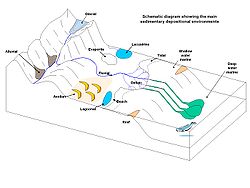
Types of depositional environment
Continental- Alluvial
- Aeolian
- FluvialFluvialFluvial is used in geography and Earth science to refer to the processes associated with rivers and streams and the deposits and landforms created by them...
- LacustrineLakeA lake is a body of relatively still fresh or salt water of considerable size, localized in a basin, that is surrounded by land. Lakes are inland and not part of the ocean and therefore are distinct from lagoons, and are larger and deeper than ponds. Lakes can be contrasted with rivers or streams,...
Transitional
- DeltaicRiver deltaA delta is a landform that is formed at the mouth of a river where that river flows into an ocean, sea, estuary, lake, reservoir, flat arid area, or another river. Deltas are formed from the deposition of the sediment carried by the river as the flow leaves the mouth of the river...
- Tidal
- LagoonalLagoonA lagoon is a body of shallow sea water or brackish water separated from the sea by some form of barrier. The EU's habitat directive defines lagoons as "expanses of shallow coastal salt water, of varying salinity or water volume, wholly or partially separated from the sea by sand banks or shingle,...
- BeachBeachA beach is a geological landform along the shoreline of an ocean, sea, lake or river. It usually consists of loose particles which are often composed of rock, such as sand, gravel, shingle, pebbles or cobblestones...
Marine
- Shallow water marine environment
- Deep water marine environment
- ReefReefIn nautical terminology, a reef is a rock, sandbar, or other feature lying beneath the surface of the water ....
Others
- EvaporiteEvaporiteEvaporite is a name for a water-soluble mineral sediment that result from concentration and crystallization by evaporation from an aqueous solution. There are two types of evaporate deposits, marine which can also be described as ocean deposits, and non-marine which are found in standing bodies of...
- Glacial
Recognition of depositional environments in ancient sediments
Depositional environments in ancient sediments are recognised using a combination of sedimentary faciesFacies
In geology, facies are a body of rock with specified characteristics. Ideally, a facies is a distinctive rock unit that forms under certain conditions of sedimentation, reflecting a particular process or environment....
, facies associations, sedimentary structures
Sedimentary structures
Sedimentary structures are those structures formed during sediment deposition.Sedimentary structures such as cross bedding, graded bedding and ripple marks are utilized in stratigraphic studies to indicate original position of strata in geologically complex terrains and understand the depositional...
and fossils, particularly trace fossil
Trace fossil
Trace fossils, also called ichnofossils , are geological records of biological activity. Trace fossils may be impressions made on the substrate by an organism: for example, burrows, borings , urolites , footprints and feeding marks, and root cavities...
assemblages, as they indicate the environment in which they lived.