
All Topics  
Secondary surveillance radar


   Email Print
   Bookmark   Link


Secondary surveillance radar


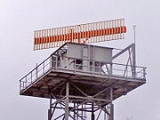
Secondary surveillance radar (SSR) is a radar
Radar

Radar is a system that uses electromagnetic radiation waves to identify the range, altitude, direction, or speed of both moving and fixed objects such as aircraft, ships, motor vehicles, weather formations, and terrain....
 system used in air traffic control
Air traffic control

Air traffic control is a service provided by ground-based Air traffic controller who direct aircraft on the ground and in the air. The primary purpose of ATC systems worldwide is to separate aircraft to prevent collisions, to organize and expedite the flow of traffic, and to provide information and other support for pilots when able....
 (ATC), which not only detects and measures the position of aircraft but also requests additional information from the aircraft itself such as its identity and altitude. Unlike primary radar systems, which measure only the range and bearing of targets by detecting reflected radio signals, rather like seeing an object in a beam of light, SSR relies on its targets being equipped with a radar transponder
Transponder (aviation)

A transponder is an electronic device that produces a response when it receives a radio-frequency interrogation. In aviation, aircraft have transponders to assist in identifying them on radar and on other aircraft's Airborne Collision Avoidance Systems....
, which replies to each interrogation signal by transmitting its own response containing encoded data.


Discussion
Ask a question about 'Secondary surveillance radar'
Start a new discussion about 'Secondary surveillance radar'
Answer questions from other users
Full Discussion Forum


Encyclopedia


Secondary surveillance radar (SSR) is a radar
Radar

Radar is a system that uses electromagnetic radiation waves to identify the range, altitude, direction, or speed of both moving and fixed objects such as aircraft, ships, motor vehicles, weather formations, and terrain....
 system used in air traffic control
Air traffic control

Air traffic control is a service provided by ground-based Air traffic controller who direct aircraft on the ground and in the air. The primary purpose of ATC systems worldwide is to separate aircraft to prevent collisions, to organize and expedite the flow of traffic, and to provide information and other support for pilots when able....
 (ATC), which not only detects and measures the position of aircraft but also requests additional information from the aircraft itself such as its identity and altitude. Unlike primary radar systems, which measure only the range and bearing of targets by detecting reflected radio signals, rather like seeing an object in a beam of light, SSR relies on its targets being equipped with a radar transponder
Transponder (aviation)

A transponder is an electronic device that produces a response when it receives a radio-frequency interrogation. In aviation, aircraft have transponders to assist in identifying them on radar and on other aircraft's Airborne Collision Avoidance Systems....
, which replies to each interrogation signal by transmitting its own response containing encoded data. SSR is based on the military "identification, friend or foe" (IFF) technology originally developed during World War II
World War II

World War II, or the Second World War , was a global military conflict which involved a Participants in World War II, including all of the great powers, organised into two opposing military alliances: the Allies of World War II and the Axis powers....
, and the two systems are still compatible today.

Monopulse secondary surveillance radar (MSSR) is a modern improved version of SSR.

Overview


The rapid wartime development of radar had obvious applications for air traffic control
Air traffic control

Air traffic control is a service provided by ground-based Air traffic controller who direct aircraft on the ground and in the air. The primary purpose of ATC systems worldwide is to separate aircraft to prevent collisions, to organize and expedite the flow of traffic, and to provide information and other support for pilots when able....
 (ATC) as a means of providing continuous surveillance of air traffic disposition. Precise knowledge of the positions of aircraft would permit a reduction in the normal procedural separation standards, which in turn promised considerable increases in the efficiency of the airways system. This type of radar (now called a "primary" radar) can detect and report the position of anything that reflects its transmitted radio signals including, depending on its design, aircraft, birds, weather and land features. For air traffic control purposes this is both an advantage and a disadvantage. Its targets do not have to co-operate, they only have to be within its coverage and be able to reflect radio waves, but it only indicates the position of the targets, it does not identify them. When primary radar was the only type of radar available, the correlation of individual radar returns with specific aircraft typically was achieved by the Controller observing a directed turn by the aircraft.

The need to be able to identify aircraft more easily and reliably led to another wartime radar development, the "identification friend or foe" (IFF) system, which had been created as a means of positively identifying friendly aircraft from enemy. This system, which became known in civil use as secondary surveillance radar (SSR) or in the USA as the air traffic control radar beacon system
Air Traffic Control Radar Beacon System

'The air traffic control radar beacon system is a system used in air traffic control to enhance radar monitoring and separation of air traffic....
 (ATCRBS), relies on a piece of equipment aboard the aircraft known as a "transponder
Transponder (aviation)

A transponder is an electronic device that produces a response when it receives a radio-frequency interrogation. In aviation, aircraft have transponders to assist in identifying them on radar and on other aircraft's Airborne Collision Avoidance Systems....
." The transponder is a radio receiver and transmitter which receives on one frequency (1030 MHz) and transmits on another (1090 MHz). The target aircraft's transponder replies to signals from an interrogator (usually, but not necessarily, a ground station co-located with a primary radar) by transmitting a coded reply signal containing the requested information.

Both the civilian SSR and the military IFF have become much more complex than their war-time ancestors, but remain compatible with each other, not least to allow military aircraft to operate in civil airspace. SSR can now provide much more detailed information and it also permits the exchange of data directly between aircraft for collision avoidance. Given its primary military role of reliably identifying friends, IFF has much more secure (encrypted) messages to prevent "spoofing" by the enemy, and also is used on all kinds of military platforms including air, sea and land vehicles.

Monopulse secondary surveillance radar


Monopulse secondary surveillance radar (MSSR) is an improved version of the classic SSR of the 50s. In the middle of the 70s engineers tried to avoid some standard problems of SSR. In particular Garbling and the False Replies Unsynchronized with the Interrogation Transmissions or simply FRUIT. Garbling was happening when flights close to each other were sending very narrowly spaced replies to the SSR
SSR

SSR can be initials for:...
 and its decoder was unable to detect them separately. The FRUIT was the result of many SSR
SSR

SSR can be initials for:...
s working in the same area where the reply from a flight due to the interrogation of one was also received by another SSR
SSR

SSR can be initials for:...
 that has not yet sent out an interrogation for this flight. Both problems resulted in loss of the aircraft position producing inaccuracies.

At the end of the 80s the SSR
SSR

SSR can be initials for:...
 antenna was modified to the LVA (Large Vertical Aperture) type were a series of many dipoles independently read the reply from a flight and the radar was then calculating the received difference in strength and phase (delay) of each one. The mathematical result was able to calculate and resolve simultaneous replies from various flights with a directional angle difference of some 0,5 degrees whereas the classic SSR
SSR

SSR can be initials for:...
 could not see the difference within an angle of some 3 degrees. Actually the mathematical model was able to calculate the flight position using a single pulse of the many (maximum 15 possible) in the reply signal. This provided the term Mono.

MSSR can reduce garbling in multi-radar environments.

The MSSR replaced most of the existing SSR
SSR

SSR can be initials for:...
s by the 90s and its accuracy provided for a reduction of separation minima in en-route ATC
ATC

ATC may refer to:...
 from to .

Operation


The purpose of this system is to improve the ability to detect and identify aircraft while it additionally provides automatically the Flight Level
Flight level

A Flight Level is a standard nominal altitude of an aircraft, in hundreds of feet. This altitude is calculated from a world-wide fixed pressure datum of 1013.25 Pascal , the average sea-level pressure, and therefore is not necessarily the same as the aircraft's true altitude either above mean sea level or above ground level....
 (pressure altitude) of a flight. An SSR continuously transmits interrogation pulses (selectively rather than continuously in Mode-4, Mode-5, and Mode-S) as its antenna rotates, or is electronically scanned in space. A transponder
Transponder (aviation)

A transponder is an electronic device that produces a response when it receives a radio-frequency interrogation. In aviation, aircraft have transponders to assist in identifying them on radar and on other aircraft's Airborne Collision Avoidance Systems....
 on an aircraft that is within line-of-sight range 'listens' for the SSR interrogation signal and sends back a reply that provides aircraft information. The reply sent depends on the mode that was interrogated (see below). The aircraft is then displayed as a tagged icon
Icon

An 'icon' is a religious work of art, most commonly a painting, from Eastern Christianity. More broadly the term is used in a wide number of contexts for an image, picture, or representation; it is a sign or likeness that stands for an object by signifying or representing it either concretely or by analogy, as in semiotics; by extension, ...
 on the controller's radar screen at the calculated bearing and range. An aircraft without an operating transponder still may be observed by primary radar, but would be displayed to the controller without the benefit of SSR derived data.

A cross-band beacon is used, which simply means that the interrogation pulses are at one frequency (1030 MHz) and the reply pulses are at a different frequency (1090 MHz).

Modes


There are several transponder
Aviation transponder interrogation modes

An aviation transponder interrogation mode is the format of a sequence of pulses from an interrogating Secondary_surveillance_radar radar, or ADS-B, and reply format usually referred to as a "Code" from a Transponder , used to determine detailed information from a suitably equipped aircraft....
 modes, each offering different information:

  • Mode 1 — provides 2-digit 5-bit mission code (military only — cockpit selectable).
  • Mode 2 — provides 4-digit octal unit code (military only — either set on the ground or changed in flight depending on the particular aircraft type).
  • Mode 3/A — provides a 4-digit octal identification code for the aircraft, known as a squawk code, assigned by the air traffic controller (military and civilian).
  • Mode 4 — provides a 3-pulse reply (dependent upon a valid 32-bit crypto coded challenge), military only.
  • Mode 5 — provides crypto secure capability similar to Mode S including transmission of ADS-B
    Automatic dependent surveillance-broadcast

    Automatic dependent surveillance-broadcast is a cooperative surveillance technique for air traffic control and related applications.An ADS-B-equipped aircraft determines its own position using a global navigation satellite system and periodically broadcasts this position and other relevant information to potential ground stations and other...
     and GPS position (military only).
  • Mode C — provides a 10-bit binary Gray code
    Gray code

    |}The reflected binary code, also known as Gray code after Frank Gray , is a binary numeral system where two successive values differ in only one bit....
     for the aircraft's pressure altitude (military and civilian).
  • Mode S — originally envisioned as a data packet standard in both uplink data (1030 MHz) and downlink data (1090 MHz) formats, also used to provide a radar design wherein the transponder responds to selective interrogations (each aircraft can be assigned a fixed, unique ICAO
    International Civil Aviation Organization

    The International Civil Aviation Organization , an agency of the United Nations, codifies the principles and techniques of international air navigation and fosters the planning and development of international scheduled air transport to ensure safe and orderly growth....
     24-bit address for selective interrogation purposes). The downlink data format can also be utilized independently to squitter information such as position and velocity (AIS-P/TailLight). (military and civilian).


For civilian flights according to ICAO the modes of operations are A, C and S.

The A mode is based on a 4-digit code using numbers between 0 and 7 assigned by the ATC
Air traffic control

Air traffic control is a service provided by ground-based Air traffic controller who direct aircraft on the ground and in the air. The primary purpose of ATC systems worldwide is to separate aircraft to prevent collisions, to organize and expedite the flow of traffic, and to provide information and other support for pilots when able....
 and set by the pilot enabling identification and monitoring. Mode C transmits pressure altitude, read automatically from the aircraft altimeter. The mode S is triggered by a mode-S interrogation and can provide the particular information that is requested by the interrogation signal. For modes A and C, all aircraft receiving the interrogation signal will reply, whereas mode S allows aircraft to be addressed individually. In modern ATC
Air traffic control

Air traffic control is a service provided by ground-based Air traffic controller who direct aircraft on the ground and in the air. The primary purpose of ATC systems worldwide is to separate aircraft to prevent collisions, to organize and expedite the flow of traffic, and to provide information and other support for pilots when able....
 systems the data appear with alphanumeric characters in a tag or label linked to the flight position symbol on the radar screen.

Future uses


Weapon scientists and science fiction authors have both envisaged similar systems for general use on the battlefield — identifying vehicles, installations or even individual soldiers. Apart from the difficulty of providing reliable systems of sufficiently compact size and low weight, there are also concerns that the use of these devices may reduce concealment from enemy fire — unlike in aerial combat, where the mere presence of enemy units is usually well known.

See also


  • Air Traffic Control Radar Beacon System, all encompassing description.
  • Automatic Dependent Surveillance-Broadcast
    Automatic dependent surveillance-broadcast

    Automatic dependent surveillance-broadcast is a cooperative surveillance technique for air traffic control and related applications.An ADS-B-equipped aircraft determines its own position using a global navigation satellite system and periodically broadcasts this position and other relevant information to potential ground stations and other...
    , Free Flight enhancement.
  • , Free Flight enhancement with ATCRBS transponder TSO corrections.


External links