


Second Battle of Independence

Encyclopedia
The Second Battle of Independence was a minor engagement of the American Civil War
October 21–22, 1864 centered in Independence, Missouri
, with some of the fiercest fighting taking place at the present-day United Nations Peace Plaza
; the "Harry Truman" Railroad Depot
; George Caleb Bingham
's residence in the city, the Community of Christ
church's Temple, Auditorium and "Stone Church"
; and the headquarters of the Church of Christ (Temple Lot)
.
This clash opened the decisive phase of Confederate
Maj. Gen. Sterling Price
’s 1864 Missouri Campaign
, and culminated in his defeat at the Battle of Westport
the next day. It was the most dramatic American Civil War action involving Jackson County, Missouri
since the Union
's devastating "Order No. 11" a year earlier.
The battle should not be confused with the First Battle of Independence
, fought in August 1862. That earlier battle resulted in a Confederate victory.
, to attempt to seize Missouri for the Confederacy. Unable to attack his primary objective, St. Louis, Price decided to execute Smith's backup plan for a westward raid through Missouri and into Kansas
and the Indian Territory
. Their ultimate goal was to destroy or capture Union supplies and outposts, which might negatively affect Abraham Lincoln
's chances for reelection in 1864.
After victories at Glasgow
and Lexington
, Price continued his march westward, in the direction of Kansas City
and Fort Leavenworth
, headquarters of the Federal Department of Kansas
. His army, which he termed the Army of Missouri
, was organized with Brig. Gen. Joseph Shelby
’s division in the lead, followed by Brig. Gen. John S. Marmaduke
’s division, with Brig. Gen. James Fagan
’s division bringing up the rear.
Union forces opposing Price consisted of militia units and the XVI Corps of Maj. Gen. Andrew J. Smith, augmented by the cavalry division of Maj. Gen. Alfred Pleasonton
, detached from William S. Rosecrans's Department of Missouri. In addition, the newly-activated Army of the Border
under Maj. Gen. Samuel R. Curtis would engage Price's force. Curtis commanded the divisions of Maj. Gen. James G. Blunt
(cavalry), Maj. Gen. George W. Dietzler (Kansas Militia Division), Pleasonton's cavalry, and two infantry divisions detached from Smith's Corps under Colonels Joseph J. Woods and David Moore—about 22,000 men in all.
, the small detachment of Union
troops engaged in this battle under General Blunt retreated west toward Independence. They set up camp on October 20 behind strong defensive positions on the west bank of the Little Blue River
, about five miles east of town, and awaited the main Confederate force. However Blunt's superior, General Curtis, ordered him to abandon these positions save for a small blocking force under Colonel Thomas Moonlight
, and return to Independence.
, in the rural easternmost boundaries of the city. It began on October 21, when General Blunt was ordered to return to the Little Blue and reoccupy the same defensive positions he had been directed to abandon only the day before. Upon his arrival, he found that Colonel Moonlight had burnt the bridge over the river as previously instructed, after being attacked by Price's advance guard.
 Price's army had arrived on the scene by this time, and fiercely engaged the Union forces. Witnesses reported that the Federals entrenched themselves behind rock walls, and forced attacking Confederates to fight for nearly every inch of ground. Gradually, however, the Union troops were compelled to give way, retreating west through Independence toward Westport. Union rearguard units attempted to impede Price's progress throughout the afternoon of the 21st, as brisk fighting raged through the streets of the city, but all were ultimately compelled to withdraw. Price's troops halted their advance at an unfinished railroad cut on the western side of town's center, and made camp there for the evening.
One casualty of the first day's fighting was Confederate raider George M. Todd
, who had participated in the First Battle of Independence in 1862, where he was guilty of summarily executing two captured Union officers.
Periodic gunfire continued throughout the night, as each side probed the other. Union troops continued their withdrawal to the Big Blue River
, west of Independence.
’s Union force of 10,000 cavalry crossed the Little Blue River
, and attacked Independence from the northeast (and thus, from the rear of Price's force) in company with the 2nd Arkansas Infantry (Union). Two of Fagan's brigades were roughly handled by the attacking Federals, being pushed back through the city toward the west, where the main Union force lay. Yet another Confederate brigade attempted to stem the onslaught on the grounds of what is now the Community of Christ
's Independence Temple
, but was practically annihilated by Pleasonton's force with only a few Rebels escaping.
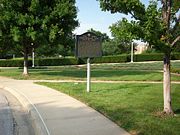 But final victory would elude the Union. Marmaduke’s division engaged Pleasonton about two miles west of Independence, managing to push the Federals back and hold them until the morning of October 23. The focus of combat now shifted westward from Independence to Westport, in modern Kansas City.
Road, once he had crossed the Big Blue River
. The following day, the 30,000 troops of both armies joined combat at the Battle of Westport
, resulting in a decisive Union victory and the end of major Confederate military efforts in Missouri.
American Civil War
The American Civil War was a civil war fought in the United States of America. In response to the election of Abraham Lincoln as President of the United States, 11 southern slave states declared their secession from the United States and formed the Confederate States of America ; the other 25...
October 21–22, 1864 centered in Independence, Missouri
Independence, Missouri
Independence is the fourth largest city in the U.S. state of Missouri, and is contained within the counties of Jackson and Clay. It is part of the Kansas City Metropolitan Area...
, with some of the fiercest fighting taking place at the present-day United Nations Peace Plaza
United Nations Peace Plaza (Independence, Missouri)
The United Nations Peace Plaza in Independence, Missouri was unveiled on October 27, 1997, formally dedicated by U.N. General Secretary Kofi Annan on April 25, 2003, and is described by its creators as "the only memorial in the world to those persons serving in the Peacekeeping Forces of the United...
; the "Harry Truman" Railroad Depot
Independence (Amtrak station)
The Independence Amtrak station, also known as Missouri Pacific Depot, is a train station in Independence, Missouri, United States served by Amtrak, the national railroad passenger system. The station was originally built in 1913 by the Missouri Pacific Railroad, and is also known as the "Truman...
; George Caleb Bingham
George Caleb Bingham
George Caleb Bingham was an American artist whose paintings of American life in the frontier lands along the Missouri River exemplify the Luminist style. Left to languish in obscurity, Bingham's work was rediscovered in the 1930s...
's residence in the city, the Community of Christ
Community of Christ
The Community of Christ, known from 1872 to 2001 as the Reorganized Church of Jesus Christ of Latter Day Saints , is an American-based international Christian church established in April 1830 that claims as its mission "to proclaim Jesus Christ and promote communities of joy, hope, love, and peace"...
church's Temple, Auditorium and "Stone Church"
Stone Church (Independence, Missouri)
The Community of Christ Stone Church is a church building in Independence, Missouri at 1012 W...
; and the headquarters of the Church of Christ (Temple Lot)
Church of Christ (Temple Lot)
The Church of Christ is a denomination of the Latter Day Saint movement headquartered in Independence, Missouri on what is known as the Temple Lot. Members of the church have been known colloquially as "Hedrickites", after Granville Hedrick, who was ordained as the church's first leader in July 1863...
.
This clash opened the decisive phase of Confederate
Confederate States of America
The Confederate States of America was a government set up from 1861 to 1865 by 11 Southern slave states of the United States of America that had declared their secession from the U.S...
Maj. Gen. Sterling Price
Sterling Price
Sterling Price was a lawyer, planter, and politician from the U.S. state of Missouri, who served as the 11th Governor of the state from 1853 to 1857. He also served as a United States Army brigadier general during the Mexican-American War, and a Confederate Army major general in the American Civil...
’s 1864 Missouri Campaign
Price's Raid
Price's Missouri Expedition, also known as Price's Raid, was an 1864 Confederate cavalry raid through the states of Missouri and Kansas during the American Civil War. While Confederate Major General Sterling Price enjoyed some successes during this campaign, he was decisively beaten at the Battle...
, and culminated in his defeat at the Battle of Westport
Battle of Westport
The Battle of Westport, sometimes referred to as the "Gettysburg of the West," was fought on October 23, 1864, in modern Kansas City, Missouri, during the American Civil War. Union forces under Major General Samuel R. Curtis decisively defeated an outnumbered Confederate force under Major General...
the next day. It was the most dramatic American Civil War action involving Jackson County, Missouri
Jackson County, Missouri
Jackson County is a county located in the U.S. state of Missouri. With a population of 674,158 in the 2010 census, Jackson County is the second most populous of Missouri's counties, after St. Louis County. Kansas City, the state's most populous city and focus city of the Kansas City Metropolitan...
since the Union
Union Army
The Union Army was the land force that fought for the Union during the American Civil War. It was also known as the Federal Army, the U.S. Army, the Northern Army and the National Army...
's devastating "Order No. 11" a year earlier.
The battle should not be confused with the First Battle of Independence
First Battle of Independence
-External links:** *...
, fought in August 1862. That earlier battle resulted in a Confederate victory.
Background
In the fall of 1864, Confederate Maj. Gen. Sterling Price was dispatched by his superior, Lt. Gen. Edmund Kirby SmithEdmund Kirby Smith
Edmund Kirby Smith was a career United States Army officer and educator. He served as a general in the Confederate States Army during the American Civil War, notable for his command of the Trans-Mississippi Department of the Confederacy after the fall of Vicksburg.After the conflict ended Smith...
, to attempt to seize Missouri for the Confederacy. Unable to attack his primary objective, St. Louis, Price decided to execute Smith's backup plan for a westward raid through Missouri and into Kansas
Kansas
Kansas is a US state located in the Midwestern United States. It is named after the Kansas River which flows through it, which in turn was named after the Kansa Native American tribe, which inhabited the area. The tribe's name is often said to mean "people of the wind" or "people of the south...
and the Indian Territory
Indian Territory
The Indian Territory, also known as the Indian Territories and the Indian Country, was land set aside within the United States for the settlement of American Indians...
. Their ultimate goal was to destroy or capture Union supplies and outposts, which might negatively affect Abraham Lincoln
Abraham Lincoln
Abraham Lincoln was the 16th President of the United States, serving from March 1861 until his assassination in April 1865. He successfully led his country through a great constitutional, military and moral crisis – the American Civil War – preserving the Union, while ending slavery, and...
's chances for reelection in 1864.
After victories at Glasgow
Battle of Glasgow
The Battle of Glasgow was fought on October 15, 1864, in and near Glasgow, Missouri as part of Price's Missouri Expedition during the American Civil War...
and Lexington
Battle of Lexington II
The Second Battle of Lexington was a minor skirmish during the American Civil War, taking place on October 19, 1864, in Lexington, the county seat of Lafayette County, Missouri. It formed a part of Confederate Maj. Gen...
, Price continued his march westward, in the direction of Kansas City
Kansas City, Missouri
Kansas City, Missouri is the largest city in the U.S. state of Missouri and is the anchor city of the Kansas City Metropolitan Area, the second largest metropolitan area in Missouri. It encompasses in parts of Jackson, Clay, Cass, and Platte counties...
and Fort Leavenworth
Fort Leavenworth
Fort Leavenworth is a United States Army facility located in Leavenworth County, Kansas, immediately north of the city of Leavenworth in the upper northeast portion of the state. It is the oldest active United States Army post west of Washington, D.C. and has been in operation for over 180 years...
, headquarters of the Federal Department of Kansas
Kansas
Kansas is a US state located in the Midwestern United States. It is named after the Kansas River which flows through it, which in turn was named after the Kansa Native American tribe, which inhabited the area. The tribe's name is often said to mean "people of the wind" or "people of the south...
. His army, which he termed the Army of Missouri
Army of Missouri
The Army of Missouri was an independent military formation during the American Civil War within the Confederate States Army, created in the fall of 1864 under the command of Maj. Gen. Sterling Price to invade Missouri. Price's Raid was unsuccessful, and his army retreated to Arkansas, where it was...
, was organized with Brig. Gen. Joseph Shelby
Joseph O. Shelby
Joseph Orville Shelby was a noted Confederate cavalry general in the Trans-Mississippi Theater of the American Civil War.-Early life and education:...
’s division in the lead, followed by Brig. Gen. John S. Marmaduke
John S. Marmaduke
John Sappington Marmaduke was a career military man and a West Point graduate. He is known for his service as a Confederate Major general during the American Civil War...
’s division, with Brig. Gen. James Fagan
James Fagan
James Fagan is a folk musician from Sydney, Australia. He in a singer and multi-instrumentalist specialising in the Irish bouzouki....
’s division bringing up the rear.
Union forces opposing Price consisted of militia units and the XVI Corps of Maj. Gen. Andrew J. Smith, augmented by the cavalry division of Maj. Gen. Alfred Pleasonton
Alfred Pleasonton
Alfred Pleasonton was a United States Army officer and General of Union cavalry during the American Civil War. He commanded the Cavalry Corps of the Army of the Potomac during the Gettysburg Campaign, including the largest predominantly cavalry battle of the war, Brandy Station...
, detached from William S. Rosecrans's Department of Missouri. In addition, the newly-activated Army of the Border
Army of the Border
The Army of the Border was a Union army during the American Civil War. It was created from units in the Department of Kansas to oppose Sterling Price's Raid in 1864. Samuel R. Curtis was in command of the army throughout its duration.Major General James G...
under Maj. Gen. Samuel R. Curtis would engage Price's force. Curtis commanded the divisions of Maj. Gen. James G. Blunt
James G. Blunt
James Gillpatrick Blunt was a physician and abolitionist who rose to Union major general during the American Civil War.-Early life & career:...
(cavalry), Maj. Gen. George W. Dietzler (Kansas Militia Division), Pleasonton's cavalry, and two infantry divisions detached from Smith's Corps under Colonels Joseph J. Woods and David Moore—about 22,000 men in all.
Prelude
Following their defeat at LexingtonBattle of Lexington II
The Second Battle of Lexington was a minor skirmish during the American Civil War, taking place on October 19, 1864, in Lexington, the county seat of Lafayette County, Missouri. It formed a part of Confederate Maj. Gen...
, the small detachment of Union
Union (American Civil War)
During the American Civil War, the Union was a name used to refer to the federal government of the United States, which was supported by the twenty free states and five border slave states. It was opposed by 11 southern slave states that had declared a secession to join together to form the...
troops engaged in this battle under General Blunt retreated west toward Independence. They set up camp on October 20 behind strong defensive positions on the west bank of the Little Blue River
Little Blue River (Missouri)
Little Blue River is a stream in Jackson County, Missouri, USA, that gave its name to the Battle of Little Blue River during the American Civil War. It rises in the southern Jackson County town of Grandview and empties into the Missouri River just west of the town of Sibley. Despite its name, it...
, about five miles east of town, and awaited the main Confederate force. However Blunt's superior, General Curtis, ordered him to abandon these positions save for a small blocking force under Colonel Thomas Moonlight
Thomas Moonlight
Thomas Moonlight was a United States politician and general.-Birth:Thomas was baptised on 30 September 1833 in St Vigeans, Angus, Scotland with birth record number 319/0040 0169...
, and return to Independence.
October 21st
The Second Battle of Independence actually commenced as a connected engagement at the Little Blue RiverBattle of Little Blue River
The Battle of Little Blue River was a minor battle of the American Civil War, occurring on October 21, 1864 in Jackson County, Missouri during Price's Missouri Expedition of that year. It became the opening round of the Second Battle of Independence, which began on this same day and was...
, in the rural easternmost boundaries of the city. It began on October 21, when General Blunt was ordered to return to the Little Blue and reoccupy the same defensive positions he had been directed to abandon only the day before. Upon his arrival, he found that Colonel Moonlight had burnt the bridge over the river as previously instructed, after being attacked by Price's advance guard.
One casualty of the first day's fighting was Confederate raider George M. Todd
George M. Todd
George M. Todd was a Confederate guerrilla leader during the American Civil War who served under the infamous William C. Quantrill...
, who had participated in the First Battle of Independence in 1862, where he was guilty of summarily executing two captured Union officers.
Periodic gunfire continued throughout the night, as each side probed the other. Union troops continued their withdrawal to the Big Blue River
Blue River (Missouri)
The Blue River is a stream that flows through Johnson County, Kansas and Jackson County, Missouri in the Kansas City Metropolitan Area. The river rises in Johnson County near the border of the states of Kansas and Missouri...
, west of Independence.
October 22nd
At dawn on the 22nd, Maj. Gen. Alfred PleasontonAlfred Pleasonton
Alfred Pleasonton was a United States Army officer and General of Union cavalry during the American Civil War. He commanded the Cavalry Corps of the Army of the Potomac during the Gettysburg Campaign, including the largest predominantly cavalry battle of the war, Brandy Station...
’s Union force of 10,000 cavalry crossed the Little Blue River
Little Blue River (Missouri)
Little Blue River is a stream in Jackson County, Missouri, USA, that gave its name to the Battle of Little Blue River during the American Civil War. It rises in the southern Jackson County town of Grandview and empties into the Missouri River just west of the town of Sibley. Despite its name, it...
, and attacked Independence from the northeast (and thus, from the rear of Price's force) in company with the 2nd Arkansas Infantry (Union). Two of Fagan's brigades were roughly handled by the attacking Federals, being pushed back through the city toward the west, where the main Union force lay. Yet another Confederate brigade attempted to stem the onslaught on the grounds of what is now the Community of Christ
Community of Christ
The Community of Christ, known from 1872 to 2001 as the Reorganized Church of Jesus Christ of Latter Day Saints , is an American-based international Christian church established in April 1830 that claims as its mission "to proclaim Jesus Christ and promote communities of joy, hope, love, and peace"...
's Independence Temple
Independence Temple
The Temple in Independence, Missouri, is a house of worship and education "dedicated to the pursuit of peace". It dominates the skyline of Independence, Missouri, USA, and has become the focal point of the headquarters of the Community of Christ...
, but was practically annihilated by Pleasonton's force with only a few Rebels escaping.
Aftermath
Although Price could claim a victory due to the bravery of Marmaduke and his men, Pleasonton’s bold actions greatly worried him. Concerned for the safety of his supplies, Price accordingly sent his wagon trains to Little Santa Fe on the Fort ScottFort Scott
General Winfield Scott, former General-in-Chief of the U.S. Army, was the namesake for five places named Fort Scott:*Fort Scott, Kansas, a city that grew up around a military fort of the same name**Fort Scott National Historic Site...
Road, once he had crossed the Big Blue River
Blue River (Missouri)
The Blue River is a stream that flows through Johnson County, Kansas and Jackson County, Missouri in the Kansas City Metropolitan Area. The river rises in Johnson County near the border of the states of Kansas and Missouri...
. The following day, the 30,000 troops of both armies joined combat at the Battle of Westport
Battle of Westport
The Battle of Westport, sometimes referred to as the "Gettysburg of the West," was fought on October 23, 1864, in modern Kansas City, Missouri, during the American Civil War. Union forces under Major General Samuel R. Curtis decisively defeated an outnumbered Confederate force under Major General...
, resulting in a decisive Union victory and the end of major Confederate military efforts in Missouri.
External links
- U.S. National Park Service CWSAC Battle Summary
- CWSAC Report Update
- The "First" and "Second" Battles of Independence pp. 708–709, 'Historical Dictionary of the Civil War: A-L' by Terry L. Jones, Rowman & Littlefield, 2002.