

Search and destroy

Encyclopedia
Military
A military is an organization authorized by its greater society to use lethal force, usually including use of weapons, in defending its country by combating actual or perceived threats. The military may have additional functions of use to its greater society, such as advancing a political agenda e.g...
strategy
Strategy
Strategy, a word of military origin, refers to a plan of action designed to achieve a particular goal. In military usage strategy is distinct from tactics, which are concerned with the conduct of an engagement, while strategy is concerned with how different engagements are linked...
that became a notorious component of the Vietnam War
Vietnam War
The Vietnam War was a Cold War-era military conflict that occurred in Vietnam, Laos, and Cambodia from 1 November 1955 to the fall of Saigon on 30 April 1975. This war followed the First Indochina War and was fought between North Vietnam, supported by its communist allies, and the government of...
. The idea was to insert ground forces
Army
An army An army An army (from Latin arma "arms, weapons" via Old French armée, "armed" (feminine), in the broadest sense, is the land-based military of a nation or state. It may also include other branches of the military such as the air force via means of aviation corps...
into hostile territory, search out the enemy, destroy them, and withdraw immediately afterward. The strategy was the result of a new technology, the helicopter
Helicopter
A helicopter is a type of rotorcraft in which lift and thrust are supplied by one or more engine-driven rotors. This allows the helicopter to take off and land vertically, to hover, and to fly forwards, backwards, and laterally...
, which resulted in a new form of warfare, the fielding of air cavalry
Air assault
Air assault is the movement of ground-based military forces by vertical take-off and landing aircraft—such as the helicopter—to seize and hold key terrain which has not been fully secured, and to directly engage enemy forces...
, and was thought to be ideally suited to counter-guerrilla jungle warfare
Jungle warfare
Jungle warfare is a term used to cover the special techniques needed for military units to survive and fight in jungle terrain.It has been the topic of extensive study by military strategists, and was an important part of the planning for both sides in many conflicts, including World War II and the...
. The complementary conventional strategy, which entailed attacking and conquering an enemy position, then fortifying and holding it indefinitely, was known as "clear and hold
Clear and hold
Clear and hold is a counter-insurgency strategy in which military personnel clear an area of guerrillas or other insurgents, then keep the area clear of insurgents while winning the support of the populace for the government and its policies...
" or "clear and secure." In theory, since the traditional methods of "taking ground" could not be used in this war, a war of attrition would be used, eliminating the enemy by the use of "searching" for them, then "destroying" them, and the "body count
Body count
A body count is the total number of people killed in a particular event. In combat, a body count is often based on the number of confirmed kills, but occasionally only an estimate.-Military use:...
" would be the measuring tool to determine the success of the strategy of "search and destroy." It is common practice among military forces to enforce strict rules on a search and destroy mission.
It became an offensive tool, crucial to General
General (United States)
In the United States Army, United States Air Force, and United States Marine Corps, general is a four-star general officer rank, with the pay grade of O-10. General ranks above lieutenant general and below General of the Army or General of the Air Force; the Marine Corps does not have an...
William Westmoreland
William Westmoreland
William Childs Westmoreland was a United States Army General, who commanded US military operations in the Vietnam War at its peak , during the Tet Offensive. He adopted a strategy of attrition against the National Liberation Front of South Vietnam and the North Vietnamese Army. He later served as...
’s second phase. In his three phase strategy, the first consisted of slowing down the Viet Cong Forces; the second was to resume the offensive and destroy the enemy; the third was to restore the area under South Vietnamese government control. The Zippo missions were mainly assigned to the second phase around 1966 and 1967, along with operations “Clear and Secure.”
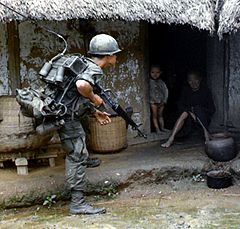
Search and destroy missions entailed sending out platoon
Platoon
A platoon is a military unit typically composed of two to four sections or squads and containing 16 to 50 soldiers. Platoons are organized into a company, which typically consists of three, four or five platoons. A platoon is typically the smallest military unit led by a commissioned officer—the...
s, companies, or larger detachments of US troops from a fortified position to locate and destroy Vietcong or NVA
Vietnam People's Army
The Vietnam People's Army is the armed forces of Vietnam. The VPA includes: the Vietnamese People's Ground Forces , the Vietnam People's Navy , the Vietnam People's Air Force, and the Vietnam Marine Police.During the French Indochina War , the VPA was often referred to as the Việt...
units in the countryside. These missions most commonly involved hiking out into the "boonies
Boondock
The term boondocks refers to a remote, usually brushy rural area; or to a remote city or town that is considered unsophisticated.-Origins:The expression was introduced to English by American military personnel serving in the Philippines during the early years of the 20th century. It derives from...
" and setting an ambush
Ambush
An ambush is a long-established military tactic, in which the aggressors take advantage of concealment and the element of surprise to attack an unsuspecting enemy from concealed positions, such as among dense underbrush or behind hilltops...
in the brush, near a suspected VC trail. The ambush typically involved the use of fixed Claymore Antipersonnel Mines
M18A1 Claymore Antipersonnel Mine
The M18A1 Claymore is a directional anti-personnel mine used by the U.S. military. It was named after the large Scottish sword by its inventor, Norman A. MacLeod...
, crossing lines of small arms
Small arms
Small arms is a term of art used by armed forces to denote infantry weapons an individual soldier may carry. The description is usually limited to revolvers, pistols, submachine guns, carbines, assault rifles, battle rifles, multiple barrel firearms, sniper rifles, squad automatic weapons, light...
fire, mortar
Mortar (weapon)
A mortar is an indirect fire weapon that fires explosive projectiles known as bombs at low velocities, short ranges, and high-arcing ballistic trajectories. It is typically muzzle-loading and has a barrel length less than 15 times its caliber....
support, and possibly additional artillery
Artillery
Originally applied to any group of infantry primarily armed with projectile weapons, artillery has over time become limited in meaning to refer only to those engines of war that operate by projection of munitions far beyond the range of effect of personal weapons...
support called in via radio from a nearby firebase
Fire support base
A fire support base is a military encampment designed to provide indirect fire artillery fire support to infantry operating in areas beyond the normal range of direct fire support from their own base camps....
.
In February 1967, the largest Zippo mission was operated in the Iron Triangle
Iron Triangle (Vietnam)
The Iron Triangle was a area in the Binh Duong Province of Vietnam, so named due to it being a stronghold of Viet Minh activity during the war...
, located between Saigon and Routes 13 and 25. The area consisted of a mass centre of Viet Cong logistics and headquarters, where they had been operating plans for Saigon. The offensive began with Operation Junction City
Operation Junction City
Operation Junction City was an 82-day military operation conducted by United States and Republic of Vietnam forces begun on 22 February 1967 during the Vietnam War. It was the largest U.S. airborne operation since Operation Market Garden during World War II, the only major airborne operation of...
, where the American units assigned had destroyed hundreds of tons of rice
Rice
Rice is the seed of the monocot plants Oryza sativa or Oryza glaberrima . As a cereal grain, it is the most important staple food for a large part of the world's human population, especially in East Asia, Southeast Asia, South Asia, the Middle East, and the West Indies...
, killed 720 guerrillas, and captured 213 prisoners. By destroying the headquarters, they disrupted any enemy plans for Saigon. Both Search and Destroy and Clearing missions stretched into the third phase beginning in 1968. The number of missions mounted, especially after the U.S. was hit by General Vo Nguyen Giap
Vo Nguyen Giap
Võ Nguyên Giáp is a retired Vietnamese officer in the Vietnam People’s Army and a politician. He was a principal commander in two wars: the First Indochina War and the Vietnam War...
’s Tet offensive attack of 1968. As the war grew more aggressive, so did the missions, to the point where there was lack of distinction between Search and Destroy, and Clear and Secure operations.
Search and destroy missions had many flaws. First, there was lack of distinction between “clearing” and search and destroy missions. Thus “clearing” missions, which were less aggressive, eventually morphed into a more violent and brutal form of tactic
Military tactics
Military tactics, the science and art of organizing an army or an air force, are the techniques for using weapons or military units in combination for engaging and defeating an enemy in battle. Changes in philosophy and technology over time have been reflected in changes to military tactics. In...
just as search and destroy missions were. With the lack of distinction between “clearing” and search and destroy missions, pacification was not pushed. Guenter Lewey, a Professor of Political Science
Political science
Political Science is a social science discipline concerned with the study of the state, government and politics. Aristotle defined it as the study of the state. It deals extensively with the theory and practice of politics, and the analysis of political systems and political behavior...
at the University of Massachusetts
University of Massachusetts
This article relates to the statewide university system. For the flagship campus often referred to as "UMass", see University of Massachusetts Amherst...
, argued that the generals and war planners severely underestimated the enemy’s abilities to match and exceed U.S. forces. Large numbers of Viet Cong troops would be killed or captured, but they were quickly replaced. Although enemy forces were pushed out of certain territories, as soon as the American forces left the areas, the North Vietnam
North Vietnam
The Democratic Republic of Vietnam , was a communist state that ruled the northern half of Vietnam from 1954 until 1976 following the Geneva Conference and laid claim to all of Vietnam from 1945 to 1954 during the First Indochina War, during which they controlled pockets of territory throughout...
ese returned with more reinforcement. Zippo missions were counterproductive towards the U.S. objective in South Vietnam
South Vietnam
South Vietnam was a state which governed southern Vietnam until 1975. It received international recognition in 1950 as the "State of Vietnam" and later as the "Republic of Vietnam" . Its capital was Saigon...
. They destroyed the countryside and rice
Rice
Rice is the seed of the monocot plants Oryza sativa or Oryza glaberrima . As a cereal grain, it is the most important staple food for a large part of the world's human population, especially in East Asia, Southeast Asia, South Asia, the Middle East, and the West Indies...
paddies, weakening the economic productivity and creating inflation in South Vietnam. They created millions of refugee
Refugee
A refugee is a person who outside her country of origin or habitual residence because she has suffered persecution on account of race, religion, nationality, political opinion, or because she is a member of a persecuted 'social group'. Such a person may be referred to as an 'asylum seeker' until...
s who lost their homes due to the missions that called for the destruction and setting fire to their bamboo
Bamboo
Bamboo is a group of perennial evergreens in the true grass family Poaceae, subfamily Bambusoideae, tribe Bambuseae. Giant bamboos are the largest members of the grass family....
houses. Moreover, with many refugees, and a damaged economic system, the missions hurt the political and social system in South Vietnam.
They also caused many American and Vietnamese casualties. In one of the first Search and Destroy missions northwest of Dau Tieng
Dau Tieng
Dau Tieng , is a district of Binh Duong Province in the Southeast region of Vietnam.As of 2003 the district had a population of 92,592. The district covers an area of 720 km². The district capital lies at Dầu Tiếng.-References:...
, named Operation Attleboro
Operation Attleboro
Operation Attleboro was a search and destroy operation by the 196th Light Infantry Brigade. The operation was named after Attleboro, Massachusetts, where the brigade had been formed...
, the report states that 155 U.S. soldiers were killed, while the North Vietnamese lost 1,106. In Operation Junction City
Operation Junction City
Operation Junction City was an 82-day military operation conducted by United States and Republic of Vietnam forces begun on 22 February 1967 during the Vietnam War. It was the largest U.S. airborne operation since Operation Market Garden during World War II, the only major airborne operation of...
, the report states that 282 U.S. soldiers were killed while the Viet Cong lost 1,728 guerrillas.