
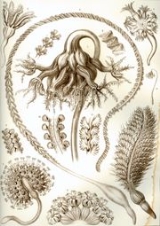
Sea pens are colonial marine
cnidariaCnidaria is a phylum containing over 9,000 species of animals found exclusively in aquatic and mostly marine environments. Their distinguishing feature is cnidocytes, specialized cells that they use mainly for capturing prey. Their bodies consist of mesoglea, a non-living jelly-like substance,...
ns belonging to the order
Pennatulacea. There are 14 families within the order; they are thought to have a
cosmopolitan distributionIn biogeography, a taxon is said to have a cosmopolitan distribution if its range extends across all or most of the world in appropriate habitats. For instance, the killer whale has a cosmopolitan distribution, extending over most of the world's oceans. Other examples include humans, the lichen...
in tropical and temperate waters worldwide. Sea pens are grouped with the octocorals ("soft
coralCorals are marine animals in class Anthozoa of phylum Cnidaria typically living in compact colonies of many identical individual "polyps". The group includes the important reef builders that inhabit tropical oceans and secrete calcium carbonate to form a hard skeleton.A coral "head" is a colony of...
s"), together with sea whips and gorgonians.
Although named after their feather-like appearance reminiscent of antique quill pens, only sea pen species belonging to the suborder
Subselliflorae live up to the comparison. Those belonging to the much larger suborder
Sessiliflorae lack feathery structures and grow in club-like or radiating forms. The latter suborder includes what are commonly known as
sea pansiesThe Sea pansy is quite frequently found washed ashore on northeast Florida beaches following northeasterly winds or rough surf conditions. It also can often be found living intertidally completely buried in the sand. Its predator is the striped sea slug, Armina tigrina.The Sea pansy is a...
.
The sea pen
fossilFossils are the preserved remains or traces of animals , plants, and other organisms from the remote past...
record is patchy and disputed by some; while the earliest accepted fossils are known from the
CambrianThe Cambrian is the first geological period of the Paleozoic Era, lasting from Mya ; it is succeeded by the Ordovician. Its subdivisions, and indeed its base, are somewhat in flux. The period was established by Adam Sedgwick, who named it after Cambria, the Latin name for Wales, where Britain's...
-aged
Burgess ShaleThe Burgess Shale Formation, located in the Canadian Rockies of British Columbia, is one of the world's most celebrated fossil fields, and the best of its kind. It is famous for the exceptional preservation of the soft parts of its fossils...
(
ThaumaptilonThaumaptilon is a fossil from the middle Cambrian Burgess Shale which some authors have compared to members of the Ediacaran biota, generally believed to have disappeared at the start of the Cambrian,...
), similar fossils from the
EdiacaranThe Ediacaran Period , named after the Ediacara Hills of South Australia, is the last geological period of the Neoproterozoic Era and of the Proterozoic Eon, immediately preceding the Cambrian Period, the first period of the Paleozoic Era and of the Phanerozoic Eon...
(ala
CharniaCharnia is the genus name given to a frond-like Ediacaran lifeform with segmented ridges branching alternately to the right and left from a zig-zag medial suture. The genus Charnia was named after Charnwood Forest in Leicestershire, England, where the first fossilised specimen was found.- Diversity...
) may represent the dawn of sea pens. Precisely what these early fossils are, however, is not decided.
Biology
As octocorals, sea pens are colonial animals with multiple
polypA polyp in zoology is one of two forms found in the phylum Cnidaria, the other being the medusa. Polyps are approximately cylindrical in shape and elongated at the axis of the body...
s (which look somewhat like miniature
sea anemoneSea anemones are a group of water-dwelling, predatory animals of the order Actiniaria; they are named after the anemone, a terrestrial flower. Sea anemones are classified in the phylum Cnidaria, class Anthozoa, subclass Zoantharia. Anthozoa often have large polyps that allow for digestion of larger...
s), each with eight
tentacleA tentacle or bothrium is one of usually two or more elongated flexible organs present in animals, especially invertebrates. The term may also refer to the hairs of the leaves of some insectivorous plants. Usually, tentacles are used for feeding, feeling and grasping. Anatomically, they work like...
s. Unlike other octocorals, however, a sea pen's
polypA polyp in zoology is one of two forms found in the phylum Cnidaria, the other being the medusa. Polyps are approximately cylindrical in shape and elongated at the axis of the body...
s are specialized to specific functions: a single polyp develops into a rigid, erect stalk (the
rachis) and loses its tentacles, forming a bulbous "root" or
peduncle at its base. The other polyps branch out from this central stalk, forming water intake structures (
siphonozooids), feeding structures (
autozooids) with nematocysts, and reproductive structures. The entire colony is fortified by calcium carbonate in the form of
spicules and a central
axial rod.
Using their root-like peduncles to anchor themselves in sandy or muddy substrate, the exposed portion of sea pens may rise up to 2 metres (6.6 ft) in some species, such as the tall sea pen (
Funiculina quadrangularis). Sea pens are sometimes brightly coloured; the orange sea pen (
Ptilosarcus gurneyi) is a notable example. Rarely found above depths of 10 metres (32.8 ft), sea pens prefer deeper waters where turbulence is less likely to uproot them. Some species may inhabit depths of 2000 metres (6,561.7 ft) or more.
While generally sessile animals, sea pens are able to relocate and re-anchor themselves if need be. They position themselves favourably in the path of currents, ensuring a steady flow of
planktonPlankton are any drifting organisms that inhabit the pelagic zone of oceans, seas, or bodies of fresh water. That is, plankton are defined by their ecological niche rather than phylogenetic or taxonomic classification...
, the sea pens' chief source of food. Their primary predators are
nudibranchA nudibranch is a member of what is now a taxonomic clade, and what was previously a suborder, of soft-bodied, marine gastropod mollusks which shed their shell after their larval stage. They are noted for their often extraordinary colors and striking forms...
s and
sea starStarfish or sea stars are echinoderms belonging to the class Asteroidea. The names "starfish" and "sea star" essentially refer to members of the class Asteroidea...
s, some of which feed exclusively on sea pens. When touched, sea pens emit a bright greenish light; this is known as
bioluminescenceBioluminescence is the production and emission of light by a living organism. Its name is a hybrid word, originating from the Greek bios for "living" and the Latin lumen "light". Bioluminescence is a naturally occurring form of chemiluminescence where energy is released by a chemical reaction in...
. They may also force water out of themselves as a defensive act, deflating and retreating into their peduncle.
Like other
anthozoaCorals are marine animals in class Anthozoa of phylum Cnidaria typically living in compact colonies of many identical individual "polyps". The group includes the important reef builders that inhabit tropical oceans and secrete calcium carbonate to form a hard skeleton.A coral "head" is a colony of...
ns, sea pens reproduce by co-ordinating a release of sperm and eggs into the water column; this may occur seasonally or throughout the year. Fertilized eggs develop into larvae called
planulae which drift freely for about a week before settling on the substrate. Mature sea pens provide shelter for other animals, such as juvenile
fishFish are a paraphyletic group of organisms that consist of all gill-bearing aquatic vertebrate animals that lack limbs with digits. Included in this definition are the living hagfish, lampreys, and cartilaginous and bony fish, as well as various extinct related groups...
. Analysis of rachis growth rings indicates sea pens may live for 100 years or more, if the rings are indeed annual in nature.
External links