

Sea monster

Encyclopedia
Marine monsters can take many forms, including sea dragon
Dragon
A dragon is a legendary creature, typically with serpentine or reptilian traits, that feature in the myths of many cultures. There are two distinct cultural traditions of dragons: the European dragon, derived from European folk traditions and ultimately related to Greek and Middle Eastern...
s, sea serpent
Sea serpent
A sea serpent or sea dragon is a type of sea monster either wholly or partly serpentine.Sightings of sea serpents have been reported for hundreds of years, and continue to be claimed today. Cryptozoologist Bruce Champagne identified more than 1,200 purported sea serpent sightings...
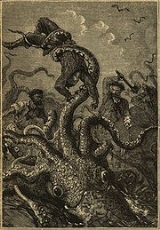
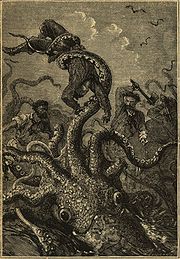
s, or multi-armed beasts. They can be slimy or scaly and are often pictured threatening ships or spouting jets of water. The definition of a "monster" is subjective, and some sea monsters may have been exaggerations of scientifically accepted creatures such as whale
Whale
Whale is the common name for various marine mammals of the order Cetacea. The term whale sometimes refers to all cetaceans, but more often it excludes dolphins and porpoises, which belong to suborder Odontoceti . This suborder also includes the sperm whale, killer whale, pilot whale, and beluga...
s and types of giant
Giant squid
The giant squid is a deep-ocean dwelling squid in the family Architeuthidae, represented by as many as eight species...
and colossal squid
Colossal Squid
The colossal squid , sometimes called the Antarctic or giant cranch squid, is believed to be the largest squid species in terms of mass. It is the only known member of the genus Mesonychoteuthis...
.
Sightings and legends
Historically, decorative drawings of heraldic dolphins and sea monsters were frequently used to illustrateIllustration
An illustration is a displayed visualization form presented as a drawing, painting, photograph or other work of art that is created to elucidate or dictate sensual information by providing a visual representation graphically.- Early history :The earliest forms of illustration were prehistoric...
maps, such as the Carta marina
Carta marina
The Carta marina , created by Olaus Magnus in the 16th century, is the earliest map of the Nordic countries that gives details and placenames...
. This practice died away with the advent of modern cartography
Cartography
Cartography is the study and practice of making maps. Combining science, aesthetics, and technique, cartography builds on the premise that reality can be modeled in ways that communicate spatial information effectively.The fundamental problems of traditional cartography are to:*Set the map's...
. Nevertheless, stories of sea monsters and eyewitness accounts which claim to have seen these beasts persist to this day. Such sightings are often cataloged and studied by folklorists and cryptozoologists
Cryptozoology
Cryptozoology refers to the search for animals whose existence has not been proven...
.

Avienus
Avienus was a Latin writer of the 4th century AD. According to an inscription from Bulla Regia, his full name was Postumius Rufius Festus Avienius.He was a native of Volsinii in Etruria, from the distinguished family of the Rufii Festi...
relates of Carthaginian explorer Himilco
Himilco the Navigator
Himilco , a Carthaginian navigator and explorer, lived during the height of Carthaginian power, the 5th century BC....
's voyage "...there monsters of the deep, and beasts swim amid the slow and sluggishly crawling ships." (lines 117-29 of Ora Maritima). Sir Humphrey Gilbert
Humphrey Gilbert
Sir Humphrey Gilbert of Devon in England was a half-brother of Sir Walter Raleigh. Adventurer, explorer, member of parliament, and soldier, he served during the reign of Queen Elizabeth and was a pioneer of English colonization in North America and the Plantations of Ireland.-Early life:Gilbert...
claimed to have encountered a lion-like monster with "glaring eyes" on his return voyage after formally claiming St. John's, Newfoundland (1583) for England. Another account of an encounter with a sea monster comes from July 1734. Hans Egede
Hans Egede
Hans Poulsen Egede was a Norwegian-Danish Lutheran missionary who launched mission efforts to Greenland, which led him to be styled the Apostle of Greenland. He established a successful mission among the Inuit and is credited with revitalizing Dano-Norwegian interest in the island after contact...
, a Danish/Norwegian
Denmark
Denmark is a Scandinavian country in Northern Europe. The countries of Denmark and Greenland, as well as the Faroe Islands, constitute the Kingdom of Denmark . It is the southernmost of the Nordic countries, southwest of Sweden and south of Norway, and bordered to the south by Germany. Denmark...
missionary, reported that on a voyage to Gothaab/Nuuk
Nuuk
Nuuk, is the capital of Greenland, the northernmost capital in North America and the largest city in Greenland. Located in the Nuup Kangerlua fjord, the city lies on the eastern shore of the Labrador Sea and on the west coast of Sermersooq. Nuuk is the largest cultural and economic center in...
on the western coast of Greenland
Greenland
Greenland is an autonomous country within the Kingdom of Denmark, located between the Arctic and Atlantic Oceans, east of the Canadian Arctic Archipelago. Though physiographically a part of the continent of North America, Greenland has been politically and culturally associated with Europe for...
he observed:
a most terrible creature, resembling nothing they saw before. The monster lifted its head so high that it seemed to be higher than the crow's nestCrow's nestA crow's nest is a structure in the upper part of the mainmast of a ship or structure, that is used as a lookout point.This position ensured the best view of the approaching hazards, other ships or land. It was the best device for this purpose until the invention of radar.In early ships it was...
on the mainmast. The head was small and the body short and wrinkled. The unknown creature was using giant fins which propelled it through the water. Later the sailors saw its tail as well. The monster was longer than our whole ship.
Other reports are known from the Pacific
Pacific Ocean
The Pacific Ocean is the largest of the Earth's oceanic divisions. It extends from the Arctic in the north to the Southern Ocean in the south, bounded by Asia and Australia in the west, and the Americas in the east.At 165.2 million square kilometres in area, this largest division of the World...
, Indian
Indian Ocean
The Indian Ocean is the third largest of the world's oceanic divisions, covering approximately 20% of the water on the Earth's surface. It is bounded on the north by the Indian Subcontinent and Arabian Peninsula ; on the west by eastern Africa; on the east by Indochina, the Sunda Islands, and...
and Southern
Southern Ocean
The Southern Ocean comprises the southernmost waters of the World Ocean, generally taken to be south of 60°S latitude and encircling Antarctica. It is usually regarded as the fourth-largest of the five principal oceanic divisions...
Oceans (e.g. see Heuvelmans 1968).
There is a Tlingit legend about a sea monster named Gunakadeit (Goo-na'-ka-date) who brought prosperity and good luck to a village in crisis, people starving in the home they made for themselves on the southeastern coast of Alaska.
A more recent development has been the two mysterious noises "Bloop
Bloop
The Bloop is the name given to an ultra-low frequency and extremely powerful underwater sound detected by the U.S. National Oceanic and Atmospheric Administration in 1997...
" and "Slow Down
Slow Down (unidentified sound)
Slow Down is a sound recorded on May 19, 1997, in the Equatorial Pacific Ocean by the U.S. National Oceanic and Atmospheric Administration. The source of the sound remains unknown.-Analysis:...
" picked up by hydrophonic equipment in 1997 and not heard since. While matching the audio characteristics of an animal, they were deemed too large to be a whale. Investigations thus far have been inconclusive.
It is debatable what these modern "monsters" might be. Possibilities include the frilled shark, basking shark
Basking shark
The basking shark is the second largest living fish, after the whale shark. It is a cosmopolitan migratory species, found in all the world's temperate oceans. It is a slow moving and generally harmless filter feeder and has anatomical adaptations to filter feeding, such as a greatly enlarged...
, oarfish
Oarfish
Oarfish are large, greatly elongated, pelagic Lampriform fishes comprising the small family Regalecidae. Found in all temperate to tropical oceans yet rarely seen, the oarfish family contains four species in two genera...
, giant squid
Giant squid
The giant squid is a deep-ocean dwelling squid in the family Architeuthidae, represented by as many as eight species...
, seiche
Seiche
A seiche is a standing wave in an enclosed or partially enclosed body of water. Seiches and seiche-related phenomena have been observed on lakes, reservoirs, swimming pools, bays, harbors and seas...
s, or whales. For example Ellis (1999) suggested the Egede monster might have been a giant squid
Giant squid
The giant squid is a deep-ocean dwelling squid in the family Architeuthidae, represented by as many as eight species...
. Other hypotheses are that modern-day monsters are surviving specimens of giant marine reptiles, such as an ichthyosaur
Ichthyosaur
Ichthyosaurs were giant marine reptiles that resembled fish and dolphins...
or plesiosaur
Plesiosaur
Plesiosauroidea is an extinct clade of carnivorous plesiosaur marine reptiles. Plesiosauroids, are known from the Jurassic and Cretaceous Periods...
, from the Jurassic
Jurassic
The Jurassic is a geologic period and system that extends from about Mya to Mya, that is, from the end of the Triassic to the beginning of the Cretaceous. The Jurassic constitutes the middle period of the Mesozoic era, also known as the age of reptiles. The start of the period is marked by...
and Cretaceous
Cretaceous
The Cretaceous , derived from the Latin "creta" , usually abbreviated K for its German translation Kreide , is a geologic period and system from circa to million years ago. In the geologic timescale, the Cretaceous follows the Jurassic period and is followed by the Paleogene period of the...
Periods, or extinct whales like Basilosaurus
Basilosaurus
Basilosaurus is a genus of cetacean that lived from in the Late Eocene. Its fossilized remains were first discovered in the southern United States . The American fossils were initially believed to be some sort of reptile, hence the suffix -"saurus", but later found to be a marine mammal...
. Tropical cyclones such as hurricanes or typhoons may also be another possible origin of sea monsters, mainly through ship damage accounts.
In 1892, Anthonie Cornelis Oudemans, then director of the Royal Zoological Gardens at The Hague
The Hague
The Hague is the capital city of the province of South Holland in the Netherlands. With a population of 500,000 inhabitants , it is the third largest city of the Netherlands, after Amsterdam and Rotterdam...
saw the publication of his The Great Sea Serpent, which suggested that many sea serpent reports were best accounted for as a previously unknown giant, long-necked pinniped
Pinniped
Pinnipeds or fin-footed mammals are a widely distributed and diverse group of semiaquatic marine mammals comprising the families Odobenidae , Otariidae , and Phocidae .-Overview: Pinnipeds are typically sleek-bodied and barrel-shaped...
.
It is likely that many other reports of sea monsters are misinterpreted sightings of shark and whale carcasses (see below), floating kelp
Kelp
Kelps are large seaweeds belonging to the brown algae in the order Laminariales. There are about 30 different genera....
, logs or other flotsam such as abandoned rafts, canoes and fishing nets.
Alleged sea monster carcasses
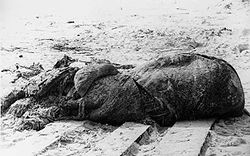
Zuiyo Maru
The Zuiyo-maru carcass is a creature initially claimed to be a prehistoric plesiosaur that was caught by the Japanese fishing trawler off the coast of New Zealand in 1977...
off New Zealand caused a sensation in 1977 and was immortalized on a Brazilian postage stamp before it was suggested by the FBI to be the decomposing carcass of a basking shark
Basking shark
The basking shark is the second largest living fish, after the whale shark. It is a cosmopolitan migratory species, found in all the world's temperate oceans. It is a slow moving and generally harmless filter feeder and has anatomical adaptations to filter feeding, such as a greatly enlarged...
. Likewise, DNA testing confirmed that an alleged sea monster washed up on Fortune Bay
Fortune Bay
Fortune Bay is a fairly large natural bay located on the south coast of the island of Newfoundland, Canada. The Bay is bounded by Point Crewe on the Burin Peninsula and Pass Island at the entrance to Hermitage Bay to the northwest for a distance of 56 kilometers...
, Newfoundland
Newfoundland and Labrador
Newfoundland and Labrador is the easternmost province of Canada. Situated in the country's Atlantic region, it incorporates the island of Newfoundland and mainland Labrador with a combined area of . As of April 2011, the province's estimated population is 508,400...
in August, 2001, was a sperm whale
Sperm Whale
The sperm whale, Physeter macrocephalus, is a marine mammal species, order Cetacea, a toothed whale having the largest brain of any animal. The name comes from the milky-white waxy substance, spermaceti, found in the animal's head. The sperm whale is the only living member of genus Physeter...
.
Another modern example of a "sea monster" was the strange creature washed up in Los Muermos
Los Muermos
Los Muermos is a city and commune in Llanquihue Province, Los Lagos Region in southern Chile.-Demographics:According to the 2002 census of the National Statistics Institute, Los Muermos spans an area of and has 16,964 inhabitants . Of these, 5,707 lived in urban areas and 11,257 in rural areas...
on the Chile
Chile
Chile ,officially the Republic of Chile , is a country in South America occupying a long, narrow coastal strip between the Andes mountains to the east and the Pacific Ocean to the west. It borders Peru to the north, Bolivia to the northeast, Argentina to the east, and the Drake Passage in the far...
an sea shore in July, 2003. It was first described as a "mammoth jellyfish
Jellyfish
Jellyfish are free-swimming members of the phylum Cnidaria. Medusa is another word for jellyfish, and refers to any free-swimming jellyfish stages in the phylum Cnidaria...
as long as a bus
Bus
A bus is a road vehicle designed to carry passengers. Buses can have a capacity as high as 300 passengers. The most common type of bus is the single-decker bus, with larger loads carried by double-decker buses and articulated buses, and smaller loads carried by midibuses and minibuses; coaches are...
" but was later determined to be another corpse of a sperm whale
Sperm Whale
The sperm whale, Physeter macrocephalus, is a marine mammal species, order Cetacea, a toothed whale having the largest brain of any animal. The name comes from the milky-white waxy substance, spermaceti, found in the animal's head. The sperm whale is the only living member of genus Physeter...
. Cases of boneless, amorphic globsters are sometimes believed to be gigantic octopus
Octopus
The octopus is a cephalopod mollusc of the order Octopoda. Octopuses have two eyes and four pairs of arms, and like other cephalopods they are bilaterally symmetric. An octopus has a hard beak, with its mouth at the center point of the arms...
es, but it has now been determined that sperm whales dying at sea decompose in such a way that the blubber detaches from the body, forming featureless whitish masses that sometimes exhibit a hairy texture due to exposed strands of collagen
Collagen
Collagen is a group of naturally occurring proteins found in animals, especially in the flesh and connective tissues of mammals. It is the main component of connective tissue, and is the most abundant protein in mammals, making up about 25% to 35% of the whole-body protein content...
fibers. The analysis of the Zuiyō Maru carcass revealed a comparable phenomenon in decomposing basking shark carcasses, which lose most of the lower head area and the dorsal and caudal fins first, making them resemble a plesiosaur.
Legendary sea monsters
- The AspidocheloneAspidocheloneAccording to the tradition of the Physiologus and medieval bestiaries, the aspidochelone is a fabled sea creature, variously described as a large whale or sea turtle, that is as large as an island. The name aspidochelone appears to be a compound word combining Greek aspis , and chelone, the turtle...
, a giant turtle or whale that appeared to be an island, and lured sailors to their doom - Capricorn, Babylonian Water-Goat, in the ZodiacZodiacIn astronomy, the zodiac is a circle of twelve 30° divisions of celestial longitude which are centred upon the ecliptic: the apparent path of the Sun across the celestial sphere over the course of the year...
- CharybdisCharybdisCharybdis or Kharybdis was a sea monster, later rationalised as a whirlpool and considered a shipping hazard in the Strait of Messina.-The mythological background:...
of HomerHomerIn the Western classical tradition Homer , is the author of the Iliad and the Odyssey, and is revered as the greatest ancient Greek epic poet. These epics lie at the beginning of the Western canon of literature, and have had an enormous influence on the history of literature.When he lived is...
, a monstrous whirlpool that sucked any ship nearby - Cirein-cròinCirein-cròinCeirean, Cirein-cròin or cionarain-crò was a large sea monster in Scottish Gaelic folklore. An old saying claims that it was so large that it fed on seven whales:Gaelic'Translation'Notes...
- Coinchenn, from whose bone the Gae BulgGáe BulgThe Gáe Bulg , meaning "spear of mortal pain/death spear", "gapped/notched spear", or "belly spear", was the name of the spear of Cúchulainn in the Ulster Cycle of Irish mythology...
is made in Celtic mythologyCeltic mythologyCeltic mythology is the mythology of Celtic polytheism, apparently the religion of the Iron Age Celts. Like other Iron Age Europeans, the early Celts maintained a polytheistic mythology and religious structure... - Curruid, the sea monster who killed the Coinchenn
- HydraLernaean HydraIn Greek mythology, the Lernaean Hydra was an ancient nameless serpent-like chthonic water beast, with reptilian traits, that possessed many heads — the poets mention more heads than the vase-painters could paint, and for each head cut off it grew two more — and poisonous breath so virulent even...
, Greece - Iku-TursoIku-TursoIku-Turso is a malevolent sea monster in the Finnish mythology. Nowadays Meritursas means octopus in Finnish, named after Iku-Turso, but originally tursas is an old name for walrus while the more common term is mursu. However, it is more common to see the word Iku-Turso is a malevolent sea...
, Reputedly a type of colossal octopus or walrus. - JörmungandrJörmungandrIn Norse mythology, Jörmungandr , mostly known as Jormungand, orJörmungand , or Midgard Serpent , or World Serpent, is a sea serpent, and the middle child of the giantess Angrboða and the god Loki...
, the Norse Midgard Serpent. - KrakenKrakenKraken are legendary sea monsters of giant proportions said to have dwelt off the coasts of Norway and Iceland.In modern German, Krake means octopus but can also refer to the legendary Kraken...
, A gigantic octopusOctopusThe octopus is a cephalopod mollusc of the order Octopoda. Octopuses have two eyes and four pairs of arms, and like other cephalopods they are bilaterally symmetric. An octopus has a hard beak, with its mouth at the center point of the arms...
or squidSquidSquid are cephalopods of the order Teuthida, which comprises around 300 species. Like all other cephalopods, squid have a distinct head, bilateral symmetry, a mantle, and arms. Squid, like cuttlefish, have eight arms arranged in pairs and two, usually longer, tentacles... - LeviathanLeviathanLeviathan , is a sea monster referred to in the Bible. In Demonology, Leviathan is one of the seven princes of Hell and its gatekeeper . The word has become synonymous with any large sea monster or creature...
- Loch Ness MonsterLoch Ness MonsterThe Loch Ness Monster is a cryptid that is reputed to inhabit Loch Ness in the Scottish Highlands. It is similar to other supposed lake monsters in Scotland and elsewhere, though its description varies from one account to the next....
- ProteusProteusIn Greek mythology, Proteus is an early sea-god, one of several deities whom Homer calls the "Old Man of the Sea", whose name suggests the "first" , as protogonos is the "primordial" or the "firstborn". He became the son of Poseidon in the Olympian theogony In Greek mythology, Proteus (Πρωτεύς)...
- ScyllaScyllaIn Greek mythology, Scylla was a monster that lived on one side of a narrow channel of water, opposite its counterpart Charybdis. The two sides of the strait were within an arrow's range of each other—so close that sailors attempting to avoid Charybdis would pass too close to Scylla and vice...
of HomerHomerIn the Western classical tradition Homer , is the author of the Iliad and the Odyssey, and is revered as the greatest ancient Greek epic poet. These epics lie at the beginning of the Western canon of literature, and have had an enormous influence on the history of literature.When he lived is...
, a six-headed serpentine that devoured six men from each ship that passed by - SirenSirenIn Greek mythology, the Sirens were three dangerous mermaid like creatures, portrayed as seductresses who lured nearby sailors with their enchanting music and voices to shipwreck on the rocky coast of their island. Roman poets placed them on an island called Sirenum scopuli...
s of HomerHomerIn the Western classical tradition Homer , is the author of the Iliad and the Odyssey, and is revered as the greatest ancient Greek epic poet. These epics lie at the beginning of the Western canon of literature, and have had an enormous influence on the history of literature.When he lived is... - TaniwhaTaniwhaIn Māori mythology, taniwha are beings that live in deep pools in rivers, dark caves, or in the sea, especially in places with dangerous currents or deceptive breakers...
- The Rainbow FishThe rainbow fishThe Rainbow Fish is a legendary creature in Hinduism as large as a whale which ate Vishnu's incarnation Buddha who removed suffering from the world. It was caught by some fishermen who freed Buddha...
- TiamatTiamatIn Babylonian mythology, Tiamat is a chaos monster, a primordial goddess of the ocean, mating with Abzû to produce younger gods. It is suggested that there are two parts to the Tiamat mythos, the first in which Tiamat is 'creatrix', through a "Sacred marriage" between salt and fresh water,...
- The constellation CetusCetusCetus is a constellation. Its name refers to Cetus, a sea monster in Greek mythology, although it is often called 'the whale' today. Cetus is located in the region of the sky that contains other water-related constellations such as Aquarius, Pisces, and Eridanus.-Ecliptic:Although Cetus is not...
- UmibōzuUmibozuis a spirit in Japanese folklore. The Umibōzu is said to live in the ocean and capsize the ship of anyone who dares speak to it. This spirit's name, which combines the character for "sea" with the character of "Buddhist monk," is possibly related to the fact that the Umibōzu is said to have a...
- YacumamaYacumamaIn the mythology of the indigenous people of South America, the yacu-mama is a sea monster, fifty paces long, believed to inhabit the mouth of the Amazon River and the nearby lagoons. According to the legend, the yacu-mama would suck up any living thing that passed within 100 paces of it...
, South America
Historically reported sea monsters
Sea monsters actually reported first or second hand include- A giant octopusGigantic octopusAn unknown species of gigantic octopus has been hypothesised as a source of reports of sea monsters such as the lusca and the kraken as well as the source of some of the carcasses of unidentified origin known as globsters like the St. Augustine Monster. The species that the St...
by PlinyPliny the ElderGaius Plinius Secundus , better known as Pliny the Elder, was a Roman author, naturalist, and natural philosopher, as well as naval and army commander of the early Roman Empire, and personal friend of the emperor Vespasian...
. N.B. Not the giant octopusGiant octopusEnteroctopus is an octopus genus, many of whose members are sometimes known as giant octopuses.- Description :Enteroctopus is a genus of generally temperate octopuses. Members of the genus Enteroctopus are characterized by their large size and are often known as the giant octopuses...
of the Pacific. - CecaeliaHybrid (mythology)Hybrids are mythological creatures combining body parts of more than one real species.They can be classified as partly human hybrids , and non-human hybrids combining two or more animal species...
s or Octopus people - Sea monkSea monkThe sea monk, or sometimes monk-fish, was the name given to a sea animal found off the eastern coast of the Danish island of Zealand almost certainly in 1546. It was described as a "fish" that looked superficially like a monk. It was mentioned and pictured in the fourth volume of Conrad Gesner's...
- Various sea serpentSea serpentA sea serpent or sea dragon is a type of sea monster either wholly or partly serpentine.Sightings of sea serpents have been reported for hundreds of years, and continue to be claimed today. Cryptozoologist Bruce Champagne identified more than 1,200 purported sea serpent sightings...
s - TritonTriton (mythology)Triton is a mythological Greek god, the messenger of the big sea. He is the son of Poseidon, god of the sea, and Amphitrite, goddess of the sea, whose herald he is...
s by PlinyPliny the ElderGaius Plinius Secundus , better known as Pliny the Elder, was a Roman author, naturalist, and natural philosopher, as well as naval and army commander of the early Roman Empire, and personal friend of the emperor Vespasian...
Currently reported specific sea monsters
- CadborosaurusCadborosaurus willsi"Cadborosaurus willsi", nicknamed Caddy, is an alleged sea serpent reported to be living on the Pacific Coast of North America. Its name is derived from Cadboro Bay in Victoria, British Columbia, and the Greek root word "saurus" meaning lizard or reptile...
of the Pacific Northwest - ChessieChessie (sea monster)Chessie is a legendary sea monster said to live in the midst of the Chesapeake Bay. Over the years there have been many alleged sightings of a serpent-like creature with flippers as part of its body....
of the Chesapeake BayChesapeake BayThe Chesapeake Bay is the largest estuary in the United States. It lies off the Atlantic Ocean, surrounded by Maryland and Virginia. The Chesapeake Bay's drainage basin covers in the District of Columbia and parts of six states: New York, Pennsylvania, Delaware, Maryland, Virginia, and West... - LuscaLuscaThe lusca is a name given to a sea monster reported from the Caribbean. It has been suggested by cryptozoologists that the lusca is a gigantic octopus, far larger than the known giant octopuses of the genus Enteroctopus.-Sightings:...
- MorgawrMorgawr (cryptid)Morgawr , is a plesiosaur-like cryptid purported to live in the sea near Falmouth Bay, Cornwall. It has been photographed and even caught on tape....
- Ayia Napa Sea MonsterAyia Napa sea monsterThe Ayia Napa Sea Monster is a cryptid, claimed to inhabit the coast off of Ayia Napa in Cyprus, a popular tourist resort on the Mediterranean. Most sightings occur around Cape Greco . It is known by the local fishermen as "To Filiko Teras", which translates as "The Friendly Monster"...
, of Ayia Napa, Cyprus
Sea monsters in fiction
- Creatures of H. P. Lovecraft'sH. P. LovecraftHoward Phillips Lovecraft --often credited as H.P. Lovecraft — was an American author of horror, fantasy and science fiction, especially the subgenre known as weird fiction....
Cthulhu MythosCthulhu MythosThe Cthulhu Mythos is a shared fictional universe, based on the work of American horror writer H. P. Lovecraft.The term was first coined by August Derleth, a contemporary correspondent of Lovecraft, who used the name of the creature Cthulhu - a central figure in Lovecraft literature and the focus...
. - Creatures of The X-FilesThe X-FilesThe X-Files is an American science fiction television series and a part of The X-Files franchise, created by screenwriter Chris Carter. The program originally aired from to . The show was a hit for the Fox network, and its characters and slogans became popular culture touchstones in the 1990s...
episodes Aqua MalaThe X-Files (season 6)The sixth season of the science fiction television series The X-Files commenced airing on the Fox Broadcasting Network in the United States on November 8, 1998, concluding on the same channel on May 16, 1999, and contained 22 episodes. The series was developed by Chris Carter, who also serves as...
and QuagmireQuagmire (The X-Files)"Quagmire" is a 1996 episode of The X-Files television series. It was the twenty-second episode broadcast in the show's third season. "Quagmire" features Mulder and Scully investigating a series of deaths at a lake in Georgia that Mulder believes were caused by a "sea" monster, Big Blue.- Plot :In...
. - Creatures in such sci-fiScience fiction filmScience fiction film is a film genre that uses science fiction: speculative, science-based depictions of phenomena that are not necessarily accepted by mainstream science, such as extraterrestrial life forms, alien worlds, extrasensory perception, and time travel, often along with futuristic...
/horrorHorror filmHorror films seek to elicit a negative emotional reaction from viewers by playing on the audience's most primal fears. They often feature scenes that startle the viewer through the means of macabre and the supernatural, thus frequently overlapping with the fantasy and science fiction genres...
films as Deepstar SixDeepstar SixDeepStar Six is an American 1989 science fiction horror film about the struggles of the crew of an underwater military outpost to defend their base against the attacks of a monster ....
, The RiftThe Rift (film)The Rift is a 1989 film directed by Juan Piquer Simón and starring R. Lee Ermey involving a submarine rescue that goes awry. It is one of many underwater-themed movies released around 1989, including The Abyss, Leviathan, Deepstar Six, The Evil Below and Lords of the Deep.-Cast:*Jack Scalia as...
, Deep RisingDeep RisingDeep Rising is a 1998 action horror film directed by Stephen Sommers. It was distributed by Hollywood Pictures and Cinergi Pictures, and was released in the United States on January 30, 1998.-Plot:...
, Deep ShockDeep ShockDeep Shock is an American film which premiered on the Sci-Fi Channel on 2003. Its plot concerns an unknown underwater object that disables an American nuclear-powered submarine and attacks a submerged Arctic research complex. It was directed by Phillip J. Roth...
, and The HostThe Host (film)The Host is a 2006 South Korean monster film, which also contains elements of comedy and drama films. The film was directed by Bong Joon-ho, who co-wrote the screenplay, along with Baek Chul-hyun....
. - Carcharodon MegalodonMegalodonThe megalodon and ὀδούς ) is an extinct species of shark that lived roughly from 28 to 1.5 million years ago, during the Cenozoic Era .The taxonomic assignment of C...
in Steve Alten'sSteve AltenSteven Robert "Steve" Alten is an American science fiction author. He is best known for his Meg series, a set of novels around the fictitious survival of the megalodon, a giant prehistoric shark...
MegMeg: A Novel of Deep TerrorMeg: A Novel of Deep Terror is a science fiction novel by Steve Alten, and was first published in July 1997. The novel, along with its sequels, follows the under water adventures of a U.S Navy deep sea diver, Jonas Taylor.-Plot summary:...
series. - CloverClover (creature)Clover is the production name given to the giant, fictional monster that appears in the 2008 film Cloverfield. The creature was originally conceived by producer J. J. Abrams and was designed by artist Neville Page. In the film, the monster is never named; the name "Cloverfield" is only given to the...
- Fictional portrayals of the Giant Squid.
- Giant octopus in It Came from Beneath the SeaIt Came from Beneath the SeaIt Came from Beneath the Sea is an American science fiction film produced by Sam Katzman and Charles Schneer for Columbia Pictures, from a script by George Worthing Yates designed to showcase the special model-animated effects of Ray Harryhausen. It was directed by Robert Gordon and stars Kenneth...
. - GigantoGigantoGiganto is the name of two Marvel Comics monsters.-Giganto I:The first Giganto seen was one of the mutates created by the Deviant scientists to serve as part of Kro's invasion force when gathered on Monster Island...
- GodzillaGodzillais a daikaijū, a Japanese movie monster, first appearing in Ishirō Honda's 1954 film Godzilla. Since then, Godzilla has gone on to become a worldwide pop culture icon starring in 28 films produced by Toho Co., Ltd. The monster has appeared in numerous other media incarnations including video games,...
and related kaijuKaijuis a Japanese word that means "strange beast," but often translated in English as "monster". Specifically, it is used to refer to a genre of tokusatsu entertainment....
. - KrakenKrakenKraken are legendary sea monsters of giant proportions said to have dwelt off the coasts of Norway and Iceland.In modern German, Krake means octopus but can also refer to the legendary Kraken...
in Pirates of the Caribbean: Dead Man's ChestPirates of the Caribbean: Dead Man's ChestPirates of the Caribbean: Dead Man's Chest is a 2006 adventure fantasy film and the second film of the Pirates of the Caribbean series, following Pirates of the Caribbean: The Curse of the Black Pearl . It was directed by Gore Verbinski, written by Ted Elliott and Terry Rossio, and produced by...
. - Leviathan in Gears of War 2Gears of War 2Gears of War 2 is a third-person shooter video game developed by Epic Games with lead design by Cliff Bleszinski, and published by Microsoft Game Studios for the Xbox 360. It is the second installment of the Gears of War series. The game was officially released in North America, Europe and...
and SupernaturalSupernaturalThe supernatural or is that which is not subject to the laws of nature, or more figuratively, that which is said to exist above and beyond nature...
. - Moby-DickMoby-DickMoby-Dick; or, The Whale, was written by American author Herman Melville and first published in 1851. It is considered by some to be a Great American Novel and a treasure of world literature. The story tells the adventures of wandering sailor Ishmael, and his voyage on the whaleship Pequod,...
- NabooNabooNaboo is a fictitious planet in the fictional Star Wars universe with a mostly green terrain and which is the homeworld of two societies: the Gungans who dwell in underwater cities and the humans who live in colonies on the surface...
ian sea monsters in Star Wars Episode I: The Phantom MenaceStar Wars Episode I: The Phantom MenaceStar Wars Episode I: The Phantom Menace is a 1999 American epic space opera film written and directed by George Lucas. It is the fourth film to be released in the Star Wars saga, as the first of a three-part prequel to the original Star Wars trilogy, as well as the first film in the saga in terms...
. - RhedosaurusThe Beast from 20,000 FathomsThe Beast from 20,000 Fathoms is a 1953 science fiction film directed by Eugène Lourié and stars Paul Christian, Paula Raymond and Cecil Kellaway with visual effects by Ray Harryhausen. The film is about an atomic bomb test in the Arctic Circle that unfreezes a hibernating fictional dinosaur, a...
- Sin
- IchthyosaurIchthyosaurIchthyosaurs were giant marine reptiles that resembled fish and dolphins...
and plesiosaurPlesiosaurPlesiosauroidea is an extinct clade of carnivorous plesiosaur marine reptiles. Plesiosauroids, are known from the Jurassic and Cretaceous Periods...
in A Journey to the Center of the Earth. - The Terrible DogfishThe Terrible DogfishThe Terrible Dogfish is a fictional sea monster which appears in Carlo Collodi's book The Adventures of Pinocchio . It is described as being larger than a five story building, a kilometre long and sporting a mouth with three rows of teeth that can easily accommodate a whole train...
- Title creature of Peter Benchley'sPeter BenchleyPeter Bradford Benchley was an American author, best known for his novel Jaws and its subsequent film adaptation, the latter co-written by Benchley and directed by Steven Spielberg...
White Shark. - The War God GoraInuYasha the Movie: Fire on the Mystic Islandis a 2004 anime film directed by Toshiya Shinohara and written by Katsuyuki Sumisawa. It is the fourth film of the InuYasha movie series. It was released in Japan on December 23, 2004 a few months after the last episode of the anime aired...