

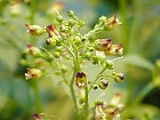
Scrophularia

Encyclopedia
The genus Scrophularia of the family Scrophulariaceae
comprises about 200 species of herbaceous
flowering plant
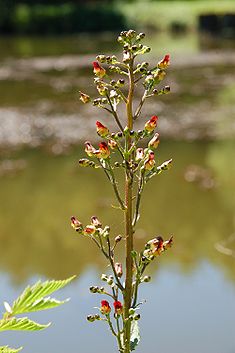
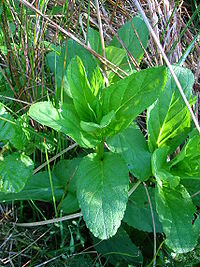
s commonly known as figworts. Species of Scrophularia all share square stems
, opposite leaves
and open two-lipped flower
s forming clusters at the end of their stems. The genus is found throughout the Northern Hemisphere
, but concentrated in Asia
with only a few species in Europe
and North America
.
Scrophularia species are used as food plants by the larva
e of some Lepidoptera
species including Phymatopus hectoides
.
Some species in this genus are known to contain potentially useful substances, such as iridoid
s, and several Scrophularia species have been used in various traditional medicine
s around the world, such as the Ningpo figwort
or Chinese figwort (S. ningpoensis). The name Scrophularia comes from scrofula
, a form of tuberculosis
, because several species have been used to treat this disease.
formerly or still in the Scrophulariaceae
- are also called "figwort". These include:
Scrophulariaceae
Scrophulariaceae, the figwort family, are a family of flowering plants. The plants are annual or perennial herbs with flowers with bilateral or rarely radial symmetry. Members of the Scrophulariaceae have a cosmopolitan distribution, with the majority found in temperate areas, including...
comprises about 200 species of herbaceous
Herbaceous
A herbaceous plant is a plant that has leaves and stems that die down at the end of the growing season to the soil level. They have no persistent woody stem above ground...
flowering plant
Flowering plant
The flowering plants , also known as Angiospermae or Magnoliophyta, are the most diverse group of land plants. Angiosperms are seed-producing plants like the gymnosperms and can be distinguished from the gymnosperms by a series of synapomorphies...
s commonly known as figworts. Species of Scrophularia all share square stems
Plant stem
A stem is one of two main structural axes of a vascular plant. The stem is normally divided into nodes and internodes, the nodes hold buds which grow into one or more leaves, inflorescence , conifer cones, roots, other stems etc. The internodes distance one node from another...
, opposite leaves
Leaf
A leaf is an organ of a vascular plant, as defined in botanical terms, and in particular in plant morphology. Foliage is a mass noun that refers to leaves as a feature of plants....
and open two-lipped flower
Flower
A flower, sometimes known as a bloom or blossom, is the reproductive structure found in flowering plants . The biological function of a flower is to effect reproduction, usually by providing a mechanism for the union of sperm with eggs...
s forming clusters at the end of their stems. The genus is found throughout the Northern Hemisphere
Northern Hemisphere
The Northern Hemisphere is the half of a planet that is north of its equator—the word hemisphere literally means “half sphere”. It is also that half of the celestial sphere north of the celestial equator...
, but concentrated in Asia
Asia
Asia is the world's largest and most populous continent, located primarily in the eastern and northern hemispheres. It covers 8.7% of the Earth's total surface area and with approximately 3.879 billion people, it hosts 60% of the world's current human population...
with only a few species in Europe
Europe
Europe is, by convention, one of the world's seven continents. Comprising the westernmost peninsula of Eurasia, Europe is generally 'divided' from Asia to its east by the watershed divides of the Ural and Caucasus Mountains, the Ural River, the Caspian and Black Seas, and the waterways connecting...
and North America
North America
North America is a continent wholly within the Northern Hemisphere and almost wholly within the Western Hemisphere. It is also considered a northern subcontinent of the Americas...
.
Scrophularia species are used as food plants by the larva
Larva
A larva is a distinct juvenile form many animals undergo before metamorphosis into adults. Animals with indirect development such as insects, amphibians, or cnidarians typically have a larval phase of their life cycle...
e of some Lepidoptera
Lepidoptera
Lepidoptera is a large order of insects that includes moths and butterflies . It is one of the most widespread and widely recognizable insect orders in the world, encompassing moths and the three superfamilies of butterflies, skipper butterflies, and moth-butterflies...
species including Phymatopus hectoides
Phymatopus
Phymatopus is a genus of moths of the family Hepialidae. There are six described species scattered across the Northern Hemisphere, placed in two groups.-Species:Phymatopus Wallengren, 1869*Phymatopus hecta Gold Swift - Europe...
.
Some species in this genus are known to contain potentially useful substances, such as iridoid
Iridoid
Iridoids are a class of secondary metabolites found in a wide variety of plants and in some animals. They are monoterpenes biosynthesized from isoprene and they are often intermediates in the biosynthesis of alkaloids. Chemically, the iridoids usually consist of a cyclopentane ring fused to a...
s, and several Scrophularia species have been used in various traditional medicine
Traditional medicine
Traditional medicine comprises unscientific knowledge systems that developed over generations within various societies before the era of modern medicine...
s around the world, such as the Ningpo figwort
Ningpo figwort
Scrophularia ningpoensis, commonly known as the Ningpo figwort or Chinese figwort, is a perennial plant of the family Scrophulariaceae . It reaches 1 m by 0.4 m. Its flowers are hermaphrodite, insect-pollinated and the plant usually flowers in late spring.-Medical use:This plant is a known to...
or Chinese figwort (S. ningpoensis). The name Scrophularia comes from scrofula
Scrofula
Tuberculous cervical lymphadenitis refers to a lymphadenitis of the cervical lymph nodes associated with tuberculosis. It was previously known as "scrofula".-The disease:...
, a form of tuberculosis
Tuberculosis
Tuberculosis, MTB, or TB is a common, and in many cases lethal, infectious disease caused by various strains of mycobacteria, usually Mycobacterium tuberculosis. Tuberculosis usually attacks the lungs but can also affect other parts of the body...
, because several species have been used to treat this disease.
Selected species
|
Scrophularia marilandica Scrophularia marilandica, also called Late Figwort, Maryland Figwort, Carpenter's Square, or Eastern Figwort, is a flowering plant in the family Scrophulariaceae, native throughout eastern and central North America, where it is found growing in dry woods from Manitoba and Quebec south to Texas and... - Late Figwort Ningpo figwort Scrophularia ningpoensis, commonly known as the Ningpo figwort or Chinese figwort, is a perennial plant of the family Scrophulariaceae . It reaches 1 m by 0.4 m. Its flowers are hermaphrodite, insect-pollinated and the plant usually flowers in late spring.-Medical use:This plant is a known to... - Ningpo Figwort Scrophularia nodosa Scrophularia nodosa is a perennial herbaceous plant found in temperate regions of the Northern hemisphere except western North America. It grows in moist and cultivated waste ground.-Growth:It grows upright, with thick, sharply square, succulent stems up to 150 cm tall from a horizontal... - Common Figwort Scrophularia umbrosa Scrophularia umbrosa, the Green figwort or Water Betony, is a perennial herbaceous plant found in temperate regions of the Northern hemisphere except western North America. Synonyms are Scrophularia alata Gilib.; Scrophularia ehrharti Stevens; Scrophularia hurstii Druce; Scrophularia towndrowi Druce... - Green Figwort Scrophularia villosa Scrophularia villosa is a species of flowering plant in the figwort family known by the common name Santa Catalina figwort. It is endemic to the Channel Islands of California, where it is known only from Catalina and San Clemente Islands. It grows in coastal sage scrub and chaparral habitat. It is... |
Other plants called "figwort"
Some other plants - mainly LamialesLamiales
Lamiales is an order in the asterid group of dicotyledonous flowering plants. It includes approximately 11,000 species divided into about 20 families...
formerly or still in the Scrophulariaceae
Scrophulariaceae
Scrophulariaceae, the figwort family, are a family of flowering plants. The plants are annual or perennial herbs with flowers with bilateral or rarely radial symmetry. Members of the Scrophulariaceae have a cosmopolitan distribution, with the majority found in temperate areas, including...
- are also called "figwort". These include:
- Euphrasia officinalis (Red Eyebright)
- Veronica officinalisVeronica officinalisVeronica officinalis is a species of Veronica, native to Europe and western Asia....
(Common Speedwell) - Veronica anagallis-aquaticaVeronica anagallis-aquaticaVeronica anagallis-aquatica is a species of flowering plant in the plantain family known by the common names water speedwell, blue speedwell, and brook pimpernel. Its true native range is not clear, but the plant is present on most continents, and in most places it is probably naturalized...
(Water Speedwell) - Gratiola officinalisGratiola officinalisGratiola officinalis is an ornamental plant in the Plantaginaceae family. It is a rhizomatous perennial herb native to Europe.- External links :*...
(Common Hedgehyssop) - Bacopa monnieriBacopa monnieriBacopa monnieri is a perennial, creeping herb whose habitat includes wetlands and muddy shores...
(Coastal Waterhyssop) - Scoparia dulcis (Sweet Broomweed)
- Ilysanthes riparia (False Pimpernel)