
Home      Discussion      Topics      Dictionary      Almanac
Signup       Login
Screw machine

Screw machine

Overview
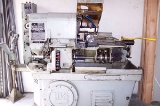
A screw machine is a metalworking machine tool
Machine tool
A machine tool is a powered mechanical device, typically used to fabricate metal components of machines by machining, which is the selective removal of metal. The term machine tool is usually reserved for tools that used a power source other than human movement, but they can be powered by people if...

 used in the high-volume manufacture of turned components. Screw machines are fundamentally a type of lathe
Lathe (metal)
A metal lathe or metalworking lathe is a large class of lathes designed for precisely machining relatively hard materials. They were originally designed to machine metals; however, with the advent of plastics and other materials, and with their inherent versatility, they are used in a wide range of...

 that is specialized for the automated
Automation
Automation is the use of control systems , in concert with other applications of information technology , to control industrial machinery and processes, reducing the need for human intervention...

 production of small parts. The name screw machine is somewhat of a misnomer, because screw machines spend much of their time making things that are not screws and that in many cases are not even threaded
Screw thread
A screw thread is a helical structure used to convert between rotational and linear movement or force.A screw thread may be thought of as an inclined plane wrapped around a cylinder or cone...

. However, the archetypal use for which screw machines were named was screw-making.

All screw machines are fully automated, whether mechanically (via cam
Cam
A cam is a rotating or sliding piece in a mechanical linkage used especially in transforming rotary motion into linear motion or vice versa. It is often a part of a rotating wheel or shaft that strikes a lever at one or more points on its circular path...

s) or by CNC (computerized control), which means that once they are set up and started running, they continue running and producing parts with very little human intervention.
Discussion
Ask a question about 'Screw machine'
Start a new discussion about 'Screw machine'
Answer questions from other users
Full Discussion Forum
 
Encyclopedia
A screw machine is a metalworking machine tool
Machine tool
A machine tool is a powered mechanical device, typically used to fabricate metal components of machines by machining, which is the selective removal of metal. The term machine tool is usually reserved for tools that used a power source other than human movement, but they can be powered by people if...

 used in the high-volume manufacture of turned components. Screw machines are fundamentally a type of lathe
Lathe (metal)
A metal lathe or metalworking lathe is a large class of lathes designed for precisely machining relatively hard materials. They were originally designed to machine metals; however, with the advent of plastics and other materials, and with their inherent versatility, they are used in a wide range of...

 that is specialized for the automated
Automation
Automation is the use of control systems , in concert with other applications of information technology , to control industrial machinery and processes, reducing the need for human intervention...

 production of small parts. The name screw machine is somewhat of a misnomer, because screw machines spend much of their time making things that are not screws and that in many cases are not even threaded
Screw thread
A screw thread is a helical structure used to convert between rotational and linear movement or force.A screw thread may be thought of as an inclined plane wrapped around a cylinder or cone...

. However, the archetypal use for which screw machines were named was screw-making.

All screw machines are fully automated, whether mechanically (via cam
Cam
A cam is a rotating or sliding piece in a mechanical linkage used especially in transforming rotary motion into linear motion or vice versa. It is often a part of a rotating wheel or shaft that strikes a lever at one or more points on its circular path...

s) or by CNC (computerized control), which means that once they are set up and started running, they continue running and producing parts with very little human intervention. This has been true since the 1870s. Mechanical automation came first, beginning in the 1870s; computerized control (via first NC
Numerical control
Numerical control refers to the automation of machine tools that are operated by abstractly programmed commands encoded on a storage medium, as opposed to manually controlled via handwheels or levers, or mechanically automated via cams alone...

 and then CNC) came later, beginning in the 1950s.

Nomenclature


The definition of the term screw machine has changed with changing technology. Any use of the term prior to the 1840s, if it occurred, would have referred ad hoc to any machine tool used to produce screws, that is, there would have been no established differentiation from the term screw-cutting lathe
Screw-cutting lathe
A screw-cutting lathe is a machine capable of cutting very accurate screw threads via single-point screw-cutting, which is the process of guiding the linear motion of the tool bit in a precisely known ratio to the rotating motion of the workpiece...

. When turret lathe
Turret lathe
The turret lathe is a form of metalworking lathe that is used for repetitive production of duplicate parts, which by the nature of their cutting process are usually interchangeable...

s were developed in the 1840s, the term screw machine was applied to them in overlapping usage with the term turret lathe. In 1860, when some of the movements, such as turret indexing, were mechanically automated, the term automatic screw machine was applied, and the term hand screw machine or manual screw machine was retronym
Retronym
A retronym is a new name for an object or concept to differentiate the original form or version of it from a more recent form or version. The original name is most often augmented with an adjective to account for later developments of the object or concept itself...

ously applied to the earlier machines. Within 15 years, the entire part-cutting cycle had been mechanically automated, and machines of the 1860 type were retronymously called semi-automatic. From that time on, machines with fully automated cycles were called automatic screw machines, and eventually the term screw machine no longer was used to refer to manual or semi-automatic turret lathes, having become reserved for one class of machine, the fully mechanically automated type. This narrow meaning of screw machine remained stable from about the 1890s until the 1950s. Within this class called screw machines there were variations, such as single-spindle
Spindle (tool)
In manufacturing and toolmaking, spindle is a general term for the main rotating axis of a machine tool, which usually has a shaft at its heart...

 versus multispindle, horizontal-turret versus vertical-turret, etc.

With the advent of NC, screw machines diverged into two classes, mechanical and NC. This distinction continues today with mechanical screw machines and CNC screw machines. However, in shop-floor jargon, the term screw machine by itself is still often understood in context to imply a mechanical screw machine, so the retronym mechanical screw machine is not consistently used.

Choice of machines


Mechanical screw machines have been replaced to some extent by CNC lathes (turning centers) and CNC screw machines. However, they are still commonly in operation, and for high-volume production of turned components it is still often true that nothing is as cost-efficient as a mechanical screw machine.

In the hierarchy of manufacturing machines, the screw machine sits at the top when large volume of product is needed. An engine lathe sits at the bottom, taking the least amount of time to set up but the most amount of skilled labor and time to actually produce a part. A turret lathe has traditionally been one step above an engine lathe, needing greater set-up time but being able to produce a higher volume of product and usually requiring a lower-skilled operator once the set-up process is complete. Screw machines may require an extensive set-up, but once they are running, a single operator can monitor the operation of several machines.

The advent of the CNC lathe (or more properly, CNC turning center) has blurred these distinct levels of production to some extent. The CNC turning center most appropriately fits in the mid-range of production, replacing the turret lathe. However, it is often possible to produce a single component with a CNC turning center more quickly than can be done with an engine lathe. To some extent too, the CNC turning center has stepped into the region traditionally occupied by the (mechanical) screw machine. CNC screw machines do this to an even greater degree, but they are expensive. In some cases they are vital, yet in others a mechanical machine can match or beat overall performance and profitability. There are many variables involved in answering the question of which is best for a particular part at a particular company.

Design


A screw machine may have a single spindle or multiple spindles. Each spindle contains a bar of material that is being machined simultaneously. A common configuration is six spindles. The cage that holds these six bars of material indexes after each machining operation is complete. The indexing is reminiscent of a Gatling gun
Gatling gun
The Gatling gun was one of the most well known rapid-fire weapons to be used in the 1860s by the Union forces of the American Civil War, following the 1851 invention of the mitrailleuse by the Belgian Army....

.

Each station may have multiple tools that cut the material in sequence. The operation of these tools is similar to that on a turret lathe.

By way of example: a bar of material is fed forward through the spindle. The face of the bar is machined (facing operation). The outside of the bar is machined to shape (turning
Turning
Turning is the process whereby a single point cutting tool is parallel to the surface. It can be done manually, in a traditional form of lathe, which frequently requires continuous supervision by the operator, or by using a computer controlled and automated lathe which does not. This type of...

 operation). The bar is drill
Drill bit
Drill bits are cutting tools used to create cylindrical holes. Bits are held in a tool called a drill, which rotates them and provides torque and axial force to create the hole. Specialized bits are also available for non-cylindrical-shaped holes....

ed or bored, and finally, the part is cut off (parting operation).

In a single-spindle machine, these four operations would most likely be performed sequentially, with four cross-slides each coming into position in turn to perform their operation. In a multi-spindle machine, each station corresponds to a stage in the production sequence through which each piece is then cycled, all operations occurring simultaneously, but on different pieces of work, in the manner of an assembly line
Assembly line
An assembly line is a manufacturing process in which parts are added to a product in a sequential manner using optimally planned logistics to create a finished product much faster than with handcrafting-type methods...

.


Form tools


For the machining of complex shapes, it is common to use form tools. This contrasts with the cutting that is performed on an engine lathe where the cutting tool is usually a single-point tool
Tool bit
The term tool bit generally refers to a non-rotary cutting tool used in metal lathes, shapers, and planers. Such cutters are also often referred to by the set-phrase name of single-point cutting tool. The cutting edge is ground to suit a particular machining operation and may be resharpened or...

. A form tool has the form or contour of the final part but in reverse, so it cuts the material leaving the desired component shape. This contrasts to a single-point tool, which cuts on one point at a time and the shape of the component is dictated by the motion of the tool rather than its shape.

Threading


Unlike on a lathe, single-point threading is rarely if ever performed; single-point threading is too time consuming for the short cycle times that are typical of screw machines. A regular threading die
Taps and dies
Taps and dies are cutting tools used to create screw threads in solid substances including metal, wood, and plastic. A tap is used to cut the female portion of the mating pair . A die is used to cut the male portion of the mating pair . The process of cutting the threads in a hole is called...

 can cut rapidly but it requires the machine to reverse in order to be removed from the work. It is impractical to reverse the rotation of the spindle[s] of the machine so it is necessary to have a cutting tool that can cut in one direction and cut fast and be removed without interrupting the rotation of the machine. Threading is performed with a die head
Die head
A die head is a threading die that is used in the high volume production of threaded components.Die heads are commonly used on lathes, turret lathes, screw machines and CNC lathes. They may be used for either cutting a thread or rolling a thread...

 - a device that cuts the thread then opens and withdraws rapidly.

Rotary broaching


Rotary broaching (or "wobble broaching") is another common operation. The broach holder is mounted stationary while its internal live spindle and end cutting broach tool are driven by the workpiece. As the broach is fed into or around the workpiece, the broach's contact points are constantly changing, easily creating the desired form. The most common form made this way is a hexagonal socket
Hex key
A hex key, also known as an Allen, Inbus, zeta, or Unbrako key or wrench, is a tool of hexagonal cross-section used to drive bolts and screws that have a hexagonal socket in the head . The name zeta refers to zeta, the sixth letter of the Greek alphabet...

 in the end of a cap screw.

Automatic chucking machine


An automatic chucking machine is very similar to an automatic screw machine, except it is not bar-fed, but rather is fed by a magazine full of blanks (pieces of stock), each of which gets a turn at being chucked. (This is analogous to the way that each round of ammunition in the magazine of a semi-automatic pistol gets its turn at being chambered.) While a screw machine is limited to around 3.5 inches in practice, automatic chuckers are available that can handle up to 12" chucks arranged in the same way that a screw machine would arrange multiple spindles. The chucks are air-operated.

Rotary transfer machine


Rotary transfers can be relatively small to very large, CNC multi-station milling and turning centers. It utilizes between 6 and 24 and more turret stations, with each turret face holding a chuck or collet. The parts are loaded by a parts bin into the holding fixture, and the part is then taken through whatever number of stations for machining. Each station can be fitted with various CNC turning, milling,slotting and grinding fixtures, and the holding stations are fully indexable. Rotary transfer machines can forgo turning operations entirely, and perform pure milling operations on bar stock. These are the singlemost expensive machine tools available today, and the highest throughput capability. One manufacturer has reported that a 12-station cnc rotary transfer machine has taken the production load off six CNC screw machines, and several CNC lathes and mills used in secondary operations. There is a Swiss manufacturer of Transfer Machines who claims production output of up to 450 parts per minute performing up to 8 machining operations on each part. These machines are often multiple tooled i.e. several parts are machined at the same time. Rotary Transfer Machines, also called, Dial Index Machines are used wherever metal components require multiple machining operations and large volume production output.
Modern Transfer Machines can hold very close tolerances and achieve astounding surface machining finishes.

External links