


Scotch Tape

Encyclopedia

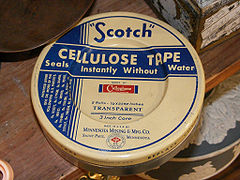
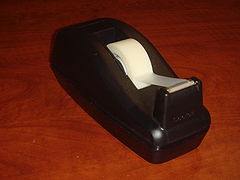
Pressure sensitive tape
Pressure-sensitive tape, known also in various countries as PSA tape, adhesive tape, self-stick tape, sticky tape, or just tape, is an adhesive tape that will stick with application pressure, without the need for solvent, heat, or water for activation...
s manufactured by 3M
3M
3M Company , formerly known as the Minnesota Mining and Manufacturing Company, is an American multinational conglomerate corporation based in Maplewood, Minnesota, United States....
as part of the company's Scotch brand.
History
The precursor to the current tapes was developed in the 1930s in Minneapolis, Minnesota by Richard DrewRichard Drew (inventor)
Richard Gurley Drew was an American inventor who worked for Johnson and Johnson, Permacel Co., and 3M in St. Paul, Minnesota, where he invented masking tape and cellophane tape.-Biography:...
to seal a then-new transparent material known as cellophane
Cellophane
Cellophane is a thin, transparent sheet made of regenerated cellulose. Its low permeability to air, oils, greases, bacteria and water makes it useful for food packaging...
.
Trade names
Although it is a trademarkTrademark
A trademark, trade mark, or trade-mark is a distinctive sign or indicator used by an individual, business organization, or other legal entity to identify that the products or services to consumers with which the trademark appears originate from a unique source, and to distinguish its products or...
ed brand name, it has sometimes been used in the United States
United States
The United States of America is a federal constitutional republic comprising fifty states and a federal district...
and elsewhere as a generic term
Genericized trademark
A genericized trademark is a trademark or brand name that has become the colloquial or generic description for, or synonymous with, a general class of product or service, rather than as an indicator of source or affiliation as intended by the trademark's holder...
for transparent adhesive tape. The Scotch brand includes many different constructions (backings, adhesives, etc.) and colors of tape.
Use of the term "Scotch" in the name has a pejorative
Pejorative
Pejoratives , including name slurs, are words or grammatical forms that connote negativity and express contempt or distaste. A term can be regarded as pejorative in some social groups but not in others, e.g., hacker is a term used for computer criminals as well as quick and clever computer experts...
origin. A customer complained that 3M was manufacturing its masking tape too cheaply, and told company engineer Richard Drew to, "take this tape back to your stingy Scotch bosses and tell them to put more adhesive on it."
Scotty McTape, a kilt
Kilt
The kilt is a knee-length garment with pleats at the rear, originating in the traditional dress of men and boys in the Scottish Highlands of the 16th century. Since the 19th century it has become associated with the wider culture of Scotland in general, or with Celtic heritage even more broadly...
-wearing cartoon
Cartoon
A cartoon is a form of two-dimensional illustrated visual art. While the specific definition has changed over time, modern usage refers to a typically non-realistic or semi-realistic drawing or painting intended for satire, caricature, or humor, or to the artistic style of such works...
boy, was the brand's mascot
Mascot
The term mascot – defined as a term for any person, animal, or object thought to bring luck – colloquially includes anything used to represent a group with a common public identity, such as a school, professional sports team, society, military unit, or brand name...
for two decades, first appearing in 1944. The familiar plaid
Tartan
Tartan is a pattern consisting of criss-crossed horizontal and vertical bands in multiple colours. Tartans originated in woven wool, but now they are made in many other materials. Tartan is particularly associated with Scotland. Scottish kilts almost always have tartan patterns...
design, a take on the Wallace
Clan Wallace
-Origins of the clan:The Wallace family first came to Scotland with a Norman family in the 11th century. King David was eager to extend the benefits of Norman influence and gave grants to the nobles of the south. Among them was Walter Fitzallan, who the Scottish king appointed his Steward in 1136...
tartan, was introduced in 1945.
The Scotch brand and Scotch Tape are registered trademarks of 3M. Besides using "Scotch" as a prefix in its brand names (Scotchgard
Scotchgard
Scotchgard is a 3M brand of products used to protect fabric, furniture, and carpets from stains.The original formula for Scotchgard was discovered accidentally in 1952 by 3M chemists Patsy Sherman and Samuel Smith...
and Scotchlite
Scotchlite
Scotchlite is a retroreflective material made by 3M. Its primary use is in nighttime high-visibility applications, such as 'reflective tape' for cyclists, safety vests for road workers, or the front of many traffic signs...
), the company also used the name "Scotch" for its (mainly professional) audiovisual magnetic tape products, until the early 1990s when the tapes were branded solely with the 3M logo. In 1996 3M exited the magnetic tape business, selling its assets to Quantegy
Quantegy
Quantegy Recording Solutions is a manufacturer of magnetic tape and professional external hard drives based in Opelika, Alabama. Their tape products are primarily used in analog audio and video recording studios, but they also have some use with digital data storage devices and instrumentation...
(which is a spin-off of Ampex
Ampex
Ampex is an American electronics company founded in 1944 by Alexander M. Poniatoff. The name AMPEX is an acronym, created by its founder, which stands for Alexander M. Poniatoff Excellence...
).

X-rays
In 1953, Russian scientists showed that triboluminescenceTriboluminescence
Triboluminescence is an optical phenomenon in which light is generated when material is pulled apart, ripped, scratched, crushed, or rubbed through the breaking of chemical bonds in the material. The phenomenon is not fully understood, but appears to be caused by the separation and reunification...
caused by peeling a roll of an unidentified Scotch brand tape in a vacuum
Vacuum
In everyday usage, vacuum is a volume of space that is essentially empty of matter, such that its gaseous pressure is much less than atmospheric pressure. The word comes from the Latin term for "empty". A perfect vacuum would be one with no particles in it at all, which is impossible to achieve in...
can produce X-ray
X-ray
X-radiation is a form of electromagnetic radiation. X-rays have a wavelength in the range of 0.01 to 10 nanometers, corresponding to frequencies in the range 30 petahertz to 30 exahertz and energies in the range 120 eV to 120 keV. They are shorter in wavelength than UV rays and longer than gamma...
s . In 2008, American scientists performed an experiment that showed the rays can be strong enough to leave an X-ray image of a finger on photographic paper
Photographic paper
Photographic paper is paper coated with light-sensitive chemicals, used for making photographic prints.Photographic paper is exposed to light in a controlled manner, either by placing a negative in contact with the paper directly to produce a contact print, by using an enlarger in order to create a...
.
See also
- Duct tapeDuct tapeDuct tape, or duck tape, is cloth- or scrim-backed pressure sensitive tape often sealed with polyethylene. It is very similar to gaffer tape but differs in that gaffer tape was designed to be cleanly removed, while duct tape was not. It has a standard width of and is generally silver or black...
- Magic TapeMagic tapeMagic Tape, also known as Magic Transparent Tape, is a brand within the Scotch Tape family of adhesive tapes made by 3M, sold in distinctive plaid packaging....
- Pressure-sensitive tape
- SellotapeSellotapeSellotape is a British brand of transparent, cellulose-based, pressure sensitive adhesive tape, and is the leading brand of clear, pressure sensitive tape in the United Kingdom. Sellotape is generally used for joining, sealing, attaching and mending...
- VelostatVelostatVelostat is a packaging material impregnated with carbon black to make it electrically conductive. It is used for the protection of items or devices that are prone to damage from electrostatic discharge. It was developed by Custom Materials, now part of 3M....
External links
- The History of Cellophane Tape and the Scotch Brand
- Scotch 75th Anniversary — pages with history information and old commercials featuring Scotty McTape
- www.scotch-tape.co.uk — the official website for the UK
- www.scotchtape.com — the official website for the USA
- — A brief history of tape