

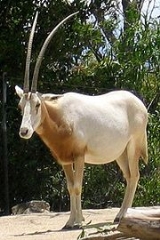
Scimitar Oryx

Encyclopedia
The Scimitar Oryx, or Scimitar-Horned Oryx, (Oryx dammah) is a species of oryx
which formerly inhabited the whole of North Africa
. It has been classified as extinct in the wild by the IUCN.
, resembling a scimitar
. The name is composed of two words: Orux (Greek
), meaning a gazelle
or antelope
; and Damma (Latin
), meaning a fallow deer
, an antelope
, and also dammar (Arabic), meaning a sheep. The nomenclature
of this animal has undergone many changes since its discovery in the early 19th Century
. It was first described by Lorenz Oken
, a German
naturalist
, in 1816 as Oryx algazel, but the name was soon replaced by Oryx dammah a decade
later by Philipp Jakob Cretzschmar
, a German physician
. In 1827 the species name leucoryx was used, but was soon assigned a synonym
to the Arabian Oryx
(Oryx leucoryx). Though the oldest name Oryx algazel was reintroduced after the name leucoryx failed, Sir John Ellerman (2nd Baronet), English
shipowner, natural historian and philanthropist
, and Terence Morrison-Scott
, a British
zoologist, realized that name was not suitable, in 1951. Finally in January 1956, the International Trust for Zoological Nomenclature accepted Oryx dammah as the scientific name, though many papers published shortly after that created confusion by using other names.
is white with a red-brown chest and black markings on the forehead and down the length of the nose. Calves are born with yellow coat
s and lack distinguishing marks which appear later in life. Their pelage changes to adult coloration at 3-12 months old. On a physiological level, the coat
reflects the pale rays of the sun, while the black portions and tip of the tongue provide protection against sunburn
. The white coat helps in reflecting the heat of the desert. Both sexes bear horns
, and the females are more slender. The horns
are long, thin and symmetrical and curve backwards (a distinct feature of this species) and can reach a meter to a meter and a quarter (3.28 - 4.1 ft) on both the male and the female. The horns
are so thin that they can break easily. They have long tails measuring 60 centimeters (2 feet). The female has 4 nipples
. The large, spread hooves are well-adapted and allow these antelopes to walk on the sand of their dry habitat. A Scimitar Oryx can live as long as 20 years.
. During the wet season, herds migrate north into the Sahara Desert
. Most often in any particular herd there will be a dominant or alpha bull. Usually these bulls provide guidance to the herd for their movements. A diurnal animal, the Scimitar Oryx rests in the cool early mornings
and evenings. Resting places include trees and shrubs, but when neither are available they dig holes in the soil
with their hooves and rest there. The males fight several times, but these fights do not last long and are not violent. Mostly weak and young oryx can be killed by predators like lion
, leopard
, hyena
, cheetah
, golden jackal
, vulture
and Cape hunting dog.
at these high temperatures, less water
is needed for evaporation
in order to help conduct heat away from the body. This reduced evaporation of bodily fluids helps these oryx go long periods without water
. They can also modify their body temperature to almost 46.5°C before beginning perspiration. In times of ample supply, oryx can also use fluid loss through urination and feces, to lower their body temperatures below 97 F (36 C) at night, thus allowing them more time before maximum body temperature is reached the following day. The oryx can tolerate high temperatures that would be lethal to most mammals. They have a network of fine blood vessels that carry blood
from the heart
to the brain
. These blood vessels travel close to the nasal passage, allowing cooling of up to 5°F of the blood
before it is pumped to the brain
, one of the most heat sensitive organs of the body.
and desert
where they eat foliage, grass
, herbs, shrubs, succulent plants, legumes, juicy roots, buds, and fruit
. Scimitar Oryx can survive without water
for even 9-10 months, a notable adaptation of the animal in the desert
climate, because their kidneys prevent loss of water
from urination
. It can still rely upon water-rich plants such as the wild melon
Citrullus colocynthis and leafless twigs Capparis decidua
and Indigofera oblongifolia. In the night or early morning they often search for plants like Indigofera viscosa, which produce a hygroscopic secretion
, which fulfills water
requirements. They do not like to eat tuft grasses like Cymbopogon schoenanthus, though they could be immediately available after a rain, but prefer more palatable grasses like Cenchrus biflora, Panicum laetum and Dactyloctenium aegyptium
. When the dry season begins, they feed upon seedpods of Acacia raddiana. During the dry season the oryx rely upon perennial grasses of genera
like Panicum
(notably Panicum turgidium) , Aristida and browse species like that of Leptadinia and species Cassia italica and Cornulaca monacantha.
at 1.5-2 years of age. Births peak in between March
and October
. The frequency of mating
s depend upon the environmental conditions. The more favorable the conditions, the more the mating
s occur. Zoo males are active in autumn
. Courting is done through the means of a mating circle. The male and female stand parallel to one another facing opposite directions. They then circle around one another until the female allows the male to mount from behind. However, if the female is not ready to mate, she can run away and circle in the reverse direction. Ejaculations occur in 30 minutes of courtship
. Pregnant females leave the herd for a week, give birth to the calf and re-conceive due to their postpartum estrus, with which it can produce a calf a year. The gestation
period lasts about 8-9 months, after which a single offspring is born, weighing an average of 20 to 33 lbs (9 to 15 kg). Within hours after birth, both mothers and calves return to the main herd. The female separates herself from the herd for a few hours while she nurses
the young. Weaning
starts at 3.5 months. The young become fully independent at around 14 weeks of age. The Scimitar Oryx also breeds with other species like Gazella dorcas, Gazella dama, and others.
in a narrow strip of central north Africa
(Niger
& Chad
). It is considered extinct in the wild, however. Now it is taken regionally extinct in Algeria
, Burkina Faso
, Chad
, Egypt
, Libyan Arab Jamahiriya, Mali
, Mauritania
, Morocco
, Niger
, Nigeria
, Senegal
, Sudan
, Tunisia
and western Sahara Desert
.
, almost to extinction. Originally it began to decline as a result of major climatic changes that caused the Sahara Desert
region to become dry. The northern population was mostly lost prior to the 20th Century
. The decline of the southern population accelerated as Europeans began to settle the area and hunting for meat, hides and horn-trophies increased. It is thought that World War II and the Civil War in Chad during the 1980s impacted heavily on the species through an increase in hunting for food.
Where once they occupied the whole Sahara Desert
, they are now considered to be extinct in the wild, with no confirmed sightings in the wild for over 15 years. Although there have been unconfirmed sightings in Chad
and Niger
, these reports have never been substantiated, despite extensive surveys that were carried out throughout Chad and Niger in 2001-2004 in an effort to detect Sahelo-Sahara Desert
n antelopes.
A global captive breeding programme was initiated in the 1960s. In 1996, there were at least 1,250 captive animals held in zoos and parks around the world with a further 2,145 on ranches in Texas
. In 2005, at least 1,550 captives were managed as part of breeding programmes and it is believed that more than 4,000 are held in private collections in the United Arab Emirates
. As part of the reintroduction
plans, there are fenced in herds in three reserves in Tunisia
, one reserve in Morocco
and two reserves in Senegal
.
A female calf was born in the National Zoo center in Front Royal, Virginia
on April 16, 2010, increasing the Smithsonian's herd to 17.
the Scimitar Oryx was domesticated and tamed for uncertain causes, but believed to be offerings for religious ceremonies or food for people. They were called 'ran' and bred in captivity. According to an inscription in a tomb
, a certain Sabu of Sakkarah owned 1308 oryx during 2320-2150 BC. In ancient Rome
the antelopes were kept in paddocks and used for coursings and were also a part of the buffet of wealthy Romans. It has been an integral animal for hunting for Sahelo-Sahara Desert
n tribes. The hide of the Scimitar Oryx is of a superior quality, and regarding this the king of Rio de Oro
sent 1000 shields made of this hide to a contemporary in the Middle Ages
. Since then this hide has been used to make many things like ropes, harnesses and saddlery.
may originate from sightings of injured scimitar oryx; Aristotle
and Pliny the Elder
held that the oryx was the unicorn
's "prototype". From certain angles, the oryx may be mistaken for having one horn instead of two, and given that its horns
are made from hollow bone which cannot be regrown, if an oryx were to lose one of its horns
, it would, for the rest of its life, have only one horn
.
Oryx
Oryx is one of four large antelope species of the genus Oryx. Three of the species are native to arid parts of Africa, with a fourth native to the Arabian Peninsula. Their pelage is pale with contrasing dark markings in the face and on the legs, and their long horns are almost straight...
which formerly inhabited the whole of North Africa
North Africa
North Africa or Northern Africa is the northernmost region of the African continent, linked by the Sahara to Sub-Saharan Africa. Geopolitically, the United Nations definition of Northern Africa includes eight countries or territories; Algeria, Egypt, Libya, Morocco, South Sudan, Sudan, Tunisia, and...
. It has been classified as extinct in the wild by the IUCN.
Etymology and taxonomy
The Scimitar Oryx is named so referring to its magnificent hornsHorn (anatomy)
A horn is a pointed projection of the skin on the head of various animals, consisting of a covering of horn surrounding a core of living bone. True horns are found mainly among the ruminant artiodactyls, in the families Antilocapridae and Bovidae...
, resembling a scimitar
Scimitar
A scimitar is a backsword or sabre with a curved blade, originating in Southwest Asia .The Arabic term saif translates to "sword" in general, but is normally taken to refer to the scimitar type of curved backsword in particular.The curved sword or "scimitar" was widespread throughout the Muslim...
. The name is composed of two words: Orux (Greek
Greek language
Greek is an independent branch of the Indo-European family of languages. Native to the southern Balkans, it has the longest documented history of any Indo-European language, spanning 34 centuries of written records. Its writing system has been the Greek alphabet for the majority of its history;...
), meaning a gazelle
Gazelle
A gazelle is any of many antelope species in the genus Gazella, or formerly considered to belong to it. Six species are included in two genera, Eudorcas and Nanger, which were formerly considered subgenera...
or antelope
Antelope
Antelope is a term referring to many even-toed ungulate species indigenous to various regions in Africa and Eurasia. Antelopes comprise a miscellaneous group within the family Bovidae, encompassing those old-world species that are neither cattle, sheep, buffalo, bison, nor goats...
; and Damma (Latin
Latin
Latin is an Italic language originally spoken in Latium and Ancient Rome. It, along with most European languages, is a descendant of the ancient Proto-Indo-European language. Although it is considered a dead language, a number of scholars and members of the Christian clergy speak it fluently, and...
), meaning a fallow deer
Fallow Deer
The Fallow Deer is a ruminant mammal belonging to the family Cervidae. This common species is native to western Eurasia, but has been introduced widely elsewhere. It often includes the rarer Persian Fallow Deer as a subspecies , while others treat it as an entirely different species The Fallow...
, an antelope
Antelope
Antelope is a term referring to many even-toed ungulate species indigenous to various regions in Africa and Eurasia. Antelopes comprise a miscellaneous group within the family Bovidae, encompassing those old-world species that are neither cattle, sheep, buffalo, bison, nor goats...
, and also dammar (Arabic), meaning a sheep. The nomenclature
Nomenclature
Nomenclature is a term that applies to either a list of names or terms, or to the system of principles, procedures and terms related to naming - which is the assigning of a word or phrase to a particular object or property...
of this animal has undergone many changes since its discovery in the early 19th Century
19th century
The 19th century was a period in history marked by the collapse of the Spanish, Portuguese, Chinese, Holy Roman and Mughal empires...
. It was first described by Lorenz Oken
Lorenz Oken
Lorenz Oken was a German naturalist.Oken was born Lorenz Okenfuss in Bohlsbach in Baden and studied natural history and medicine at the universities of Freiburg and Würzburg. He went on to the University of Göttingen, where he became a Privatdozent , and shortened his name to Oken...
, a German
Germany
Germany , officially the Federal Republic of Germany , is a federal parliamentary republic in Europe. The country consists of 16 states while the capital and largest city is Berlin. Germany covers an area of 357,021 km2 and has a largely temperate seasonal climate...
naturalist
Naturalist
Naturalist may refer to:* Practitioner of natural history* Conservationist* Advocate of naturalism * Naturalist , autobiography-See also:* The American Naturalist, periodical* Naturalism...
, in 1816 as Oryx algazel, but the name was soon replaced by Oryx dammah a decade
Decade
A decade is a period of 10 years. The word is derived from the Ancient Greek dekas which means ten. This etymology is sometime confused with the Latin decas and dies , which is not correct....
later by Philipp Jakob Cretzschmar
Philipp Jakob Cretzschmar
Philipp Jakob Cretzschmar was a German physician.Cretzschmar was born at Sulzbach and studied medicine at the University of Würzburg. He taught anatomy and zoology at the Senckenberg Medical Institute of Frankfurt....
, a German physician
Physician
A physician is a health care provider who practices the profession of medicine, which is concerned with promoting, maintaining or restoring human health through the study, diagnosis, and treatment of disease, injury and other physical and mental impairments...
. In 1827 the species name leucoryx was used, but was soon assigned a synonym
Synonym
Synonyms are different words with almost identical or similar meanings. Words that are synonyms are said to be synonymous, and the state of being a synonym is called synonymy. The word comes from Ancient Greek syn and onoma . The words car and automobile are synonyms...
to the Arabian Oryx
Arabian Oryx
The Arabian Oryx or White Oryx is a medium sized antelope with a distinct shoulder hump, long straight horns, and a tufted tail. It is a bovid, and the smallest member of Oryx genus, native to desert and steppe areas of the Arabian peninsula...
(Oryx leucoryx). Though the oldest name Oryx algazel was reintroduced after the name leucoryx failed, Sir John Ellerman (2nd Baronet), English
England
England is a country that is part of the United Kingdom. It shares land borders with Scotland to the north and Wales to the west; the Irish Sea is to the north west, the Celtic Sea to the south west, with the North Sea to the east and the English Channel to the south separating it from continental...
shipowner, natural historian and philanthropist
Philanthropist
A philanthropist is someone who engages in philanthropy; that is, someone who donates his or her time, money, and/or reputation to charitable causes...
, and Terence Morrison-Scott
Terence Morrison-Scott
Sir Terence Charles Stuart Morrison-Scott DSC DSc FMA was a British zoologist who was Director of the Science Museum and the British Museum of Natural History in London, England....
, a British
United Kingdom
The United Kingdom of Great Britain and Northern IrelandIn the United Kingdom and Dependencies, other languages have been officially recognised as legitimate autochthonous languages under the European Charter for Regional or Minority Languages...
zoologist, realized that name was not suitable, in 1951. Finally in January 1956, the International Trust for Zoological Nomenclature accepted Oryx dammah as the scientific name, though many papers published shortly after that created confusion by using other names.
Physical description
The Scimitar Oryx is just over a meter (3.28 ft) at the shoulder and weighs around two hundred kilograms (440 lbs). Males are larger than females. Its coatCoat (animal)
Coat, or the nature and quality of a show mammal's pelage, is important to the animal fancy in the judging of the animal, particularly at conformation dog shows, cat shows and horse shows...
is white with a red-brown chest and black markings on the forehead and down the length of the nose. Calves are born with yellow coat
Coat (animal)
Coat, or the nature and quality of a show mammal's pelage, is important to the animal fancy in the judging of the animal, particularly at conformation dog shows, cat shows and horse shows...
s and lack distinguishing marks which appear later in life. Their pelage changes to adult coloration at 3-12 months old. On a physiological level, the coat
Coat (animal)
Coat, or the nature and quality of a show mammal's pelage, is important to the animal fancy in the judging of the animal, particularly at conformation dog shows, cat shows and horse shows...
reflects the pale rays of the sun, while the black portions and tip of the tongue provide protection against sunburn
Sunburn
A sunburn is a burn to living tissue, such as skin, which is produced by overexposure to ultraviolet radiation, commonly from the sun's rays. Usual mild symptoms in humans and other animals include red or reddish skin that is hot to the touch, general fatigue, and mild dizziness. An excess of UV...
. The white coat helps in reflecting the heat of the desert. Both sexes bear horns
Horn (anatomy)
A horn is a pointed projection of the skin on the head of various animals, consisting of a covering of horn surrounding a core of living bone. True horns are found mainly among the ruminant artiodactyls, in the families Antilocapridae and Bovidae...
, and the females are more slender. The horns
Horn (anatomy)
A horn is a pointed projection of the skin on the head of various animals, consisting of a covering of horn surrounding a core of living bone. True horns are found mainly among the ruminant artiodactyls, in the families Antilocapridae and Bovidae...
are long, thin and symmetrical and curve backwards (a distinct feature of this species) and can reach a meter to a meter and a quarter (3.28 - 4.1 ft) on both the male and the female. The horns
Horn (anatomy)
A horn is a pointed projection of the skin on the head of various animals, consisting of a covering of horn surrounding a core of living bone. True horns are found mainly among the ruminant artiodactyls, in the families Antilocapridae and Bovidae...
are so thin that they can break easily. They have long tails measuring 60 centimeters (2 feet). The female has 4 nipples
Nipple
In its most general form, a nipple is a structure from which a fluid emanates. More specifically, it is the projection on the breasts or udder of a mammal by which breast milk is delivered to a mother's young. In this sense, it is often called a teat, especially when referring to non-humans, and...
. The large, spread hooves are well-adapted and allow these antelopes to walk on the sand of their dry habitat. A Scimitar Oryx can live as long as 20 years.
Ecology
The Scimitar Oryx is a very sociable animal; for this reason, they form herds of mixed sex (the sex ratio being 50:50) containing up to 70 animals. Though not observed, it is believed that bachelor males form their own herds. Formerly they would gather in groups of several thousand for migrationMigration
Migration, Migratory behavior, or Migratory may refer* Gene migration, a process in evolution and population genetics* Animal migration, the travelling of long distances in search of a new habitat...
. During the wet season, herds migrate north into the Sahara Desert
Sahara
The Sahara is the world's second largest desert, after Antarctica. At over , it covers most of Northern Africa, making it almost as large as Europe or the United States. The Sahara stretches from the Red Sea, including parts of the Mediterranean coasts, to the outskirts of the Atlantic Ocean...
. Most often in any particular herd there will be a dominant or alpha bull. Usually these bulls provide guidance to the herd for their movements. A diurnal animal, the Scimitar Oryx rests in the cool early mornings
Morning
The word morning originally referred to the sunrise. Morning precedes midday, afternoon, and night in the sequence of a day.Morning is the part of the day usually reckoned from dawn to noon...
and evenings. Resting places include trees and shrubs, but when neither are available they dig holes in the soil
Soil
Soil is a natural body consisting of layers of mineral constituents of variable thicknesses, which differ from the parent materials in their morphological, physical, chemical, and mineralogical characteristics...
with their hooves and rest there. The males fight several times, but these fights do not last long and are not violent. Mostly weak and young oryx can be killed by predators like lion
Lion
The lion is one of the four big cats in the genus Panthera, and a member of the family Felidae. With some males exceeding 250 kg in weight, it is the second-largest living cat after the tiger...
, leopard
Leopard
The leopard , Panthera pardus, is a member of the Felidae family and the smallest of the four "big cats" in the genus Panthera, the other three being the tiger, lion, and jaguar. The leopard was once distributed across eastern and southern Asia and Africa, from Siberia to South Africa, but its...
, hyena
Hyena
Hyenas or Hyaenas are the animals of the family Hyaenidae of suborder feliforms of the Carnivora. It is the fourth smallest biological family in the Carnivora , and one of the smallest in the mammalia...
, cheetah
Cheetah
The cheetah is a large-sized feline inhabiting most of Africa and parts of the Middle East. The cheetah is the only extant member of the genus Acinonyx, most notable for modifications in the species' paws...
, golden jackal
Golden Jackal
The golden jackal , also known as the common jackal, Asiatic jackal, thos or gold-wolf is a Canid of the genus Canis indigenous to north and northeastern Africa, southeastern and central Europe , Asia Minor, the Middle East and southeast Asia...
, vulture
Vulture
Vulture is the name given to two groups of convergently evolved scavenging birds, the New World Vultures including the well-known Californian and Andean Condors, and the Old World Vultures including the birds which are seen scavenging on carcasses of dead animals on African plains...
and Cape hunting dog.
Adaptations
With functioning metabolismMetabolism
Metabolism is the set of chemical reactions that happen in the cells of living organisms to sustain life. These processes allow organisms to grow and reproduce, maintain their structures, and respond to their environments. Metabolism is usually divided into two categories...
at these high temperatures, less water
Water
Water is a chemical substance with the chemical formula H2O. A water molecule contains one oxygen and two hydrogen atoms connected by covalent bonds. Water is a liquid at ambient conditions, but it often co-exists on Earth with its solid state, ice, and gaseous state . Water also exists in a...
is needed for evaporation
Evaporation
Evaporation is a type of vaporization of a liquid that occurs only on the surface of a liquid. The other type of vaporization is boiling, which, instead, occurs on the entire mass of the liquid....
in order to help conduct heat away from the body. This reduced evaporation of bodily fluids helps these oryx go long periods without water
Water
Water is a chemical substance with the chemical formula H2O. A water molecule contains one oxygen and two hydrogen atoms connected by covalent bonds. Water is a liquid at ambient conditions, but it often co-exists on Earth with its solid state, ice, and gaseous state . Water also exists in a...
. They can also modify their body temperature to almost 46.5°C before beginning perspiration. In times of ample supply, oryx can also use fluid loss through urination and feces, to lower their body temperatures below 97 F (36 C) at night, thus allowing them more time before maximum body temperature is reached the following day. The oryx can tolerate high temperatures that would be lethal to most mammals. They have a network of fine blood vessels that carry blood
Blood
Blood is a specialized bodily fluid in animals that delivers necessary substances such as nutrients and oxygen to the cells and transports metabolic waste products away from those same cells....
from the heart
Heart
The heart is a myogenic muscular organ found in all animals with a circulatory system , that is responsible for pumping blood throughout the blood vessels by repeated, rhythmic contractions...
to the brain
Brain
The brain is the center of the nervous system in all vertebrate and most invertebrate animals—only a few primitive invertebrates such as sponges, jellyfish, sea squirts and starfishes do not have one. It is located in the head, usually close to primary sensory apparatus such as vision, hearing,...
. These blood vessels travel close to the nasal passage, allowing cooling of up to 5°F of the blood
Blood
Blood is a specialized bodily fluid in animals that delivers necessary substances such as nutrients and oxygen to the cells and transports metabolic waste products away from those same cells....
before it is pumped to the brain
Brain
The brain is the center of the nervous system in all vertebrate and most invertebrate animals—only a few primitive invertebrates such as sponges, jellyfish, sea squirts and starfishes do not have one. It is located in the head, usually close to primary sensory apparatus such as vision, hearing,...
, one of the most heat sensitive organs of the body.
Feeding
Scimitar Oryx natively inhabit steppeSteppe
In physical geography, steppe is an ecoregion, in the montane grasslands and shrublands and temperate grasslands, savannas, and shrublands biomes, characterized by grassland plains without trees apart from those near rivers and lakes...
and desert
Desert
A desert is a landscape or region that receives an extremely low amount of precipitation, less than enough to support growth of most plants. Most deserts have an average annual precipitation of less than...
where they eat foliage, grass
Grass
Grasses, or more technically graminoids, are monocotyledonous, usually herbaceous plants with narrow leaves growing from the base. They include the "true grasses", of the Poaceae family, as well as the sedges and the rushes . The true grasses include cereals, bamboo and the grasses of lawns ...
, herbs, shrubs, succulent plants, legumes, juicy roots, buds, and fruit
Fruit
In broad terms, a fruit is a structure of a plant that contains its seeds.The term has different meanings dependent on context. In non-technical usage, such as food preparation, fruit normally means the fleshy seed-associated structures of certain plants that are sweet and edible in the raw state,...
. Scimitar Oryx can survive without water
Water
Water is a chemical substance with the chemical formula H2O. A water molecule contains one oxygen and two hydrogen atoms connected by covalent bonds. Water is a liquid at ambient conditions, but it often co-exists on Earth with its solid state, ice, and gaseous state . Water also exists in a...
for even 9-10 months, a notable adaptation of the animal in the desert
Desert
A desert is a landscape or region that receives an extremely low amount of precipitation, less than enough to support growth of most plants. Most deserts have an average annual precipitation of less than...
climate, because their kidneys prevent loss of water
Water
Water is a chemical substance with the chemical formula H2O. A water molecule contains one oxygen and two hydrogen atoms connected by covalent bonds. Water is a liquid at ambient conditions, but it often co-exists on Earth with its solid state, ice, and gaseous state . Water also exists in a...
from urination
Urination
Urination, also known as micturition, voiding, peeing, weeing, pissing, and more rarely, emiction, is the ejection of urine from the urinary bladder through the urethra to the outside of the body. In healthy humans the process of urination is under voluntary control...
. It can still rely upon water-rich plants such as the wild melon
Melon
thumb|200px|Various types of melonsThis list of melons includes members of the plant family Cucurbitaceae with edible, fleshy fruit e.g. gourds or cucurbits. The word "melon" can refer to either the plant or specifically to the fruit...
Citrullus colocynthis and leafless twigs Capparis decidua
Capparis decidua
Capparis decidua is commonly known as kerda, kair, karir, kirir, karril, etc. .- Tree characteristics :...
and Indigofera oblongifolia. In the night or early morning they often search for plants like Indigofera viscosa, which produce a hygroscopic secretion
Secretion
Secretion is the process of elaborating, releasing, and oozing chemicals, or a secreted chemical substance from a cell or gland. In contrast to excretion, the substance may have a certain function, rather than being a waste product...
, which fulfills water
Water
Water is a chemical substance with the chemical formula H2O. A water molecule contains one oxygen and two hydrogen atoms connected by covalent bonds. Water is a liquid at ambient conditions, but it often co-exists on Earth with its solid state, ice, and gaseous state . Water also exists in a...
requirements. They do not like to eat tuft grasses like Cymbopogon schoenanthus, though they could be immediately available after a rain, but prefer more palatable grasses like Cenchrus biflora, Panicum laetum and Dactyloctenium aegyptium
Dactyloctenium aegyptium
Dactyloctenium aegyptium, or Egyptian crowfoot grass is a member of the family Poaceae native in Africa. The plant mostly grows in heavy soils at damp sites.-Description:...
. When the dry season begins, they feed upon seedpods of Acacia raddiana. During the dry season the oryx rely upon perennial grasses of genera
Genera
Genera is a commercial operating system and development environment for Lisp machines developed by Symbolics. It is essentially a fork of an earlier operating system originating on the MIT AI Lab's Lisp machines which Symbolics had used in common with LMI and Texas Instruments...
like Panicum
Panicum
Panicum is a large genus of about 450 species of grasses native throughout the tropical regions of the world, with a few species extending into the northern temperate zone...
(notably Panicum turgidium) , Aristida and browse species like that of Leptadinia and species Cassia italica and Cornulaca monacantha.
Reproduction
Both males and females reach sexual maturitySexual maturity
Sexual maturity is the age or stage when an organism can reproduce. It is sometimes considered synonymous with adulthood, though the two are distinct...
at 1.5-2 years of age. Births peak in between March
March
March is in present time held to be the third month of the year in both the Julian and Gregorian calendars. It is one of the seven months which are 31 days long....
and October
October
October is the tenth month of the year in the Julian and Gregorian Calendars and one of seven months with a length of 31 days. The eighth month in the old Roman calendar, October retained its name after January and February were inserted into the calendar that had originally been created by the...
. The frequency of mating
Mating
In biology, mating is the pairing of opposite-sex or hermaphroditic organisms for copulation. In social animals, it also includes the raising of their offspring. Copulation is the union of the sex organs of two sexually reproducing animals for insemination and subsequent internal fertilization...
s depend upon the environmental conditions. The more favorable the conditions, the more the mating
Mating
In biology, mating is the pairing of opposite-sex or hermaphroditic organisms for copulation. In social animals, it also includes the raising of their offspring. Copulation is the union of the sex organs of two sexually reproducing animals for insemination and subsequent internal fertilization...
s occur. Zoo males are active in autumn
Autumn
Autumn is one of the four temperate seasons. Autumn marks the transition from summer into winter usually in September or March when the arrival of night becomes noticeably earlier....
. Courting is done through the means of a mating circle. The male and female stand parallel to one another facing opposite directions. They then circle around one another until the female allows the male to mount from behind. However, if the female is not ready to mate, she can run away and circle in the reverse direction. Ejaculations occur in 30 minutes of courtship
Courtship
Courtship is the period in a couple's relationship which precedes their engagement and marriage, or establishment of an agreed relationship of a more enduring kind. In courtship, a couple get to know each other and decide if there will be an engagement or other such agreement...
. Pregnant females leave the herd for a week, give birth to the calf and re-conceive due to their postpartum estrus, with which it can produce a calf a year. The gestation
Pregnancy (mammals)
In mammals, pregnancy is the period of reproduction during which a female carries one or more live offspring from implantation in the uterus through gestation. It begins when a fertilized zygote implants in the female's uterus; and ends once it leaves the uterus.-Fertilization and implantation:A...
period lasts about 8-9 months, after which a single offspring is born, weighing an average of 20 to 33 lbs (9 to 15 kg). Within hours after birth, both mothers and calves return to the main herd. The female separates herself from the herd for a few hours while she nurses
Breastfeeding
Breastfeeding is the feeding of an infant or young child with breast milk directly from female human breasts rather than from a baby bottle or other container. Babies have a sucking reflex that enables them to suck and swallow milk. It is recommended that mothers breastfeed for six months or...
the young. Weaning
Weaning
Weaning is the process of gradually introducing a mammal infant, either human or animal, to what will be its adult diet and withdrawing the supply of its mother's milk.The process takes place only in mammals, as only mammals produce milk...
starts at 3.5 months. The young become fully independent at around 14 weeks of age. The Scimitar Oryx also breeds with other species like Gazella dorcas, Gazella dama, and others.
Habitat and distribution
The Scimitar Oryx inhabits grassy steppes, semi-deserts (mostly in the Great Steppe)and desertsDéserts
Déserts is a piece by Edgard Varèse for brass , percussion , piano, and tape. Percussion instruments are exploited for their resonant potential, rather than used solely as accompaniment...
in a narrow strip of central north Africa
Africa
Africa is the world's second largest and second most populous continent, after Asia. At about 30.2 million km² including adjacent islands, it covers 6% of the Earth's total surface area and 20.4% of the total land area...
(Niger
Niger
Niger , officially named the Republic of Niger, is a landlocked country in Western Africa, named after the Niger River. It borders Nigeria and Benin to the south, Burkina Faso and Mali to the west, Algeria and Libya to the north and Chad to the east...
& Chad
Chad
Chad , officially known as the Republic of Chad, is a landlocked country in Central Africa. It is bordered by Libya to the north, Sudan to the east, the Central African Republic to the south, Cameroon and Nigeria to the southwest, and Niger to the west...
). It is considered extinct in the wild, however. Now it is taken regionally extinct in Algeria
Algeria
Algeria , officially the People's Democratic Republic of Algeria , also formally referred to as the Democratic and Popular Republic of Algeria, is a country in the Maghreb region of Northwest Africa with Algiers as its capital.In terms of land area, it is the largest country in Africa and the Arab...
, Burkina Faso
Burkina Faso
Burkina Faso – also known by its short-form name Burkina – is a landlocked country in west Africa. It is surrounded by six countries: Mali to the north, Niger to the east, Benin to the southeast, Togo and Ghana to the south, and Côte d'Ivoire to the southwest.Its size is with an estimated...
, Chad
Chad
Chad , officially known as the Republic of Chad, is a landlocked country in Central Africa. It is bordered by Libya to the north, Sudan to the east, the Central African Republic to the south, Cameroon and Nigeria to the southwest, and Niger to the west...
, Egypt
Egypt
Egypt , officially the Arab Republic of Egypt, Arabic: , is a country mainly in North Africa, with the Sinai Peninsula forming a land bridge in Southwest Asia. Egypt is thus a transcontinental country, and a major power in Africa, the Mediterranean Basin, the Middle East and the Muslim world...
, Libyan Arab Jamahiriya, Mali
Mali
Mali , officially the Republic of Mali , is a landlocked country in Western Africa. Mali borders Algeria on the north, Niger on the east, Burkina Faso and the Côte d'Ivoire on the south, Guinea on the south-west, and Senegal and Mauritania on the west. Its size is just over 1,240,000 km² with...
, Mauritania
Mauritania
Mauritania is a country in the Maghreb and West Africa. It is bordered by the Atlantic Ocean in the west, by Western Sahara in the north, by Algeria in the northeast, by Mali in the east and southeast, and by Senegal in the southwest...
, Morocco
Morocco
Morocco , officially the Kingdom of Morocco , is a country located in North Africa. It has a population of more than 32 million and an area of 710,850 km², and also primarily administers the disputed region of the Western Sahara...
, Niger
Niger
Niger , officially named the Republic of Niger, is a landlocked country in Western Africa, named after the Niger River. It borders Nigeria and Benin to the south, Burkina Faso and Mali to the west, Algeria and Libya to the north and Chad to the east...
, Nigeria
Nigeria
Nigeria , officially the Federal Republic of Nigeria, is a federal constitutional republic comprising 36 states and its Federal Capital Territory, Abuja. The country is located in West Africa and shares land borders with the Republic of Benin in the west, Chad and Cameroon in the east, and Niger in...
, Senegal
Senegal
Senegal , officially the Republic of Senegal , is a country in western Africa. It owes its name to the Sénégal River that borders it to the east and north...
, Sudan
Sudan
Sudan , officially the Republic of the Sudan , is a country in North Africa, sometimes considered part of the Middle East politically. It is bordered by Egypt to the north, the Red Sea to the northeast, Eritrea and Ethiopia to the east, South Sudan to the south, the Central African Republic to the...
, Tunisia
Tunisia
Tunisia , officially the Tunisian RepublicThe long name of Tunisia in other languages used in the country is: , is the northernmost country in Africa. It is a Maghreb country and is bordered by Algeria to the west, Libya to the southeast, and the Mediterranean Sea to the north and east. Its area...
and western Sahara Desert
Sahara
The Sahara is the world's second largest desert, after Antarctica. At over , it covers most of Northern Africa, making it almost as large as Europe or the United States. The Sahara stretches from the Red Sea, including parts of the Mediterranean coasts, to the outskirts of the Atlantic Ocean...
.
Status and conservation
Scimitar Oryx were hunted for their hornsHorn (anatomy)
A horn is a pointed projection of the skin on the head of various animals, consisting of a covering of horn surrounding a core of living bone. True horns are found mainly among the ruminant artiodactyls, in the families Antilocapridae and Bovidae...
, almost to extinction. Originally it began to decline as a result of major climatic changes that caused the Sahara Desert
Sahara
The Sahara is the world's second largest desert, after Antarctica. At over , it covers most of Northern Africa, making it almost as large as Europe or the United States. The Sahara stretches from the Red Sea, including parts of the Mediterranean coasts, to the outskirts of the Atlantic Ocean...
region to become dry. The northern population was mostly lost prior to the 20th Century
20th century
Many people define the 20th century as running from January 1, 1901 to December 31, 2000, others would rather define it as beginning on January 1, 1900....
. The decline of the southern population accelerated as Europeans began to settle the area and hunting for meat, hides and horn-trophies increased. It is thought that World War II and the Civil War in Chad during the 1980s impacted heavily on the species through an increase in hunting for food.
Where once they occupied the whole Sahara Desert
Sahara
The Sahara is the world's second largest desert, after Antarctica. At over , it covers most of Northern Africa, making it almost as large as Europe or the United States. The Sahara stretches from the Red Sea, including parts of the Mediterranean coasts, to the outskirts of the Atlantic Ocean...
, they are now considered to be extinct in the wild, with no confirmed sightings in the wild for over 15 years. Although there have been unconfirmed sightings in Chad
Chad
Chad , officially known as the Republic of Chad, is a landlocked country in Central Africa. It is bordered by Libya to the north, Sudan to the east, the Central African Republic to the south, Cameroon and Nigeria to the southwest, and Niger to the west...
and Niger
Niger
Niger , officially named the Republic of Niger, is a landlocked country in Western Africa, named after the Niger River. It borders Nigeria and Benin to the south, Burkina Faso and Mali to the west, Algeria and Libya to the north and Chad to the east...
, these reports have never been substantiated, despite extensive surveys that were carried out throughout Chad and Niger in 2001-2004 in an effort to detect Sahelo-Sahara Desert
Sahara
The Sahara is the world's second largest desert, after Antarctica. At over , it covers most of Northern Africa, making it almost as large as Europe or the United States. The Sahara stretches from the Red Sea, including parts of the Mediterranean coasts, to the outskirts of the Atlantic Ocean...
n antelopes.
A global captive breeding programme was initiated in the 1960s. In 1996, there were at least 1,250 captive animals held in zoos and parks around the world with a further 2,145 on ranches in Texas
Texas
Texas is the second largest U.S. state by both area and population, and the largest state by area in the contiguous United States.The name, based on the Caddo word "Tejas" meaning "friends" or "allies", was applied by the Spanish to the Caddo themselves and to the region of their settlement in...
. In 2005, at least 1,550 captives were managed as part of breeding programmes and it is believed that more than 4,000 are held in private collections in the United Arab Emirates
United Arab Emirates
The United Arab Emirates, abbreviated as the UAE, or shortened to "the Emirates", is a state situated in the southeast of the Arabian Peninsula in Western Asia on the Persian Gulf, bordering Oman, and Saudi Arabia, and sharing sea borders with Iraq, Kuwait, Bahrain, Qatar, and Iran.The UAE is a...
. As part of the reintroduction
Reintroduction
Reintroduction is the deliberate release of a species into the wild in zones formerly inhabited by said species but where it has disappeared from for a number of reasons, from captivity or relocated from other areas where the species still survives in...
plans, there are fenced in herds in three reserves in Tunisia
Tunisia
Tunisia , officially the Tunisian RepublicThe long name of Tunisia in other languages used in the country is: , is the northernmost country in Africa. It is a Maghreb country and is bordered by Algeria to the west, Libya to the southeast, and the Mediterranean Sea to the north and east. Its area...
, one reserve in Morocco
Morocco
Morocco , officially the Kingdom of Morocco , is a country located in North Africa. It has a population of more than 32 million and an area of 710,850 km², and also primarily administers the disputed region of the Western Sahara...
and two reserves in Senegal
Senegal
Senegal , officially the Republic of Senegal , is a country in western Africa. It owes its name to the Sénégal River that borders it to the east and north...
.
A female calf was born in the National Zoo center in Front Royal, Virginia
Front Royal, Virginia
Front Royal is a town in Warren County, Virginia, United States. The population was 13,589 at the 2000 census. It is the county seat of Warren County.-Geography:Front Royal is roughly west of Washington, D.C....
on April 16, 2010, increasing the Smithsonian's herd to 17.
Primitive times
In ancient EgyptEgypt
Egypt , officially the Arab Republic of Egypt, Arabic: , is a country mainly in North Africa, with the Sinai Peninsula forming a land bridge in Southwest Asia. Egypt is thus a transcontinental country, and a major power in Africa, the Mediterranean Basin, the Middle East and the Muslim world...
the Scimitar Oryx was domesticated and tamed for uncertain causes, but believed to be offerings for religious ceremonies or food for people. They were called 'ran' and bred in captivity. According to an inscription in a tomb
Tomb
A tomb is a repository for the remains of the dead. It is generally any structurally enclosed interment space or burial chamber, of varying sizes...
, a certain Sabu of Sakkarah owned 1308 oryx during 2320-2150 BC. In ancient Rome
Rome
Rome is the capital of Italy and the country's largest and most populated city and comune, with over 2.7 million residents in . The city is located in the central-western portion of the Italian Peninsula, on the Tiber River within the Lazio region of Italy.Rome's history spans two and a half...
the antelopes were kept in paddocks and used for coursings and were also a part of the buffet of wealthy Romans. It has been an integral animal for hunting for Sahelo-Sahara Desert
Sahara
The Sahara is the world's second largest desert, after Antarctica. At over , it covers most of Northern Africa, making it almost as large as Europe or the United States. The Sahara stretches from the Red Sea, including parts of the Mediterranean coasts, to the outskirts of the Atlantic Ocean...
n tribes. The hide of the Scimitar Oryx is of a superior quality, and regarding this the king of Rio de Oro
Río de Oro
Río de Oro , is, with Saguia el-Hamra, one of the two territories that formed the Spanish province of Spanish Sahara after 1969; it was originally taken as a Spanish colonial possession in the late 19th century...
sent 1000 shields made of this hide to a contemporary in the Middle Ages
Middle Ages
The Middle Ages is a periodization of European history from the 5th century to the 15th century. The Middle Ages follows the fall of the Western Roman Empire in 476 and precedes the Early Modern Era. It is the middle period of a three-period division of Western history: Classic, Medieval and Modern...
. Since then this hide has been used to make many things like ropes, harnesses and saddlery.
Unicorn myth
It has been suggested that the myth of the one-horned unicornUnicorn
The unicorn is a legendary animal from European folklore that resembles a white horse with a large, pointed, spiraling horn projecting from its forehead, and sometimes a goat's beard...
may originate from sightings of injured scimitar oryx; Aristotle
Aristotle
Aristotle was a Greek philosopher and polymath, a student of Plato and teacher of Alexander the Great. His writings cover many subjects, including physics, metaphysics, poetry, theater, music, logic, rhetoric, linguistics, politics, government, ethics, biology, and zoology...
and Pliny the Elder
Pliny the Elder
Gaius Plinius Secundus , better known as Pliny the Elder, was a Roman author, naturalist, and natural philosopher, as well as naval and army commander of the early Roman Empire, and personal friend of the emperor Vespasian...
held that the oryx was the unicorn
Unicorn
The unicorn is a legendary animal from European folklore that resembles a white horse with a large, pointed, spiraling horn projecting from its forehead, and sometimes a goat's beard...
's "prototype". From certain angles, the oryx may be mistaken for having one horn instead of two, and given that its horns
Horn (anatomy)
A horn is a pointed projection of the skin on the head of various animals, consisting of a covering of horn surrounding a core of living bone. True horns are found mainly among the ruminant artiodactyls, in the families Antilocapridae and Bovidae...
are made from hollow bone which cannot be regrown, if an oryx were to lose one of its horns
Horn (anatomy)
A horn is a pointed projection of the skin on the head of various animals, consisting of a covering of horn surrounding a core of living bone. True horns are found mainly among the ruminant artiodactyls, in the families Antilocapridae and Bovidae...
, it would, for the rest of its life, have only one horn
Horn (anatomy)
A horn is a pointed projection of the skin on the head of various animals, consisting of a covering of horn surrounding a core of living bone. True horns are found mainly among the ruminant artiodactyls, in the families Antilocapridae and Bovidae...
.