

Science and technology in Portugal

Encyclopedia
Science and technology in Portugal is mainly conducted within a network of research and development
(R&D) units belonging to public universities and state-managed autonomous research institutions. There are also non-state-run research institutions and some private R&D projects developed by companies.
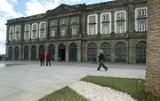
was founded in 1290 as a Studium Generale
in Lisbon
. It was focused on the arts
and humanities
, but also included a medical school
since its foundation. During the 16th century, in the Age of Discovery
, a more mathematical
educational approach flourished in this university with the creation of specialized courses and classes in the field. This included the appointment of Pedro Nunes
as mathematics teacher, in 1537, when the Portuguese university located in Lisbon was relocated back to Coimbra, and Nunes moved to the re-founded University of Coimbra to teach mathematics, a post he held until 1562. This was a new post in the University of Coimbra and it was established to provide instruction in the technical requirements for navigation: clearly a topic of great importance in Portugal
at this period, when control of sea trade was the primary source of Portuguese wealth. Mathematics became an independent post in 1544. By the 18th century, under the enlightened
political leadership of the Marquis of Pombal, the University of Coimbra was modernized with the appointment of new professors, both Portuguese and foreigners, and the establishment of several facilities directed towards the teaching of the natural science
s. Also in the 18th century, one of the oldest learned societies of Portugal, the Sciences Academy of Lisbon
, was founded in 1779.
Historically, within the scope of the now defunct Portuguese Empire
, the Portuguese founded in 1792 the oldest engineering school of Latin America
(the Real Academia de Artilharia, Fortificação e Desenho), as well as the oldest medical college of Asia
(the Escola Médico-Cirúrgica de Goa) in 1842.
In 1911, the oldest non-military Portuguese university degree-conferring institution of engineering was founded - it was the Instituto Superior Técnico
, in Lisbon, as well as new Science Faculties in the newly-founded University of Lisbon and Porto
.
 In 1949, the Portuguese neurologist António Egas Moniz, an early developer of the cerebral angiography
, was awarded the Nobel Prize in Medicine.
The Instituto Gulbenkian de Ciência
(IGC) a international centre for biomedical research and graduate education, located in Oeiras, Portugal
, was founded by the Calouste Gulbenkian Foundation
(FCG) in 1961. Its campus includes other research institutes in biology
, biotechnology
and chemistry
, with complementary research interests and facilities: protein structure and design, synthesis and theory of chemicals with biological interest, molecular microbiology, plant biotechnology, biotechnology, downstream processing, etc. The excellence of the IGC was attested by rankings published in 2010 and 2011, when the IGC was ranked as one of the Top Ten best Places for post-docs, by The Scientist
- Faculty of 1000.
The Champalimaud Foundation
, based in Lisbon, Portugal, was created at the bequest of the late Portuguese industrialist and entrepreneur, António de Sommer Champalimaud
. At the end of 2004 it was officially incorporated as the Anna de Sommer Champalimaud and Dr. Carlos Montez Champalimaud Foundation, in honour of the benefactor’s parents. The Champalimaud Foundation's focus is on the fields of neuroscience
and oncology
. On October 5th 2010 the Foundation inaugurated a clinical and research centre in Lisbon - the Champalimaud Centre for the Unknown.
In November 19, 2005, the International Iberian Nanotechnology Laboratory
to be built in Braga
, was announced by the head of Government of Spain and the Prime Minister of Portugal at the end of the XXI Portugal-Spain Summit that took place in Évora.
 In Portugal
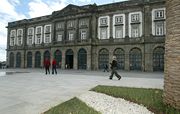
, a network of research and development units belonging to public universities and state-managed autonomous research institutions like the INETI - Instituto Nacional de Engenharia, Tecnologia e Inovação
, the ITN - Instituto Tecnológico e Nuclear, the INRB - Instituto Nacional dos Recursos Biológicos, the INSA - Instituto Nacional de Saúde Dr. Ricardo Jorge
, the IPO - Instituto Português de Oncologia
, the LNEC - Laboratório Nacional de Engenharia Civil and the LIP - Laboratório de Instrumentação e Física Experimental de Partículas
, makes the core of Portugal's science and technology research output. The funding of this research system is mainly conducted under the authority of the Ministry of Science, Technology and Higher Education
, namely through its foundation for science and technology, the FCT - Fundação para a Ciência e Tecnologia
.
 The largest R&D units of the public universities (over 380 units in total which are distributed across 14 public universities) by number of peer-reviewed publications and research grants, include the IPATIMUP, the Instituto de Biologia Molecular e Celular
and the Abel Salazar Biomedical Sciences Institute
, all of them at the University of Porto
; the Instituto de Medicina Molecular
at the University of Lisbon; or the Centre for Neuroscience and Cell Biology
at the University of Coimbra, among others. Private universities have a lower research output, however, there are a number of research units accredited by the Ministry and the FCT, these include the Facial Emotion Expression Lab
at the University Fernando Pessoa. Although smaller and generally with less resources devoted to investigation than the universities, since after the Bologna Process
(2006/2007) which allowed the polytechnical institutions to award masters' degrees and required the admission of doctorate-level staff, an increasingly large number of Portuguese polytechnical
institutions have also established and expanded their own research facilities. However, polytechnic's limited research activities are very small when compared to the state-run universities due to both a lack of research budget and doctorate-level teaching staff and investigators. Several other scientific fields are covered by specialized research organizations which are noted for their role as technology business incubator
s, like the International Iberian Nanotechnology Laboratory
, the Instituto Pedro Nunes
and Taguspark
, a science park
. The largest non-state-run research institutions in Portugal
, include the Instituto Gulbenkian de Ciência
and the Champalimaud Foundation
which recognises outstanding contributions to research in vision and associated areas through a major annual award.
The Champalimaud Foundation's research center at the mouth of the River Tagus in Lisbon
, opened in 2010 with diagnostic and treatment units for cancer patients on the lower floors and research labs above. The Ibercivis
, a distributed computing
platform, based on BOINC, that allows all ordinary citizens to participate on scientific research in a direct way and in real time as voluteer donors of unused computer cycles is a joint scientific collaboration of the Portuguese
and Spanish
governments. The Bial Foundation (Fundação Bial), named after a Portuguese pharmaceutical company, awards one of Portugal's most noted prizes for scientific research in the area of health. A number of both national and multinational high-tech and industrial companies present in Portugal, are also responsible for research and development projects in different fields. The Academia das Ciências de Lisboa (Academy of Sciences of Lisbon), created in 1779, is one of the oldest learned societies in Portugal.
The sole Portuguese science-related Laureate, having been awarded the Nobel Prize in Medicine in 1949, was Egas Moniz
.
According to the European Innovation Scoreboard 2010, Portugal is one of the moderate innovators with a below average performance. Relative strengths are in open, excellent and attractive research systems, finance and support and innovators. Relative weaknesses are in firm investments, intellectual assets and outputs. Positive growth is observed for most indicators, and in particular for business R&D expenditure, PCT patent applications in societal challenges and community designs. A substantial decline can be observed for venture capital and non-R&D innovation expenditure over the 5 year reference period, although venture capital has almost doubled in 2009 with respect to 2008. Growth performance in open, excellent and attractive research systems, linkages & entrepreneurship and intellectual assets is above average. In the other dimensions it is below average.
The European Innovation Scoreboard 2011, placed Portugal-based innovation in the 15th position, with an impressive increase in innovation expenditure and output.
accredited by FCT - Fundação para a Ciência e a Tecnologia, as of 2004:
and the European Union
(EU), Portugal has full membership into several pan-European scientific organizations like the European Space Agency
(ESA), the European Laboratory for Particle Physics (CERN), ITER
, and the European Southern Observatory
(ESO). Portuguese scientists and technicians work in all of those organizations. In the period 2005-2007, Portugal was the EU member state with the highest growth rate in research and development
(R&D) investment as a percentage of the GDP - a 46% growth. Portugal's R&D investment equals 1.2% of Portuguese GDP. This was the 15th largest allocation of funds as a percentage of the GDP for R&D, among the 27 EU member states in 2007.
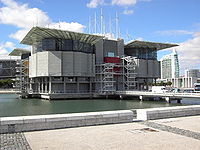 Notable organizations focused on science-related exhibits and divulgation, include the state agency Ciência Viva, a programme of the Portuguese Ministry of Science and Technology to the promotion of a scientific and technological culture among the Portuguese population, the Science Museum of the University of Coimbra
, the Museum of Natural History at the University of Lisbon, the Visionarium
and the Lisbon Oceanarium
.
s throughout the world which helped create many thousands of scientific, technological and knowledge-based businesses, Portugal started to develop several science parks across the country. These include the Taguspark
(in Oeiras), the Coimbra inovação Parque (in Coimbra
), the Biocant park (in Cantanhede), the Tecmaia (in Maia
), the Parque de Ciência e Tecnologia do Porto (in Santa Maria da Feira and Guimarães
), the Madeira Tecnopolo
(in Funchal
), Sines Tecnopolo
(in Sines
) and Parkurbis
(in Covilhã
). Companies locate in the Portuguese science parks to take advantage of a variety of services ranging from financial and legal advice through to marketing and technological support.
 Some examples of notable Portuguese people who had made important contributions to science and technology, becoming in their time internationally known within their respective field, include:
Research and development
The phrase research and development , according to the Organization for Economic Co-operation and Development, refers to "creative work undertaken on a systematic basis in order to increase the stock of knowledge, including knowledge of man, culture and society, and the use of this stock of...
(R&D) units belonging to public universities and state-managed autonomous research institutions. There are also non-state-run research institutions and some private R&D projects developed by companies.
History
The first university of PortugalHigher education in Portugal
Higher education in Portugal is divided into two main subsystems: university and polytechnic education. It is provided in autonomous public universities, private universities, public or private university institutes, polytechnic institutions and higher education institutions of other types...
was founded in 1290 as a Studium Generale
Studium Generale
Studium generale is the old customary name for a Medieval university.- Definition :There is no clear official definition of what constituted a Studium generale...
in Lisbon
Lisbon
Lisbon is the capital city and largest city of Portugal with a population of 545,245 within its administrative limits on a land area of . The urban area of Lisbon extends beyond the administrative city limits with a population of 3 million on an area of , making it the 9th most populous urban...
. It was focused on the arts
The arts
The arts are a vast subdivision of culture, composed of many creative endeavors and disciplines. It is a broader term than "art", which as a description of a field usually means only the visual arts. The arts encompass visual arts, literary arts and the performing arts – music, theatre, dance and...
and humanities
Humanities
The humanities are academic disciplines that study the human condition, using methods that are primarily analytical, critical, or speculative, as distinguished from the mainly empirical approaches of the natural sciences....
, but also included a medical school
Medical school
A medical school is a tertiary educational institution—or part of such an institution—that teaches medicine. Degree programs offered at medical schools often include Doctor of Osteopathic Medicine, Bachelor/Doctor of Medicine, Doctor of Philosophy, master's degree, or other post-secondary...
since its foundation. During the 16th century, in the Age of Discovery
Portugal in the Age of Discovery
During the history of Portugal between 1415 and 1578, Portugal discovered an eastern route to India that rounded the Cape of Good Hope, discovered Brazil, established trading routes throughout most of southern Asia, colonized selected areas of Africa, and sent the first direct European maritime...
, a more mathematical
Mathematics
Mathematics is the study of quantity, space, structure, and change. Mathematicians seek out patterns and formulate new conjectures. Mathematicians resolve the truth or falsity of conjectures by mathematical proofs, which are arguments sufficient to convince other mathematicians of their validity...
educational approach flourished in this university with the creation of specialized courses and classes in the field. This included the appointment of Pedro Nunes
Pedro Nunes
Pedro Nunes , was a Portuguese mathematician, cosmographer, and professor, from a New Christian family. Nunes, considered to be one of the greatest mathematicians of his time , is best known for his contributions in the technical field of navigation, which was crucial to the Portuguese period of...
as mathematics teacher, in 1537, when the Portuguese university located in Lisbon was relocated back to Coimbra, and Nunes moved to the re-founded University of Coimbra to teach mathematics, a post he held until 1562. This was a new post in the University of Coimbra and it was established to provide instruction in the technical requirements for navigation: clearly a topic of great importance in Portugal
Portugal
Portugal , officially the Portuguese Republic is a country situated in southwestern Europe on the Iberian Peninsula. Portugal is the westernmost country of Europe, and is bordered by the Atlantic Ocean to the West and South and by Spain to the North and East. The Atlantic archipelagos of the...
at this period, when control of sea trade was the primary source of Portuguese wealth. Mathematics became an independent post in 1544. By the 18th century, under the enlightened
Age of Enlightenment
The Age of Enlightenment was an elite cultural movement of intellectuals in 18th century Europe that sought to mobilize the power of reason in order to reform society and advance knowledge. It promoted intellectual interchange and opposed intolerance and abuses in church and state...
political leadership of the Marquis of Pombal, the University of Coimbra was modernized with the appointment of new professors, both Portuguese and foreigners, and the establishment of several facilities directed towards the teaching of the natural science
Natural science
The natural sciences are branches of science that seek to elucidate the rules that govern the natural world by using empirical and scientific methods...
s. Also in the 18th century, one of the oldest learned societies of Portugal, the Sciences Academy of Lisbon
Sciences Academy of Lisbon
The Sciences Academy of Lisbon ' was created in 1779 in Lisbon, Portugal, as an institution dedicated to the advancement of science and learning with the goal of promoting academic progress and prosperity to the country...
, was founded in 1779.
Historically, within the scope of the now defunct Portuguese Empire
Portuguese Empire
The Portuguese Empire , also known as the Portuguese Overseas Empire or the Portuguese Colonial Empire , was the first global empire in history...
, the Portuguese founded in 1792 the oldest engineering school of Latin America
Latin America
Latin America is a region of the Americas where Romance languages – particularly Spanish and Portuguese, and variably French – are primarily spoken. Latin America has an area of approximately 21,069,500 km² , almost 3.9% of the Earth's surface or 14.1% of its land surface area...
(the Real Academia de Artilharia, Fortificação e Desenho), as well as the oldest medical college of Asia
Asia
Asia is the world's largest and most populous continent, located primarily in the eastern and northern hemispheres. It covers 8.7% of the Earth's total surface area and with approximately 3.879 billion people, it hosts 60% of the world's current human population...
(the Escola Médico-Cirúrgica de Goa) in 1842.
In 1911, the oldest non-military Portuguese university degree-conferring institution of engineering was founded - it was the Instituto Superior Técnico
Instituto Superior Técnico
Instituto Superior Técnico is a reputed school of engineering, part of Universidade Técnica de Lisboa . IST is the largest and the most prestigious school of engineering in Portugal...
, in Lisbon, as well as new Science Faculties in the newly-founded University of Lisbon and Porto
University of Porto
The University of Porto is a Portuguese public university located in Porto, and founded 22 March 1911. It is the largest Portuguese university by number of enrolled students and has one of the most noted research outputs in Portugal...
.
Post-World War II
Cerebral angiography
Cerebral angiography is a form of angiography which provides images of blood vessels in and around the brain, thereby allowing detection of abnormalities such as arteriovenous malformations and aneurysms....
, was awarded the Nobel Prize in Medicine.
The Instituto Gulbenkian de Ciência
Instituto Gulbenkian de Ciência
The is an international centre for biomedical research and graduate education, located in in Oeiras, Portugal. It was founded by the Calouste Gulbenkian Foundation in 1961. António Coutinho has been the Institute's Director since 1998....
(IGC) a international centre for biomedical research and graduate education, located in Oeiras, Portugal
Portugal
Portugal , officially the Portuguese Republic is a country situated in southwestern Europe on the Iberian Peninsula. Portugal is the westernmost country of Europe, and is bordered by the Atlantic Ocean to the West and South and by Spain to the North and East. The Atlantic archipelagos of the...
, was founded by the Calouste Gulbenkian Foundation
Calouste Gulbenkian Foundation
The Calouste Gulbenkian Foundation is a Portuguese private foundation of public utility whose statutory aims are in the fields of arts, charity, education, and science...
(FCG) in 1961. Its campus includes other research institutes in biology
Biology
Biology is a natural science concerned with the study of life and living organisms, including their structure, function, growth, origin, evolution, distribution, and taxonomy. Biology is a vast subject containing many subdivisions, topics, and disciplines...
, biotechnology
Biotechnology
Biotechnology is a field of applied biology that involves the use of living organisms and bioprocesses in engineering, technology, medicine and other fields requiring bioproducts. Biotechnology also utilizes these products for manufacturing purpose...
and chemistry
Chemistry
Chemistry is the science of matter, especially its chemical reactions, but also its composition, structure and properties. Chemistry is concerned with atoms and their interactions with other atoms, and particularly with the properties of chemical bonds....
, with complementary research interests and facilities: protein structure and design, synthesis and theory of chemicals with biological interest, molecular microbiology, plant biotechnology, biotechnology, downstream processing, etc. The excellence of the IGC was attested by rankings published in 2010 and 2011, when the IGC was ranked as one of the Top Ten best Places for post-docs, by The Scientist
The Scientist
The Scientist: Magazine of Life Sciences is a professional magazine intended for life scientists. Coverage includes reviews of widely noticed research papers, informing its audience of current research, updates to technology, updates to career information, profiles of scientists achieving...
- Faculty of 1000.
The Champalimaud Foundation
Champalimaud Foundation
The Champalimaud Foundation is a private Portuguese biomedical research foundation, which aims to support the biomedical sciences, focused in particular, on the fields of neuroscience and cancer...
, based in Lisbon, Portugal, was created at the bequest of the late Portuguese industrialist and entrepreneur, António de Sommer Champalimaud
António de Sommer Champalimaud
António de Sommer Champalimaud was a Portuguese banker and industrialist who in 2004 was the wealthiest man in Portugal. He earned his fortune with insurance, banking and cement industries which were nationalized after the Carnation Revolution of 1974...
. At the end of 2004 it was officially incorporated as the Anna de Sommer Champalimaud and Dr. Carlos Montez Champalimaud Foundation, in honour of the benefactor’s parents. The Champalimaud Foundation's focus is on the fields of neuroscience
Neuroscience
Neuroscience is the scientific study of the nervous system. Traditionally, neuroscience has been seen as a branch of biology. However, it is currently an interdisciplinary science that collaborates with other fields such as chemistry, computer science, engineering, linguistics, mathematics,...
and oncology
Oncology
Oncology is a branch of medicine that deals with cancer...
. On October 5th 2010 the Foundation inaugurated a clinical and research centre in Lisbon - the Champalimaud Centre for the Unknown.
In November 19, 2005, the International Iberian Nanotechnology Laboratory
International Iberian Nanotechnology Laboratory
International Iberian Nanotechnology Laboratory , in Braga, Portugal, is the first, and so far the only, fully international research organization in Europe in the field of nanoscience and nanotechnology...
to be built in Braga
Braga
Braga , a city in the Braga Municipality in northwestern Portugal, is the capital of the Braga District, the oldest archdiocese and the third major city of the country. Braga is the oldest Portuguese city and one of the oldest Christian cities in the World...
, was announced by the head of Government of Spain and the Prime Minister of Portugal at the end of the XXI Portugal-Spain Summit that took place in Évora.
Research and development
Portugal
Portugal , officially the Portuguese Republic is a country situated in southwestern Europe on the Iberian Peninsula. Portugal is the westernmost country of Europe, and is bordered by the Atlantic Ocean to the West and South and by Spain to the North and East. The Atlantic archipelagos of the...
, a network of research and development units belonging to public universities and state-managed autonomous research institutions like the INETI - Instituto Nacional de Engenharia, Tecnologia e Inovação
Instituto Nacional de Engenharia, Tecnologia e Inovação
The Instituto Nacional de Engenharia, Tecnologia e Inovação , usually known as INETI for short, is a state-run R&D institution in Lisbon, Portugal, with scientific and technological activities in areas like new systems, processes and products; environmental and sustainable management; geological...
, the ITN - Instituto Tecnológico e Nuclear, the INRB - Instituto Nacional dos Recursos Biológicos, the INSA - Instituto Nacional de Saúde Dr. Ricardo Jorge
Instituto Nacional de Saúde Dr. Ricardo Jorge
The Instituto Nacional de Saúde Dr. Ricardo Jorge ' is a public institution under the Portuguese Ministry of Health, with self scientific, technical, administrative, and financial autonomy....
, the IPO - Instituto Português de Oncologia
Instituto Português de Oncologia
The Instituto Português de Oncologia Francisco Gentil, also known as Instituto Português de Oncologia and ' , is a state-run cancer hospital and research organization from Portugal. The I.P.O. has autonomous regional branches in Lisbon, Porto and Coimbra.-External links:***...
, the LNEC - Laboratório Nacional de Engenharia Civil and the LIP - Laboratório de Instrumentação e Física Experimental de Partículas
Laboratory of Instrumentation and Experimental Particles Physics
The Laboratory of Instrumentation and Experimental Particle Physics ' is a state-run Portuguese research laboratory created in 1986 under the sponsorship of the National Foundation for Science of the Portuguese Ministry of Science, Technology and Higher Education...
, makes the core of Portugal's science and technology research output. The funding of this research system is mainly conducted under the authority of the Ministry of Science, Technology and Higher Education
Ministry of Science, Technology and Higher Education
The Ministry of Science, Technology and Higher Education , MCTES, is a Portuguese government ministry.-External links:*...
, namely through its foundation for science and technology, the FCT - Fundação para a Ciência e Tecnologia
Fundação para a Ciência e Tecnologia
The Foundation for Science and Technology , FCT, is an organization within the Ministério da Ciência, Tecnologia e Ensino Superior in Portugal which funds scientific research activities, in particular in the areas of natural sciences, exact sciences, social sciences and humanities....
.
Instituto de Biologia Molecular e Celular
The Institute of Molecular and Cell Biology in Porto, Portugal, was founded in the 1990s as a multidisciplinary research institution in the fields of genetic diseases, infectious diseases and immunology, neuroscience, stress and structural biology.Most of its investigators are University of...
and the Abel Salazar Biomedical Sciences Institute
Abel Salazar Biomedical Sciences Institute
The Instituto de Ciências Biomédicas Abel Salazar - ICBAS is a medical school , veterinary sciences school and also a school of marine biology, located in Porto, Portugal...
, all of them at the University of Porto
University of Porto
The University of Porto is a Portuguese public university located in Porto, and founded 22 March 1911. It is the largest Portuguese university by number of enrolled students and has one of the most noted research outputs in Portugal...
; the Instituto de Medicina Molecular
Instituto de Medicina Molecular
The Instituto de Medicina Molecular , or IMM for short, is an associated research institution of the University of Lisbon, in Lisbon, Portugal....
at the University of Lisbon; or the Centre for Neuroscience and Cell Biology
Centre for Neuroscience and Cell Biology
The Centre for Neuroscience and Cell Biology is a bioscience and biomedicine research institute of the University of Coimbra, in Coimbra, Portugal. Its researchers come from three faculties of the University of Coimbra: the Faculties of Medicine, Pharmacy, and Science and Technology at the...
at the University of Coimbra, among others. Private universities have a lower research output, however, there are a number of research units accredited by the Ministry and the FCT, these include the Facial Emotion Expression Lab
Facial Emotion Expression Lab
The Facial Expression Emotion Lab was founded by Armindo Freitas-Magalhães in 2003 and is a unit of the College of Health Sciences at the Universidade Fernando Pessoa, Porto, Portugal. The mission of the lab is to create new scientific knowledge about the human emotions and their forms of social...
at the University Fernando Pessoa. Although smaller and generally with less resources devoted to investigation than the universities, since after the Bologna Process
Bologna process
The purpose of the Bologna Process is the creation of the European Higher Education Area by making academic degree standards and quality assurance standards more comparable and compatible throughout Europe, in particular under the Lisbon Recognition Convention...
(2006/2007) which allowed the polytechnical institutions to award masters' degrees and required the admission of doctorate-level staff, an increasingly large number of Portuguese polytechnical
Polytechnic (Portugal)
A polytechnic is a higher education educational institution in Portugal created in the 1980s. After 1998 they were upgraded to institutions which are allowed to confer licenciatura degrees. Before then, they only awarded short-cycle degrees which were known as bacharelatos and didn't provide...
institutions have also established and expanded their own research facilities. However, polytechnic's limited research activities are very small when compared to the state-run universities due to both a lack of research budget and doctorate-level teaching staff and investigators. Several other scientific fields are covered by specialized research organizations which are noted for their role as technology business incubator
Business incubator
Business incubators are programs designed to accelerate the successful development of entrepreneurial companies through an array of business support resources and services, developed and orchestrated by incubator management and offered both in the incubator and through its network of contacts...
s, like the International Iberian Nanotechnology Laboratory
International Iberian Nanotechnology Laboratory
International Iberian Nanotechnology Laboratory , in Braga, Portugal, is the first, and so far the only, fully international research organization in Europe in the field of nanoscience and nanotechnology...
, the Instituto Pedro Nunes
Instituto Pedro Nunes
Instituto Pedro Nunes is a non-profit private organization for innovation and technology transfer based in Coimbra, Portugal. It is named after the Portuguese 16th century mathematician and professor Pedro Nunes, who lived in the city of Coimbra and worked for the local university.-IPN profile:The...
and Taguspark
Taguspark
Taguspark is a science and technology park located in the municipality of Oeiras, Greater Lisbon subregion, Portugal. In an area of approximately 3.6 km², 2 km² of which are occupied by the Park, there are several research and development labs, innovative startups and business incubators in a range...
, a science park
Science park
A research park, science park, or science and technology park is an area with a collection of buildings dedicated to scientific research on a business footing. There are many approximate synonyms for "science park", including research park, technology park, technopolis and biomedical park...
. The largest non-state-run research institutions in Portugal
Portugal
Portugal , officially the Portuguese Republic is a country situated in southwestern Europe on the Iberian Peninsula. Portugal is the westernmost country of Europe, and is bordered by the Atlantic Ocean to the West and South and by Spain to the North and East. The Atlantic archipelagos of the...
, include the Instituto Gulbenkian de Ciência
Instituto Gulbenkian de Ciência
The is an international centre for biomedical research and graduate education, located in in Oeiras, Portugal. It was founded by the Calouste Gulbenkian Foundation in 1961. António Coutinho has been the Institute's Director since 1998....
and the Champalimaud Foundation
Champalimaud Foundation
The Champalimaud Foundation is a private Portuguese biomedical research foundation, which aims to support the biomedical sciences, focused in particular, on the fields of neuroscience and cancer...
which recognises outstanding contributions to research in vision and associated areas through a major annual award.
The Champalimaud Foundation's research center at the mouth of the River Tagus in Lisbon
Lisbon
Lisbon is the capital city and largest city of Portugal with a population of 545,245 within its administrative limits on a land area of . The urban area of Lisbon extends beyond the administrative city limits with a population of 3 million on an area of , making it the 9th most populous urban...
, opened in 2010 with diagnostic and treatment units for cancer patients on the lower floors and research labs above. The Ibercivis
Ibercivis
Ibercivis is a distributed computing platform which allows internet users to participate in scientific research by donating unused computer cycles to run scientific simulations and other tasks...
, a distributed computing
Distributed computing
Distributed computing is a field of computer science that studies distributed systems. A distributed system consists of multiple autonomous computers that communicate through a computer network. The computers interact with each other in order to achieve a common goal...
platform, based on BOINC, that allows all ordinary citizens to participate on scientific research in a direct way and in real time as voluteer donors of unused computer cycles is a joint scientific collaboration of the Portuguese
Portugal
Portugal , officially the Portuguese Republic is a country situated in southwestern Europe on the Iberian Peninsula. Portugal is the westernmost country of Europe, and is bordered by the Atlantic Ocean to the West and South and by Spain to the North and East. The Atlantic archipelagos of the...
and Spanish
Spain
Spain , officially the Kingdom of Spain languages]] under the European Charter for Regional or Minority Languages. In each of these, Spain's official name is as follows:;;;;;;), is a country and member state of the European Union located in southwestern Europe on the Iberian Peninsula...
governments. The Bial Foundation (Fundação Bial), named after a Portuguese pharmaceutical company, awards one of Portugal's most noted prizes for scientific research in the area of health. A number of both national and multinational high-tech and industrial companies present in Portugal, are also responsible for research and development projects in different fields. The Academia das Ciências de Lisboa (Academy of Sciences of Lisbon), created in 1779, is one of the oldest learned societies in Portugal.
The sole Portuguese science-related Laureate, having been awarded the Nobel Prize in Medicine in 1949, was Egas Moniz
Egas Moniz
António Caetano de Abreu Freire Egas Moniz , known as Egas Moniz , was a Portuguese neurologist and the developer of cerebral angiography...
.
Research and development output
In 2001 Portugal was ranked 28th among countries that contributed to the top 1% of the world's highly-cited publications. Accounting for 0.25% of these publications, Portugal ranked above South Africa (0.21%) and Iran (0.04%), but below Spain (2.08%), Ireland (0.36%), and Greece (0.3%).2010 report
According to the European Innovation Scoreboard 2010, Portugal is one of the moderate innovators with a below average performance. Relative strengths are in open, excellent and attractive research systems, finance and support and innovators. Relative weaknesses are in firm investments, intellectual assets and outputs. Positive growth is observed for most indicators, and in particular for business R&D expenditure, PCT patent applications in societal challenges and community designs. A substantial decline can be observed for venture capital and non-R&D innovation expenditure over the 5 year reference period, although venture capital has almost doubled in 2009 with respect to 2008. Growth performance in open, excellent and attractive research systems, linkages & entrepreneurship and intellectual assets is above average. In the other dimensions it is below average.
2011 report
The European Innovation Scoreboard 2011, placed Portugal-based innovation in the 15th position, with an impressive increase in innovation expenditure and output.
Accredited R&D centers belonging to higher learning institutions
Research centers belonging to higher learning institutionsHigher education in Portugal
Higher education in Portugal is divided into two main subsystems: university and polytechnic education. It is provided in autonomous public universities, private universities, public or private university institutes, polytechnic institutions and higher education institutions of other types...
accredited by FCT - Fundação para a Ciência e a Tecnologia, as of 2004:
| Type of institution | Number of research centers | Number of institutions |
|---|---|---|
| Public universities | 384 | 14 |
| Public polytechnics | 8 | 15 |
| Catholic University | 14 | 1 |
| Private universities | 7 | N/A |
| Other private institutions | 20 | N/A |
| Total | 433 | N/A |
Portugal's European integration in science and technology
Within EuropeEurope
Europe is, by convention, one of the world's seven continents. Comprising the westernmost peninsula of Eurasia, Europe is generally 'divided' from Asia to its east by the watershed divides of the Ural and Caucasus Mountains, the Ural River, the Caspian and Black Seas, and the waterways connecting...
and the European Union
European Union
The European Union is an economic and political union of 27 independent member states which are located primarily in Europe. The EU traces its origins from the European Coal and Steel Community and the European Economic Community , formed by six countries in 1958...
(EU), Portugal has full membership into several pan-European scientific organizations like the European Space Agency
European Space Agency
The European Space Agency , established in 1975, is an intergovernmental organisation dedicated to the exploration of space, currently with 18 member states...
(ESA), the European Laboratory for Particle Physics (CERN), ITER
ITER
ITER is an international nuclear fusion research and engineering project, which is currently building the world's largest and most advanced experimental tokamak nuclear fusion reactor at Cadarache in the south of France...
, and the European Southern Observatory
European Southern Observatory
The European Southern Observatory is an intergovernmental research organisation for astronomy, supported by fifteen countries...
(ESO). Portuguese scientists and technicians work in all of those organizations. In the period 2005-2007, Portugal was the EU member state with the highest growth rate in research and development
Research and development
The phrase research and development , according to the Organization for Economic Co-operation and Development, refers to "creative work undertaken on a systematic basis in order to increase the stock of knowledge, including knowledge of man, culture and society, and the use of this stock of...
(R&D) investment as a percentage of the GDP - a 46% growth. Portugal's R&D investment equals 1.2% of Portuguese GDP. This was the 15th largest allocation of funds as a percentage of the GDP for R&D, among the 27 EU member states in 2007.
Science museums, exhibits and divulgation
Science Museum of the University of Coimbra
The Science Museum of the University of Coimbra ' gathers the historical scientific collections of several units of the University of Coimbra, in Coimbra, Portugal...
, the Museum of Natural History at the University of Lisbon, the Visionarium
Visionarium (Portugal)
Visionarium is a science museum with state-of-the-art interactive displays covering subjects ranging from the Portuguese voyages of discoveries to the interiors of microchips and cells...
and the Lisbon Oceanarium
Lisbon Oceanarium
The Oceanarium is an oceanarium in Lisbon, Portugal. It is located in the Parque das Nações, which was the exhibition grounds for the Expo '98.- Architecture :...
.
Science parks
With the emergence and growth of several science parkScience park
A research park, science park, or science and technology park is an area with a collection of buildings dedicated to scientific research on a business footing. There are many approximate synonyms for "science park", including research park, technology park, technopolis and biomedical park...
s throughout the world which helped create many thousands of scientific, technological and knowledge-based businesses, Portugal started to develop several science parks across the country. These include the Taguspark
Taguspark
Taguspark is a science and technology park located in the municipality of Oeiras, Greater Lisbon subregion, Portugal. In an area of approximately 3.6 km², 2 km² of which are occupied by the Park, there are several research and development labs, innovative startups and business incubators in a range...
(in Oeiras), the Coimbra inovação Parque (in Coimbra
Coimbra
Coimbra is a city in the municipality of Coimbra in Portugal. Although it served as the nation's capital during the High Middle Ages, it is better-known for its university, the University of Coimbra, which is one of the oldest in Europe and the oldest academic institution in the...
), the Biocant park (in Cantanhede), the Tecmaia (in Maia
Maia, Portugal
Maia Municipality is located in the Porto Metropolitan Area, Grande Porto subregion, in Norte Region, Portugal. The city of Maia includes the parishes of Gueifães, Maia and Vermoim, and has 39,949 inhabitants. The Maia Municipality comprises 135,049 inhabitants in 17 parishes for a total land...
), the Parque de Ciência e Tecnologia do Porto (in Santa Maria da Feira and Guimarães
Guimarães
Guimarães Municipality is located in northwestern Portugal in the province of Minho and in the Braga District. It contains the city of Guimarães.The present Mayor is António Magalhães Silva, elected by the Socialist Party.-Parishes:-Economy:...
), the Madeira Tecnopolo
Madeira Tecnopolo
Madeira Tecnopolo is a Free Science Park in Funchal, Madeira, Portugal, .-ICEC Centre:Within the Tecnopolo park is the ICEC Exhibition and Congress Centre, the largest indoor arena on the island. As well as various conferences and exhibitions, including Portugal Fashion, it has also held events...
(in Funchal
Funchal
Funchal is the largest city, the municipal seat and the capital of Portugal's Autonomous Region of Madeira. The city has a population of 112,015 and has been the capital of Madeira for more than five centuries.-Etymology:...
), Sines Tecnopolo
Sines Tecnopolo
The Sines Tecnopolo is a Portuguese science park headquartered in Sines. It is linked with two public universities , two public polytechnics and the Sines Municipality.The park is devoted to technological transfer, entrepreneurship promotion and advanced...
(in Sines
Sines, Portugal
Sines is a coastal municipality in the district of Setúbal, in the Alentejo Litoral region of the Portuguese Alentejo. Its population in 2011 was over 14260 residents, with a total area of 203.3 km², concentrated on the municipal seat of Sines.-History:...
) and Parkurbis
Parkurbis
Parkurbis is a Portuguese science park in Covilhã. This organization is oriented to the support and fostering of new technology based businesses, providing support services to start ups and infrastructures that fit the needs of the new entrepreneurs and assure them the best conditions for the...
(in Covilhã
Covilhã
Covilhã is a city in Covilha Municipality in Centro region, Portugal. The city proper has 36,723 inhabitants, and the municipality has an area of 555.6 km² with a total population of 53,501, being composed of 31 parishes. It is located in the Cova da Beira subregion, in the district of...
). Companies locate in the Portuguese science parks to take advantage of a variety of services ranging from financial and legal advice through to marketing and technological support.
Noted contributors to science and technology
- Corino AndradeCorino AndradeMário Corino da Costa Andrade was a leading twentieth century Portuguese neurologist and researcher who first described the familial amyloidotic polyneuropathy syndrome that later came to be associated with his name .Corino was a founder of the Instituto de Ciências Biomédicas Abel Salazar, a...
- 20th century researcher who first described the familial amyloidotic polyneuropathy - António DamásioAntonio DamasioAntonio Damasio is David Dornsife Professor of Neuroscience at the University of Southern California, where he heads USC's Brain and Creativity Institute and Adjunct Professor at the Salk Institute. Prior to taking up his posts at USC, in 2005, Damasio was M.W...
- 20th/21st century researcher in several areas of the neurology, and a best-selling author of books which describe his scientific thinking - Amato LusitanoAmato LusitanoJoão Rodrigues de Castelo Branco, better known as Amato Lusitano and Amatus Lusitanus , was a notable Portuguese Jewish physician of the 16th century. Like Herophilus, Galen, Ibn al-Nafis, Michael Servetus, Realdo Colombo and William Harvey, he is credited as making a discovery in the circulation...
- 16th century physician, discovered the circulation of the blood, was one of the first to observe and speculate about the venous valves found in the Azigos vein - Froilano de MelloFroilano de MelloFroilano de Mello was an Indo-Portuguese microbiologist, medical scientist, professor, author and an independent MP in the Portuguese parliament....
- 20th century microbiologist and medical scientist - Egas MonizEgas MonizAntónio Caetano de Abreu Freire Egas Moniz , known as Egas Moniz , was a Portuguese neurologist and the developer of cerebral angiography...
- 20th century Nobel Prize in Medicine "for his discovery of the therapeutic value of leucotomy in certain psychoses", he also was a pioneer in the development of cerebral angiography - Pedro NunesPedro NunesPedro Nunes , was a Portuguese mathematician, cosmographer, and professor, from a New Christian family. Nunes, considered to be one of the greatest mathematicians of his time , is best known for his contributions in the technical field of navigation, which was crucial to the Portuguese period of...
- 16th century mathematician, one of the greatest of his time, he is best known for his contributions in the technical field of navigation - Garcia de OrtaGarcia de OrtaGarcia de Orta was a Portuguese Renaissance Sephardi Jewish physician and naturalist. He was a pioneer of tropical medicine.- Life :...
- 16th century physician and naturalist, he was a pioneer of tropical medicine
See also
- Agência de InovaçãoAgência de InovaçãoThe Agência de Inovação is a Portuguese government agency funded by the Ministry of Science, Technology and Higher Education and the Ministry of the Economy and Innovation. The agency tries to promote innovation and technological development and to facilitate cooperation between research and...
- Higher education in PortugalHigher education in PortugalHigher education in Portugal is divided into two main subsystems: university and polytechnic education. It is provided in autonomous public universities, private universities, public or private university institutes, polytechnic institutions and higher education institutions of other types...
- Fundação para a Ciência e TecnologiaFundação para a Ciência e TecnologiaThe Foundation for Science and Technology , FCT, is an organization within the Ministério da Ciência, Tecnologia e Ensino Superior in Portugal which funds scientific research activities, in particular in the areas of natural sciences, exact sciences, social sciences and humanities....