

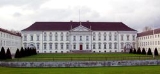
Schloss Bellevue

Encyclopedia
Schloss Bellevue is the official residence
of the President of Germany
since 1994. The palace in the central Tiergarten
district of Berlin
is situated on the northern edge of the Großer Tiergarten
park, on the banks of the Spree
river, near the Berlin Victory Column
. Its name ("beautiful view" in French) derives from the scenic prospect over the river course.
, according to plans by architect Michael Philipp Boumann on the site of a manor built in 1743 by Georg Wenzeslaus von Knobelsdorff
. It then was the first Neoclassical
building in Germany, characterized by its Corinthian
pilasters, with wings on either side ("Ladies' wing" and "Spree wing"). The upper floor features a ball room designed by Carl Gotthard Langhans
. The palace is surrounded by a park covering about 20 hectare
s. In 1843 Bellevue was acquired by King Frederick William IV of Prussia
and in 1865 became the residence of his niece Princess Alexandrine
after her marriage with William of Mecklenburg-Schwerin. It served the royal and imperial princes of the Hohenzollern dynasty
until the German Revolution of 1918.
A property of the Free State of Prussia since 1928, the building in the mid-1930s was used as a museum of ethnography, before being renovated as a guest house for the Nazi
government in 1938. During World War II
it was severely damaged by strategic bombing
and the 1945 Battle of Berlin
, whereafter it was refurbished substantially in the 1950s. Inaugurated by President Theodor Heuss
in 1959, it served as the secondary residence of the West German
president, a pied à terre in West Berlin
to supplement his primary residence at the Hammerschmidt Villa
in Bonn
. The palace was refurbished again in 1986-87, and after German reunification
President Richard von Weizsäcker
moved his primary residence to it in 1994. A modern annex was erected at the southern wing in 1998 to host the offices of the affiliated Bundespräsidialamt federal agency
.
President Roman Herzog
remained the only office holder, who actually lived at Bellevue during his incumbency 1994-1999. The palace was reconstructed again in 2004-05 to remedy defects in earlier renovations. President Horst Köhler
used nearby Charlottenburg Palace
for representative purposes during this period. Bellevue became the president's primary official seat again in January 2006, but since this reconstruction has not included living quarters. The Federal President lives in a government-owned villa in the suburban Dahlem
district of southwestern Berlin.
Official residence
An official residence is the residence at which heads of state, heads of government, gubernatorial or other senior figures officially reside...
of the President of Germany
President of Germany
The President of the Federal Republic of Germany is the country's head of state. His official title in German is Bundespräsident . Germany has a parliamentary system of government and so the position of President is largely ceremonial...
since 1994. The palace in the central Tiergarten
Tiergarten
Tiergarten is a locality within the borough of Mitte, in central Berlin . Notable for the great and homonymous urban park, before German reunification, it was a part of West Berlin...
district of Berlin
Berlin
Berlin is the capital city of Germany and is one of the 16 states of Germany. With a population of 3.45 million people, Berlin is Germany's largest city. It is the second most populous city proper and the seventh most populous urban area in the European Union...
is situated on the northern edge of the Großer Tiergarten
Großer Tiergarten
The Großer Tiergarten, simply known as Tiergarten, is an urban public park of Germany located in the middle of Berlin, completely in the homonymous locality...
park, on the banks of the Spree
Spree
The Spree is a river that flows through the Saxony, Brandenburg and Berlin states of Germany, and in the Ústí nad Labem region of the Czech Republic...
river, near the Berlin Victory Column
Berlin Victory Column
The Victory Column is a monument in Berlin, Germany. Designed by Heinrich Strack after 1864 to commemorate the Prussian victory in the Danish-Prussian War, by the time it was inaugurated on 2 September 1873, Prussia had also defeated Austria in the Austro-Prussian War and France in the...
. Its name ("beautiful view" in French) derives from the scenic prospect over the river course.
Overview
Schloss Bellevue was erected in 1786 as a summer residence for Prince Augustus Ferdinand of Prussia, the younger brother of King Frederick IIFrederick II of Prussia
Frederick II was a King in Prussia and a King of Prussia from the Hohenzollern dynasty. In his role as a prince-elector of the Holy Roman Empire, he was also Elector of Brandenburg. He was in personal union the sovereign prince of the Principality of Neuchâtel...
, according to plans by architect Michael Philipp Boumann on the site of a manor built in 1743 by Georg Wenzeslaus von Knobelsdorff
Georg Wenzeslaus von Knobelsdorff
Hans Georg Wenzeslaus von Knobelsdorff was a painter and architect in Prussia.Knobelsdorff was born in Kuckädel, now in Krosno Odrzańskie County. A soldier in the service of Prussia, he resigned his commission in 1729 as captain so that he could pursue his interest in architecture...
. It then was the first Neoclassical
Neoclassical architecture
Neoclassical architecture was an architectural style produced by the neoclassical movement that began in the mid-18th century, manifested both in its details as a reaction against the Rococo style of naturalistic ornament, and in its architectural formulas as an outgrowth of some classicizing...
building in Germany, characterized by its Corinthian
Corinthian order
The Corinthian order is one of the three principal classical orders of ancient Greek and Roman architecture. The other two are the Doric and Ionic. When classical architecture was revived during the Renaissance, two more orders were added to the canon, the Tuscan order and the Composite order...
pilasters, with wings on either side ("Ladies' wing" and "Spree wing"). The upper floor features a ball room designed by Carl Gotthard Langhans
Carl Gotthard Langhans
Carl Gotthard Langhans was a Prussian builder and architect. His works are among the earliest buildings in the German classicism movement. His best-known work is the Brandenburg Gate in Berlin.- Life :...
. The palace is surrounded by a park covering about 20 hectare
Hectare
The hectare is a metric unit of area defined as 10,000 square metres , and primarily used in the measurement of land. In 1795, when the metric system was introduced, the are was defined as being 100 square metres and the hectare was thus 100 ares or 1/100 km2...
s. In 1843 Bellevue was acquired by King Frederick William IV of Prussia
Frederick William IV of Prussia
|align=right|Upon his accession, he toned down the reactionary policies enacted by his father, easing press censorship and promising to enact a constitution at some point, but he refused to enact a popular legislative assembly, preferring to work with the aristocracy through "united committees" of...
and in 1865 became the residence of his niece Princess Alexandrine
Princess Alexandrine of Prussia (1842-1906)
Princess Frederica Wilhelmina Louise Elisabeth Alexandrine of Prussia was a member of the House of Hohenzollern as the daughter of Prince Albert of Prussia and his wife Princess Marianne of the Netherlands....
after her marriage with William of Mecklenburg-Schwerin. It served the royal and imperial princes of the Hohenzollern dynasty
House of Hohenzollern
The House of Hohenzollern is a noble family and royal dynasty of electors, kings and emperors of Prussia, Germany and Romania. It originated in the area around the town of Hechingen in Swabia during the 11th century. They took their name from their ancestral home, the Burg Hohenzollern castle near...
until the German Revolution of 1918.
A property of the Free State of Prussia since 1928, the building in the mid-1930s was used as a museum of ethnography, before being renovated as a guest house for the Nazi
Nazi Germany
Nazi Germany , also known as the Third Reich , but officially called German Reich from 1933 to 1943 and Greater German Reich from 26 June 1943 onward, is the name commonly used to refer to the state of Germany from 1933 to 1945, when it was a totalitarian dictatorship ruled by...
government in 1938. During World War II
World War II
World War II, or the Second World War , was a global conflict lasting from 1939 to 1945, involving most of the world's nations—including all of the great powers—eventually forming two opposing military alliances: the Allies and the Axis...
it was severely damaged by strategic bombing
Strategic bombing during World War II
Strategic bombing during World War II is a term which refers to all aerial bombardment of a strategic nature between 1939 and 1945 involving any nations engaged in World War II...
and the 1945 Battle of Berlin
Battle of Berlin
The Battle of Berlin, designated the Berlin Strategic Offensive Operation by the Soviet Union, was the final major offensive of the European Theatre of World War II....
, whereafter it was refurbished substantially in the 1950s. Inaugurated by President Theodor Heuss
Theodor Heuss
Theodor Heuss was a liberal German politician who served as the first President of the Federal Republic of Germany after World War II from 1949 to 1959...
in 1959, it served as the secondary residence of the West German
West Germany
West Germany is the common English, but not official, name for the Federal Republic of Germany or FRG in the period between its creation in May 1949 to German reunification on 3 October 1990....
president, a pied à terre in West Berlin
West Berlin
West Berlin was a political exclave that existed between 1949 and 1990. It comprised the western regions of Berlin, which were bordered by East Berlin and parts of East Germany. West Berlin consisted of the American, British, and French occupation sectors, which had been established in 1945...
to supplement his primary residence at the Hammerschmidt Villa
Hammerschmidt Villa
Villa Hammerschmidt was designated the official residence of the President of Germany in 1951. Located in the former West German capital of Bonn, it remained the official residence of the President until the government offices were returned to the recently-reunified Berlin in 1994...
in Bonn
Bonn
Bonn is the 19th largest city in Germany. Located in the Cologne/Bonn Region, about 25 kilometres south of Cologne on the river Rhine in the State of North Rhine-Westphalia, it was the capital of West Germany from 1949 to 1990 and the official seat of government of united Germany from 1990 to 1999....
. The palace was refurbished again in 1986-87, and after German reunification
German reunification
German reunification was the process in 1990 in which the German Democratic Republic joined the Federal Republic of Germany , and when Berlin reunited into a single city, as provided by its then Grundgesetz constitution Article 23. The start of this process is commonly referred by Germans as die...
President Richard von Weizsäcker
Richard von Weizsäcker
Richard Karl Freiherr von Weizsäcker , known as Richard von Weizsäcker, is a German politician . He served as Governing Mayor of West Berlin from 1981 to 1984, and as President of the Federal Republic of Germany from 1984 to 1994...
moved his primary residence to it in 1994. A modern annex was erected at the southern wing in 1998 to host the offices of the affiliated Bundespräsidialamt federal agency
Federal agency (Germany)
Federal agencies in Germany are established to assist the country's executive branch on the federal level according to of the Basic Law for the Federal Republic of Germany...
.
President Roman Herzog
Roman Herzog
Roman Herzog is a German politician as a member of the Christian Democratic Union, and served as President of Germany from 1994 to 1999...
remained the only office holder, who actually lived at Bellevue during his incumbency 1994-1999. The palace was reconstructed again in 2004-05 to remedy defects in earlier renovations. President Horst Köhler
Horst Köhler
Horst Köhler is a German politician of the Christian Democratic Union. He was President of Germany from 2004 to 2010. As the candidate of the two Christian Democratic sister parties, the CDU and the CSU, and the liberal FDP, Köhler was elected to his first five-year term by the Federal Assembly on...
used nearby Charlottenburg Palace
Charlottenburg Palace
Charlottenburg Palace is the largest palace in Berlin, Germany, and the only royal residency in the city dating back to the time of the Hohenzollern family. It is located in the Charlottenburg district of the Charlottenburg-Wilmersdorf burough.The palace was built at the end of the 17th century...
for representative purposes during this period. Bellevue became the president's primary official seat again in January 2006, but since this reconstruction has not included living quarters. The Federal President lives in a government-owned villa in the suburban Dahlem
Dahlem (Berlin)
Dahlem is a locality of the Steglitz-Zehlendorf borough in southwestern Berlin. Until Berlin's 2001 administrative reform it was a part of the former borough of Zehlendorf. Dahlem is one of the most affluent parts of the city and home to the main campus of the Free University of Berlin with the...
district of southwestern Berlin.
Standard
Contrary to popular belief, the presidential standard is flown on top of the palace even on many days when the President is not in Berlin. It is lowered only when the President takes up official residence elsewhere - e.g. on the occasion of a state visit, when the standard is raised over his temporary residence abroad, or when he uses his second residence at Villa Hammerschmidt. If he is just on vacation, Schloss Bellevue remains his official residence and the standard is flown over it.External links
- Berlin Tourism
- Bundeswehr - Großer Zapfenstreich 1/4 Großer ZapfenstreichGroßer ZapfenstreichThe is a military ceremony performed in Germany and Austria. It is similar to the military tattoo ceremony carried out in English-speaking countries, and is the most important ceremonial act executed by the German federal armed forces, the Bundeswehr...
ceremony for the President of Germany at Bellevue