
All Topics  
Sawfish

 
Sawfish

   Email Print
   Bookmark   Link


Sawfish


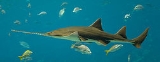
Sawfishes are a family of marine animals related to rays
Batoidea

Batoidea is a superorder of Chondrichthyes containing more than 500 described species in thirteen families. They are commonly known as rays, but that term is also used specifically for batoids in the order Rajiformes, the "true rays"....
. Their most striking appearance is a long, toothy snout. They are members of the sole living family Pristidae within the order Pristiformes, from the Greek pristes meaning "a sawyer" or "a saw".

They are not to be confused with sawshark
Sawshark

The sawsharks or saw sharks are an order of sharks bearing long blade-like snouts edged with teeth, which they use to slash and disable their prey....
s (order Pristiophoriformes), which have a similar physical appearance.

All species of sawfish are considered critically endangered
Critically endangered

---- Organisms with a conservation status of critically endangered have an extremely high risk of becoming extinct....
 and international trade is banned.

most eye-catching feature of the sawfish is their saw-like rostrum
Rostrum (anatomy)

A rostrum is an anatomy structure resembling a beak, such as the snout of a crocodile or dolphin or the foremost extension of a crustacean carapace....
.


Discussion
Ask a question about 'Sawfish'
Start a new discussion about 'Sawfish'
Answer questions from other users
Full Discussion Forum


Recent Posts


Encyclopedia


Sawfishes are a family of marine animals related to rays
Batoidea

Batoidea is a superorder of Chondrichthyes containing more than 500 described species in thirteen families. They are commonly known as rays, but that term is also used specifically for batoids in the order Rajiformes, the "true rays"....
. Their most striking appearance is a long, toothy snout. They are members of the sole living family Pristidae within the order Pristiformes, from the Greek pristes meaning "a sawyer" or "a saw".

They are not to be confused with sawshark
Sawshark

The sawsharks or saw sharks are an order of sharks bearing long blade-like snouts edged with teeth, which they use to slash and disable their prey....
s (order Pristiophoriformes), which have a similar physical appearance.

All species of sawfish are considered critically endangered
Critically endangered

---- Organisms with a conservation status of critically endangered have an extremely high risk of becoming extinct....
 and international trade is banned.

Description

The most eye-catching feature of the sawfish is their saw-like rostrum
Rostrum (anatomy)

A rostrum is an anatomy structure resembling a beak, such as the snout of a crocodile or dolphin or the foremost extension of a crustacean carapace....
. The rostrum is covered with motion- and electro-sensitive pores that allow sawfish to detect movement and even heartbeats of buried prey in the ocean floor as the sawfish hovers over the bottom. It is also used as a digging tool to unearth buried crustaceans. When a suitable prey swims by, the normally lethargic sawfish will spring from the bottom and slash at it furiously with its saw. This generally stuns or injures the prey sufficiently for the sawfish to devour it without much resistance. Sawfishes have also been known to defend themselves with their rostrum, against predators such as sharks, and against intruding divers. The "teeth" protruding from the rostrum are not real teeth, but modified tooth-like structures called denticles.
Sawfish Plate
The body and head of a sawfish are flat, and they spend most of their time lying on the sea floor. Like rays, the mouth and nostrils of sawfishes are located on their flat undersides. The mouth is lined with small, dome-shaped teeth for eating small fish and crustaceans; though sometimes the fish swallows them whole. Sawfishes breathe with two spiracle
Spiracle

Spiracles are small openings on the surface of some animals that usually lead to respiratory systems.In elasmobranchs , a spiracle is found behind each eye, and is often used to pump water through the gills while the animal is at rest ....
s just behind the eyes that draw water to the gills. The skin is covered with tiny dermal denticles that gives the fish a rough texture. Sawfishes are usually light grey or brown; the smalltooth sawfish
Smalltooth sawfish

The smalltooth sawfish, Pristis pectinata, is a sawfish of the family Pristidae, found in shallow subtropical waters circumglobally, between latitudes 44? N and 37? S....
, Pristis pectinata, appears olive green.

Like other elasmobranchs, sawfishes lack a swim bladder and use a large, oil-filled liver
Liver

The liver is a vital organ present in vertebrates and some other animals; it has a wide range of functions, a few of which are detoxification, protein synthesis, and production of biochemicals necessary for digestion....
 instead to keep them buoyant. Their skeleton is made of cartilage
Cartilage

Cartilage is a type of dense connective tissue. It is composed of specialized cells called chondrocyte that produce a large amount of extracellular matrix composed of collagen fibers, abundant ground substance rich in proteoglycan, and elastin fibers....
.

The eyes of sawfish are undeveloped due to their muddy habitat. The rostrum is the main sensory device.

The intestines are shaped like a corkscrew, called a spiral-valve.

The smallest sawfish is the 1.4 m (4.6 foot) dwarf sawfish
Dwarf sawfish

The dwarf sawfish or Queensland sawfish, Pristis clavata, is a sawfish of the family Pristidae, found in shallow tropical Australian waters between latitudes 10? S and 22? S....
, Pristis clavata, a species much smaller than most other sawfish. The largest species seem to be the largetooth sawfish
Largetooth sawfish

The largetooth sawfish, Pristis microdon, is a sawfish of the family Pristidae, found in shallow tropical Indo-Pacific oceans from East Africa to Papua New Guinea, north to the Philippines and Viet Nam, and south to Australia, between latitudes 11th parallel north and 39th parallel south....
, Pristis microdon and the southern sawfish, Pristis perotteti, both of which can exceed 7 m (23 feet) in length. One southern sawfish, whose length for some reason went unmeasured, was said to have weighed 2,455 kg (5,400 lb).

In 1927, the English writer T.C. Bridges wrote in his book Heroes of Modern Adventure that he captured a very large sawfish on a fishing expedition off the coast of Panama
Panama

Panama, officially the Republic of Panama , is the southernmost country of Central America and, in turn, North America. Situated on an isthmus connecting North and South America, some categorize it as a transcontinental nation....
. He claimed that the fish was 31 feet (9.4 m) in length, 21 feet (6.4 m) in girth, and 5,700 lb (2,585 kg) in weight, a half-tone photograph of the fish being presented on page 151. This claim has not been scientifically verified and is not considered reliable.

Distribution and habitat

Sawfish are found in tropical and sub-tropical areas around Africa and Australia
Australia

Australia, officially the Commonwealth of Australia, is a country in the southern hemisphere comprising the Australia of the world's smallest continent, the major island of Tasmania, and numerous list of islands of Australia in the Indian Ocean and Pacific Oceans....
 and in the Caribbean
Caribbean

The Caribbean is a region consisting of the Caribbean Sea, its islands , and the surrounding coasts. The region is located southeast of the Gulf of Mexico and Northern America, east of Central America, and to the north of South America....
, and frequently ascend far into rivers. They are also found in shallow bays and estuaries.

Sawfish live only in shallow, muddy water and can be found in both freshwater
Freshwater

Freshwater is a word that refers to bodies of water such as ponds, lakes, rivers and streams containing low concentrations of dissolved salts and other total dissolved solids....
 and saltwater
Seawater

Seawater is water from a sea or ocean. On average, seawater in the world's oceans has a salinity of about 3.5%, or 35 parts per thousand . This means that every 1 kg of seawater has approximately 35 grams of sea salt ....
. Most prefer river mouths and freshwater systems. All sawfish have the ability to traverse between fresh and saltwater, and often do so.

Behavior

Sawfish are nocturnal, usually sleeping during the day, hunting at night. Despite fearsome appearances, they are gentle fishes and will not attack humans unless provoked or surprised. The smalltooth sawfish is well known by fishermen as a prize game fish because of the fight it puts up once hooked. Capturing sawfish is illegal in the United States and Australia.

Reproduction

Little is known about the reproduction habits of the sawfish. Each individual lives around 25 to 30 years, and matures at 10 years.

Females give live birth to pups, whose semi-hardened rostrum is covered with a rubbery envelope. This prevents the pup from injuring its mother during birth. The rubbery envelope eventually disintegrates and falls off.

The sawfish is estimated to mate once every two years, with an average litter of around eight pups. They mature slowly; it is estimated that they do not reach sexual maturity until they are 3.5 to 4 meters long and 10 to 12 years old. They also reproduce at lower rates than most other fish do. This makes the animals especially slow to recover from overfishing.

Species

There are seven species of sawfish, in two genera:

Family Pristidae
  • Genus Anoxypristis
    • Knifetooth sawfish
      Knifetooth sawfish

      The knifetooth sawfish or pointed sawfish, Anoxypristis cuspidata, is a sawfish of the family Pristidae, the only member of the genus Anoxypristis, found in the tropical Indo-Pacific oceans in the Red Sea, the Persian Gulf, Papua New Guinea, and southern Japan to northern Australia....
      , Anoxypristis cuspidata (Latham
      John Latham (ornithologist)

      John Latham was an England physician, natural history and author.Latham has been called the "grandfather" of Australian ornithology. He was able to examine specimens of Australian birds which reached England in the last twenty years of the 18th century, and was responsible for naming many of them....
      , 1794)
      .
  • :Also known as the narrow or pointed sawfish. Lives in muddy areas, appears grey.
  • Genus Pristis
    • Dwarf sawfish
      Dwarf sawfish

      The dwarf sawfish or Queensland sawfish, Pristis clavata, is a sawfish of the family Pristidae, found in shallow tropical Australian waters between latitudes 10? S and 22? S....
      , Pristis clavata Garman
      Samuel Garman

      Samuel Walton Garman was a natural history/ zoologist from Pennsylvania. He studied under Louis Agassiz. In 1868 he joined an expedition to the American West with John Wesley Powell....
      , 1906
      .
  • :Also known as the Queensland sawfish. Inhabits muddy bays and estuaries along the northern coast of Australia. Relatively small compared to other species, only around 1.4 m.
    • Largetooth sawfish
      Largetooth sawfish

      The largetooth sawfish, Pristis microdon, is a sawfish of the family Pristidae, found in shallow tropical Indo-Pacific oceans from East Africa to Papua New Guinea, north to the Philippines and Viet Nam, and south to Australia, between latitudes 11th parallel north and 39th parallel south....
      , Pristis microdon Latham
      John Latham (ornithologist)

      John Latham was an England physician, natural history and author.Latham has been called the "grandfather" of Australian ornithology. He was able to examine specimens of Australian birds which reached England in the last twenty years of the 18th century, and was responsible for naming many of them....
      , 1794
      .
  • :Inhabits freshwater systems and have been found deep inland. The largest Australian freshwater fish.
    • Smalltooth sawfish
      Smalltooth sawfish

      The smalltooth sawfish, Pristis pectinata, is a sawfish of the family Pristidae, found in shallow subtropical waters circumglobally, between latitudes 44? N and 37? S....
      , Pristis pectinata Latham
      John Latham (ornithologist)

      John Latham was an England physician, natural history and author.Latham has been called the "grandfather" of Australian ornithology. He was able to examine specimens of Australian birds which reached England in the last twenty years of the 18th century, and was responsible for naming many of them....
      , 1794
      .
  • :Also known as the wide sawfish. Lives in muddy areas, appears green or bluish-grey. Found Also lives in the Caribbean and around the Australian and African coastlines.
    • Large-tooth sawfish
      Large-tooth sawfish

      The large-tooth sawfish, Pristis perotteti, is a sawfish of the family Pristidae, found in tropical waters of the north Atlantic and the central Pacific, between latitudes 32? N and 19? S....
      , Pristis perotteti Müller
      Johannes Peter Müller

      Johannes Peter M?ller , was a Germany physiologist, comparative anatomy, and ichthyology not only known for his discoveries but also for his ability to synthesize knowledge....
       & Henle
      Friedrich Gustav Jakob Henle

      Friedrich Gustav Jakob Henle was a Germany physician, pathologist and anatomist. He is credited with the discovery of the loop of Henle in the kidney....
      , 1841
      .
  • :Lives around the Caribbean and Central American coastline. Seriously endangered in Central and South America, especially Lake Nicaragua.
    • Common sawfish
      Common sawfish

      The common sawfish, Pristis pristis, is a sawfish of the family Pristidae, found in subtropical waters of the Pacific Ocean, between latitudes 45? N and 17? S....
      , Pristis pristis (Linnaeus
      Carolus Linnaeus

      Carl Linnaeus was a Sweden botanist, physician, and zoologist, who laid the foundations for the modern scheme of binomial nomenclature. He is known as the father of modern alpha taxonomy, and is also considered one of the fathers of modern ecology....
      , 1758)
      .
  • :Once plentiful in the eastern Atlantic and Mediterranean, this species has become either critically endangered or is assumed extinct.
    • Longcomb sawfish
      Longcomb sawfish

      The longcomb sawfish, Pristis zijsron, is a sawfish of the family Pristidae, found in tropical waters of the Indo-Pacific oceans, from the Red Sea and east Africa to Papua New Guinea, north to southern China, and south to New South Wales, Australia, between latitudes 21? N and 37? S....
      , Pristis zijsron Bleeker
      Pieter Bleeker

      Pieter Bleeker was a Netherlands medical doctor and ichthyology, famous for his work on the fishes of East Asia.He was employed as a medical officer in the Dutch East Indian Army from 1842 to 1860, stationed in Indonesia....
      , 1851
      .
  • :Prefers muddy bays and estuaries. The most common sawfish.


Conservation


All species of sawfish are considered critically endangered
Critically endangered

---- Organisms with a conservation status of critically endangered have an extremely high risk of becoming extinct....
. As well as being accidentally caught in fishing nets sawfish are also hunted for their rostrum (which is prized as a curiosity
Curiosity

Curiosity is an emotion that causes natural inquisitive behaviour such as exploration, investigation, and learning, evident by observation in human and many animal species....
 by some), their fins (which are eaten as a delicacy), and their liver oil for use as medicine.

It is illegal to capture Sawfish in the United States and in Australia. The sale of smalltooth sawfish rostra is also prohibited in the United States under the Endangered Species Act
Endangered Species Act

The Endangered Species Act of 1973 or ESA is the most wide-ranging of the dozens of United States environmental laws passed in the 1970s....
 (ESA); the sale of other sawfish rostra remains legal. However, due to the fact that most rostra on the American market are from the smalltooth sawfish and very few laymen can differentiate the species from which the rostra originated; it is therefore generally advised not to purchase sawfish rostra at all.

Habitat destruction
Habitat destruction

Habitat destruction is the process in which natural habitat is rendered functionally unable to support the species originally present. In this process, plants and animals which previously used the site are displaced or destroyed, reducing biodiversity....
 is another threat to sawfish conservation.

Sawfishes are difficult to conserve in aquaria
Aquarium

An aquarium is a vivarium consisting of at least one transparent side in which water-dwelling plants or animals are kept. fishkeeping use aquaria to keep fish, invertebrates, amphibians, marine mammals, turtles, and aquatic plants....
 because they may require a blend of saltwater and freshwater to stay healthy. However, the amount and duration of exposure are uncertain.

As of June 2007 the international trade of sawfish has been banned by the CITES convention. At the 14th Conference of the Parties to CITES an annotation to listing all species from the family Pristidae to Appendix I was made by the Australian delegation. The annotation, which was supported by the required two thirds majority, was for Pristis microdon to be treated as Appendix II “for the exclusive purpose of allowing international trade in live animals to appropriate and acceptable aquaria for primarily conservation purposes.” The annotation was accepted on the basis that Australian populations ofP. microdon are robust relative to other populations in the species range; and that a Non Detriment Finding is unlikely to be supported from any other country than Australia.

The annotaion means that the hundreds of millions of people that visit public aquaria worldwide annually will gain awareness of this unique species and the issues that have endangered its survival through much of the species range. All trade must be accompanied by an agreement between the exporter, importer and the Australian CITES Management Authority ensuring that the receiving aquarium has the capacity to house and care for the animal and that display is accompanied by comprehensive educational material. Since the implementation of the annotation, a sawfish research association has been established in northern Australia to facilitate accelerated research effort in P. microdon and other euryhaline
Euryhaline

Euryhaline organisms are able to adapt to a wide range of salinities. An example of a euryhaline fish is the Poecilia_sphenops which can live in Fresh_water, brackish, or Sea_water water....
 elasmobranchs in rivers that drain to the Gulf of Carpentaria.

Cultural perception

Sawfish became a powerful symbol in many cultures. Aztecs revered sawfish as an "Earth monster." Its rostrum is used by some Asian shamans for exorcisms and other ceremonies to repel demons and disease, which has contributed to its demise.