


Saul the King

Encyclopedia
According to the Bible
, Saul (circa 1079 BC – 1007 BC) was the first king of the united Kingdom of Israel. He was anointed by the prophet Samuel and reigned from Gibeah
. He commited suicide to avoid arrest in the battle against the Philistines
at Mount Gilboa, during which three of his sons were also killed. The succession to his throne was contested by Ish-bosheth
, his only surviving son, and his son-in-law David
, who eventually prevailed.
The main account of Saul's life and reign is found in the Books of Samuel
.
, Saul was the son of Kish
, of the family of the Matrites, and a member of the tribe of Benjamin
, one of the twelve Tribes of Israel. It appears that he came from Gibeah
.
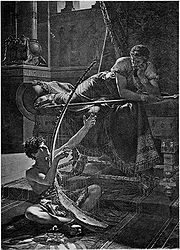 Saul married Ahinoam
, daughter of Ahimaaz
. They had four sons and two daughters. The sons were Jonathan
, Abinadab
, Malchishua and Ish-bosheth
. Their daughters were named Merab and Michal
.
Saul also had a concubine named Rizpah
, daughter of Aiah, who bore him two sons, Armoni
and Mephibosheth
.
Saul offered Merab to David
as a wife
after his victory over Goliath, but David does not seem to have been interested in the arrangement. Saul then gave his other daughter Michal in marriage to David, but when David became Saul's rival to the kingship, Saul gave Michal in marriage to Palti, son of Laish.
Saul was slain at the Battle of Mount Gilboa , and was buried in Zelah
, in the region of Benjamin
in modern-day Israel
.
When Saul first became king, he followed Samuel's bidding. Eventually, as Saul disobeyed God, God told Samuel to anoint a new king.
became king of Israel, at the age of forty. Michal was returned as wife to David.
Ish-bosheth reigned for two years and was killed by two of his own captains. The only male descendant of Saul to survive was Mephibosheth
, Jonathan's son, who had been five when his father and grandfather Saul had died in battle. In time, he came under the protection of David. Mephibosheth had a young son, Micah, of whom nothing more is heard.
Armoni and Mephibosheth (Saul's sons with his concubine, Rizpah) were given by David along with the five sons of Merab (Saul's daughter) to the Gibeonites, who killed them. Michal was childless.
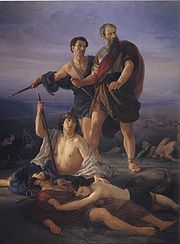 Samuel, the Judge, had sons who were dishonest and not trustworthy of the faith
. The leaders of the Israelites feared that it would be disastrous if his sons were to be judge over them and requested that Samuel give them a king. God warned that if he appointed a king over them, they would suffer from the dealings of the king. Saul, a young Israelite, was commanded by his father, Kish, to go and locate their lost donkeys. Saul obeyed and Samuel saw him walking toward him. God revealed to Samuel that Saul would be the one anointed as the "first" King of Israel. Peter J. Leithart observes:
In the Books of Samuel
, Saul is not referred to as a king (melech), but rather as a “leader” or “commander” (nagid) . However (possibly representing an opposing literary strain), Saul is said to be made a "king" (melech) at Gilgal
. Even David, before he was anointed king, was referred to only as a future nagid, or military commander .
The Israelite people generally used the term “king,” because their desire, 1 Samuel recounts, was to be like the other nations . This may be indicative of the tension between what a certain faction of the people wanted, and a definite reluctance of certain leaders (e.g., the prophet Samuel) to break with the old tribal order. But Saul was finally crowned as "king" (melech) in Gilgal.
The Books of Samuel give three events in Saul's rise to the throne:
 According to , Samuel had told Saul to wait for seven days after which they would meet; Samuel giving Saul further instructions. But as Samuel did not arrive after 7 days and with the Israelites growing restless, Saul started preparing for battle by offering sacrifices. Samuel arrived just as Saul finished offering his sacrifices and reprimanded Saul for not obeying his instructions. As a result of not keeping God's instructions, and for taking the duties of a Levite priest into his own hands, God took away Saul's kingship .
After the battle with the Philistines was over, the text describes Samuel as having instructed Saul to kill all the Amalekites, which was in accordance with the mitzvah
to do so. Having forewarned the Kenite
s who were living among the Amalekites to leave, Saul went to war and defeated the Amalekites. Saul killed all the babies, women, children, poor quality livestock and men, and left alive the king and best livestock.
When Samuel found out that Saul had not killed them all, he became angry and launched into a long and bitter diatribe about how God regretted making Saul king, because Saul was disobedient. When Samuel turned away, Saul grabbed Samuel by his clothes and tore a small piece off them, which Samuel states is a prophecy about what will happen to Saul's kingdom. Samuel then commands that the Amalekite king (who, like all other Amalekite kings in the Hebrew Bible, is named Agag
) should be brought forth. Samuel proceeds to kill the Amalekite himself and makes a final departure.
, a son of Jesse
, from the tribe of Judah
, enters the story:
 In the text, Saul's son Jonathan becomes David's dearest friend
. Eventually, David becomes Jonathan's brother-in-law by Michal
. Jonathan recognises David as the rightful king, and 1 Samuel 18 states "Jonathan made a covenant with David, because he loved him as his own soul." Jonathan even gives David his military clothes, symbolizing David's position as successor to Saul.
God makes David successful wherever Saul sends him. Therefore Saul sets David in charge of the army. After David returns from battle, the women heap praise upon him and refer to him as a greater military hero than Saul...who becomes jealous, fearing David as a rival to the throne.
Another day, while David is playing the harp, Saul - possessed by an evil spirit - throws a spear at him but misses on two occasions. Saul removes David from the court and appoints him an officer, but David becomes increasingly successful...which makes Saul even more resentful of him. In return for being his champion, Saul offers his daughter Merob to David as a wife. But David is too humble to accept, so Merob is married to a different man. When Saul's other daughter Michal
falls in love with David, Saul repeats the offer. Again David turns it down, claiming he lacks the wealth of a suitable husband. Saul persuades David that the bride price
would only be 100 foreskins from the Philistines; he secretly hopes that David will be slain trying to achieve this. Instead, David obtains 200 foreskins and is consequently married to Michal.
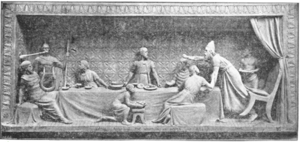
The narrative continues as Saul plots against David, but Jonathan dissuades Saul from this course of action; he also tells David of it. Saul tries to have David killed during the night, but Michal helps him escape and tricks his pursuers by using a household idol to make it seem that David is still in bed. David flees to Jonathan, who wasn't living near Saul. Jonathan returns to Saul, hoping to discover his father's ultimate intent. While dining with Saul, Jonathan pretends that David has been called away to his brothers. But Saul sees through the ruse and castigates Jonathan for being David's protector; clearly, Saul wants David slain. The next day, Jonathan meets with David and tells him Saul's intent. The two friends say their goodbyes, and David flees into the countryside. Saul later marries Michal to another man.
Saul is later informed by his head shepherd, an Edom
ite named Doeg
, that Ahimelech
assisted David. A henchman is sought to kill Ahimelech and the other priests of Nob. None of Saul's henchmen are willing to do this, so Doeg offers to do it instead...killing 85 priests. Saul also kills every man, woman and child living in Nob.
David had already left Nob by this point and had amassed about 400 disaffected men including a group of outlaws. With these men David launches an attack on the Philistines at Keilah
. Saul realises he could trap David and his men by laying the city to siege. Yet David hears about this and, having received divine counsel (via the Ephod
), finds that the citizens of Keilah would betray him to Saul. He flees to Ziph
. Saul discovers this and pursues David on two occasions:
in later Israelite culture. Two accounts of its origin are given:
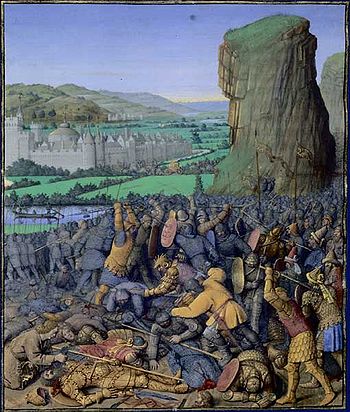 Despite the oath(s) of reconciliation, the biblical text states that David felt insecure, and so made an alliance with the Philistines, becoming their vassal
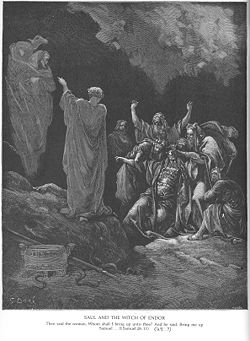
. Emboldened by this, the Philistines prepared to attack Israel, and Saul led out his army to face them at Mount Gilboa, but before the battle decided to consult the witch of Endor
for advice. The witch, unaware of who he is, reminds Saul that the king (i.e. Saul himself) had made witchery a capital offence
, but after being assured that Saul wouldn't harm her, the witch conjures up the spirit of Samuel. Upon seeing the spirit of Samuel Saul falls with his face to the ground and Samuel asks Saul "Why have you disquieted me, to bring me up?" (I Samuel 28:15) Saul tells Samuel's spirit of the forthcoming battle with Philistine and that God will not answer him anymore when he prays, and asks for understanding. Samuel then tells Saul that he will lose the battle and his life.
Broken in spirit, Saul returns to face the enemy, and the Israelites are duly defeated. To escape the ignominy of capture, Saul asks his armour bearer to kill him, but is forced to commit suicide
by falling on his sword when the armour bearer refuses. An Amalekite then claims to have killed Saul, and the Amalekite tells David. Infuriated, David orders the Amalekite to be put to death as punishment for killing the God's anointed, despite Saul's earlier assassination attempt upon David. (2 Samuel 1:1-16) The body of Saul, with those of his sons, are fastened to the wall of Beth-shan, and his armor was hung up in the house of Ashtaroth (an Ascalon
ian temple of the Canaanites). The inhabitants of Jabesh-gilead (the scene of Saul's first victory) rescue the bodies and take them to Jabesh-gilead, where they burn their flesh and bury the bones (Sam.I 31,13).
that punishment is a proof of guilt, and therefore seeks to rob Saul of any halo which might surround him; typically this view is similar to the republican source. The passage referring to Saul as a choice young man, and goodly (1 Samuel 9:2) is in this view interpreted as meaning that Saul was not good in every respect, but goodly only with respect to his personal appearance (Num. Rashi 9:28). According to this view, Saul is only a weak branch (Gen. Rashi 25:3), owing his kingship not to his own merits, but rather to his grandfather, who had been accustomed to light the streets for those who went to the bet ha-midrash, and had received as his reward the promise that one of his grandsons should sit upon the throne (Lev. Rashi 9:2).
The second view of Saul makes him appear in the most favourable light as man, as hero, and as king. This view is similar to that of the monarchical source. In this view it was on account of his modesty that he did not reveal the fact that he had been anointed king (1 Samuel 10:16; Meg. 13b); and he was extraordinarily upright as well as perfectly just. Nor was there any one more pious than he (M. Q. 16b; Ex. Rashi 30:12); for when he ascended the throne he was as pure as a child, and had never committed sin (Yoma 22b). He was marvelously handsome; and the maidens who told him concerning Samuel (cf 1 Samuel 9:11-13) talked so long with him that they might observe his beauty the more (Ber. 48b). In war he was able to march 120 miles without rest. When he received the command to smite Amalek
(1 Samuel 15:3), Saul said: For one found slain the Torah
requires a sin offering [Deuteronomy 21:1-9]; and here so many shall be slain. If the old have sinned, why should the young suffer; and if men have been guilty, why should the cattle be destroyed? It was this mildness that cost him his crown. And while Saul was merciful to his enemies, he was strict with his own people; when he found out that Avimelech, a kohen, had assisted David with finding food, Saul, in retaliation, killed the rest of the 85 kohanim of the family of Avimelech and the rest of his hometown, Nov. (Yoma 22b; Num. Rashi 1:10) The fact that he was merciful even to his enemies, being indulgent to rebels themselves, and frequently waiving the homage due to him, was incredible as well as deceiving. But if his mercy toward a foe was a sin, it was his only one; and it was his misfortune that it was reckoned against him, while David, although he had committed much iniquity, was so favored that it was not remembered to his injury (Yoma 22b; M. Q. 16b, and Rashi ad loc.). In some respects Saul was superior to David, e.g., in having only one concubine {Rizpah
}, while David had many. Saul expended his own substance for the war, and although he knew that he and his sons would fall in battle, he nevertheless went forward, while David heeded the wish of his soldiers not to go to war in person (2 Samuel 21:17; Lev. Rashi 26:7; Yalq., Sam. 138).
According to the Rabbis, Saul ate his food with due regard for the rules of ceremonial purity prescribed for the sacrifice (Yalq., l.c.), and taught the people how they should slay cattle (cf 1 Samuel 14:34). As a reward for this, God himself gave Saul a sword on the day of battle, since no other sword suitable for him was found (ibid 13:22). Saul's attitude toward David finds its excuse in the fact that his courtiers were all tale-bearers, and slandered David to him (Deut. Rashi 5:10); and in like manner he was incited by Doeg
against the priests of Nob (1 Samuel 22:16-19; Yalq., Sam. 131) - this act was forgiven him, however, and a heavenly voice (bat qol) was heard, proclaiming: Saul is the chosen one of God (Ber. 12b). His anger at the Gibeonites (2 Samuel 21:2) was not personal hatred, but was induced by zeal for the welfare of Israel (Num. Rashi 8:4). The fact that he made his daughter remarry (1 Samuel 25:44), finds its explanation in his (Saul's) view that her betrothal to David had been gained by false pretenses, and was therefore invalid (Sanhedrin 19b). During the lifetime of Saul there was no idolatry in Israel. The famine in the reign of David (cf 2 Samuel 21:1) was to punish the people, because they had not accorded Saul the proper honours at his burial (Num. Rashi 8:4). In Sheol
, Samuel reveals to Saul that in the next world, Saul would dwell with Samuel, which is a proof that all has been forgiven him by god('Er. 53ba]
is found at 1 Samuel 1-28. It describes how Samuel's mother Hannah
requests a son from Yahweh, and dedicates the child to God at the shrine of Shiloh. The passage makes extensive play with the root-elements of Saul's name, and ends with the phrase hu sa'ul le-Yahweh, "he is dedicated to Yahweh." Hannah names the resulting son Samuel, giving as her explanation, "because from God I requested him." Samuel's name, however, means "name of God," and the etymology and multiple references to the root of the name seems to fit Saul instead. The majority explanation for the discrepancy is that the narrative originally described the birth of Saul, and was given to Samuel in order to enhance the position of David
and Samuel
at the former king's expense.
is anointed, "the spirit of the Lord comes upon [him]." David's anointment differs from Saul's because it is relatively unfailing throughout the narrative despite David's shortcomings, such as his adultery with Bathsheba
and murder of Uriah
.
, Saul was chosen by the prophet Samuel (not mentioned by name explicitly but rather as "a Prophet" of Israelites) after being asked by the people of Israel for a king to lead them into war. The Israelites criticized Samuel for appointing Saul because Saul was not wealthy so they had no respect for him. Samuel rebuked the people for this and told them that Saul was far more favored than they were. Saul led the Israelites to victory over the army of Goliath who was killed by David
. Saul is not considered a prophet generally but rather a divinely appointed king.
, the name Tālūt means 'tall' (from the Arabic "tūl") and refers to the extraordinary stature of Saul - in consonance with Biblical accounts, Muslim exegetes explain that Saul's remarkable feature was his stature. In explanation of the name, exegetes such as Tha'labi
hold that at this time, the future king of Israel was to be recognised by his height; Samuel set up a measure, but no one in Israel reached its height except Tālūt (Saul).
. God appointed Saul king, but the people did not find him worthy of the throne. Saul was distinguished for the greatness of his knowledge and for his great physique; it was a sign of his role as King to rule that God
brought back the Ark of the Covenant
for Israel
. Saul tested his people at a river; whoever drank from it, would not follow him in battle. Many drunk but only the faithful ventured on. In the battle, however, David
slew Goliath and was made the subsequent King of Israel
.
The Qur'anic account differs slightly from the Biblical account in that the sacred ark was recaptured in the Bible before Saul's accession and the test by drinking water is made in the Bible
not by Saul but by Gideon.
Bible
The Bible refers to any one of the collections of the primary religious texts of Judaism and Christianity. There is no common version of the Bible, as the individual books , their contents and their order vary among denominations...
, Saul (circa 1079 BC – 1007 BC) was the first king of the united Kingdom of Israel. He was anointed by the prophet Samuel and reigned from Gibeah
Gibeah
Gibeah is a biblical site identified by archaeologists as a hill in Jerusalem, on the outskirts of the Pisgat Ze'ev neighborhood, known as Tell el-Ful.-Etymology:...
. He commited suicide to avoid arrest in the battle against the Philistines
Philistines
Philistines , Pleshet or Peleset, were a people who occupied the southern coast of Canaan at the beginning of the Iron Age . According to the Bible, they ruled the five city-states of Gaza, Askelon, Ashdod, Ekron and Gath, from the Wadi Gaza in the south to the Yarqon River in the north, but with...
at Mount Gilboa, during which three of his sons were also killed. The succession to his throne was contested by Ish-bosheth
Ish-bosheth
According to the Hebrew Bible, Ish-bosheth also called Eshbaal , Ashbaal or Ishbaal, was one of the four sons of King Saul, born c. 1047 BC...
, his only surviving son, and his son-in-law David
David
David was the second king of the united Kingdom of Israel according to the Hebrew Bible and, according to the Gospels of Matthew and Luke, an ancestor of Jesus Christ through both Saint Joseph and Mary...
, who eventually prevailed.
The main account of Saul's life and reign is found in the Books of Samuel
Books of Samuel
The Books of Samuel in the Jewish bible are part of the Former Prophets, , a theological history of the Israelites affirming and explaining the Torah under the guidance of the prophets.Samuel begins by telling how the prophet Samuel is chosen by...
.
House of King Saul
According to the TanakhTanakh
The Tanakh is a name used in Judaism for the canon of the Hebrew Bible. The Tanakh is also known as the Masoretic Text or the Miqra. The name is an acronym formed from the initial Hebrew letters of the Masoretic Text's three traditional subdivisions: The Torah , Nevi'im and Ketuvim —hence...
, Saul was the son of Kish
Kish (Bible)
Kish was the father of the first king of the Israelites, Saul. -Life:Kish was a Benjamite of the family of the Matrites , and there is some question over whether he is the brother or son of Ner . The question may be resolved by reading both Ner and Kish as sons of Abiel.-Residence:It appears that...
, of the family of the Matrites, and a member of the tribe of Benjamin
Tribe of Benjamin
According to the Hebrew Bible, the Tribe of Benjamin בִּנְיָמִין was one of the Tribes of Israel.From after the conquest of the land by Joshua until the formation of the first Kingdom of Israel in c. 1050 BCE, the Tribe of Benjamin was a part of a loose confederation of Israelite tribes...
, one of the twelve Tribes of Israel. It appears that he came from Gibeah
Gibeah
Gibeah is a biblical site identified by archaeologists as a hill in Jerusalem, on the outskirts of the Pisgat Ze'ev neighborhood, known as Tell el-Ful.-Etymology:...
.
Ahinoam
Ahinoam is a Hebrew name literally meaning brother of pleasantness, thus meaning pleasant.There are two references in the Bible to people who bear that name:...
, daughter of Ahimaaz
Ahimaaz
Ahimaaz was son and successor of Zadok in the office of high priest . On the occasion of the revolt of Absalom he remained faithful to David, and was of service to him in conveying to him tidings of the proceedings of Absalom in Jerusalem...
. They had four sons and two daughters. The sons were Jonathan
Jonathan (Samuel)
Jonathan is a heroic figure in 1 Samuel in the Hebrew Bible. He was the son of King Saul and close friend of King David...
, Abinadab
Abinadab
Abinadab may refer to:# A man of Kirjath-jearim widely identified as a Levite , in whose house the ark of the covenant was deposited after having been brought back from the land of the Philistines . It remained there twenty years, until it was at length removed by David . It has been argued that...
, Malchishua and Ish-bosheth
Ish-bosheth
According to the Hebrew Bible, Ish-bosheth also called Eshbaal , Ashbaal or Ishbaal, was one of the four sons of King Saul, born c. 1047 BC...
. Their daughters were named Merab and Michal
Michal
Michal was a daughter of Saul, king of Israel, who loved and became the wife of David, who later became king of Judah, and later still of the united Kingdom of Israel....
.
Saul also had a concubine named Rizpah
Rizpah
Rizpah was the daughter of Aiah, and one of Saul's concubines. She was the mother of Armoni and Mephibosheth .After the death of Saul, Abner took her as wife, resulting in a quarrel between him and Saul's son and successor, Ishbosheth. The quarrel led to Abner's going over to the side of David, ...
, daughter of Aiah, who bore him two sons, Armoni
Armoni
Armoni was the first-named of the two sons of Saul with his concubine Rizpah, daughter of Aiah. He and his brother Mephibosheth were two of the seven descendants of Saul to be given by David to the Gibeonites to be hanged....
and Mephibosheth
Mephibosheth
Mephibosheth was the name of two men of the family of Saul, who is stated in the books of Samuel of the Hebrew Bible to have been the first king of ancient Israel:...
.
Saul offered Merab to David
David
David was the second king of the united Kingdom of Israel according to the Hebrew Bible and, according to the Gospels of Matthew and Luke, an ancestor of Jesus Christ through both Saint Joseph and Mary...
as a wife
Wife
A wife is a female partner in a marriage. The rights and obligations of the wife regarding her spouse and others, and her status in the community and in law, varies between cultures and has varied over time.-Origin and etymology:...
after his victory over Goliath, but David does not seem to have been interested in the arrangement. Saul then gave his other daughter Michal in marriage to David, but when David became Saul's rival to the kingship, Saul gave Michal in marriage to Palti, son of Laish.
Saul was slain at the Battle of Mount Gilboa , and was buried in Zelah
Zelah, Judea
Zelah was a place in the territory of the Tribe of Benjamin, ancient Judea, known as the burial place of King Saul, his father Kish and his son Jonathan. Saul and Jonathan died during the Battle of Gilboa.-Source:...
, in the region of Benjamin
Benjamin
Benjamin was the last-born of Jacob's twelve sons, and the second and last son of Rachel in Jewish, Christian and Islamic tradition. He was the founder of the Israelite Tribe of Benjamin. In the Biblical account, unlike Rachel's first son, Joseph, Benjamin was born in Canaan. He died in Egypt on...
in modern-day Israel
Israel
The State of Israel is a parliamentary republic located in the Middle East, along the eastern shore of the Mediterranean Sea...
.
When Saul first became king, he followed Samuel's bidding. Eventually, as Saul disobeyed God, God told Samuel to anoint a new king.
Ish-bosheth
Three of Saul's sons – Jonathan, and Abinadab, and Malchishua – died with him at Mount Gilboa . Ish-boshethIsh-bosheth
According to the Hebrew Bible, Ish-bosheth also called Eshbaal , Ashbaal or Ishbaal, was one of the four sons of King Saul, born c. 1047 BC...
became king of Israel, at the age of forty. Michal was returned as wife to David.
Ish-bosheth reigned for two years and was killed by two of his own captains. The only male descendant of Saul to survive was Mephibosheth
Mephibosheth
Mephibosheth was the name of two men of the family of Saul, who is stated in the books of Samuel of the Hebrew Bible to have been the first king of ancient Israel:...
, Jonathan's son, who had been five when his father and grandfather Saul had died in battle. In time, he came under the protection of David. Mephibosheth had a young son, Micah, of whom nothing more is heard.
Armoni and Mephibosheth (Saul's sons with his concubine, Rizpah) were given by David along with the five sons of Merab (Saul's daughter) to the Gibeonites, who killed them. Michal was childless.
Anointed as king
Faith
Faith is confidence or trust in a person or thing, or a belief that is not based on proof. In religion, faith is a belief in a transcendent reality, a religious teacher, a set of teachings or a Supreme Being. Generally speaking, it is offered as a means by which the truth of the proposition,...
. The leaders of the Israelites feared that it would be disastrous if his sons were to be judge over them and requested that Samuel give them a king. God warned that if he appointed a king over them, they would suffer from the dealings of the king. Saul, a young Israelite, was commanded by his father, Kish, to go and locate their lost donkeys. Saul obeyed and Samuel saw him walking toward him. God revealed to Samuel that Saul would be the one anointed as the "first" King of Israel. Peter J. Leithart observes:
- Saul, the first king, begins as an ideal choice to lead and judge Israel ..... Saul cares for his father's animals (as did Joseph and MosesMosesMoses was, according to the Hebrew Bible and Qur'an, a religious leader, lawgiver and prophet, to whom the authorship of the Torah is traditionally attributed...
, and as DavidDavidDavid was the second king of the united Kingdom of Israel according to the Hebrew Bible and, according to the Gospels of Matthew and Luke, an ancestor of Jesus Christ through both Saint Joseph and Mary...
will), and he is a dutiful son ..... Saul is a handsome man and a head taller than any Israelite
In the Books of Samuel
Books of Samuel
The Books of Samuel in the Jewish bible are part of the Former Prophets, , a theological history of the Israelites affirming and explaining the Torah under the guidance of the prophets.Samuel begins by telling how the prophet Samuel is chosen by...
, Saul is not referred to as a king (melech), but rather as a “leader” or “commander” (nagid) . However (possibly representing an opposing literary strain), Saul is said to be made a "king" (melech) at Gilgal
Gilgal
Gilgal is a place name mentioned by the Hebrew Bible. It is a matter of debate how many of the places named Gilgal are identical.-The Gilgal associated peacefully with Joshua:...
. Even David, before he was anointed king, was referred to only as a future nagid, or military commander .
The Israelite people generally used the term “king,” because their desire, 1 Samuel recounts, was to be like the other nations . This may be indicative of the tension between what a certain faction of the people wanted, and a definite reluctance of certain leaders (e.g., the prophet Samuel) to break with the old tribal order. But Saul was finally crowned as "king" (melech) in Gilgal.
The Books of Samuel give three events in Saul's rise to the throne:
- Saul was sent with a servant to look for his father's donkeys, who had strayed; leaving his home at GibeahGibeahGibeah is a biblical site identified by archaeologists as a hill in Jerusalem, on the outskirts of the Pisgat Ze'ev neighborhood, known as Tell el-Ful.-Etymology:...
, they eventually wandered to the district of ZuphZuphZuph meaning honeycomb in Hebrew - is the Biblical name of:* A Kohathite Levite, ancestor of Elkanah and Samuel ; called also Zophai and Ziph....
, at which point Saul suggested abandoning their search. Saul's servant however, remarked that they happened to be near the town of RamahRamathaim-ZophimRamathaim-Zophim , also called Ramah and Ramatha in the Douay-Rheims, is a town that has been identified with the modern Neby Samwil , about 4 or 5 miles north-west of Jerusalem...
, where a famous seer was located, and suggested that they should consult him first. The seer (later identified by the text as Samuel), having previously had a vision instructing him to do so, offered hospitality to Saul when he entered Ramah, and later anointedAnointingTo anoint is to pour or smear with perfumed oil, milk, water, melted butter or other substances, a process employed ritually by many religions. People and things are anointed to symbolize the introduction of a sacramental or divine influence, a holy emanation, spirit, power or God...
him in private.
- ( and ) Reflecting a desire to be like other nations, there was a popular movement to establish a centralised monarchy. Samuel therefore assembled the people at Mizpah in BenjaminMizpah in BenjaminMizpah was a city of Benjamin.Tell en-Nasbeh is one of two sites often identified with Biblical Mizpah of Benjamin, and is located about 8 miles north of Jerusalem. The other suggested location is Neby Samwil, which is some 4 miles north-west of Jerusalem, and situated on the loftiest hill in the...
, and despite having strong reservations, which he made no attempt to hide, allowed the appointment of a king. Samuel used cleromancyCleromancyCleromancy is a form of divination using sortition, casting of lots, or casting bones or stones, in which an outcome is determined by means that normally would be considered random, such as the rolling of dice, but are sometimes believed to reveal the will of God, or other supernatural entities.-In...
to determine who it was that God desired to be the king, whittling the assembly down into ever smaller groups until Saul was finally identified. Saul, hiding among the baggage, was then publicly affirmed.
- ( and ) The AmmonAmmonAmmon , also referred to as the Ammonites and children of Ammon, was an ancient nation located east of the Jordan River, Gilead, and the Dead Sea, in present-day Jordan. The chief city of the country was Rabbah or Rabbath Ammon, site of the modern city of Amman, Jordan's capital...
ites, led by Nahash, laid siege to Jabesh-GileadJabesh-GileadJabesh-Gilead is an ancient town referred to in four books of the Old Testament. Some biblical scholars believe it to have been located east of the Jordan River, in the vicinity of Wadi Yabes....
, which was forced to surrender. Under the terms of surrender, the occupants of the city would be forced into slavery, and have their right eyes removed as a sign of this. The city's occupants sent out word of this to the other tribes of Israel, and the tribes west of the Jordan assembled an army under the leadership of Saul. Saul led the army to victory against the Ammonites, and, in gratitude and appreciation of his military skill, the people congregated at GilgalGilgalGilgal is a place name mentioned by the Hebrew Bible. It is a matter of debate how many of the places named Gilgal are identical.-The Gilgal associated peacefully with Joshua:...
, and acclaimed Saul as king.
Rejection
After the battle with the Philistines was over, the text describes Samuel as having instructed Saul to kill all the Amalekites, which was in accordance with the mitzvah
613 mitzvot
The 613 commandments is a numbering of the statements and principles of law, ethics, and spiritual practice contained in the Torah or Five Books of Moses...
to do so. Having forewarned the Kenite
Kenite
Kenites or Cinites , according to the Hebrew Bible, were a nomadic clan in the ancient Levant, sent under Jethro a priest in the land of Midian. They played an important role in the history of ancient Israel. The Kenites were coppersmiths and metalworkers. Moses' father-in-law, Jethro, was a...
s who were living among the Amalekites to leave, Saul went to war and defeated the Amalekites. Saul killed all the babies, women, children, poor quality livestock and men, and left alive the king and best livestock.
When Samuel found out that Saul had not killed them all, he became angry and launched into a long and bitter diatribe about how God regretted making Saul king, because Saul was disobedient. When Samuel turned away, Saul grabbed Samuel by his clothes and tore a small piece off them, which Samuel states is a prophecy about what will happen to Saul's kingdom. Samuel then commands that the Amalekite king (who, like all other Amalekite kings in the Hebrew Bible, is named Agag
Agag
Agag was the name of two kings of the Amalekites mentioned in the Hebrew Bible. It has been conjectured that the name was a standing title of the kings of the Amalekites...
) should be brought forth. Samuel proceeds to kill the Amalekite himself and makes a final departure.
Saul and David
It is at this point that DavidDavid
David was the second king of the united Kingdom of Israel according to the Hebrew Bible and, according to the Gospels of Matthew and Luke, an ancestor of Jesus Christ through both Saint Joseph and Mary...
, a son of Jesse
Jesse
Jesse, Eshai or Yishai, is the father of the David, who became the king of the Israelites. His son David is sometimes called simply "Son of Jesse" ....
, from the tribe of Judah
Tribe of Judah
According to the Hebrew Bible, the Tribe of Judah was one of the Tribes of Israel.Following the completion of the conquest of Canaan by the Israelite tribes after about 1200 BCE, Joshua allocated the land among the twelve tribes....
, enters the story:
- Samuel is surreptitiously sent by God to Jesse. While offering a sacrifice in the vicinity, Samuel includes Jesse among the invited guests. Dining together, Jesse's sons are brought one by one to Samuel, each time being rejected by him, speaking for God; running out of sons, Jesse sends for David, the youngest, who was tending sheep. When brought to Samuel, David is anointed by him in front of his other brothers.
- Saul is troubled by an evil spirit sent by God (some translations euphemistically just describe God not preventing an evil spirit from troubling Saul). Saul requests soothing music, and a servant recommends David the son of Jesse, who is renowned as a skillful harpist and soldier. When word of Saul's needs reach Jesse, he sends David, who had been looking after a flock, and David is appointed as Saul's armor bearer. David remains at court playing the harp as needed by Saul to calm his moods.
- The Philistines return with an army to attack Israel, but, having amassed on a hillside opposite to the Israelite forces, suggest that to save effort and lives on both sides, it would be better to have a proxy combatProxy warA proxy war or proxy warfare is a war that results when opposing powers use third parties as substitutes for fighting each other directly. While powers have sometimes used governments as proxies, violent non-state actors, mercenaries, or other third parties are more often employed...
between their champion, a Rephaim from Gath named Goliath, and someone of Saul's choosing. David, a young shepherd boy, happens to be delivering food to his three eldest brothers, who are in the Israelite army, at the time that the challenge is made. David, who is faithful of God's power to defeat his enemies, talks to the nearby soldiers mocking the Philistines, but is reprimanded by his brothers for doing so. David's speech is overheard and reported to Saul, who summons David and on hearing David's views decides to fit him out with his (Saul's) own armour. Saul then appoints David as his champion, and David defeats Goliath with a single shot from a slingSling (weapon)A sling is a projectile weapon typically used to throw a blunt projectile such as a stone or lead "sling-bullet". It is also known as the shepherd's sling....
, which hits him in between the eyes. Goliath falls forward and David uses his sword to decapitate Goliath.
Saul's love of glory
David and Jonathan
David and Jonathan were heroic figures of the Kingdom of Israel, whose covenant was recorded favourably in the books of Samuel. Jonathan was the son of Saul, king of Israel, of the tribe of Benjamin, and David was the son of Jesse of Bethlehem and Jonathan's presumed rival for the crown...
. Eventually, David becomes Jonathan's brother-in-law by Michal
Michal
Michal was a daughter of Saul, king of Israel, who loved and became the wife of David, who later became king of Judah, and later still of the united Kingdom of Israel....
. Jonathan recognises David as the rightful king, and 1 Samuel 18 states "Jonathan made a covenant with David, because he loved him as his own soul." Jonathan even gives David his military clothes, symbolizing David's position as successor to Saul.
God makes David successful wherever Saul sends him. Therefore Saul sets David in charge of the army. After David returns from battle, the women heap praise upon him and refer to him as a greater military hero than Saul...who becomes jealous, fearing David as a rival to the throne.
Another day, while David is playing the harp, Saul - possessed by an evil spirit - throws a spear at him but misses on two occasions. Saul removes David from the court and appoints him an officer, but David becomes increasingly successful...which makes Saul even more resentful of him. In return for being his champion, Saul offers his daughter Merob to David as a wife. But David is too humble to accept, so Merob is married to a different man. When Saul's other daughter Michal
Michal
Michal was a daughter of Saul, king of Israel, who loved and became the wife of David, who later became king of Judah, and later still of the united Kingdom of Israel....
falls in love with David, Saul repeats the offer. Again David turns it down, claiming he lacks the wealth of a suitable husband. Saul persuades David that the bride price
Bride price
Bride price, also known as bride wealth, is an amount of money or property or wealth paid by the groom or his family to the parents of a woman upon the marriage of their daughter to the groom...
would only be 100 foreskins from the Philistines; he secretly hopes that David will be slain trying to achieve this. Instead, David obtains 200 foreskins and is consequently married to Michal.
The narrative continues as Saul plots against David, but Jonathan dissuades Saul from this course of action; he also tells David of it. Saul tries to have David killed during the night, but Michal helps him escape and tricks his pursuers by using a household idol to make it seem that David is still in bed. David flees to Jonathan, who wasn't living near Saul. Jonathan returns to Saul, hoping to discover his father's ultimate intent. While dining with Saul, Jonathan pretends that David has been called away to his brothers. But Saul sees through the ruse and castigates Jonathan for being David's protector; clearly, Saul wants David slain. The next day, Jonathan meets with David and tells him Saul's intent. The two friends say their goodbyes, and David flees into the countryside. Saul later marries Michal to another man.
Saul is later informed by his head shepherd, an Edom
Edom
Edom or Idumea was a historical region of the Southern Levant located south of Judea and the Dead Sea. It is mentioned in biblical records as a 1st millennium BC Iron Age kingdom of Edom, and in classical antiquity the cognate name Idumea was used to refer to a smaller area in the same region...
ite named Doeg
Doeg the Edomite
Doeg was an Edomite, chief herdsman to Saul, King of Israel.He is mentioned in the Hebrew Bible book of First Samuel, chapters 21 and 22, where he is depicted as responsible for the deaths of a large number of priests.-Biblical account:...
, that Ahimelech
Ahimelech
Ahimelech , the son of Ahitub and father of Abiathar , described in 2 Sam. 8:17 as the son of Abiathar and in four places in 1 Chronicles. He descended from Eli in the line of Ithamar. In 1 Chr. 18:16 his name is Abimelech according to the Masoretic Text, and is probably the same as Ahiah...
assisted David. A henchman is sought to kill Ahimelech and the other priests of Nob. None of Saul's henchmen are willing to do this, so Doeg offers to do it instead...killing 85 priests. Saul also kills every man, woman and child living in Nob.
David had already left Nob by this point and had amassed about 400 disaffected men including a group of outlaws. With these men David launches an attack on the Philistines at Keilah
Keilah
Keilah was a city in the lowlands of Judah . In 1 Samuel, David rescued it from the attack of the Philistines but the inhabitants proved unfaithful to him, in that they sought to deliver him up to Saul . He and his men "departed from Keilah, and went whithersoever they could go.” They fled to the...
. Saul realises he could trap David and his men by laying the city to siege. Yet David hears about this and, having received divine counsel (via the Ephod
Ephod
An ephod was an article of clothing, and a worship object, in ancient Israelite culture, and was closely connected with oracular practices....
), finds that the citizens of Keilah would betray him to Saul. He flees to Ziph
Ziph (Judean Mountains)
Ziph was a city in the Judean Mountains , south-east of Hebron. Here David hid himself from Saul . The name of Zif is found about four miles south of Hebron, attached to a rounded hill of some 100 feet in height, which is called Tell Zif.-From archaeology:Scholars debate the interpretation of the...
. Saul discovers this and pursues David on two occasions:
- Some of the inhabitants of Ziph betray David's location to Saul, but David hears about it and flees with his men to Maon. Saul follows David, but while Saul travels along one side of the gorge, David travels along the other, and Saul is forced to break off pursuit when the Philistines invade. This is supposedly how the place became known as the gorge of divisions. DavidDavidDavid was the second king of the united Kingdom of Israel according to the Hebrew Bible and, according to the Gospels of Matthew and Luke, an ancestor of Jesus Christ through both Saint Joseph and Mary...
hides in the caves at EngediEin GediEin Gedi is an oasis in Israel, located west of the Dead Sea, near Masada and the caves of Qumran.-Etymology:The name En-gedi is composed of two Hebrew words: ein means spring and gdi means goat-kid. En Gedi thus means "Kid spring."...
and after fighting the Philistines, Saul returns to Engedi to attack him. Saul eventually enters the cave in which David had been hiding, but as David is in the darkest recesses Saul doesn't spot him. David cuts off a piece of Saul's robe; yet David restrains himself and his associates from going further, due to a tabooTabooA taboo is a strong social prohibition relating to any area of human activity or social custom that is sacred and or forbidden based on moral judgment, religious beliefs and or scientific consensus. Breaking the taboo is usually considered objectionable or abhorrent by society...
against killing an anointed king...and also due to the risk of rationalizing Saul's jealousy and paranoia. David then leaves the cave, revealing himself to Saul, and gives a speech that persuades Saul to reconcile.
- On the second occasion, Saul returns to Ziph with his men. When David hears of this he sneaks into Saul's camp by night, and thrusts his spear into the ground near where Saul is sleeping. David prevents his associates from killing Saul, because doing so would prove the former no more worthy than the latter; Instead, David merely steals Saul's spear and water jug. The next day, David stands atop a slope opposite Saul's camp; he shows the jug and spear as proof that he could have slain Saul but did not. David then persuades Saul to reconcile with him; the two swear never to harm one another.
Saul is among the prophets
The phrase Saul is among the prophets, is mentioned by the text in a way that suggests it was a proverbProverb
A proverb is a simple and concrete saying popularly known and repeated, which expresses a truth, based on common sense or the practical experience of humanity. They are often metaphorical. A proverb that describes a basic rule of conduct may also be known as a maxim...
in later Israelite culture. Two accounts of its origin are given:
- (1 Samuel 10:11 etc.) Having been anointed by Samuel, Saul is told of signs he will receive to know that he has been divinely appointed. The last of these signs is that Saul will be met by an ecstatic group of prophets leaving a high place and playing music on lyreLyreThe lyre is a stringed musical instrument known for its use in Greek classical antiquity and later. The word comes from the Greek "λύρα" and the earliest reference to the word is the Mycenaean Greek ru-ra-ta-e, meaning "lyrists", written in Linear B syllabic script...
, tambourineTambourineThe tambourine or marine is a musical instrument of the percussion family consisting of a frame, often of wood or plastic, with pairs of small metal jingles, called "zils". Classically the term tambourine denotes an instrument with a drumhead, though some variants may not have a head at all....
, and fluteFluteThe flute is a musical instrument of the woodwind family. Unlike woodwind instruments with reeds, a flute is an aerophone or reedless wind instrument that produces its sound from the flow of air across an opening...
s. The signs come true (though the text skips the first two, suggesting that a portion of the text has been lost, or edited out for some reason), and Saul joins the ecstatic prophets, hence the phrase.
- (1 Samuel 19:24 etc.) Saul sends men to pursue David, but when they meet a group of ecstatic prophets playing music on lyreLyreThe lyre is a stringed musical instrument known for its use in Greek classical antiquity and later. The word comes from the Greek "λύρα" and the earliest reference to the word is the Mycenaean Greek ru-ra-ta-e, meaning "lyrists", written in Linear B syllabic script...
, tambourineTambourineThe tambourine or marine is a musical instrument of the percussion family consisting of a frame, often of wood or plastic, with pairs of small metal jingles, called "zils". Classically the term tambourine denotes an instrument with a drumhead, though some variants may not have a head at all....
, and fluteFluteThe flute is a musical instrument of the woodwind family. Unlike woodwind instruments with reeds, a flute is an aerophone or reedless wind instrument that produces its sound from the flow of air across an opening...
, they become possessed by a prophetic state and join in. Saul sends more men, but they too join the prophets. Eventually Saul himself goes, and also joins the prophets, hence the phrase.
Battle of Gilboa and the death of King Saul
Vassal
A vassal or feudatory is a person who has entered into a mutual obligation to a lord or monarch in the context of the feudal system in medieval Europe. The obligations often included military support and mutual protection, in exchange for certain privileges, usually including the grant of land held...
. Emboldened by this, the Philistines prepared to attack Israel, and Saul led out his army to face them at Mount Gilboa, but before the battle decided to consult the witch of Endor
Witch of Endor
The Witch of Endor, sometimes called the Medium of Endor, was a woman who called up the ghost of the recently deceased prophet Samuel, at the demand of King Saul of the Kingdom of Israel in the First Book of Samuel, chapter...
for advice. The witch, unaware of who he is, reminds Saul that the king (i.e. Saul himself) had made witchery a capital offence
Capital punishment
Capital punishment, the death penalty, or execution is the sentence of death upon a person by the state as a punishment for an offence. Crimes that can result in a death penalty are known as capital crimes or capital offences. The term capital originates from the Latin capitalis, literally...
, but after being assured that Saul wouldn't harm her, the witch conjures up the spirit of Samuel. Upon seeing the spirit of Samuel Saul falls with his face to the ground and Samuel asks Saul "Why have you disquieted me, to bring me up?" (I Samuel 28:15) Saul tells Samuel's spirit of the forthcoming battle with Philistine and that God will not answer him anymore when he prays, and asks for understanding. Samuel then tells Saul that he will lose the battle and his life.
Broken in spirit, Saul returns to face the enemy, and the Israelites are duly defeated. To escape the ignominy of capture, Saul asks his armour bearer to kill him, but is forced to commit suicide
Suicide
Suicide is the act of intentionally causing one's own death. Suicide is often committed out of despair or attributed to some underlying mental disorder, such as depression, bipolar disorder, schizophrenia, alcoholism, or drug abuse...
by falling on his sword when the armour bearer refuses. An Amalekite then claims to have killed Saul, and the Amalekite tells David. Infuriated, David orders the Amalekite to be put to death as punishment for killing the God's anointed, despite Saul's earlier assassination attempt upon David. (2 Samuel 1:1-16) The body of Saul, with those of his sons, are fastened to the wall of Beth-shan, and his armor was hung up in the house of Ashtaroth (an Ascalon
Ashkelon
Ashkelon is a coastal city in the South District of Israel on the Mediterranean coast, south of Tel Aviv, and north of the border with the Gaza Strip. The ancient seaport of Ashkelon dates back to the Neolithic Age...
ian temple of the Canaanites). The inhabitants of Jabesh-gilead (the scene of Saul's first victory) rescue the bodies and take them to Jabesh-gilead, where they burn their flesh and bury the bones (Sam.I 31,13).
Classical Rabbinical views
Two opposing views of Saul are found in classical rabbinical literature. One is based on the reverse logicAbductive reasoning
Abduction is a kind of logical inference described by Charles Sanders Peirce as "guessing". The term refers to the process of arriving at an explanatory hypothesis. Peirce said that to abduce a hypothetical explanation a from an observed surprising circumstance b is to surmise that a may be true...
that punishment is a proof of guilt, and therefore seeks to rob Saul of any halo which might surround him; typically this view is similar to the republican source. The passage referring to Saul as a choice young man, and goodly (1 Samuel 9:2) is in this view interpreted as meaning that Saul was not good in every respect, but goodly only with respect to his personal appearance (Num. Rashi 9:28). According to this view, Saul is only a weak branch (Gen. Rashi 25:3), owing his kingship not to his own merits, but rather to his grandfather, who had been accustomed to light the streets for those who went to the bet ha-midrash, and had received as his reward the promise that one of his grandsons should sit upon the throne (Lev. Rashi 9:2).
The second view of Saul makes him appear in the most favourable light as man, as hero, and as king. This view is similar to that of the monarchical source. In this view it was on account of his modesty that he did not reveal the fact that he had been anointed king (1 Samuel 10:16; Meg. 13b); and he was extraordinarily upright as well as perfectly just. Nor was there any one more pious than he (M. Q. 16b; Ex. Rashi 30:12); for when he ascended the throne he was as pure as a child, and had never committed sin (Yoma 22b). He was marvelously handsome; and the maidens who told him concerning Samuel (cf 1 Samuel 9:11-13) talked so long with him that they might observe his beauty the more (Ber. 48b). In war he was able to march 120 miles without rest. When he received the command to smite Amalek
Amalek
The Amalekites are a people mentioned a number of times in the Hebrew Bible. They are considered to be descended from an ancestor Amalek....
(1 Samuel 15:3), Saul said: For one found slain the Torah
Torah
Torah- A scroll containing the first five books of the BibleThe Torah , is name given by Jews to the first five books of the bible—Genesis , Exodus , Leviticus , Numbers and Deuteronomy Torah- A scroll containing the first five books of the BibleThe Torah , is name given by Jews to the first five...
requires a sin offering [Deuteronomy 21:1-9]; and here so many shall be slain. If the old have sinned, why should the young suffer; and if men have been guilty, why should the cattle be destroyed? It was this mildness that cost him his crown. And while Saul was merciful to his enemies, he was strict with his own people; when he found out that Avimelech, a kohen, had assisted David with finding food, Saul, in retaliation, killed the rest of the 85 kohanim of the family of Avimelech and the rest of his hometown, Nov. (Yoma 22b; Num. Rashi 1:10) The fact that he was merciful even to his enemies, being indulgent to rebels themselves, and frequently waiving the homage due to him, was incredible as well as deceiving. But if his mercy toward a foe was a sin, it was his only one; and it was his misfortune that it was reckoned against him, while David, although he had committed much iniquity, was so favored that it was not remembered to his injury (Yoma 22b; M. Q. 16b, and Rashi ad loc.). In some respects Saul was superior to David, e.g., in having only one concubine {Rizpah
Rizpah
Rizpah was the daughter of Aiah, and one of Saul's concubines. She was the mother of Armoni and Mephibosheth .After the death of Saul, Abner took her as wife, resulting in a quarrel between him and Saul's son and successor, Ishbosheth. The quarrel led to Abner's going over to the side of David, ...
}, while David had many. Saul expended his own substance for the war, and although he knew that he and his sons would fall in battle, he nevertheless went forward, while David heeded the wish of his soldiers not to go to war in person (2 Samuel 21:17; Lev. Rashi 26:7; Yalq., Sam. 138).
According to the Rabbis, Saul ate his food with due regard for the rules of ceremonial purity prescribed for the sacrifice (Yalq., l.c.), and taught the people how they should slay cattle (cf 1 Samuel 14:34). As a reward for this, God himself gave Saul a sword on the day of battle, since no other sword suitable for him was found (ibid 13:22). Saul's attitude toward David finds its excuse in the fact that his courtiers were all tale-bearers, and slandered David to him (Deut. Rashi 5:10); and in like manner he was incited by Doeg
Doeg the Edomite
Doeg was an Edomite, chief herdsman to Saul, King of Israel.He is mentioned in the Hebrew Bible book of First Samuel, chapters 21 and 22, where he is depicted as responsible for the deaths of a large number of priests.-Biblical account:...
against the priests of Nob (1 Samuel 22:16-19; Yalq., Sam. 131) - this act was forgiven him, however, and a heavenly voice (bat qol) was heard, proclaiming: Saul is the chosen one of God (Ber. 12b). His anger at the Gibeonites (2 Samuel 21:2) was not personal hatred, but was induced by zeal for the welfare of Israel (Num. Rashi 8:4). The fact that he made his daughter remarry (1 Samuel 25:44), finds its explanation in his (Saul's) view that her betrothal to David had been gained by false pretenses, and was therefore invalid (Sanhedrin 19b). During the lifetime of Saul there was no idolatry in Israel. The famine in the reign of David (cf 2 Samuel 21:1) was to punish the people, because they had not accorded Saul the proper honours at his burial (Num. Rashi 8:4). In Sheol
Sheol
Sheol |Hebrew]] Šʾôl) is the "grave", "pit", or "abyss" in Hebrew. She'ol is the earliest conception of the afterlife in the Jewish scriptures. It is a place of darkness to which all dead go, regardless of the moral choices made in life, and where they are "removed from the light of God"...
, Samuel reveals to Saul that in the next world, Saul would dwell with Samuel, which is a proof that all has been forgiven him by god('Er. 53ba]
Saul's name and Samuel's birth-narrative
The birth-narrative of the prophet SamuelSamuel
Samuel is a leader of ancient Israel in the Books of Samuel in the Hebrew Bible. He is also known as a prophet and is mentioned in the Qur'an....
is found at 1 Samuel 1-28. It describes how Samuel's mother Hannah
Hannah (Bible)
Hannah is the wife of Elkanah mentioned in the Books of Samuel. According to the Hebrew Bible she was the mother of Samuel...
requests a son from Yahweh, and dedicates the child to God at the shrine of Shiloh. The passage makes extensive play with the root-elements of Saul's name, and ends with the phrase hu sa'ul le-Yahweh, "he is dedicated to Yahweh." Hannah names the resulting son Samuel, giving as her explanation, "because from God I requested him." Samuel's name, however, means "name of God," and the etymology and multiple references to the root of the name seems to fit Saul instead. The majority explanation for the discrepancy is that the narrative originally described the birth of Saul, and was given to Samuel in order to enhance the position of David
David
David was the second king of the united Kingdom of Israel according to the Hebrew Bible and, according to the Gospels of Matthew and Luke, an ancestor of Jesus Christ through both Saint Joseph and Mary...
and Samuel
Samuel
Samuel is a leader of ancient Israel in the Books of Samuel in the Hebrew Bible. He is also known as a prophet and is mentioned in the Qur'an....
at the former king's expense.
Divine Rejection or Judgement
The main challenge Saul encounters is his lack of divine approval; he is portrayed negatively as soon as David is added to the narrative. At this point Saul is rejected and the Spirit of the Lord is replaced by an "evil spirit" explained in 1 Samuel 16:14. In contrast, once DavidDavid
David was the second king of the united Kingdom of Israel according to the Hebrew Bible and, according to the Gospels of Matthew and Luke, an ancestor of Jesus Christ through both Saint Joseph and Mary...
is anointed, "the spirit of the Lord comes upon [him]." David's anointment differs from Saul's because it is relatively unfailing throughout the narrative despite David's shortcomings, such as his adultery with Bathsheba
Bathsheba
According to the Hebrew Bible, Bathsheba was the wife of Uriah the Hittite and later of David, king of the United Kingdom of Israel and Judah. She is most known for the Bible story in which King David seduced her....
and murder of Uriah
Uriah the Hittite
Uriah the Hittite was a soldier in King David’s army mentioned in the Hebrew Bible. He was the husband of Bathsheba, and was murdered by order of David by having the soldiers retreat from him in battle. Uriah's wife was pregnant by King David through an adulterous affair...
.
In Islam
Muslims believe Saul was the first king of Israel, as do Jews and Christians. According to the Qur'anQur'an
The Quran , also transliterated Qur'an, Koran, Alcoran, Qur’ān, Coran, Kuran, and al-Qur’ān, is the central religious text of Islam, which Muslims consider the verbatim word of God . It is regarded widely as the finest piece of literature in the Arabic language...
, Saul was chosen by the prophet Samuel (not mentioned by name explicitly but rather as "a Prophet" of Israelites) after being asked by the people of Israel for a king to lead them into war. The Israelites criticized Samuel for appointing Saul because Saul was not wealthy so they had no respect for him. Samuel rebuked the people for this and told them that Saul was far more favored than they were. Saul led the Israelites to victory over the army of Goliath who was killed by David
David
David was the second king of the united Kingdom of Israel according to the Hebrew Bible and, according to the Gospels of Matthew and Luke, an ancestor of Jesus Christ through both Saint Joseph and Mary...
. Saul is not considered a prophet generally but rather a divinely appointed king.
Name
The name Tālūt has uncertain etymological origins. It is not similar to the Hebrew name (Sha'ul), like most Qur'anic figures. According to Muslim exegetesTafsir
Tafseer is the Arabic word for exegesis or commentary, usually of the Qur'an. Ta'wīl is a subset of tafsir and refers to esoteric or mystical interpretation. An author of tafsir is a mufassir .- Etymology :...
, the name Tālūt means 'tall' (from the Arabic "tūl") and refers to the extraordinary stature of Saul - in consonance with Biblical accounts, Muslim exegetes explain that Saul's remarkable feature was his stature. In explanation of the name, exegetes such as Tha'labi
Ahmad ibn Muhammad al-Tha'labi
Abu Ishaq Ahmad Ibn Muhammed Ibn Ibrahim Al-Thalabi was an 11th century Islamic scholar.-Works:*Tafsir al-Thalabi*Lives of the Prophets , translated by William M. Brinner and Beate Wiesmuller-Sunni view:...
hold that at this time, the future king of Israel was to be recognised by his height; Samuel set up a measure, but no one in Israel reached its height except Tālūt (Saul).
Saul as the first King
In the Qur'an, Israel demanded a king after the time of MosesMoses
Moses was, according to the Hebrew Bible and Qur'an, a religious leader, lawgiver and prophet, to whom the authorship of the Torah is traditionally attributed...
. God appointed Saul king, but the people did not find him worthy of the throne. Saul was distinguished for the greatness of his knowledge and for his great physique; it was a sign of his role as King to rule that God
God
God is the English name given to a singular being in theistic and deistic religions who is either the sole deity in monotheism, or a single deity in polytheism....
brought back the Ark of the Covenant
Ark of the Covenant
The Ark of the Covenant , also known as the Ark of the Testimony, is a chest described in Book of Exodus as solely containing the Tablets of Stone on which the Ten Commandments were inscribed...
for Israel
Israel
The State of Israel is a parliamentary republic located in the Middle East, along the eastern shore of the Mediterranean Sea...
. Saul tested his people at a river; whoever drank from it, would not follow him in battle. Many drunk but only the faithful ventured on. In the battle, however, David
David
David was the second king of the united Kingdom of Israel according to the Hebrew Bible and, according to the Gospels of Matthew and Luke, an ancestor of Jesus Christ through both Saint Joseph and Mary...
slew Goliath and was made the subsequent King of Israel
Israel
The State of Israel is a parliamentary republic located in the Middle East, along the eastern shore of the Mediterranean Sea...
.
The Qur'anic account differs slightly from the Biblical account in that the sacred ark was recaptured in the Bible before Saul's accession and the test by drinking water is made in the Bible
Bible
The Bible refers to any one of the collections of the primary religious texts of Judaism and Christianity. There is no common version of the Bible, as the individual books , their contents and their order vary among denominations...
not by Saul but by Gideon.
Further reading
- Wellhausen, Julius, Der Text der Bücher Samuelis
- Budde, Die Bücher Richter und Samuel, 1890, pp. 167–276
- Driver, S. R., Notes on the Hebrew Text of the Books of Samuel, 1890
- Cheyne, T. K., Aids to the Devout Study of Criticism, 1892, pp. 1–126
- Smith, H. P., Old Testament History, 1903, ch. vii.
- Cheyne, T. K., and Black, (eds.) Encyclopedia Biblica
- SAMUEL AND SAUL: A NEGATIVE SYMBIOSIS by Rabbi Moshe Reiss
- Hudson, J. Francis, 'Rabshakeh' [Lion Publishing 1992] is a fictionalisation of Saul's tragedy.
- Green, A., 'King Saul, The True History of the First Messiah' [Lutterworth Press 2007]