
Saudi Aramco Residential Camp in Dhahran, casually known by its inhabitants as the
Dhahran Camp, is the residential community built by
Saudi AramcoSaudi Aramco is the state-owned national oil company of Saudi Arabia. It is the largest oil corporation in the world with the largest proven crude oil reserves and production. Headquartered in Dhahran, Saudi Arabia, Saudi Aramco also operates the world's largest single hydrocarbon network, the...
for its employees. It is located within the city of
DhahranDhahran is located in Saudi Arabia's Eastern Province, and is a major administrative center for the Saudi oil industry. Large oil reserves were first identified in the Dhahran area in 1931, and in 1935 Standard Oil of California drilled the first commercially viable oil well...
(
ArabicArabic is a Central Semitic language, thus related to and classified alongside other Semitic languages such as Hebrew and the Neo-Aramaic languages. In terms of speakers, the Arabic macrolanguage is the largest member of the Semitic language family. It is spoken by more than 280 million people as...
الظهران
al-dhahrān) in
Saudi ArabiaSaudi Arabia , is an Arab country and the largest country of the Arabian Peninsula. It is bordered by Jordan on the northwest, Iraq on the north and northeast, Kuwait, Qatar, Bahrain, and the United Arab Emirates on the east, Oman on the southeast, and Yemen on the south...
's Eastern Province.
The
DhahranDhahran is located in Saudi Arabia's Eastern Province, and is a major administrative center for the Saudi oil industry. Large oil reserves were first identified in the Dhahran area in 1931, and in 1935 Standard Oil of California drilled the first commercially viable oil well...
residential camp is a fenced-in company compound and only
Saudi AramcoSaudi Aramco is the state-owned national oil company of Saudi Arabia. It is the largest oil corporation in the world with the largest proven crude oil reserves and production. Headquartered in Dhahran, Saudi Arabia, Saudi Aramco also operates the world's largest single hydrocarbon network, the...
employees and their dependents may live inside. It is located near the
US consulate as well as the Dhahran military airbase, which is located in an area that formerly housed the domestic and international air terminals for the Eastern Province. All commercial air passenger operations have since been moved to
King Fahd International AirportDammam King Fahd International Airport is located 20 kilometers northwest of Dammam . It is the largest airport in the world in terms of land area , thus making it larger than the nearby country of Bahrain...
in Dammam.
The Dhahran camp (Aramco code: DH) is one of three original expatriate oil company compounds or "districts" in the east of the country, along with the camps in
Ras TanuraRas Tanura is a city in the Eastern Province of Saudi Arabia located on a peninsula extending into the Persian Gulf...
(the refinery and port), and
AbqaiqBqaiq is a Saudi Aramco camp in the interior of the Eastern Province of Saudi Arabia, located in the desert 60 km southwest of the Dhahran-Dammam-Khobar metropolitan area. The camp was built in the 1940s by ARAMCO...
(also Buqayq). Later, other Saudi Aramco compounds were built, such as
UdhailiyahUdhailiyah [pronounced Ew'd Aleea] is a small oil company compound in the interior of the Eastern Province of Saudi Arabia located in the desert southwest of the Dhahran-Dammam-Khobar metropolitan area...
, Safaniyah and Tanajib. More recently, the company established housing areas in various other Saudi cities including Jubail, Yanbu, Jeddah and Rabigh among others - though not all of these are self-contained company compounds. Dhahran camp was the first company compound, founded in the late 1930s, and is still the largest, with space to accommodate over 11,000 residents. In line with the make up of the overall company workforce, the residents are Westeners, Saudis, Asians and citizens of other Arab countries. The town consists of three main divisions: Dhahran "main camp" (the oldest section), Dhahran Hills and the newer Ar-Rabiyah (Executive Housing Area).
Geography and geology
The Dhahran residential camp is a short distance west of downtown Al Khobar, the closest Saudi town to Dhahran, and its traditional shopping center, and about 15 km south of
DammamDammam is the capital of the Eastern Province of Saudi Arabia. Dammam is the largest city in the Eastern Province and third largest in Saudi Arabia after Riyadh and Jeddah. Dammam Port is the largest on the Persian Gulf...
, both older Saudi port cities on the
Persian GulfThe Persian Gulf, in the Southwest Asian region, is an extension of the Indian Ocean located between Iran and the Arabian Peninsula. Historically and commonly known as the Persian Gulf, this body of water is sometimes controversially referred to as the Arabian Gulf by most Arab states or simply The...
. Looking farther afield, Dhahran is northeast of
AbqaiqBqaiq is a Saudi Aramco camp in the interior of the Eastern Province of Saudi Arabia, located in the desert 60 km southwest of the Dhahran-Dammam-Khobar metropolitan area. The camp was built in the 1940s by ARAMCO...
, also a Saudi Aramco compound, and southeast of
QatifQatif or Al-Qatif is a historic, coastal oasis region located on the western shore of the Persian Gulf in the Eastern Province of Saudi Arabia. It extends from Ras Tanura and Jubail in the north to Dammam in the south, and from the Persian Gulf in the east to King Fahd International Airport in the...
(a traditional Shi'ite oasis town) and, further north,
Ras TanuraRas Tanura is a city in the Eastern Province of Saudi Arabia located on a peninsula extending into the Persian Gulf...
, Saudi Aramco's main oil port. The island nation of
BahrainThe Kingdom of Bahrain is a small island country in the Persian Gulf ruled by the Al Khalifa royal family. Saudi Arabia lies to the west and is connected to Bahrain via the King Fahd Causeway, which was officially opened on the 25th of November 1986. Qatar is to the southeast across the Gulf of...
is also within easy driving distance to the east (about 20 miles) across a causeway from Al Khobar.
Economy
Saudi Aramco, the national oil company with its headquarters in Dhahran, is considered by many measures to be the largest oil company in the world with the largest oil reserves in the world, and it produces more oil per day than any other country or company in the world. Approximately three quarters of the production is exported as crude oil with the remainder being refined in the country to meet local Saudi needs and added value refined and petrochemicals products.
Saudi AramcoSaudi Aramco is the state-owned national oil company of Saudi Arabia. It is the largest oil corporation in the world with the largest proven crude oil reserves and production. Headquartered in Dhahran, Saudi Arabia, Saudi Aramco also operates the world's largest single hydrocarbon network, the...
is also the largest oil exporter in the world.
Seventy-five years on, Dhahran is still Saudi Aramco's worldwide headquarters and the center of the company's finance, exploration, engineering, drilling services, medical services, materials supply and other company organisations. Company-wide, Saudi Aramco has a very large multi-national workforce, which, at the end of 2007, totalled over 52,000 mainly Saudi employees scattered around the country, including approximately 6,000 expatriates. Saudi Aramco is the only oil company with operations in Dhahran, and everyone who lives in the compound is either employed by the company or the dependent of an employee.
Demographics
Aramco has several self-contained communities to house its employees in the Eastern Province of which Dhahran is the largest community. It has a total population of about 11,000, most of whom are of Asian origin; either Saudis or citizens of other Arab and Asian nations (employees, spouses and children). Due to the ongoing Saudi-ization of the workforce, along with a drive to recruit from less far afield, Western expatriates are now in the minority, both in the company as a whole and in the Dhahran residential community.

While in the past, the "senior staff" inhabitants of Dhahran were mainly US employees of Saudi Aramco, this is no longer the case. For instance, the Ar-Rabiyah Executive Management housing area is almost exclusively Saudi. Other inhabitants of the non-Executive housing areas include various other Western nationalities, non-Saudi Arab nationals (e.g. Lebanese, Palestinians and Egyptians), other non-Western nationalities (e.g. Indians, Pakistanis and Filipinos) as well as Saudi nationals. After several decades of "Saudi-ization" by the now 100% Saudi-controlled company, many Saudi families now live on the compound, which culturally and linguistically is becoming less and less "westernized" (although it is still true that Saudi and Islamic laws are applied to a lesser extent there than outside of the compound, and that English is the common language of communication and education).
The community is also unusual demographically in that all residents of Dhahran are either employees of (Saudi) Aramco or their dependents; consequently, several age demographics are missing - 15-25-year olds (Saudi Aramco provides no
high schoolHigh school is the name used in some parts of the world, particularly in Scotland, Northern America and Oceania, to describe an institution that provides all or part of secondary education...
or
universityA university is an institution of higher education and research, which grants academic degrees in a variety of subjects. A university provides both undergraduate education and postgraduate education...
for dependents' children so they must leave for schools elsewhere) and persons aged 60+ (retirees leave the company).
After 75+ years of community life, Dhahran - and the other three Saudi Aramco compounds - have spawned several generations of "Aramcons", most of whom now reside in their country of origin rather than Saudi Arabia. Community ties remain strong years after employees have left, however, and "Aramco Reunions" are held by ex-Aramcons in various locations in the US every two years. In addition, the children of Saudi Aramco employees, "
Aramco bratsAramco brats is a nickname applied to the children of employees of Saudi Aramco oil company, some of whom may have been born in Saudi Arabia and others who came with their parents later in childhood....
", have developed their own cultural identity and hold their own biannual reunions.
Government, law, and security

Laws in Dhahran camp (and the other old Saudi Aramco compounds) are distinct from the rest of Saudi Arabia's, and law enforcement -- in addition to health care and fire protection -- is mostly the internal responsibility of Saudi Aramco. Thus, some Saudi national laws are not applied in Dhahran. For example, women, forbidden from driving in the rest of the country, can drive freely within the compound and are not subject to the same restrictive dress code as women in the rest of the kingdom. While there was once a subsection of the Dhahran employees' commissary where non-Muslim families could buy a rationed amount of pork products this closed in 1989 and so has not existed for more than 20 years. Beginning in the 1940s and for some time thereafter, at a time when alcohol was still not illegal for non-Muslims in Saudi Arabia, Aramco produced a publication on the safe bootleg production of household alcohol, however this was discontinued even before the law was changed to outlaw alcohol completely in the mid-70's. (Selling it to Saudi nationals invited certain expulsion or imprisonment.) Other national laws are enforced on the compound. For example, any foreigner that tests positive, during the annual medical checkup, for
HIVHuman immunodeficiency virus is a lentivirus that causes acquired immunodeficiency syndrome , a condition in humans in which the immune system begins to fail, leading to life-threatening opportunistic infections. Infection with HIV occurs by the transfer of blood, semen, vaginal fluid,...
(the virus causing
AIDSAcquired immune deficiency syndrome or acquired immunodeficiency syndrome is a disease of the human immune system caused by the human immunodeficiency virus ....
) will be deported. Hence, issues relating to public health, safety, or certain moral issues (e.g.,
adulteryAdultery is referred to as extramarital sex, philandery, or infidelity, but does not include fornication. The term "adultery" for many people carries a moral or religious association, while the term "extramarital sex" is morally or judgmentally neutral....
,
homosexualityHomosexuality is the romantic or sexual attraction or behavior among members of the same sex, situationally or as an enduring disposition. As a sexual orientation, homosexuality is considered to lie within the heterosexual-homosexual continuum of human sexuality, and refers to an individual’s...
) that become too public or involve Muslims, especially Saudi Muslims, are taken extremely seriously and can lead to termination, deportation, or other severe consequences if the rules are not obeyed. Early in Aramco's history, a special department of Government Relations was formed to mediate between non-Saudi employees within the compound and the Saudi government, in effect, providing a buffer between Western "compound culture" and traditional Saudi culture.
The
de factoDe facto is a Latin expression that means "by [the] fact". In law, it is meant to mean "in practice but not necessarily ordained by law" or "in practice or actuality, but without being officially established"...
government of Dhahran camp consists of some departments of Saudi Aramco that are related, such as Loss Prevention, Industrial Security, Community Services, Fire Protection, etc. Saudi Aramco's Industrial Security Department is the traffic, security, and safety enforcement service. In addition to regular law enforcement forces, it operates K-9; the Special Search Unit. The K-9 has been active since terrorist attacks hit other parts of the country.
Saudi Special Emergency Forces' Eastern Province headquarters is located one kilometre away from the main gate of Dhahran; the forces do not enter the camp unless some serious security issue has occurred (which has so far never happened). Beyond a secondary interest in community moral policing, the government is, post-
September 11, 2001 attacksThe September 11 attacks were a series of coordinated suicide attacks by Al-Qaeda upon the United States on September 11, 2001. On that morning, 19 Al-Qaeda terrorists hijacked four commercial passenger jet airliners...
, mainly preoccupied with ensuring the physical safety of expatriate workers.
Although terrorist incidents in Saudi Arabia since 1996 have targeted Westerners in neighboring Al-Khobar and Abqaiq, no single incident has so far occurred in the Dhahran compound itself, due perhaps in part to the vigilance of the company's security organization but possibly also to the fact that Westerners now represent only a minority of the compound's inhabitants. (See:
List of terrorist incidents in Saudi ArabiaTerrorism in Saudi Arabia is unleashed by radical Islamic fighters. Their targets include foreign civilians—mainly Westerners affiliated with its oil-based economy—as well as Saudi civilians and security forces...
.) During the
Six-Day WarThe Six-Day War of June 5-10, 1967 was a war between the Israel army and the armies of the neighboring states of Egypt, Jordan, and Syria. The Arab states of Iraq, Saudi Arabia, Sudan, Tunisia, Morocco and Algeria also contributed troops and arms. At the war's end, Israel had gained control of the...
in June 1967, however, a small-scale riot erupted outside the compound due to anger at perceived US support of Israel, and some rioters (mainly non-Saudi Muslims) managed to gain entrance to the camp, inflicting minimal damage (overturned vehicles, broken car windows) but scaring US employees and their families enough that the company saw fit to evacuate most dependents and repatriate them for several months at company expense.
Also, there is added security in the fact that the residential camp lies
inside the Saudi Aramco camp. In order to get in, a person must first pass through a main outside gate, where vehicle stickers and company IDs are checked. Then, there is a second gate where identification and vehicle stickers are checked for eligibility to enter the residential camp. The area between the two gates contains the industrial area of the Saudi Aramco camp, which contains the different buildings where the residents work. Only residents, their dependents and employees of a specific grade code may enter the residential camp. Any visitors not carrying Saudi Aramco identification must stop at a visitor centre and have a resident sponsor their entry.
Transportation
As the centre of the nation's oil industry, Dhahran enjoys excellent transportation resources both nationally and internationally.
The nation's excellent highway infrastructure was modernized extensively in the '70s and '80s and connects the Dhahran area with all major urban centres in the Kingdom, including its neighbors
KuwaitThe State of Kuwait is a sovereign Arab emirate bordered by Saudi Arabia to the south and Iraq to the north and west. The greatest distance from north to south is 200 km and from east to west 170 km . The name is a diminutive of an Arabic word meaning "fortress built near water." It has a...
,
QatarQatar , also known as the State of Qatar or locally ', is an Arab emirate in the Middle East, occupying the small Qatar Peninsula on the northeasterly coast of the larger Arabian Peninsula...
, and via causeway, the nearby island nation of
BahrainThe Kingdom of Bahrain is a small island country in the Persian Gulf ruled by the Al Khalifa royal family. Saudi Arabia lies to the west and is connected to Bahrain via the King Fahd Causeway, which was officially opened on the 25th of November 1986. Qatar is to the southeast across the Gulf of...
. The oil company also built and maintains a Tapline road for its pipeline stations spread along the highway northwest into
JordanJordan , officially the Hashemite Kingdom of Jordan, is a country in Western Asia spanning the southern part of the Syrian Desert down to the Gulf of Aqaba. Jordan shares borders with Syria to the north, Iraq to the northeast, Saudi Arabia to the east and south, the Gulf of Aqaba to the southwest,...
. Roads early linked Dhahran with Saudi Aramco's other major compounds
Ras TanuraRas Tanura is a city in the Eastern Province of Saudi Arabia located on a peninsula extending into the Persian Gulf...
and
AbqaiqBqaiq is a Saudi Aramco camp in the interior of the Eastern Province of Saudi Arabia, located in the desert 60 km southwest of the Dhahran-Dammam-Khobar metropolitan area. The camp was built in the 1940s by ARAMCO...
and with its nearest traditional Saudi community Al Khobar.
The King Abdulaziz Airbase, a major
Royal Saudi Air ForceThe Royal Saudi Air Force , is the air force branch of Saudi Arabian armed forces. After the Turkish Air Force and the Israeli Air Force, the RSAF has the third largest air combat capability in the Middle East. The RSAF has developed from a largely defensive military force into one with an advanced...
base lies a short distance east of the compound. The area it occupies used to house one of Saudi Arabia's three major international airports, the
Dhahran AirportDhahran International Airport in Dhahran formerly served the Ash Sharqiyah Province in Saudi Arabia. In 1999, after the opening of King Fahd International Airport, all scheduled flights were shifted out of Dhahran and the airport now serves as the King Abdulaziz Air Base of the Royal Saudi Air...
(DHA). Dhahran airport originally consisted of three sections: the old King Fahd Air Terminal for regular passengers, separate facilities for Aramco corporate use (Aramco formerly had its own passenger airplanes offering international air service for employees until the early '60s), and the
Dhahran AirfieldThe Dhahran Airfield was an airfield operated by the United States from 1945 until 1962. The military relationship that exists today between the United States and Saudi Arabia was highly influenced by the origin and development of this airfield.-Background:...
, an airfield operated by the U.S. from 1946 until 1962. Today,
King Fahd International AirportDammam King Fahd International Airport is located 20 kilometers northwest of Dammam . It is the largest airport in the world in terms of land area , thus making it larger than the nearby country of Bahrain...
(DMM) serves the entire metropolitan area of
DhahranDhahran is located in Saudi Arabia's Eastern Province, and is a major administrative center for the Saudi oil industry. Large oil reserves were first identified in the Dhahran area in 1931, and in 1935 Standard Oil of California drilled the first commercially viable oil well...
,
DammamDammam is the capital of the Eastern Province of Saudi Arabia. Dammam is the largest city in the Eastern Province and third largest in Saudi Arabia after Riyadh and Jeddah. Dammam Port is the largest on the Persian Gulf...
, Qatif and Al Khobar. DHA also used to contain a section designated to Aramco Aviation Department, from which all company-run flights operated, but Aramco Aviation Department has since moved its services to its own buildings located near the King Fahd International Airport. The American air force still maintains a presence there.
Although rail service in Saudi Arabia plays a much more minor role today than 50 years ago, an industrial railroad with a station adjacent to Dhahran still exists, linking it to the capital
RiyadhRiyadh is the capital and largest city of Saudi Arabia. It is also the capital of Riyadh Province, and belongs to the historical regions of Nejd and Al-Yamama. It is situated in the center of the Arabian Peninsula on a large plateau, and is home to 1,444,500 people, and the urban center of a...
.
Within the company itself, Saudi Aramco runs free bus service for its employees, both within the compound, between the Dhahran Inter-District Bus Station and each of the three other Aramco districts, and shopping bus service into
KhobarKhobar is a large city located in the Eastern Province of the Kingdom of Saudi Arabia on the Persian Gulf. It has a population of 165,799 and forms part of the greater Dammam metropolitan area along with Dhahran, which together have a combined population of over one million...
. Taxi service is also available within the compound. There are basically no traffic jams in Dhahran even in rush hours (with the exception of the security gates and around the core area). However, all traffic lights in Dhahran camp are computer-controlled to maximize the traffic flow.
Dhahran's main office buildings, where most of the residents of the Dhahran camp work, include the Exploration and Petroleum Engineering Center (EXPEC) Building and the Engineering Building, as well as the Tower Building, the Old Administration Building and the New (Executive) Administration Building. The EXPEC, Engineering and Tower buildings are connected by an underground tunnel to help employees avoid exposure to the extremes of the Saudi climate. These offices are located within the Saudi Aramco camp, but outside the residential camp proper.
Communications
The Communications Department of Saudi Aramco administers land line communications in Dhahran. All local telecom services are provided for free, as well as home internet (except ADSL and Fiber Optic services, which cost $40 per month). The Communication organisation does not provide mobile communications however, these services are provided by national companies such as
STCSaudi Telecom Company, STC is a Saudi Arabia-based telecommunications company that offers landline, mobile and Internet services.-Profile:...
and
MobilyMobily is the trade name of Saudi Arabia's second Telecommunications company, Etihad-Etisalat consortium . The company, as the winning bidder for Saudi Arabia's second GSM licence, provides mobile telecom services nationwide, breaking Saudi Telecom's monopoly in the wireless business...
.
Local calls (i.e., calls in the Eastern Region) and calls to other Aramco Camps are free. Calls to other cities are charged at the same rates as those set by the
Saudi Telecom CompanySaudi Telecom Company, STC is a Saudi Arabia-based telecommunications company that offers landline, mobile and Internet services.-Profile:...
.
Education
Within the compound itself, Saudi Aramco operates two schools, the
Dhahran Hills School (Elementary, K-5) and the
Dhahran Middle School (6-9). The company has never provided a high school level, which used to compel employees to send dependent students out of country after the 9th grade for secondary school and college. (A graduation ceremony is attached to this rite of passage, and
Aramco bratsAramco brats is a nickname applied to the children of employees of Saudi Aramco oil company, some of whom may have been born in Saudi Arabia and others who came with their parents later in childhood....
identify themselves thereafter as the "Class of 1990", for example.) In recent years however, the International Schools Group (ISG) Dhahran campus, located within a mile of the Saudi Aramco compound in Dhahran, has offered US-based curriculum education through to 12th grade, enabling Dhahran residents to send their children there after leaving the Saudi Aramco school system, if they wish.
Dhahran schools employ an American-based curriculum in teaching whatever the nationality of the pupil. All children of Saudi Aramco employees are allowed to attend, with the noted exception of the children of Saudi employees, who are required to attend alternative Saudi-curriculum schools. Until 1980, Saudi employees living on camp were allowed to register their children in the company school, but thereafter the Saudi Ministry of Education regulations were enforced. These do not allow Saudi students to attend expatriate schools unless they have been living abroad and do have a sufficient grasp of Arabic to allow them to study at a Saudi Arabian Government-run school. However such students are only allowed to attend non-Saudi schools for two years after returning from abroad, after which time they must transfer to a Saudi school.
Beyond the compound, the greater Dhahran area is home to the
King Fahd University of Petroleum and MineralsKing Fahd University of Petroleum and Minerals King Fahd University of Petroleum and Minerals (KFUPM or UPM) King Fahd University of Petroleum and Minerals (KFUPM or UPM) (Arabic: جامعة الملك فهد للبترول و المعادن - short is a male-only public university in Dhahran, Saudi Arabia....
, a national technical institution built just outside the compound's original
perimeter fenceA perimeter fence is a structure that circles the perimeter of an area to prevent access. These fences are frequently made out of single vertical metal bars connected at the top and bottom with a horizontal bar. They often have spikes on the top to prevent climbing. Residential perimeter fences are...
, and the Aramco Training Center (ATC), which includes the campus of the selective
College Preparatory CenterSaudi Aramco's College Preparatory Center is where College Preparatory Program takes place. It is a pre-requisite to entering the College Degree Program for Non Employees , a highly selective program run by the Saudi Arabian Oil Company, Saudi Aramco...
for promising Saudi secondary students preparing for study abroad.
Newspapers and magazines
All papers published locally are either owned by
Saudi AramcoSaudi Aramco is the state-owned national oil company of Saudi Arabia. It is the largest oil corporation in the world with the largest proven crude oil reserves and production. Headquartered in Dhahran, Saudi Arabia, Saudi Aramco also operates the world's largest single hydrocarbon network, the...
or special community interest groups (SIGs), and they are all free. The main weekly is the
Arabian Sun newspaper. Most Saudi Aramco-owned papers and magazines are available online at
Aramco's official website (anyone may request a hard-copy subscription free of charge). The papers that are owned by SIGs are available online only through Saudi Aramco's internal network.
The company's highly regarded
Aramco World magazine of Middle Eastern and Islamic topics can be subscribed to in the United States for about $3. (Website: http://www.saudiaramcoworld.com)
Television
Aramco TV (Dhahran TV, and named Channel 3 later) was the first TV channel in the
Persian GulfThe Persian Gulf, in the Southwest Asian region, is an extension of the Indian Ocean located between Iran and the Arabian Peninsula. Historically and commonly known as the Persian Gulf, this body of water is sometimes controversially referred to as the Arabian Gulf by most Arab states or simply The...
area and the second in the
Middle EastThe Middle East is a region that spans southwestern Asia, southeastern Europe, and northeastern Africa. It has no clear boundaries, often used as a synonym to Near East, in opposition to Far East...
. Dhahran TV started broadcasting on September 16, 1957. Although originally in English, it later started to broadcast in Arabic, but at the same time, viewers could listen to the English version of the TV programs through Aramco radio simultaneously. By 1970, it had become a commercial free, all-English channel after the Saudi channel started broadcasting in 1966. Up until the first
Persian Gulf WarThe Persian Gulf War , known also as the Gulf War, the First Gulf War,or often as the Second Gulf War and by Iraqi leader Saddam Hussein as The Mother of all Battles, or commonly as Desert Storm, for the military response...
Channel 3 was the only English language television station readily available and it was sometimes the object of humor for its airing of dated and censored entertainment programming, and a bland nightly news broadcast.
Many expat that grew up in Dhahran in the 1980s and 1990s will recall some quaint memories of the channel, e.g., the onscreen calligraphy that appeared to announce the prayer times, or the fact that "Children's Shows" were at least a couple years old and could not show any kissing between men and women. Most Dhahran residents used their television set to watch VHS tapes or play video games. The highlight of Channel 3 was that it did air well done documentaries on Middle Eastern history, culture, cuisine and environment, and during the first Gulf War it aired a documentary on how to properly use gas masks, after some accidental deaths occurred.
The death of Channel 3 was that Dhahran residents started to get other choices for English language entertainment and news television. In the early 1990s the first Persian Gulf War gave Dhahran residents the ability to pick up the Armed Forces Radio and Television Service. By the late 1990s, satellite television services were becoming more affordable and offering a wider selection of commercial news and entertainment programming that was less censored and more contemporary. The result was that in 1998 Saudi Aramco shut down the channel.
Sport
The Dhahran community has a very active social calendar undertaken through 'Self-Directed groups' within the Saudi Aramco community. These groups are organized through four main areas; Cultural Groups; Service Groups; Special Interest Groups and Sports Activities, with the latter being the most active, and heavily pursued within Dhahran and the other main areas. A number of the sporting groups have participated internationally, for example Saudi Aramco Youth Soccer Organization (SAYSO) travel teams regularly participate in tournaments in the Middle East and Europe (notably the
Gothia CupGothia Cup is a youth association football tournament held annually in Gothenburg, Sweden, open for both boys and girls of ages 11 to 19 years. With respect to the number of participants, it is the world's largest football tournament: in 2007, a total of 34,200 players and team leaders from 1585...
,
Dana CupThe Dana Cup, one of the world's largest football tournaments, takes place every year in the North Jutland town of Hjørring in Denmark at the end of July. In 2008 there were over 25,000 participants from all around the world...
and
Norway CupNorway Cup is an international youth football tournament held annually in Oslo, Norway since 1972. For years it was the biggest football tournament of its kind in the world. In 2006 there were 1,500 teams from 45 countries with 30,000 participants between the ages of 10 and 19...
) and the running group compete in races all over the Middle East. The Little League Baseball team from Dhahran qualified for the
Little League World SeriesThe Little League World Series is a baseball tournament for children aged 11 to 13 years old. Named for the World Series in Major League Baseball, it was first held in 1947 and is held every August in Williamsport, Pennsylvania in the United States...
in 1983, 1985, 1987-1989, 1991, 1994-1998, 2000-2004,
2005The 2005 Little League World Series took place between August 19 and August 28 in South Williamsport, Pennsylvania. The Oahu Little League of Ewa Beach, Hawaii defeated the defending champion Pabao Little League of Willemstad, Curaçao in the championship game of the 59th Little League World Series....
,
2006The Little League World Series, held in South Williamsport, Pennsylvania, took place between August 18 and August 28, one day later than originally scheduled. Inclement weather forced the cancellation of the third-place game on August 27 and the postponement of the championship game also scheduled...
,
2007The Little League World Series was a baseball tournament held August 17 through August 26 in South Williamsport, Pennsylvania. Eight teams from the United States and eight from throughout the world competed to decide the winner of the 61st installment of the Little League World Series. It was...
,
2008The Little League World Series, was held in South Williamsport, Pennsylvania. It began on August 15 and ended August 24. Eight teams from the United States and eight from throughout the world competed to decide the winner of the 62nd installment of the Little League World Series.-Pool play:The top...
, and
2009The Little League World Series, was held in South Williamsport, Pennsylvania. It began on August 21 and ended on August 30. Eight teams from the United States and eight from throughout the world competed.-Pool play:...
.
Sites of interest
- Ar Rabiyah Compound
- Dhahran Hills Park
- Dhahran Rolling Hills Golf Course
- Saudi Aramco Oil Exhibit
- The Heritage Gallery
- Al-Fayrouz Theater
- Munira Ashgar's Museum
- King's Road Theater
- Hamilton Guest House
- Dhahran Hobby Farm
- King's Road Library
- EXPEC Building (in the Admin Area)
- The Al Mujamma (Blue) Mosque
- Engineering Complex (Office Buildings and Library)
- King's Road Recreation Area
- Steineke Hall
- King's Road Ball Field
- Dhahran Dining Hall
- Tower Building
- Dhahran Rolling Hills Putting Area
More information
The following text has been adapted from Aramco's relocation and orientation guide for new employees.
The community of Dhahran is composed of two sections: Dhahran main camp and Dhahran Hills. These two sections are separated by Dhahran's 27-hole Rolling Hills golf course and club house. The term 'camp' has stuck with Dhahran and the other communities, since its early development in the 1930s and 1940s. However, in reality, Dhahran is a community with tree-lined streets, stone houses and grass lawns.
Dhahran main camp is located at the site of the original Dhahran camp and contains the administration complex, health center, dental clinic, dining hall, library and theatre. The community's
Al Mujamma service center
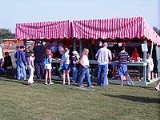
(seen in the image) is a mall-type complex which houses the mail center, barber shop, travel office, photo shop, laundry, dry cleaners, housing office, community bulletin boards and ticket office for community events. The supermarket and florist are adjacent to Al Mujamma, as is the bank. The Dhahran dining hall is also on the main camp, not far from Al Mujamma.
There are two recreation complexes on the main camp. One complex is next to the middle school and includes a youth center, swimming pool, gym, tennis courts, squash courts and games fields. The other is situated near the community library. Included in this complex is the bowling alley, movie theatre, games room and dance hall.
Most homes in the main camp are constructed of brick or fieldstone, and many have undergone recent modernisation. There are also some newer, modular homes in this area. The gardens and landscaped areas of these homes are surprisingly green with large shade trees and flowering bougainvillea and oleanders.
Dhahran Hills, which is mostly residential, is located about 2 miles west of Dhahran main camp, just beyond the community's golf course. Most houses in the hills were constructed in the early 80s. The Dhahran Hills school, for kids aged 5-10, is located in the hills. Adjacent to the school is a large community recreation center similar to the ones in the main camp.
Dhahran also has a hobby farm (horse stables), bicycle and jogging paths, and a rugby field.
Dhahran's marina and adjoining beach facility are at Half Moon Bay, a small inlet of the Persian Gulf. It is 40 minutes from the community of Dhahran. Sailing, fishing and water-skiing facilities are available.
Al-Munirah is a compound in Dhahran but outside the main camp and the Hills, it is designated for junior staff (as Dhahran Hills and the Main Camp are for senior staff and their families). Ar-Rabiyah, a compound that is "attached" to Dhahran, is exclusively reserved for managers and executive vice presidents and their families. Ar-Rabiyah is also considered one of the classiest compounds in the whole region, even being referred to as the "Golden Ghetto" (a name also used to describe Beverly Hills, an exclusive neighborhood of
Los Angeles, CaliforniaLos Angeles is the largest city in the state of California and the second largest in the United States. Often abbreviated as L.A. and nicknamed The City of Angels, Los Angeles has an estimated population of 3.8 million and spans over in Southern California...
).
Dhahran in film and TV
- HOME-The Aramco Brats' Story: a movie that gives a glimpse, for the first time ever, into expatriate life within Dhahran and other Aramco camps in Saudi Arabia through the eyes of its children - the Aramco Brats'. To be aired on PBS, Discovery Channel
Discovery Channel is an American satellite and cable TV channel , founded by John Hendricks and distributed by Discovery Communications. It provides documentary programming focused primarily on popular science, technology, and history...
, History Channel and Arabian Networks
- The West Wing: In one episode, the story plot was picketers outside the Aramco camp of Dhahran.
- CNN
Cable News Network, almost always referred to by its initialism CNN, is an U.S. cable news network founded in 1980 by Ted Turner. Upon its launch, CNN was the first network to provide 24-hour television news coverage, and the first all-news television network in the United States...
: A report about the Dhahran compound was aired.
- In 1998 after the kidnapping and murder of Matthew Shepard
Matthew Wayne Shepard was a student at the University of Wyoming who was tortured and murdered near Laramie, Wyoming in 1998...
, a WyomingWyoming is a state in the Western United States. The majority of the state is dominated by the mountain ranges and rangelands of the Rocky Mountain West, while the easternmost section of the state includes part of a high elevation prairie region known as the High Plains. While the tenth largest...
college student, the major American news networks would occasionally mention that the student's parents lived in Dhahran and worked for Saudi Aramco. In 2002 a made-for-TV movie “The Matthew Shepard Story” was produced by the US-based TV company, NBC.
- In 2007 the movie "The Kingdom" was released in theaters in America. The story is about the investigation by the FBI of a bombing of a Western compound in Riyadh, though many have noticed superficial similarities to the ARAMCO compound of Dhahran.
External links