

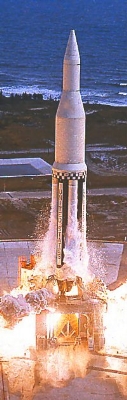
Saturn I

Encyclopedia
- For the moon of Saturn, see Mimas (moon)Mimas (moon)Mimas is a moon of Saturn which was discovered in 1789 by William Herschel. It is named after Mimas, a son of Gaia in Greek mythology, and is also designated Saturn I....
.
The Saturn I was the United States' first heavy-lift
Heavy Lift Launch Vehicle
A Heavy Lift Launch Vehicle, or HLLV, is a launch vehicle capable of lifting more mass into Low Earth Orbit than Medium Lift or Mid-Heavy Lift Launch Vehicles.There is no universally accepted capability requirements for heavy-lift launch vehicles....
dedicated space launcher, a rocket
Rocket
A rocket is a missile, spacecraft, aircraft or other vehicle which obtains thrust from a rocket engine. In all rockets, the exhaust is formed entirely from propellants carried within the rocket before use. Rocket engines work by action and reaction...
designed specifically to launch large payloads into low Earth orbit
Low Earth orbit
A low Earth orbit is generally defined as an orbit within the locus extending from the Earth’s surface up to an altitude of 2,000 km...
. Most of the rocket's power came from a clustered lower stage consisting of tanks taken from older rocket designs and strapped together to make a single large booster, leading critics to jokingly refer to it as "Cluster's Last Stand". However, its design proved sound and very flexible. Its major successes were launching the Pegasus satellites
Pegasus satellite program
The Pegasus satellite program was a series of three American satellites launched in 1965 to study the frequency of micrometeorite impacts on spacecraft...
and flight verification of the Apollo Command and Service Module
Apollo Command/Service Module
The Command/Service Module was one of two spacecraft, along with the Lunar Module, used for the United States Apollo program which landed astronauts on the Moon. It was built for NASA by North American Aviation...
aerodynamics in the launch phase. Originally intended as a near-universal military booster during the 1960s, it served only for a brief period and only with NASA
NASA
The National Aeronautics and Space Administration is the agency of the United States government that is responsible for the nation's civilian space program and for aeronautics and aerospace research...
; ten Saturn Is were flown before it was replaced by the derivative Saturn IB
Saturn IB
The Saturn IB was an American launch vehicle commissioned by the National Aeronautics and Space Administration for use in the Apollo program...
, which featured a more powerful upper stage and improved instrumentation.
President John F. Kennedy identified the Saturn I, and the SA-5
SA-5 (Apollo)
SA-5 was the first launch of the Block II Saturn I rocket and was part of the Apollo Program.-Upgrades and objectives:The major changes that occurred on SA-5 were that for the first time the Saturn I would fly with two stages - the S-I first stage and the S-IV second stage. The second stage...
launch in particular, as being the point where US lift capability would surpass the Soviets, after being behind since Sputnik. That was last mentioned in a speech he gave at Brooks AFB in San Antonio on the day before he was assassinated. He never lived to see this capability realized.
Origins
The Saturn project was started as one of a number of proposals to meet a new Department of DefenseUnited States Department of Defense
The United States Department of Defense is the U.S...
(DoD) requirement for a heavy-lift vehicle to orbit a new class of communications and "other" satellites. The requirements called for a vehicle capable of putting 9,000 to 18,000 kilograms into orbit, or accelerating 2,700 to 5,400 kg to escape velocity
Escape velocity
In physics, escape velocity is the speed at which the kinetic energy plus the gravitational potential energy of an object is zero gravitational potential energy is negative since gravity is an attractive force and the potential is defined to be zero at infinity...
. Existing launchers could place a maximum of about 1,400 kg in orbit, but might be expanded to as much as 4,500 kg with new high-energy upper stages. In any event, these upper stages would not be available until 1961 or 62 at the earliest, and would still not meet the DoD requirements for heavy loads.
Wernher von Braun
Wernher von Braun
Wernher Magnus Maximilian, Freiherr von Braun was a German rocket scientist, aerospace engineer, space architect, and one of the leading figures in the development of rocket technology in Nazi Germany during World War II and in the United States after that.A former member of the Nazi party,...
's team at the U.S. Army Ballistic Missile Agency
Army Ballistic Missile Agency
The Army Ballistic Missile Agency was the agency formed to develop the US Army's first intermediate range ballistic missile. It was established at Redstone Arsenal on February 1, 1956 and commanded by Major General John B...
(ABMA) started studying the problem in April 1957. They calculated that a rocket with the required performance would require a lower stage booster with a thrust of about 1.5 million pound-force
Pound-force
The pound force is a unit of force in some systems of measurement including English engineering units and British gravitational units.- Definitions :...
(6.7 MN) thrust at takeoff. As it happened, the Air Force
Air force
An air force, also known in some countries as an air army, is in the broadest sense, the national military organization that primarily conducts aerial warfare. More specifically, it is the branch of a nation's armed services that is responsible for aerial warfare as distinct from an army, navy or...
had recently started work on just such an engine, eventually emerging as the F-1
F-1 (rocket engine)
The F-1 is a rocket engine developed by Rocketdyne and used in the Saturn V. Five F-1 engines were used in the S-IC first stage of each Saturn V, which served as the main launch vehicle in the Apollo program. The F-1 is still the most powerful single-chamber liquid-fueled rocket engine ever...
, but this would not be available in the time frame that the DoD was demanding and would be limited to about 1 million lbf in the short term anyway. Another possibility was a Rocketdyne
Rocketdyne
Rocketdyne was a Rocket engine design and production company headquartered in Canoga Park, California, United States. The company was related to North American Aviation for most of its history. NAA merged with Rockwell International, which was then bought by Boeing in December, 1996...
engine, then known as the E-1
E-1 (rocket engine)
Rocketdyne's E-1 was a liquid propellant rocket engine originally built as a backup design for the Titan I missile. While it was being developed, Heinz-Hermann Koelle at the Army Ballistic Missile Agency selected it as the primary engine for the rocket that would emerge as the Saturn I...
, which provided about 360,000 to 380000 lbf (1,690.3 kN), four of which would reach the required thrust levels. This approach became the favorite, and in order to quickly provide fuel tankage to supply the engines, a new stage consisting of the tank from a Jupiter wrapped with eight taken from the Redstone would be used along with a thrust plate on the bottom where the engines would be attached.
Von Braun returned the design to DoD in December, 1957 as A National Integrated Missile and Space Vehicle Development Program, outlining the new design, then known simply as "Super-Jupiter". Several variations were proposed, using a common clustered first stage, and upper stages based on either the Atlas or Titan I. ABMA favored the Titan as the Atlas production was extremely high-priority and there was little or no excess capacity to spare. They proposed using the existing Titan tooling at 120" diameter, but lengthening it to produce a new 200 feet (61 m)-long stage. A Centaur
Centaur (rocket stage)
Centaur is a rocket stage designed for use as the upper stage of space launch vehicles. Centaur boosts its satellite payload to geosynchronous orbit or, in the case of an interplanetary space probe, to or near to escape velocity...
would be used as a third stage, which was expected to be ready for operational use in 1963, right when the lower two stages would have completed their testing. The resulting three-stage design was much taller and skinnier than the Saturn design that was eventually built.
Advanced Research Projects Agency (ARPA) was formed in February 1958 as part of DoD and was in charge of the requirements. ARPA asked for only one change to the design; concerned that the E-1 was still in early development, they suggested looking at alternatives in order to ensure the rocket would enter production as soon as possible. ABMA quickly responded with a slightly modified design replacing the four E-1's with eight H-1
H-1 (rocket engine)
Rocketdyne's H-1 is a thrust liquid-propellant rocket engine burning LOX and RP-1. The H-1 was developed for use in the S-IB first stage of the Saturn I and Saturn IB rockets, where it was used in clusters of eight engines...
engines, a minor upgrade to the S-3D engine used on Thor and Jupiter missiles. They estimated that changing the engines would save about $60 million and as much as two years research and development time. Von Braun had earlier referred to Redstone and Jupiter rockets being used as space launchers as the Juno I
Juno I
The Juno I was a four-stage American booster rocket which launched America's first satellite, Explorer 1, in 1958. A member of the Redstone rocket family, it was derived from the Jupiter-C sounding rocket...
and Juno II
Juno II
Juno II was an American space launch vehicle used during the late 1950s and early 1960s. It was derived from the Jupiter missile, which was used as the first stage.-Development:...
, respectively, and made proposals for multi-stage versions as the Juno III and IV, and so he changed the name of the new design to Juno V. The total development cost of $850 million ($5.6 billion in year-2007 dollars) between 1958-1963 also covered 30 research and development flights, some carrying manned and unmanned space payloads.
Work begins
Satisfied with the outcome, ARPA Order Number 14-59, dated 15 August 1958, ordered the program into existence:- Initiate a development program to provide a large space vehicle booster of approximately 1,500,000-lb. thrust based on a cluster of available rocket engines. The immediate goal of this program is to demonstrate a full-scale captive dynamic firing by the end of CY 1959.
This was followed on 11 September 1958 with another contract with Rocketdyne to start work on the H-1. On 23 September 1958, ARPA and the Army Ordnance Missile Command (AOMC) drew up an additional agreement enlarging the scope of the program, stating "In addition to the captive dynamic firing..., it is hereby agreed that this program should now be extended to provide for a propulsion flight test of this booster by approximately September 1960." Further, they wanted ABMA to produce three additional boosters, the last two of which would be "capable of placing limited payloads in orbit."
Von Braun had high hopes for the design, feeling it would make an excellent test-bed for other propulsion systems, notably the F-1 if it matured. He outlined uses for the Juno V as a general carrier vehicle for research and development of "offensive and defensive space weapons." Specific uses were forecast for each of the military services, including navigation satellites for the Navy; reconnaissance, communications, and meteorological satellites for the Army and Air Force; support for Air Force manned missions; and surface-to-surface logistics supply for the Army at distances up to 6400 kilometers. Von Braun also proposed using the Juno V as the basis of a manned lunar mission as part of Project Horizon
Project Horizon
Project Horizon was a study to determine the feasibility of constructing a scientific / military base on the Moon. On June 8, 1959, a group at the Army Ballistic Missile Agency produced for the U.S. Department of the Army a report entitled Project Horizon, A U.S. Army Study for the Establishment...
. Juno could lift up to 20,000 pounds (9,000 kg) into low earth orbit
Low Earth orbit
A low Earth orbit is generally defined as an orbit within the locus extending from the Earth’s surface up to an altitude of 2,000 km...
, and he proposed launching 15 of them to build a 200000 lb (90,718.5 kg) lunar spacecraft in Earth orbit.
Even by this point the name "Saturn", as "the one after Jupiter" was being used. One early ARPA report noted "The SATURN is considered to be the first real space vehicle as the Douglas DC-3 was the first real airliner and durable work-horse in aeronautics." The name change became official in February 1959.
Enter NASA
The formation of NASA on July 29, 1958 led to an effort to collect the existing heavy-launch rocket programs and select a single set of designs for future work. At the time, both the Air ForceUnited States Air Force
The United States Air Force is the aerial warfare service branch of the United States Armed Forces and one of the American uniformed services. Initially part of the United States Army, the USAF was formed as a separate branch of the military on September 18, 1947 under the National Security Act of...
and US Army had teams developing such vehicles, the Army's Saturn and the Air Force's Space Launching System (SLS). The SLS used a set of common modular components with solid fuel boosters and hydrogen/oxygen upper stages to allow a wide variety of launch configurations and payload weights. Both groups had also developed plans for manned lunar bases, ABMA's Horizon with its Earth Orbit Rendezvous
Earth orbit rendezvous
Earth orbit rendezvous is a type of space rendezvous and a spaceflight methodology most notable for enabling round trip human missions to the moon...
method of building a large lunar rocket in Earth orbit, and the Air Force's Lunex Project
Lunex Project
The Lunex Project was a US Air Force 1958 plan for a manned lunar landing prior to the Apollo Program. The final lunar expedition plan in 1961 was for a 21-airman underground Air Force base on the Moon by 1968 at a total cost of $ 7.5 billion....
which planned on launching a single huge lander using the largest of the SLS configurations. As if this were not enough, NASA's own engineers had started the design of their own Nova
Nova rocket
Nova was a series of proposed rocket designs, originally as NASA's first large launchers for missions similar to the production-level Saturn V, and later as larger follow-ons to the Saturn V intended for missions to Mars. The two series of designs were essentially separate, but shared their name...
design series, planning to use it in the direct ascent
Direct ascent
Direct ascent was a proposed method for a mission to the Moon. In the United States, direct ascent proposed using the enormous Nova rocket to launch a spacecraft directly to the Moon, where it would land tail-first and then launch off the Moon back to Earth...
profile similar to the Air Force's approach.
Von Braun was asked to chair a committee to study the existing efforts and write up recommendations. They presented their report on 18 July, starting with a criticism of how the US program had been mishandled to date and pointing out that the Soviet program was definitely ahead. It went on to describe five "generations" of rockets, starting with the early Vanguard, through the Junos, ICBM
Intercontinental ballistic missile
An intercontinental ballistic missile is a ballistic missile with a long range typically designed for nuclear weapons delivery...
s like Atlas and Titan, clustered designs like the Saturn, and finally the ultimate development, a cluster using the F-1 with 6 million pounds of thrust. The report went on to outline a manned exploration program using these rockets as they became available; using existing ICBMs a small four-man space station could be operational 1961, the clusters would support a manned lunar landing in 1965-1966 and a larger 50-man space station by 1967, while the largest of the rockets would support large moon expeditions in 1972, set up a permanent moon base in 1973-1974, and launch manned interplanetary trips in 1977.
In December all of the teams gathered to present their designs. NASA selected von Braun's proposal on January 6, giving it a vital boost. At the end of January NASA outlined their complete development program. This included the Vega and Centaur upper stages, as well as the Juno V and their own Nova boosters. Vega was later cancelled when information on the formerly secret Agena
RM-81 Agena
The RM-81 Agena was an American rocket upper stage and satellite support bus which was developed by Lockheed initially for the canceled WS-117L reconnaissance satellite program...
upper stage was released (then known as "Hustler"), and it had performance roughly comparable to NASA's design.
Near-cancellation
Progress on the Saturn design seemed to go smoothly. In April the first H-1 engines started arriving at ABMA, and test firings started in May. Construction of the Complex 34Cape Canaveral Air Force Station Launch Complex 34
Cape Canaveral Air Force Station Launch Complex 34 is a launch site on Cape Canaveral, Florida. LC-34 and its twin to the north, LC-37, were used by NASA as part of the Apollo Program to launch Saturn I and IB rockets from 1961 through 1968...
launch sites started at Cape Canaveral
Cape Canaveral Air Force Station
Cape Canaveral Air Force Station is an installation of the United States Air Force Space Command's 45th Space Wing, headquartered at nearby Patrick Air Force Base. Located on Cape Canaveral in the state of Florida, CCAFS is the primary launch head of America's Eastern Range with four launch pads...
in June.
Then, quite unexpectedly, on 9 June 1959, Herbert York, Director of Department of Defense Research and Engineering, announced that he had decided to terminate the Saturn program. He later stated that he was concerned that the project was taking ARPA money from more pressing projects, and that as it seemed upgrades to existing ICBMs would provide the needed heavy-lift capability in the short term. As ABMA commander John B. Medaris put it:
- By this time, my nose was beginning to sniff a strange odor of "fish." I put my bird dogs to work to try to find out what was going on and with whom we had to compete. We discovered that the Air Force had proposed a wholly different and entirely new vehicle as the booster for Dynasoar, using a cluster of Titan engines and upgrading their performance to get the necessary first-stage thrust for take-off. This creature was variously christened the Super Titan, or the Titan C. No work had been done on this vehicle other than a hasty engineering outline. Yet the claim was made that the vehicle in a two-stage or three-stage configuration could be flown more quickly than the Saturn, on which we had already been working hard for many months. Dates and estimates were attached to that proposal which at best ignored many factors of costs, and at worst were strictly propaganda.
Looking to head off the cancellation, Saturn supporters from the DoD and ARPA drafted their own memo arguing against the cancellation. Working against them was the fact that neither the Army nor NASA had any in-writing requirement for the booster at that time. A three-day meeting between 16 and 18 September 1959 followed, where York and Dryden reviewed Saturn's future and discussed the roles of the Titan C and Nova. The outcome was equally unexpected; York agreed to defer the cancellation and continue short-term funding, but only if NASA agreed to take over the ABMA team and continue development without the help of the DoD. NASA was equally concerned that by relying on 3rd parties for their boosters they were putting their entire program in jeopardy.
As the parties continued discussions over the next week and agreement was hammered out; von Braun's team at ABMA would be kept together and continue working as the lead developers of Saturn, but the entire organization would be transferred to NASA's management. By a presidential executive order on 15 March 1960, ABMA became NASA's George C. Marshall Space Flight Center (MSFC).
Selecting the upper stages
In July 1959 a change request was received from ARPA to upgrade the upper stage to a much more powerful design using four new 20000 lbf (89 kN) liquid hydrogenLiquid hydrogen
Liquid hydrogen is the liquid state of the element hydrogen. Hydrogen is found naturally in the molecular H2 form.To exist as a liquid, H2 must be pressurized above and cooled below hydrogen's Critical point. However, for hydrogen to be in a full liquid state without boiling off, it needs to be...
/liquid oxygen
Liquid oxygen
Liquid oxygen — abbreviated LOx, LOX or Lox in the aerospace, submarine and gas industries — is one of the physical forms of elemental oxygen.-Physical properties:...
powered engines in a larger-diameter 160" second stage, with an upgraded Centaur using two engines of the same design for the third stage. On this change Medaris noted:
- For reasons of economy we had recommended, and it had been approved, that in building the second stage, we would use the same diameter as the Titan first stage 120 inches. The major costs of tooling for the fabrication of missile tanks and main structure is related to the diameter. Changes in length cost little or nothing in tooling. How the tanks are divided internally, or the structure reinforced inside, or the kind of structural detail that is used at the end in order to attach the structure to a big booster below, or to a different size stage above, have very little effect on tooling problems. However, a change in diameter sets up a major question of tools, costs, and time.
- Suddenly, out of the blue came a directive to suspend work on the second stage, and a request for a whole new series of cost and time estimates, including consideration of increasing the second stage diameter to 160 inches. It appeared that Dr. York had entered the scene, and had pointed up the future requirements of Dynasoar as being incompatible with the 120-inch diameter. He had posed the question of whether it was possible for the Saturn to be so designed as to permit it to be the booster for that Air Force project.
- We were shocked and stunned. This was no new problem, and we could find no reason why it should not have been considered, if necessary, during the time that the Department of Defense and NASA were debating the whole question of what kind of upper stages we should use. Nevertheless, we very speedily went about the job of estimating the project on the basis of accepting the 160-inch diameter. At the same time it was requested that we submit quotations for a complete operational program to boost the Dynasoar for a given number of flights. As usual, we were given two or three numbers, rather than one fixed quantity, and asked to estimate on each of them.
In order to reach some sort of accommodation, a group pulled from NASA, Air Force, ARPA, ABMA, and the Office of the Department of Defense Research and Engineering formed under the Silverstein Committee
Silverstein Committee
The Saturn Vehicle Evaluation Committee, better known as the Silverstein Committee, was a US government commission assembled in 1959 to recommend specific directions that NASA could take with the Saturn program...
in December. Originally skeptical, the Committee convinced von Braun that liquid hydrogen was the way to go on upper stage development. Once these changes had been made, NASA's booster project was now entirely free of any dependence on military developments. At that point any sort of upper stage was fair game, and "If these propellants are to be accepted for the difficult top-stage applications," the committee concluded, "there seem to be no valid engineering reasons for not accepting the use of high-energy propellants for the less difficult application to intermediate stages."
The Committee outlined a number of different potential launch configurations, grouped into three broad categories. The "A" group were low-risk versions similar to the Saturn designs proposed prior to the meeting; the original design using Titan and Centaur upper stages became the A-1, while another model replacing the Titan with cluster of IRBMs became A-2. The B-1 design proposed a new second stage replacing the A-2s cluster with a new four-engine design using the H-1 like the lower stage. Finally there were three C-series models that replaced all of the upper stages with liquid hydrogen ones. The C-1 used the existing S-I clustered lower, adding the new S-IV stage with four new 15,000 to 20000 lbf (89 kN) engines, and keeping the two-engine Centaur on top, now to be known as the S-V stage. The C-II model added a new S-III stage with two new 150,000 to 200000 lbf (889.6 kN) engines, keeping the S-IV and S-V on top. Finally, the C-3 configuration added the S-II stage with four of these same engines, keeping only the S-III and S-IV on top. The C models easily outperformed the A's and B's, with the added advantage that they were interchangeable and could be built up in order to fit any needed payload requirement.
Saturn emerges
Ironically, of these new stage designs only the S-IV would ever be delivered, and not in the form that was drawn up in the Committee report. In order to meet development schedules a cluster of six Centaur engines were placed in the new 220" stage to produce the "new" S-IVS-IV
The S-IV was the second stage of the Saturn I, a rocket-powered launch vehicle used by NASA for early flights in the Apollo program.The S-IV was manufactured by the Douglas Aircraft Company and later modified by them to the S-IVB, a similar but distinct stage used on the Saturn IB and Saturn V...
of roughly the same performance as the original four upgraded engines. A large number of small engines is less efficient and more problematic than a smaller number of large engines, and this made it a target for an early upgrade to a single J-2
J-2 (rocket engine)
Rocketdyne's J-2 rocket engine was a major component of the Saturn V rocket used in the Apollo program to send men to the Moon. Five J-2 engines were used on the S-II second stage, and one J-2 was used on the S-IVB third stage. The S-IVB was also used as the second stage of the smaller Saturn IB...
. The resulting stage, the S-IVB
S-IVB
The S-IVB was built by the Douglas Aircraft Company and served as the third stage on the Saturn V and second stage on the Saturn IB. It had one J-2 engine...
, improved performance so much that the Saturn was able to launch the Apollo CSM
Apollo Command/Service Module
The Command/Service Module was one of two spacecraft, along with the Lunar Module, used for the United States Apollo program which landed astronauts on the Moon. It was built for NASA by North American Aviation...
, proving invaluable during the Apollo Project.
In the end the Titan C was never delivered, and the Air Force instead turned to "thrust augmented" Titan II's using clustered solid fuel rockets. These new designs, the Titan III's, became the workhorse of the Department of Defense's launch needs. A Titan III has about the same lift capability as a Saturn IB but costs less to manufacture and launch. Likewise, the development of the Titan III eliminated the need for the "flexible" staging concepts of the Saturn, which was now only intended to be used for manned launches in the Apollo program. With the need for flexibility in launch configuration removed, most of these designs were subsequently dropped. Only the S-V survived in its original form, while the S-IV would appear in modified form and the Saturn V
Saturn V
The Saturn V was an American human-rated expendable rocket used by NASA's Apollo and Skylab programs from 1967 until 1973. A multistage liquid-fueled launch vehicle, NASA launched 13 Saturn Vs from the Kennedy Space Center, Florida with no loss of crew or payload...
would feature an entirely different S-II stage.
The main payload of the Saturn I was the boilerplate version of the Apollo Command and Service Modules
Apollo Command/Service Module
The Command/Service Module was one of two spacecraft, along with the Lunar Module, used for the United States Apollo program which landed astronauts on the Moon. It was built for NASA by North American Aviation...
and Launch Escape System. It was also considered at one time for launch of the X-20 Dyna-Soar
X-20 Dyna-Soar
The X-20 Dyna-Soar was a United States Air Force program to develop a spaceplane that could be used for a variety of military missions, including reconnaissance, bombing, space rescue, satellite maintenance, and sabotage of enemy satellites...
spaceplane and later, for launching a Gemini capsule
Project Gemini
Project Gemini was the second human spaceflight program of NASA, the civilian space agency of the United States government. Project Gemini was conducted between projects Mercury and Apollo, with ten manned flights occurring in 1965 and 1966....
on a proposed lunar mission. The final three were used to launch the three Pegasus micrometeroid satellites
Pegasus satellite program
The Pegasus satellite program was a series of three American satellites launched in 1965 to study the frequency of micrometeorite impacts on spacecraft...
.
Data for the original Saturn I
| Parameter | S-I – 1st Stage | S-IV – 2nd Stage | S-V – 3rd Stage |
|---|---|---|---|
| Height (m) | 24.48 | 12.19 | 9.14 |
| Diameter (m) | 6.52 | 5.49 | 3.05 |
| Gross mass (kg) | 432,681 | 50,576 | 15,600 |
| Empty mass (kg) | 45,267 | 5,217 | 1,996 |
| Engines | Eight – H-1 | Six – RL10 | Two – RL10 |
| Thrust (kN) | 7,582 | 400 | 133 |
| ISP (seconds) | 288 | 410 | 425 |
| ISP (kN·s/kg) | 2.82 | 4.02 | 4.17 |
| Burn duration (s) | 150 | 482 | 430 |
| Propellant | LOX/RP-1 | LOX/LH2 | LOX/LH2 |
S-I stage
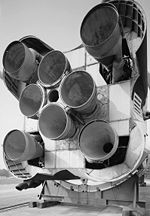
H-1 (rocket engine)
Rocketdyne's H-1 is a thrust liquid-propellant rocket engine burning LOX and RP-1. The H-1 was developed for use in the S-IB first stage of the Saturn I and Saturn IB rockets, where it was used in clusters of eight engines...
rocket engine
Rocket engine
A rocket engine, or simply "rocket", is a jet engineRocket Propulsion Elements; 7th edition- chapter 1 that uses only propellant mass for forming its high speed propulsive jet. Rocket engines are reaction engines and obtain thrust in accordance with Newton's third law...
s burning RP-1
RP-1
RP-1 is a highly refined form of kerosene outwardly similar to jet fuel, used as a rocket fuel. Although having a lower specific impulse than liquid hydrogen , RP-1 is cheaper, can be stored at room temperature, is far less of an explosive hazard and is far denser...
fuel with liquid oxygen
Liquid oxygen
Liquid oxygen — abbreviated LOx, LOX or Lox in the aerospace, submarine and gas industries — is one of the physical forms of elemental oxygen.-Physical properties:...
(LOX) as oxidizer. The propellant tanks consisted of a central Jupiter rocket tank containing LOX, surrounded by a cluster of eight Redstone rocket tanks: four painted white, containing LOX; and four painted black, containing the RP-1 fuel. The four outboard engines were mounted on gimbal
Gimbal
A gimbal is a pivoted support that allows the rotation of an object about a single axis. A set of two gimbals, one mounted on the other with pivot axes orthogonal, may be used to allow an object mounted on the innermost gimbal to remain immobile regardless of the motion of its support...
s, allowing them to be steered to guide the rocket. On the Block II vehicles (SA-5 through SA-10), eight fins provided aerodynamic stability in the flight through the atmosphere.
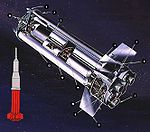
Height: 80.3 feet (24.5 m)
Diameter: 21.4 feet (6.5 m)
Engines: 8 H-1
Thrust: 1500000 pound-forces (6,672.3 kN)
Fuel: RP-1
RP-1
RP-1 is a highly refined form of kerosene outwardly similar to jet fuel, used as a rocket fuel. Although having a lower specific impulse than liquid hydrogen , RP-1 is cheaper, can be stored at room temperature, is far less of an explosive hazard and is far denser...
(Refined kerosene
Kerosene
Kerosene, sometimes spelled kerosine in scientific and industrial usage, also known as paraffin or paraffin oil in the United Kingdom, Hong Kong, Ireland and South Africa, is a combustible hydrocarbon liquid. The name is derived from Greek keros...
), 41,000 US gal
Gallon
The gallon is a measure of volume. Historically it has had many different definitions, but there are three definitions in current use: the imperial gallon which is used in the United Kingdom and semi-officially within Canada, the United States liquid gallon and the lesser used United States dry...
(155 m3)
Oxidizer: liquid oxygen (LOX), 66,000 US gal (250 m3)
Burn time: 150 sec
Burnout altitude: 37 nautical miles (68.5 km)
S-IV stage
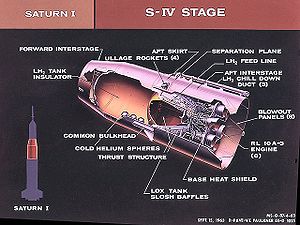
Liquid hydrogen
Liquid hydrogen is the liquid state of the element hydrogen. Hydrogen is found naturally in the molecular H2 form.To exist as a liquid, H2 must be pressurized above and cooled below hydrogen's Critical point. However, for hydrogen to be in a full liquid state without boiling off, it needs to be...
-fueled RL10 engines, mounted on gimbals. The propellant tanks used a single, common bulkhead to separate the LOX and LH2 propellant tanks, saving about ten tons of weight.
Specifications:
Height: 40 feet (12.2 m)
Diameter: 18 feet (5.5 m)
Engines: 6 RL10
Thrust: 90000 pound-forces (400.3 kN)
Fuel: liquid hydrogen (LH2)
Oxidizer: liquid oxygen (LOX)
Burn time: approx. 410 sec
Burnout altitude: up to 240 nautical miles (444.5 km)
Saturn I Instrument Unit
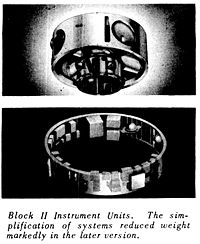
The Block II vehicles (SA-5 to -10) included two powered stages, and went into orbits. Beginning with SA-5, the guidance instruments were carried on a separate stage, the instrument unit (IU)
Saturn V Instrument Unit
The Saturn V Instrument Unit is a ring-shaped structure fitted to the top of the Saturn V rocket's third stage and the Saturn IB's second stage . It was immediately below the SLA panels that contained the Lunar Module. The Instrument Unit contains the guidance system for the Saturn V rocket...
, just ahead of the S-IV stage. The first version of the IU was 154 inches (3,911.6 mm) in diameter and 58 inches (1,473.2 mm) high, and was both designed and built by Marshall Space Flight Center
Marshall Space Flight Center
The George C. Marshall Space Flight Center is the U.S. government's civilian rocketry and spacecraft propulsion research center. The largest center of NASA, MSFC's first mission was developing the Saturn launch vehicles for the Apollo moon program...
. Guidance, telemetry, tracking and power components were contained in four pressurized, cylindrical containers attached like spokes to a central hub. This version flew on SA-5, 6, and 7.
MSFC flew version 2 of the IU on SA-8, 9 and 10. Version 2 was the same diameter as version 1, but only 34 inches (863.6 mm) high. Instead of pressurized containers, the components were hung on the inside of the cylindrical wall, achieving a reduction in weight.
The guidance computer for Block II was the IBM ASC-15
ASC-15
The ASC-15 was a digital computer developed by International Business Machines for use on the Titan II intercontinental ballistic missile . It was subsequently modified and used on the Titan III and Saturn I Block II launch vehicles. Its principal function on these rockets was to make navigation...
. Other instruments carried by the IU included active components, that guided the vehicle; and passenger components, that telemetered data to the ground for test and evaluation for use in later flights. The ST-90 stabilized platform was the active IMU for SA-5 and the first stage of SA-6. The ST-124
ST-124-M3 inertial platform
The ST-124-M3 is a device for measuring acceleration and attitude of the Saturn V launch vehicle. It was carried by the Saturn V Instrument Unit, a , section of the Saturn V that fit between the third stage and the Apollo spacecraft...
was the passenger on SA-5 and active for the second stage of SA-6 and subsequent missions. The IU had an optical window to allow alignment of the inertial platform before launch.
Saturn I launches
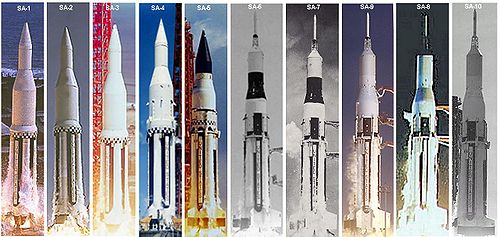
| Serial number | Mission | Launch date | Notes |
| SA-1 | SA-1 SA-1 (Apollo) SA-1 was the first Saturn I space launch vehicle, the first in the Saturn family, and was part of the American Apollo program. The rocket was launched on October 27, 1961 from Cape Canaveral, Florida.-Objectives:... |
October 27, 1961 | First test flight. Block I. Suborbital. Range 398 km, Apogee 136.5 km. Apogee Mass 115,700 lb (52,500 kg). |
| SA-2 | SA-2 SA-2 (Apollo) SA-2 was the second flight of the Saturn I launch vehicle, the first flight of Project Highwater, and was part of the American Apollo program. The rocket was launched on April 25, 1962 from Cape Canaveral, Florida.-Objectives:... |
April 25, 1962 | Second test flight. Block I. Suborbital. 86,000 kg water released at apogee of 145 km. |
| SA-3 | SA-3 SA-3 (Apollo) SA-3 was the third flight Saturn I launch vehicle, the second flight of Project Highwater and was part of the Apollo Program.-Objectives:... |
November 16, 1962 | Third test flight. Block I. Suborbital. 86,000 kg water released at apogee of 167 km. |
| SA-4 | SA-4 SA-4 (Apollo) SA-4 was the fourth launch of a Saturn I launch vehicle and the last of the initial test phase of the first stage. It was part of the Apollo Program.-Objectives:SA-4 was the last flight to test only the S-I first stage of the Saturn I rocket... |
March 28, 1963 | Fourth test flight. Block I. Suborbital. Dummy SIV second stage. Apogee 129 km, range 400 km. |
| SA-5 | SA-5 SA-5 (Apollo) SA-5 was the first launch of the Block II Saturn I rocket and was part of the Apollo Program.-Upgrades and objectives:The major changes that occurred on SA-5 were that for the first time the Saturn I would fly with two stages - the S-I first stage and the S-IV second stage. The second stage... |
January 29, 1964 | First live S-IV second stage. First Block II. First to orbit (760 by 264) km. Mass 38,700 lb (17,550 kg). Decayed 30 April 1966. JFK identified this launch as the one, after being behind since Sputnik, where US lift capability surpassed the Soviets. |
| SA-6 | A-101 | May 28, 1964 | First Apollo boilerplate CSM launch. Block II. Orbit 204 by 179 km. Mass 38,900 lb (17,650 kg). Apollo BP-13 Decayed 1 June 1964. |
| SA-7 | A-102 | September 18, 1964 | Second Apollo boilerplate CSM launch. Block II. Orbit 203 by 178 km. Mass 36,800 lb (16,700 kg). Apollo BP-15 Decayed 22 September 1964. |
| SA-9 | A-103 | February 16, 1965 | Third Apollo boilerplate CSM; first Pegasus micrometeoroid satellite. Orbit 523 by 430 km. Mass 3,200 lb (1,450 kg). Pegasus 1 Decayed 17 September 1978. Apollo BP-26 Decayed 10 July 1985. |
| SA-8 | A-104 | May 25, 1965 | Fourth Apollo boilerplate CSM; second Pegasus micrometeoroid satellite. Orbit 594 by 467 km. Mass 3,200 lb (1,450 kg). Pegasus 2 Decayed 3 November 1979. Apollo BP-16 Decayed 8 July 1989. |
| SA-10 | A-105 | July 30, 1965 | Third Pegasus micrometeoroid satellite. Orbit 567 by 535 km. Mass 3,200 lb (1,450 kg). Pegasus 3 Decayed 4 August 1969. Apollo BP-9A Decayed 22 November 1975. |
For further launches of Saturn-1 series vehicles, see the Saturn IB
Saturn IB
The Saturn IB was an American launch vehicle commissioned by the National Aeronautics and Space Administration for use in the Apollo program...
page.