

Saola

Encyclopedia
The Saola, Vu Quang ox or Asian unicorn, also, infrequently, Vu Quang bovid (Pseudoryx nghetinhensis), one of the world's rarest mammal
s, is a forest-dwelling bovine found only in the Annamite Range
of Vietnam
and Laos
. The species was "discovered" by science in 1992 in Vu Quang
Nature Reserve by a joint survey of the Ministry of Forestry and the World Wide Fund for Nature
. The team found three skulls with unusual long straight horns kept in hunters' houses. In their article, the team proposed "a three month survey to observe the living animal" but, more than 18 years later, there is still no reported sighting of a Saola in the wild by a scientist.
In late August 2010, a Saola was captured by villagers in Laos
but died in captivity before government conservationists could arrange for it to be released back in to the wild. The carcass is being studied with the hope that it will advance scientific understanding of the Saola.
's moist forests and the Eastern Indochina
dry and monsoon
forests. They have been spotted in steep river valleys at about 300 to 1800 m above sea level. These regions are distant from human settlements, covered primarily in evergreen
or mixed evergreen and deciduous
woodlands. The species seems to prefer edge zones of the forests.
Saola stay in mountain forests during the wet seasons, when water in streams and rivers is abundant, and move down to the lowlands in winter. They are shy and never enter cultivated fields or come close to villages. To date, all known captive saola have died, leading to the belief that this species cannot live in captivity.
; in other words its closest relatives are cattle
, true buffaloes, and bison
. However its simple horns and teeth and some other morphological features are typical of less-derived or 'primitive' bovids. Saola are antelopes, in the sense that an antelope is any bovid that is not a cow, sheep, buffalo, bison, or goat. It is not known how many individuals exist, as only 11 have been recorded alive.
Local populations report having seen saola traveling in groups of two or three, rarely more.
Saola mark their territories by opening up a fleshy flap on their snout to reveal scent glands. They subsequently rub the underside against objects leaving a musky, pungent paste. The saolas' colossal scent glands are thought to be the largest of any living mammal.
—especially fig leaves, and stems along rivers. The animal seems to have a browsing diet, considering its small incisor
s.
[-horned] although the precise meaning is actually 'spinning-wheel post horn'. The name comes from a Tai
language of Vietnam but the meaning is the same in the Lao language. The specific name nghetinhensis refers to the two Vietnamese provinces of Nghe An and Ha Tinh while Pseudoryx acknowledges the animal's similarities with the Arabian or African oryx
. Hmong people
in Lao refer to this beast as saht-supahp, a term derived from Lao meaning "the polite animal", because it moves quietly through the forest. Other names used by minority groups in the Saola's range are 'Lagiang' (Van Kieu
), 'A Ngao' (Ta Oi
) and 'Xoong Xor' (Katu
) In the press, Saola have been referred to as Asian Unicorns. The appellation is apparently due to the saola's rarity and apparently gentle nature and perhaps because both the saola and the oryx
have been linked with the unicorn
(see wikipedia unicorn
article). There is no known link with the mythical beast; nor with the 'Chinese unicorn', the Qilin
.
Mammal
Mammals are members of a class of air-breathing vertebrate animals characterised by the possession of endothermy, hair, three middle ear bones, and mammary glands functional in mothers with young...
s, is a forest-dwelling bovine found only in the Annamite Range
Annamite Range
The Annamite Range or the Annamese Mountains is a mountain range of eastern Indochina, which extends approximately through Laos, Vietnam, and a small area in northeast Cambodia. It is known in Vietnamese as Dãy Trường Sơn, in Lao as Xai Phou Luang , and in French as the Chaîne Annamitique...
of Vietnam
Vietnam
Vietnam – sometimes spelled Viet Nam , officially the Socialist Republic of Vietnam – is the easternmost country on the Indochina Peninsula in Southeast Asia. It is bordered by China to the north, Laos to the northwest, Cambodia to the southwest, and the South China Sea –...
and Laos
Laos
Laos Lao: ສາທາລະນະລັດ ປະຊາທິປະໄຕ ປະຊາຊົນລາວ Sathalanalat Paxathipatai Paxaxon Lao, officially the Lao People's Democratic Republic, is a landlocked country in Southeast Asia, bordered by Burma and China to the northwest, Vietnam to the east, Cambodia to the south and Thailand to the west...
. The species was "discovered" by science in 1992 in Vu Quang
Vu Quang
Vu Quang is a remote forested region of Vietnam, in which several new species of deer and antelope have been discovered since the 1990s. Some are so new that scientific description is still pending, although most have local names....
Nature Reserve by a joint survey of the Ministry of Forestry and the World Wide Fund for Nature
World Wide Fund for Nature
The World Wide Fund for Nature is an international non-governmental organization working on issues regarding the conservation, research and restoration of the environment, formerly named the World Wildlife Fund, which remains its official name in Canada and the United States...
. The team found three skulls with unusual long straight horns kept in hunters' houses. In their article, the team proposed "a three month survey to observe the living animal" but, more than 18 years later, there is still no reported sighting of a Saola in the wild by a scientist.
In late August 2010, a Saola was captured by villagers in Laos
Laos
Laos Lao: ສາທາລະນະລັດ ປະຊາທິປະໄຕ ປະຊາຊົນລາວ Sathalanalat Paxathipatai Paxaxon Lao, officially the Lao People's Democratic Republic, is a landlocked country in Southeast Asia, bordered by Burma and China to the northwest, Vietnam to the east, Cambodia to the south and Thailand to the west...
but died in captivity before government conservationists could arrange for it to be released back in to the wild. The carcass is being studied with the hope that it will advance scientific understanding of the Saola.
Habitat and distribution
The saola inhabits the Annamite RangeAnnamite Range
The Annamite Range or the Annamese Mountains is a mountain range of eastern Indochina, which extends approximately through Laos, Vietnam, and a small area in northeast Cambodia. It is known in Vietnamese as Dãy Trường Sơn, in Lao as Xai Phou Luang , and in French as the Chaîne Annamitique...
's moist forests and the Eastern Indochina
Indochina
The Indochinese peninsula, is a region in Southeast Asia. It lies roughly southwest of China, and east of India. The name has its origins in the French, Indochine, as a combination of the names of "China" and "India", and was adopted when French colonizers in Vietnam began expanding their territory...
dry and monsoon
Monsoon
Monsoon is traditionally defined as a seasonal reversing wind accompanied by corresponding changes in precipitation, but is now used to describe seasonal changes in atmospheric circulation and precipitation associated with the asymmetric heating of land and sea...
forests. They have been spotted in steep river valleys at about 300 to 1800 m above sea level. These regions are distant from human settlements, covered primarily in evergreen
Evergreen
In botany, an evergreen plant is a plant that has leaves in all seasons. This contrasts with deciduous plants, which completely lose their foliage during the winter or dry season.There are many different kinds of evergreen plants, both trees and shrubs...
or mixed evergreen and deciduous
Deciduous
Deciduous means "falling off at maturity" or "tending to fall off", and is typically used in reference to trees or shrubs that lose their leaves seasonally, and to the shedding of other plant structures such as petals after flowering or fruit when ripe...
woodlands. The species seems to prefer edge zones of the forests.
Saola stay in mountain forests during the wet seasons, when water in streams and rivers is abundant, and move down to the lowlands in winter. They are shy and never enter cultivated fields or come close to villages. To date, all known captive saola have died, leading to the belief that this species cannot live in captivity.
Taxonomy
The saola belongs to the family Bovidae and genetic analysis places it in the tribe BoviniBovini
The Bovini tribe is made up of large to very large grazers, including large animals of great economic significance to humans in Domestic Cattle, Domestic buffalo, and the Yak, as well as smaller Asian relatives, and large free-roaming bovids in the African Buffalo and the American...
; in other words its closest relatives are cattle
Cattle
Cattle are the most common type of large domesticated ungulates. They are a prominent modern member of the subfamily Bovinae, are the most widespread species of the genus Bos, and are most commonly classified collectively as Bos primigenius...
, true buffaloes, and bison
Bison
Members of the genus Bison are large, even-toed ungulates within the subfamily Bovinae. Two extant and four extinct species are recognized...
. However its simple horns and teeth and some other morphological features are typical of less-derived or 'primitive' bovids. Saola are antelopes, in the sense that an antelope is any bovid that is not a cow, sheep, buffalo, bison, or goat. It is not known how many individuals exist, as only 11 have been recorded alive.
Description
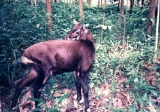
The saola stands about 85 cm at the shoulder and weighs approximately 90 kg. The coat is a dark brown with a black stripe along the back. Its legs are darkish and there are white patches on the feet, and white stripes vertically across the cheeks, on the eyebrows and splotches on the nose and chin. All saolas have slightly backward-curved horns, which grow to half a meter in length.Local populations report having seen saola traveling in groups of two or three, rarely more.
Saola mark their territories by opening up a fleshy flap on their snout to reveal scent glands. They subsequently rub the underside against objects leaving a musky, pungent paste. The saolas' colossal scent glands are thought to be the largest of any living mammal.
Diet
They are reported to eat small leafy plantsShrub
A shrub or bush is distinguished from a tree by its multiple stems and shorter height, usually under 5–6 m tall. A large number of plants may become either shrubs or trees, depending on the growing conditions they experience...
—especially fig leaves, and stems along rivers. The animal seems to have a browsing diet, considering its small incisor
Incisor
Incisors are the first kind of tooth in heterodont mammals. They are located in the premaxilla above and mandible below.-Function:...
s.
Names
The name Saola has been translated as spindleSpindle (textiles)
A spindle is a wooden spike used for spinning wool, flax, hemp, cotton, and other fibres into thread. It is commonly weighted at either the bottom middle or top, most commonly by a circular or spherical object called a whorl, and may also have a hook, groove or notch, though spindles without...
[-horned] although the precise meaning is actually 'spinning-wheel post horn'. The name comes from a Tai
Tai peoples
The Tai ethnicity refers collectively to the ethnic groups of southern China and Southeast Asia, stretching from Hainan to eastern India and from southern Sichuan to Laos, Thailand, and parts of Vietnam, which speak languages in the Tai family and share similar traditions and festivals, including...
language of Vietnam but the meaning is the same in the Lao language. The specific name nghetinhensis refers to the two Vietnamese provinces of Nghe An and Ha Tinh while Pseudoryx acknowledges the animal's similarities with the Arabian or African oryx
Oryx
Oryx is one of four large antelope species of the genus Oryx. Three of the species are native to arid parts of Africa, with a fourth native to the Arabian Peninsula. Their pelage is pale with contrasing dark markings in the face and on the legs, and their long horns are almost straight...
. Hmong people
Hmong people
The Hmong , are an Asian ethnic group from the mountainous regions of China, Vietnam, Laos, and Thailand. Hmong are also one of the sub-groups of the Miao ethnicity in southern China...
in Lao refer to this beast as saht-supahp, a term derived from Lao meaning "the polite animal", because it moves quietly through the forest. Other names used by minority groups in the Saola's range are 'Lagiang' (Van Kieu
Bru people
The Bru are an ethnic group living in Vietnam, Laos, and Thailand. They speak Bru, a Mon–Khmer language, which has several dialects...
), 'A Ngao' (Ta Oi
Ta Oi people
The Tà Ôi is an ethnic group of Vietnam . They speak a Mon–Khmer language and are concentrated in A Lưới district of Thừa Thiên-Huế province and Hương Hóa district of Quảng Trị province....
) and 'Xoong Xor' (Katu
Co Tu people
The Co Tu are an ethnic group in Vietnam. Most Co Tu live in the provinces of Thừa Thiên -Huế and Quảng Nam. The population in Vietnam was 50,458 in 1999 census and 61,588 in 2009 census...
) In the press, Saola have been referred to as Asian Unicorns. The appellation is apparently due to the saola's rarity and apparently gentle nature and perhaps because both the saola and the oryx
Oryx
Oryx is one of four large antelope species of the genus Oryx. Three of the species are native to arid parts of Africa, with a fourth native to the Arabian Peninsula. Their pelage is pale with contrasing dark markings in the face and on the legs, and their long horns are almost straight...
have been linked with the unicorn
Unicorn
The unicorn is a legendary animal from European folklore that resembles a white horse with a large, pointed, spiraling horn projecting from its forehead, and sometimes a goat's beard...
(see wikipedia unicorn
Unicorn
The unicorn is a legendary animal from European folklore that resembles a white horse with a large, pointed, spiraling horn projecting from its forehead, and sometimes a goat's beard...
article). There is no known link with the mythical beast; nor with the 'Chinese unicorn', the Qilin
Qilin
The Qilin is a mythical hooved Chinese chimerical creature known throughout various East Asian cultures, and is said to appear with the imminent arrival or passing of a wise sage or an illustrious ruler. It is a good omen that brings rui . It is often depicted with what looks like fire all over...
.
See also
Other rarely seen big mammals of the Indochina peninsula, also discovered in the 1990s:- Muntiacus putaoensis
- Muntiacus truongsonensis
- Muntiacus vuquangensis
External links
- Unicorn Watch: They Exist... in Laos
- BBC: Rare antelope-like mammal caught in Asia
- ARKive - images and movies of the saola (Pseudoryx nghetinhensis)
- Saola factsheet at Ultimate Ungulate
- "A new cow - a new species of ox, the pseudoryx, found in Southeast Asia - 1993 - The Year in Science", from DiscoverDiscover (magazine)Discover is an American science magazine that publishes articles about science for a general audience. The monthly magazine was launched in October 1980 by Time Inc. It was sold to Family Media, the owners of Health, in 1987. Walt Disney Company bought the magazine when Family Media went out of...
, Jan. 1994. - The Vu Quang Bovid at BrainBox
- Vu Quang Ox - Pseudoryx nghetinhensis from the United Nations Environment Programme World Conservation Monitoring Centre
- "A new species of living bovid from Vietnam" June 1993 article from NatureNature (journal)Nature, first published on 4 November 1869, is ranked the world's most cited interdisciplinary scientific journal by the Science Edition of the 2010 Journal Citation Reports...
- Saola Conservation in Central Vietnam - Center for Biodiversity and Conservation, American Museum of Natural History