

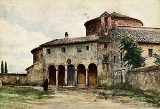
Santo Stefano Rotondo

Encyclopedia
Basilica
The Latin word basilica , was originally used to describe a Roman public building, usually located in the forum of a Roman town. Public basilicas began to appear in Hellenistic cities in the 2nd century BC.The term was also applied to buildings used for religious purposes...
and titular church in Rome
Rome
Rome is the capital of Italy and the country's largest and most populated city and comune, with over 2.7 million residents in . The city is located in the central-western portion of the Italian Peninsula, on the Tiber River within the Lazio region of Italy.Rome's history spans two and a half...
, Italy
Italy
Italy , officially the Italian Republic languages]] under the European Charter for Regional or Minority Languages. In each of these, Italy's official name is as follows:;;;;;;;;), is a unitary parliamentary republic in South-Central Europe. To the north it borders France, Switzerland, Austria and...
. Commonly named Santo Stefano Rotondo, the church is the National church in Rome
National churches in Rome
Charitable institutions attached to churches in Rome were founded right through the medieval period and included hospitals, hostels and others providing assistance to pilgrims to Rome from a certain "nation", which thus became these nations' national churches in Rome...
of Hungary
Hungary
Hungary , officially the Republic of Hungary , is a landlocked country in Central Europe. It is situated in the Carpathian Basin and is bordered by Slovakia to the north, Ukraine and Romania to the east, Serbia and Croatia to the south, Slovenia to the southwest and Austria to the west. The...
dedicated to Saint Stephen
Saint Stephen
Saint Stephen The Protomartyr , the protomartyr of Christianity, is venerated as a saint in the Roman Catholic, Anglican, Lutheran, Oriental Orthodox and Eastern Orthodox Churches....
and Saint Stephen of Hungary. The minor basilica
Minor basilica
Minor basilica is a title given to some Roman Catholic churches. By canon law no Catholic church can be honoured with the title of basilica unless by apostolic grant or from immemorial custom....
is also the rectory church of the Pontifical Collegium Germanicum et Hungaricum
Collegium Germanicum et Hungaricum
The Collegium Germanicum et Hungaricum or simply Collegium Germanicum is a German-speaking seminary for Roman Catholic priests in Rome, founded in 1552. Since 1580 its full name has been Pontificium Collegium Germanicum et Hungaricum de Urbe....
.
The Cardinal Priest or titular
Titular (Catholicism)
In Roman Catholicism, a titular can be:*the cardinal who holds a titulus, one of the main churches of Rome. Such holders were initially by tradition native-born Romans . The first church in Rome to have a non-Italian titular was Santi Quattro Coronati: Dietrich of Trier was appointed titular in...
S. Stephano is Friedrich Wetter.
History
The earliest church was consecrated by Pope SimpliciusPope Simplicius
Pope Saint Simplicius was Pope from 468 to March 10, 483.He was born in Tivoli, Italy, the son of a citizen named Castinus. Most of what is known of him is derived from the Liber Pontificalis....
between 468 and 483. It was dedicated to the protomartyr Saint Stephen
Saint Stephen
Saint Stephen The Protomartyr , the protomartyr of Christianity, is venerated as a saint in the Roman Catholic, Anglican, Lutheran, Oriental Orthodox and Eastern Orthodox Churches....
, whose body had been discovered a few decades before in the Holy Land
Holy Land
The Holy Land is a term which in Judaism refers to the Kingdom of Israel as defined in the Tanakh. For Jews, the Land's identifiction of being Holy is defined in Judaism by its differentiation from other lands by virtue of the practice of Judaism often possible only in the Land of Israel...
, and brought to Rome. The church was the first in Rome to have a circular plan, inspired by the Church of the Holy Sepulchre
Church of the Holy Sepulchre
The Church of the Holy Sepulchre, also called the Church of the Resurrection by Eastern Christians, is a church within the walled Old City of Jerusalem. It is a few steps away from the Muristan....
in Jerusalem.
Santo Stefano was probably financed by the wealthy Valerius
Valerius
Valerius is the nomen of gens Valeria, one of the oldest patrician families of Rome. The name was in use throughout Roman history...
family, whose estates covered large parts of the Caelian Hill. Their villa stood nearby, on the site of the present-day Hospital of San Giovanni - Addolorata. St Melania the Elder
Melania the Elder
Saint Melania the Elder or Maior was a Desert Mother who was an influential figure in the Christian ascetic movement that sprang up in the generation after the Emperor Constantine made Christianity the official religion of the Roman Empire...
, a member of the family, was a frequent pilgrim to Jerusalem and died there, so the family had connections to the Holy Land.
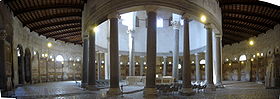
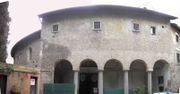
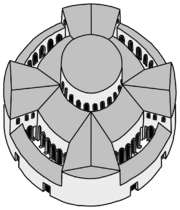
Originally the church had three concentric ambulatories flanked by 22 Ionic columns, surrounding the central circular space surmounted by a tambour
Tambour
In classical architecture, a tambour is the inverted bell of the Corinthian capital around which are carved acanthus leaves for decoration....
(22 m high and 22 m wide). There were 22 windows in the tambour but most of them were walled up in the 15th century restoration. The outermost corridor was later demolished.
The church was embellished by Pope John I
Pope John I
Pope Saint John I was Pope from 523 to 526. He was a native of Siena or the Castello di Serena, near Chiusdino. He is the first pope known to have visited Constantinople while in office....
and Pope Felix IV
Pope Felix IV
Pope Saint Felix IV was pope from 526 to 530.He came from Samnium, the son of one Castorius. Following the death of Pope John I at the hands of the Ostrogoth King Theodoric the Great, the papal voters gave in to the king's demands and chose Cardinal Felix as Pope...
in the 6th century. In 1130 Innocent II
Pope Innocent II
Pope Innocent II , born Gregorio Papareschi, was pope from 1130 to 1143, and was probably one of the clergy in personal attendance on the antipope Clement III .-Early years:...
had three transversal arches added to support the dome.
In the Middle Ages, Santo Stefano Rotondo was in the charge of the Canons of San Giovanni in Laterano, but as time went on it fell unto disrepair. In the middle of the 15th century, Flavio Biondo
Flavio Biondo
Flavio Biondo was an Italian Renaissance humanist historian. He was one of the first historians to used a three-period division of history and is known as one of the first archaeologists.Born in the capital city of Forlì, in the Romagna region, Flavio was well schooled from an early age,...
praised the marble columns, marble covered walls and cosmatesque
Cosmatesque
Cosmatesque, or Cosmati, is a style of geometric decorative inlay stonework typical of Medieval Italy, and especially of Rome and its surroundings. It was used most extensively for the decoration of church floors, but was also used to decorate church walls, pulpits, and bishop's thrones...
works-of-art of the church, but he added that unfortunately "nowadays Santo Stefano Rotondo has no roof". Blondus claimed that the church was built on the remains of an ancient Temple of Faunus
Faunus
In ancient Roman religion and myth, Faunus was the horned god of the forest, plains and fields; when he made cattle fertile he was called Inuus. He came to be equated in literature with the Greek god Pan....
. Excavations in 1969 to 1975 revealed that the building was actually never converted from a pagan temple but was always a church, erected under Constantine I in the first half of the 4th century.
In 1454, Pope Nicholas V
Pope Nicholas V
Pope Nicholas V , born Tommaso Parentucelli, was Pope from March 6, 1447 to his death in 1455.-Biography:He was born at Sarzana, Liguria, where his father was a physician...
entrusted the ruined church to the Pauline Fathers, the only Catholic Order founded by Hungarians. This is the reason why Santo Stefano Rotondo later became the unofficial church of the Hungarians in Rome. The church was restored by Bernardo Rossellino
Bernardo Rossellino
Bernardo di Matteo del Borra Gamberelli , better known as Bernardo Rossellino, was an Italian sculptor and architect, the elder brother of the sculptor Antonio Rossellino...
, it is presumed under the guidance of Leon Battista Alberti.
In 1579, the Hungarian Jesuits followed the Pauline Fathers. The Collegium Hungaricum, established here by István Arator that year, was soon merged with the Collegium Germanicum in 1580, which became the Collegium Germanicum et Hungaricum
Collegium Germanicum et Hungaricum
The Collegium Germanicum et Hungaricum or simply Collegium Germanicum is a German-speaking seminary for Roman Catholic priests in Rome, founded in 1552. Since 1580 its full name has been Pontificium Collegium Germanicum et Hungaricum de Urbe....
, because very few Hungarian students were able to travel to Rome from the Turkish-occupied Kingdom of Hungary
Kingdom of Hungary
The Kingdom of Hungary comprised present-day Hungary, Slovakia and Croatia , Transylvania , Carpatho Ruthenia , Vojvodina , Burgenland , and other smaller territories surrounding present-day Hungary's borders...
.
The Cardinal Priest of the Titulus S. Stephani in Coelio Monte has been Friedrich Wetter since 1985. His predecessor József Mindszenty was famous as the persecuted Catholic leader of Hungary under the Communist dictatorship.
Interior
Niccolò Circignani
Niccolò Circignani was an Italian painter of the late-Renaissance or Mannerist period.Born in Pomarance, he is one of three Italian painters called Pomarancio. His first works are documented from the 1560s, where he painted frescos on the Old Testament stories for the Vatican Belvedere, where he...
(Niccolò Pomarancio) and Antonio Tempesta
Antonio Tempesta
Antonio Tempesta was an Italian painter and engraver, a point of connection between Baroque Rome and the culture of Antwerp. He was born and trained in Florence and painted in a variety of styles, influenced to some degree by "Contra-Maniera" or Counter-Mannerism...
portraying 34 scenes of martyrdom, commissioned by Gregory XIII
Pope Gregory XIII
Pope Gregory XIII , born Ugo Boncompagni, was Pope from 1572 to 1585. He is best known for commissioning and being the namesake for the Gregorian calendar, which remains the internationally-accepted civil calendar to this date.-Youth:He was born the son of Cristoforo Boncompagni and wife Angela...
in the 16th century. Each paintings has a titulus
Titulus (inscription)
Titulus is a term used for the labels or captions naming figures or subjects in art, which were commonly added in classical and medieval art, and remain conventional in Eastern Orthodox icons...
or inscription explaining the scene and giving the name of the emperor who ordered the execution, as well as a quotation from the Bible. The paintings, naturalistic depictions of torture and execution, are somewhat morbid, if not gruesome.
Works of art
The altar was made by the Florentine artist Bernardo RossellinoBernardo Rossellino
Bernardo di Matteo del Borra Gamberelli , better known as Bernardo Rossellino, was an Italian sculptor and architect, the elder brother of the sculptor Antonio Rossellino...
in the 15th century. The painting in the apse shows Christ between two martyrs. The mosaic and marble decoration is from the period 523-530. One mosaic shows the martyrs St Primus and St Felicianus flanking a crux gemmata
Crux Gemmata
A crux gemmata is a form of cross typical of Early Christian and Early Medieval art, where the cross, or at least its front side, is principally decorated with jewels...
(jewelled cross).
There is a tablet recording the burial here of the Irish king Donough O'Brien
Donnchad mac Briain
Donnchadh mac Briain , formerly anglicised as Donough O'Brian, son of Brian Bóruma and Gormflaith ingen Murchada, was King of Munster.-Background:...
of Cashel and Thomond, who died in Rome in 1064.
An ancient chair of Pope Gregory the Great from around 580 is preserved here.
The Chapel of Ss. Primo e Feliciano has very interesting and rare mosaics from the 7th century. The chapel was built by Pope Theodore I
Pope Theodore I
Pope Theodore I , who was pope from November 24, 642, to May 14, 649, is considered a Greek, but was born in Jerusalem. He was made a cardinal deacon, and a full cardinal by Pope John IV....
who brought here the relics of the martyrs and buried them (together with the remains of his father).
Hungarian Chapel
Unlike nationals of other European nations, Hungarians lacked a national church in Rome, because the old Santo Stefano degli UngheresiSanto Stefano degli Ungheresi
Santo Stefano degli Ungheresi was the church of the Hungarians in Rome, next to the Vatican. The old church was pulled down in 1776, to make room for an extension of St. Peter's Basilica....
in the Vatican
Vatican City
Vatican City , or Vatican City State, in Italian officially Stato della Città del Vaticano , which translates literally as State of the City of the Vatican, is a landlocked sovereign city-state whose territory consists of a walled enclave within the city of Rome, Italy. It has an area of...
was pulled down to make way for the sacristy of the St Peter's Basilica in 1778. As a compensation for the loss of the ancient church, Pope Pius VI
Pope Pius VI
Pope Pius VI , born Count Giovanni Angelo Braschi, was Pope from 1775 to 1799.-Early years:Braschi was born in Cesena...
built a Hungarian chapel in Santo Stefano Rotondo according to the plans of Pietro Camporesi.
The Hungarian chapel is dedicated to King Stephen I of Hungary, Szent István, the canonized first king of the Magyars. The feast of St Stephen is held on 20 August. Hungarian pilgrims frequently visit the place.
Hungarian experts took part in the ongoing restoration and archeological exploration of the church during the 20th century together with German and Italian colleagues. Notable Hungarian visitors were Vilmos Fraknói
Vilmos Fraknói
Vilmos Fraknói was a Hungarian historian. He was an expert in Hungarian ecclesiastical history.- Life :...
, Frigyes Riedl
Frigyes Riedl
Frigyes Riedl was a prominent Hungarian essayist, critic and literature historian. His most famous work is the monography of János Arany, one of the most important 19th century Hungarian poets....
, and László Cs. Szabó, who all wrote about the history and importance of Santo Stefano.
Recent archeological explorations revealed the late-antique floor of the church in the chapel. The floor is composed of coloured marble slabs and was restored in 2006 by an international team led by Zsuzsanna Wierdl.
The frescoes of the chapel were painted in 1776 but older strata of paintings were recently discovered under them.
Burials
Archdeacon János Lászai, canon of Gyulafehérvár, was buried in the Santo Stefano Rotondo in 1523. Lászai left Hungary and moved to Rome where he became a papal confessor. His burial monument is an interesting example of Renaissance funeral sculpture. The inscription says: "Roma est patria omnium" (Rome is everybody's fatherland).Mithraeum
Under the church there is a 2nd-century mithraeumMithraeum
A Mithraeum is a place of worship for the followers of the mystery religion of Mithraism.The Mithraeum was either an adapted natural cave or cavern or an artificial building imitating a cavern. Mithraea were dark and windowless, even if they were not actually in a subterranean space or in a natural...
, related to the presence of the barracks of Roman soldiers in the neighbourhood. The cult of Mithras was especially popular among soldiers. The remains of Castra Peregrinorum, the barracks of the peregrini, officials detached for special service to the capital from the provincial armies, were found right under Santo Stefano Rotondo. The mithraeum belonged to Castra Peregrinorum but it was probably also attended by the soldiers of Cohors V Vigilum, whose barracks stood nearby on the other side of Via della Navicella.
The mithraeum is currently being excavated. The remains of the Roman military barracks (from the Severan Age
Severan dynasty
The Severan dynasty was a Roman imperial dynasty, which ruled the Roman Empire between 193 and 235. The dynasty was founded by the Roman general Septimius Severus, who rose to power during the civil war of 193, known as the Year of the Five Emperors....
) and the mithraeum under the church remain closed to the public. A coloured marble bas-relief, "Mithras slaying the bull" from the third century is today in Museo Nazionale Romano.
List of Cardinal Priest of the church
The titulus S. Stephani in Coelio Monte was cited for the first time in the Roman synod of 499.- Marcello (499)
- Benedetto (993)
- Crescenzio (1015)
- Sasso de Anagni (1116–1131)
- Martino Cybo (1132–1142)
- Raniero (1143–1144)
- Villano Gaetani (1144–1146)
- Gerardo (1151–1158)
- Gero (1172), pseudocardinal of the Antipope Calixtus III
- Vibiano (1175–1184)
- Giovanni di Salerno (1190–1208)
- Robert of CourçonRobert of CourçonRobert of Courçon was an English cardinal of the Roman Catholic Church.-Life:He was born sometime between 1160 and 1170 in Derbyshire, England; possibly in the village of Kedleston. After having studied at Oxford, Paris, and Rome, he became the Chancellor of the University of Paris in 1211...
(or de Corzon, or Cursonus) (1212–1219) - Michel Du Bec-Crespin (1312–1318)
- Pierre Le Tessier (1320–1325)
- Pierre de Montemart (1327–1335)
- Guillaume d'Aure, O.S.B. (1339–1353)
- Élie de Saint-Irier (or Saint Yrieux) (1356–1363)
- Guillaume d'Aigrefeuille le Jeune (1367–1401)
- Gugilemo d'Altavilla (1384–1389)
- Angelo Cino (or Ghini Malpighi) (1408–1412)
- Pierre Ravat (or Rabat) (1408–1417), pseudocardinal of the Antipope Benedict XIIIAntipope Benedict XIIIBenedict XIII, born Pedro Martínez de Luna y Pérez de Gotor , known as in Spanish, was an Aragonese nobleman, who is officially considered by the Catholic Church to be an antipope....
- Pierre of Foix, (1417–1431)
- Jean Carrier (1423-c. 1429), pseudocardinal of the Antipope Benedict XIIIAntipope Benedict XIIIBenedict XIII, born Pedro Martínez de Luna y Pérez de Gotor , known as in Spanish, was an Aragonese nobleman, who is officially considered by the Catholic Church to be an antipope....
- Vacant (1431–1440)
- Renault de Chartres (or Renaud) (1440–1444)
- Jean d'Arces (1444–1449), pseudocardinal of the Antipope Felix VAntipope Felix V-External links:*...
- Jean Rolin (1448–1483)
- Giovanni Giacomo SclafenatiGiovanni Giacomo SclafenatiGiovanni Giacomo Sclafenati was an Italian cardinal of the Catholic Church. He was bishop of Parma in Italy.He was made cardinal on 15 November 1483 by Pope Sixtus IV.-External links:*...
(1483–1484); in commendam (1484–1497) - Vacant (1497–1503)
- Jaime Casanova (1503–1504)
- Antonio Pallavicini GentiliAntonio Pallavicini GentiliAntonio Pallavicini Gentili was an Italian Cardinal. He was considered papabile in 1492. Bishop of Frascati from April until December 1503; later bishop of Palestrina....
(or Antoniotto), in commendam (1504–1505) - Antonio Trivulzio l'Ancien (1505–1507)
- Melchior von Meckau (1507–1509)
- François Guillaume de Castelnau-Clermont-LudèveFrançois Guillaume de Castelnau-Clermont-LudèveFrançois Guillaume de Castelnau de Clermont-Ludève was a French diplomat and CardinalHe was administrator of Saint-Pons-de-Thomières ; archbishop of Narbonne from 1502; bishop of Auch in 1507; bishop of Senez, 1508-9; bishop of Valence 1523-1531, and bishop of Agde from 1531. He was created...
(1509–1523) - Bernardo ClesioBernardo ClesioBernardo III Clesio was an Italian cardinal, bishop, prince, diplomat, humanist and botanist.Born in Cles, Trentino, he graduated from the University of Bologna, and later became Prince-bishop of Trento , bishop of Brixen , cardinal, and chancellor for the Holy Roman Emperor Ferdinand I.He was a...
(1530–1539) - David BeatonDavid BeatonThe Most Rev. Dr. David Cardinal Beaton was Archbishop of St Andrews and the last Scottish Cardinal prior to the Reformation.-Career:...
(1539–1546) - Giovanni MoroneGiovanni MoroneGiovanni Morone was an Italian cardinal. He was named Bishop of Modena in 1529 and was created Cardinal in 1542 by Pope Paul III...
(1549–1553) - Pope Pius IVPope Pius IVPope Pius IV , born Giovanni Angelo Medici, was Pope from 1559 to 1565. He is notable for presiding over the culmination of the Council of Trent.-Biography:...
(1553–1557)
- Fulvio Giulio della Corgna (1557–1562)
- Girolamo da Correggio (1562–1568)
- Diego Espinosa (1568–1572)
- Zaccaria Delfino (1578–1579)
- Matteo Contarelli (1584–1585)
- Federico CornaroFederico Baldissera Bartolomeo Cornarothumb|Painting of Cardinal Cornaro by [[Bernardo Strozzi]] Federico Baldissera Bartolomeo Cornaro was an Italian Catholic Cardinal and Patriarch of Venice.-Early life:...
(1586–1590) - Antonio Maria Sauli (1591–1603)
- Giacomo Sannesio (1604–1621)
- Lucio Sanseverino (1621–1623)
- Bernardino Spada (1627–1642)
- John de LugoJohn de LugoJohn de Lugo , a Spanish Jesuit and Cardinal, was an eminent theologian of the Renaissance.-Biography:He was born at Madrid in November, 1583, though he used to call himself a "Hispalensis", because his family seat was at Seville...
(1644) - Giovanni Giacomo PanciroliGiovanni Giacomo PanciroliGiovanni Giacomo Panciroli was an Italian Catholic Cardinal and Cardinal Secretary of State.Panciroli was born in 1587 in Rome and was educated there, receiving a doctorate utroque iure in 1605....
(1644–1651) - Marcello Santacroce Publicola (1652–1674)
- Bernardino Rocci (1675–1680)
- Raimondo Capizucchi (1681–1687)
- Francesco Bonvisi (1689–1700)
- Giovanni Battista TolomeiGiovanni Battista TolomeiGiovanni Battista Tolomei was an Italian Jesuit theologian and Cardinal.-Life:...
(1712–1726) - Giovanni Battista Salerno (1726–1729)
- Camillo Cybo (1729–1731)
- Antonio Saverio Gentili (1731–1747)
- Filippo Maria Monti (1747–1754)
- Fabrizio SerbelloniFabrizio SerbelloniFabrizio Serbelloni was an Italian Cardinal. He was from a prominent family in Milan.He was a graduate of the University of Pavia, becoming doctor in utroque iure. He served as inquisitor general in Malta, in 1726....
(1754–1763) - Pietro Paolo Conti (1763–1770)
- Lodovico Calini (1771–1782)
- Vacant (1782–1786)
- Niccolò Colonna di Stigliano (1786–1796)
- Étienne Hubert de Cambacérès (1805–1818)
- Vacant (1818–1834)
- Francesco Tiberi (1834–1839)
- Vacant (1839–1845)
- Fabio Maria AsquiniFabio Maria AsquiniFabio Maria Asquini was a Catholic Cardinal and was Prefect of the Sacred Congregation of Induglences and Sacred Relics and Camerlengo of the Sacred College of Cardinals.-Personal life:...
(1845–1877) - Manuel García Gil (1877–1881)
- Paul MelchersPaul MelchersPaul Melchers was a Cardinal and Archbishop of Cologne. At the height of the Kulturkampf he took refuge in the Netherlands.-Life:Melchers was born in Münster...
(1885–1895) - Sylvester SembratovychSylvester SembratovychSylvester Sembratovych was the Metropolitan Archbishop of the Ukrainian Greek Catholic Church from 1885 until his death in 1898 and a Cardinal of the Catholic Church.-Life:...
(1896–1898) - Jakob Missia (1899–1902)
- Lev Skrbenský Hríšte (1902–1938)
- Vacant (1938–1946)
- József Mindszenty (1946–1975)
- Vacant (1975–1985)
- Friedrich Wetter (1985-incumbent)
See also
- Caelian HillCaelian HillThe Caelian Hill is one of the famous Seven Hills of Rome. Under reign of Tullus Hostilius, the entire population of Alba Longa was forcibly resettled on the Caelian Hill...
- Santa Maria in DomnicaSanta Maria in DomnicaSanta Maria in Domnica — also known as Santa Maria alla Navicella — is a basilica church in Rome.-History:The church was built in ancient times, close to the Vigiles 5th cohort's barracks. The church was built no later than the 7th century...
- Santi Quattro CoronatiSanti Quattro CoronatiSanti Quattro Coronati is an ancient basilica in Rome, Italy. The church dates back to the 4th century, and is devoted to four anonymous saints and martyrs. The complex of the basilica with its two courtyards, the fortified Cardinal Palace with the St...
- RotundaRotunda (architecture)A rotunda is any building with a circular ground plan, sometimes covered by a dome. It can also refer to a round room within a building . The Pantheon in Rome is a famous rotunda. A Band Rotunda is a circular bandstand, usually with a dome...
External links
- Santo Stefano Rotondo al Celio, by Chris Nyborg.
- Photos of the discovered Roman floor, with Hungarian text only
- Official Homepage of the Church