


Santa Fe Opera

Encyclopedia

Opera
Opera is an art form in which singers and musicians perform a dramatic work combining text and musical score, usually in a theatrical setting. Opera incorporates many of the elements of spoken theatre, such as acting, scenery, and costumes and sometimes includes dance...
company, located 7 miles (11.3 km) north of Santa Fe
Santa Fe, New Mexico
Santa Fe is the capital of the U.S. state of New Mexico. It is the fourth-largest city in the state and is the seat of . Santa Fe had a population of 67,947 in the 2010 census...
in the U.S. state
U.S. state
A U.S. state is any one of the 50 federated states of the United States of America that share sovereignty with the federal government. Because of this shared sovereignty, an American is a citizen both of the federal entity and of his or her state of domicile. Four states use the official title of...
of New Mexico
New Mexico
New Mexico is a state located in the southwest and western regions of the United States. New Mexico is also usually considered one of the Mountain States. With a population density of 16 per square mile, New Mexico is the sixth-most sparsely inhabited U.S...
, headquartered on a former guest ranch of 199 acre (0.80532514 km²).
General history
John CrosbyJohn Crosby (conductor)
John O’Hea Crosby was an American musician, conductor and arts administrator...
, a New York
New York
New York is a state in the Northeastern region of the United States. It is the nation's third most populous state. New York is bordered by New Jersey and Pennsylvania to the south, and by Connecticut, Massachusetts and Vermont to the east...
-based conductor, founded SFO in 1956, originally as the Opera Association of New Mexico. His goal was to give American singers the opportunity to learn and perform new roles while having ample time for rehearsal and preparation. Its first season began on 3 July 1957.
SFO is internationally known for introducing new operas as well as for its productions of the standard operatic repertoire. Since its inception, the Santa Fe Opera has staged over forty American
United States
The United States of America is a federal constitutional republic comprising fifty states and a federal district...
and eleven international premieres, and has commissioned nine new operas.
Crosby remained as general director until 2000, the longest general directorship in US opera history. Richard Gaddes
Richard Gaddes
Richard Gaddes is an English-born opera company administrator based in the United States.-Career in England:Gaddes was born in Wallsend, England. He studied at Trinity College of Music in London. At Wigmore Hall, London’s famed recital hall, he created a series of lunchtime concerts designed to...
served as SFO's General Director from 2000 through 2008. In November 2007, SFO named Charles MacKay
Charles MacKay (US arts administrator)
Charles MacKay is an American arts administrator, currently the General Director of The Santa Fe Opera in New Mexico...
the company's third general director, effective 1 October 2008.
In addition to being SFO's founding General Director, Crosby had simultaneously served as SFO's de facto first principal conductor. Alan Gilbert
Alan Gilbert (conductor)
Alan Gilbert is an American violinist and conductor. He is currently the Music Director of the New York Philharmonic, making his debut performance as the orchestra's music director on September 16, 2009.-Early years:...
became the company's first music director
Music director
A music director may be the director of an orchestra, the director of music for a film, the director of music at a radio station, the head of the music department in a school, the co-ordinator of the musical ensembles in a university or college , the head bandmaster of a military band, the head...
from 2003 to 2006. In May 2007, SFO announced the official conclusion of Gilbert's tenure as music director, and the appointment of Kenneth Montgomery
Kenneth Montgomery
Kenneth Montgomery OBE is a British conductor, the only child of Lily and Tom Montgomery. His upbringing was in Wandsworth Parade and he attended the Royal Belfast Academical Institution. His musical studies were at the Royal College of Music...
as interim music director. Montgomery served as interim music director through the 2007 season. In July 2007, the Santa Fe Opera named Edo de Waart
Edo de Waart
Edo de Waart is a Dutch conductor, and the Music Director of both the Milwaukee Symphony Orchestra and the Hong Kong Philharmonic Orchestra....
their chief conductor, effective 1 October 2007, with an initial contract was of 4 years. However, in November 2008, SFO announced de Waart's departure from the post before the end of his contract, no earlier than the end of the 2009 season. de Waart cited health and family reasons for this decision. In May 2010, SFO announced the appointment of Frédéric Chaslin
Frédéric Chaslin
Frédéric Chaslin is a French conductor, composer and pianist.The son of an architect, Chaslin studied at the Conservatoire de Paris , where he won first prizes in harmony, counterpoint, fugue, piano accompaniment, vocal direction, and orchestration...
as the company's next chief conductor, effective 1 October 2010, with an initial contract of 3 years.
Programming and organizational philosophy
From the beginning, certain characteristics of what was to become a typical season emerged. It runs annually from late June or the beginning of July to the third week of August, with five operas presented in rotating repertory.Generally, from the time of Crosby's inception of the company, two popular operas opened the season. An American (or world) premiere was generally in the program and these included works commissioned by the company. A lifelong lover of the operas of Richard Strauss
Richard Strauss
Richard Georg Strauss was a leading German composer of the late Romantic and early modern eras. He is known for his operas, which include Der Rosenkavalier and Salome; his Lieder, especially his Four Last Songs; and his tone poems and orchestral works, such as Death and Transfiguration, Till...
, Crosby regularly scheduled one and presented many American premieres of the composer’s work, an example being the 1964 U.S. premiere of the 1938 Daphne
Daphne (opera)
Daphne is an opera in one act by Richard Strauss, his 13th opera, subtitled "A Bucolic Tragedy in One Act". The German libretto was by Joseph Gregor. The opera is based loosely on a myth from Ovid's Metamorphoses, and also includes elements taken from The Bacchae by Euripides...
. Finally, the fifth opera was often a rarely performed work. The same philosophy continues to the present day. For modern works, US premiere productions of contemporary operas include Thomas Adès
Thomas Adès
Thomas Adès is a British composer, pianist and conductor.-Biography:Adès studied piano with Paul Berkowitz and later composition with Robert Saxton at Guildhall School of Music and Drama, London...
' The Tempest
The Tempest (Adès)
The Tempest is an opera by English composer Thomas Adès with a libretto in English by Meredith Oakes based on the play, The Tempest by William Shakespeare.-Background and premiere performances:...
(2006), Tan Dun
Tan Dun
Tan Dun is a Chinese contemporary classical composer, most widely known for his scores for the movies Crouching Tiger, Hidden Dragon and Hero.-Early life in China:...
's Tea: A Mirror of Soul, Kaija Saariaho
Kaija Saariaho
Kaija Saariaho is a Finnish composer.Kaija Saariaho studied composition in Helsinki, Freiburg and Paris, where she has lived since 1982. Her studies and research at IRCAM have had a major influence on her music and her characteristically luxuriant and mysterious textures are often created by...
's Adriana Mater
Adriana Mater
Adriana Mater is the second opera by the Finnish composer Kaija Saariaho, with a libretto in French by her frequent collaborator, Amin Maalouf. The National Opera of Paris and the Finnish National Opera jointly commissioned the opera. It received its world premiere at the Opéra Bastille on 3 April...
, the July 2009 world premiere of The Letter
The Letter (opera)
The Letter is an opera by composer Paul Moravec and librettist Terry Teachout. It was commissioned by the Santa Fe Opera and was premiered there on July 25, 2009....
, by composer Paul Moravec
Paul Moravec
Paul Moravec is an American composer and a University Professor at Adelphi University on Long Island, New York...
and librettist Terry Teachout
Terry Teachout
Terry Teachout is a critic, biographer and blogger. He is the drama critic of The Wall Street Journal, the chief culture critic of Commentary, and the author of "Sightings," a column about the arts in America that appears biweekly in the Friday Wall Street Journal...
, and the first full production of Lewis Spratlan
Lewis Spratlan
M. Lewis Spratlan Jr. is an American music academic and composer of contemporary classical music.Born in Miami, Florida, Spratlan played the oboe as a youth. He attended Yale University and was a student of Mel Powell and Gunther Schuller...
's Life Is A Dream in July 2010.
The Apprentice Programs
In his first season, Crosby created the Apprentice Program, whereby eight young people were to be given living expenses and paid per performance to be members of the chorus and to understudy major roles. Unusual for its time, in America in the 1950s, the Apprentice Program helped young singers to make the transition from academic to professional life. To date, over 1,500 aspiring opera singers have participated. As Crosby noted:"In this country young artists have to do something which is impossible – gain experience. But with our plan, these young people will be scheduled in small roles and will have the opportunity of working with their older brothers and sisters who have already won their spurs. To get such experience now, a young artist has to go to Europe."
The Apprentice Program for Technicians was added in 1965.
The Program has formal academic goals in addition to the "hands on" experience provided by the preparation for and participation in professional productions. Seminars and master classes are conducted; singers receive coaching in voice, music, body movement, career counseling, and diction. Technical apprentices are provided with instruction in stage operations, stage properties, costume and wig construction, scenic art, wigs and make up, music services, and stage lighting.
The Apprentice Program for Singers and Technicians continues at the Santa Fe Opera today. Typically, about 1,400 aspiring young singers and 600 technicians apply; in 2010, 38 singers and 70 technical apprentices worked at the opera.
The singers act as the chorus for each opera, as well as performing small roles. In addition, apprentices "cover" (understudy) some leading roles.
The technical apprentices perform a variety of backstage functions. They are divided into five separate running crews: scenery, electrics, properties, and orchestra services. These five crews perform the majority of work on the daily changeovers between the five operas of the summer season and also fill positions crucial to the live running of productions. At the end of the summer, the apprentice crews are invited to apply for staff positions for the two weekends of "Apprentice Scenes," a showcase for the Apprentice Singers, and can serve as everything from costume and lighting designers, to lighting and stage supervisors, to followspot operators and assistant stage managers and more.
Apprentices who have gone on to major singing careers
Some of the major names in American and international opera who have been apprentices since 1957 include the sopranos Judith BlegenJudith Blegen
Judith Blegen is an American soprano, particularly associated with light lyric roles of the French, Italian and German repertories.-Life and career:Blegen was raised and attended high school in Missoula, Montana...
(1961), Ashley Putnam
Ashley Putnam
Ashley Putnam is an American soprano from New York City. Her professional singing career began in 1976 and has spanned over 30 years.-Early Life & Career:...
(1973 and 1975), and Celena Shafer
Celena Shafer
Celena Shafer is an American soprano, born ca. 1975 in Centerville, Utah.At age 17, Shafer won a vocal competition at the Utah State Fair, and was selected to sing with the Utah Symphony orchestra in their Salute to Youth concert. After graduating from Viewmont High School, she enrolled in the...
(1999–2000); mezzos Joyce DiDonato
Joyce DiDonato
Joyce DiDonato is an award-winning American operatic mezzo-soprano particularly admired for her interpretations of the works of Handel, Mozart, and Rossini...
(1995), Susan Quittmeyer (1978), and Michelle DeYoung
Michelle DeYoung
Michelle DeYoung is an American classical vocalist who has an active international career performing in operas and concerts. Raised in Colorado and California, DeYoung is a graduate of the Metropolitan Opera's Lindemann Young Artists Development Program...
(?); tenors Carl Tanner
Carl Tanner
Carl Tanner is an American operatic tenor.-Biography and career:Born into "very modest means," Carl Tanner's earliest exposure to music was in the form of country icons such as John Denver, Willie Nelson, and Roy Clark...
(1992,93), William Burden (1989–90), Richard Croft (1978), Chris Merritt
Chris Merritt
Chris Merritt is an opera singer. He studied piano, singing, dance and drama at Oklahoma City University where he made his first stage appearance in Jacques Offenbach's Les contes d'Hoffmann in a university production. At age 21, he was accepted into the summer season Apprentice Program for...
(1974–75), and Neil Shicoff
Neil Shicoff
Neil Shicoff is an American Jewish opera singer and cantor known for his lyric tenor singing and his dramatic, emotional acting.- Beginnings :...
(1973); baritones David Gockley
David Gockley
David Gockley is an American opera company administrator. He served as general director of Houston Grand Opera from 1972 to 2005 and has been general director of San Francisco Opera since 2006.-Biography:...
(1965–67; he went on to become general manager of the Houston Grand Opera
Houston Grand Opera
Houston Grand Opera Houston Grand Opera was founded in 1955 through the joint efforts of Maestro Walter Herbert and cultural leaders Mrs. Louis G. Lobit, Edward Bing and Charles Cockrell...
and, since 2005, the San Francisco Opera
San Francisco Opera
San Francisco Opera is an American opera company, based in San Francisco, California.It was founded in 1923 by Gaetano Merola and is the second largest opera company in North America...
) and Sherrill Milnes
Sherrill Milnes
Sherrill Milnes is an American operatic baritone most famous for his Verdi roles. From 1965 until 1997 he was associated with the Metropolitan Opera....
(1959); and basses Mark Doss (1983), James Morris
James Morris (opera singer)
James Morris is a leading American opera singer with a bass-baritone voice. He is best known for his interpretation of the taxing role of Wotan in Richard Wagner's operatic cycle, Der Ring des Nibelungen...
(1969) and Samuel Ramey
Samuel Ramey
Samuel Edward Ramey is an American operatic bass with a long, distinguished career.During his best years, he was greatly admired for his range and versatility, having possessed a sufficiently accomplished bel canto technique to enable him to sing the music of Handel, Mozart, Rossini, yet power...
(1966).
Many of the former apprentice singers have returned to perform major roles with the company, notably in recent years, Mark Doss in the 2011 Faust
Faust (opera)
Faust is a drame lyrique in five acts by Charles Gounod to a French libretto by Jules Barbier and Michel Carré from Carré's play Faust et Marguerite, in turn loosely based on Johann Wolfgang von Goethe's Faust, Part 1...
, Joyce DiDonato
Joyce DiDonato
Joyce DiDonato is an award-winning American operatic mezzo-soprano particularly admired for her interpretations of the works of Handel, Mozart, and Rossini...
in the 2006 Cendrillon
Cendrillon
Cendrillon is an opera—described as a "fairy tale"—in four acts by Jules Massenet to a French libretto by Henri Cain based on Perrault's 1698 version of the Cinderella fairy tale. The scenario was conceived by Massenet and Cain at the Cavendish Hotel while they were in London for the...
, Chris Merritt also in 2006 in The Tempest
The Tempest (Adès)
The Tempest is an opera by English composer Thomas Adès with a libretto in English by Meredith Oakes based on the play, The Tempest by William Shakespeare.-Background and premiere performances:...
, and Carl Tanner
Carl Tanner
Carl Tanner is an American operatic tenor.-Biography and career:Born into "very modest means," Carl Tanner's earliest exposure to music was in the form of country icons such as John Denver, Willie Nelson, and Roy Clark...
in the 2005 production of Turandot
Turandot
Turandot is an opera in three acts by Giacomo Puccini, set to a libretto in Italian by Giuseppe Adami and Renato Simoni.Though Puccini's first interest in the subject was based on his reading of Friedrich Schiller's adaptation of the play, his work is most nearly based on the earlier text Turandot...
.
Theaters and other facilities
There have been three theaters on the present site of the Santa Fe Opera. Each has been located on a mesaMesa
A mesa or table mountain is an elevated area of land with a flat top and sides that are usually steep cliffs. It takes its name from its characteristic table-top shape....
, with the audience facing West toward an ever-changing horizon of sunsets and thunderstorms, frequently visible throughout many productions when no backdrops are used. Over the years, due to the first and second theaters’ exposure to the elements, rainstorms drenched both audiences and orchestra members (and threatened their instruments), requiring occasional cancellations, postponements, or extended intermissions. This fact (plus several others, such as the desire to improve acoustics, to comply with the Americans with Disabilities Act
Americans with Disabilities Act of 1990
The Americans with Disabilities Act of 1990 is a law that was enacted by the U.S. Congress in 1990. It was signed into law on July 26, 1990, by President George H. W. Bush, and later amended with changes effective January 1, 2009....
, to improve patron facilities, and to provide more seating) led to the need to reconstruct the third theater.
Three key features of each of the theaters has been the fact that, unlike a conventional theater, there is no fly system to allow for scenery to be lowered from above, there is no proscenium arch (and thus no curtain nor means of projecting surtitles), the sides of the house are open, and the rear of the stage may be completely opened to provide westward views.
Performances begin close to sunset, so that the lighting of the productions is not compromised by the sides of the theatre being open to the outside environment. More social aspects of the performance starting time include giving opera-goers the opportunity to observe New Mexico sunsets against the surrounding landscape and the tradition of tailgate dining
Tailgate party
In the United States, a tailgate party is a social event held on and around the open tailgate of a vehicle. Tailgating often involves consuming alcoholic beverages and grilling food. Tailgate parties usually occur in the parking lots at stadiums and arenas, before and occasionally after games and...
.
Original theatre, 1957 to 1967
The totally open-air theater was designed to seat 480 and was built for $115,000 on a site carefully selected by Crosby and an acoustician friend, who fired off a series of rifle shots until they found the perfect natural location for an outdoor theatre. It was "the only outdoor theatre in America exclusively designed for opera". Audience members sat on benches. The architectural design calculations for the theatre were performed by structural engineer, Sergio Acosta, an immigrant from Panama who graduated from the University of Texas and was a resident of Albuquerque, NM from 1948 until his death at age 78.This was the location of the inaugural performance on opening night, 3 July 1957. Madama Butterfly
Madama Butterfly
Madama Butterfly is an opera in three acts by Giacomo Puccini, with an Italian libretto by Luigi Illica and Giuseppe Giacosa. Puccini based his opera in part on the short story "Madame Butterfly" by John Luther Long, which was dramatized by David Belasco...
played to a sold-out crowd. By the end of the eight-week season, the 12,000 people who attended accounted for sales at 90% of capacity.
A mezzanine was added in 1965 but, on 27 July 1967, four weeks into the season, a fire demolished the theater, causing the company to move to a local high school for the remainder of the season. From the Sweeney Gymnasium, they created the "Sweeney Opera House", and completed the season, albeit without most of the original costumes or sets. A huge fund-raising operation took place, backed by Igor Stravinsky, and $2.4 million was raised to rebuild the theatre in time for the following season.
Rebuilt theatre, 1968 to 1997
The second theatre, a new open-air house seating 1,889, was ready for the start of the new season on 26 June 1968. Just like the company's opening night in 1957, it presented Puccini’s Madama Butterfly.The new theatre was designed by the Santa Fe firm of McHugh and Kidder. One of its principal features was the partial opening of the roof towards the middle of the orchestra section, provided by the curving, audience-facing slope of the stage roof and the thrust of the mezzanine and rear orchestra roof forward. Also, the auditorium’s sides were open, as was the rear of the stage (although sliding doors could be closed). It provided for spectacular Westward views - as well as giving some centrally located audience members a view of the night sky.
Most of the new theatre's backstage facilities, including scenery construction and storage and costume and props production, were actually constructed below the stage level in order to preserve the open views to the West. A large elevator, located immediately behind the stage, provides the means whereby scenery can be moved up from the construction shop one level below or down to the storage area, three levels below.
Present theatre, since 1998
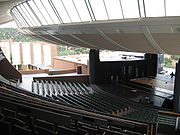
James Polshek
James Stewart Polshek is an American architect based in New York City. He is the founder of Polshek Partnership, the firm at which he was Principal Design Partner for more than four decades...
of New York
New York
New York is a state in the Northeastern region of the United States. It is the nation's third most populous state. New York is bordered by New Jersey and Pennsylvania to the south, and by Connecticut, Massachusetts and Vermont to the east...
. It was built during extensive reconstruction, which followed the tearing down of the 1968 theatre right at the end of the opera season in late August 1997. The new theatre was completed in ten months for an early July 1998 opening of new season. Like the previous opening nights of 1957 and 1968, it featured a performance of Madama Butterfly this time sung by Miriam Gauci, the Maltese soprano who had her debut in the same role at the SFO in 1987.
With fewer storm-related problems (and, with a higher stage roof providing a better view of the Westward landscape), the theater now seats 2,128 plus 106 standees, although it has a strikingly intimate feel. It added a wider and more complete roof structure, with the new front and rear portions supported by cables and joined together with a clerestory
Clerestory
Clerestory is an architectural term that historically denoted an upper level of a Roman basilica or of the nave of a Romanesque or Gothic church, the walls of which rise above the rooflines of the lower aisles and are pierced with windows. In modern usage, clerestory refers to any high windows...
window. This offers protection from the sky, but with the sides remaining open to the elements. The presence of wind baffles and Stieren Hall has helped improve exposure on the southern, windward side of the auditorium.
In 1999, as an alternative to translations by use of supertitles or surtitles, an electronic titles system
Electronic libretto
The Electronic libretto system is used primarily in opera houses and is a device which presents translations of lyrics into an audience's language or transcribes lyrics that may be difficult to understand in the sung form....
was installed in the Crosby Theatre. Invented by Figaro Systems
Figaro Systems
Figaro Systems, Inc. is an American company that provides seatback and wireless titling software and system installations to opera houses and other music performance venues worldwide. The company is based in Santa Fe, New Mexico...
of Santa Fe, and only the second one after the Metropolitan opera
Metropolitan Opera
The Metropolitan Opera is an opera company, located in New York City. Originally founded in 1880, the company gave its first performance on October 22, 1883. The company is operated by the non-profit Metropolitan Opera Association, with Peter Gelb as general manager...
's MetTitles installed in 1995, the system provides individual screens in front of each patron's seat, showing a translation of the sung text in either English or Spanish with the possibility of handling up to six other languages.
Stieren Orchestra Hall
Completed for the 2001 season under the patronage of Arthur and Jane Stieren, the hall fulfills the long-standing need for an orchestra rehearsal hall. Constructed on three levels with a total of 12650 square feet (1,175.2 m²), the building is also used for lectures, recitals, and social events. Its main level features a space which is the replica of the main stage and offstage wings, and is thus used for stage rehearsals. Large sliding doors provide access from the scenery deck level for fully staged rehearsals.Dapples Pavilion, the new cantina
Construction of the new cantina was completed in time for the opening of the 2008 season. Its arching roof matches the architecture of the main hall. Now known as the Dapples Pavilion (named after long-time supporter Florence Dapples), the cantina supplies season-long food and drink for the staff and artists, as well as functioning as the location for pre-performance buffet dinners for the general public.Rehearsal Halls
Eight rehearsal halls exist on the campus grounds, the newest, completed for the 2010 season, being the Richard Gaddes Rehearsal Hall. It reproduces the full size and layout of the stage and complements the existing full-size O'Shaughnessy Hall in addition to six others of varying sizes so that several productions can be rehearsed simultaneously.General Directors
- John Crosby (1957–2000)
- Richard Gaddes (2000–2008)
- Charles MacKay (2008–present)
Conductors in leadership positions
- John Crosby (1957–2000, de facto principal conductor)
- Alan Gilbert (2003–2006, Music Director)
- Kenneth Montgomery (2007, Acting Music Director)
- Edo de Waart (2007–2009, Chief Conductor)
- Frédéric Chaslin (2010–present, Chief Conductor)