

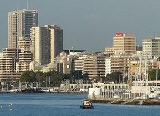
Santa Cruz de Tenerife

Encyclopedia
Santa Cruz de Tenerife is the capital (jointly with Las Palmas
), second-most populous city of the Autonomous Community
of the Canary Islands
and the 21st largest city in Spain
, with a population of 222,417 in 2009. It is, depending on sources, the 13th, 14th, or 16th-most populous metropolitan area in Spain, with the population 404,913, 481,592 or 581,947. Santa Cruz is the second largest city and metropolitan area of the European Union
outside Europe
. Santa Cruz de Tenerife is also the capital of the island of Tenerife
(most populated of archipelago and Spain) and capital of the province of Santa Cruz de Tenerife. Located in northeast quadrant of Tenerife, about 210 kilometres (130.5 mi) off the northwestern coast of Africa within the Atlantic Ocean
. Between the 1833 territorial division of Spain
and 1927 Santa Cruz de Tenerife was the sole capital of the Canary Islands, until 1927 when a decree ordered that the capital of the Canary Islands be shared, as it remains at present. The port is of great importance and is the communications hub between Europe
, Africa
and Americas
, with cruise ships arriving from many nations. The city is the nerve center on domestic and inter-island communications in the Canary Islands.
The city is home to the Parliament of the Canary Islands, the Canarian Ministry of Presidency (shared in a four-year term with Las Palmas de Gran Canaria
), one half of the ministries and boards of the Canarian Government, (the other half being located in Gran Canaria
), the Tenerife Provincial Courts and two courts of the Superior Court of Justice of the Canary Islands. There are several facilities of the La Laguna University in Santa Cruz, including the Fine Arts School and the Naval Sciences Faculty. Its harbour is one of Spain's busiest; it comprises three sectors. It is important for commercial and passenger traffic, as well as for being a major stopover for cruisers en route from Europe to the Caribbean. The city also has one of the world's largest carnival
s. The Carnival of Santa Cruz de Tenerife
now aspires to become a World Heritage Site
, and is the most important of Spain and the second largest in the world.
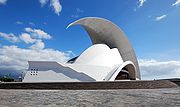
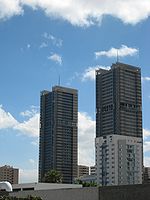
The main landmarks of the city include the Auditorio de Tenerife
(Auditorium of Tenerife), the Santa Cruz Towers (Torres de Santa Cruz
) and the Iglesia de la Concepción
. Santa Cruz de Tenerife hosts the first headquarters of the Center UNESCO
in the Canary Islands. The city is a melting pot of diverse cultures that give it a cosmopolitan character. The largest distinct communities have immigrants from: Latin America, Africa and Western Europe. In recent years the city of Santa Cruz de Tenerife has had a significant aug bizarre constructions, the horizon (Skyline
) is the sixth in height across the country, only behind Madrid
, Benidorm
, Barcelona
, Valencia and Bilbao
.
name), Puerto de Santiago Santa Cruz de Tenerife and Santa Cruz de Tenerife (current), which means: "holy cross
in the island Tenerife," in memory of the foundation of the city, when a Christian cross
was planted in the place that is now the center of town.
, the first inhabitants of the island, as Añazo. Later, it became one of the most important ports of the Atlantic and the Canary Islands, a status it retains to this day. This former fishermen's village rose to prominence after a Volcano destroyed the port of Garachico
in the 18th century. Santa Cruz became the major port on the Island. It first won its independence from La Laguna and, in the 19th century, was awarded the status of Capital of the Canary Islands province by King Ferdinand VII.
Between 1833 and 1927 Santa Cruz de Tenerife was the sole capital of the Canary Islands, until in 1927 a decree ordered that the capital of the Canary Islands is shared with the Las Palmas, it remains as at present.
In recent years, it has become clear that there exists a de facto union with neighbouring city San Cristóbal de La Laguna
(141,627 inhabitants as in 2005 census) due to the rapid population growth and lack of empty space between both, forming a merged metropolitan union home to 420,198 inhabitants including nearby municipalities Tegueste, Candelaria and El Rosario. Regarding this situation, the mayor of Santa Cruz, Miguel Zerolo Aguilar and his La Laguna counterpart, Ana María Oramas Moro, both belonging to the Canarian Coalition
, have stated several times to local media that they share a willingness to proceed to a full political union between their municipalities, even though the decision is due to be postponed to a date after the forthcoming local elections in 2007.
from Latin America
and Africa. Santa Cruz de Tenerife and the city of San Cristóbal de La Laguna
are physically and urban together, so that together have a population of over 382,331 inhabitants.
Ethnically, the population is a mix of Spanish, Portuguese, German, British, and Latin American (especially Cuban and Venezuelan), as well as Northern and Sub-Sahara African. There are also important historical minorities such as Indians (Sindhi
), Koreans (see Koreans in Spain#Santa Cruz) and lately Russians
. The majority of the population professes the Catholic
religion, but there are also the communities of Hindu
s and Muslim
s. In Santa Cruz de Tenerife crimes decreased by 8.65% and 5.01% a fault. The city is also known for tolerance of its inhabitants, in fact, Santa Cruz de Tenerife was the first city of the Canary Islands in which waved the rainbow flag
alongside the flag of the city council in June 2008.
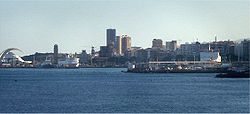
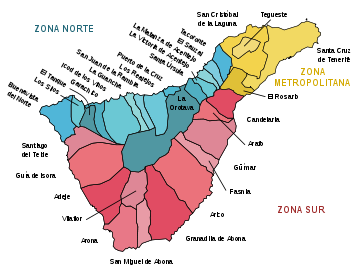 The Santa Cruz de Tenerife-La Laguna Metropolitan Area the second largest city and metropolitan area of the European Union
outside Europe
. According to data provided by the Canary Islands Government and Cabildo de Tenerife
the metropolitan area of Santa Cruz de Tenerife is composed of the municipalities of Santa Cruz de Tenerife, San Cristobal de La Laguna, El Rosario
and Tegueste with a population of 404,913 inhabitants in 2008, 322.13 km2, and a population density of 1,156.33 inhabitants/km2.
According to AUDES5 this conurbation also comprises the municipalities of Tacoronte and El Sauzal
, bringing the total population of the urban population would reach 581.947 (2008).
The cities of Santa Cruz and San Cristobal de La Laguna and urban are physically linked, so that together have a population of over 382,331 inhabitants. What makes them the largest urban area in the Canaries (independent of municipal lines).
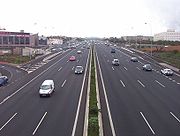 Santa Cruz, being the centre of the Tenerife Metropolitan Area, is the logical hub for the island's motorway network.
The 85 km. long TF1 Motorway
links the south of the island including Playa de las Américas
and other southern resorts and towns with its capital. The motorway itself starts near the Auditorio and allows to access Santa Cruz and La Laguna through three different ways.
TF5 Motorway
links Santa Cruz with the Puerto de la Cruz
, La Orotava and the northern side of the island, passing right through La Laguna before entering Santa Cruz.
The Santa Cruz harbour is one of the busiest in Spain; three quays host regular ferries, fast ferries, cruise ships and merchant ships.
Tenerife North Airport lies on the TF5 Motorway
on the outskirts of the city.
The mostly tourist Tenerife South Airport
ranks 47th in Spain and is located next to the TF1 Motorway
, 75 km. south of Santa Cruz. There are plans to link this airport to the capital with a railway network.
The Intercambiador
is in the Avenida 3 de Mayo, hub for all TITSA
bus lines and the start of the new Tenerife Tram
service, and major parking places.
The first tram line (opened in 2007) line 1, starts at the Intercambiador
, and ends at La Laguna's Avenida Trinidad, with a planned extension to Tenerife North Airport A second line between La Cuesta and Tíncer opened in 2009 (connecting with Line 1 at Hospital Universitario and El Cardonal). Main article Tenerife Tram
.jpg) The economy of Santa Cruz relies mainly on services. Trade, tourism, import-export, the seaport and the presence of the major political and financial institutions, as well as the most important companies, guarantee a strong economic activity and development. The building sector is relevant, while industry, apart from the oil refinery
The economy of Santa Cruz relies mainly on services. Trade, tourism, import-export, the seaport and the presence of the major political and financial institutions, as well as the most important companies, guarantee a strong economic activity and development. The building sector is relevant, while industry, apart from the oil refinery
and food processing, is minor. The city of Santa Cruz has refurnished many of its quarters, modernised its infrastructure, built brand new areas, malls, high buildings and some charismatic structures, such as Calatrava
´s Auditorio or the Congress Hall, César Manrique
´s Marina or the not yet completed Óscar Domínguez
Museum of Modern Art and Culture (IODACC) and the new Plaza de España layout, both by Basel
-based Pritzker Prize
winner studio Herzog & de Meuron
. The work to renew the concept under man-made Las Teresitas Beach is under the direction of French architect Dominique Perrault
.
, which makes Santa Cruz de Tenerife, a spanish cities with more than futuristic buildings.
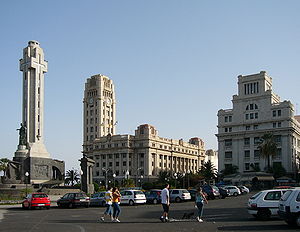
twisted by the wind.
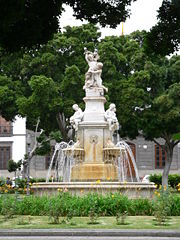
But surely the whole of the Exhibition of Outdoor Sculpture in Santa Cruz de Tenerife is the most important. Situated along the Ramblas and the Parque Garcia Sanabria, and contains works by artists such as Henry Moore
, Andreu Alfaro, Martin Chirino, Joan Miró
and Óscar Domínguez
, among others.
 Santa Cruz has not been characterized by an intense night life, in contrast to the nearby university town of La Laguna
. Nevertheless, there are several clubs and pubs spread across the city. The best known are in the Parque Marítimo César Manrique, May 3 Avenue and back, and in La Noria street Residencial Anaga. Moreover, in the area of Industrial Mayorazgo, three new clubs have opened. There are also pubs that have survived without belonging to a particular location for leisure, as the platform, near the Bullring, which opened its doors in 1991.
It has recently gained importance as a leisure street Antonio Dominguez Alfonso (popularly known as Calle La Noria) and adjacent in the vicinity of the Church of the Conception
. After several years of neglect, all the houses in this area has been recovered by the local hotel as tapas, light dinner and drinks. This street also hosts the headquarters of several murgas, music groups linked to Carnival
, and independent organ of Events and Recreation.
Popularly known as the Avenida de Anaga (as known to all roads adjacent to the port) is in his section of Avenida Francisco la Roche a classic dinner and drinks first. During the 90s was the nerve center of nightlife, the best known local focus of the city. Although many of them closed down because of licenses and noise, attempt to regain its glory today. To that end, the City will undertake various initiatives through 2009.
In 2007, as decided by the City Council and managed by the Society for Development, is set in motion an ambitious plan for revitalization of the city under the brand name "Santa Cruz + Viva ', in accordance with Cabildo Insular de Tenerife
and Government of the Canary Islands.
and El Día
), as well as editors of newspapers regional La Gaceta de Canarias.
Also located in the city the headquarters of various TV channels, most of which broadcast on the island: Spanish Television
in the Canary Islands, Television Canaria
, Antena 3 TV Canary Islands
, Television Day, Canal 7 Atlantic, Channel 4 Tenerife, Channel 8
, etc.
Most radio stations are also located in the city. Radio Club Tenerife (Cadena SER
), RNE, Teide Radio-Onda Cero
, Radio Day
, Radio ECCA etc.. In the city is the headquarters of the TV Canaria
.
s.
In 1656, Admiral Robert Blake
totally destroyed a Spanish silver fleet of 16 ships for the loss of none of his own, despite being under fire from shore batteries and attacking and withdrawing on the tide. 50 years later, the British under John Genings were defeated when they attacked the island on November 6, 1706 during the War of the Spanish Succession
.
In 1797 Admiral
Horatio Nelson met with bloody defeat in an attempt
to storm the harbour. It was at this battle that Nelson lost his right arm having been hit before he had stepped off the ship's boat. It was on Santiago's day and that is the reason for having Santiago's sword cutting the lion's head as a symbol of the British defeat.
 The seal of Santa Cruz de Tenerife has the characteristic features of the Loyal, Noble, Invicta and very beneficial Town, Port and Plaza de Santa Cruz de Santiago de Tenerife. Curiously, it is not square or shield-shaped, but oval. In a blue background with anchors and castles have a green cross, the symbol of the Foundation Cross, which gave the city its name. Behind the cross is a sword of Santiago in red, reminiscent of the day in which the city of Santiago defeated Horatio Nelson. Under this sword are three lion heads facing right (the shield), which symbolizes the victories of the city over Nelson's English privateers, Blake and Jennings. It has castles, anchors and an island of silver. Also holds the Medal of Charity and the Crown. The crown of laurel
and olive trees surrounding the shield is the symbol of victory for the city to each and every one of the attacks.
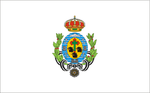 The flag of Santa Cruz de Tenerife is all white with the municipal shield in the center. Granted by Royal Warrant of King Charles IV
of 28 August 1803. On a white cloth, coat of arms of the city. The white, the characteristic of the Bourbon dynasty, refers to fidelity to the city of Santa Cruz de Tenerife in the Royal House of Spain.
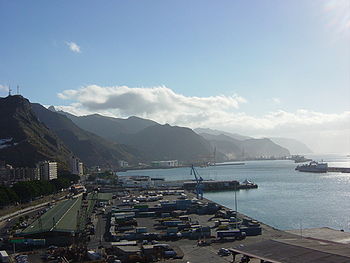 The Port of Santa Cruz de Tenerife
is a fishing port, commercial, passenger and sports from the city of Santa Cruz de Tenerife, capital of the island, located in the Atlantic Ocean
. It is managed by the Port Authority of Santa Cruz de Tenerife.
It is the first fishing port in the Canary Islands
with approximately 7,500 tons of fish caught, according to the Statistical Yearbook of the State Ports 2006 (the latest of which is changing). Following this report is the largest port number of passengers recorded.
: 61%. Sunshine hours average at 2,868 per year, from 180 in November and January (6 hours of sunshine a day) to 310 in July and August (10 hours of sunshine a day). Precipitation per year is only 214 millimetres (8.4 in), concentrated heavily between November and March: May to September are normally completely dry.
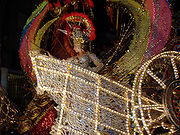
, thousands of people take to the streets each year for over a week. On January 18, 1980 it was declared a Fiesta of International Tourist Interest by the Secretary of State for Tourism, and is one of the world's largest carnivals. At present, the Carnival of Santa Cruz hopes to become a World Heritage Site
.
, Mango
, H&M
, Ordning&Reda, El Corte Inglés
, Ikea
, C&A
, McDonalds and Burger King
are much present on the island. Not only the wide range of shops makes the city attractive but the lower prices found in many items, such as tobacco, alcohol, electronic devices, beauty products, sunglasses or even food or coffee. They are indeed much lower than in most cities of Western Europe
including Spain, due to the very special and much lighter taxation on goods enjoyed on the Canary Islands.
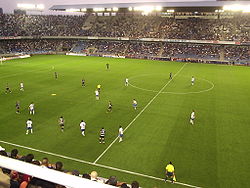
Honours: In 1991, Argentine Jorge Valdano took charge of the club as manager, and would help rob former side Real Madrid of two consecutive league titles in the last round, to the benefit of FC Barcelona
; in the first season, the Canary Islands
outfit barely avoided relegation, but would finish in a best-ever fifth position in the following year, eventually reaching the round of 16 in the subsequent UEFA Cup
, losing to Juventus FC 2–4 on aggregate. Fifth two positions in the League. It is the only Canary equipment that has played an European glass.
.jpg)
, Spain
San Antonio
, USA Santa Cruz, California
, USA Atlanta, USA Santa Cruz de la Sierra
, Bolivia
Caracas
, Venezuela
Cádiz
, Spain Rio de Janeiro
, Brazil
Nice
, France
Santa Cruz del Norte
, Cuba
Guatemala City
, Guatemala
Miami-Dade County, Florida
, USA St. Petersburg, Russia
Santo Domingo
, Dominican Republic
Corporation (Multilingual)
Las Palmas de Gran Canaria
Las Palmas de Gran Canaria commonly known as Las Palmas is the political capital, jointly with Santa Cruz, the most populous city in the Autonomous Community of the Canary Islands and the ninth largest city in Spain, with a population of 383,308 in 2010. Nearly half of the people of the island...
), second-most populous city of the Autonomous Community
Autonomous communities of Spain
An autonomous community In other languages of Spain:*Catalan/Valencian .*Galician .*Basque . The second article of the constitution recognizes the rights of "nationalities and regions" to self-government and declares the "indissoluble unity of the Spanish nation".Political power in Spain is...
of the Canary Islands
Canary Islands
The Canary Islands , also known as the Canaries , is a Spanish archipelago located just off the northwest coast of mainland Africa, 100 km west of the border between Morocco and the Western Sahara. The Canaries are a Spanish autonomous community and an outermost region of the European Union...
and the 21st largest city in Spain
Spain
Spain , officially the Kingdom of Spain languages]] under the European Charter for Regional or Minority Languages. In each of these, Spain's official name is as follows:;;;;;;), is a country and member state of the European Union located in southwestern Europe on the Iberian Peninsula...
, with a population of 222,417 in 2009. It is, depending on sources, the 13th, 14th, or 16th-most populous metropolitan area in Spain, with the population 404,913, 481,592 or 581,947. Santa Cruz is the second largest city and metropolitan area of the European Union
European Union
The European Union is an economic and political union of 27 independent member states which are located primarily in Europe. The EU traces its origins from the European Coal and Steel Community and the European Economic Community , formed by six countries in 1958...
outside Europe
Europe
Europe is, by convention, one of the world's seven continents. Comprising the westernmost peninsula of Eurasia, Europe is generally 'divided' from Asia to its east by the watershed divides of the Ural and Caucasus Mountains, the Ural River, the Caspian and Black Seas, and the waterways connecting...
. Santa Cruz de Tenerife is also the capital of the island of Tenerife
Tenerife
Tenerife is the largest and most populous island of the seven Canary Islands, it is also the most populated island of Spain, with a land area of 2,034.38 km² and 906,854 inhabitants, 43% of the total population of the Canary Islands. About five million tourists visit Tenerife each year, the...
(most populated of archipelago and Spain) and capital of the province of Santa Cruz de Tenerife. Located in northeast quadrant of Tenerife, about 210 kilometres (130.5 mi) off the northwestern coast of Africa within the Atlantic Ocean
Atlantic Ocean
The Atlantic Ocean is the second-largest of the world's oceanic divisions. With a total area of about , it covers approximately 20% of the Earth's surface and about 26% of its water surface area...
. Between the 1833 territorial division of Spain
1833 territorial division of Spain
The 1833 territorial division of Spain divided Spain into provinces, classified into "historic regions" . on the official web site of the government of the Canary Islands, accessed 2009-12-31...
and 1927 Santa Cruz de Tenerife was the sole capital of the Canary Islands, until 1927 when a decree ordered that the capital of the Canary Islands be shared, as it remains at present. The port is of great importance and is the communications hub between Europe
Europe
Europe is, by convention, one of the world's seven continents. Comprising the westernmost peninsula of Eurasia, Europe is generally 'divided' from Asia to its east by the watershed divides of the Ural and Caucasus Mountains, the Ural River, the Caspian and Black Seas, and the waterways connecting...
, Africa
Africa
Africa is the world's second largest and second most populous continent, after Asia. At about 30.2 million km² including adjacent islands, it covers 6% of the Earth's total surface area and 20.4% of the total land area...
and Americas
Americas
The Americas, or America , are lands in the Western hemisphere, also known as the New World. In English, the plural form the Americas is often used to refer to the landmasses of North America and South America with their associated islands and regions, while the singular form America is primarily...
, with cruise ships arriving from many nations. The city is the nerve center on domestic and inter-island communications in the Canary Islands.
The city is home to the Parliament of the Canary Islands, the Canarian Ministry of Presidency (shared in a four-year term with Las Palmas de Gran Canaria
Las Palmas de Gran Canaria
Las Palmas de Gran Canaria commonly known as Las Palmas is the political capital, jointly with Santa Cruz, the most populous city in the Autonomous Community of the Canary Islands and the ninth largest city in Spain, with a population of 383,308 in 2010. Nearly half of the people of the island...
), one half of the ministries and boards of the Canarian Government, (the other half being located in Gran Canaria
Gran Canaria
Gran Canaria is the second most populous island of the Canary Islands, with a population of 838,397 which constitutes approximately 40% of the population of the archipelago...
), the Tenerife Provincial Courts and two courts of the Superior Court of Justice of the Canary Islands. There are several facilities of the La Laguna University in Santa Cruz, including the Fine Arts School and the Naval Sciences Faculty. Its harbour is one of Spain's busiest; it comprises three sectors. It is important for commercial and passenger traffic, as well as for being a major stopover for cruisers en route from Europe to the Caribbean. The city also has one of the world's largest carnival
Carnival
Carnaval is a festive season which occurs immediately before Lent; the main events are usually during February. Carnaval typically involves a public celebration or parade combining some elements of a circus, mask and public street party...
s. The Carnival of Santa Cruz de Tenerife
Carnival of Santa Cruz de Tenerife
The Carnival of Santa Cruz de Tenerife is held each February in Santa Cruz de Tenerife, the capital of the largest of the Canary Islands, and attracts people from all over the world. It is considered the second-most popular and internationally-known carnival, after the one held in Rio de Janeiro...
now aspires to become a World Heritage Site
World Heritage Site
A UNESCO World Heritage Site is a place that is listed by the UNESCO as of special cultural or physical significance...
, and is the most important of Spain and the second largest in the world.
The main landmarks of the city include the Auditorio de Tenerife
Auditorio de Tenerife
The Auditorio de Tenerife "Adán Martín" , was designed by architect Santiago Calatrava Valls. It is located on the Avenue of the Constitution in the Canarian capital, Santa Cruz de Tenerife , and next to the Atlantic Ocean in the southern part of Port of Santa Cruz de Tenerife...
(Auditorium of Tenerife), the Santa Cruz Towers (Torres de Santa Cruz
Torres de Santa Cruz
The Torres de Santa Cruz is a residential complex composed of the twin towers located in the city of Santa Cruz de Tenerife...
) and the Iglesia de la Concepción
Iglesia de la Concepción (Santa Cruz de Tenerife)
The Iglesia-Parroquia Matriz de Nuestra Señora de La Concepción is a Catholic church located in the city of Santa Cruz de Tenerife...
. Santa Cruz de Tenerife hosts the first headquarters of the Center UNESCO
UNESCO
The United Nations Educational, Scientific and Cultural Organization is a specialized agency of the United Nations...
in the Canary Islands. The city is a melting pot of diverse cultures that give it a cosmopolitan character. The largest distinct communities have immigrants from: Latin America, Africa and Western Europe. In recent years the city of Santa Cruz de Tenerife has had a significant aug bizarre constructions, the horizon (Skyline
Skyline
A skyline is the overall or partial view of a city's tall buildings and structures consisting of many skyscrapers in front of the sky in the background. It can also be described as the artificial horizon that a city's overall structure creates. Skylines serve as a kind of fingerprint of a city, as...
) is the sixth in height across the country, only behind Madrid
Madrid
Madrid is the capital and largest city of Spain. The population of the city is roughly 3.3 million and the entire population of the Madrid metropolitan area is calculated to be 6.271 million. It is the third largest city in the European Union, after London and Berlin, and its metropolitan...
, Benidorm
Benidorm
Benidorm is a coastal town and municipality located in the comarca of Marina Baixa, in the province of Alicante, Valencian community, Spain, by the Western Mediterranean....
, Barcelona
Barcelona
Barcelona is the second largest city in Spain after Madrid, and the capital of Catalonia, with a population of 1,621,537 within its administrative limits on a land area of...
, Valencia and Bilbao
Bilbao
Bilbao ) is a Spanish municipality, capital of the province of Biscay, in the autonomous community of the Basque Country. With a population of 353,187 , it is the largest city of its autonomous community and the tenth largest in Spain...
.
Etymology
The area where Santa Cruz currently lies belonged to Menceyato Guanche Anaga, which was the most easterly of the island. The city that is now Santa Cruz had a few names throughout its history: Añazo (GuancheGuanche language
Guanche is an extinct language that was spoken by the Guanches of the Canary Islands until the 16th or 17th century. It is only known today through a few sentences and individual words recorded by early travellers, supplemented by several placenames, as well as some words assimilated into the...
name), Puerto de Santiago Santa Cruz de Tenerife and Santa Cruz de Tenerife (current), which means: "holy cross
Cross
A cross is a geometrical figure consisting of two lines or bars perpendicular to each other, dividing one or two of the lines in half. The lines usually run vertically and horizontally; if they run obliquely, the design is technically termed a saltire, although the arms of a saltire need not meet...
in the island Tenerife," in memory of the foundation of the city, when a Christian cross
Christian cross
The Christian cross, seen as a representation of the instrument of the crucifixion of Jesus Christ, is the best-known religious symbol of Christianity...
was planted in the place that is now the center of town.
History
The area on which now stands the city and the municipality of Santa Cruz de Tenerife has been the subject of human occupation since the time of the Guanches, approximately 2000 years ago, as attested by the archaeological sites found. The area was known to the GuanchesGuanches
Guanches is the name given to the aboriginal Berber inhabitants of the Canary Islands. It is believed that they migrated to the archipelago sometime between 1000 BCE and 100 BCE or perhaps earlier...
, the first inhabitants of the island, as Añazo. Later, it became one of the most important ports of the Atlantic and the Canary Islands, a status it retains to this day. This former fishermen's village rose to prominence after a Volcano destroyed the port of Garachico
Garachico
Garachico is a municipality and town on the northern coast of Tenerife, It is located on the TF42 Road about 60km West of the capital Santa Cruz de Tenerife , 50km from Tenerife North Airport and 67 km from Tenerife South Airport. The town itself nestles below a 500m+ cliff...
in the 18th century. Santa Cruz became the major port on the Island. It first won its independence from La Laguna and, in the 19th century, was awarded the status of Capital of the Canary Islands province by King Ferdinand VII.
Between 1833 and 1927 Santa Cruz de Tenerife was the sole capital of the Canary Islands, until in 1927 a decree ordered that the capital of the Canary Islands is shared with the Las Palmas, it remains as at present.
In recent years, it has become clear that there exists a de facto union with neighbouring city San Cristóbal de La Laguna
San Cristóbal de la Laguna
San Cristóbal de La Laguna is a city and municipality in the northern part of the island of Tenerife in the Province of Santa Cruz de Tenerife, on the Canary Islands . The city is third-most populous city of the archipelago and second-most populous city of the island. It is a suburban area of the...
(141,627 inhabitants as in 2005 census) due to the rapid population growth and lack of empty space between both, forming a merged metropolitan union home to 420,198 inhabitants including nearby municipalities Tegueste, Candelaria and El Rosario. Regarding this situation, the mayor of Santa Cruz, Miguel Zerolo Aguilar and his La Laguna counterpart, Ana María Oramas Moro, both belonging to the Canarian Coalition
Canarian Coalition
The Canarian Coalition , abbreviated to CC, is a Canarian nationalist and liberal political party in the Canary Islands of Spain. The party aim is for greater autonomy for the islands, but short of independence. The party has governed the Canary Islands since 1993...
, have stated several times to local media that they share a willingness to proceed to a full political union between their municipalities, even though the decision is due to be postponed to a date after the forthcoming local elections in 2007.
Administrative divisions
Santa Cruz is divided administratively into five districts, which in turn are subdivided into districts, not necessarily consistent with the traditional neighborhoods.| No | District | Population |
|---|---|---|
| 1 | Anaga | 14.135 |
| 2 | Centro-Ifara | 53.652 |
| 3 | La Salud-La Salle | 70.120 |
| 4 | Ofra-Costa Sur | 47.977 |
| 5 | Distrito Suroeste | 41.136 |
Demographics
In 1990, the population peaked above the 200,000 mark; it next hit a record level in the 2003 census. The population has continued to increase, with immigrationImmigration
Immigration is the act of foreigners passing or coming into a country for the purpose of permanent residence...
from Latin America
Latin America
Latin America is a region of the Americas where Romance languages – particularly Spanish and Portuguese, and variably French – are primarily spoken. Latin America has an area of approximately 21,069,500 km² , almost 3.9% of the Earth's surface or 14.1% of its land surface area...
and Africa. Santa Cruz de Tenerife and the city of San Cristóbal de La Laguna
San Cristóbal de la Laguna
San Cristóbal de La Laguna is a city and municipality in the northern part of the island of Tenerife in the Province of Santa Cruz de Tenerife, on the Canary Islands . The city is third-most populous city of the archipelago and second-most populous city of the island. It is a suburban area of the...
are physically and urban together, so that together have a population of over 382,331 inhabitants.
Ethnically, the population is a mix of Spanish, Portuguese, German, British, and Latin American (especially Cuban and Venezuelan), as well as Northern and Sub-Sahara African. There are also important historical minorities such as Indians (Sindhi
Sindhi people
Sindhis are a Sindhi speaking socio-ethnic group of people originating from Sindh, a province Formerly of British India, now in Pakistan. Today Sindhis that live in Pakistan belong to various religious denominations including Islam, Zoroastrianism, Hinduism, Sikhism and Christianity...
), Koreans (see Koreans in Spain#Santa Cruz) and lately Russians
Russians
The Russian people are an East Slavic ethnic group native to Russia, speaking the Russian language and primarily living in Russia and neighboring countries....
. The majority of the population professes the Catholic
Catholic
The word catholic comes from the Greek phrase , meaning "on the whole," "according to the whole" or "in general", and is a combination of the Greek words meaning "about" and meaning "whole"...
religion, but there are also the communities of Hindu
Hindu
Hindu refers to an identity associated with the philosophical, religious and cultural systems that are indigenous to the Indian subcontinent. As used in the Constitution of India, the word "Hindu" is also attributed to all persons professing any Indian religion...
s and Muslim
Muslim
A Muslim, also spelled Moslem, is an adherent of Islam, a monotheistic, Abrahamic religion based on the Quran, which Muslims consider the verbatim word of God as revealed to prophet Muhammad. "Muslim" is the Arabic term for "submitter" .Muslims believe that God is one and incomparable...
s. In Santa Cruz de Tenerife crimes decreased by 8.65% and 5.01% a fault. The city is also known for tolerance of its inhabitants, in fact, Santa Cruz de Tenerife was the first city of the Canary Islands in which waved the rainbow flag
Rainbow flag
A rainbow flag is a multi-colored flag consisting of stripes in the colors of the rainbow. The actual colors shown differ, but many of the designs are based on the traditional scheme of red, orange, yellow, green, blue, indigo and violet, or some more modern division of the rainbow spectrum .The...
alongside the flag of the city council in June 2008.
| Year | Population | Density |
|---|---|---|
| 1991 | 200,172 | 1,329.52/km2 |
| 1996 | 203,787 | 1,353.53/km2 |
| 2001 | 188,477 | 1,251.84/km2 |
| 2002 | 217,414 | 1,440.07/km2 |
| 2003 | 220,022 | 1,461.36/km2 |
| 2004 | 219,466 | 1,457.66/km2 |
| 2006 | 221,956 | 1,474.20/km2 |
| 2007 | 220.902 | 1.467,20/km2 |
| 2008 | 226.232 | 1,474.20/km2 |
Metropolitan area
European Union
The European Union is an economic and political union of 27 independent member states which are located primarily in Europe. The EU traces its origins from the European Coal and Steel Community and the European Economic Community , formed by six countries in 1958...
outside Europe
Europe
Europe is, by convention, one of the world's seven continents. Comprising the westernmost peninsula of Eurasia, Europe is generally 'divided' from Asia to its east by the watershed divides of the Ural and Caucasus Mountains, the Ural River, the Caspian and Black Seas, and the waterways connecting...
. According to data provided by the Canary Islands Government and Cabildo de Tenerife
Cabildo de Tenerife
Cabildo de Tenerife is the governing body of the island of Tenerife , Spain. It was established on 16 March 1913 in Santa Cruz de Tenerife, in a session held by the City Council, it was at that time, the first corporation...
the metropolitan area of Santa Cruz de Tenerife is composed of the municipalities of Santa Cruz de Tenerife, San Cristobal de La Laguna, El Rosario
El Rosario, Santa Cruz de Tenerife
El Rosario is a municipality of the northeastern part of the island of Tenerife in the Santa Cruz de Tenerife province, on the Canary Islands. The city is also a suburban area of the Santa Cruz de Tenerife area...
and Tegueste with a population of 404,913 inhabitants in 2008, 322.13 km2, and a population density of 1,156.33 inhabitants/km2.
According to AUDES5 this conurbation also comprises the municipalities of Tacoronte and El Sauzal
El Sauzal
El Sauzal is located on the north coast of Tenerife 19 to 20 km E of Puerto de la Cruz, about 20 km SSW of the island's capital, Santa Cruz de Tenerife, NE of Los Cristianos and Las Américas of Arona and WSW of Tenerife North Airport.The population is 8,267 , its density is 451.50/km² and the area...
, bringing the total population of the urban population would reach 581.947 (2008).
The cities of Santa Cruz and San Cristobal de La Laguna and urban are physically linked, so that together have a population of over 382,331 inhabitants. What makes them the largest urban area in the Canaries (independent of municipal lines).
Infrastructure
The 85 km. long TF1 Motorway
TF1 Motorway
The TF-1 is a superhighway encircling the eastern and the southern parts of the island of Tenerife . The TF-1 motorway runs from the capital Santa Cruz in the north to Adeje with its major tourist resorts Los Cristianos and Playa de las Américas in the south of the island...
links the south of the island including Playa de las Américas
Playa de las Américas
Playa de las Américas is a purpose-built holiday resort in the northern part of the Municipality of Arona, close to the adjoining Municipality of Adeje in the south of Tenerife, one of the Canary Islands. It was built in the 1960s beside the town of Los Cristianos and stretching northward to the...
and other southern resorts and towns with its capital. The motorway itself starts near the Auditorio and allows to access Santa Cruz and La Laguna through three different ways.
TF5 Motorway
TF5 Motorway
The TF5 Motorway is a motorway in the Canary Islands, north of Tenerife running from Santa Cruz de Tenerife to Puerto de la Cruz....
links Santa Cruz with the Puerto de la Cruz
Puerto de la Cruz
Puerto de la Cruz is a city and municipality located in Spain, on the north coast of Tenerife island, in the Orotava Valley...
, La Orotava and the northern side of the island, passing right through La Laguna before entering Santa Cruz.
The Santa Cruz harbour is one of the busiest in Spain; three quays host regular ferries, fast ferries, cruise ships and merchant ships.
Tenerife North Airport lies on the TF5 Motorway
TF5 Motorway
The TF5 Motorway is a motorway in the Canary Islands, north of Tenerife running from Santa Cruz de Tenerife to Puerto de la Cruz....
on the outskirts of the city.
The mostly tourist Tenerife South Airport
Tenerife South Airport
Tenerife South Airport , previously known as Tenerife South-Reina Sofia Airport, is one of two international airports located on the island of Tenerife, the largest of the Canary Islands . Between its opening and the end of 2006, a total of 173,912,207 passengers passed through the airport...
ranks 47th in Spain and is located next to the TF1 Motorway
TF1 Motorway
The TF-1 is a superhighway encircling the eastern and the southern parts of the island of Tenerife . The TF-1 motorway runs from the capital Santa Cruz in the north to Adeje with its major tourist resorts Los Cristianos and Playa de las Américas in the south of the island...
, 75 km. south of Santa Cruz. There are plans to link this airport to the capital with a railway network.
The Intercambiador
Intercambiador
The Intercambiador in Santa Cruz de Tenerife, the capital of Tenerife, combines the main station of the TITSA public bus service with parking for private vehicles and access to trams. The station was opened on June 17, 2006.It is located on Avenida Tres de Mayo in downtown Santa Cruz...
is in the Avenida 3 de Mayo, hub for all TITSA
TITSA
TITSA is the Transportes interurbanos de Tenerife, S.A. which operates the only public bus service in Tenerife, on the Canary Islands. It carries over 60 million travellers a year, has a fleet of, approx., 600 vehicles, takes children to school, old persons to hospital, and offers the tourist a...
bus lines and the start of the new Tenerife Tram
Tenerife Tram
Tenerife Tram is a light rail or tram service located on the island of Tenerife, one of the Canary Islands . It is operated by Metropolitano de Tenerife, a limited company 80% owned by the Cabildo of Tenerife. Service started on 2 June 2007 over a line which links the Intercambiador in Santa...
service, and major parking places.
The first tram line (opened in 2007) line 1, starts at the Intercambiador
Intercambiador
The Intercambiador in Santa Cruz de Tenerife, the capital of Tenerife, combines the main station of the TITSA public bus service with parking for private vehicles and access to trams. The station was opened on June 17, 2006.It is located on Avenida Tres de Mayo in downtown Santa Cruz...
, and ends at La Laguna's Avenida Trinidad, with a planned extension to Tenerife North Airport A second line between La Cuesta and Tíncer opened in 2009 (connecting with Line 1 at Hospital Universitario and El Cardonal). Main article Tenerife Tram
Tenerife Tram
Tenerife Tram is a light rail or tram service located on the island of Tenerife, one of the Canary Islands . It is operated by Metropolitano de Tenerife, a limited company 80% owned by the Cabildo of Tenerife. Service started on 2 June 2007 over a line which links the Intercambiador in Santa...
Economy
Refinería de Santa Cruz de Tenerife
The Refinería de Santa Cruz de Tenerife is the industry's largest and most important of the Canary Islands . Is controversial because of its large size, which prevents the growth of the city....
and food processing, is minor. The city of Santa Cruz has refurnished many of its quarters, modernised its infrastructure, built brand new areas, malls, high buildings and some charismatic structures, such as Calatrava
Santiago Calatrava
Santiago Calatrava Valls is a Spanish architect, sculptor and structural engineer whose principal office is in Zürich, Switzerland. Classed now among the elite designers of the world, he has offices in Zürich, Paris, Valencia, and New York City....
´s Auditorio or the Congress Hall, César Manrique
César Manrique
César Manrique was an artist and an architect.-Biography:Manrique grew up in the area of San Ginés lagoon. At age 23, he participated in his first exhibition in Arrecife. He attended the University of La Laguna. In 1945, Manrique attended the art school San Fernando in Madrid for five years...
´s Marina or the not yet completed Óscar Domínguez
Óscar Domínguez
Oscar M. Domínguez was a Spanish surrealist painter.Born in San Cristóbal de La Laguna on the island of Tenerife, Domínguez spent his youth with his grandmother in Tacoronte and devoted himself to painting at a young age after suffering a serious illness which affected his growth and caused a...
Museum of Modern Art and Culture (IODACC) and the new Plaza de España layout, both by Basel
Basel
Basel or Basle In the national languages of Switzerland the city is also known as Bâle , Basilea and Basilea is Switzerland's third most populous city with about 166,000 inhabitants. Located where the Swiss, French and German borders meet, Basel also has suburbs in France and Germany...
-based Pritzker Prize
Pritzker Prize
The Pritzker Architecture Prize is awarded annually by the Hyatt Foundation to honour "a living architect whose built work demonstrates a combination of those qualities of talent, vision and commitment, which has produced consistent and significant contributions to humanity and the built...
winner studio Herzog & de Meuron
Herzog & de Meuron
Herzog & de Meuron Architekten, BSA/SIA/ETH is a Swiss architecture firm, founded and headquartered in Basel, Switzerland in 1978. The careers of founders and senior partners Jacques Herzog , and Pierre de Meuron , closely paralleled one another, with both attending the Swiss Federal Institute of...
. The work to renew the concept under man-made Las Teresitas Beach is under the direction of French architect Dominique Perrault
Dominique Perrault
Dominique Perrault is a French architect. He became world known for the design of the French National Library, distinguished with the Mies van der Rohe Prize in 1996....
.
Arts and Culture
Santa Cruz de Tenerife has a lot of buildings, especially stresses the contemporary architectureContemporary architecture
Contemporary architecture is generally speaking the architecture of the present time.The term contemporary architecture is also applied to a range of styles of recently built structures and space which are optimized for current use....
, which makes Santa Cruz de Tenerife, a spanish cities with more than futuristic buildings.
Cultural Areas
- Auditorio de TenerifeAuditorio de TenerifeThe Auditorio de Tenerife "Adán Martín" , was designed by architect Santiago Calatrava Valls. It is located on the Avenue of the Constitution in the Canarian capital, Santa Cruz de Tenerife , and next to the Atlantic Ocean in the southern part of Port of Santa Cruz de Tenerife...
: the work of Spanish architect Santiago CalatravaSantiago CalatravaSantiago Calatrava Valls is a Spanish architect, sculptor and structural engineer whose principal office is in Zürich, Switzerland. Classed now among the elite designers of the world, he has offices in Zürich, Paris, Valencia, and New York City....
. Is an emblematic building of Spanish architectureSpanish architectureSpanish architecture refers to architecture carried out in any area in what is now modern-day Spain, and by Spanish architects worldwide. The term includes buildings within the current geographical limits of Spain before this name was given to those territories...
. The Tenerife Auditorium stands northeast of the Marine Park. Their great sailing boat simulating has become a symbol of the city, island and archipelago. The auditorium has two rooms and a chamber symphony. It is the seat of Orquesta Sinfónica de TenerifeOrquesta Sinfónica de TenerifeThe Orquesta Sinfónica de Tenerife is an orchestra in the city of Santa Cruz de Tenerife on the island of Tenerife in the Canary Islands. The Tenerife Symphony Orchestra is considered one of the best symphony orchestras in Spain.The symphony orchestra was first opened in 1970. It is presently the...
and it holds, among other acts, the Festival de Ópera de Tenerife, the Classical Music Festival of the Canary Islands, the Tenerife International Film Music FestivalTenerife International Film Music FestivalThe Tenerife International Film Music Festival is an international film music festival that is held in Santa Cruz de Tenerife in the island of Tenerife in the Canary Islands. The festival takes place every year...
and the delivery of awards Cadena DialCadena DialCadena Dial is a Spanish radio station based in Seville. The station belongs to the Spanish Media Group PRISA. It was founded in 1988 and broadcasts exclusively music in Spanish language....
. - Guimerá TheaterTeatro GuimeráTeatro Guimerá is a theatre located in the capital city of Santa Cruz de Tenerife in the island of Tenerife in the Canary Islands is the oldest theater in the Canary Islands.Founded in the 19th century...
: Opened on July 25, 1851. Great 19th century building located in the central street of Angel GuimeráÀngel GuimeràÀngel Guimerà i Jorge was a Spanish Canarian writer, born in Santa Cruz de Tenerife, Canary Islands, to a Catalan father and a Canary islander mother...
, is the oldest theater in the Canary Islands. - Museum of Fine Arts: This museum has, in addition to a fund with a deposit of works from the Prado Museum. Outstanding paintings by artists such as Peter Coeck, Ribera, Madrazo and Sorolla. As a fixed background, artists such as canaries Gaspar de Quevedo, Cristóbal Hernández de Quintana, and Juan Miranda González Méndez, among others.
- Museum of Nature and Man: history, through pictures and objects, the GuanchesGuanchesGuanches is the name given to the aboriginal Berber inhabitants of the Canary Islands. It is believed that they migrated to the archipelago sometime between 1000 BCE and 100 BCE or perhaps earlier...
. There is a room where is the formation of the Canary Islands. Among the archaeological finds shown are several Guanche mummiesGuanche mummiesThe Guanches, the ancient inhabitants of the Canary Islands mummified their dead.This practice was intended to preserve the body of the deceased through embalming techniques similar to those performed in other ancient civilizations. Its purpose, linked to their religious beliefs, was to protect...
, including two mummified fetuses. There are a lot of Guanche skulls and reproductions of works of AfricaAfricaAfrica is the world's second largest and second most populous continent, after Asia. At about 30.2 million km² including adjacent islands, it covers 6% of the Earth's total surface area and 20.4% of the total land area...
and the pre-Columbian America among many other samples. It is a museum of international reputation since it has participated in international meetings on archeology. - Circulo de Bellas Artes: Founded in 1926 and based in Castle Street 43, is a cultural center that program of events, such as art exhibitions of painting and photography in the courtroom on the ground floor, directly accessible from the street. It has a cafeteria on the first floor.
- Espacio Cultural El Tanque: In 1997 a former container tank at the refinery, there becomes exhibitions, dance and audio, alternative music, theater, classical music, new technologies and multimedia, among other productions.
- Centro de Fotografía Isla de TenerifeCentro de Fotografía Isla de TenerifeThe Centro de Fotografía Isla de Tenerife is located in the city of Santa Cruz de Tenerife and was created in 1989....
: It has areas suitable for exhibition and study of traditional and contemporary photography. - The Art Room Recova: The Recova the Art Room is located in the old market town. Do not have a permanent collection, but are rotating exhibitions throughout the year.
- TEA - Tenerife Espacio de las ArtesTenerife Espacio de las ArtesThe Tenerife Space of Arts ; is a building of approximately 20,622 square metres that houses the contemporary museum Óscar Domínguez Institute ; the Alejandro Cioranescu Island Library and the Center for Photography Island of Tenerife The Tenerife Space of Arts (Tenerife Espacio de las Artes -...
: work of Herzog & de MeuronHerzog & de MeuronHerzog & de Meuron Architekten, BSA/SIA/ETH is a Swiss architecture firm, founded and headquartered in Basel, Switzerland in 1978. The careers of founders and senior partners Jacques Herzog , and Pierre de Meuron , closely paralleled one another, with both attending the Swiss Federal Institute of...
opened in 2008.
Urban Sculpture
The city contains many pieces of sculpture, visible both in their places in their walks, so out of the fertility or Parque Garcia Sanabria Arbórea statue recalls a SabinaSabina
Sabina, the region in the Sabine Hills of Latium named for the Sabines, is the ancient territory that today is still identified mainly with the North-Eastern Province of Rome and the Province of Rieti, Lazio.-History:...
twisted by the wind.
But surely the whole of the Exhibition of Outdoor Sculpture in Santa Cruz de Tenerife is the most important. Situated along the Ramblas and the Parque Garcia Sanabria, and contains works by artists such as Henry Moore
Henry Moore
Henry Spencer Moore OM CH FBA was an English sculptor and artist. He was best known for his semi-abstract monumental bronze sculptures which are located around the world as public works of art....
, Andreu Alfaro, Martin Chirino, Joan Miró
Joan Miró
Joan Miró i Ferrà was a Spanish Catalan painter, sculptor, and ceramicist born in Barcelona.Earning international acclaim, his work has been interpreted as Surrealism, a sandbox for the subconscious mind, a re-creation of the childlike, and a manifestation of Catalan pride...
and Óscar Domínguez
Óscar Domínguez
Oscar M. Domínguez was a Spanish surrealist painter.Born in San Cristóbal de La Laguna on the island of Tenerife, Domínguez spent his youth with his grandmother in Tacoronte and devoted himself to painting at a young age after suffering a serious illness which affected his growth and caused a...
, among others.
Cultural events
- Festival de Música Clásica de Canarias.
- Festival de Ópera de Tenerife.
- Tenerife International Film Music FestivalTenerife International Film Music FestivalThe Tenerife International Film Music Festival is an international film music festival that is held in Santa Cruz de Tenerife in the island of Tenerife in the Canary Islands. The festival takes place every year...
- Festival de Zarzuela de Canarias.
- Festival Santa Blues de Tenerife.
- Plátano Rock Festival.
- MUMES. Mestizo Music Festival.
- Festival de Salsa del Atlántico.
- Carnaval
- Día de la Cruz
Nightlife
San Cristóbal de la Laguna
San Cristóbal de La Laguna is a city and municipality in the northern part of the island of Tenerife in the Province of Santa Cruz de Tenerife, on the Canary Islands . The city is third-most populous city of the archipelago and second-most populous city of the island. It is a suburban area of the...
. Nevertheless, there are several clubs and pubs spread across the city. The best known are in the Parque Marítimo César Manrique, May 3 Avenue and back, and in La Noria street Residencial Anaga. Moreover, in the area of Industrial Mayorazgo, three new clubs have opened. There are also pubs that have survived without belonging to a particular location for leisure, as the platform, near the Bullring, which opened its doors in 1991.
It has recently gained importance as a leisure street Antonio Dominguez Alfonso (popularly known as Calle La Noria) and adjacent in the vicinity of the Church of the Conception
Iglesia de la Concepción (Santa Cruz de Tenerife)
The Iglesia-Parroquia Matriz de Nuestra Señora de La Concepción is a Catholic church located in the city of Santa Cruz de Tenerife...
. After several years of neglect, all the houses in this area has been recovered by the local hotel as tapas, light dinner and drinks. This street also hosts the headquarters of several murgas, music groups linked to Carnival
Carnival
Carnaval is a festive season which occurs immediately before Lent; the main events are usually during February. Carnaval typically involves a public celebration or parade combining some elements of a circus, mask and public street party...
, and independent organ of Events and Recreation.
Popularly known as the Avenida de Anaga (as known to all roads adjacent to the port) is in his section of Avenida Francisco la Roche a classic dinner and drinks first. During the 90s was the nerve center of nightlife, the best known local focus of the city. Although many of them closed down because of licenses and noise, attempt to regain its glory today. To that end, the City will undertake various initiatives through 2009.
In 2007, as decided by the City Council and managed by the Society for Development, is set in motion an ambitious plan for revitalization of the city under the brand name "Santa Cruz + Viva ', in accordance with Cabildo Insular de Tenerife
Cabildo de Tenerife
Cabildo de Tenerife is the governing body of the island of Tenerife , Spain. It was established on 16 March 1913 in Santa Cruz de Tenerife, in a session held by the City Council, it was at that time, the first corporation...
and Government of the Canary Islands.
Media
In Santa Cruz de Tenerife have drafted the three provincial newspapers (The Day Diario de Avisos, La Opinión de TenerifeLa Opinión de Tenerife
La Opinión de Tenerife is a newspaper of the province of Santa Cruz de Tenerife that was initially launched online on September 11, 1999 and distributed in print kiosks just ten days later, on 21 September, 1999. It has its editorial and administrative offices in Santa Cruz de Tenerife and is...
and El Día
El Día (Canarias)
El Día is a Spanish newspaper published in the city of Santa Cruz de Tenerife , founded in 1939 under the name of "La Prensa". According to EGM, the newspaper is on average more daily readers of the Canary Islands....
), as well as editors of newspapers regional La Gaceta de Canarias.
Also located in the city the headquarters of various TV channels, most of which broadcast on the island: Spanish Television
Spanish television
Spanish television may refer to:*Television in Spain*Televisión Española, the national state-owned public-service television broadcaster in Spain....
in the Canary Islands, Television Canaria
TV Canaria
Televisión Canaria is an autonomous television network for the Canary Islands. Although the registered office and principal place of TV Canaria is located in Santa Cruz de Tenerife....
, Antena 3 TV Canary Islands
Antena 3 (Spain)
Antena 3 is a Spanish terrestrial television channel owned by Antena 3 de Televisión. Some of the more popular programmes broadcast by Antena 3 include Aquí no hay quien viva, El Barco, Los Protegidos, Los Simpson and El Internado....
, Television Day, Canal 7 Atlantic, Channel 4 Tenerife, Channel 8
Channel 8
Channel 8, as a television channel, may refer to*MediaCorp Channel 8, Singapore*TVB8*Channel 8 Australia, a now defunct erotic TV channel*Canal 8 de Tucumán, a television station in San Miguel de Tucumán, Argentina...
, etc.
Most radio stations are also located in the city. Radio Club Tenerife (Cadena SER
Cadena SER
La Cadena SER is Spain's premier radio network in terms of both seniority and audience share...
), RNE, Teide Radio-Onda Cero
Onda Cero
Onda Cero, a subsidiary of Antena 3, is Spain's number two radio station.Some of its programs are these:Herrera en la Onda,La Brújula,Julia en la Onda,Noticias Mediodía,Te doy mi palabra,Radioestadio,Gente Viajera,Noticias Fin de Semana....
, Radio Day
Radio Day
Radio Day , Communications Workers' Day or Radio and Television Day is a commemoration of the development of radio in Russia...
, Radio ECCA etc.. In the city is the headquarters of the TV Canaria
TV Canaria
Televisión Canaria is an autonomous television network for the Canary Islands. Although the registered office and principal place of TV Canaria is located in Santa Cruz de Tenerife....
.
Tourist sites
- Auditorio de TenerifeAuditorio de TenerifeThe Auditorio de Tenerife "Adán Martín" , was designed by architect Santiago Calatrava Valls. It is located on the Avenue of the Constitution in the Canarian capital, Santa Cruz de Tenerife , and next to the Atlantic Ocean in the southern part of Port of Santa Cruz de Tenerife...
(Auditorium of Tenerife): Designed by Santiago CalatravaSantiago CalatravaSantiago Calatrava Valls is a Spanish architect, sculptor and structural engineer whose principal office is in Zürich, Switzerland. Classed now among the elite designers of the world, he has offices in Zürich, Paris, Valencia, and New York City....
, the Auditorium of Tenerife was constructed in 2003. The building has an organic and famous structure in the shape of 'sails' with white blue rollers. The auditorium has a big room for concerts, a room for opera and other smaller rooms. It is an emblem of the city and is one of the more photographed buildings. This building is in the Port of Santa Cruz de TenerifePort of Santa Cruz de TenerifePort of Santa Cruz de Tenerife is a port of fishing, commercial, passenger and sports in the Santa Cruz de Tenerife, Spain, European Union. Located in the Atlantic Ocean. It is managed by the Port Authority of Santa Cruz de Tenerife...
close to the sea. It was inaugurated on September 26, 2003 with the presence of Felipe de Borbón, Prince of Asturias, and was also visited by former U.S. President Bill ClintonBill ClintonWilliam Jefferson "Bill" Clinton is an American politician who served as the 42nd President of the United States from 1993 to 2001. Inaugurated at age 46, he was the third-youngest president. He took office at the end of the Cold War, and was the first president of the baby boomer generation...
. The profile of the famous and majestic auditorium has become a symbol of the city of Santa Cruz de Tenerife. It is one of the main attractions of Tenerife and the Canary Islands.
- Torres de Santa CruzTorres de Santa CruzThe Torres de Santa Cruz is a residential complex composed of the twin towers located in the city of Santa Cruz de Tenerife...
(Towers of Santa Cruz): Twin towers finished in 2006 are the highest skyscrapers of the city and the Canary Islands, was the tallest residential building in Spain until 2010. The Torres de Santa Cruz are also the tallest twin towers in Spain.
- Plaza de EspañaPlaza de España (Santa Cruz de Tenerife)Plaza de España , is the largest square in the city of Santa Cruz de Tenerife and the Canary Islands . The square is located in the centre of town, just meters north of the Auditorio de Tenerife....
(Spain Square): is the largest squareTown squareA town square is an open public space commonly found in the heart of a traditional town used for community gatherings. Other names for town square are civic center, city square, urban square, market square, public square, and town green.Most town squares are hardscapes suitable for open markets,...
in the city of Santa Cruz de Tenerife and the Canary Islands. The square is located in the center of town, just meters north of the Auditorio de TenerifeAuditorio de TenerifeThe Auditorio de Tenerife "Adán Martín" , was designed by architect Santiago Calatrava Valls. It is located on the Avenue of the Constitution in the Canarian capital, Santa Cruz de Tenerife , and next to the Atlantic Ocean in the southern part of Port of Santa Cruz de Tenerife...
. It is the heart of the city, stands the great artificial lake source or work of Swiss architects Herzog & de MeuronHerzog & de MeuronHerzog & de Meuron Architekten, BSA/SIA/ETH is a Swiss architecture firm, founded and headquartered in Basel, Switzerland in 1978. The careers of founders and senior partners Jacques Herzog , and Pierre de Meuron , closely paralleled one another, with both attending the Swiss Federal Institute of...
.
- Tenerife Espacio de las ArtesTenerife Espacio de las ArtesThe Tenerife Space of Arts ; is a building of approximately 20,622 square metres that houses the contemporary museum Óscar Domínguez Institute ; the Alejandro Cioranescu Island Library and the Center for Photography Island of Tenerife The Tenerife Space of Arts (Tenerife Espacio de las Artes -...
(Tenerife Space of Arts - TEA): Building designed by the Swiss firm of architects Herzog & de MeuronHerzog & de MeuronHerzog & de Meuron Architekten, BSA/SIA/ETH is a Swiss architecture firm, founded and headquartered in Basel, Switzerland in 1978. The careers of founders and senior partners Jacques Herzog , and Pierre de Meuron , closely paralleled one another, with both attending the Swiss Federal Institute of...
and directed by the Canary architect Virgilio Gutierrez Herreros. The building houses the contemporary museum Óscar Domínguez Institute, the Alejandro Cioranescu Island Library and the Center for Photography Island of Tenerife. In addition, the property has a hall, a restaurant, a shop, a public plaza, offices.
- Parque García SanabriaParque García SanabriaParque García Sanabria is a public urban park in the heart of Santa Cruz de Tenerife in Tenerife . It was inaugurated in 1926. It is a large garden area, combined with fountains and architectural groups....
: is a public urban parkUrban parkAn urban park, is also known as a municipal park or a public park, public open space or municipal gardens , is a park in cities and other incorporated places to offer recreation and green space to residents of, and visitors to, the municipality...
in the heart of Santa Cruz de Tenerife, it was inaugurated in 1926. It is a large garden area, combined with fountains and architectural groups. It is the largest urban park in the Canary Islands. It has an area of 67.230 m².
- Centro Internacional de Ferias y Congresos de TenerifeCentro Internacional de Ferias y Congresos de TenerifeThe Tenerife International Centre for Trade Fairs and Congresses , also known as "The Fair Recint" was opened in May 1996. The building, covers an area exceeding 40,000 square meters in the sea front of Santa Cruz de Tenerife. Is in close proximity to other venues such as the Parque Marítimo César...
(Tenerife International Centre for Trade Fairs and Congresses): The complex was designed by architect and engineer Santiago CalatravaSantiago CalatravaSantiago Calatrava Valls is a Spanish architect, sculptor and structural engineer whose principal office is in Zürich, Switzerland. Classed now among the elite designers of the world, he has offices in Zürich, Paris, Valencia, and New York City....
is configured as a multipurpose building that can host major fairs, exhibitions and conferences that take place on the island of Tenerife. The Great HallGreat HallGreat Hall may refer to* Great hall, the main room of a royal palace, nobleman's castle or large manor house* Great Hall of the People, Tiananmen Square, Beijing* Great Hall of the University of Sydney, Australia* Cooper_Union#The_Great_Hall, New York...
, located on the top floor, took a total of 12,000 square meters, making it the largest covered space in the Canary Islands.
- Playa de Las TeresitasPlaya de Las TeresitasThe Playa de Las Teresitas is a beach in the village of San Andrés municipality of Santa Cruz de Tenerife in Tenerife .Until its conversion was divided into three distinct parts that had different names: After the Arena which was the original, The Moors, in the middle and finally the area bounded...
: is a beachBeachA beach is a geological landform along the shoreline of an ocean, sea, lake or river. It usually consists of loose particles which are often composed of rock, such as sand, gravel, shingle, pebbles or cobblestones...
in the village of San Andrés municipality of Santa Cruz de Tenerife. It is one of the most important beaches of the Tenerife and the Canary Islands.
- Museo de la Naturaleza y el HombreMuseo de la Naturaleza y el HombreMuseo de la Naturaleza y el Hombre , , is a museum based in Santa Cruz de Tenerife, Tenerife, . It contains many significant archaeological finds and is considered the best repository of objects from the Prehispanic Canary Islands...
(Museum of Nature and Man) is a museumMuseumA museum is an institution that cares for a collection of artifacts and other objects of scientific, artistic, cultural, or historical importance and makes them available for public viewing through exhibits that may be permanent or temporary. Most large museums are located in major cities...
of archeology and biologyBiologyBiology is a natural science concerned with the study of life and living organisms, including their structure, function, growth, origin, evolution, distribution, and taxonomy. Biology is a vast subject containing many subdivisions, topics, and disciplines...
that has participated in international meetings on archeology, but his fame is mainly due to its formidable collection of Guanche mummiesGuanche mummiesThe Guanches, the ancient inhabitants of the Canary Islands mummified their dead.This practice was intended to preserve the body of the deceased through embalming techniques similar to those performed in other ancient civilizations. Its purpose, linked to their religious beliefs, was to protect...
. For this reason, the Museum of Nature and Man is a world reference in regard to preservation of mummies.
Naval history
Due to the strategic location of Tenerife on the route between the Mediterranean and the Americas, it was attacked a number of times by the English and the Dutch. In particular, Santa Cruz Bay was the scene of two notable naval engagements involving two of the most famous British admiralAdmiral
Admiral is the rank, or part of the name of the ranks, of the highest naval officers. It is usually considered a full admiral and above vice admiral and below admiral of the fleet . It is usually abbreviated to "Adm" or "ADM"...
s.
In 1656, Admiral Robert Blake
Robert Blake (admiral)
Robert Blake was one of the most important military commanders of the Commonwealth of England and one of the most famous English admirals of the 17th century. Blake is recognised as the chief founder of England's naval supremacy, a dominance subsequently inherited by the British Royal Navy into...
totally destroyed a Spanish silver fleet of 16 ships for the loss of none of his own, despite being under fire from shore batteries and attacking and withdrawing on the tide. 50 years later, the British under John Genings were defeated when they attacked the island on November 6, 1706 during the War of the Spanish Succession
War of the Spanish Succession
The War of the Spanish Succession was fought among several European powers, including a divided Spain, over the possible unification of the Kingdoms of Spain and France under one Bourbon monarch. As France and Spain were among the most powerful states of Europe, such a unification would have...
.
In 1797 Admiral
Admiral
Admiral is the rank, or part of the name of the ranks, of the highest naval officers. It is usually considered a full admiral and above vice admiral and below admiral of the fleet . It is usually abbreviated to "Adm" or "ADM"...
Horatio Nelson met with bloody defeat in an attempt
Battle of Santa Cruz de Tenerife (1797)
The Battle of Santa Cruz de Tenerife was an amphibious assault by the Royal Navy on the Spanish port city of Santa Cruz de Tenerife in the Canary Islands. Launched by Rear-Admiral Horatio Nelson on 22 July 1797, the assault was heavily defeated, and on 25 July the remains of the landing party ...
to storm the harbour. It was at this battle that Nelson lost his right arm having been hit before he had stepped off the ship's boat. It was on Santiago's day and that is the reason for having Santiago's sword cutting the lion's head as a symbol of the British defeat.
Seal
Bay Laurel
The bay laurel , also known as sweet bay, bay tree, true laurel, Grecian laurel, laurel tree, or simply laurel, is an aromatic evergreen tree or large shrub with green, glossy leaves, native to the Mediterranean region. It is the source of the bay leaf used in cooking...
and olive trees surrounding the shield is the symbol of victory for the city to each and every one of the attacks.
Flag
Charles IV of Spain
Charles IV was King of Spain from 14 December 1788 until his abdication on 19 March 1808.-Early life:...
of 28 August 1803. On a white cloth, coat of arms of the city. The white, the characteristic of the Bourbon dynasty, refers to fidelity to the city of Santa Cruz de Tenerife in the Royal House of Spain.
Port of Santa Cruz de Tenerife
Port of Santa Cruz de Tenerife
Port of Santa Cruz de Tenerife is a port of fishing, commercial, passenger and sports in the Santa Cruz de Tenerife, Spain, European Union. Located in the Atlantic Ocean. It is managed by the Port Authority of Santa Cruz de Tenerife...
is a fishing port, commercial, passenger and sports from the city of Santa Cruz de Tenerife, capital of the island, located in the Atlantic Ocean
Atlantic Ocean
The Atlantic Ocean is the second-largest of the world's oceanic divisions. With a total area of about , it covers approximately 20% of the Earth's surface and about 26% of its water surface area...
. It is managed by the Port Authority of Santa Cruz de Tenerife.
It is the first fishing port in the Canary Islands
Canary Islands
The Canary Islands , also known as the Canaries , is a Spanish archipelago located just off the northwest coast of mainland Africa, 100 km west of the border between Morocco and the Western Sahara. The Canaries are a Spanish autonomous community and an outermost region of the European Union...
with approximately 7,500 tons of fish caught, according to the Statistical Yearbook of the State Ports 2006 (the latest of which is changing). Following this report is the largest port number of passengers recorded.
Climate
Santa Cruz has a subtropical-semi-arid climate, with warm dry summers and moderately warm winters. Its average annual temperature is 21 °C (69.8 °F): 24 °C (75.2 °F) during the day and 17 °C (62.6 °F) at night. In the coolest month - January, the typically temperature ranges from 17–21 °C (62.6–69.8 F) during the day, 14–15 °C (57.2–59 F) at night, the average sea temperature is 19 °C (66.2 °F). In the warmest month, August, the typically temperature during the day ranges from 26–30 °C (78.8–86 F), above 20 °C (68 °F) at night, whilst the average sea temperature is 23 °C (73.4 °F). Average number of days per year above 32 °C (89.6 °F) is 11. Average relative humidityRelative humidity
Relative humidity is a term used to describe the amount of water vapor in a mixture of air and water vapor. It is defined as the partial pressure of water vapor in the air-water mixture, given as a percentage of the saturated vapor pressure under those conditions...
: 61%. Sunshine hours average at 2,868 per year, from 180 in November and January (6 hours of sunshine a day) to 310 in July and August (10 hours of sunshine a day). Precipitation per year is only 214 millimetres (8.4 in), concentrated heavily between November and March: May to September are normally completely dry.
Carnival
During the Carnival of Santa Cruz de TenerifeCarnival of Santa Cruz de Tenerife
The Carnival of Santa Cruz de Tenerife is held each February in Santa Cruz de Tenerife, the capital of the largest of the Canary Islands, and attracts people from all over the world. It is considered the second-most popular and internationally-known carnival, after the one held in Rio de Janeiro...
, thousands of people take to the streets each year for over a week. On January 18, 1980 it was declared a Fiesta of International Tourist Interest by the Secretary of State for Tourism, and is one of the world's largest carnivals. At present, the Carnival of Santa Cruz hopes to become a World Heritage Site
World Heritage Site
A UNESCO World Heritage Site is a place that is listed by the UNESCO as of special cultural or physical significance...
.
Attractions
- Calle de la Noria
- Macizo de AnagaMacizo de AnagaMacizo de Anaga is a mountain range in the northeastern part of the island of Tenerife in the Canary Islands. The highest point is 1,024 m . It extends to the Punta de Anaga in the northeast up to Cruz del Carmen in the southwest. Anaga features the mountain points of Bichuelo, Anambro,...
- Igueste de San Andrés
- Taganana
- San Andrés
- Palmetum of Santa Cruz de TenerifePalmetum of Santa Cruz de TenerifeThe Palmetum of Santa Cruz de Tenerife is a botanical garden of 120.000 m2 specialized in palms . It is located in Santa Cruz de Tenerife, Canary Islands, Spain. The park is divided in "biogeographical sections" and includes a large system of waterfalls, streams and ponds, an ethnographical museum...
- Museo de la Naturaleza y el HombreMuseo de la Naturaleza y el HombreMuseo de la Naturaleza y el Hombre , , is a museum based in Santa Cruz de Tenerife, Tenerife, . It contains many significant archaeological finds and is considered the best repository of objects from the Prehispanic Canary Islands...
- Parque Marítimo César ManriqueParque Marítimo César ManriqueThe Parque Marítimo César Manrique is an entertainment complex, designed by architect César Manrique, located in the city of Santa Cruz de Tenerife ....
- Playa de Las TeresitasPlaya de Las TeresitasThe Playa de Las Teresitas is a beach in the village of San Andrés municipality of Santa Cruz de Tenerife in Tenerife .Until its conversion was divided into three distinct parts that had different names: After the Arena which was the original, The Moors, in the middle and finally the area bounded...
- Auditorio de TenerifeAuditorio de TenerifeThe Auditorio de Tenerife "Adán Martín" , was designed by architect Santiago Calatrava Valls. It is located on the Avenue of the Constitution in the Canarian capital, Santa Cruz de Tenerife , and next to the Atlantic Ocean in the southern part of Port of Santa Cruz de Tenerife...
- Teatro GuimeráTeatro GuimeráTeatro Guimerá is a theatre located in the capital city of Santa Cruz de Tenerife in the island of Tenerife in the Canary Islands is the oldest theater in the Canary Islands.Founded in the 19th century...
Skyscraper
- Torres de Santa CruzTorres de Santa CruzThe Torres de Santa Cruz is a residential complex composed of the twin towers located in the city of Santa Cruz de Tenerife...
- Rascacielos de la avenida Tres de MayoRascacielos de la avenida Tres de MayoThe Rascacielos de la avenida Tres de Mayo is a skyscraper in the city of Santa Cruz on the Tenerife, Canary Islands, Spain, located on Avenida Tres de Mayo....
- Edificio Olimpo
- Edificio Juan Amador
Parks and Squares
- Parque García SanabriaParque García SanabriaParque García Sanabria is a public urban park in the heart of Santa Cruz de Tenerife in Tenerife . It was inaugurated in 1926. It is a large garden area, combined with fountains and architectural groups....
- Parque de La GranjaParque de La GranjaThe Parque de La Granja was built between 1969 and 1976. Is a wide area designated for sports, games, rides to admire the flora and more. It is one of the largest urban parks in the Canary Islands....
- Plaza de 25 de julio (de los Patos)
- Plaza de EspañaPlaza de España (Santa Cruz de Tenerife)Plaza de España , is the largest square in the city of Santa Cruz de Tenerife and the Canary Islands . The square is located in the centre of town, just meters north of the Auditorio de Tenerife....
- Plaza de la CandelariaPlaza de la CandelariaThe Plaza de la Candelaria, is a square in the city of Santa Cruz de Tenerife , which is located next to the Plaza de España....
- Plaza del Príncipe
- Plaza de Weyler
- Plaza del Chicharro
Churches and historical monuments
- Iglesia de La ConcepciónIglesia de la Concepción (Santa Cruz de Tenerife)The Iglesia-Parroquia Matriz de Nuestra Señora de La Concepción is a Catholic church located in the city of Santa Cruz de Tenerife...
(church) - Iglesia de San Francisco de Asís (church)
- Cabildo Insular de Tenerife (governing body of the island)
- Castillo de San Juan BautistaCastillo de San Juan BautistaThe Castillo de San Juan Bautista , also called Castillo Negro , in the city of Santa Cruz de Tenerife in the Canary Islands of Spain, was the second most important fort in the defense of Santa Cruz de Tenerife.It is set in the heart of the capital, behind the Auditorio de Tenerife...
or Castllo Negro (castle) - Castillo de San CristóbalCastillo de San Cristóbal (Santa Cruz de Tenerife)The Castillo de San Cristóbal in Santa Cruz de Tenerife was the first fortification of significance on the island of Tenerife and the main defensive building on Santa Cruz Bay....
(castle) - Parlamento de Canarias (Parliament of the Canary Islands)
- Masonic Temple of Santa Cruz de TenerifeMasonic Temple of Santa Cruz de TenerifeHistoric Masonic Temple of Santa Cruz de Tenerife, is a masonic temple located in the city of Santa Cruz de Tenerife , on San Lucas street. The building was constructed for use by the Lodge Añaza between 1899 and 1902...
Commercial areas
Santa Cruz is popular for its wide commercial offerings, including zona Centro (Central part) - Pedestrian calle Castillo, San José, del Pilar, Viera y Clavijo Zona Rambla (Rambla area) or Rambla de Pulido, calle Ramón y Cajal, and the big shopping centres and department stores in Avenida de 3 Mayo, plus the big malls in Añaza on the southern suburbs. The most upmarket and high street shopping is located along Calle del Pilar and nearby Parque Bulevar Shopping Centre, where many designer shops can be found. International and local brands of shops and restaurants, such as ZaraZara (clothing)
Zara is a Spanish clothing and accessories retailer based in Arteixo, Galicia, and founded in 1975 by Amancio Ortega and Rosalía Mera. It is the flagship chain store of the Inditex group; the fashion group also owns brands such as Massimo Dutti, Pull and Bear, Oysho, Uterqüe, Stradivarius and...
, Mango
Mango (clothing)
Mango, stylized MANGO, is a clothing design and manufacturing company. Isak Andic is the president.Its goal is "to be present in every city" in the world...
, H&M
H&M
H & M Hennes & Mauritz AB is a Swedish retail-clothing company, known for its fast-fashion clothing offerings for women, men, teenagers and children....
, Ordning&Reda, El Corte Inglés
El Corte Inglés
El Corte Inglés S.A. , headquartered in Madrid, is the biggest department store group in Europe and ranks fourth worldwide...
, Ikea
IKEA
IKEA is a privately held, international home products company that designs and sells ready-to-assemble furniture such as beds and desks, appliances and home accessories. The company is the world's largest furniture retailer...
, C&A
C&A
C&A is an international chain of fashion retail clothing stores, with its European head offices in Vilvoorde , Belgium and Düsseldorf, Germany...
, McDonalds and Burger King
Burger King
Burger King, often abbreviated as BK, is a global chain of hamburger fast food restaurants headquartered in unincorporated Miami-Dade County, Florida, United States. The company began in 1953 as Insta-Burger King, a Jacksonville, Florida-based restaurant chain...
are much present on the island. Not only the wide range of shops makes the city attractive but the lower prices found in many items, such as tobacco, alcohol, electronic devices, beauty products, sunglasses or even food or coffee. They are indeed much lower than in most cities of Western Europe
Western Europe
Western Europe is a loose term for the collection of countries in the western most region of the European continents, though this definition is context-dependent and carries cultural and political connotations. One definition describes Western Europe as a geographic entity—the region lying in the...
including Spain, due to the very special and much lighter taxation on goods enjoyed on the Canary Islands.
Sports
- CD TenerifeCD TenerifeClub Deportivo Tenerife, S.A.D. is a Spanish football club based in Santa Cruz de Tenerife, in Tenerife . Founded in 1922, it currently plays in Segunda División B, holding home matches at Estadio Heliodoro Rodríguez López, with a 24,000-seat capacity.-History:Club Deportivo Tenerife was founded in...
: is a Canary football club based in Santa Cruz de Tenerife, in the Canary Islands. Founded in 1922, it currently plays in Segunda División, holding home matches at the Estadio Heliodoro Rodríguez López, with a 24,000-seat capacity.
Honours: In 1991, Argentine Jorge Valdano took charge of the club as manager, and would help rob former side Real Madrid of two consecutive league titles in the last round, to the benefit of FC Barcelona
FC Barcelona
Futbol Club Barcelona , also known as Barcelona and familiarly as Barça, is a professional football club, based in Barcelona, Catalonia, Spain....
; in the first season, the Canary Islands
Canary Islands
The Canary Islands , also known as the Canaries , is a Spanish archipelago located just off the northwest coast of mainland Africa, 100 km west of the border between Morocco and the Western Sahara. The Canaries are a Spanish autonomous community and an outermost region of the European Union...
outfit barely avoided relegation, but would finish in a best-ever fifth position in the following year, eventually reaching the round of 16 in the subsequent UEFA Cup
UEFA Cup
The UEFA Europa League is an annual association football cup competition organised by UEFA since 1971 for eligible European football clubs. It is the second most prestigious European club football contest after the UEFA Champions League...
, losing to Juventus FC 2–4 on aggregate. Fifth two positions in the League. It is the only Canary equipment that has played an European glass.
- CV Tenerife: Volleyball is one of the island's most successful sports, particularly in women's volleyball where CV Tenerife were European champions and participate in the Spanish Super League.[9] Two other teams are the women's CV Aguere 2009/2010 Super League champions[10] and the men's Arona Playa de las Américas which competes in the Spanish Super League. There is a growing interest in this sport in Tenerife.
- Isla Tenerife CanariasCB 1939 CanariasClub Baloncesto 1939 Canarias, also known as Iberostar Canarias by sponsorship reasons, is a professional basketball team based in San Cristóbal de La Laguna, Canary Islands and plays in the Pabellón Insular Santiago Martín, in LEB league....
: is a professional basketball team based in San Cristóbal de La LagunaSan Cristóbal de la LagunaSan Cristóbal de La Laguna is a city and municipality in the northern part of the island of Tenerife in the Province of Santa Cruz de Tenerife, on the Canary Islands . The city is third-most populous city of the archipelago and second-most populous city of the island. It is a suburban area of the...
, TenerifeTenerifeTenerife is the largest and most populous island of the seven Canary Islands, it is also the most populated island of Spain, with a land area of 2,034.38 km² and 906,854 inhabitants, 43% of the total population of the Canary Islands. About five million tourists visit Tenerife each year, the...
, Canary IslandsCanary IslandsThe Canary Islands , also known as the Canaries , is a Spanish archipelago located just off the northwest coast of mainland Africa, 100 km west of the border between Morocco and the Western Sahara. The Canaries are a Spanish autonomous community and an outermost region of the European Union...
, and plays in the Juan Ríos Tejera, in Liga Española de BaloncestoLiga Española de BaloncestoLiga Española de Baloncesto is the second league of the Spanish basketball league system behind the ACB. It is run by the FEB. The Liga Española de Baloncesto is divided into two categories and they are sponsored by Adecco. The names of the two leagues are Adecco Oro and Adecco Plata.The LEB league...
(LEB) league.
Celebrations of the city
- January 27 anniversary of the appointment of Santa Cruz de Tenerife of the Canary Islands as the capital.
- February, CarnivalCarnivalCarnaval is a festive season which occurs immediately before Lent; the main events are usually during February. Carnaval typically involves a public celebration or parade combining some elements of a circus, mask and public street party...
(of International Tourist Interest).
- May 3, May festivities. Día de la Cruz (Day of the City of Santa Cruz de Tenerife).
- July 25, the day of Saint James the GreatSaint James the GreatJames, son of Zebedee was one of the Twelve Apostles of Jesus. He was a son of Zebedee and Salome, and brother of John the Apostle...
(patron saint of Santa Cruz de Tenerife) and defeat of Admiral NelsonHoratio Nelson, 1st Viscount NelsonHoratio Nelson, 1st Viscount Nelson, 1st Duke of Bronté, KB was a flag officer famous for his service in the Royal Navy, particularly during the Napoleonic Wars. He was noted for his inspirational leadership and superb grasp of strategy and unconventional tactics, which resulted in a number of...
.
Consulates
The consulates located in Santa Cruz de Tenerife are:- AustriaAustriaAustria , officially the Republic of Austria , is a landlocked country of roughly 8.4 million people in Central Europe. It is bordered by the Czech Republic and Germany to the north, Slovakia and Hungary to the east, Slovenia and Italy to the south, and Switzerland and Liechtenstein to the...
- ArgentinaArgentinaArgentina , officially the Argentine Republic , is the second largest country in South America by land area, after Brazil. It is constituted as a federation of 23 provinces and an autonomous city, Buenos Aires...
- BelgiumBelgiumBelgium , officially the Kingdom of Belgium, is a federal state in Western Europe. It is a founding member of the European Union and hosts the EU's headquarters, and those of several other major international organisations such as NATO.Belgium is also a member of, or affiliated to, many...
- BoliviaBoliviaBolivia officially known as Plurinational State of Bolivia , is a landlocked country in central South America. It is the poorest country in South America...
- BrazilBrazilBrazil , officially the Federative Republic of Brazil , is the largest country in South America. It is the world's fifth largest country, both by geographical area and by population with over 192 million people...
- ChileChileChile ,officially the Republic of Chile , is a country in South America occupying a long, narrow coastal strip between the Andes mountains to the east and the Pacific Ocean to the west. It borders Peru to the north, Bolivia to the northeast, Argentina to the east, and the Drake Passage in the far...
- ColombiaColombiaColombia, officially the Republic of Colombia , is a unitary constitutional republic comprising thirty-two departments. The country is located in northwestern South America, bordered to the east by Venezuela and Brazil; to the south by Ecuador and Peru; to the north by the Caribbean Sea; to the...
- Costa RicaCosta RicaCosta Rica , officially the Republic of Costa Rica is a multilingual, multiethnic and multicultural country in Central America, bordered by Nicaragua to the north, Panama to the southeast, the Pacific Ocean to the west and the Caribbean Sea to the east....
- DenmarkDenmarkDenmark is a Scandinavian country in Northern Europe. The countries of Denmark and Greenland, as well as the Faroe Islands, constitute the Kingdom of Denmark . It is the southernmost of the Nordic countries, southwest of Sweden and south of Norway, and bordered to the south by Germany. Denmark...
- EcuadorEcuadorEcuador , officially the Republic of Ecuador is a representative democratic republic in South America, bordered by Colombia on the north, Peru on the east and south, and by the Pacific Ocean to the west. It is one of only two countries in South America, along with Chile, that do not have a border...
- PhilippinesPhilippinesThe Philippines , officially known as the Republic of the Philippines , is a country in Southeast Asia in the western Pacific Ocean. To its north across the Luzon Strait lies Taiwan. West across the South China Sea sits Vietnam...
- FinlandFinlandFinland , officially the Republic of Finland, is a Nordic country situated in the Fennoscandian region of Northern Europe. It is bordered by Sweden in the west, Norway in the north and Russia in the east, while Estonia lies to its south across the Gulf of Finland.Around 5.4 million people reside...
- FranceFranceThe French Republic , The French Republic , The French Republic , (commonly known as France , is a unitary semi-presidential republic in Western Europe with several overseas territories and islands located on other continents and in the Indian, Pacific, and Atlantic oceans. Metropolitan France...
- United KingdomUnited KingdomThe United Kingdom of Great Britain and Northern IrelandIn the United Kingdom and Dependencies, other languages have been officially recognised as legitimate autochthonous languages under the European Charter for Regional or Minority Languages...
- GermanyGermanyGermany , officially the Federal Republic of Germany , is a federal parliamentary republic in Europe. The country consists of 16 states while the capital and largest city is Berlin. Germany covers an area of 357,021 km2 and has a largely temperate seasonal climate...
- GuatemalaGuatemalaGuatemala is a country in Central America bordered by Mexico to the north and west, the Pacific Ocean to the southwest, Belize to the northeast, the Caribbean to the east, and Honduras and El Salvador to the southeast...
- HondurasHondurasHonduras is a republic in Central America. It was previously known as Spanish Honduras to differentiate it from British Honduras, which became the modern-day state of Belize...
- IndiaIndiaIndia , officially the Republic of India , is a country in South Asia. It is the seventh-largest country by geographical area, the second-most populous country with over 1.2 billion people, and the most populous democracy in the world...
- IrelandIrelandIreland is an island to the northwest of continental Europe. It is the third-largest island in Europe and the twentieth-largest island on Earth...
- ItalyItalyItaly , officially the Italian Republic languages]] under the European Charter for Regional or Minority Languages. In each of these, Italy's official name is as follows:;;;;;;;;), is a unitary parliamentary republic in South-Central Europe. To the north it borders France, Switzerland, Austria and...
- LiberiaLiberiaLiberia , officially the Republic of Liberia, is a country in West Africa. It is bordered by Sierra Leone on the west, Guinea on the north and Côte d'Ivoire on the east. Liberia's coastline is composed of mostly mangrove forests while the more sparsely populated inland consists of forests that open...
- MéxicoMexicoThe United Mexican States , commonly known as Mexico , is a federal constitutional republic in North America. It is bordered on the north by the United States; on the south and west by the Pacific Ocean; on the southeast by Guatemala, Belize, and the Caribbean Sea; and on the east by the Gulf of...
- MonacoMonacoMonaco , officially the Principality of Monaco , is a sovereign city state on the French Riviera. It is bordered on three sides by its neighbour, France, and its centre is about from Italy. Its area is with a population of 35,986 as of 2011 and is the most densely populated country in the...
- NicaraguaNicaraguaNicaragua is the largest country in the Central American American isthmus, bordered by Honduras to the north and Costa Rica to the south. The country is situated between 11 and 14 degrees north of the Equator in the Northern Hemisphere, which places it entirely within the tropics. The Pacific Ocean...
- NorwayNorwayNorway , officially the Kingdom of Norway, is a Nordic unitary constitutional monarchy whose territory comprises the western portion of the Scandinavian Peninsula, Jan Mayen, and the Arctic archipelago of Svalbard and Bouvet Island. Norway has a total area of and a population of about 4.9 million...
- NetherlandsNetherlandsThe Netherlands is a constituent country of the Kingdom of the Netherlands, located mainly in North-West Europe and with several islands in the Caribbean. Mainland Netherlands borders the North Sea to the north and west, Belgium to the south, and Germany to the east, and shares maritime borders...
- PerúPeruPeru , officially the Republic of Peru , is a country in western South America. It is bordered on the north by Ecuador and Colombia, on the east by Brazil, on the southeast by Bolivia, on the south by Chile, and on the west by the Pacific Ocean....
- PortugalPortugalPortugal , officially the Portuguese Republic is a country situated in southwestern Europe on the Iberian Peninsula. Portugal is the westernmost country of Europe, and is bordered by the Atlantic Ocean to the West and South and by Spain to the North and East. The Atlantic archipelagos of the...
- Sri LankaSri LankaSri Lanka, officially the Democratic Socialist Republic of Sri Lanka is a country off the southern coast of the Indian subcontinent. Known until 1972 as Ceylon , Sri Lanka is an island surrounded by the Indian Ocean, the Gulf of Mannar and the Palk Strait, and lies in the vicinity of India and the...
- SwedenSwedenSweden , officially the Kingdom of Sweden , is a Nordic country on the Scandinavian Peninsula in Northern Europe. Sweden borders with Norway and Finland and is connected to Denmark by a bridge-tunnel across the Öresund....
- TurkeyTurkeyTurkey , known officially as the Republic of Turkey , is a Eurasian country located in Western Asia and in East Thrace in Southeastern Europe...
- UruguayUruguayUruguay ,officially the Oriental Republic of Uruguay,sometimes the Eastern Republic of Uruguay; ) is a country in the southeastern part of South America. It is home to some 3.5 million people, of whom 1.8 million live in the capital Montevideo and its metropolitan area...
- VenezuelaVenezuelaVenezuela , officially called the Bolivarian Republic of Venezuela , is a tropical country on the northern coast of South America. It borders Colombia to the west, Guyana to the east, and Brazil to the south...
Sister cities
Aranda de DueroAranda de Duero
Aranda de Duero is a Spanish town and municipality in the south of the province of Burgos, autonomous community of Castile and León. It has a population of roughly 33,000 people. The post code for the town is 09400. The closest airport is in Valladolid....
, Spain
Spain
Spain , officially the Kingdom of Spain languages]] under the European Charter for Regional or Minority Languages. In each of these, Spain's official name is as follows:;;;;;;), is a country and member state of the European Union located in southwestern Europe on the Iberian Peninsula...
San Antonio
San Antonio, Texas
San Antonio is the seventh-largest city in the United States of America and the second-largest city within the state of Texas, with a population of 1.33 million. Located in the American Southwest and the south–central part of Texas, the city serves as the seat of Bexar County. In 2011,...
, USA Santa Cruz, California
Santa Cruz, California
Santa Cruz is the county seat and largest city of Santa Cruz County, California in the US. As of the 2010 U.S. Census, Santa Cruz had a total population of 59,946...
, USA Atlanta, USA Santa Cruz de la Sierra
Santa Cruz de la Sierra
Santa Cruz de la Sierra, commonly known as Santa Cruz, is the capital of the Santa Cruz department in eastern Bolivia and the largest city in the country...
, Bolivia
Bolivia
Bolivia officially known as Plurinational State of Bolivia , is a landlocked country in central South America. It is the poorest country in South America...
Caracas
Caracas
Caracas , officially Santiago de León de Caracas, is the capital and largest city of Venezuela; natives or residents are known as Caraquenians in English . It is located in the northern part of the country, following the contours of the narrow Caracas Valley on the Venezuelan coastal mountain range...
, Venezuela
Venezuela
Venezuela , officially called the Bolivarian Republic of Venezuela , is a tropical country on the northern coast of South America. It borders Colombia to the west, Guyana to the east, and Brazil to the south...
Cádiz
Cádiz
Cadiz is a city and port in southwestern Spain. It is the capital of the homonymous province, one of eight which make up the autonomous community of Andalusia....
, Spain Rio de Janeiro
Rio de Janeiro
Rio de Janeiro , commonly referred to simply as Rio, is the capital city of the State of Rio de Janeiro, the second largest city of Brazil, and the third largest metropolitan area and agglomeration in South America, boasting approximately 6.3 million people within the city proper, making it the 6th...
, Brazil
Brazil
Brazil , officially the Federative Republic of Brazil , is the largest country in South America. It is the world's fifth largest country, both by geographical area and by population with over 192 million people...
Nice
Nice
Nice is the fifth most populous city in France, after Paris, Marseille, Lyon and Toulouse, with a population of 348,721 within its administrative limits on a land area of . The urban area of Nice extends beyond the administrative city limits with a population of more than 955,000 on an area of...
, France
France
The French Republic , The French Republic , The French Republic , (commonly known as France , is a unitary semi-presidential republic in Western Europe with several overseas territories and islands located on other continents and in the Indian, Pacific, and Atlantic oceans. Metropolitan France...
Santa Cruz del Norte
Santa Cruz del Norte
Santa Cruz del Norte is a municipality in the Mayabeque Province of Cuba. Before 2011 belonged to [La Habana Province]. It is located in the north shore, between the cities of Havana and Matanzas, at the mouth of the Santa Cruz River....
, Cuba
Cuba
The Republic of Cuba is an island nation in the Caribbean. The nation of Cuba consists of the main island of Cuba, the Isla de la Juventud, and several archipelagos. Havana is the largest city in Cuba and the country's capital. Santiago de Cuba is the second largest city...
Guatemala City
Guatemala City
Guatemala City , is the capital and largest city of the Republic of Guatemala and Central America...
, Guatemala
Guatemala
Guatemala is a country in Central America bordered by Mexico to the north and west, the Pacific Ocean to the southwest, Belize to the northeast, the Caribbean to the east, and Honduras and El Salvador to the southeast...
Miami-Dade County, Florida
Miami-Dade County, Florida
Miami-Dade County is a county located in the southeastern part of the state of Florida. As of 2010 U.S. Census, the county had a population of 2,496,435, making it the most populous county in Florida and the eighth-most populous county in the United States...
, USA St. Petersburg, Russia
Russia
Russia or , officially known as both Russia and the Russian Federation , is a country in northern Eurasia. It is a federal semi-presidential republic, comprising 83 federal subjects...
Santo Domingo
Santo Domingo
Santo Domingo, known officially as Santo Domingo de Guzmán, is the capital and largest city in the Dominican Republic. Its metropolitan population was 2,084,852 in 2003, and estimated at 3,294,385 in 2010. The city is located on the Caribbean Sea, at the mouth of the Ozama River...
, Dominican Republic
Dominican Republic
The Dominican Republic is a nation on the island of La Hispaniola, part of the Greater Antilles archipelago in the Caribbean region. The western third of the island is occupied by the nation of Haiti, making Hispaniola one of two Caribbean islands that are shared by two countries...
Notable Santacruceros
- Juan de Abreu, painter and sculptor.
- Víctor Añino Bermúdez, footballer.
- Carlos Armas, singer.
- Rafael ArozarenaRafael ArozarenaRafael Arozarena was a Spanish poet and novelist who was born in Tenerife, in the Canary Islands. He studied medicine and after that he started writing books, because writing is what he likes most and what he usually does. He spent his youth under the influence of the Spanish Civil War and the...
, writer. - Antonio Betancor, film director.
- Caco Senante, singer.
- Pedro Rodríguez LedesmaPedro Rodríguez LedesmaPedro Eliezer Rodríguez Ledesma , commonly known as Pedro or Pedrito, is a Spanish footballer who plays for FC Barcelona and the Spanish national team, as a forward or winger....
, footballer
See also
- Carnival of Santa Cruz de TenerifeCarnival of Santa Cruz de TenerifeThe Carnival of Santa Cruz de Tenerife is held each February in Santa Cruz de Tenerife, the capital of the largest of the Canary Islands, and attracts people from all over the world. It is considered the second-most popular and internationally-known carnival, after the one held in Rio de Janeiro...
- Auditorio de TenerifeAuditorio de TenerifeThe Auditorio de Tenerife "Adán Martín" , was designed by architect Santiago Calatrava Valls. It is located on the Avenue of the Constitution in the Canarian capital, Santa Cruz de Tenerife , and next to the Atlantic Ocean in the southern part of Port of Santa Cruz de Tenerife...
- List of municipalities in Santa Cruz de Tenerife (province)
- San Andrés
External links
Corporation (Multilingual)
- Map and aerial photos
- Street map: Street map from Mapquest, MapPoint or Google
- Satellite images: Google